REVIEW 2 minor
Lightweight AI models run inference inside Near-RT RIC xApps in 1-25 microseconds while meeting the 10 ms timing budget.
Reviewed by Pith at T0; open to challenge. T0 means a machine referee read the full paper against a public rubric. the ladder, T0–T4 →
T0 review · grok-4.3
2026-07-03 04:42 UTC pith:DXBV5VHC
load-bearing objection The paper measures that LR and a small MLP compiled to C inside a Near-RT RIC xApp hit 1-25 μs inference and stay under 4 ms end-to-end on the OAI/FlexRIC testbed.
Enabling Real-Time AI in O-RAN: Deploying and Measuring AI Inside a Near-RT RIC xApp
The pith
A machine-rendered reading of the paper's core claim, the machinery that carries it, and where it could break.
Core claim
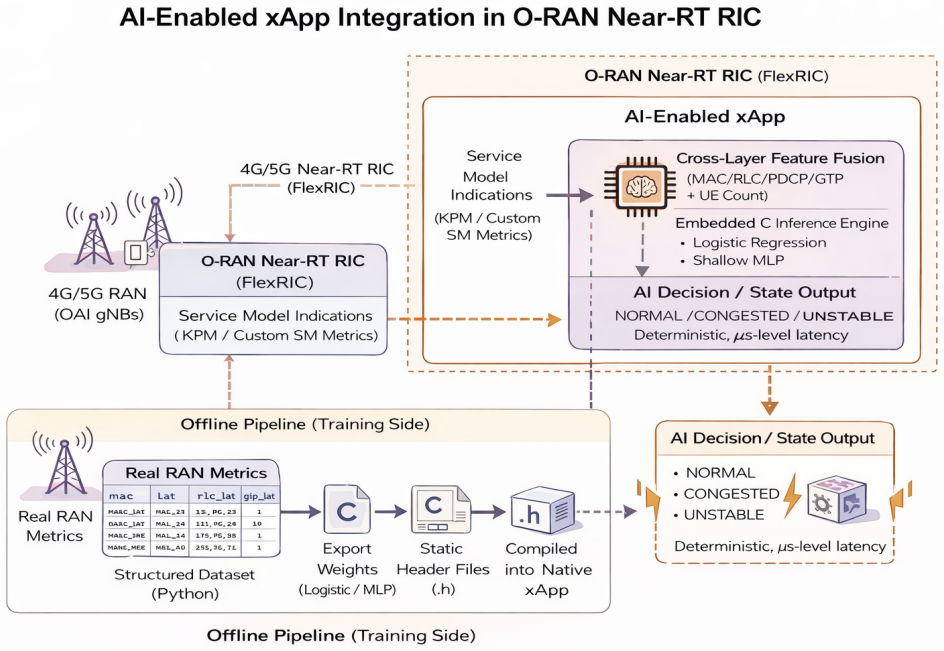
An AI-enabled network-state classification xApp was built on an OpenAirInterface and FlexRIC testbed. Logistic regression and a shallow multilayer perceptron were exported as deterministic C inference modules and compiled into the xApp binary, removing external machine-learning dependencies. On a structured synthetic dataset emulating RAN states, inference latency measured 1-5 microseconds for logistic regression and 10-25 microseconds for the MLP, with end-to-end service latency below 4 ms. Both models satisfied the 10 ms Near-RT RIC budget for more than 95 percent of projected executions while preserving deterministic behavior.
What carries the argument
Deterministic C inference modules for logistic regression and multilayer perceptron compiled directly into the xApp binary to eliminate external runtime dependencies.
Load-bearing premise
The structured synthetic dataset that emulates cross-layer RAN states using MAC, RLC, PDCP, GTP, and UE-count features is representative enough for the timing and feasibility results to hold outside the testbed.
What would settle it
Deploy the identical xApp on a production O-RAN setup with live user equipment and real traffic, then check whether inference latency exceeds 10 ms or accuracy drops below 0.85 in more than 5 percent of loop executions.
If this is right
- xApps can incorporate supervised AI without introducing external machine-learning runtime dependencies.
- End-to-end service latency remains below 4 ms while inference stays in the microsecond range.
- Both logistic regression and the shallow MLP satisfy the 10 ms Near-RT budget for over 95 percent of executions.
- A six-model comparison shows supervised models reach 0.88-0.90 accuracy, with similarity tied to the proxy problem structure.
- The released RIC Workbench enables reproduction of the testbed on commodity hardware.
Where Pith is reading between the lines
- The same compilation approach could extend to other xApp functions or to Non-RT RIC rApps if similar timing headroom exists.
- Validation on live RAN traffic rather than synthetic data would be required before claiming production readiness.
- The microsecond inference times leave margin for modestly deeper models if the accuracy gap justifies added compute.
- Releasing the orchestration dashboard lowers the barrier for other groups to test embedded AI loops in O-RAN environments.
Editorial analysis
A structured set of objections, weighed in public.
Referee Report
Summary. The paper presents an AI-enabled network-state classification xApp implemented on an OpenAirInterface (OAI) and FlexRIC testbed for the Near-RT RIC. Logistic regression and a shallow MLP are trained on a structured synthetic dataset emulating cross-layer RAN states (MAC, RLC, PDCP, GTP, UE-count features), exported as deterministic C inference modules, and compiled into the xApp binary. Direct measurements show inference latencies of 1-5 μs (LR) and 10-25 μs (MLP), end-to-end service latency below 4 ms, and compliance with the 10 ms Near-RT budget for more than 95% of projected loop executions. A six-model comparison yields accuracies of 0.88-0.90. The work releases the RIC Workbench for testbed reproduction and scopes results to embedding feasibility on this testbed rather than production generalization.
Significance. If the reported measurements hold, the paper provides concrete testbed evidence that lightweight supervised models can be embedded directly in the Near-RT RIC xApp loop using deterministic C implementations that eliminate external ML runtimes and satisfy timing constraints. The direct latency measurements (independent of training data contents) and public release of the RIC Workbench for reproduction on commodity hardware are clear strengths that enhance the contribution's utility for the O-RAN community.
minor comments (2)
- [Abstract] Abstract: the six-model comparison reports accuracy 0.88-0.90 but does not name the other four models; adding their identities would clarify why LR and MLP similarity is attributed to problem structure.
- The CDF-based latency characterization and 95% compliance claim would be strengthened by an explicit equation or pseudocode showing how 'projected loop executions' are computed from the measured service latencies.
Simulated Author's Rebuttal
We thank the referee for the thorough summary and positive recommendation to accept the manuscript. The report accurately captures the scope, contributions, and limitations of the work.
Circularity Check
No significant circularity
full rationale
The paper's central claims rest on direct testbed measurements of inference latency (1-5 μs LR, 10-25 μs MLP), end-to-end service latency (<4 ms), and accuracy (0.88-0.90) for C-compiled deterministic modules. These timings derive from fixed-size code paths and compilation, independent of training data contents or any fitted parameters. No equations, self-citations, or ansatzes are invoked as load-bearing steps for the feasibility conclusions. The synthetic dataset affects only model weights, not the reported execution metrics. This is a standard non-circular empirical measurement paper.
Axiom & Free-Parameter Ledger
axioms (1)
- domain assumption The synthetic dataset emulating cross-layer RAN states is representative for feasibility demonstration
read the original abstract
Open Radio Access Network (O-RAN) architectures introduce programmable Near-Real-Time RAN Intelligent Controllers (Near-RT RICs) that support closed-loop control through xApps at timescales from 10 ms to 1 s. Although AI has been widely studied for RAN optimization, fewer works demonstrate measured AI inference embedded directly within the Near-RT RIC software loop on a live testbed. This paper presents an AI-enabled network-state classification xApp implemented on an OpenAirInterface (OAI) and FlexRIC testbed. The xApp is trained and evaluated on a structured synthetic dataset that emulates cross-layer RAN states using MAC, RLC, PDCP, GTP, and UE-count features. The results validate embedding and execution feasibility rather than production-level generalization. Logistic regression and a shallow multilayer perceptron (MLP) are exported as deterministic C inference modules and compiled into the xApp binary, eliminating external machine-learning runtime dependencies. Measured inference latency is 1 to 5 microseconds for logistic regression and 10 to 25 microseconds for the MLP, while end-to-end service latency remains below 4 ms. A six-model comparison shows that supervised models achieve similar accuracy, ranging from 0.88 to 0.90, indicating that LR and MLP similarity reflects the proxy problem structure rather than limited model exploration. Noise ablation, confusion-matrix analysis, and CDF-based latency characterization show that both embedded models satisfy the 10 ms Near-RT budget for more than 95% of projected loop executions. These results demonstrate that lightweight AI can operate within Near-RT RIC timing constraints while preserving deterministic execution. We also release RIC Workbench, a lightweight orchestration dashboard for reproducing the testbed on commodity hardware.
Figures


discussion (0)
Sign in with ORCID, Apple, or X to comment. Anyone can read and Pith papers without signing in.