REVIEW 4 major objections 4 minor 1 cited by
Bound on efficiency of heat engine from uncertainty relation viewpoint
T0 review · 4 major / 4 minor · reviewed 2026-08-14 · deepseek-v4-flash
Pith's one-line read The paper derives upper and lower bounds on a quantum Stirling engine's efficiency directly from the position-momentum uncertainty relation.
desk verdict The efficiency bounds are not derived from uncertainty: Eq. (17) is a fitted reparameterization, and D and E just rescale the bath temperatures. read the letter →
The pith
A machine-rendered reading of the paper's core claim, the machinery that carries it, and where it could break.
The reading
What carries the argument
The load-bearing object is the approximate identity Eq. (17), $Z=\frac{L\sqrt{2}}{\hbar\sqrt{\pi}}(\Delta X_T+\Delta P_T+C_T)$, which converts the partition function of the trapped particle into a linear function of the thermal sum uncertainty, with $C_T$ a temperature-dependent constant obtained by expanding Eq. (10) and dropping higher-order terms in $\alpha\beta$. This identity lets the paper rewrite the partition functions at each stage of the Stirling cycle as uncertainty expressions, and the resulting $D$ and $E$ coefficients carry those expressions into the efficiency formula. Supporting it are the sum-uncertainty bounds: the lower bound on $\Delta X^2+\Delta P^2$ for incompatible observables and the reverse-uncertainty upper bound derived from an inequality relating the sum of uncertainties to the uncertainty of the difference. The Stirling cycle enters through the standard four-stage analysis of isothermal barrier insertion, isochoric cooling, isothermal removal, and isochoric heating, whose work and efficiency are re-expressed in terms of $D$ and $E$.
What would settle it
Compute the exact partition function $Z=\sum_n e^{-\beta E_n}$ and the exact sum uncertainty $\Delta X_T+\Delta P_T$ at $T_1=320$ K and $T_2=80$ K for $L$ from 1 to 5 nm, then test whether Eq. (17) holds; if the relative error is not small, the efficiency bounds in Eq. (30) do not hold as stated.
Extended reading notes
Core claim
The central claim is Eq. (30): for a quantum Stirling engine whose working substance is a particle of mass $m$ in a box of width $2L$ coupled to hot and cold baths at temperatures $T_1$ and $T_2$, the efficiency is $$\eta = \frac{D\ln(Z_B/Z_A)+E\ln(Z_D/Z_C)}{D(\ln(Z_B/Z_A)+1/2)-E/2},$$ where $D=\frac{8L^2}{\pi^3\hbar^2}(\Delta X_{T_1}+\Delta P_{T_1}+C_{T_1})^2$ and $E$ is the same combination evaluated at $T_2$. Because $D$ and $E$ are built solely from the thermal position-momentum sum uncertainty plus a temperature-dependent constant, the paper takes this to show that the efficiency bounds are governed by the uncertainty relation. The paper also reports that the upper bound so obtained stays consistent with the Carnot bound $1-T_2/T_1$, and that the lower bound decreases as uncertainty grows, saturating at large uncertainty.
Load-bearing premise
The argument leans on Eq. (17)'s truncated expansion: if the discarded higher-order terms are not negligible for the stated temperatures and box lengths, then D and E are not faithful measures of the bath temperatures and the efficiency bounds lose thermodynamic meaning.
Editorial extensions
If this is right
- Efficiency bounds for the quantum Stirling engine can be stated using $\Delta X_T+\Delta P_T+C_T$, so the cycle can be analysed without projective measurements or multiple state copies.
- The upper bound follows the Carnot limit $1-T_2/T_1$, so the uncertainty formulation reproduces the second-law ceiling for this model.
- The lower efficiency bound decreases as sum uncertainty increases and saturates at large uncertainty, making the conversion ratio a function of the working medium's quantum spread.
- Helmholtz free energy and entropy are written as functions of the uncertainty terms, giving an uncertainty-based route into the rest of the engine's thermodynamics.
Reading between the lines
- A natural next test, not given in the paper, is to check whether the same uncertainty-based bounds survive when the potential is finite or anharmonic; if they do, the method would generalize beyond particle-in-a-box.
- The paper's entropy-uncertainty link suggests that entanglement estimates could be read off from measured sum uncertainty for any exactly solvable model, but the paper only raises this as an open direction.
- Treating $C_T$ as a fitting parameter rather than a computed constant would turn Eq. (17) into an empirical relation, allowing experiment to decide how much of the efficiency bound is genuinely uncertainty-driven.
Signed reviews
Editorial analysis
A structured set of objections, weighed in public.
Referee Report
Summary. The manuscript attempts to connect the thermal sum uncertainty relation of position and momentum for a particle in a one-dimensional infinite potential well to thermodynamic quantities, and claims to derive upper and lower bounds on the efficiency of a quantum Stirling engine from that uncertainty relation. The central construction is Eq. (17), which expresses the partition function Z in terms of (ΔX_T + ΔP_T + C_T), and Eqs. (29)-(30), which express work and efficiency through constants D and E built from the same uncertainty sum. The paper asserts that the resulting efficiency bounds are consistent with the Carnot bound and that this establishes a direct link between quantum uncertainty and thermodynamic performance.
Significance. The question addressed is meaningful: if a genuine two-sided connection between uncertainty relations and heat-engine efficiency existed, it would provide a fundamental quantum constraint on thermodynamic cycles and could be of broad interest. The paper also contains explicit analytic expressions for thermal variances in a box, which are useful intermediate results. However, the central bridge is not a derived consequence of an uncertainty relation but an identity constructed by defining C_T; consequently, the claimed uncertainty-based bounds reduce to a relabeling of the bath temperatures under the exact form of Eq. (17), or lose thermodynamic meaning if the truncation is not exact. As presented, the central claim is therefore unsupported, and the manuscript does not establish a new uncertainty-relation constraint on efficiency.
major comments (4)
- [IV, Eq. (17)] The bridge Z = π n̄/2 = L√2/(ℏ√π)(ΔX_T + ΔP_T + C_T) is not a theorem but an identity by construction: C_T is defined by expanding Eq. (10) and discarding higher-order terms, with no error estimate. If the discarded terms are not negligible for the stated T1=320 K, T2=80 K and L in the nanometer range, then D and E in Eq. (30) are not proportional to the bath temperatures and the efficiency expression has no thermodynamic meaning. If the equality were exact, D and E would simply be rescaled values of Z^2 ∝ k_B T, and Eq. (30) would reproduce the standard Stirling efficiency with temperatures relabeled, so the uncertainty relation would impose no independent constraint. Either way, the central claim that the uncertainty relation determines the efficiency bounds is not supported.
- [II, Eq. (10) and IV, Eq. (17)] Equation (10) adds ΔX_T, which has dimensions of length, and ΔP_T, which has dimensions of momentum; no unit convention (for example ℏ=m=1) is stated that makes this addition meaningful. The constant C_T is also a length, so the right-hand side of Eq. (17) has dimensions of (length)^2/(ℏ), which is not the dimensionless partition function. The same dimensional problem propagates into D and E in Eq. (30), and into the work expression in Eq. (29), where with Eq. (17) the prefactor 8L^2α/(ℏ^2π^2)=1/m leaves W with dimensions of inverse mass unless unstated units are assumed.
- [III, Eqs. (13)-(15)] The upper bound is misapplied. For the symmetric box eigenstates, Cov(X,P)=(1/2)⟨XP+PX⟩−⟨X⟩⟨P⟩=0, so the denominator in Eq. (14) is 1 and the Dunkl–Williams inequality reduces to the trivial statement (ΔX−ΔP)^2 ≥ 0. The right-hand side of Eq. (15), L^2/3 − 2L^2/(nπ)^2 + π^2ℏ^2n^2/(4L^2), is exactly ΔX^2+ΔP^2, the quantity under bound, and it does not follow from Eq. (14). Thus the claimed upper bound on the sum of variances is not an independent uncertainty-relation constraint.
- [V, Eq. (30) and Fig. 6] The paper claims upper and lower bounds on efficiency from the uncertainty relation, but no procedure is given for converting Eq. (30) into bounds. D and E are determined by the temperatures and the box length, not by an uncertainty inequality, and the bounds on ΔX^2+ΔP^2 developed in Section III do not translate into two-sided bounds on (ΔX_T+ΔP_T+C_T)^2 that would bound the efficiency. Figure 6 plots two curves labeled 'upper bound' and 'lower bound' without specifying which parameter choices or which uncertainty bounds produce them, so the main claim of the paper is not demonstrated.
minor comments (4)
- [II, Eqs. (4), (7)-(10)] Notation is inconsistent: the paper uses ΔxΔp, (ΔX)_T, ΔX_T, and ΔP_T without clearly distinguishing the standard deviation from the variance; clarifying this would improve readability.
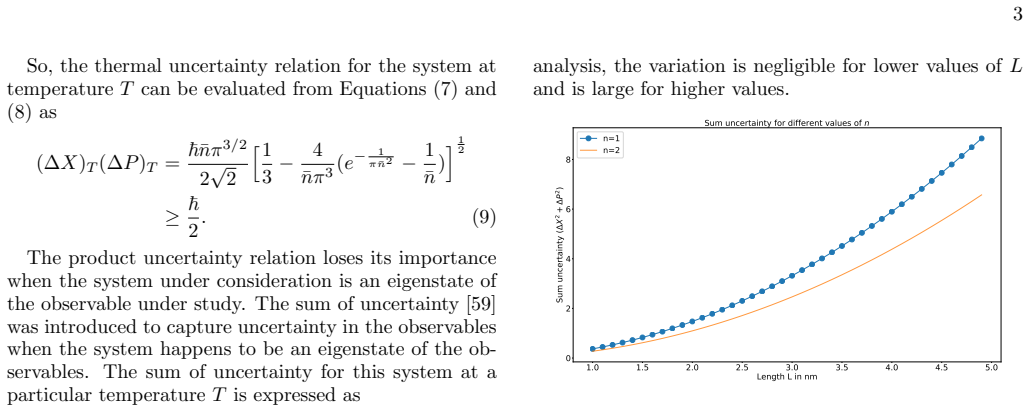
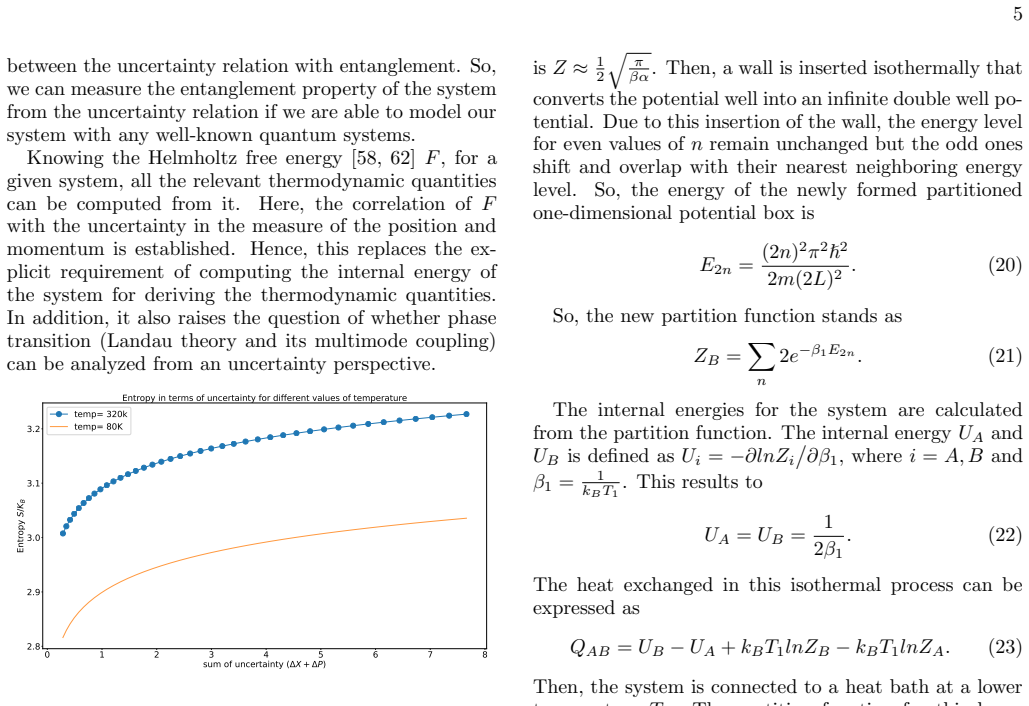
- [Figs. 1 and 2] The axis labels say 'Sum uncertainty (X2 + P2)', but the plotted quantity is ΔX_T + ΔP_T, not ΔX^2 + ΔP^2; the labels should be corrected.
- [V, Eq. (30)] The first displayed expression for efficiency uses terms such as n̄^2 T2 ln(ZD/ZC), while the final expression uses D ln(ZB/ZA) + E ln(ZD/ZC); the relation between these forms, especially the placement of T1 and T2 in numerator and denominator, is not explained and appears to contain a typographical error.
- [IV, Eq. (19)] The entropy expression contains the auxiliary quantities ν and γ whose definitions are dense and not derived; a short derivation or a reference would help the reader verify the result.
Circularity Check
Eq. (17) constructs an ad hoc bridge; D and E simply rename n̄², so the uncertainty relation does not determine the efficiency bounds.
-
fitted input called prediction
[Section IV, Eq. (17)]
"Z = π¯n/2 = L√2/(ℏ√π)(∆XT + ∆PT +CT), where CT =−L/3 + 2L/π^{5/2}√(αβT) [αβT −√π(αβT)^{3/2} −1] is a constant for a specific temperature, which is derived by expanding Equation 10, and neglecting the higher order terms as the products of α and β are small."
This is the only bridge between the thermodynamic object Z and the uncertainty combination. C_T is constructed by expansion and truncation so that the bracket equals Z up to discarded terms; it is not derived from the uncertainty principle. Inserting Eq. (17) into the later definitions gives D = n̄²_T1 and E = n̄²_T2 exactly. Thus the claimed uncertainty-based prediction inherits a fitted identity rather than an independent constraint. The paper itself defers the required error control: 'Computing the error margins would help us understand this behavior better, which we intend to do in a future paper.'
-
renaming known result
[Section V, Eq. (30) and the definitions of D and E]
"η = [D ln(ZB/ZA)+E ln(ZD/ZC)]/[−E/2 +D(ln(ZB/ZA)+1/2)], where D = 8L2/π3ℏ2 (∆XT1 + ∆PT1 + CT1)2 and E = 8L2/π3ℏ2 (∆XT2 + ∆PT2 +CT2)2."
By Eq. (17), (∆X_T+∆P_T+C_T) = ℏπ^{3/2} n̄/(2√2 L), so D = n̄²_T1 and E = n̄²_T2. The line immediately preceding Eq. (30) already gives the same efficiency in terms of n̄² at the two temperatures. Hence Eq. (30) is the standard partition-function Stirling efficiency with n̄² relabeled as an 'uncertainty combination'; the uncertainty relation adds no independent bound. The plotted upper and lower efficiency curves are therefore the familiar thermodynamic formula plotted against a rescaled variable.
full rationale
The central claim of the paper is that the uncertainty relation determines upper and lower bounds on the efficiency of the heat engine. The chain of derivation rests entirely on Eq. (17), where Z is equated to a combination of thermal position and momentum uncertainties plus an expressly constructed constant C_T. Because C_T is defined so that the equality holds after expanding Eq. (10) and dropping higher-order terms, Eq. (17) is a fitted bridge rather than a consequence of the uncertainty principle. Once that bridge is accepted, D and E in Eq. (30) reduce exactly to n̄² at T1 and T2, so the efficiency formula is identical to the conventional partition-function result that appears one line earlier in the paper. The uncertainty relation therefore does no independent work; the 'bounds from uncertainty' are a renaming of the known Stirling-engine efficiency. No load-bearing self-citation or uniqueness argument is involved, and the issue is not a question of scientific consensus but of a constructed identity whose error is unquantified and explicitly deferred. This is partial-to-strong circularity: the prediction reduces by construction to the input thermodynamic formula, yielding a score of 8.
Assumptions & free parameters
free parameters (1)
- C_T =
temperature-dependent expression from expansion of Eq. (10)
assumptions (4)
- standard math One-dimensional infinite potential well eigenstates and energies, including the Delta x Delta p relation in Eq. (4).
- domain assumption Partition function can be replaced by the Gaussian integral Z approximately (1/2) sqrt(pi/(beta alpha)) because beta alpha is small.
- domain assumption The Stirling cycle with barrier insertion and removal is modeled by partition-function ratios Z_B = 2 sum e^{-beta E_{2n}} and Z_C similarly, following Ref. [67].
- standard math The Dunkl-Williams inequality (Eq. (13)) can be squared and applied to give an upper bound on DeltaX^2 + DeltaP^2.
Cite this review
Pith. "Pith review of Bound on efficiency of heat engine from uncertainty relation viewpoint." pith.science (2026). https://pith.science/paper/DXEG2VDS
@misc{pith2026190806804,
  author       = {Pith},
  title        = {Pith review of: Bound on efficiency of heat engine from uncertainty relation viewpoint},
  year         = {2026},
  howpublished = {\url{https://pith.science/paper/DXEG2VDS}},
  note         = {Machine review of arXiv:1908.06804}
}
read the original abstract
Quantum cycles in established heat engines can be modeled with various quantum systems as working substances. For example, a heat engine can be modeled with an infinite potential well as the working substance to determine the efficiency and work done. However, in this method, the relationship between the quantum observables and the physically measurable parameters i.e., the efficiency and work done is not well understood from the quantum mechanics approach. A detailed analysis is needed to link the thermodynamic variables (on which the efficiency and work done depends) with the uncertainty principle for better understanding. Here, we present the connection of the sum uncertainty relation of position and momentum operators with thermodynamic variables in the quantum heat engine model. We are able to determine the upper and lower bounds on the efficiency of the heat engine through the uncertainty relation.
Figures


Figures from the paper (4 more)


Forward citations
Cited by 1 Pith paper
-
Relativistic quantum heat engine from uncertainty relation standpoint
Relativistic Stirling engine efficiency bounds claimed via uncertainty relation are dimensionally inconsistent and vanish under the paper's own partition-function approximations.
Reference graph
Works this paper leans on
-
[67]
Realization of a micrometre- sized stochastic heat engine
Blickle, V.; Bechinger, C. Realization of a micrometre- sized stochastic heat engine. Nat. Phys. 2011, 8, 143
work page 2011
-
[1]
Black holes and thermodynamics
Hawking, S.W. Black holes and thermodynamics. Phys. Rev. D 1976, 13, 191
work page 1976
-
[2]
(9) The product uncertainty relation loses its importance when the system under consideration is an eigenstate of the observable under study. The sum of uncertainty [59] was introduced to capture uncertainty in the observables when the system happens to be an eigenstate of the ob- servables. The sum of uncertainty for this system at a particular temperatu...
-
[3]
Gravity and the thermodynamics of 8 horizons
Padmanabhan, T. Gravity and the thermodynamics of 8 horizons. Phys. Rep. 2005, 406, 49–125
work page 2005
-
[4]
Hologra- phy and thermodynamics of 5D dilaton-gravity
G¨ ursoy,U.; Kiritsis, E.; Mazzanti, L.; Nitti, F. Hologra- phy and thermodynamics of 5D dilaton-gravity. J. High Energy Phys. 2009, 2009, 033
work page 2009
-
[5]
The Quantum Open System as a Model of the Heat Engine
Alicki, R. The Quantum Open System as a Model of the Heat Engine. J. Phys. A 1979, 12, L103
work page 1979
-
[6]
Equivalence of quantum heat machines, and quantum-thermodynamic signatures
Uzdin, R.; Levy, A.; Kosloff, R. Equivalence of quantum heat machines, and quantum-thermodynamic signatures. Phys. Rev. X 2015, 5, 031044
work page 2015
-
[7]
A Quantum Mechanical Open System as a Model of a Heat Engine
Kosloff, R. A Quantum Mechanical Open System as a Model of a Heat Engine. J. Chem. Phys. 1984, 80, 1625
work page 1984
Show all 76 references
-
[8]
Quantum Heat Engines and Refrig- erators: Continuous Devices
Kosloff, R.; Levy, A. Quantum Heat Engines and Refrig- erators: Continuous Devices. Annu. Rev. Phys. Chem. 2014, 65, 365
2014
-
[9]
Work Extraction and Thermodynamics for Individual Quantum Systems
Skrzypczyk, P.; Short, A.J.; Popescu, S. Work Extraction and Thermodynamics for Individual Quantum Systems. Nat. Commun. 2014, 5, 4185
2014
-
[10]
Quantum Bath Refrigeration Towards Absolute Zero: Challenging the Unattainability Principle
Kol´ aˇ r, M.; Gelbwaser-Klimovsky, D.; Alicki, R.; Kur- izki, G. Quantum Bath Refrigeration Towards Absolute Zero: Challenging the Unattainability Principle. Phys. Rev. Lett. 2012, 109, 090601
2012
-
[11]
Quantum Thermodynamic Cycles and Quantum Heat Engines
Quan, H.T.; Liu, Y.X.; Sun, C.P.; Nori, F. Quantum Thermodynamic Cycles and Quantum Heat Engines. Phys. Rev. E 2007, 76, 031105
2007
-
[12]
Nanoscale Heat Engine Beyond the Carnot Limit
Roßnagel, J.; Abah, O.; Schmidt-Kaler, F.; Singer, K.; Lutz, E. Nanoscale Heat Engine Beyond the Carnot Limit. Phys. Rev. Lett. 2014, 112, 030602
2014
-
[13]
Quantum-Enhanced Absorption Refrigerators
Correa, L.A.; Palao, J.P.; Alonso, D.; Adesso, G. Quantum-Enhanced Absorption Refrigerators. Sci. Rep. 2014, 4, 3949
2014
-
[14]
Extracting Quantum Work Statistics and Fluctuation Theorems by Single-Qubit Interferometry
Dorner, R.; Clark, S.R.; Heaney, L.; Fazio, R.; Goold, J.; Vedral, V. Extracting Quantum Work Statistics and Fluctuation Theorems by Single-Qubit Interferometry. Phys. Rev. Lett. 2013, 110, 230601
2013
-
[15]
Thermalization in Na- ture and on a Quantum Computer
Riera, A.; Gogolin, C.; Eisert, J. Thermalization in Na- ture and on a Quantum Computer. Phys. Rev. Lett. 2012, 108, 080402
2012
-
[16]
Single-Ion Heat Engine at Maximum Power
Abah, O.; Roßnagel, J.; Jacob, G.; Deffner, S.; Schmidt Kaler, F.; Singer, K.; Lutz, E. Single-Ion Heat Engine at Maximum Power. Phys. Rev. Lett. 2012, 109, 203006
2012
-
[17]
All-Optical Nano- mechanical Heat Engine
Dechant, A.; Kiesel, N.; Lutz, E. All-Optical Nano- mechanical Heat Engine. Phys. Rev. Lett. 2015, 114, 183602
2015
-
[18]
Quantum Opto- mechanical Heat Engine
Zhang, K.; Bariani, F.; Meystre, P. Quantum Opto- mechanical Heat Engine. Phys. Rev. Lett. 2014, 112, 150602
2014
-
[19]
Cooling by Heating: Very Hot Ther- mal Light Can Significantly Cool Quantum Systems
Mari, A.; Eisert, J. Cooling by Heating: Very Hot Ther- mal Light Can Significantly Cool Quantum Systems. Phys. Rev. Lett. 2012, 108, 120602
2012
-
[20]
Maxwell’s demon, Szilard’s engine and quantum measurements
Zurek, W.H. Maxwell’s demon, Szilard’s engine and quantum measurements. arXiv 2003, arXiv:quant- ph/0301076
2003
-
[21]
¨Uber die Entropieverminderung in einem ther- modynamischen System bei Eingriffen intelligenter We- sen
Szilard, L. ¨Uber die Entropieverminderung in einem ther- modynamischen System bei Eingriffen intelligenter We- sen. Zeitschrift f¨ ur Physik1929, 53, 840–856
-
[22]
Quan- tum Szilard engine
Kim, S.W.; Sagawa, T.; De Liberato, S.; Ueda, M. Quan- tum Szilard engine. Phys. Rev. Lett. 2011, 106, 070401
2011
-
[23]
Revisiting the quantum Szilard engine with fully quantum consid- erations
Li, H.; Zou, J.; Li, J.-G.; Shao, B.; Wu, L.-A. Revisiting the quantum Szilard engine with fully quantum consid- erations. Ann. Phys. 2012, 327, 2955
2012
-
[24]
Szilard’s information heat engines in the deep quantum regime
Kim, K.H.; Kim, S.W. Szilard’s information heat engines in the deep quantum regime. J. Korean Phys. Soc. 2012, 61, 1187
2012
-
[25]
Multiparticle quantum Szilard engine with optimal cycles assisted by a Maxwell’s demon
Cai, C.Y.; Dong, H.; Sun, C.P. Multiparticle quantum Szilard engine with optimal cycles assisted by a Maxwell’s demon. Phys. Rev. E 2012, 85, 031114
2012
-
[26]
Quantum Szilard engines with arbitrary spin
Zhuang, Z.; Liang, S.D. Quantum Szilard engines with arbitrary spin. Phys. Rev. E 2014, 90, 052117
2014
-
[27]
Supremacy of the quantum many-body Szilard engine with attractive bosons
Bengtsson, J.; Nilsson Tengstrand, M.; Wacker, A.; Samuelsson, P.; Ueda, M.; Linke, H.; Reimann, S.M. Supremacy of the quantum many-body Szilard engine with attractive bosons. arXiv 2017, arXiv:1701.08138
2017 arXiv
-
[28]
The quantum harmonic Otto cycle
Kosloff, R.; Rezek, Y. The quantum harmonic Otto cycle. Entropy 2017, 19, 136
2017
-
[29]
Efficiency of harmonic quantum Otto engines at maximal power
Deffner, S. Efficiency of harmonic quantum Otto engines at maximal power. Entropy 2018, 20, 875
2018
-
[30]
Thermodynamics and steady state of quantum motors and pumps far from equi- librium
Bustos-Mar´ un, R.A.; Calvo, H.L. Thermodynamics and steady state of quantum motors and pumps far from equi- librium. Entropy 2019, 21, 824
2019
-
[31]
Optimal power and efficiency of multi-stage endoreversible quantum Carnot heat en- gine with harmonic oscillators at the classical limit
Meng, Z.; Chen, L.; Wu, F. Optimal power and efficiency of multi-stage endoreversible quantum Carnot heat en- gine with harmonic oscillators at the classical limit. En- tropy 2020, 22, 457
2020
-
[32]
The quantum friction and optimal finite- time performance of the quantum Otto cycle
Insinga, A.R. The quantum friction and optimal finite- time performance of the quantum Otto cycle. Entropy 2020, 22, 1060
2020
-
[33]
Quantum finite-time thermodynamics: Insight from a single qubit engine
Dann, R.; Kosloff, R.; Salamon, P. Quantum finite-time thermodynamics: Insight from a single qubit engine. En- tropy 2020, 22, 1255
2020
-
[34]
Quantum thermodynamics and open-systems modeling
Kosloff, R. Quantum thermodynamics and open-systems modeling. J. Chem. Phys. 2019, 150, 204105
2019
-
[35]
Exergy- based ecological optimization of an irreversible quantum Carnot heat pump with harmonic oscillators
Chen, L.; Liu, X.; Wu, F.; Xia, S.; Feng, H. Exergy- based ecological optimization of an irreversible quantum Carnot heat pump with harmonic oscillators. Phys. A Stat. Mech. Appl. 2020, 537, 122597
2020
-
[36]
Maximum power from fluid flow by applying the first and second laws of thermodynamics
Diaz, G.A.; Forero, J.D.; Garcia, J.; Rincon, A.; Fontalvo, A.; Bula, A.; Padilla, R.V. Maximum power from fluid flow by applying the first and second laws of thermodynamics. J. Energy Resour. Technol. 2017, 139, 3
2017
-
[37]
Shortcuts to adiabaticity in a time-dependent box
Del Campo, A.; Boshier, M.G. Shortcuts to adiabaticity in a time-dependent box. Sci. Rep. 2012, 2, 1–6
2012
-
[38]
Optimal shortcuts to adiabaticity for a quantum piston
Stefanatos, D. Optimal shortcuts to adiabaticity for a quantum piston. Automatica 2013, 49, 3079–3083
2013
-
[39]
Exponential bound in the quest for abso- lute zero
Stefanatos, D. Exponential bound in the quest for abso- lute zero. Phys. Rev. E 2017, 96, 042103
2017
-
[40]
Relativistic quantum heat engine from uncertainty relation standpoint
Chattopadhyay, P.; Paul, G. Relativistic quantum heat engine from uncertainty relation standpoint. Sci. Rep. 2019, 9, 16967
2019
-
[41]
Quantum-state disturbance ver- sus information gain: Uncertainty relations for quantum information
Fuchs, C.A.; Peres, A. Quantum-state disturbance ver- sus information gain: Uncertainty relations for quantum information. Phys. Rev. A 1996, 53, 2038
1996
-
[42]
Unconditional security of quantum key dis- tribution and the uncertainty principle
Koashi, M. Unconditional security of quantum key dis- tribution and the uncertainty principle. J. Phys. Conf. Ser. 2006, 36, 16
2006
-
[43]
Simple security proof of quantum key distribution via uncertainty principle
Koashi, M. Simple security proof of quantum key distribution via uncertainty principle. arXiv 2005, arXiv:0505108
2005
-
[44]
Violation of local uncer- tainty relations as a signature of entanglement
Hofmann, H.F.; Takeuchi, S. Violation of local uncer- tainty relations as a signature of entanglement. Phys. Rev. A 2003, 68, 032103
2003
-
[45]
Entanglement and its facets in condensed matter systems
Osterloh, A. Entanglement and its facets in condensed matter systems. arXiv 2008, arXiv:0810.1240
2008 arXiv
-
[46]
Quantifying entanglement with scattering experiments
Marty, O.; Epping, M.; Kampermann, H.; Bruß, D.; Ple- nio, M.B.; Cramer, M. Quantifying entanglement with scattering experiments. Phys. Rev. B 2014, 89, 125117
2014
-
[47]
Characterizing entanglement via uncertainty 9 relations
G¨ uhne, O. Characterizing entanglement via uncertainty 9 relations. Phys. Rev. Lett. 2004, 9, 117903
2004
-
[48]
Advances in quantum metrology
Giovannetti, V.; Lloyd, S.; Maccone, L. Advances in quantum metrology. Nat. Photonics 2011, 5, 222
2011
-
[49]
Quantum coherence sets the quantum speed limit for mixed states.Phys
Mondal, D.; Datta, C.; Sazim, S.K. Quantum coherence sets the quantum speed limit for mixed states.Phys. Lett. A 2016, 380, 689–695
2016
-
[50]
Quantum speed limits, coherence, and asymmetry
Marvian, I.; Spekkens, R.W.; Zanardi, P. Quantum speed limits, coherence, and asymmetry. Phys. Rev. A 2016, 93, 052331
2016
-
[51]
Quantum speed limits: from Heisenberg’s uncertainty principle to optimal quantum control
Deffner, S.; Campbell, S. Quantum speed limits: from Heisenberg’s uncertainty principle to optimal quantum control. J. Phys. A 2017, 50, 453001
2017
-
[52]
Generalized geometric quantum speed limits
Pires, D.P.; Cianciaruso, M.; C´ eleri, L.C.; Adesso, G.; Soares-Pinto, D.O. Generalized geometric quantum speed limits. Phys. Rev. X 2016, 6, 021031,
2016
-
[53]
Experimental test of uncertainty relations for general unitary operators
Xiao, L. Experimental test of uncertainty relations for general unitary operators. Opt. Express 2017, 25, 17904– 17910
2017
-
[54]
Experimental test of Heisenberg’s measurement uncertainty relation based on statistical distances
Ma, W. Experimental test of Heisenberg’s measurement uncertainty relation based on statistical distances. Phys. Rev. Lett. 2016, 116, 160405
2016
-
[55]
Experimental violation and reformulation of the Heisen- berg’s error disturbance uncertainty relation
Baek, S.Y.; ; Kaneda, F.; Ozawa, ; M.; Edamatsu, K. Experimental violation and reformulation of the Heisen- berg’s error disturbance uncertainty relation. Sci. Rep. 2013, 3, 2221
2013
-
[56]
Tighter uncertainty and reverse uncertainty relations
Mondal, D.; Bagchi, S.; Pati, A.K. Tighter uncertainty and reverse uncertainty relations. Phys. Rev. A 2017, 95, 052117
2017
-
[57]
Quantum Mechanics, International series in pure and applied physics ; McGraw-Hill: New York, NY, USA, 1955
Schiff, L. Quantum Mechanics, International series in pure and applied physics ; McGraw-Hill: New York, NY, USA, 1955
1955
-
[58]
Griffiths, D. J. Introduction to Quantum Mechanics ; Pearson Prentice Hall: Upper Saddle River, NJ, USA, 2005
2005
-
[59]
Fundamentals of Statistical and Thermal Physics; Waveland Press: Long Grove, IL, USA, 2009
Reif, F. Fundamentals of Statistical and Thermal Physics; Waveland Press: Long Grove, IL, USA, 2009
2009
-
[60]
Stronger uncertainty relations for all incompatible observables
Maccone, L.; Pati, A.K. Stronger uncertainty relations for all incompatible observables. Phys. Rev. Lett. 2014, 113, 260401
2014
-
[61]
Probing Un- certainty Relations in Non-Commutative Space
Chattopadhyay, P.; Mitra, A.; Paul, G. Probing Un- certainty Relations in Non-Commutative Space. Int. J. Theor. Phys. 2019, 58, 2619–2631
2019
-
[62]
Mathematical Inequalities ; Chapman and Hall/CRC: London, UK, 2011; pp
Cerone, P.; Dragomir, S.S. Mathematical Inequalities ; Chapman and Hall/CRC: London, UK, 2011; pp. 241– 313
2011
-
[63]
Saha, M.; and Srivastava, B. N. Treatise on Heat ; Long- man, Rees, Orme, Brown, Green & Longman: New York, NY, USA, 1935
1935
-
[64]
Quantum degeneracy effect on the work output from a Stirling cycle
Saygin, H.; S ¸i¸ sman, A. Quantum degeneracy effect on the work output from a Stirling cycle. J. Appl. Phys. 2001, 90, 3086–3089
2001
-
[65]
Quantum dynamical framework for Brownian heat engines
Agarwal, G.S.; Chaturvedi, S. Quantum dynamical framework for Brownian heat engines. Phys. Rev. E 2013, 88, 012130
2013
-
[66]
Quantum Stirling heat engine and refrigerator with single and cou- pled spin systems
Huang, X.L.; Niu, X.Y.; Xiu, X.M.; Yi, X.X. Quantum Stirling heat engine and refrigerator with single and cou- pled spin systems. Eur. Phys. J. D 2014, 68, 32
2014
-
[68]
Quantum heat en- gine based on level degeneracy
Thomas, G.; Das, D.; Ghosh, S. Quantum heat en- gine based on level degeneracy. Phys. Rev. E 2019, 100, 012123
2019
-
[69]
Quantum engine efficiency bound beyond the second law of thermodynamics
Niedenzu, W.; Mukherjee, V.; Ghosh, A.; Kofman, A.G.; Kurizki, G. Quantum engine efficiency bound beyond the second law of thermodynamics. Nat. Commun. 2018, 9, 165
2018
-
[70]
An introduction to entangle- ment measures
Plenio, M.B.; Virmani, S. An introduction to entangle- ment measures. In Quantum Information and Coherence ; Springer: Cham, Switzerland, 2014; pp. 173–209
2014
-
[71]
Relativistic particle in a box
Alberto, P.; Fiolhais, C.; Gil, V.M.S. Relativistic particle in a box. Eur. J. Phys. 1996, 17, 19
1996
-
[72]
Holographic derivation of entan- glement entropy from the anti–de sitter space/conformal field theory correspondence
Ryu, S.; Takayanagi, T. Holographic derivation of entan- glement entropy from the anti–de sitter space/conformal field theory correspondence. Phys. Rev. Lett. 2006, 96, 181602
2006
-
[73]
Hilbert space rep- resentation of the minimal length uncertainty relation
Kempf, A.; Mangano, G.; Mann, R.B. Hilbert space rep- resentation of the minimal length uncertainty relation. Phys. Rev. D 1995, 52, 1108
1995
-
[74]
Composite system in de- formed space with minimal length
Quesne, C.; Tkachuk, V.M. Composite system in de- formed space with minimal length. Phys. Rev. A 2010, 81, 012106
2010
-
[75]
Noncommutative differen- tial forms on the kappa-deformed space.J
Meljanac, S.; Kreˇ si´ c-Juri´ c, S. Noncommutative differen- tial forms on the kappa-deformed space.J. Phys. A 2009, 42, 365204
2009
-
[76]
Irreversible performance of a quan- tum harmonic heat engine
Rezek, Y.; Kosloff, R. Irreversible performance of a quan- tum harmonic heat engine. New J. Phys. 2006, 8, 83
2006
Reviewed August 14, 2026 · model on record in the stance chip above.
Discussion (0). Continue with ORCID to comment.