REVIEW 4 major objections 5 minor 65 references
Quantum fluctuations beyond the Gutzwiller approximation in the Bose-Hubbard model
T0 review · 4 major / 5 minor · reviewed 2026-08-14 · deepseek-v4-flash
Pith's one-line read Quantizing the Gutzwiller ansatz and keeping only quadratic fluctuations yields accurate correlations across the whole Bose-Hubbard phase diagram, including both universality classes of the superfluid-to-Mott-insulator transition.
desk verdict Solid method paper, but the abstract oversells QMC validation: superfluid stiffness has no QMC comparison and the g(2) comparison rescales the axis. read the letter →
The pith
A machine-rendered reading of the paper's core claim, the machinery that carries it, and where it could break.
The reading
What carries the argument
The central object is the quantized Gutzwiller field, in which the local wave-function coefficients become operators $\hat c_n(r) = \hat A(r)c^0_n + \delta\hat c_n(r)$, with the normalization operator $\hat A(r)$ enforcing the constraint $\sum_n \hat c_n^\dagger(r)\hat c_n(r)=1$. Expanding the Hamiltonian to quadratic order in $\delta\hat c$ gives a pseudo-Hermitian matrix $\hat L_k$; a Bogoliubov rotation diagonalizes it into independent bosonic modes $\hat b_{\alpha,k}$ with frequencies $\omega_{\alpha,k}$. The load-bearing identity is the quasi-bosonic commutation relation $[\delta\hat c_n(r),\delta\hat c_m^\dagger(s)]=\delta_{r,s}(\delta_{n,m}-c^0_n c^0_m)$, whose correction term removes the spurious local-phase gauge mode. Observables are evaluated by expanding the corresponding operator in $\delta\hat c$ and applying Wick's theorem on the Bogoliubov vacuum, with the $\hat A$ expansion becoming essential for density correlations near and inside the Mott phase.
What would settle it
Compute the fourth-order terms in the expansion of the Hamiltonian, or of the current operator, and evaluate their contribution to the superfluid density for parameters where $F$ is largest, for instance the strongly interacting superfluid near the transition at non-commensurate filling; if those contributions are comparable to the quadratic-order result, the Gaussian truncation is not reliable and the central claim fails. Alternatively, a high-precision quantum Monte Carlo or cold-atom measurement of the superfluid fraction in that regime that disagrees beyond the Gaussian prediction would falsify the quantitative claim.
Extended reading notes
Core claim
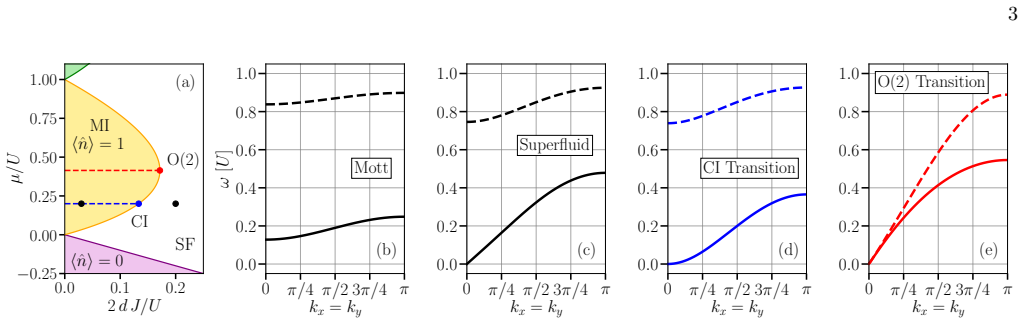
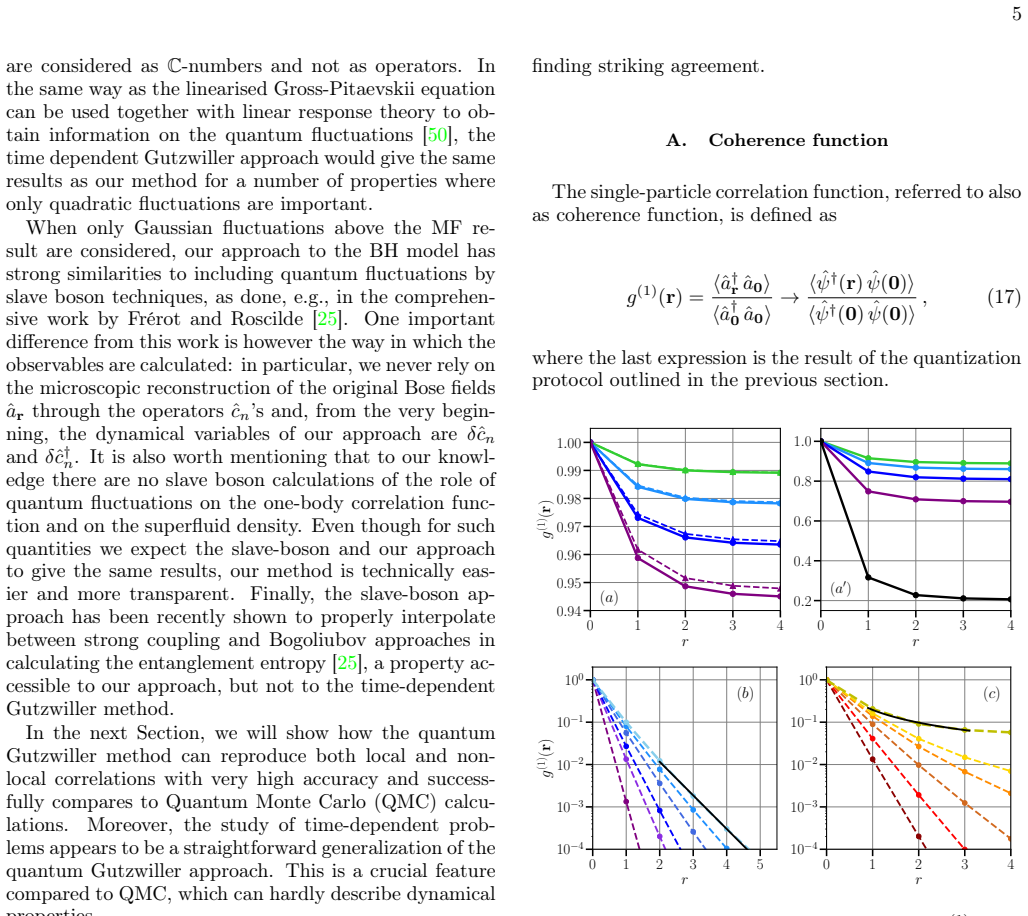
Quantizing the time-dependent Gutzwiller action, treating the coefficients $c_n(r)$ as operators with canonical commutation relations and expanding the Hamiltonian to quadratic order in the fluctuations, produces a theory whose collective modes are the Goldstone and Higgs branches in the superfluid and the particle/hole branches in the Mott insulator. Within this Gaussian theory the single-particle coherence $g^{(1)}(r)$ becomes exponentially decaying in the Mott phase with a finite coherence length, turns into a power-law at the tip of the Mott lobe, and develops long-range order in the superfluid; the superfluid density is reduced below the condensate fraction by the coupling of collective modes in the current response; and the on-site density correlation $g^{(2)}(0)$ acquires the virtual doublon-hole contribution $\propto J^2$ in the insulator. The paper argues that these results are quantitatively reliable throughout the phase diagram, matching quantum Monte Carlo where available, and that the two universality classes of the transition emerge naturally from which modes become gapless.
Load-bearing premise
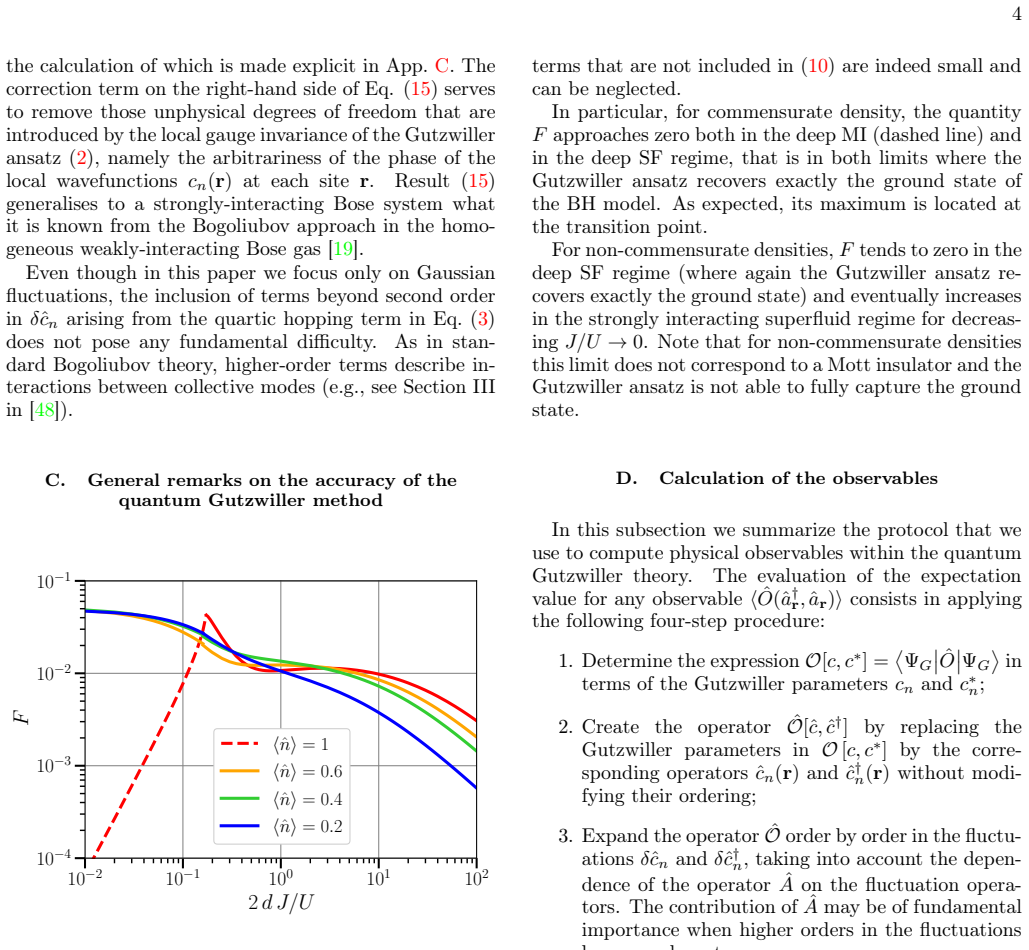
The load-bearing premise is that truncating the action at quadratic order in the fluctuations is quantitatively faithful for the observables computed, with the smallness of the fluctuation parameter $F$ taken as sufficient evidence that the neglected higher-order terms are negligible.
Editorial extensions
If this is right
- A single Bogoliubov diagonalization of $\hat L_k$ yields coherence, superfluid density, and density correlations on equal footing, giving a cheap semi-analytic benchmark for the Bose-Hubbard model.
- Inside the Mott lobe, the theory produces a finite coherence length and $g^{(2)}(0)\sim J^2$, the signature of virtual doublon-hole pairs, without reconstructing the original bosonic fields microscopically.
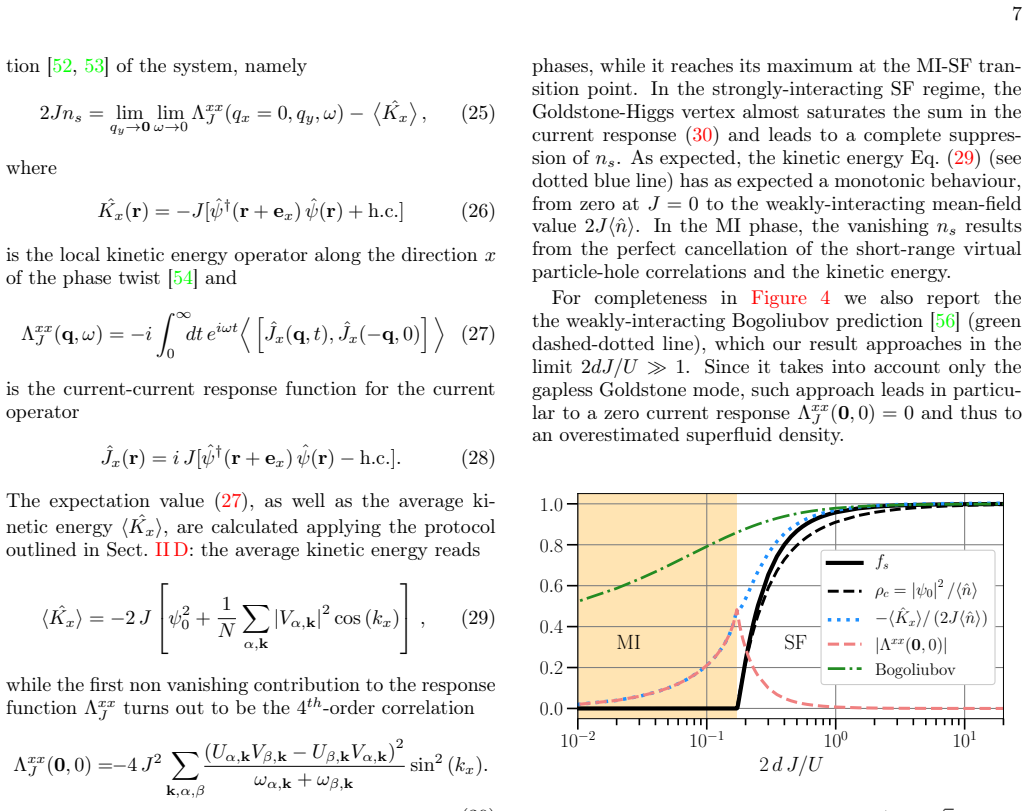
- The superfluid density is suppressed below the condensate fraction, and the dominant suppression near the transition comes from the Goldstone-Higgs coupling term in the current response.
- At the tip of the Mott lobe both modes become gapless, yielding a divergent coherence length and power-law $g^{(1)}$; away from the tip only one mode is gapless, so the decay stays exponential, recovering the O(2) and commensurate-incommensurate universality classes.
- Because the fluctuation amplitudes are computed once, finite-temperature and time-dependent extensions follow from the same quadratic Hamiltonian without a new expensive calculation.
Reading between the lines
- A natural extension the paper does not develop is applying the same canonical-quantization protocol to cluster Gutzwiller or fermionic ansatze; the paper sketches this possibility but reports no results for it.
- A quantitative test of the central claim would be to compute the fourth-order terms generated by the quartic hopping term and compare their contribution to the superfluid current response where the control parameter $F$ is largest; the paper does not provide this error estimate.
- Since the normalization operator $\hat A$ dominates density correlations in the Mott phase, one testable prediction is that corrections beyond Gaussian order will first appear in $g^{(2)}(r)$ rather than in $g^{(1)}(r)$.
- At finite temperature, thermal occupation of the collective modes will increase the fluctuation strength $F$, so an implicit extension is that the method's accuracy degrades at higher temperature; this is our inference, not a claim made in the paper.
Signed reviews
Editorial analysis
A structured set of objections, weighed in public.
Referee Report
Summary. The paper develops a quantum many-body theory of the three-dimensional Bose-Hubbard model by canonically quantizing the time-dependent Gutzwiller action. Expanding around the Gutzwiller ground state to quadratic order in the local fluctuations, the authors obtain a multi-branch Gaussian theory of collective excitations (Sec. IIB), define a control parameter F measuring zero-point fluctuations (Sec. IIC), and use a four-step operator-ordering protocol to compute the one-body coherence function g(1)(r), the superfluid fraction f_s, and the density correlation function g(2)(r) (Sec. III). The central claims are that the method is accurate throughout the phase diagram, reproduces the different universality classes of the commensurate and incommensurate superfluid-insulator transitions, and gives quantitative agreement with quantum Monte Carlo data for the computed observables.
Significance. If the central claims hold, this is a valuable semi-analytical tool: it is parameter-free, built from a transparent first-principles derivation, and inexpensive compared with QMC or B-DMFT. The quantization protocol is clearly formulated, and the relation to earlier time-dependent Gutzwiller and slave-boson approaches is honestly discussed. The paper would be a useful contribution to the theory of strongly correlated lattice bosons, provided the validation evidence is presented without overstatement and the Gaussian truncation is tested against an independent benchmark.
major comments (4)
- [Abstract; Sec. III.B, Fig. 4] The abstract states that the results for the two-point correlation functions, superfluid stiffness, and density fluctuations show quantitative agreement with available QMC data, but Fig. 4 contains no QMC data for the superfluid stiffness, and no QMC comparison is shown for g(1)(r) either. The only QMC comparisons in the paper are for g(2)(0) and g(2)(r) in Fig. 5. The claim of quantitative agreement for f_s is therefore unsupported by the presented evidence, and the abstract should be qualified or a QMC comparison for f_s (or at least for a related quantity) should be added.
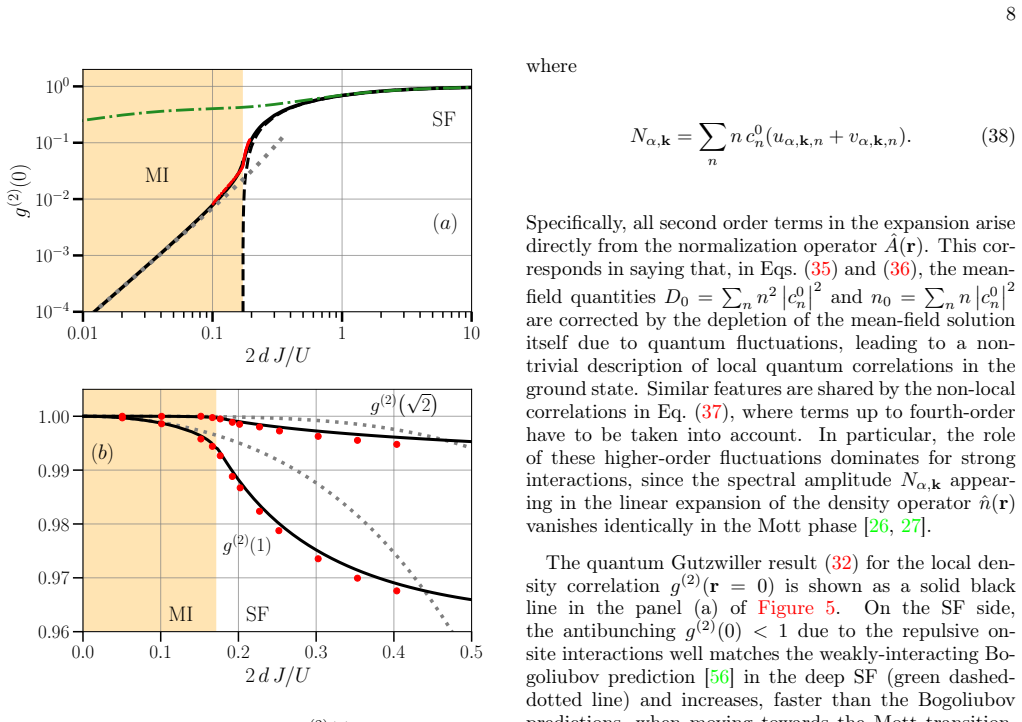
- [Sec. III.C, Fig. 5(a)] The QMC comparison for g(2)(0) is performed after rescaling the QMC hopping axis by the factor J_c/J_QMC_c so that the critical points of the two theories coincide. This rescaling removes the dominant quantitative error of the mean-field Gutzwiller phase boundary from the comparison and reduces the test to a shape comparison near the transition. The authors should show the comparison with and without this rescaling, or otherwise quantify how much of the apparent agreement depends on the rescaling.
- [Sec. II.C, Eq. (16); Sec. III.B, Eq. (30)] The control parameter F defined in Eq. (16) is computed within the Gaussian theory itself, using expectation values of δc†δc on the Bogoliubov vacuum. It is therefore not an independent test of the validity of the Gaussian truncation. This matters because the superfluid stiffness in Eq. (30) is a fourth-order correlation of the fluctuation operators, and the derivation assumes that Wick contractions of these operators with the quadratic action capture the current response. An independent check, for example against exact diagonalization on small lattices or against QMC data for f_s, is needed before the claim of quantitative accuracy in the superfluid regime can be accepted.
- [Sec. III.A, Fig. 3(c)] The statement that the method recovers the O(2) and commensurate-incommensurate universality classes is supported by fitted exponential and power-law forms in panels (b) and (c) of Fig. 3, but no fitting uncertainties, correlation-length values, or critical exponents are reported. Since the abstract elevates this universality-class recovery to a headline result, the authors should either provide a quantitative analysis (e.g., extracted exponents and a comparison with known O(2) values) or explicitly present this as a qualitative feature rather than a quantitative reproduction of critical behavior.
minor comments (5)
- [Sec. III.C, Fig. 5 caption] The caption refers to a '53 lattice'; this should presumably read '5^3 lattice' or '5×5×5 lattice'.
- [Sec. II.B, Eq. (10)] The pseudo-Hermitian matrix L_k is not displayed in the main text until Appendix B; a parenthetical reference to Appendix B at Eq. (10) would help the reader follow the diagonalization procedure.
- [Sec. II.C, Fig. 2] The dashed and solid line styles in Fig. 2 are described in the caption, but the text would benefit from an explicit statement that for n~=1 the system remains superfluid for all shown J/U so that the increase of F at small J/U does not signal a Mott transition.
- [Sec. III.B, Eq. (29)] The notation K_x for the local kinetic energy operator and K_x for its expectation value is used interchangeably in the text; this is not confusing on its own, but the authors should be consistent about operator versus expectation-value notation.
- [General] There are minor typos, e.g., 'refereed to as Higgs' in Sec. II.A and 'as expected ... as expected' in Sec. III.B; these should be corrected in a final pass.
Circularity Check
No circularity: the quantum Gutzwiller derivation is self-contained, and QMC data enter only as external benchmarks, not as fitted inputs.
full rationale
The central derivation is self-contained: starting from the Gutzwiller ansatz (2), the paper builds the Lagrangian (3), promotes the variational parameters to operators via canonical commutation relations (6), expands to quadratic order (10), diagonalizes by a Bogoliubov transformation, and computes observables through a stated four-step protocol ending in Wick's theorem. No free parameter is fitted to the quantities that are later called predictions; the QMC comparisons in Fig. 5 are external benchmarks, not fitting targets. The rescaling of the QMC hopping axis by Jc/J_QMC_c is a comparison convention that aligns critical points; it does not feed any parameter back into the theory and does not make the g(2) values equal by construction. Self-citations appear, e.g., Ref. [27] for spectral identifications and Ref. [51] for a forthcoming check, but the spectra and the formulas for g(1), ns, and g(2) are derived in the present text rather than imported as unverified premises. The Gaussian truncation and the smallness of the control parameter F in Eq. (16) are self-consistency approximations, not definitions of the predicted observables; whether they are quantitatively sufficient is a correctness or accuracy concern, not circularity. Consequently, no load-bearing step reduces to its own input, and the derivation is not circular.
Assumptions & free parameters
assumptions (4)
- domain assumption Quadratic order in the fluctuation operators is sufficient for the observables studied (Gaussian approximation).
- domain assumption The fluctuation operators satisfy the local constraint sum_n delta-c-dagger_n(r) c0_n = 0, and the spurious zero-energy eigenvector (c0, (c0)*) of Lk is projected out.
- domain assumption The Gutzwiller mean-field state is the correct reference state for quantization across the whole phase diagram.
- standard math Spectral properties of pseudo-Hermitian matrices (sum rule (C.2)) and the Bogoliubov normalization (14) hold.
Cite this review
Pith. "Pith review of Quantum fluctuations beyond the Gutzwiller approximation in the Bose-Hubbard model." pith.science (2026). https://pith.science/paper/DXJK4Z7Y
@misc{pith2026190803470,
  author       = {Pith},
  title        = {Pith review of: Quantum fluctuations beyond the Gutzwiller approximation in the Bose-Hubbard model},
  year         = {2026},
  howpublished = {\url{https://pith.science/paper/DXJK4Z7Y}},
  note         = {Machine review of arXiv:1908.03470}
}
read the original abstract
We develop a quantum many-body theory of the Bose-Hubbard model based on the canonical quantization of the action derived from a Gutzwiller mean-field ansatz. Our theory is a systematic generalization of the Bogoliubov theory of weakly-interacting gases. The control parameter of the theory, defined as the zero point fluctuations on top of the Gutzwiller mean-field state, remains small in all regimes. The approach provides accurate results throughout the whole phase diagram, from the weakly to the strongly interacting superfluid and into the Mott insulating phase. As specific examples of application, we study the two-point correlation functions, the superfluid stiffness, the density fluctuations, for which quantitative agreement with available quantum Monte Carlo data is found. In particular, the two different universality classes of the superfluid-insulator quantum phase transition at integer and non-integer filling are recovered.
Figures
Figures from the paper (3 more)
Reference graph
Works this paper leans on
-
[1]
Determine the expressionO[c,c∗] = ⟨ ΨG ⏐⏐ ˆO ⏐⏐ΨG ⟩ in terms of the Gutzwiller parameterscn and c∗ n
-
[2]
Create the operator ˆO[ˆc, ˆc†] by replacing the Gutzwiller parameters in O [c,c∗] by the corre- sponding operators ˆcn(r) and ˆc† n(r) without modi- fying their ordering
-
[3]
Expand theoperator ˆO order by orderin the fluctu- ationsδˆcn andδˆc† n, taking into account the depen- dence of the operator ˆA on the fluctuation opera- tors. The contribution ofˆA may be of fundamental importance when higher orders in the fluctuations become relevant
-
[4]
Forthespecificcaseconsideredinthisworkofnegli- gible interactions between excitation modes, invoke Wick theorem to compute the expectation value of products of operators on Gaussian states – such as ground or thermal states obtained fromH (2). In the following, we apply this protocol to compute ⟨ ˆO⟩, where the expectation value is intended to be eval- uat...
-
[5]
In panel (b) of Figure 5 we report the quantum Gutzwiller predictions for g(2)(1) and g(2)( √
-
[6]
Super- conductivity, Ferroelectric- ity and Magnetism in bad metals
along the⟨ˆn⟩ = 1 filling line across the tip of the Mott lobe. These curves are successfully compared to available Quantum Monte Carlo data (see [42] and references therein) and to strong- coupling perturbation theory, which shows that our the- ory is accurate across the whole phase transition and cor- rectly interpolates between a strongly-interacting Mo...
work page 2015
-
[7]
P. W. Anderson, Science235, 1196 (1987)
1987
-
[8]
P. A. Lee, N. Nagaosa, and X.-G. Wen, Rev. Mod. Phys. 78, 17 (2006)
2006
Show all 65 references
-
[9]
Castellani, C
C. Castellani, C. Di Castro, D. Feinberg, and J. Ran- ninger, Phys. Rev. Lett.43, 1957 (1979)
1979
-
[10]
Vollhardt, Rev
D. Vollhardt, Rev. Mod. Phys.56, 99 (1984)
1984
-
[11]
E. Gull, O. Parcollet, and A. J. Millis, Phys. Rev. Lett. 110, 216405 (2013)
2013
-
[12]
A. S. Darmawan, Y. Nomura, Y. Yamaji, and M. Imada, Phys. Rev. B98, 205132 (2018)
2018
-
[13]
M. P. A. Fisher, P. B. Weichman, G. Grinstein, and D. S. Fisher, Phys. Rev. B40, 546 (1989)
1989
-
[14]
Jaksch, C
D. Jaksch, C. Bruder, J. I. Cirac, C. W. Gardiner, and P. Zoller, Phys. Rev. Lett.81, 3108 (1998)
1998
-
[15]
Greiner, O
M. Greiner, O. Mandel, T. Esslinger, T. W. Hänsch, and I. Bloch, Nature415, 39 (2002)
2002
-
[16]
Stöferle, H
T. Stöferle, H. Moritz, C. Schori, M. Köhl, and T. Esslinger, Phys. Rev. Lett.92, 130403 (2004)
2004
-
[17]
Fölling, F
S. Fölling, F. Gerbier, A. Widera, O. Mandel, T. Gericke, and I. Bloch, Nature434, 481 (2005)
2005
-
[18]
W. S. Bakr, J. I. Gillen, A. Peng, S. Fölling, and M. Greiner, Nature462, 74 (2009)
2009
-
[19]
P. T. Ernst, S. Götze, J. S. Krauser, K. Pyka, D.-S. Lüh- mann, D. Pfannkuche, and K. Sengstock, Nat. Phys.6, 56 (2010)
2010
-
[20]
Endres, T
M. Endres, T. Fukuhara, D. Pekker, M. Cheneau, P. Schauß, C. Gross, E. Demler, S. Kuhr, and I. Bloch, Nature (London)487, 454 (2012)
2012
-
[21]
L.P.PitaevskiiandS.Stringari, Bose-Einstein condensa- tion and superfluidity(Oxford Science Publications, New York, 2016)
2016
-
[22]
Carusotto and C
I. Carusotto and C. Ciuti, Reviews of Modern Physics 85, 299 (2013)
2013
-
[23]
R. Ma, B. Saxberg, C. Owens, N. Leung, Y. Lu, J. Simon, and D. I. Schuster, Nature566, 51 (2019)
2019
-
[24]
Carusotto, A
I. Carusotto, A. A. Houck, A. Kollár, P. Roushan, D. Schuster, and J. Simon, Nat. Phys.16, 268 (2020)
2020
-
[25]
Castin, inCoherent atomic matter waves, edited by R
Y. Castin, inCoherent atomic matter waves, edited by R. Kaiser, C. Westbrook, and F. David (EDP Sciences and Springer-Verlag, 2001) pp. 1–136
2001
-
[26]
Carusotto and Y
I. Carusotto and Y. Castin, Phys. Rev. Lett.90, 030401 (2003)
2003
-
[27]
Ramakrishnan, Europhys
K.Sheshadri, H.R.Krishnamurthy, R.Pandit, andT.V. Ramakrishnan, Europhys. Lett.22, 257 (1993)
1993
-
[28]
van Oosten, P
D. van Oosten, P. van der Straten, and H. T. C. Stoof, Phys. Rev. A63, 053601 (2001)
2001
-
[29]
Menotti and N
C. Menotti and N. Trivedi, Phys. Rev. B 77, 235120 (2008)
2008
-
[30]
D.B.M.Dickerscheid, D.vanOosten, P.J.H.Denteneer, and H. T. C. Stoof, Phys. Rev. A68, 043623 (2003)
2003
-
[31]
Frérot and T
I. Frérot and T. Roscilde, Phys. Rev. Lett.116, 190401 (2016)
2016
-
[32]
K. V. Krutitsky and P. Navez, Phys. Rev. A84, 033602 (2011)
2011
-
[33]
Di Liberto, A
M. Di Liberto, A. Recati, N. Trivedi, I. Carusotto, and C. Menotti, Phys. Rev. Lett.120, 073201 (2018)
2018
-
[34]
Capogrosso-Sansone, N
B. Capogrosso-Sansone, N. V. Prokof’ev, and B. V. Svis- tunov, Phys. Rev. B75, 134302 (2007)
2007
-
[35]
Capogrosso-Sansone, S
B. Capogrosso-Sansone, S. G. Söyler, N. Prokof’ev, and B. Svistunov, Phys. Rev. A77, 015602 (2008)
2008
-
[36]
Kato and N
Y. Kato and N. Kawashima, Phys. Rev. E79, 021104 (2009)
2009
-
[37]
Pollet and N
L. Pollet and N. V. Prokof’ev, Phys. Rev. Lett.109, 010401 (2012)
2012
-
[38]
Byczuk and D
K. Byczuk and D. Vollhardt, Phys. Rev. B77, 235106 (2008)
2008
-
[39]
Hu and N.-H
W.-J. Hu and N.-H. Tong, Phys. Rev. B 80, 245110 (2009)
2009
-
[40]
Anders, E
P. Anders, E. Gull, L. Pollet, M. Troyer, and P. Werner, New Journal of Physics13, 075013 (2011)
2011
-
[41]
Sengupta and N
K. Sengupta and N. Dupuis, Phys. Rev. A71, 033629 (2005)
2005
-
[42]
Rançon and N
A. Rançon and N. Dupuis, Phys. Rev. B 83, 172501 (2011)
2011
-
[43]
Ohashi, M
Y. Ohashi, M. Kitaura, and H. Matsumoto, Phys. Rev. A 73, 033617 (2006)
2006
-
[44]
Sachdev,Quantum phase transitions(Cambridge Uni- versity Press, New York, 2011) Chap
S. Sachdev,Quantum phase transitions(Cambridge Uni- versity Press, New York, 2011) Chap. 16
2011
-
[45]
S. D. Huber, E. Altman, H. P. Büchler, and G. Blatter, Phys. Rev. B75, 085106 (2007)
2007
-
[46]
Fabrizio, Phys
M. Fabrizio, Phys. Rev. B95, 075156 (2017)
2017
-
[47]
Krauth, M
W. Krauth, M. Caffarel, and J.-P. Bouchaud, Phys. Rev. B 45, 3137 (1992)
1992
-
[48]
K. V. Krutitsky, Phys. Rep.607, 1 (2016)
2016
-
[49]
Pekker and C
D. Pekker and C. M. Varma, Annu. Rev. Condens. Mat- ter Phys.6, 269 (2015)
2015
-
[50]
Podolsky and S
D. Podolsky and S. Sachdev, Phys. Rev. B86, 054508 (2012)
2012
-
[51]
Podolsky, A
D. Podolsky, A. Auerbach, and D. P. Arovas, Phys. Rev. B 84, 174522 (2011)
2011
-
[52]
Cohen-Tannoudji, J
C. Cohen-Tannoudji, J. Dupont-Roc, and G. Grynberg, Photons and atoms: introduction to quantum electrody- namics (Wiley-VCH Verlag GmbH & Co. KGaA, Wein- heim, Germany, 1997)
1997
-
[53]
Blaizot and G
J.-P. Blaizot and G. Ripka,Quantum theory of finite sys- tems (The Massachusetts Institute of Technology Press, Cambridge, Massachusetts, 1986)
1986
-
[54]
L. D. Landau, E. M. Lifshitz, and L. P. Pitaevskii, Course of Theoretical Physics: Statistical Physics, Part 2, Vol. 9 (Pergamon Press, Oxford, New York, 1980)
1980
-
[55]
Here it is a mathematical object indicat- ing how much the local wave functions appearing in the Gutzwiller ansatz vary under the effect of quantum fluc- tuations
In the standard Bogoliubov theory, the small parame- ter controlling the accuracy of the Bogoliubov approach has the physical meaning of the non-condensed fraction of the gas. Here it is a mathematical object indicat- ing how much the local wave functions appearing in the Gutz...
-
[56]
Stringari, Journal of Experimental and Theoretical Physics 127, 844 (2018)
S. Stringari, Journal of Experimental and Theoretical Physics 127, 844 (2018)
2018
-
[57]
Caleffiet al., in preparation
A more detailed description of the exponential behaviour 12 ofg(1)(r)at the CI transition in terms of the properties of the self-energy within the present quantum theory con- firming these physical arguments will be the subject of a forthcoming work, F. Caleffiet al., in preparation
-
[58]
D. J. Scalapino, S. R. White, and S. C. Zhang, Phys. Rev. Lett.68, 2830 (1992)
1992
-
[59]
D. J. Scalapino, S. R. White, and S. C. Zhang, Phys. Rev. B47, 7995 (1993)
1993
-
[60]
In the absence of the lattice, due to Galilean invariance the kinetic energy term is replaced by the total density
-
[61]
Romito, C
The very same expression indeed gives the collisionless drag between two Bose gases at zero temperature, where the modes are the in-phase and out-of-phase modes, D. Romito, C. Lobo and A. Recati, arXiv:2002.03955
2002 arXiv
-
[62]
A. M. Rey, K. Burnett, R. Roth, M. Edwards, C. J. Williams, and C. W. Clark, J. Phys. B: At. Mol. Opt. Phys. 36, 825 (2003)
2003
-
[63]
O. A. Prośniak, M. Ł¸ acki, and B. Damski, Sci. Rep.9, 8687 (2019)
2019
-
[64]
Caleffi,Quantum fluctuations beyond the Gutzwiller approximation in the Bose-Hubbard model, Master’s the- sis, University of Trento (2018)
F. Caleffi,Quantum fluctuations beyond the Gutzwiller approximation in the Bose-Hubbard model, Master’s the- sis, University of Trento (2018)
2018
-
[65]
Recati and F
A. Recati and F. Piazza, Physical Review B99, 064505 (2019)
2019
Reviewed August 14, 2026 · model on record in the stance chip above.
Discussion (0). Continue with ORCID to comment.