REVIEW 2 major objections 4 minor 79 references
dtControl2+$\varepsilon$: Trading Optimality for Explainability in MDPs via Decision Trees
T0 review · 2 major / 4 minor · reviewed 2026-08-01 · deepseek-v4-flash
Pith's one-line read A small, user-chosen allowance of imprecision ε makes decision-tree controllers for Markov decision processes orders of magnitude smaller, while a model-checking loop certifies that every returned tree stays within ε of the optimal value.
desk verdict Credible tool paper with a real ε-optimality theorem and strong empirical results; the practical guarantee leans on Storm's numerics more than the proof admits. read the letter →
The pith
A machine-rendered reading of the paper's core claim, the machinery that carries it, and where it could break.
The reading
What carries the argument
The load-bearing mechanism is the permissive dataset plus a verification loop. Rather than learning a tree from one optimal controller (one action per state), the tool builds a dataset assigning each state a set of allowed actions so that every controller consistent with it is provably ε-optimal (Theorem 1). Safe reductions delete states — AllOpt (all actions equally good), Agency (best-vs-worst value gap ≤ ε), Dominance (another state reached with probability 1 regardless of choice), Unreach (never reached from the start) — while keeping the ε-claim. Greedier steps (simulation-weighted learning, early stopping, pruning) may break the guarantee, so each candidate tree is model-checked and th
What would settle it
On a benchmark where the tool aborts at ε=0 because the model checker's returned controller was confirmed non-optimal (e.g., consensus4-4-c2 or zeroconf-1000-2-false-correctmax), compute the true optimal value with an independent exact-arithmetic solver, then model-check the tree the tool outputs at ε=1e-6; if the true gap exceeds 1e-6, the ε-optimality guarantee is broken. The paper supplies the ingredients for this test: its own second model checking query disagreed with the first by more than 10^-14 on those benchmarks.
Extended reading notes
Core claim
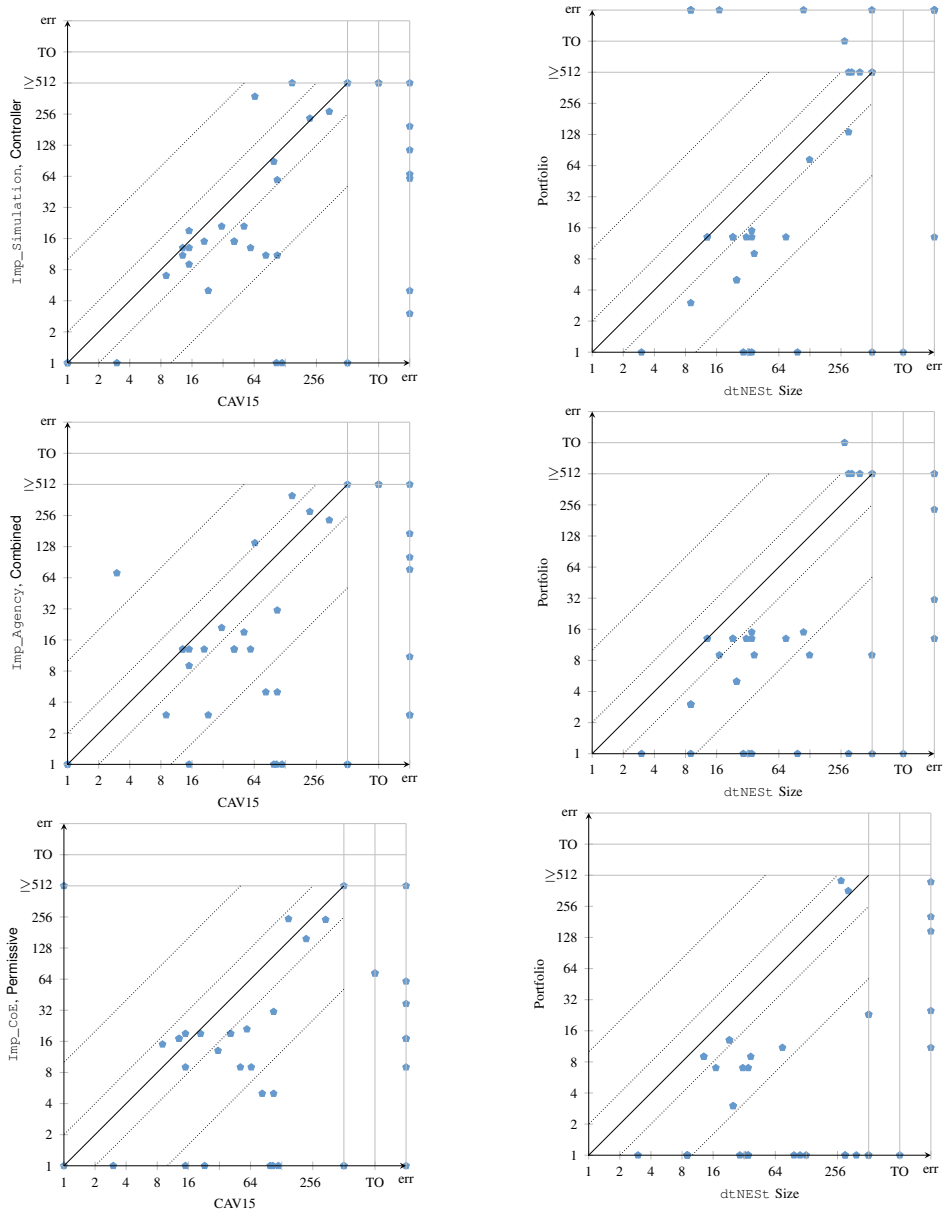
On its own terms, the paper establishes a guarantee and an empirical fact. The guarantee: given any MDP, any standard objective (reachability, safety, reach-avoid, expected reward, LTL with memory), and any precision ε ≥ 0, the tool returns a decision tree T with |V^T(s̄) − V(s̄)| ≤ ε — the tree's value at the initial state is within ε of optimal; ε=0 recovers an exact optimal controller. The empirical fact: on 38 benchmarks the trees beat all four competitors, more than two orders of magnitude smaller than the previous tool on 12 of 38, and at ε=1e-2 produce trees of at most 15 nodes on 30 benchmarks and single-node trees on 18 — in nearly half the benchmark systems, always playing one fixe
Load-bearing premise
The whole guarantee rests on the model checker computing exact optimal values: the verification loop that certifies ε-optimality compares the candidate tree's value with the solver's own optimum, and the appendix reports ε=0 runs where the solver's 'optimal' controller was provably not optimal (differing by more than 10^-14 between two queries) — so if the solver's numerical error exceeds the allowed ε, an output tree can violate its certificate without the tool detecting it.
Editorial extensions
If this is right
- The user can dial a single parameter ε and receive a certified bound on the controller's suboptimality, so the simplicity/performance trade-off becomes explicit and auditable rather than a gamble on a pruning heuristic.
- The single-node results at ε=1e-2 imply that many standard benchmark MDPs do not actually need a complex policy: a fixed action with uniform random fallback is within 1% of optimal, a structural fact about the models that exact controller synthesis had hidden.
- The guarantee transfers across the full objective spectrum — reachability, safety, reach-avoid, expected reward/cost, and LTL with memory (the only tool in its class with LTL support) — so the same ε-optimal simplification applies in each of these settings.
- Even at ε=0 the pipeline is strictly better than the predecessor tool on every benchmark, by more than two orders of magnitude on 12 of 38 — the permissive dataset, safe reductions, and automatic predicates improve exact representation too.
- Because the verification loop certifies the final tree, future aggressive heuristics can be added without endangering correctness: if they produce an ε-violating tree, the tool detects it and relaxes them.
Reading between the lines
- A cheap complexity probe suggests itself: run the pipeline at a coarse ε (say 1e-2) before committing to full synthesis; if the result is one or a few nodes, the system's apparent decision complexity is not load-bearing for the specification, and the remaining work in building and maintaining a detailed controller may be unnecessary.
- The reduced dataset size (after safe reductions) could serve as a definition of an MDP's decision complexity per se, separating 'hard' systems from merely 'large' ones — a distinction the paper itself notes indirectly when observing no correlation between model size and runtime.
- For ε near the solver's numerical noise floor, a practical hardening would run the verification loop with exact rational arithmetic: the certifier, not the learner, is what must be made exact, and the paper's appendix shows ε=0 cases where the solver's own two query results disagreed beyond floating-point precision.
- The permissive-dataset formulation points toward a transfer route for parameterised model families: a tree certified on one instance could be checked and locally patched on nearby instances, turning per-instance compression into a reusable rule.
Editorial analysis
A structured set of objections, weighed in public.
Referee Report
Summary. The paper presents dtControl2+ε, an extension of dtControl2 that constructs decision-tree controllers for MDPs with a formal ε-optimality guarantee. The workflow solves the MDP with Storm, constructs a permissive/reduced dataset of 'relevant' decisions, learns and prunes a DT, and validates the result by model checking. The central Theorem 1 states that the dataset construction and reductions are ε-optimal; the appendix contains a proof. Empirically, on 38 PRISM benchmarks the tool reports substantially smaller DTs than dtControl2, dtPaynt, dtNESt, and CAV15, including single-node DTs for 18 benchmarks at ε=1e-2. The paper also documents that on several ε=0 benchmarks Storm returned a controller that was not optimal and the tool aborts.
Significance. If the guarantee is delivered, this is a notable advance: it provides tunable explanations for MDP controllers with a formal bound, covers standard objectives, and has a reproducible artifact. The proof of Theorem 1 is a genuine effort, and the evaluation is extensive with full tables. The main caveat is that the practical guarantee depends on numerical exactness of Storm. Since the paper itself reports failures of that exactness, the advertised absolute guarantee is currently too strong. With a clarified assumption or a certified downstream check, the contribution would be solid.
major comments (2)
- [§III Problem Statement and §III-C; Appendix E3/E4] The paper states: 'Given an MDP, objective, and precision ε≥0, obtain a (small) decision tree T such that |V^T(¯s)-V(¯s)| ≤ ε.' Appendix E3/E4 reports that for several ε=0 benchmarks the controller obtained from Storm 'was not optimal, as confirmed through a second model checking query; it also differed by more than the float precision of 10^-14', and the tool aborts. Thus the claim as stated is false for the implemented tool. Theorem 1's proof assumes the initial dataset is built from a truly optimal controller. Please either (a) restrict all claims to the case where Storm's oracle is exact, or (b) provide a certified exact solving/validation path that justifies the absolute statement.
- [§III-C verification loop] The verification step compares the DT's value against Storm's computed optimal value, both produced by Storm. If Storm's optimal value has numerical error δ > 0, a DT whose true error is ε+δ can pass the check. The paper gives no bound on δ and indeed documents numerical inexactness in Appendix E3/E4. This is not a remote edge case: the same solver is used both to construct the dataset and to validate the DT. Please add a numerical error analysis or an external exact checker, or at minimum explicitly state that the guarantee is relative to Storm's arithmetic.
minor comments (4)
- [§III] The statement 'if a decision tree exists, our tool will always find one by omitting aggressive heuristics when necessary' is not justified by Algorithm 1, which is a greedy heuristic with a fixed predicate set. If the dataset contains states with identical feature values but different required actions, no axis-aligned split can separate them. Please either weaken this claim or provide a proof.
- [Appendix E3/E4] The sentence 'Even though we set Storm to sound solving, we were not able to avoid such cases. In these cases, dtControl 2+ε aborts.' appears verbatim in both E3 and E4. Please remove the duplication and clarify whether the abort is triggered by the second model-checking query or by an exception.
- [§V-B] For Imp_Simulation and Imp_CoE, the text says that adding a small positive weight 'ensures ε-optimality'. A small weight by itself does not guarantee the bound; the final model-checking step is what enforces it. Please rephrase to avoid the implication that the weighting alone is sufficient.
- [Appendix A] The LTL support is described as a differentiator, but the appendix admits that memory states are opaque numbers and that no LTL benchmarks are evaluated. Please label this as preliminary and provide at least the hand-crafted instances or a clear statement that LTL is not part of the experimental comparison.
Circularity Check
No circular reduction found; the ε-optimality guarantee is derived from standard MDP arguments and an external published certificate, not from fitted benchmark values.
full rationale
The paper's central correctness claim (Theorem 1, Appendix D) is not built by fitting or by defining the target in terms of the output. Lemma 1 and Lemma 2 are proved in the appendix from MDP semantics. The permissive initial dataset construction relies on [20]'s fixed-point certificate (used as Lemma 3); although [20] shares an author with this paper, it is an externally published TACAS result with stated assumptions that do not include the current benchmarks, and the paper reproduces the argument rather than merely citing it as a uniqueness theorem. No benchmark constant or measured DT size is fed back into the derivation, and ε is an input, not a fitted parameter. The tool's final model-checking step is a verification oracle, not a fitted source of the claimed guarantee. The appendix's admission that on some ε=0 instances Storm's controller 'was not optimal, as confirmed through a second model checking query; it also differed by more than the float precision of 10^-14' is a real numerical-correctness risk, but it is a limitation of the external oracle, not a circular step in the derivation. Accordingly, no circularity step is warranted.
Assumptions & free parameters
free parameters (3)
- Early-stopping threshold θ =
0.5, decremented by 0.1 until success (min 0.0)
- Importance weight floor for Imp_Simulation =
1e-6
- Unspecified small positive weight in Imp_CoE =
not given
assumptions (5)
- domain assumption Storm returns a truly optimal controller and exact model-checking values for the MDP/objective.
- domain assumption GoodActions correctness follows from Chatterjee et al. [20, Prop. 5 and Section 3].
- domain assumption Lemma 1: mixture of ε-optimal actions preserves ε-optimality, including when a state is revisited infinitely often.
- ad hoc to paper For LTL, extending states with memory-state pairs preserves ε-optimality and produces interpretable DTs.
- domain assumption PRISM guard expressions are good candidate predicates for DT splits.
invented entities (1)
-
Unif special leaf label
Cite this review
Pith. "Pith review of dtControl2+$\varepsilon$: Trading Optimality for Explainability in MDPs via Decision Trees." pith.science (2026). https://pith.science/paper/DXN64TPD
@misc{pith2026260725925,
  author       = {Pith},
  title        = {Pith review of: dtControl2+$\varepsilon$: Trading Optimality for Explainability in MDPs via Decision Trees},
  year         = {2026},
  howpublished = {\url{https://pith.science/paper/DXN64TPD}},
  note         = {Machine review of arXiv:2607.25925}
}
abstract
Over the past decade, decision trees have been used to represent controllers (a.k.a. policies) in an explainable way, with dtControl2 as a current state-of-the-art tool. However, for systems that are large or have many corner cases, even such representations tend to be too complex and not human-comprehensible. Unfortunately, reducing the size of the decision tree is not straightforward, as missing just a single crucial case might result in an incorrect controller. We tackle this issue in the setting of Markov decision processes, extending dtControl2 by "$\varepsilon$" functionality: Given an allowed imprecision $\varepsilon \geq 0$, we construct a smaller decision tree, distilling the essence of the controller, while still guaranteeing its $\varepsilon$-optimality. This enables us to provide tunably simpler explanations, omitting a controllable amount of detail. Our tool constructs decision trees that are orders of magnitude smaller than the state of the art.
Figures


Figures from the paper (8 more)







Reference graph
Works this paper leans on
-
[1]
In: TOOLympics@ETAPS
Andriushchenko, R., Bork, A., Budde, C.E., ˇCeška, M., Grover, K., Hahn, E.M., Hartmanns, A., Israelsen, B., Jansen, N., Jeppson, J., Junges, S., Köhl, M.A., Könighofer, B., K ˇretínský, J., Meggendorfer, T., Parker, D., Pranger, S., Quatmann, T., Ruijters, E., Taylor, L., V olk, M., Weininger, M., Zhang, Z.: Tools at the frontiers of quantitative ver- if...
2023
-
[2]
In: Cussens, J., Zhang, K
Andriushchenko, R., ˇCeška, M., Junges, S., Katoen, J.P.: Inductive synthesis of finite-state controllers for pomdps. In: Cussens, J., Zhang, K. (eds.) Proceedings of the Thirty-Eighth Conference on Uncertainty in Artificial Intelligence. Proceedings of Machine Learning Research, vol. 180, pp. 85–95. PMLR (01–05 Aug 2022), https://proceedings.mlr. press/v...
2022
-
[3]
Andriushchenko, R., ˇCeška, M., Chakraborty, D., Junges, S., K ˇretínský, J., Macák, F.: Symbiotic local search for small decision tree poli- cies in MDPs. In: UAI. Proceedings of Machine Learning Research, vol. 286, pp. 132–148. PMLR (2025), https://openreview.net/forum?id= P0JNSkJtyN
2025
-
[4]
Andriushchenko, R., ˇCeška, M., Junges, S., Macák, F.: Small deci- sion trees for MDPs with deductive synthesis. In: CA V (2). Lecture Notes in Computer Science, vol. 15932, pp. 169–192. Springer (2025). https://doi.org/10.1007/978-3-031-98679-6_8
-
[5]
Angelov, P.P., Soares, E.A., Jiang, R., Arnold, N.I., Atkinson, P.M.: Ex- plainable artificial intelligence: an analytical review. WIREs Data Min- ing Knowl. Discov.11(5) (2021). https://doi.org/10.1002/WIDM.1424
-
[6]
Arrieta, A.B., Rodríguez, N.D., Ser, J.D., Bennetot, A., Tabik, S., Bar- bado, A., García, S., Gil-Lopez, S., Molina, D., Benjamins, R., Chatila, R., Herrera, F.: Explainable artificial intelligence (XAI): concepts, taxonomies, opportunities and challenges toward responsible AI. Inf. Fusion58, 82–115 (2020). https://doi.org/10.1016/j.inffus.2019.12.012
- [7]
-
[8]
Ashok, P., Jackermeier, M., K ˇretínský, J., Weinhuber, C., Weininger, M., Yadav, M.: dtControl 2.0: Explainable strategy representation via decision tree learning steered by experts. In: TACAS (2). Lecture Notes in Computer Science, vol. 12652, pp. 326–345. Springer (2021). https://doi.org/10.1007/978-3-030-72013-1_17
Show all 79 references
-
[9]
In: QEST
Ashok, P., K ˇretínský, J., Larsen, K.G., Coënt, A.L., Taankvist, J.H., Weininger, M.: SOS: safe, optimal and small strategies for hybrid Markov decision processes. In: QEST. Lecture Notes in Computer Science, vol. 11785, pp. 147–164. Springer (2019). https://doi.org/10.1007/9...
2019 doi
-
[10]
In: VMCAI (2025)
Azeem, M., Chakraborty, D., Kanav, S., K ˇretínský, J., Mohagheghi, M., Mohr, S., Weininger, M.: 1-2-3-go! Policy synthesis for parameterized Markov decision processes via decision-tree learning and generalization. In: VMCAI (2025). https://doi.org/10.1007/978-3-031-82703-7_5
2025 doi
-
[11]
MIT Press (2008), https://mitpress.mit.edu/books/principles-model-checking
Baier, C., Katoen, J.: Principles of model checking. MIT Press (2008), https://mitpress.mit.edu/books/principles-model-checking
2008
-
[12]
In: Bengio, S., Wallach, H., Larochelle, H., Grauman, K., Cesa-Bianchi, N., Garnett, R
Bastani, O., Pu, Y ., Solar-Lezama, A.: Verifiable reinforcement learning via policy extraction. In: Bengio, S., Wallach, H., Larochelle, H., Grauman, K., Cesa-Bianchi, N., Garnett, R. (eds.) Advances in Neural Information Processing Systems. vol. 31. Curran Associates, Inc. (...
2018
-
[13]
https://doi.org/10.1145/3632935
Batz, K., Biskup, T.J., Katoen, J.P., Winkler, T.: Programmatic strategy synthesis: Resolving nondeterminism in probabilistic programs (2023). https://doi.org/10.1145/3632935
2023 doi
-
[14]
In: CA V (1)
Brázdil, T., Chatterjee, K., Chmelik, M., Fellner, A., K ˇretínský, J.: Counterexample explanation by learning small strategies in Markov decision processes. In: CA V (1). Lecture Notes in Computer Science, vol. 9206, pp. 158–177. Springer (2015). https://doi.org/10.1007/978-3...
2015 doi
-
[15]
https://doi.org/10.1007/978-3-032-09524-4_7
Brorholt, A.H., Høeg-Petersen, A.H., Jensen, P.G., Larsen, K.G., Mikuˇcionis, M., Schilling, C., W ˛ asowski, A.: Uppaal coshy: Au- tomatic synthesis of compact shields for hybrid systems (2025). https://doi.org/10.1007/978-3-032-09524-4_7
2025 doi
-
[16]
In: AISoLA
Budde, C.E., D’Argenio, P.R., Hartmanns, A.: Digging for decision trees: A case study in strategy sampling and learning. In: AISoLA. Lecture Notes in Computer Science, vol. 15217, pp. 354–378. Springer (2024). https://doi.org/10.1007/978-3-031-75434-0_24
2024 doi
-
[17]
In: ISoLA (4)
Budde, C.E., Hartmanns, A., Klauck, M., K ˇretínský, J., Parker, D., Quatmann, T., Turrini, A., Zhang, Z.: On correctness, precision, and performance in quantitative verification - QComp 2020 competition report. In: ISoLA (4). Lecture Notes in Computer Science, vol. 12479, pp....
2020 doi
-
[18]
In: Proceedings of the Twenty-Ninth International Conference on International Joint Conferences on Artificial Intelligence
Carr, S., Jansen, N., Topcu, U.: Verifiable rnn-based policies for pomdps under temporal logic constraints. In: Proceedings of the Twenty-Ninth International Conference on International Joint Conferences on Artificial Intelligence. pp. 4121–4127 (2021)
2021
-
[19]
In: HSCC ’25: Proceedings of the 28th ACM International Conference on Hybrid Systems: Computation and Control (2025)
Chakraborty, D., Dubslaff, C., Kanav, S., K ˇretínský, J., Weinhu- ber, C.: Explaining control policies through predicate decision dia- grams. In: HSCC ’25: Proceedings of the 28th ACM International Conference on Hybrid Systems: Computation and Control (2025). https://doi.org/...
2025
-
[20]
In: TACAS (2)
Chatterjee, K., Quatmann, T., Schäffeler, M., Weininger, M., Winkler, T., Zilken, D.: Fixed point certificates for reachability and expected rewards in MDPs. In: TACAS (2). Lecture Notes in Computer Science, vol. 15697, pp. 130–151. Springer (2025). https://doi.org/10.1007/978...
2025 doi
-
[21]
Formal Meth- ods Syst
Chen, T., Forejt, V ., Kwiatkowska, M.Z., Parker, D., Simaitis, A.: Automatic verification of competitive stochastic systems. Formal Meth- ods Syst. Des.43(1), 61–92 (2013). https://doi.org/10.1007/s10703-013- 0183-7
2013 doi
-
[22]
In: IJCAI
Córdoba, F.C., Judson, S., Antonopoulos, T., Bjørner, K., Shoemaker, N., Shapiro, S.J., Piskac, R., Könighofer, B.: Analyzing intentional behavior in autonomous agents under uncertainty. In: IJCAI. pp. 372–
-
[23]
Costa, V .G., Pedreira, C.E.: Recent advances in decision trees: an updated survey. Artif. Intell. Rev.56(5), 4765– 4800 (2023). https://doi.org/10.1007/S10462-022-10275-5, https://doi.org/10.1007/s10462-022-10275-5
2023 doi
-
[24]
In: PAPM-PROBMIV
D’Argenio, P.R., Jeannet, B., Jensen, H.E., Larsen, K.G.: Reduction and refinement strategies for probabilistic analysis. In: PAPM-PROBMIV. LNCS, vol. 2399, pp. 57–76. Springer (2002). https://doi.org/10.1007/3- 540-45605-8_5
2002 doi
-
[25]
Proceedings of the AAAI Conference on Artificial Intelligence29(1) (Feb 2015)
Das Gupta, U., Talvitie, E., Bowling, M.: Policy tree: Adaptive representation for policy gradient. Proceedings of the AAAI Conference on Artificial Intelligence29(1) (Feb 2015). https://doi.org/10.1609/aaai.v29i1.9613
2015 doi
-
[26]
Journal of Machine Learning Research23(26), 1–47 (2022), http://jmlr.org/papers/v23/20-520.html
Demirovi ´c, E., Lukina, A., Hebrard, E., Chan, J., Bailey, J., Leckie, C., Ramamohanarao, K., Stuckey, P.J.: Murtree: Optimal decision trees via dynamic programming and search. Journal of Machine Learning Research23(26), 1–47 (2022), http://jmlr.org/papers/v23/20-520.html
2022
-
[27]
https://doi.org/10.48550/arXiv.1910.03016, https://arxiv.org/abs/ 1910.03016
Du, S.S., Kakade, S.M., Wang, R., Yang, L.F.: Is a good represen- tation sufficient for sample efficient reinforcement learning? CoRR (2019). https://doi.org/10.48550/arXiv.1910.03016, https://arxiv.org/abs/ 1910.03016
-
[28]
In: xAI (2)
Dubslaff, C., Klös, V ., Päßler, J.: Template decision diagrams for meta control and explainability. In: xAI (2). Communications in Computer and Information Science, vol. 2154, pp. 219–242. Springer (2024). https://doi.org/10.1007/978-3-031-63797-1_12
2024 doi
-
[29]
Eisentraut, J., Kelmendi, E., K ˇretínský, J., Weininger, M.: Value iteration for simple stochastic games: Stopping criterion and learning algorithm. Inf. Comput.285(Part), 104886 (2022). https://doi.org/10.1016/j.ic.2022.104886
2022
-
[30]
Esparza, J., K ˇretínský, J., Sickert, S.: A unified translation of linear temporal logic toω-automata. J. ACM67(6), 33:1–33:61 (2020). https://doi.org/10.1145/3417995
2020 doi
-
[31]
In: HICSS
Gerlings, J., Shollo, A., Constantiou, I.D.: Reviewing the need for ex- plainable artificial intelligence (xAI). In: HICSS. pp. 1–10. ScholarSpace (2021). https://doi.org/10.24251/HICSS.2021.156
2021 doi
-
[32]
Gunning, D., Stefik, M., Choi, J., Miller, T., Stumpf, S., Yang, G.: XAI - explainable artificial intelligence. Sci. Robotics4(37) (2019). https://doi.org/10.1126/scirobotics.aay7120
2019 doi
-
[33]
In: Sankaranarayanan, S., Sharygina, N
Hartmanns, A., Junges, S., Quatmann, T., Weininger, M.: A practitioner’s guide to MDP model checking algorithms. In: Sankaranarayanan, S., Sharygina, N. (eds.) 29th International Conference on Tools and Algo- rithms for the Construction and Analysis of Systems (TACAS). Lecture...
2023 doi
-
[34]
STTT (to 12 appear), preprint available on github (2026), https://sjunges.github.io/ files/revised_practitioners_guide.pdf
Hartmanns, A., Junges, S., Quatmann, T., Weininger, M.: The revised practitioner’s guide to MDP model checking algorithms. STTT (to 12 appear), preprint available on github (2026), https://sjunges.github.io/ files/revised_practitioners_guide.pdf
2026
-
[35]
In: TACAS (1)
Hartmanns, A., Klauck, M., Parker, D., Quatmann, T., Ruijters, E.: The quantitative verification benchmark set. In: TACAS (1). Lecture Notes in Computer Science, vol. 11427, pp. 344–350. Springer (2019). https://doi.org/10.1007/978-3-030-17462-0_20
2019 doi
-
[36]
Hensel, C., Junges, S., Katoen, J., Quatmann, T., V olk, M.: The proba- bilistic model checker Storm. Int. J. Softw. Tools Technol. Transf.24(4), 589–610 (2022). https://doi.org/10.1007/S10009-021-00633-Z
2022 doi
-
[37]
Huysmans, J., Dejaeger, K., Mues, C., Vanthienen, J., Baesens, B.: An empirical evaluation of the comprehensibility of decision table, tree and rule based predictive models. Decis. Support Syst.51(1), 141–154 (2011). https://doi.org/10.1016/j.dss.2010.12.003
2011 doi
-
[38]
Hyafil, L., Rivest, R.L.: Constructing optimal binary decision trees is NP-complete. Inf. Process. Lett.5(1), 15–17 (1976). https://doi.org/10.1016/0020-0190(76)90095-8
1976 doi
-
[39]
https://doi.org/10.2759/177365
Independent High-Level Expert Group on Artificial Intelligence: Ethics guidelines for trustworthy AI - European commission, directorate- general for communications networks, content and technology (2019). https://doi.org/10.2759/177365
2019 doi
-
[40]
In: Proceedings of the ninth annual ACM symposium on Principles of distributed computing
Israeli, A., Jalfon, M.: Token management schemes and random walks yield self-stabilizing mutual exclusion. In: Proceedings of the ninth annual ACM symposium on Principles of distributed computing. pp. 119–131 (1990)
1990
-
[41]
In: FMCAD
Jantsch, S., Harder, H., Funke, F., Baier, C.: SWITSS: Computing small witnessing subsystems. In: FMCAD. pp. 236–244. IEEE (2020). https://doi.org/10.34727/2020/ISBN.978-3-85448-042-6_31
2020 doi
-
[42]
In: DASC
Julian, K., Lopez, J., Brush, J., Owen, M., Kochenderfer, M.: Policy compression for aircraft collision avoidance systems. In: DASC. pp. 1– 10 (09 2016). https://doi.org/10.1109/DASC.2016.7778091
2016
-
[43]
Jüngermann, F., K ˇretínský, J., Weininger, M.: Algebraically explain- able controllers: decision trees and support vector machines join forces. Int. J. Softw. Tools Technol. Transf.25(3), 249–266 (2023). https://doi.org/10.1007/S10009-023-00716-Z
2023 doi
-
[44]
Lecture Notes
Kallenberg, L.: Markov decision processes. Lecture Notes. University of Leiden428(2011), https://www.researchgate.net/profile/ Lodewijk-Kallenberg/publication/359893791_Lecture_Notes_Markov_ Decision_Processes_-_version_2022/links/62553afbb0cee02d6965cab0/ Lecture-Notes-Markov...
2011
-
[45]
In: 2022 International Conference on Robotics and Automation, ICRA 2022, Philadel- phia, PA, USA, May 23-27, 2022
Kiesbye, J., Grover, K., Ashok, P., K ˇretínský, J.: Planning via model checking with decision-tree controllers. In: 2022 International Conference on Robotics and Automation, ICRA 2022, Philadel- phia, PA, USA, May 23-27, 2022. pp. 4347–4354. IEEE (2022). https://doi.org/10.11...
2022
-
[46]
In: Workshop on Interpretable Policies in Reinforcement Learning @RLC-2024 (2024), https://openreview.net/forum?id=zafp5CwoTq
Kohler, H., Delfosse, Q., Akrour, R., Kersting, K., Preux, P.: Inter- pretable and editable programmatic tree policies for reinforcement learn- ing. In: Workshop on Interpretable Policies in Reinforcement Learning @RLC-2024 (2024), https://openreview.net/forum?id=zafp5CwoTq
2024
-
[47]
In: Enea, C., Lal, A
K ˇretínský, J., Meggendorfer, T., Prokop, M., Rieder, S.: Guessing winning policies in ltl synthesis by semantic learning. In: Enea, C., Lal, A. (eds.) Computer Aided Verification. pp. 390–414. Springer Nature Switzerland, Cham (2023)
2023
-
[48]
K ˇretínský, J., Meggendorfer, T.: Of cores: A partial-exploration frame- work for Markov decision processes. Log. Methods Comput. Sci.16(4) (2020). https://doi.org/10.23638/LMCS-16(4:3)2020
2020 doi
-
[49]
In: ATV A
K ˇretínský, J., Meggendorfer, T., Sickert, S.: Owl: A library forω-words, automata, and LTL. In: ATV A. Lecture Notes in Computer Science, vol. 11138, pp. 543–550. Springer (2018). https://doi.org/10.1007/978-3-030- 01090-4_34
2018 doi
-
[50]
In: CA V (1)
K ˇretínský, J., Meggendorfer, T., Sickert, S., Ziegler, C.: Rabinizer 4: From LTL to your favourite deterministic automaton. In: CA V (1). Lecture Notes in Computer Science, vol. 10981, pp. 567–577. Springer (2018). https://doi.org/10.1007/978-3-319-96145-3_30
2018 doi
-
[51]
In: CA V
Kwiatkowska, M.Z., Norman, G., Parker, D.: PRISM 4.0: Verifi- cation of probabilistic real-time systems. In: CA V. Lecture Notes in Computer Science, vol. 6806, pp. 585–591. Springer (2011). https://doi.org/10.1007/978-3-642-22110-1_47
2011 doi
-
[52]
In: 2010 IEEE Globecom Workshops
Liu, S., Panangadan, A., Talukder, A., Raghavendra, C.S.: Compact rep- resentation of coordinated sampling policies for body sensor networks. In: 2010 IEEE Globecom Workshops. pp. 2044–2048. IEEE (2010). https://doi.org/10.1109/GLOCOMW.2010.5700304
2010
-
[53]
In: Bouajjani, A., Holík, L., Wu, Z
Meggendorfer, T.: PET - A partial exploration tool for probabilistic verification. In: Bouajjani, A., Holík, L., Wu, Z. (eds.) Automated Tech- nology for Verification and Analysis - 20th International Symposium, ATV A 2022, Virtual Event, October 25-28, 2022, Proceedings. Lect...
2022 doi
-
[54]
In: CA V (3)
Meggendorfer, T., Weininger, M.: Playing games with your PET: ex- tending the partial exploration tool to stochastic games. In: CA V (3). Lecture Notes in Computer Science, vol. 14683, pp. 359–372. Springer (2024). https://doi.org/10.1007/978-3-031-65633-0_16
2024 doi
-
[55]
Information Systems Management39(1), 53–63 (2022)
Meske, C., Bunde, E., Schneider, J., Gersch, M.: Explainable arti- ficial intelligence: objectives, stakeholders, and future research op- portunities. Information Systems Management39(1), 53–63 (2022). https://doi.org/10.1080/10580530.2020.1849465
2022
-
[56]
Miller, T., Hoffman, R.R., Amir, O., Holzinger, A.: Special issue on explainable artificial intelligence (XAI). Artif. Intell.307, 103705 (2022). https://doi.org/10.1016/j.artint.2022.103705
2022
-
[57]
McGraw-Hill Series in Computer Science, McGraw-Hill (1997), https://www.worldcat
Mitchell, T.M.: Machine learning, International Edition. McGraw-Hill Series in Computer Science, McGraw-Hill (1997), https://www.worldcat. org/oclc/61321007
1997
-
[58]
In: International Conference on Tools and Algorithms for the Construction and Analysis of Systems
Neider, D., Topcu, U.: An automaton learning approach to solving safety games over infinite graphs. In: International Conference on Tools and Algorithms for the Construction and Analysis of Systems. pp. 204–221. Springer (2016)
2016
-
[59]
Phillips, P.J., Hahn, C.A., Fontana, P.C., Broniatowski, D.A., Przy- bocki, M.A.: Four principles of explainable artificial intelligence - (U.S.) national institute of standards and technology (NIST) (2020), https://doi.org/10.6028/NIST.IR.8312-draft
2020 doi
-
[60]
Appl.62, 333–346 (2016)
Piltaver, R., Lustrek, M., Gams, M., Martincic-Ipsic, S.: What makes classification trees comprehensible? Expert Syst. Appl.62, 333–346 (2016). https://doi.org/10.1016/j.eswa.2016.06.009
2016 doi
-
[61]
In: POPL
Pnueli, A., Rosner, R.: On the synthesis of a reactive module. In: POPL. pp. 179–190. ACM Press (1989). https://doi.org/10.1145/75277.75293
1989
-
[62]
In: Proceedings of the third annual ACM symposium on Principles of distributed computing
Pnueli, A., Zuck, L.: Verification of multiprocess probabilistic protocols. In: Proceedings of the third annual ACM symposium on Principles of distributed computing. pp. 12–27 (1984)
1984
-
[63]
Wiley Series in Probability and Statistics, Wiley (1994)
Puterman, M.L.: Markov Decision Processes: Discrete Stochastic Dy- namic Programming. Wiley Series in Probability and Statistics, Wiley (1994). https://doi.org/10.1002/9780470316887
1994 doi
-
[64]
Ramadge, P.J., Wonham, W.M.: The control of discrete event systems. Proc. IEEE77(1), 81–98 (1989). https://doi.org/10.1109/5.21072
1989 doi
-
[65]
Rudin, C.: Stop explaining black box machine learning models for high stakes decisions and use interpretable models instead. Nat. Mach. Intell. 1(5), 206–215 (2019). https://doi.org/10.1038/s42256-019-0048-x
2019 doi
-
[66]
CoRR (2016), http://arxiv.org/abs/1511.06295
Rusu, A.A., Colmenarejo, S.G., Gülçehre, Ç., Desjardins, G., Kirk- patrick, J., Pascanu, R., Mnih, V ., Kavukcuoglu, K., Hadsell, R.: Policy distillation. CoRR (2016), http://arxiv.org/abs/1511.06295
2016 arXiv
-
[67]
Bell Syst
Shannon, C.E.: A mathematical theory of communication. Bell Syst. Tech. J.27(4), 623–656 (1948). https://doi.org/10.1002/j.1538- 7305.1948.tb00917.x
1948
-
[68]
IEEE Trans
Tjoa, E., Guan, C.: A survey on explainable artificial intelligence (XAI): Toward medical XAI. IEEE Trans. Neural Networks Learn. Syst.32(11), 4793–4813 (2021). https://doi.org/10.1109/TNNLS.2020.3027314
2021
-
[69]
In: AAAI
Topin, N., Milani, S., Fang, F., Veloso, M.: Iterative bounding MDPs: Learning interpretable policies via non-interpretable methods. In: AAAI. pp. 9923–9931. AAAI Press (2021). https://doi.org/10.1609/AAAI.V35I11.17192
2021 doi
-
[70]
In: Dy, J., Krause, A
Verma, A., Murali, V ., Singh, R., Kohli, P., Chaudhuri, S.: Programmat- ically interpretable reinforcement learning. In: Dy, J., Krause, A. (eds.) Proceedings of the 35th International Conference on Machine Learning. Proceedings of Machine Learning Research, vol. 80, pp. 5045...
2018
-
[71]
waiting for a request
V os, D., Verwer, S.: Optimal decision tree policies for Markov decision processes. In: IJCAI. pp. 5457–5465. ijcai.org (2023). https://doi.org/10.24963/IJCAI.2023/606 13 APPENDIX A. Linear Temporal Logic and Decision Trees We extend our approach to also represent (ε-optimal) ...
2023 doi
-
[73]
•dtNESt: We tried using the artefact at DOI 10.5281/ zenodo.15642001
Details on Tool Configurations:For the competitors in our experimental evaluation, we used the following configura- tions: •dtControl 2: We use the default con- figuration ofdtControl 2, using commit 6e0eb73c2d67a77611ad015c4fea9f7917c83da1 of our extension (https://gitlab.com...
-
[74]
We start by comparing the different datasets in Tables IV to VI and find that, depending on the model, the impact of the heuristics varies widely
Summary of Additional Results:The following sections provide deeper insights and more data about our experiments. We start by comparing the different datasets in Tables IV to VI and find that, depending on the model, the impact of the heuristics varies widely. Applying the com...
-
[75]
Results are shown in Table IV forPermissive, Table V forCombined, and Table VI andController
Sizes for Dataset Construction:We compare the number of states that can be reduced by the different relevance heuris- tics across the different dataset configurations. Results are shown in Table IV forPermissive, Table V forCombined, and Table VI andController. Mostly, we foun...
-
[76]
We highlight the columns fordtPaynt
Results on DT Sizes:Table VII shows the sizes of the computed DTs. We highlight the columns fordtPaynt. While the tool aims to provide the smallest possible DTs, we found provably smaller ones, suggesting either an internal timeout during some steps of the computation or a bug...
-
[77]
Results on Runtime:This section compares run- time across the different configurations implemented in dtControl 2 +ε, as well as withdtNESt
-
[78]
We also exclude the time for pruning, as pruning often tends to exhaust the given budget
Comparison of Different Configurations:For the follow- ing experiments, we measured the time withindtControl 2 and excluded the time required for model solving, as it is the same for all methods. We also exclude the time for pruning, as pruning often tends to exhaust the given...
-
[79]
For both, we measured the time outside of the Docker container, meaning the time includes startup and shut- down
Runtime Comparison todtNESt:In this section, we report on the runtime of thedtControl 2 +εportfolio and dtNESt. For both, we measured the time outside of the Docker container, meaning the time includes startup and shut- down. Experiments were repeated 5 times.dtControl 2 +ε is...
2020
-
[381]
https://doi.org/10.24963/ijcai.2023/42
ijcai.org (2023). https://doi.org/10.24963/ijcai.2023/42
2023 doi
Reviewed August 1, 2026 · model on record in the stance chip above.
Discussion (0). Continue with ORCID to comment.