REVIEW 2 major objections 8 minor 1 cited by
Refractory phosphorus in the HD 100546 protoplanetary disk
T0 review · 2 major / 8 minor · reviewed 2026-08-16 · deepseek-v4-flash
Pith's one-line read Phosphorus in the HD 100546 planet-forming disk is almost entirely carried by refractory dust, with gas-phase P depleted by a factor of at least 129 inside the main dust trap and at least 513 outside it.
desk verdict First empirical P volatile/refractory budget for a planet-forming disk; solid but conditional on HCP modeling and stellar abundance systematics. read the letter →
The pith
A machine-rendered reading of the paper's core claim, the machinery that carries it, and where it could break.
The reading
What carries the argument
The central diagnostic is the stellar accretion-contamination method: the star's slowly mixing radiative envelope preserves freshly accreted disk material in its photosphere, so the photospheric phosphorus-to-hydrogen ratio measures the total gas-plus-dust inventory of the material that crosses the last major dust trap. The dust trap is the 22-40 au ring where large grains are stopped, which removes the refractory fraction from the accretion stream. Comparing the stellar total with the gas-phase disk abundance isolates the fraction locked in solids. The gas-phase side is carried by a two-dimensional thermo-chemical disk model with a phosphorus chemical network, whose calculated PO and PN line fluxes are compared with the sub-millimetre upper limits, in a two-zone version that lets the inner and outer disk gas-phase P/H vary independently.
What would settle it
A deeper sub-millimetre or mid-infrared search for P-bearing molecules in the HD 100546 disk that detects a line flux above the 3-sigma upper limits used here, or an independent stellar abundance re-analysis that returns a phosphorus-to-hydrogen ratio within 0.1 dex of solar, would contradict the inferred depletion and settle the claim.
Extended reading notes
Core claim
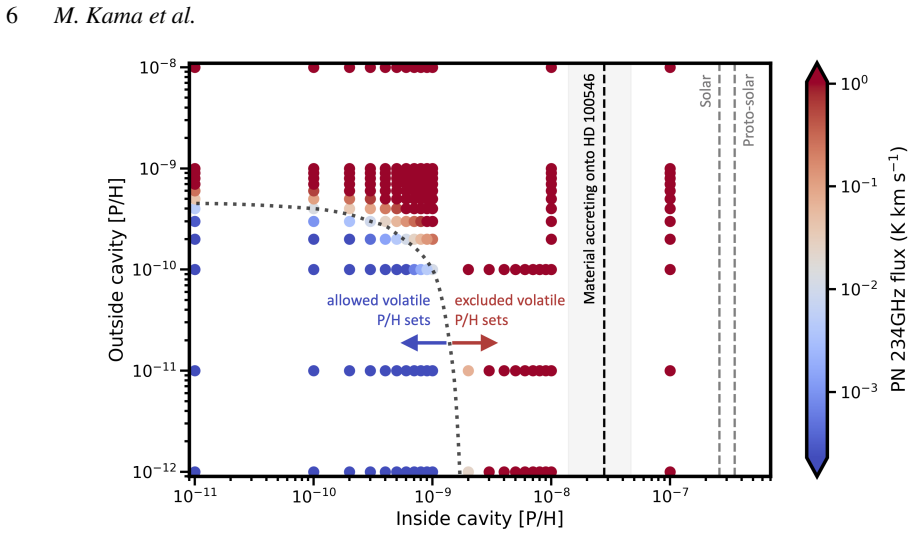
On its own terms, the discovery is that phosphorus in the HD 100546 disk is strongly depleted from gas into dust. The gas-phase elemental abundance inside the main dust trap is at least a factor of 129 below the solar reference, outside it at least a factor of 513 below, and the total gas-plus-dust inventory crossing into the accretion stream is depleted by a factor of about 8. Because roughly 90 percent of the refractory element mass is held back by the dust trap while volatile carriers like water ice pass through, the phosphorus carrier must remain solid at temperatures up to roughly 180 K rather than being a volatile ice such as PO, PN, or $\mathrm{PH_3}$. The preferred solid reservoir is a mineral such as apatite or schreibersite; ammonium phosphate remains a candidate but would require a special formation mechanism to avoid depleting nitrogen on the star.
Load-bearing premise
The load-bearing premise is that the phosphorus-to-hydrogen ratio measured on the star's surface equals the total phosphorus-to-hydrogen ratio of the gas and dust that cross the 22 au dust trap and fall onto the star, which requires a roughly 98 percent mixing fraction for freshly accreted material and no chemical sorting between gas and dust during accretion.
Editorial extensions
If this is right
- Giant planets forming inside and outside the 22 au dust trap will accrete very different phosphorus inventories: the inner planet candidate receives dust-poor, low-phosphorus gas, while the outer planet can gather more of the refractory reservoir.
- The P/H ratio in a giant planet's envelope becomes a tracer of its refractory-element accretion history, comparable to or better than sulfur, because almost all phosphorus is delivered in solids.
- Chemical habitability arguments should treat phosphorus as a primarily solid-delivered element in transitional disks, so exoplanet-atmosphere phosphorus detections must be interpreted against a refractory delivery pathway.
- The same comparison between a stellar photospheric abundance and disk gas-phase upper limits can map the volatile-versus-refractory budget of other elements in other transitional disks.
Reading between the lines
- Editorial extension: if the stellar mixing fraction is close to the assumed 98 percent, a survey of Herbig Ae/Be stars with dust traps should find broadly similar phosphorus behaviour, which would turn this single-object result into a general property of transitional disks.
- Editorial extension: the current non-detections leave room for a phosphorus carrier that the chemical network does not include; a targeted search for HCP or $\mathrm{PH_3}$ lines at the same sensitivity would distinguish apatite or schreibersite carriers from an unmodelled volatile reservoir.
- Editorial extension: simultaneous abundance measurements of calcium, iron, and phosphorus in the accreting photosphere could test whether phosphorus rides on the same refractory grains as these metals, and whether the inferred 90 percent grain-trapping efficiency is consistent across elements.
Signed reviews
Editorial analysis
A structured set of objections, weighed in public.
Referee Report
Summary. The paper constrains the phosphorus budget of the HD 100546 protoplanetary disk by combining a photospheric P abundance measurement from HST/STIS ultraviolet spectroscopy (log(P/H)_star = -7.50(+0.23/-0.28)) with APEX sub-millimetre non-detections of PO and PN rotational lines, modeled with the DALI thermochemical code to obtain gas-phase upper limits of (P/H)_in < 2e-9 inside the 22 au dust cavity and (P/H)_out < 5e-10 outside. Interpreting the stellar abundance as the total gas-plus-dust P/H of the accretion stream via the stellar mixing fraction f_acc = 98%, they conclude that phosphorus in the disk is predominantly locked in refractory solids, consistent with apatite/schreibersite, and discuss implications for the two protoplanet candidates and for chemical habitability.
Significance. This would be the first empirical determination of the volatile-versus-refractory partitioning of phosphorus in a planet-forming disk, a quantity relevant to planet formation, atmospheric chemistry, and prebiotic potential. The study uses two independent datasets and an established accretion-contamination method, and the stellar depletion factor (~8) is consistent with the depletion of other refractory elements. The paper also makes falsifiable predictions for future JWST/Ariel observations. The principal caveats are the dependence of the conclusions on a single stellar-mixing model and on the completeness of the disk phosphorus chemical network, in particular the unmodeled HCP line.
major comments (2)
- [§4.2 / Table 2] The observed HCP J=6-5 transition is listed in Table 2 with a 3-sigma upper limit of 26.4 mK km/s, but the text states that 'The HCP line was not included in the modelling.' Since Section 1 identifies HCP as one of the three dominant gas-phase P carriers in the interstellar medium, the gas-phase P/H upper limits derived solely from PO and PN (P/H_in < 2e-9, P/H_out < 5e-10) are not total gas-phase phosphorus limits unless HCP is explicitly shown to be negligible. The authors should either incorporate HCP into the DALI network and model its line, or provide a quantitative argument, for example based on photodissociation rates or chemical network predictions for protoplanetary disks, that HCP carries a negligible fraction of gas-phase P. Without this, the central claim in Conclusions (iii) that phosphorus is 'strongly depleted from the gas into a refractory reservoir' is not fully supported.
- [§4 (stellar mixing fraction)] The identification of the measured photospheric abundance log(P/H)_star = -7.50 with the total P/H of the inner-disk accretion stream relies on the mixing fraction f_acc = 98% from Jermyn & Kama (2022). This is a model-dependent quantity, and if f_acc were substantially lower, the stellar abundance would not trace the inner-disk P inventory, weakening the inferred factor ~8 total-P depletion and the contrast with the gas-phase limits. The authors should include a sensitivity test or an explicit error budget for f_acc, or cite independent validation of this mixing fraction, to make the central interpretation robust.
minor comments (8)
- [§5.1] The text says the gas-phase chemistry was 'probed by our ALMA observations,' but the observations were taken with APEX; please correct the instrument name.
- [References] The entries Jenkins 2009a and Jenkins 2009b refer to the same publication (ApJ 700, 1299) and should be merged or distinguished consistently.
- [§3.2 / Table 2] The text states that the 234 GHz setting covers PO and HCP lines and the 242 GHz setting covers PN, but the observed PN line is at 234.936 GHz while the PO and HCP lines are near 240 GHz; the assignment of lines to local oscillator settings appears reversed.
- [Table A1] Section 4.2 states that the disk extends to R_out = 500 au, while Table A1 lists R_out = 1000 au; please resolve this inconsistency.
- [§5.2] The sentence 'The conclusion from above that most, or all, elemental P is locked in refractory solids.' is a sentence fragment and should be rephrased.
- [Figure 5 caption] There is a typo, 'phoshporous,' in the caption; it should be 'phosphorus.'
- [Abstract / throughout] The word 'phosphorous' is used in several places (e.g., abstract, Figure 5 caption); the correct spelling for the element is 'phosphorus.'
- [§4.2] The phrase 'constant volatile P/H ratio' could be misunderstood; consider using 'constant gas-phase elemental P/H ratio' to avoid confusion between volatility and gas phase.
Circularity Check
No circular derivation found: the stellar P/H and disk gas upper limits are forward-modeled measurements; self-cited mixing and disk models are assumptions, not inputs that define the result.
full rationale
The central claim that phosphorus is refractory in HD 100546 rests on two independently derived constraints. The photospheric abundance log(P/H)_star=-7.50 is obtained from chi-square fitting of HST/STIS P II/P I lines with gf values calibrated on Vega; it is not defined in terms of the disk refractory fraction. The inner and outer disk gas limits, (P/H)_in<2e-9 and (P/H)_out<5e-10, are forward-model upper limits from a DALI grid over volatile P/H compared with APEX 3-sigma non-detections of PO and PN; they are not fitted parameters renamed as predictions. The interpretation that P/H_star traces the total gas plus dust P inventory of the inner disk relies on the accretion-mixing fraction f_acc=98% from Jermyn & Kama (2022), a self-cited published stellar mixing calculation. That step is load-bearing and model-dependent, but it is not circular: no equation in this paper reduces the refractory conclusion to that f_acc by construction, and the prior result is an external, parameterized calculation with stated assumptions that do not include the target P reservoir. The paper explicitly notes 'The HCP line was not included in the modelling' (Table 2 note), an acknowledged completeness limitation for the gas-phase tracer, but this is a correctness risk rather than a circular step. The self-citations to Kama et al. (2015, 2016, 2019) and Keyte et al. (2023, 2024) import the disk structure and the accretion-contamination method, but these are prior published results whose assumptions do not include the conclusion about phosphorus. Score 2 reflects moderate reliance on self-cited prior models, with no circular step identified.
Assumptions & free parameters
free parameters (2)
- log(gf) of P II 1543.133 Å line =
-2.224
- log(gf) of P II 1535.9225 Å line =
-1.470
assumptions (5)
- domain assumption The stellar mixing model of Jermyn & Kama (2022) yields f_acc = 98% for HD 100546, so the photospheric composition is nearly entirely accreted disk material.
- domain assumption The DALI disk physical structure for HD 100546 (Bruderer et al. 2012; Kama et al. 2016; Keyte et al. 2023, 2024) correctly describes the temperature, density, and dust distribution needed to convert non-detections into P/H upper limits.
- domain assumption All phosphorus-bearing species in the chemical network have binding energy E_B = 5770 K (T_sub ~ 125 K), following Piacentino & Öberg (2022).
- domain assumption The Vega-calibrated oscillator strengths for the P lines are transferable to HD 100546.
- domain assumption Photospheric abundances are derived under LTE with ATLAS9 model atmospheres and the adopted stellar parameters from Kama et al. (2016).
Cite this review
Pith. "Pith review of Refractory phosphorus in the HD 100546 protoplanetary disk." pith.science (2026). https://pith.science/paper/DYA7DIQK
@misc{pith2026250414228,
  author       = {Pith},
  title        = {Pith review of: Refractory phosphorus in the HD 100546 protoplanetary disk},
  year         = {2026},
  howpublished = {\url{https://pith.science/paper/DYA7DIQK}},
  note         = {Machine review of arXiv:2504.14228}
}
abstract
The phosphorus budget of planets is intertwined with their formation history and is thought to influence their habitability. The chemical reservoirs and volatile \emph{vs} refractory budget of phosphorus in planet-forming environments have so far eluded empirical characterisation. We employ high-resolution spectra from HST/STIS in the ultraviolet and APEX in the sub-mm to constrain the phosphorus budget in the well-characterized HD\,100546 star and protoplanetary disk system. We measure $\log{(P/H)_{\star}}=-7.50^{+0.23}_{-0.28}$ on the stellar surface, which traces the total inventory of P in accreting gas \emph{and }dust from the inner disk. The inner disk gas, inside of the main dust trap, has $\log{(P/H)_{\rm in}}\lesssim-8.70$, and the outer disk gas $\log{(P/H)_{\rm out}}\lesssim-9.30$. Phosphorus in the disk is carried by a relatively refractory reservoir, consistent with minerals such as apatite or schreibersite, or with ammonium phosphate salts, in terms of sublimation temperature. We discuss the impact this might have on the two protoplanets around HD\,100546. Our results contribute to our understanding of the chemical habitability of planetary systems and lay a foundation for future explorations, especially in the context of JWST and \emph{Ariel} which can study phosphorus in exoplanet atmospheres.
Figures


Figures from the paper (3 more)


Forward citations
Cited by 1 Pith paper
-
Unraveling the non-equilibrium chemistry of the temperate sub-Neptune K2-18 b
A grid of non-equilibrium chemical models fit to JWST spectra of K2-18 b favors high metallicity (266x solar) and C/O > 2.1, with methane robustly detected.
Reference graph
Works this paper leans on
-
[1]
write newline
" write newline "" before.all 'output.state := FUNCTION fin.entry write newline FUNCTION new.block output.state before.all = 'skip after.block 'output.state := if FUNCTION new.sentence output.state after.block = 'skip output.state before.all = 'skip after.sentence 'output.state := if if FUNCTION not #0 #1 if FUNCTION and 'skip pop #0 if FUNCTION or pop #1...
-
[2]
G., McIntosh B
Adams N. G., McIntosh B. J., Smith D., 1990, , https://ui.adsabs.harvard.edu/abs/1990A&A...232..443A 232, 443
1990
-
[3]
Ag \'u ndez M., Cernicharo J., Gu \'e lin M., 2007, @doi [ ] 10.1086/519561 , https://ui.adsabs.harvard.edu/abs/2007ApJ...662L..91A 662, L91
doi:10.1086/519561 2007
-
[4]
Ag \'u ndez M., Cernicharo J., Pardo J. R., Gu \'e lin M., Phillips T. G., 2008, @doi [ ] 10.1051/0004-6361:200810193 , https://ui.adsabs.harvard.edu/abs/2008A&A...485L..33A 485, L33
-
[5]
Ag \'u ndez M., Cernicharo J., Decin L., Encrenaz P., Teyssier D., 2014, @doi [ ] 10.1088/2041-8205/790/2/L27 , https://ui.adsabs.harvard.edu/abs/2014ApJ...790L..27A 790, L27
-
[6]
Altwegg K., et al., 2020, @doi [Nature Astronomy] 10.1038/s41550-019-0991-9 , https://ui.adsabs.harvard.edu/abs/2020NatAs...4..533A 4, 533
-
[7]
Altwegg K., et al., 2022, @doi [ ] 10.1093/mnras/stac2440 , https://ui.adsabs.harvard.edu/abs/2022MNRAS.516.3900A 516, 3900
-
[8]
Aota T., Aikawa Y., 2012, @doi [ ] 10.1088/0004-637X/761/1/74 , https://ui.adsabs.harvard.edu/abs/2012ApJ...761...74A 761, 74
Show all 103 references
-
[9]
J., Scott P., 2009, @doi [ ] 10.1146/annurev.astro.46.060407.145222 , https://ui.adsabs.harvard.edu/abs/2009ARA&A..47..481A 47, 481
Asplund M., Grevesse N., Sauval A. J., Scott P., 2009, @doi [ ] 10.1146/annurev.astro.46.060407.145222 , https://ui.adsabs.harvard.edu/abs/2009ARA&A..47..481A 47, 481
2009
-
[10]
M., Grevesse N., 2021, @doi [ ] 10.1051/0004-6361/202140445 , https://ui.adsabs.harvard.edu/abs/2021A&A...653A.141A 653, A141
Asplund M., Amarsi A. M., Grevesse N., 2021, @doi [ ] 10.1051/0004-6361/202140445 , https://ui.adsabs.harvard.edu/abs/2021A&A...653A.141A 653, A141
2021 doi
-
[11]
Bains W., et al., 2021, Astrobiology, 21, 1277
2021
-
[12]
R., 2010, @doi [ ] 10.1051/0004-6361/200913590 , https://ui.adsabs.harvard.edu/abs/2010A&A...511A..75B 511, A75
Benisty M., Tatulli E., M \'e nard F., Swain M. R., 2010, @doi [ ] 10.1051/0004-6361/200913590 , https://ui.adsabs.harvard.edu/abs/2010A&A...511A..75B 511, A75
2010 doi
-
[13]
B., \"O berg K
Bergner J. B., \"O berg K. I., Walker S., Guzm \'a n V. V., Rice T. S., Bergin E. A., 2019, @doi [ ] 10.3847/2041-8213/ab48f9 , https://ui.adsabs.harvard.edu/abs/2019ApJ...884L..36B 884, L36
2019 doi
-
[14]
B., Burkhardt A
Bergner J. B., Burkhardt A. M., \"O berg K. I., Rice T. S., Bergin E. A., 2022, @doi [ ] 10.3847/1538-4357/ac47a2 , https://ui.adsabs.harvard.edu/abs/2022ApJ...927....7B 927, 7
2022 doi
-
[15]
J., Koelemay L
Bernal J. J., Koelemay L. A., Ziurys L. M., 2021, @doi [ ] 10.3847/1538-4357/abc87b , https://ui.adsabs.harvard.edu/abs/2021ApJ...906...55B 906, 55
2021 doi
-
[16]
S., Walsh C., Terwisscha van Scheltinga J., van Dishoeck E
Booth A. S., Walsh C., Terwisscha van Scheltinga J., van Dishoeck E. F., Ilee J. D., Hogerheijde M. R., Kama M., Nomura H., 2021, @doi [Nature Astronomy] 10.1038/s41550-021-01352-w , https://ui.adsabs.harvard.edu/abs/2021NatAs...5..684B 5, 684
2021 doi
-
[17]
S., et al., 2024, @doi [ ] 10.3847/1538-3881/ad2700 , https://ui.adsabs.harvard.edu/abs/2024AJ....167..164B 167, 164
Booth A. S., et al., 2024, @doi [ ] 10.3847/1538-3881/ad2700 , https://ui.adsabs.harvard.edu/abs/2024AJ....167..164B 167, 164
2024 doi
-
[18]
Broome M., Kama M., Booth R., Shorttle O., 2023, Monthly Notices of the Royal Astronomical Society, 522, 3378
2023
-
[19]
Bruderer S., 2013, @doi [ ] 10.1051/0004-6361/201321171 , https://ui.adsabs.harvard.edu/abs/2013A&A...559A..46B 559, A46
2013 doi
-
[20]
F., Doty S
Bruderer S., van Dishoeck E. F., Doty S. D., Herczeg G. J., 2012, @doi [ ] 10.1051/0004-6361/201118218 , http://adsabs.harvard.edu/abs/2012A
2012 doi
- [21]
-
[22]
M., Vasyunin A., Redaelli E., Bizzocchi L., Fontani F., Caselli P., 2020, Astronomy & Astrophysics, 633, A54
Chantzos J., Rivilla V. M., Vasyunin A., Redaelli E., Bizzocchi L., Fontani F., Caselli P., 2020, Astronomy & Astrophysics, 633, A54
2020
-
[23]
Chen K., Kama M., Pinilla P., Keyte L., 2024, @doi [ ] 10.1093/mnras/stad3247 , https://ui.adsabs.harvard.edu/abs/2024MNRAS.527.2049C 527, 2049
2024 doi
-
[24]
A., Young K
De Beck E., Kami \'n ski T., Patel N. A., Young K. H., Gottlieb C. A., Menten K. M., Decin L., 2013, @doi [ ] 10.1051/0004-6361/201321349 , https://ui.adsabs.harvard.edu/abs/2013A&A...558A.132D 558, A132
2013 doi
-
[25]
R., Oudmaijer R
Fairlamb J. R., Oudmaijer R. D., Mendigut \' a I., Ilee J. D., van den Ancker M. E., 2015, @doi [ ] 10.1093/mnras/stv1576 , https://ui.adsabs.harvard.edu/abs/2015MNRAS.453..976F 453, 976
2015 doi
-
[26]
J., Lewis J
Fegley B. J., Lewis J. S., 1980, @doi [ ] 10.1016/0019-1035(80)90228-6 , https://ui.adsabs.harvard.edu/abs/1980Icar...41..439F 41, 439
1980 doi
-
[27]
Fern \'a ndez-Ruz M., Jim \'e nez-Serra I., Aguirre J., 2023, @doi [ ] 10.3847/1538-4357/acf290 , https://ui.adsabs.harvard.edu/abs/2023ApJ...956...47F 956, 47
2023 doi
-
[28]
L., 2010, @doi [The Astrophysical Journal] 10.1088/0004-637X/725/2/2401 , 725, 2401
Fitzpatrick E. L., 2010, @doi [The Astrophysical Journal] 10.1088/0004-637X/725/2/2401 , 725, 2401
2010 doi
-
[29]
P., Bagnulo S., Wade G
Folsom C. P., Bagnulo S., Wade G. A., Alecian E., Landstreet J. D., Marsden S. C., Waite I. A., 2012, @doi [ ] 10.1111/j.1365-2966.2012.20718.x , https://ui.adsabs.harvard.edu/abs/2012MNRAS.422.2072F 422, 2072
2012
-
[30]
M., Caselli P., Vasyunin A., Palau A., 2016, @doi [ ] 10.3847/2041-8205/822/2/L30 , https://ui.adsabs.harvard.edu/abs/2016ApJ...822L..30F 822, L30
Fontani F., Rivilla V. M., Caselli P., Vasyunin A., Palau A., 2016, @doi [ ] 10.3847/2041-8205/822/2/L30 , https://ui.adsabs.harvard.edu/abs/2016ApJ...822L..30F 822, L30
2016 doi
-
[31]
Fontani F., et al., 2024, @doi [ ] 10.1051/0004-6361/202348219 , https://ui.adsabs.harvard.edu/abs/2024A&A...682A..74F 682, A74
2024 doi
-
[32]
Gardner E., et al., 2020, @doi [ ] 10.1093/mnras/staa2950 , https://ui.adsabs.harvard.edu/abs/2020MNRAS.499.1870G 499, 1870
2020 doi
-
[33]
T., Widicus Weaver S
Garrod R. T., Widicus Weaver S. L., 2013, @doi [Chemical Reviews] 10.1021/cr400147g , https://ui.adsabs.harvard.edu/abs/2013ChRv..113.8939G 113, 8939
2013 doi
-
[34]
S., et al., 2021, Nature Astronomy, 5, 655
Greaves J. S., et al., 2021, Nature Astronomy, 5, 655
2021
-
[35]
D., Villaver E., 2023, @doi [ ] 10.1051/0004-6361/202245427 , https://ui.adsabs.harvard.edu/abs/2023A&A...671A.140G 671, A140
Guzm \'a n-D \' az J., Montesinos B., Mendigut \' a I., Kama M., Meeus G., Vioque M., Oudmaijer R. D., Villaver E., 2023, @doi [ ] 10.1051/0004-6361/202245427 , https://ui.adsabs.harvard.edu/abs/2023A&A...671A.140G 671, A140
2023 doi
-
[36]
B., 2009b, @doi [ ] 10.1088/0004-637X/700/2/1299 , https://ui.adsabs.harvard.edu/abs/2009ApJ...700.1299J 700, 1299
Jenkins E. B., 2009b, @doi [ ] 10.1088/0004-637X/700/2/1299 , https://ui.adsabs.harvard.edu/abs/2009ApJ...700.1299J 700, 1299
-
[37]
B., 2009a, The Astrophysical Journal, 700, 1299
Jenkins E. B., 2009a, The Astrophysical Journal, 700, 1299
-
[38]
S., Kama M., 2018, @doi [ ] 10.1093/mnras/sty429 , https://ui.adsabs.harvard.edu/abs/2018MNRAS.476.4418J 476, 4418
Jermyn A. S., Kama M., 2018, @doi [ ] 10.1093/mnras/sty429 , https://ui.adsabs.harvard.edu/abs/2018MNRAS.476.4418J 476, 4418
2018 doi
-
[39]
S., Kama M., 2022, @doi [Research Notes of the American Astronomical Society] 10.3847/2515-5172/ac79b9 , https://ui.adsabs.harvard.edu/abs/2022RNAAS...6..131J 6, 131
Jermyn A. S., Kama M., 2022, @doi [Research Notes of the American Astronomical Society] 10.3847/2515-5172/ac79b9 , https://ui.adsabs.harvard.edu/abs/2022RNAAS...6..131J 6, 131
2022 doi
-
[40]
Jim \'e nez-Serra I., Viti S., Qu \'e nard D., Holdship J., 2018, @doi [ ] 10.3847/1538-4357/aacdf2 , https://ui.adsabs.harvard.edu/abs/2018ApJ...862..128J 862, 128
2018 doi
-
[41]
P., Pinilla P., 2015, @doi [ ] 10.1051/0004-6361/201527094 , http://adsabs.harvard.edu/abs/2015A
Kama M., Folsom C. P., Pinilla P., 2015, @doi [ ] 10.1051/0004-6361/201527094 , http://adsabs.harvard.edu/abs/2015A
2015 doi
-
[42]
Kama M., et al., 2016, @doi [ ] 10.1051/0004-6361/201526991 , http://adsabs.harvard.edu/abs/2016A
2016 doi
-
[43]
S., Folsom C
Kama M., Shorttle O., Jermyn A. S., Folsom C. P., Furuya K., Bergin E. A., Walsh C., Keller L., 2019, @doi [ ] 10.3847/1538-4357/ab45f8 , https://ui.adsabs.harvard.edu/abs/2019ApJ...885..114K 885, 114
2019 doi
-
[44]
Keyte L., et al., 2023, @doi [Nature Astronomy] 10.1038/s41550-023-01951-9 , https://ui.adsabs.harvard.edu/abs/2023NatAs...7..684K 7, 684
2023 doi
-
[45]
I., Drozdovskaya M
Keyte L., Kama M., Chuang K.-J., Cleeves L. I., Drozdovskaya M. N., Furuya K., Rawlings J., Shorttle O., 2024, @doi [ ] 10.1093/mnras/stae019 , https://ui.adsabs.harvard.edu/abs/2024MNRAS.528..388K 528, 388
2024 doi
-
[46]
A., Shorttle O., Walsh K
Krijt S., Kama M., McClure M., Teske J., Bergin E. A., Shorttle O., Walsh K. J., Raymond S. N., 2023, in Inutsuka S., Aikawa Y., Muto T., Tomida K., Tamura M., eds, Astronomical Society of the Pacific Conference Series Vol. 534, Astronomical Society of the Pacific Conference S...
2023
-
[47]
A., Stempels H
Kupka F., Piskunov N., Ryabchikova T. A., Stempels H. C., Weiss W. W., 1999, @doi [ ] 10.1051/aas:1999267 , https://ui.adsabs.harvard.edu/abs/1999A&AS..138..119K 138, 119
1999 doi
-
[48]
G., Ryabchikova T
Kupka F. G., Ryabchikova T. A., Piskunov N. E., Stempels H. C., Weiss W. W., 2000, @doi [Baltic Astronomy] 10.1515/astro-2000-0420 , https://ui.adsabs.harvard.edu/abs/2000BaltA...9..590K 9, 590
2000 doi
-
[49]
Kurucz CD-ROM No
Kurucz R., 1993, ATLAS9 Stellar Atmosphere Programs and 2 km/s grid. Kurucz CD-ROM No. 13. Cambridge, https://ui.adsabs.harvard.edu/abs/1993KurCD..13.....K 13
1993
-
[50]
L., 2012, Robert L
Kurucz R. L., 2012, Robert L. Kurucz on-line database of observed and predicted atomic transitions
2012
-
[51]
L., Peytremann E., 1975, SAO Special Report, http://cdsads.u-strasbg.fr/abs/1975SAOSR.362.....K 362, 1
Kurucz R. L., Peytremann E., 1975, SAO Special Report, http://cdsads.u-strasbg.fr/abs/1975SAOSR.362.....K 362, 1
1975
-
[52]
D., 1988, @doi [ ] 10.1086/166155 , https://ui.adsabs.harvard.edu/abs/1988ApJ...326..967L 326, 967
Landstreet J. D., 1988, @doi [ ] 10.1086/166155 , https://ui.adsabs.harvard.edu/abs/1988ApJ...326..967L 326, 967
1988 doi
-
[53]
D., 2011, @doi [ ] 10.1051/0004-6361/201016259 , https://ui.adsabs.harvard.edu/abs/2011A&A...528A.132L 528, A132
Landstreet J. D., 2011, @doi [ ] 10.1051/0004-6361/201016259 , https://ui.adsabs.harvard.edu/abs/2011A&A...528A.132L 528, A132
2011 doi
-
[54]
S., et al., 2024, @doi [Meteoritics and Planetary Science] 10.1111/maps.14227 , https://ui.adsabs.harvard.edu/abs/2024M&PS...59.2453L 59, 2453
Lauretta D. S., et al., 2024, @doi [Meteoritics and Planetary Science] 10.1111/maps.14227 , https://ui.adsabs.harvard.edu/abs/2024M&PS...59.2453L 59, 2453
2024 doi
-
[55]
Lefloch B., et al., 2016, @doi [ ] 10.1093/mnras/stw1918 , https://ui.adsabs.harvard.edu/abs/2016MNRAS.462.3937L 462, 3937
2016 doi
-
[56]
P., et al., 2021, The Astrophysical Journal Letters, 908, L44
Lincowski A. P., et al., 2021, The Astrophysical Journal Letters, 908, L44
2021
-
[57]
Lique F., Jim \'e nez-Serra I., Viti S., Marinakis S., 2018, @doi [Physical Chemistry Chemical Physics (Incorporating Faraday Transactions)] 10.1039/C7CP05605B , https://ui.adsabs.harvard.edu/abs/2018PCCP...20.5407L 20, 5407
2018 doi
-
[58]
Lodders K., 2003, @doi [ ] 10.1086/375492 , https://ui.adsabs.harvard.edu/abs/2003ApJ...591.1220L 591, 1220
2003 doi
-
[59]
MacKay D. D. S., Charnley S. B., 2001, @doi [ ] 10.1046/j.1365-8711.2001.04429.x , https://ui.adsabs.harvard.edu/abs/2001MNRAS.325..545M 325, 545
2001
-
[60]
N., Halfen D
Milam S. N., Halfen D. T., Tenenbaum E. D., Apponi A. J., Woolf N. J., Ziurys L. M., 2008, @doi [ ] 10.1086/589135 , https://ui.adsabs.harvard.edu/abs/2008ApJ...684..618M 684, 618
2008 doi
-
[61]
J., 1991, , https://ui.adsabs.harvard.edu/abs/1991A&A...242..241M 242, 241
Millar T. J., 1991, , https://ui.adsabs.harvard.edu/abs/1991A&A...242..241M 242, 241
1991
-
[62]
J., Bennett A., Herbst E., 1987, @doi [ ] 10.1093/mnras/229.1.41P , https://ui.adsabs.harvard.edu/abs/1987MNRAS.229P..41M 229, 41P
Millar T. J., Bennett A., Herbst E., 1987, @doi [ ] 10.1093/mnras/229.1.41P , https://ui.adsabs.harvard.edu/abs/1987MNRAS.229P..41M 229, 41P
1987 doi
-
[63]
M., Beltr \'a n M
Mininni C., Fontani F., Rivilla V. M., Beltr \'a n M. T., Caselli P., Vasyunin A., 2018, @doi [ ] 10.1093/mnrasl/sly026 , https://ui.adsabs.harvard.edu/abs/2018MNRAS.476L..39M 476, L39
2018 doi
-
[64]
K., 2006, @doi [ ] 10.1016/j.gca.2006.08.007 , https://ui.adsabs.harvard.edu/abs/2006GeCoA..70.5371M 70, 5371
Morlok A., Bischoff A., Stephan T., Floss C., Zinner E., Jessberger E. K., 2006, @doi [ ] 10.1016/j.gca.2006.08.007 , https://ui.adsabs.harvard.edu/abs/2006GeCoA..70.5371M 70, 5371
2006 doi
-
[65]
I., Wordsworth R., 2019, @doi [ ] 10.3847/1538-3881/ab46a8 , https://ui.adsabs.harvard.edu/abs/2019AJ....158..194O 158, 194
\"O berg K. I., Wordsworth R., 2019, @doi [ ] 10.3847/1538-3881/ab46a8 , https://ui.adsabs.harvard.edu/abs/2019AJ....158..194O 158, 194
2019 doi
-
[66]
Pani \'c O., Min M., 2017, @doi [ ] 10.1093/mnras/stx114 , https://ui.adsabs.harvard.edu/abs/2017MNRAS.467.1175P 467, 1175
2017 doi
-
[67]
F., Hogerheijde M
Pani \'c O., van Dishoeck E. F., Hogerheijde M. R., Belloche A., G \"u sten R., Boland W., Baryshev A., 2010, @doi [ ] 10.1051/0004-6361/200913709 , https://ui.adsabs.harvard.edu/abs/2010A&A...519A.110P 519, A110
2010 doi
-
[68]
A., 2019, Icarus, 317, 59
Pasek M. A., 2019, Icarus, 317, 59
2019
-
[69]
Pasek M., Lauretta D., 2008, @doi [Origins of Life and Evolution of the Biosphere] 10.1007/s11084-007-9110-5 , https://ui.adsabs.harvard.edu/abs/2008OLEB...38....5P 38, 5
2008 doi
-
[70]
A., Dworkin J
Pasek M. A., Dworkin J. P., Lauretta D. S., 2007, Geochimica et Cosmochimica Acta, 71, 1721
2007
-
[71]
H., Percivalle C., Ritson D
Patel B. H., Percivalle C., Ritson D. J., Duffy C. D., Sutherland J. D., 2015, Nature chemistry, 7, 301
2015
-
[72]
L., \"O berg K
Piacentino E. L., \"O berg K. I., 2022, @doi [ ] 10.3847/1538-4357/ac96e2 , https://ui.adsabs.harvard.edu/abs/2022ApJ...939...93P 939, 93
2022 doi
-
[73]
J., 1998, @doi [ ] 10.1086/316197 , https://ui.adsabs.harvard.edu/abs/1998PASP..110..863P 110, 863
Pickles A. J., 1998, @doi [ ] 10.1086/316197 , https://ui.adsabs.harvard.edu/abs/1998PASP..110..863P 110, 863
1998 doi
-
[74]
Pilorget C., et al., 2024, @doi [Nature Astronomy] 10.1038/s41550-024-02366-w , https://ui.adsabs.harvard.edu/abs/2024NatAs...8.1529P 8, 1529
2024 doi
-
[75]
Pinilla P., Birnstiel T., Walsh C., 2015, @doi [ ] 10.1051/0004-6361/201425539 , https://ui.adsabs.harvard.edu/abs/2015A&A...580A.105P 580, A105
2015 doi
-
[76]
A., Sokolov D
Pirim C., Pasek M. A., Sokolov D. A., Sidorov A. N., Gann R. D., Orlando T. M., 2014, @doi [ ] 10.1016/j.gca.2014.05.027 , https://ui.adsabs.harvard.edu/abs/2014GeCoA.140..259P 140, 259
2014 doi
-
[77]
E., Kupka F., Ryabchikova T
Piskunov N. E., Kupka F., Ryabchikova T. A., Weiss W. W., Jeffery C. S., 1995, , https://ui.adsabs.harvard.edu/abs/1995A&AS..112..525P 112, 525
1995
-
[78]
Poch O., et al., 2020, @doi [Science] 10.1126/science.aaw7462 , https://ui.adsabs.harvard.edu/abs/2020Sci...367.7462P 367, aaw7462
2020 doi
-
[79]
A., Delage T
Pyerin M. A., Delage T. N., Kurtovic N. T., G \'a rate M., Henning T., Pinilla P., 2021, @doi [ ] 10.1051/0004-6361/202141998 , https://ui.adsabs.harvard.edu/abs/2021A&A...656A.150P 656, A150
2021 doi
-
[80]
P., Amara A., Meyer M
Quanz S. P., Amara A., Meyer M. R., Kenworthy M. A., Kasper M., Girard J. H., 2013, @doi [ ] 10.1088/2041-8205/766/1/L1 , https://ui.adsabs.harvard.edu/abs/2013ApJ...766L...1Q 766, L1
2013 doi
-
[81]
M., Fontani F., Beltr \'a n M
Rivilla V. M., Fontani F., Beltr \'a n M. T., Vasyunin A., Caselli P., Mart \' n-Pintado J., Cesaroni R., 2016, @doi [ ] 10.3847/0004-637X/826/2/161 , https://ui.adsabs.harvard.edu/abs/2016ApJ...826..161R 826, 161
2016 doi
-
[82]
M., et al., 2018, @doi [ ] 10.1093/mnrasl/slx208 , https://ui.adsabs.harvard.edu/abs/2018MNRAS.475L..30R 475, L30
Rivilla V. M., et al., 2018, @doi [ ] 10.1093/mnrasl/slx208 , https://ui.adsabs.harvard.edu/abs/2018MNRAS.475L..30R 475, L30
2018 doi
-
[83]
M., et al., 2020, @doi [ ] 10.1093/mnras/stz3336 , https://ui.adsabs.harvard.edu/abs/2020MNRAS.492.1180R 492, 1180
Rivilla V. M., et al., 2020, @doi [ ] 10.1093/mnras/stz3336 , https://ui.adsabs.harvard.edu/abs/2020MNRAS.492.1180R 492, 1180
2020 doi
-
[84]
A., Piskunov N
Ryabchikova T. A., Piskunov N. E., Kupka F., Weiss W. W., 1997, @doi [Baltic Astronomy] 10.1515/astro-1997-0216 , https://ui.adsabs.harvard.edu/abs/1997BaltA...6..244R 6, 244
1997 doi
-
[85]
L., Stempels H
Ryabchikova T., Piskunov N., Kurucz R. L., Stempels H. C., Heiter U., Pakhomov Y., Barklem P. S., 2015, @doi [ ] 10.1088/0031-8949/90/5/054005 , https://ui.adsabs.harvard.edu/abs/2015PhyS...90e4005R 90, 054005
2015 doi
-
[86]
L., van der Tak F
Sch \"o ier F. L., van der Tak F. F. S., van Dishoeck E. F., Black J. H., 2005, @doi [ ] 10.1051/0004-6361:20041729 , https://ui.adsabs.harvard.edu/abs/2005A&A...432..369S 432, 369
2005 doi
-
[87]
W., 1978, @doi [Earth and Planetary Science Letters] 10.1016/0012-821X(78)90002-X , https://ui.adsabs.harvard.edu/abs/1978E&PSL..41..128S 41, 128
Sears D. W., 1978, @doi [Earth and Planetary Science Letters] 10.1016/0012-821X(78)90002-X , https://ui.adsabs.harvard.edu/abs/1978E&PSL..41..128S 41, 128
1978 doi
-
[88]
Sil M., et al., 2021, @doi [ ] 10.3847/1538-3881/ac09f9 , https://ui.adsabs.harvard.edu/abs/2021AJ....162..119S 162, 119
2021 doi
-
[89]
J., Zhan Z., Hu R., Bains W., 2020, Astrobiology, 20, 235
Sousa-Silva C., Seager S., Ranjan S., Petkowski J. J., Zhan Z., Hu R., Bains W., 2020, Astrobiology, 20, 235
2020
-
[90]
Szul \'a gyi J., Binkert F., Surville C., 2022, @doi [ ] 10.3847/1538-4357/ac32d1 , https://ui.adsabs.harvard.edu/abs/2022ApJ...924....1S 924, 1
2022 doi
-
[91]
A., 2019, @doi [ ] 10.1038/s41586-019-1642-0 , https://ui.adsabs.harvard.edu/abs/2019Natur.574..378T 574, 378
Teague R., Bae J., Bergin E. A., 2019, @doi [ ] 10.1038/s41586-019-1642-0 , https://ui.adsabs.harvard.edu/abs/2019Natur.574..378T 574, 378
2019 doi
-
[92]
R., Anicich V
Thorne L. R., Anicich V. G., Prasad S. S., Huntress W. T. J., 1984, @doi [ ] 10.1086/161977 , https://ui.adsabs.harvard.edu/abs/1984ApJ...280..139T 280, 139
1984 doi
-
[93]
H., 2007, @doi [ ] 10.1051/0004-6361:20077339 , https://ui.adsabs.harvard.edu/abs/2007A&A...468.1123T 468, 1123
Tobo a R., K os J., Lique F., Cha asi \'n ski G., Alexander M. H., 2007, @doi [ ] 10.1051/0004-6361:20077339 , https://ui.adsabs.harvard.edu/abs/2007A&A...468.1123T 468, 1123
2007 doi
-
[94]
Turcotte S., 2002, @doi [ ] 10.1086/342054 , https://ui.adsabs.harvard.edu/abs/2002ApJ...573L.129T 573, L129
2002 doi
-
[95]
Villanueva G., et al., 2021, Nature Astronomy, 5, 631
2021
-
[96]
A., Bagnulo, S
Wade G. A., Bagnulo, S. Kochukhov, O. Landstreet, J. D. Piskunov, N. Stift, M. J. 2001, @doi [A&A] 10.1051/0004-6361:20010735 , 374, 265
2001 doi
-
[97]
Walsh C., et al., 2014, @doi [ ] 10.1088/2041-8205/791/1/L6 , https://ui.adsabs.harvard.edu/abs/2014ApJ...791L...6W 791, L6
2014 doi
-
[98]
H., 1987, Science, 235, 1173
Westheimer F. H., 1987, Science, 235, 1173
1987
-
[99]
L., Downes D., Bieging J., 1979, , https://ui.adsabs.harvard.edu/abs/1979A&A....71..275W 71, 275
Wilson T. L., Downes D., Bieging J., 1979, , https://ui.adsabs.harvard.edu/abs/1979A&A....71..275W 71, 275
1979
-
[100]
J., Millar T
Woodall J., Ag \'u ndez M., Markwick-Kemper A. J., Millar T. J., 2007, @doi [ ] 10.1051/0004-6361:20064981 , https://ui.adsabs.harvard.edu/abs/2007A&A...466.1197W 466, 1197
2007 doi
-
[101]
B., 2022, @doi [ ] 10.3847/1538-4357/ac7c0e , https://ui.adsabs.harvard.edu/abs/2022ApJ...934..153W 934, 153
Wurmser S., Bergner J. B., 2022, @doi [ ] 10.3847/1538-4357/ac7c0e , https://ui.adsabs.harvard.edu/abs/2022ApJ...934..153W 934, 153
2022 doi
-
[102]
Yamaguchi T., et al., 2011, @doi [ ] 10.1093/pasj/63.5.L37 , https://ui.adsabs.harvard.edu/abs/2011PASJ...63L..37Y 63, L37
2011 doi
-
[103]
M., 1987, @doi [ ] 10.1086/185010 , https://ui.adsabs.harvard.edu/abs/1987ApJ...321L..81Z 321, L81
Ziurys L. M., 1987, @doi [ ] 10.1086/185010 , https://ui.adsabs.harvard.edu/abs/1987ApJ...321L..81Z 321, L81
1987 doi
Reviewed August 16, 2026 · model on record in the stance chip above.
Discussion (0). Continue with ORCID to comment.