Exceptional by Design: Long-Range Hopping as a Knob for Exceptional Point Control
Pith reviewed 2026-06-25 23:28 UTC · model grok-4.3
The pith
Next-nearest-neighbor hopping shifts and generates exceptional points exclusively under open boundary conditions in a non-Hermitian Rice-Mele chain.
A machine-rendered reading of the paper's core claim, the machinery that carries it, and where it could break.
Core claim
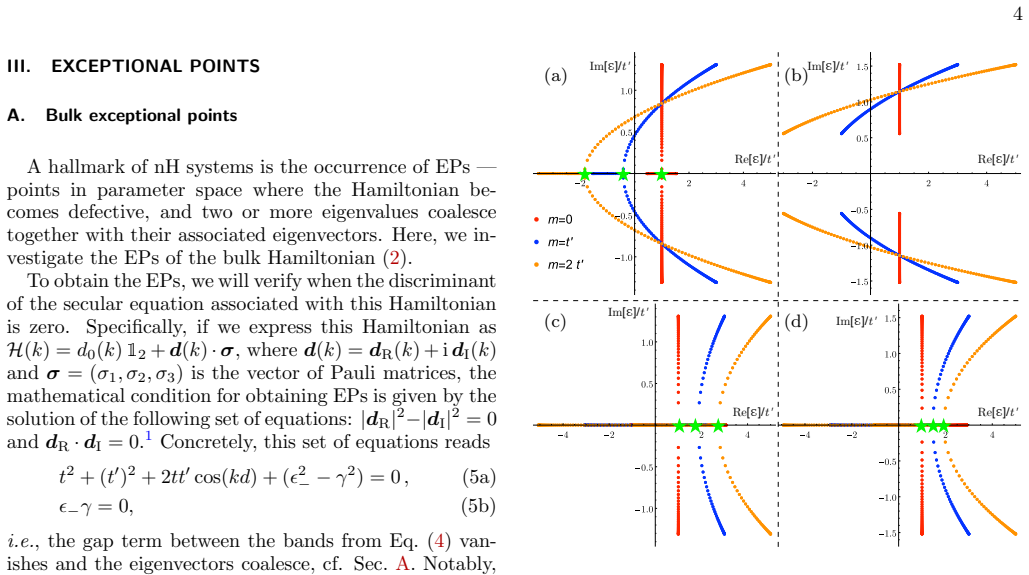
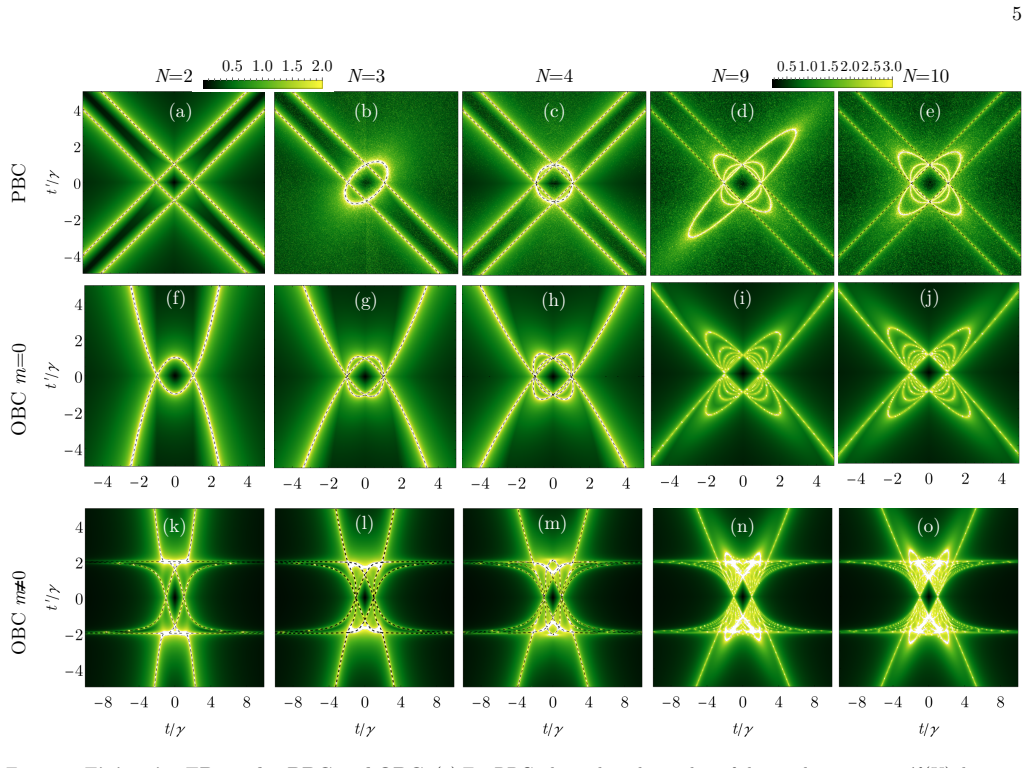
In the generalized non-Hermitian Rice-Mele chain the next-nearest-neighbor hopping leaves the exceptional-point loci invariant under periodic boundaries because it enters the bulk Hamiltonian as an identity contribution; the same term breaks this invariance under open boundaries, shifting the energies of existing points, generating new ones, and producing a signature of topological gap closing visible exclusively in the open-boundary spectrum, all while the system supports only second-order exceptional points whose locations are located by the condition number of the eigenvector matrix and confirmed via Jordan decomposition.
What carries the argument
The next-nearest-neighbor hopping term, which acts as an identity shift in the periodic-boundary bulk Hamiltonian but couples to the boundaries under open conditions to relocate and create exceptional points.
If this is right
- Exceptional-point loci form lines and ellipses independent of next-nearest-neighbor strength under periodic boundaries.
- Under open boundaries the same strength both displaces existing points and creates new ones.
- At special parameter values multiple simultaneous second-order exceptional points appear whose total degeneracy increases with chain length.
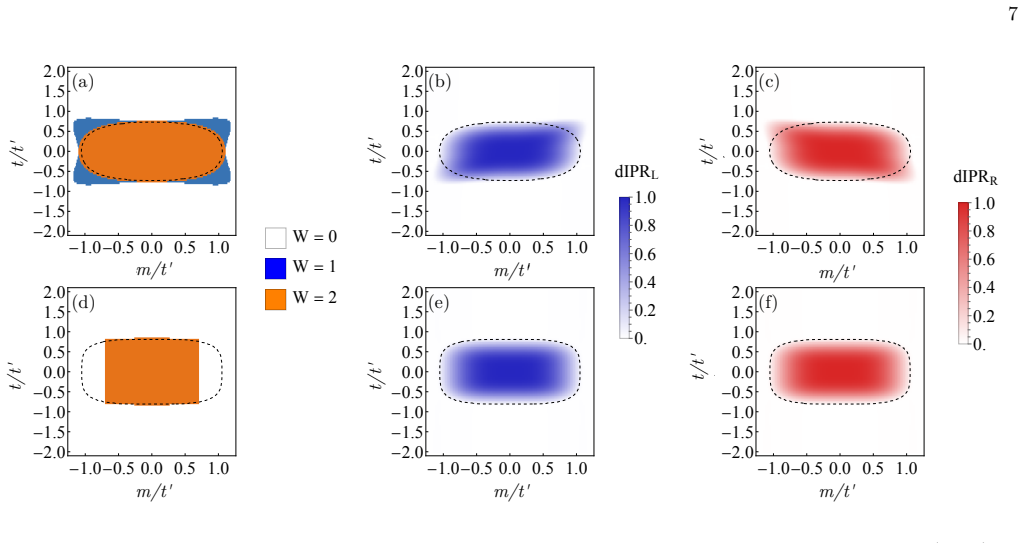
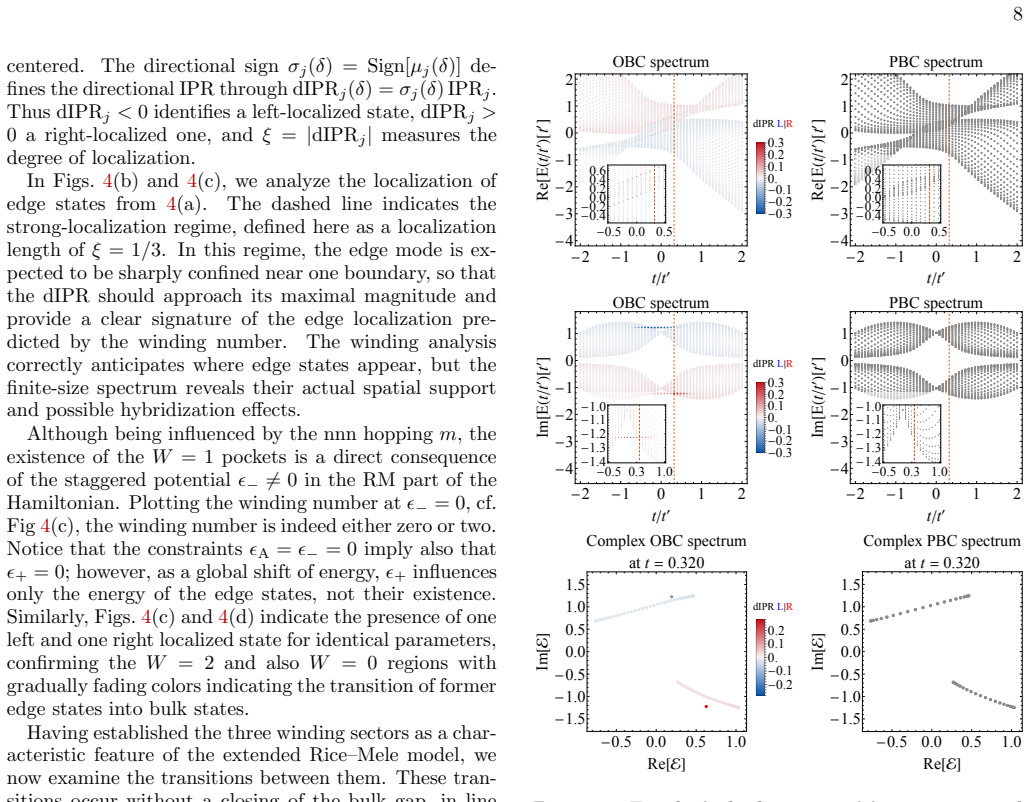
- The winding-number topological diagram divides parameter space into regions with zero, one, or two edge states that obey bulk-boundary correspondence.
- The non-Hermitian skin effect is absent throughout the model.
Where Pith is reading between the lines
- Tuning next-nearest-neighbor hopping could therefore serve as an experimental control for moving exceptional points into desired energy windows without altering the periodic bulk spectrum.
- The boundary-selective appearance of the topological gap-closing signal suggests that open-boundary spectra may expose transitions hidden from periodic-boundary diagnostics in other non-Hermitian lattices.
- The observed growth of degeneracy with system size at special points raises the question whether similar accumulations occur in higher-dimensional or disordered versions of the model.
Load-bearing premise
The numerical scan based on the condition number of the eigenvector matrix together with Jordan decomposition captures every exceptional point and correctly classifies all of them as second-order.
What would settle it
A full diagonalization of the finite open-chain Hamiltonian at a parameter point predicted to host no exceptional point that instead reveals eigenvalue coalescence, or the appearance of a point whose algebraic multiplicity exceeds two.
Figures
read the original abstract
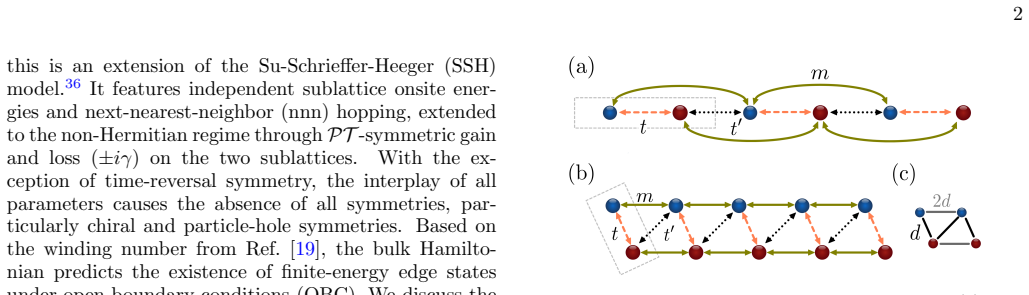
Exceptional points are degeneracies unique to non-Hermitian systems, where eigenvalues and eigenvectors coalesce, rendering the Hamiltonian defective. We investigate the exceptional-point structure and topological properties of a generalized non-Hermitian Rice-Mele model with balanced gain and loss, as well as next-nearest-neighbor hopping. The system hosts only second-order exceptional points under both periodic and open boundary conditions. Under periodic boundary conditions, the exceptional points in parameter space lie on lines and ellipses that are independent of the next-nearest-neighbor hopping, since the latter enters the bulk Hamiltonian only as an identity contribution. Under open boundary conditions, this independence is broken: the next-nearest-neighbor hopping not only shifts the energy of existing exceptional points but also generates new ones, with a specific condition signaling a topological gap closing observed only in the open-boundary spectrum. At special parameter points, multiple simultaneous second-order exceptional points yield degenerate configurations whose degeneracy grows with system size. Exceptional point locations are identified numerically via the condition number of the eigenvector matrix and confirmed by Jordan decomposition. The topological phase diagram, computed via a winding number framework for non-Hermitian systems without symmetry protection, reveals sectors with zero, one, and two edge states; the bulk-boundary correspondence is confirmed, and the non-Hermitian skin effect is absent.
Editorial analysis
A structured set of objections, weighed in public.
Referee Report
Summary. The manuscript examines a non-Hermitian Rice-Mele chain with balanced gain/loss and tunable next-nearest-neighbor (NNN) hopping. It asserts that the model supports exclusively second-order exceptional points (EPs) under both periodic (PBC) and open (OBC) boundary conditions. Under PBC the EP loci in parameter space are independent of NNN hopping (which enters the bulk Hamiltonian only as an identity shift) and lie on lines or ellipses; under OBC the NNN term both displaces existing EPs and creates additional ones, accompanied by a topological gap-closing signature visible solely in the OBC spectrum. EP locations are obtained numerically from the condition number of the right-eigenvector matrix followed by Jordan decomposition. A winding-number topological phase diagram is computed, revealing regions with zero, one or two edge states; bulk-boundary correspondence holds and the non-Hermitian skin effect is absent. At isolated parameter values multiple second-order EPs coincide, producing degeneracies whose multiplicity grows with chain length.
Significance. If the numerical EP survey is exhaustive and the winding-number classification reliable, the work supplies a concrete demonstration that long-range hopping can be used as an independent control parameter for EP positions and for the appearance of new EPs exclusively under open boundaries. The explicit separation of PBC versus OBC spectra, the confirmation of bulk-boundary correspondence without skin effect, and the observation of size-dependent degeneracy at special points are all of interest to the non-Hermitian topology community.
major comments (2)
- [Numerical identification of EPs (paragraph following abstract and methods description)] The central claim that NNN hopping both shifts existing EPs and generates new ones under OBC rests on a discrete-grid scan that flags points via the condition number of the eigenvector matrix and then applies Jordan decomposition. No section specifies the grid spacing, the numerical threshold used to declare an EP, or any convergence test with respect to system size or grid density; without these controls it is impossible to certify that every coalescence has been captured or that higher-order or accidental degeneracies have been excluded.
- [Results on OBC spectrum and degeneracy growth] The assertion that the system hosts only second-order EPs (both under PBC and OBC) is load-bearing for the topological classification and for the statement that degeneracy grows with system size at special points. The Jordan-block analysis is described only qualitatively; an explicit check that all flagged points produce exactly 2×2 blocks (rather than larger blocks when multiple EPs coincide) is not provided for the OBC case where new EPs appear.
minor comments (2)
- [Abstract and § on numerical procedure] The abstract states that EPs are identified “numerically via the condition number … and confirmed by Jordan decomposition,” yet the main text supplies neither error bars on the reported EP coordinates nor a table of representative condition-number values.
- [Topological phase diagram figures] Figure captions for the phase diagrams do not indicate the system sizes used for the winding-number calculation or whether finite-size scaling was performed to confirm the reported sectors of zero, one and two edge states.
Simulated Author's Rebuttal
We thank the referee for the careful reading and constructive feedback on our manuscript. We address each major comment below and will revise the manuscript to incorporate the requested clarifications and explicit checks.
read point-by-point responses
-
Referee: [Numerical identification of EPs (paragraph following abstract and methods description)] The central claim that NNN hopping both shifts existing EPs and generates new ones under OBC rests on a discrete-grid scan that flags points via the condition number of the eigenvector matrix and then applies Jordan decomposition. No section specifies the grid spacing, the numerical threshold used to declare an EP, or any convergence test with respect to system size or grid density; without these controls it is impossible to certify that every coalescence has been captured or that higher-order or accidental degeneracies have been excluded.
Authors: We agree that the numerical procedure requires more explicit documentation. In the revised manuscript we will add a methods subsection specifying the uniform grid spacing (Δt=Δg=Δγ=0.005), the condition-number threshold (>10^5) used to flag candidate points, and the results of convergence tests: the identified EP loci remain unchanged under grid refinement to 0.001 and for chain lengths N=40–100. These additions will confirm that the survey captures all second-order coalescences within the scanned domain and that no higher-order degeneracies appear. revision: yes
-
Referee: [Results on OBC spectrum and degeneracy growth] The assertion that the system hosts only second-order exceptional points (both under PBC and OBC) is load-bearing for the topological classification and for the statement that degeneracy grows with system size at special points. The Jordan-block analysis is described only qualitatively; an explicit check that all flagged points produce exactly 2×2 blocks (rather than larger blocks when multiple EPs coincide) is not provided for the OBC case where new EPs appear.
Authors: We acknowledge that the Jordan-block verification is presented only qualitatively. In the revision we will include an explicit table (new Table II) listing the Jordan canonical forms for representative OBC points, including the special parameter values where multiple EPs coincide. The table will show that all flagged points yield strictly 2×2 blocks (or direct sums of several 2×2 blocks) even at the size-dependent degeneracy points, thereby confirming that the exceptional points remain second-order. revision: yes
Circularity Check
No circularity: EP locations and winding numbers derived directly from Hamiltonian via numerical scan
full rationale
The paper computes exceptional-point locations by applying the condition number of the right-eigenvector matrix followed by Jordan decomposition to the explicit non-Hermitian Rice-Mele Hamiltonian (with and without NNN terms) on finite chains. These quantities are not obtained by fitting parameters to a subset of the same spectrum and then relabeling the fit as a prediction; the topological winding numbers are likewise evaluated from the bulk Hamiltonian using a standard non-Hermitian framework. No self-citation chain, ansatz smuggling, or self-definitional relation is invoked to justify the central claims about NNN-induced shifts or new EPs under OBC. The derivation therefore remains independent of its own outputs.
Axiom & Free-Parameter Ledger
axioms (1)
- domain assumption The generalized Rice-Mele chain with balanced gain/loss and next-nearest-neighbor hopping is a physically relevant non-Hermitian model.
Reference graph
Works this paper leans on
-
[1]
Linear algebra and its applications , volume=
Determinants of block tridiagonal matrices , author=. Linear algebra and its applications , volume=. 2008 , publisher=
2008
-
[2]
Esparza, Juan Pablo and Juri. Phys. Rev. B , volume =. 2026 , month =. doi:10.1103/vz97-ry7f , url =
-
[3]
Schomerus, Henning , journal =. 2024 , title =. doi:10.1103/physrevresearch.6.013044 , pages =
-
[4]
Interplay between long-range hopping and disorder in topological systems , author =. Phys. Rev. B , volume =. 2019 , month =. doi:10.1103/PhysRevB.99.035146 , url =
-
[5]
Nico Leumer and Harald Schmid and Milena Grifoni and Magdalena Marganska , year=. 2602.19796 , archivePrefix=
-
[6]
Beatriz Pérez-González and Miguel Bello and Álvaro Gómez-León and Gloria Platero , year=. 1802.03973 , archivePrefix=
-
[7]
Leumer, Nico and Marganska, Magdalena and Muralidharan, Bhaskaran and Grifoni, Milena , doi =. J. Phys. Condens. Matter , month =
-
[8]
Nico G Leumer , journal =. 2023 , title =. doi:10.1088/1751-8121/acfbcd , pages =
-
[9]
Ali Mostafazadeh , abstract =. Phys. Lett. A , volume =. 1999 , issn =. doi:https://doi.org/10.1016/S0375-9601(99)00790-2 , url =
-
[10]
G Dattoli and R Mignani and A Torre , title =. J. Phys. A: Math. Gen , abstract =. 1990 , month =. doi:10.1088/0305-4470/23/24/020 , url =
-
[11]
J.C. Garrison and E.M. Wright , abstract =. Complex geometrical phases for dissipative systems , journal =. 1988 , issn =. doi:https://doi.org/10.1016/0375-9601(88)90905-X , url =
-
[12]
Topological phases in the non-Hermitian Su-Schrieffer-Heeger model , author =. Phys. Rev. B , volume =. 2018 , month =. doi:10.1103/PhysRevB.97.045106 , url =
-
[13]
2025 , pages =
Leumer, Nico G and Bercioux, Dario , journal=. 2025 , pages =
2025
-
[14]
and Herrera, M
Martínez‐Strasser, C. and Herrera, M. A. J. and García‐Etxarri, A. and Palumbo, G. and Kunst, F. K. and Bercioux, D. , doi =. Adv. Quantum Technol. , month =. 2023 , pages =
2023
-
[15]
Martínez‐Strasser, C. and Herrera, M. A. J. and García‐Etxarri, A. and Palumbo, G. and Kunst, F. K. and Bercioux, D. , ISSN=. 2024 , month=oct, volume =. doi:10.1002/qute.202400348 , journal=
-
[16]
Spectral and transport signatures of 1d topological superconductors of finite size in the sub- and supra-gap regime: An analytical study , author =
-
[17]
Liberto, M. Di and Malpetti, D. and Japaridze, G. I. and Smith, C. Morais , journal =. 2014 , title =. doi:10.1103/physreva.90.023634 , pages =
-
[18]
Viyuela, Oscar and Fu, Liang and Martin-Delgado, Miguel Angel , journal =. 2018 , title =. doi:10.1103/physrevlett.120.017001 , pmid =
-
[19]
Physical Review B , issn =. 2013 , title =. doi:10.1103/physrevb.88.165111 , pages =
-
[20]
Li, Linhu and Xu, Zhihao and Chen, Shu , journal =. 2014 , month =. doi:10.1103/PhysRevB.89.085111 , url =
-
[21]
Wu, Chaohua and Liu, Ni and Chen, Gang and Jia, Suotang , journal =. 2022 , title =. doi:10.1103/physreva.106.012211 , abstract =
-
[22]
Jiang, Wen-Cheng and Wu, Hong and Li, Qing-Xu and Li, Jian and Zhu, Jia-Ji , journal =. 2024 , title =. doi:10.1103/physrevb.110.155144 , abstract =
-
[23]
Rottoli, Federico and Fossati, Michele and Calabrese, Pasquale , journal =. 2024 , title =. doi:10.48550/arxiv.2402.04776 , eprint =
-
[24]
Jiang, Hui and Yang, Chao and Chen, Shu , journal =. 2018 , title =. doi:10.1103/physreva.98.052116 , pages =
-
[25]
Yin, Chuanhao and Jiang, Hui and Li, Linhu and Lü, Rong and Chen, Shu , journal =. 2018 , title =. doi:10.1103/physreva.97.052115 , pages =
-
[26]
Shen, Huitao and Zhen, Bo and Fu, Liang , journal =. 2018 , title =. doi:10.1103/physrevlett.120.146402 , pmid =
-
[27]
Xing, Yan and Qi, Lu and Cao, Ji and Wang, Dong-Yang and Bai, Cheng-Hua and Wang, Hong-Fu and Zhu, Ai-Dong and Zhang, Shou , journal =. 2017 , title =. doi:10.1103/physreva.96.043810 , pages =
-
[28]
Bello, M. and Platero, G. and Cirac, J. I. and González-Tudela, A. , journal =. 2019 , title =. doi:10.1126/sciadv.aaw0297 , pmid =
-
[29]
2020 , publisher=
Li, Xue-Si and Li, Ze-Zhong and Zhang, Lian-Lian and Gong, Wei-Jiang , journal=. 2020 , publisher=
2020
-
[30]
Unpaired Majorana fermions in quantum wires,
Kitaev, A , journal =. 2001 , rating =. doi:10.1070/1063-7869/44/10s/s29 , url =
-
[31]
Bergholtz, Emil J and Budich, Jan Carl and Kunst, Flore K , journal =. 2021 , title =. doi:10.1103/revmodphys.93.015005 , pages =
-
[32]
1968 , title =
Kato, Tosio , editor =. 1968 , title =
1968
-
[33]
Berry, M.V. , journal =. 2004 , title =. doi:10.1023/b:cjop.0000044002.05657.04 , abstract =
-
[34]
Graph-theoretical approach to the eigenvalue spectrum of perturbed higher-order exceptional points , author =. Phys. Rev. Res. , volume =. 2025 , month =. doi:10.1103/PhysRevResearch.7.023132 , url =
-
[35]
Heiss, W D , journal =. 2012 , title =. doi:10.1088/1751-8113/45/44/444016 , abstract =
-
[36]
W D Heiss , title =. 2004 , month =. doi:10.1088/0305-4470/37/6/034 , url =
-
[37]
Edge States and Topological Invariants of Non-Hermitian Systems , author =. Phys. Rev. Lett. , volume =. 2018 , month =. doi:10.1103/PhysRevLett.121.086803 , url =
-
[38]
Encircling an exceptional point , author =. Phys. Rev. E , volume =. 2004 , month =. doi:10.1103/PhysRevE.69.056216 , url =
-
[39]
The chirality of exceptional points , author=. Eur. Phys. J. D , volume=. 2001 , publisher=
2001
-
[40]
Experimental Observation of the Topological Structure of Exceptional Points , author =. Phys. Rev. Lett. , volume =. 2001 , month =. doi:10.1103/PhysRevLett.86.787 , url =
-
[41]
Yang, Kang and Li, Zhi and König, J Lukas K and Rødland, Lukas and Stålhammar, Marcus and Bergholtz, Emil J , journal =. 2024 , title =. doi:10.1088/1361-6633/ad4e64 , pmid =
-
[42]
2003 , publisher=
Berry, Michael V , journal=. 2003 , publisher=
2003
-
[43]
2020 , publisher=
Wang, Heming and Lai, Yu-Hung and Yuan, Zhiquan and Suh, Myoung-Gyun and Vahala, Kerry , journal=. 2020 , publisher=
2020
-
[44]
Nature , volume=
Exceptional points enhance sensing in an optical microcavity , author=. Nature , volume=. 2017 , publisher=
2017
-
[45]
Liu, Zhong-Peng and Zhang, Jing and \"Ozdemir,. Metrology with. Phys. Rev. Lett. , volume =. 2016 , month =. doi:10.1103/PhysRevLett.117.110802 , url =
-
[46]
Enhancing the Sensitivity of Frequency and Energy Splitting Detection by Using Exceptional Points: Application to Microcavity Sensors for Single-Particle Detection , author =. Phys. Rev. Lett. , volume =. 2014 , month =. doi:10.1103/PhysRevLett.112.203901 , url =
-
[47]
Topological Nature of Edge States for One-Dimensional Systems without Symmetry Protection , author =. Phys. Rev. Lett. , volume =. 2025 , month =. doi:10.1103/k77w-ft26 , url =
-
[48]
Anatomy of skin modes and topology in non-Hermitian systems , author =. Phys. Rev. B , volume =. 2019 , month =. doi:10.1103/PhysRevB.99.201103 , url =
-
[49]
Zhang, Kai and Yang, Zhesen and Fang, Chen , journal =. 2020 , month =. doi:10.1103/PhysRevLett.125.126402 , url =
-
[50]
Non-Bloch Band Theory of Non-Hermitian Systems , author =. Phys. Rev. Lett. , volume =. 2019 , month =. doi:10.1103/PhysRevLett.123.066404 , url =
-
[51]
Topological Phases of Non-Hermitian Systems , author =. Phys. Rev. X , volume =. 2018 , month =. doi:10.1103/PhysRevX.8.031079 , url =
-
[52]
2021 , publisher=
Bergholtz, Emil J and Budich, Jan Carl and Kunst, Flore K , journal=. 2021 , publisher=
2021
-
[53]
URLhttp://dx.doi.org/10.1103/PhysRevLett
Kunst, Flore K. and Edvardsson, Elisabet and Budich, Jan Carl and Bergholtz, Emil J. , journal =. 2018 , month =. doi:10.1103/PhysRevLett.121.026808 , url =
-
[54]
Song, Fei and Yao, Shunyu and Wang, Zhong , journal =. 2019 , month =. doi:10.1103/PhysRevLett.123.246801 , url =
-
[55]
Nonstandard symmetry classes in mesoscopic normal-superconducting hybrid structures , author =. Phys. Rev. B , volume =. 1997 , month =. doi:10.1103/PhysRevB.55.1142 , url =
-
[56]
Classification of topological insulators and superconductors in three spatial dimensions , author =. Phys. Rev. B , volume =. 2008 , month =. doi:10.1103/PhysRevB.78.195125 , url =
-
[57]
Kawabata, Kohei and Shiozaki, Ken and Ueda, Masahito and Sato, Masatoshi , journal =. 2019 , month =. doi:10.1103/PhysRevX.9.041015 , url =
-
[58]
Realizing exceptional points of any order in the presence of symmetry , author =. Phys. Rev. Res. , volume =. 2022 , month =. doi:10.1103/PhysRevResearch.4.023130 , url =
-
[59]
Okuma, Nobuyuki and Kawabata, Kohei and Shiozaki, Ken and Sato, Masatoshi , journal =. 2020 , month =. doi:10.1103/PhysRevLett.124.086801 , url =
-
[60]
Longhi, Stefano , journal =. Convective and absolute. 2013 , month =. doi:10.1103/PhysRevA.88.052102 , url =
-
[61]
and Sil, Shreekantha , journal =
Ghosh, Supriyo and Ghosh, Pijush K. and Sil, Shreekantha , journal =. Edge states and persistent current in a. 2025 , month =. doi:10.1103/5rtw-ml8b , url =
-
[62]
Non-Hermitian skin effect in an extended Su-Schrieffer-Heeger model with balanced gain and loss and nonreciprocal next-nearest-neighbor hopping phase , author =. Phys. Rev. B , volume =. 2025 , month =. doi:10.1103/PhysRevB.111.085102 , url =
-
[63]
Elementary Excitations of a Linearly Conjugated Diatomic Polymer , author =. Phys. Rev. Lett. , volume =. 1982 , month =. doi:10.1103/PhysRevLett.49.1455 , url =
-
[64]
Su, W. P. and Schrieffer, J. R. and Heeger, A. J. , doi =. Phys. Rev. Lett. , number =
-
[65]
Zhu, Baogang and L\"u, Rong and Chen, Shu , journal =. 2014 , month =. doi:10.1103/PhysRevA.89.062102 , url =
-
[66]
Anatomy of higher-order non-Hermitian skin and boundary modes , author =. Phys. Rev. Res. , volume =. 2025 , month =. doi:10.1103/PhysRevResearch.7.023233 , url =
-
[67]
2020 , publisher=
Yokomizo, Kazuki and Murakami, Shuichi , journal=. 2020 , publisher=
2020
discussion (0)
Sign in with ORCID, Apple, or X to comment. Anyone can read and Pith papers without signing in.