REVIEW 2 major objections 5 minor 41 references
On Convergence of Distributed Approximate Newton Methods: Globalization, Sharper Bounds and Beyond
T0 review · 2 major / 5 minor · reviewed 2026-08-14 · deepseek-v4-flash
Pith's one-line read Line search and a master-only local solve let DANE converge globally and, in the quadratic case, reduce communication complexity from O(κ²/n) to O(κ/√n) rounds.
desk verdict Deterministic theory is solid and worth a serious referee, but the advertised stochastic non-quadratic rates rest on an unproved uniform Hessian closeness condition. read the letter →
The pith
A machine-rendered reading of the paper's core claim, the machinery that carries it, and where it could break.
The reading
What carries the argument
The proof rests on a two-part mechanism. First, with only the master machine solving, DANE-LS's update obeys an error recursion driven by the preconditioned correction I - (H1 + γI)⁻¹H, and the spectral norm bound ||I - $H^{{1/2}}$(H1 + γI)⁻$¹H^{{1/2}}$|| ≤ 2γ/(μ+2γ) (Lemma 23) delivers a contraction factor 1 - μ/(2(μ+2γ)). Second, a backtracking Armijo line search—using either the global objective or a locally computable sufficient-descent condition—guarantees descent for arbitrary γ > 0, and the unit step is eventually accepted, turning global asymptotic convergence into a local non-asymptotic rate. For DANE-HB, the same contraction is embedded in the 2-block companion matrix of heavy-ball momentum, whose spectral radius is bounded by 1 - √(μ/(μ+2γ)) (Lemma 24). The uniform Hessian-closeness condition sup_w ||∇²F1(w) - ∇²F(w)|| ≤ γ is the thread connecting local and global Hessian information in Lemmas 27, 13, and 18.
What would settle it
Construct a strongly convex twice-differentiable pair F, F1 for which ||∇²F1(w*) - ∇²F(w*)|| ≤ γ but sup_w ||∇²F1(w) - ∇²F(w)|| ≫ γ, run DANE-LS with unit step in a neighborhood of w*, and check whether the contraction rate is the predicted O(γ/μ). If the observed rate degrades to the larger uniform value, the uniform-closeness condition is genuinely load-bearing; if not, the theorem's assumption is stronger than needed.
Extended reading notes
Core claim
The paper proves that a modest architectural change to DANE—letting one master machine solve a regularized local problem and using backtracking line search to force descent—yields both global convergence and markedly sharper communication bounds. For a quadratic objective with local Hessian H1 and global Hessian H satisfying ||H1 - H|| ≤ γ, DANE-LS contracts the distance to the optimum at a rate 1 - μ/(2(μ+2γ)) per round, giving O(γ/μ log(1/ε)) communication. In the stochastic setting with γ = L√(32 log(p/δ)/n), this becomes O(κ/√n log(p/δ) log(1/ε)), improving on prior DANE-type bounds of O(κ²/n). For strongly convex twice-differentiable objectives, DANE-LS converges globally from any starting point, and once the iterate enters a neighborhood of the minimizer the same O(γ/μ log(1/ε)) rate applies. Adding heavy-ball momentum gives a local rate O(√(γ/μ) log(1/ε)), and for linear prediction models DANE-HB-LM makes that rate global.
Load-bearing premise
The non-quadratic results assume that the local Hessian and the global Hessian differ by at most γ everywhere in the domain, not just near the minimizer; in the stochastic setting only pointwise closeness is proved, so the global/local non-quadratic rates depend on an unproved uniform version of that bound.
Editorial extensions
If this is right
- For quadratic ERM, DANE-LS improves the communication complexity from O(κ²/n) to O(κ/√n); when κ = O(√(mn)) this is O(√m) rounds, closing much of the gap to known lower bounds.
- DANE-LS's global convergence means practitioners can safely use small regularization γ (e.g., O(1/√n)) without risking divergence, and can terminate by monitoring the objective decrease or the norm of the iterate difference.
- DANE-HB matches the communication complexity of AIDE and MP-DANE for quadratic objectives using an elementary heavy-ball analysis, giving a simpler route to nearly tight second-order distributed optimization.
- For linear prediction models, DANE-HB-LM provides a global O(√(γ/μ) log²(1/ε)) communication bound, which the paper presents as the first nearly optimal non-asymptotic DANE-type result for non-quadratic convex objectives.
- The local non-quadratic rates show that the benefit of a good local Hessian approximation—measured by γ/μ or √(γ/μ)—is not an artifact of quadratic structure, so the method's advantage should persist for smooth strongly convex losses near their minimizers.
Reading between the lines
- The paper's non-quadratic stochastic conclusions appear conditional: the uniform Hessian-closeness bound sup_w ||∇²F1(w) - ∇²F(w)|| ≤ γ is assumed, while Lemma 28 only proves pointwise closeness; without a uniform convergence theorem for smooth losses, the local rates in Theorems 13 and 18 do not yet transfer to the stochastic setting.
- The master-only design suggests an asynchronous or energy-saving implementation in which workers only compute gradients at broadcast iterates; if the convergence bounds hold under asynchrony, this could further cut wall-clock time in federated settings.
- The companion-matrix heavy-ball technique used for DANE-HB is a template that could accelerate other approximate Newton methods whose local Hessian error is bounded by γ, potentially yielding analogous √(γ/μ) rates for inexact quasi-Newton-distributed algorithms.
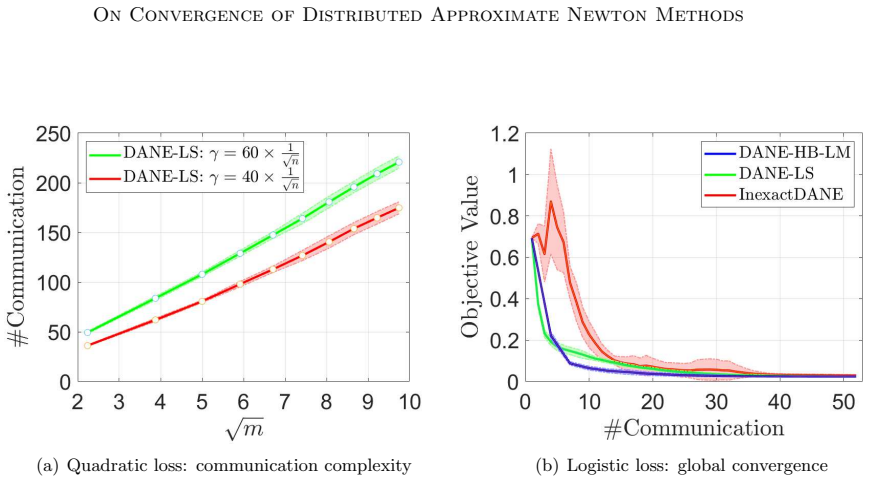
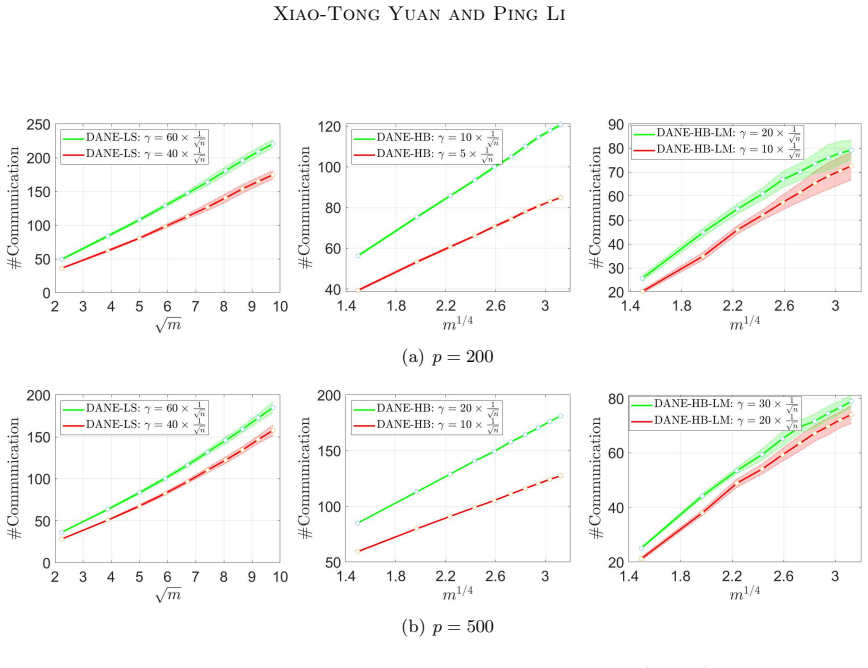
- A sharp testable prediction follows from Corollary 4 and Theorem 19: for logistic regression with n large relative to p, communication rounds should grow roughly like m^{1/4} for DANE-HB-LM and √m for DANE-LS; these scalings could serve as benchmarks for comparing distributed optimizers.
Signed reviews
Editorial analysis
A structured set of objections, weighed in public.
Referee Report
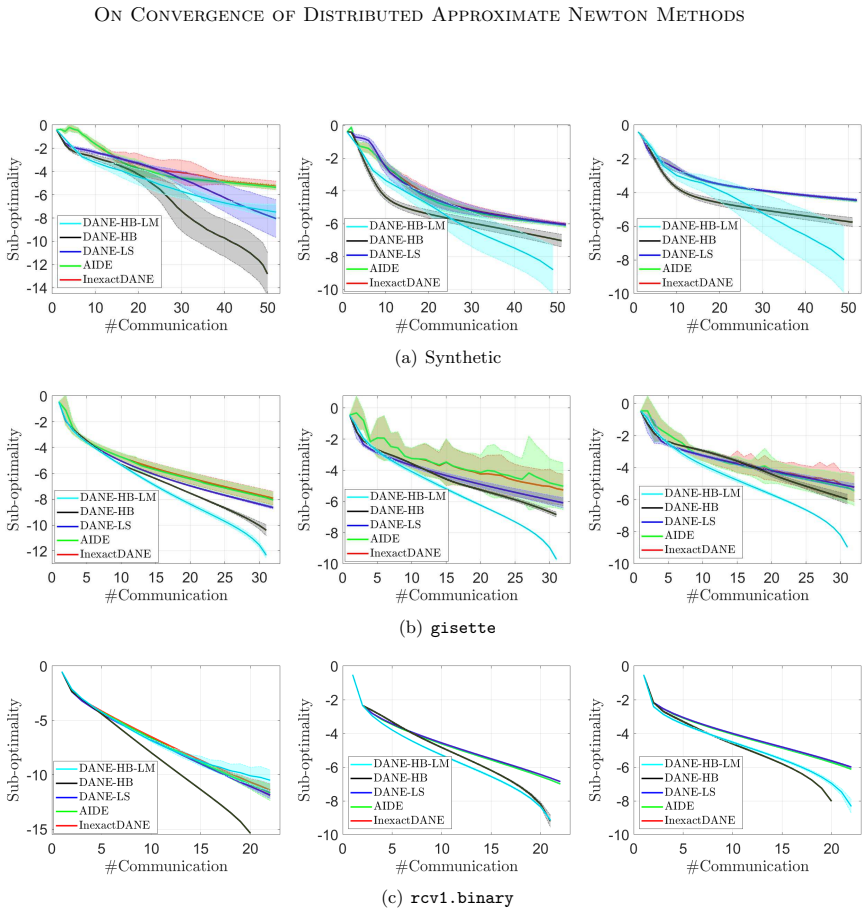
Summary. This paper studies communication-efficient distributed optimization of strongly convex empirical-risk problems. It proposes DANE-LS, a DANE variant with master-only local solves and backtracking line search, and DANE-HB, a heavy-ball accelerated variant. For quadratic objectives the authors prove stochastic communication complexity O(kappa/sqrt(n) log(1/epsilon)) for DANE-LS and O(sqrt(kappa)/n^{1/4} log(1/epsilon)) for DANE-HB, improving on previous DANE bounds. For non-quadratic strongly convex functions they prove global asymptotic convergence for DANE-LS and local linear rates O(gamma/mu log(1/epsilon)) and O(sqrt(gamma/mu) log(1/epsilon)) under a uniform Hessian closeness condition sup_w ||nabla^2 F1(w) - nabla^2 F(w)|| <= gamma; for linear prediction models a globally convergent variant DANE-HB-LM is analyzed. Numerical experiments on synthetic and real logistic-regression tasks illustrate the stability and communication advantages of the proposed methods.
Significance. If the results hold, the paper makes a solid contribution. The quadratic bounds are the cleanest part: they improve the known DANE bound from O(kappa^2/n) to O(kappa/sqrt(n)) for DANE-LS and match AIDE/MP-DANE for DANE-HB using fairly elementary spectral-radius lemmas. The heavy-ball lemmas and the convergence recurrences are transparent and give parameter-free contraction factors. The line-search globalization also addresses a practically observed instability of plain DANE. The deterministic non-quadratic local rates are natural and potentially useful. However, the stochastic non-quadratic claims currently outrun the supplied proof machinery, and the global-convergence proof has an internal gap. The quadratic results and the deterministic conditional non-quadratic rates are defensible and worth publishing after revision.
major comments (2)
- [Section 2.3, Lemma 28, Remark 14; Theorems 13 and 18] The non-quadratic results (Lemma 27, Lemma 11, Theorem 13, Theorem 18, and the local part of Theorem 8(b)) all assume the uniform bound sup_w ||nabla^2 F1(w) - nabla^2 F(w)|| <= gamma. In the stochastic sampling setting the only concentration result supplied, Lemma 28, is pointwise in w: for each fixed w, with probability at least 1 - delta, ||H1(w) - H(w)|| <= L sqrt(32 log(p/delta)/n). Since the iterates w(t) are random and depend on the same data that defines F1, this pointwise statement does not imply the uniform bound needed to apply the contraction arguments. Remark 14 cites Mei et al. (2018) for gamma = O(sqrt(p/n)), but no uniform-convergence theorem is stated and its hypotheses are not checked for the specific losses and regularizers used here. Thus the advertised non-quadratic communication improvements in Table 1 are not derived as stochastic statements. For quadratic objectives this gap is harmless because the Hessians are constant, but for logistic-type losses it is load-bearing. Please either prove a uniform concentration bound under explicit conditions or explicitly restrict the non-quadratic theorems to the deterministic setting where sup_w ||nabla^2 F1(w) - nabla^2 F(w)|| <= gamma is an assumption.
- [Appendix B.2, proof of Theorem 8(a)] The paragraph 'From Lemma 27 we know...' invokes Lemma 27, whose hypothesis sup_w ||nabla^2 F1(w) - nabla^2 F(w)|| <= gamma is not assumed in part (a), so the cited lemma cannot be used there. In addition, the displayed descent inequality eta_t rho(gamma + mu) ||w~^t - w^{t-1}||^2 <= 2(F(w^{t-1}) - F(w^t)) does not by itself imply ||w~^t - w^{t-1}|| -> 0 unless one has a lower bound on the accepted step sizes eta_t, and no such lower bound is proved. The conclusion that the iterates converge to the minimizer also requires showing that any limit point of the bounded sequence is stationary, e.g., by passing to the limit in the gradient of P^{t-1}; this step is absent. The result is likely repairable with a standard Armijo backtracking lower-bound argument, but as written the global-convergence theorem is not fully proved.
minor comments (5)
- [Corollary 4] The displayed bound t >= (1 + 2 kappa sqrt(32 log(p/delta)/n)) log(2 sqrt(kappa) ||w(0) - w*|| / epsilon) is not algebraically equivalent to Theorem 3's bound t >= 2(mu + 2 gamma)/mu log(sqrt(kappa) ||w(0) - w*|| / epsilon) with gamma = L sqrt(32 log(p/delta)/n); a factor of 2 appears to be missing. Please check the constants.
- [Appendix C] The opening sentence of Appendix C says 'proofs of results in Section 2'; it should refer to Section 3.
- [Proof of Theorem 18] In the paragraph defining the matrices at the fixed point, both Hessians are denoted H^*: the line 'Let H* = nabla^2 F(w*) and H* = nabla^2 F1(w*)' assigns the same symbol to two different matrices; the second should be H1^*.
- [Proof of Lemma 6(b)] The notation Delta F-tilde(w(t-1), w~^t) in the proof of Lemma 6(b) is undefined; it should presumably be Delta F1(w~^t, w^{t-1}).
- [Proof of Theorem 8(a)] The word 'uncles' in the proof of Theorem 8(a) is a typo for 'unless'.
Circularity Check
No circularity: all rates are conditional on explicit Hessian-closeness assumptions and derived from spectral-radius lemmas; no fitted parameter is renamed as a prediction.
full rationale
The paper's derivation chain is not circular. The quadratic-rate theorems (Theorems 3 and 15) take ||H1 - H|| <= gamma as an explicit premise and prove contraction through deterministic spectral-radius lemmas (Lemma 23 and Lemma 24); gamma is the algorithm's regularization input, not a constant fitted to reproduce the claimed convergence. Corollaries 4 and 16 instantiate gamma via Lemma 28, a matrix concentration bound, and in the quadratic case the Hessians are constant so the pointwise concentration statement is sufficient. The non-quadratic local rates (Theorems 13 and 18) explicitly assume sup_w ||∇²F1(w) - ∇²F(w)|| <= gamma, and Lemma 27 is derived from exactly that same assumption; the rate O(gamma/mu) is a conditional guarantee, not a self-definitional equivalence. Remark 14's appeal to Mei et al. for gamma = O(sqrt(p/n)) is an external uniform-convergence citation, not a self-citation, and the absence of a proof of that uniform version is a correctness/completeness gap rather than circularity. No step defines a target quantity in terms of itself, no prediction is statistically forced by fitted inputs, and no load-bearing premise rests on an author self-citation chain. The written proof of Theorem 8(a) does invoke Lemma 27 without that part's assumptions, an internal inconsistency that a careful reader should flag, but it does not make the central derivation circular. Overall, the central claims have independent mathematical content and the appropriate score is 0.
Assumptions & free parameters
free parameters (4)
- gamma (local subproblem regularization) =
L sqrt(32 log(p/delta)/n) in Corollaries 4, 16, 21; 40/sqrt(n) in experiments; arbitrary in deterministic theorems
- beta (heavy-ball momentum) =
(1 - sqrt(mu/(mu + 2*gamma)))^2
- epsilon_t (local subproblem tolerance) =
Theorem-dependent decreasing bounds
- rho (line search parameter) =
Any value in (0,1/3) for Theorem 13
assumptions (5)
- domain assumption F and F1 are mu-strongly convex and L-smooth, with nu-Lipschitz Hessian
- domain assumption Data is evenly and randomly split across m machines; each local objective is an average of n i.i.d. samples
- domain assumption Uniform Hessian closeness sup_w ||nabla^2 F1(w) - nabla^2 F(w)|| <= gamma
- standard math Spectral radius lemmas (Lemmas 24 and 25) and matrix concentration (Tropp 2012, Lemma 28)
- domain assumption Line search iterates stay bounded so D in Lemma 6(b) exists
Cite this review
Pith. "Pith review of On Convergence of Distributed Approximate Newton Methods: Globalization, Sharper Bounds and Beyond." pith.science (2026). https://pith.science/paper/DYQXAXNX
@misc{pith2026190802246,
  author       = {Pith},
  title        = {Pith review of: On Convergence of Distributed Approximate Newton Methods: Globalization, Sharper Bounds and Beyond},
  year         = {2026},
  howpublished = {\url{https://pith.science/paper/DYQXAXNX}},
  note         = {Machine review of arXiv:1908.02246}
}
read the original abstract
The DANE algorithm is an approximate Newton method popularly used for communication-efficient distributed machine learning. Reasons for the interest in DANE include scalability and versatility. Convergence of DANE, however, can be tricky; its appealing convergence rate is only rigorous for quadratic objective, and for more general convex functions the known results are no stronger than those of the classic first-order methods. To remedy these drawbacks, we propose in this paper some new alternatives of DANE which are more suitable for analysis. We first introduce a simple variant of DANE equipped with backtracking line search, for which global asymptotic convergence and sharper local non-asymptotic convergence rate guarantees can be proved for both quadratic and non-quadratic strongly convex functions. Then we propose a heavy-ball method to accelerate the convergence of DANE, showing that nearly tight local rate of convergence can be established for strongly convex functions, and with proper modification of algorithm the same result applies globally to linear prediction models. Numerical evidence is provided to confirm the theoretical and practical advantages of our methods.
Figures
Figures from the paper (1 more)

Reference graph
Works this paper leans on
-
[1]
Communication complexity of distributed convex learning and optimization
Yossi Arjevani and Ohad Shamir. Communication complexity of distributed convex learning and optimization. In Advances in Neural Information Processing Systems (NIPS), pages 1756--1764, 2015
work page 2015
-
[2]
Distributed optimization and statistical learning via the alternating direction method of multipliers
Stephen Boyd, Neal Parikh, Eric Chu, Borja Peleato, and Jonathan Eckstein. Distributed optimization and statistical learning via the alternating direction method of multipliers. Foundations and Trends in Machine Learning , 3 0 (1): 0 1--122, 2011
2011
-
[3]
Mapreduce: Simplified data processing on large clusters
Jeffrey Dean and Sanjay Ghemawat. Mapreduce: Simplified data processing on large clusters. Commun. ACM, 51 0 (1): 0 107--113, January 2008. ISSN 0001-0782. doi:10.1145/1327452.1327492. URL http://doi.acm.org/10.1145/1327452.1327492
arXiv 2008
-
[4]
Global convergence of the heavy-ball method for convex optimization
Euhanna Ghadimi, Hamid Reza Feyzmahdavian, and Mikael Johansson. Global convergence of the heavy-ball method for convex optimization. In 2015 European Control Conference (ECC), pages 310--315. IEEE, 2015
work page 2015
-
[5]
Result analysis of the nips 2003 feature selection challenge
Isabelle Guyon, Steve Gunn, Asa Ben-Hur, and Gideon Dror. Result analysis of the nips 2003 feature selection challenge. In Advances in Neural Information Processing Systems (NIPS), pages 545--552, 2005
work page 2003
-
[6]
Communication-efficient distributed dual coordinate ascent
Martin Jaggi, Virginia Smith, Martin Tak \'a c, Jonathan Terhorst, Sanjay Krishnan, Thomas Hofmann, and Michael I Jordan. Communication-efficient distributed dual coordinate ascent. In Advances in Neural Information Processing Systems (NIPS), 2014
work page 2014
-
[7]
Accelerating stochastic gradient descent using predictive variance reduction
Rie Johnson and Tong Zhang. Accelerating stochastic gradient descent using predictive variance reduction. In Advances in Neural Information Processing Systems (NIPS), pages 315--323, 2013
work page 2013
-
[8]
Communication-efficient distributed statistical inference
Michael I Jordan, Jason D Lee, and Yun Yang. Communication-efficient distributed statistical inference. Journal of the American Statistical Association, pages 1--14, 2018
work page 2018
Show all 41 references
-
[9]
Sgdlibrary: A matlab library for stochastic optimization algorithms
Hiroyuki Kasai. Sgdlibrary: A matlab library for stochastic optimization algorithms. Journal of Machine Learning Research, 18: 0 215--1, 2017
2017
-
[10]
Federated optimization: Distributed machine learning for on-device intelligence
Jakub Kone c n \`y , H Brendan McMahan, Daniel Ramage, and Peter Richt \'a rik. Federated optimization: Distributed machine learning for on-device intelligence. arXiv preprint arXiv:1610.02527, 2016
2016 arXiv
-
[11]
Distributed stochastic variance reduced gradient methods by sampling extra data with replacement
Jason D Lee, Qihang Lin, Tengyu Ma, and Tianbao Yang. Distributed stochastic variance reduced gradient methods by sampling extra data with replacement. Journal of Machine Learning Research, 18 0 (1): 0 4404--4446, 2017
2017
-
[12]
Rcv1: A new benchmark collection for text categorization research
David D Lewis, Yiming Yang, Tony G Rose, and Fan Li. Rcv1: A new benchmark collection for text categorization research. Journal of Machine Learning Research, 5 0 (Apr): 0 361--397, 2004
2004
-
[13]
Communication efficient distributed machine learning with the parameter server
Mu Li, David G Andersen, Alex J Smola, and Kai Yu. Communication efficient distributed machine learning with the parameter server. In Advances in Neural Information Processing Systems (NIPS), 2014
2014
-
[14]
A universal catalyst for first-order optimization
Hongzhou Lin, Julien Mairal, and Zaid Harchaoui. A universal catalyst for first-order optimization. In Advances in Neural Information Processing Systems (NIPS), pages 3384--3392, 2015
2015
-
[15]
Distributed inexact newton-type pursuit for non-convex sparse learning
Bo Liu, Xiao-Tong Yuan, Lezi Wang, Qingshan Liu, Junzhou Huang, and Dimitris Metaxas. Distributed inexact newton-type pursuit for non-convex sparse learning. In International Conference on Artificial Intelligence and Statistics (AISTATS), 2019
2019
-
[16]
Linearly convergent stochastic heavy ball method for minimizing generalization error
Nicolas Loizou and Peter Richt \'a rik. Linearly convergent stochastic heavy ball method for minimizing generalization error. arXiv preprint arXiv:1710.10737, 2017
2017 arXiv
-
[17]
Adding vs
Chenxin Ma, Virginia Smith, Martin Jaggi, Michael Jordan, Peter Richtarik, and Martin Takac. Adding vs. averaging in distributed primal-dual optimization. In International Conference on Machine Learning(ICML), pages 1973--1982, 2015
1973
-
[18]
Communication-efficient learning of deep networks from decentralized data
Brendan McMahan, Eider Moore, Daniel Ramage, Seth Hampson, and Blaise Aguera y Arcas. Communication-efficient learning of deep networks from decentralized data. In International Conference on Artificial Intelligence and Statistics (AISTATS), pages 1273--1282, 2017
2017
-
[19]
The landscape of empirical risk for nonconvex losses
Song Mei, Yu Bai, Andrea Montanari, et al. The landscape of empirical risk for nonconvex losses. The Annals of Statistics, 46 0 (6A): 0 2747--2774, 2018
2018
-
[20]
B. Polyak. Some methods of speeding up the convergence of iteration methods. USSR Computational Mathematics and Mathematical Physics , 4 0 (5): 0 1--17, 1964
1964
-
[21]
N. Qian. On the momentum term in gradient descent learning algorithms. Neural networks, 12 0 (1): 0 145--151, 1999
1999
-
[22]
AIDE : Fast and communication efficient distributed optimization
Sashank J Reddi, Jakub Kone c n \`y , Peter Richt \'a rik, Barnab \'a s P \'o cz \'o s, and Alex Smola. AIDE : Fast and communication efficient distributed optimization. arXiv preprint arXiv:1608.06879, 2016
2016 arXiv
-
[23]
Distributed coordinate descent method for learning with big data
Peter Richt \'a rik and Martin Tak \'a c . Distributed coordinate descent method for learning with big data. Journal of Machine Learning Research, 17 0 (1): 0 2657--2681, 2016
2016
-
[24]
Stochastic convex optimization
Shai Shalev-Shwartz, Ohad Shamir, Nathan Srebro, and Karthik Sridharan. Stochastic convex optimization. In Annual Conference on Learning Theory (COLT), 2009
2009
-
[25]
Without-replacement sampling for stochastic gradient methods
Ohad Shamir. Without-replacement sampling for stochastic gradient methods. In Advances in Neural Information Processing Systems (NIPS), pages 46--54, 2016
2016
-
[26]
Communication-efficient distributed optimization using an approximate newton-type method
Ohad Shamir, Nati Srebro, and Tong Zhang. Communication-efficient distributed optimization using an approximate newton-type method. In International Conference on Machine Learning (ICML), pages 1000--1008, 2014
2014
-
[27]
Cocoa: A general framework for communication-efficient distributed optimization
Virginia Smith, Simone Forte, Ma Chenxin, Martin Tak \'a c , Michael I Jordan, and Martin Jaggi. Cocoa: A general framework for communication-efficient distributed optimization. Journal of Machine Learning Research, 18: 0 230, 2018
2018
-
[28]
User-friendly tail bounds for sums of random matrices
Joel A Tropp. User-friendly tail bounds for sums of random matrices. Foundations of Computational Mathematics, 12 0 (4): 0 389--434, 2012
2012
-
[29]
Efficient distributed learning with sparsity
Jialei Wang, Mladen Kolar, Nathan Srebro, and Tong Zhang. Efficient distributed learning with sparsity. In International Conference on Machine Learning (ICML), pages 3636--3645, 2017 a
2017
-
[30]
Memory and communication efficient distributed stochastic optimization with minibatch prox
Jialei Wang, Weiran Wang, and Nathan Srebro. Memory and communication efficient distributed stochastic optimization with minibatch prox. In Annual Conference on Learning Theory (COLT), pages 1882--1919, 2017 b
1919
-
[31]
Giant: Globally improved approximate newton method for distributed optimization
Shusen Wang, Farbod Roosta-Khorasani, Peng Xu, and Michael W Mahoney. Giant: Globally improved approximate newton method for distributed optimization. In Advances in Neural Information Processing Systems (NeurIPS), pages 2338--2348, 2018
2018
-
[32]
A lyapunov analysis of momentum methods in optimization
Ashia C Wilson, Benjamin Recht, and Michael I Jordan. A lyapunov analysis of momentum methods in optimization. arXiv preprint arXiv:1611.02635, 2016
2016 arXiv
-
[33]
Dscovr: Randomized primal-dual block coordinate algorithms for asynchronous distributed optimization
Lin Xiao, Adams Wei Yu, Qihang Lin, and Weizhu Chen. Dscovr: Randomized primal-dual block coordinate algorithms for asynchronous distributed optimization. Journal of Machine Learning Research, 20 0 (43): 0 1--58, 2019
2019
-
[34]
Petuum: A new platform for distributed machine learning on big data
Eric P Xing, Qirong Ho, Wei Dai, Jin Kyu Kim, Jinliang Wei, Seunghak Lee, Xun Zheng, Pengtao Xie, Abhimanu Kumar, and Yaoliang Yu. Petuum: A new platform for distributed machine learning on big data. IEEE Transactions on Big Data, 1 0 (2): 0 49--67, 2015
2015
-
[35]
Xin, Patrick Wendell, Tathagata Das, Michael Armbrust, Ankur Dave, Xiangrui Meng, Josh Rosen, Shivaram Venkataraman, Michael J
Matei Zaharia, Reynold S. Xin, Patrick Wendell, Tathagata Das, Michael Armbrust, Ankur Dave, Xiangrui Meng, Josh Rosen, Shivaram Venkataraman, Michael J. Franklin, Ali Ghodsi, Joseph Gonzalez, Scott Shenker, and Ion Stoica. Apache spark: A unified engine for big data processin...
2016 doi
-
[36]
Di SCO : Distributed optimization for self-concordant empirical loss
Yuchen Zhang and Lin Xiao. Di SCO : Distributed optimization for self-concordant empirical loss. In International Conference on Machine Learning (ICML), pages 362--370, 2015
2015
-
[37]
Stochastic primal-dual coordinate method for regularized empirical risk minimization
Yuchen Zhang and Lin Xiao. Stochastic primal-dual coordinate method for regularized empirical risk minimization. Journal of Machine Learning Research, 18 0 (1): 0 2939--2980, 2017
2017
-
[38]
Efficient stochastic gradient hard thresholding
Pan Zhou, Xiaotong Yuan, and Jiashi Feng. Efficient stochastic gradient hard thresholding. In Advances in Neural Information Processing Systems (NeurIPS), pages 1984--1993, 2018
1984
-
[39]
@esa (Ref
\@ifxundefined[1] #1\@undefined \@firstoftwo \@secondoftwo \@ifnum[1] #1 \@firstoftwo \@secondoftwo \@ifx[1] #1 \@firstoftwo \@secondoftwo [2] @ #1 \@temptokena #2 #1 @ \@temptokena \@ifclassloaded agu2001 natbib The agu2001 class already includes natbib coding, so you should ...
-
[40]
\@lbibitem[] @bibitem@first@sw\@secondoftwo \@lbibitem[#1]#2 \@extra@b@citeb \@ifundefined br@#2\@extra@b@citeb \@namedef br@#2 \@nameuse br@#2\@extra@b@citeb \@ifundefined b@#2\@extra@b@citeb @num @parse #2 @tmp #1 NAT@b@open@#2 NAT@b@shut@#2 \@ifnum @merge>\@ne @bibitem@firs...
-
[41]
@open @close @open @close and [1] URL: #1 \@ifundefined chapter * \@mkboth \@ifxundefined @sectionbib * \@mkboth * \@mkboth\@gobbletwo \@ifclassloaded amsart * \@ifclassloaded amsbook * \@ifxundefined @heading @heading NAT@ctr thebibliography [1] @ \@biblabel @NAT@ctr \@bibset...
Reviewed August 14, 2026 · model on record in the stance chip above.
Discussion (0). Continue with ORCID to comment.