REVIEW 3 major objections 5 minor 1 cited by
Measuring the Suns radial velocity variability due to supergranulation over a magnetic cycle
T0 review · 3 major / 5 minor · reviewed 2026-08-06 · deepseek-v4-flash
Pith's one-line read The quiet Sun's supergranulation timescale varies by up to an order of magnitude across the solar cycle, peaking at activity minimum and anti-correlating with sunspot number.
desk verdict Two independent activity corrections agree that the supergranulation timescale in disk-integrated solar RVs anti-correlates with the cycle, but the abstract overstates the amplitude and the injection-recovery test is too thin to fully rule out a modeling artifact. read the letter →
The pith
A machine-rendered reading of the paper's core claim, the machinery that carries it, and where it could break.
The reading
What carries the argument
The argument is carried by a two-component Gaussian Process with aperiodic simple-harmonic-oscillator kernels (quality factor $Q=1/\sqrt{2}$), fitted independently to 4-week chunks of quiet-Sun radial velocities, with the supergranulation component forced to have a lower frequency than the granulation component. For each chunk the fit yields amplitude $S_0$ and angular frequency $\omega_0$ for both components, converted to timescale $\tau=2\pi/\omega_0$ and standard deviation; the resulting timescales are then correlated with the mean relative sunspot number over the same chunk. A Fisher-information calculation, based on derivatives of the covariance matrix with respect to $S_0$ and $\omega_0$, translates different observing cadences into the expected fractional uncertainty on the supergranulation timescale, which is used to predict how many nights are needed to characterise supergranulation in other stars.
What would settle it
Re-fit the same 2015-2023 HARPS-N quiet-Sun RVs with a Harvey-style kernel with a free power-law index, or with a quasi-periodic component added, and check whether the $\tau_{\mathrm{SG}}$ anti-correlation with sunspot number survives; alternatively, measure supergranule lifetimes from resolved SDO/HMI Dopplergrams over the same cycle and compare their evolution with the disk-integrated $\tau_{\mathrm{SG}}$.
Extended reading notes
Core claim
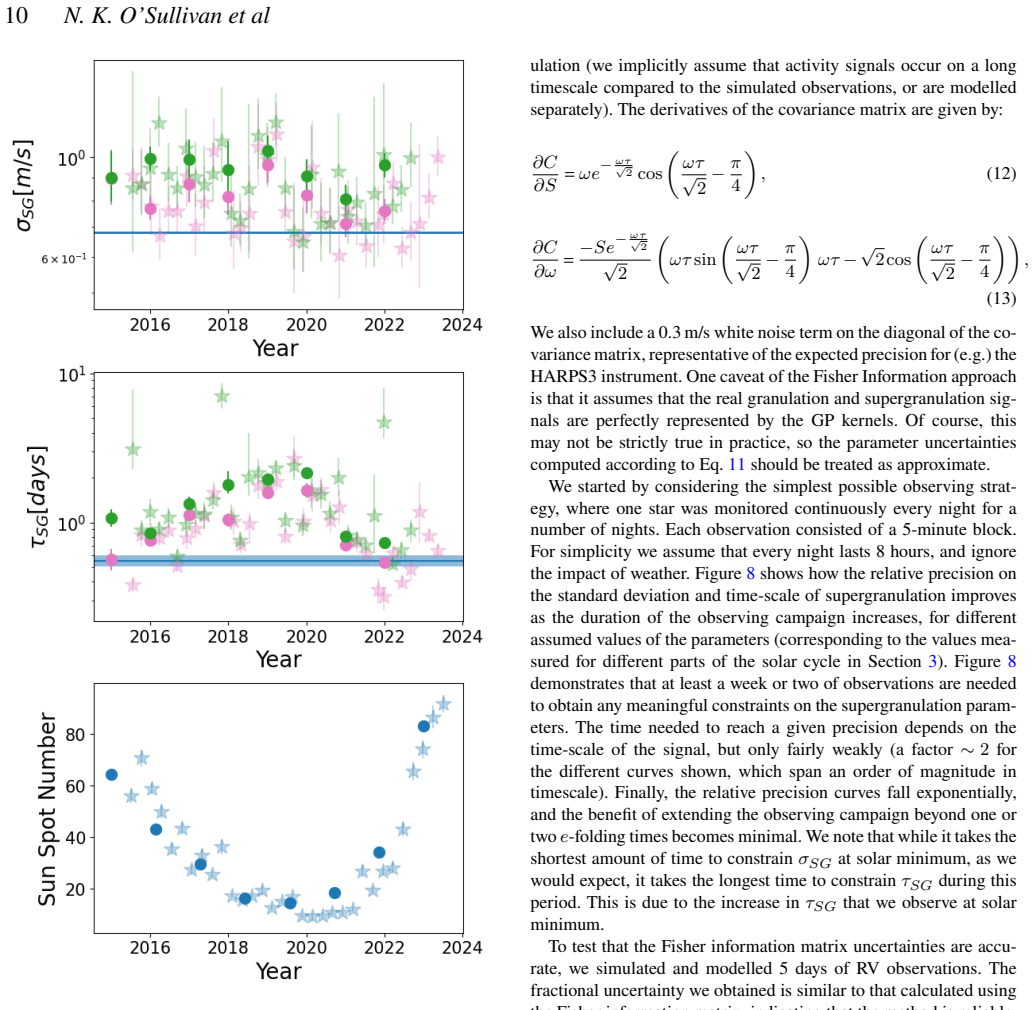
The central discovery is that the disk-integrated quiet-Sun radial-velocity signal attributed to supergranulation carries a cycle-dependent timescale: $\tau_{\mathrm{SG}}$ is longest at solar minimum, drops by a factor of roughly three during the rising and decaying phases, and anti-correlates with the relative sunspot number ($p<10^{-2}$ for the image-corrected data, $p<10^{-4}$ for the spectroscopically corrected data at 3-month chunks). The authors interpret this as a physical property of supergranulation rather than an artefact, because the two correction methods have limitations that would pull in opposite directions, and because their injection tests for reduced daily sampling and for a 13.5-day activity residual do not reproduce the effect. They also find that the supergranulation timescale measured from 4-week chunks shows large scatter that disappears at 3-month and 1-year chunk lengths, and they reconcile their results with the earlier structure-function analysis by converting their Gaussian-process covariance into structure functions.
Load-bearing premise
The analysis assumes that after active regions are removed, the quiet-Sun radial velocities are exactly the sum of two independent aperiodic SHO processes with fixed $Q=1/\sqrt{2}$, so that the fitted supergranulation timescale is an unbiased measure of the true physical timescale rather than a product of the model or of the activity correction.
Editorial extensions
If this is right
- Radial-velocity noise models for Sun-like stars must allow the supergranulation timescale to vary with activity state; a fixed kernel will misestimate the covariance on multi-year baselines.
- Exoplanet surveys that deliberately target low-activity stars to reduce spot and facula signals may unintentionally encounter a stronger, longer-timescale supergranulation signal.
- Characterising supergranulation in other stars requires dedicated campaigns of at least about 23 nights, but rapid switching between targets can monitor up to 10 stars at once to roughly 30% precision in $\tau_{\mathrm{SG}}$.
- Granulation parameters remain stable over the cycle, so the granulation component can be calibrated once and treated as stationary, while the supergranulation component cannot.
- The effect disappears when the data are analysed with daily sampling or structure functions, so non-parametric methods on sparsely sampled data can miss the cycle dependence.
Reading between the lines
- A testable consequence the paper leaves implicit: if $\tau_{\mathrm{SG}}$ is activity-dependent, then applying the same Gaussian-process analysis to long-baseline radial-velocity time series of other Sun-like stars, alongside an activity indicator such as the S-index, should reveal a similar anti-correlation between the fitted convective timescale and activity level.
- The factor-of-two change in timescale is larger than the roughly 10% changes in supergranule size reported in imaging studies, suggesting that the disk-integrated timescale may be modulated by something other than cell size alone, perhaps the distribution of cell lifetimes or the magnetic network; resolved-imaging lifetime measurements over a full cycle would be a discriminating test.
- Because the spectroscopic correction linearly decorrelates against the S-index, part of the apparent cycle could in principle be caused by activity-dependent removal of supergranulation; the agreement with the image-based correction argues against this, but injecting activity-correlated supergranulation signals into the pipeline would settle it.
Editorial analysis
A structured set of objections, weighed in public.
Referee Report
Summary. This paper uses eight years of HARPS-N Sun-as-a-star radial velocities (July 2015 to November 2023) to measure the granulation and supergranulation properties of the quiet Sun after subtracting active-region contributions with two independent methods: an SDO/HMI image-based correction and the YARARA spectral decorrelation. The quiet-Sun RVs are modelled in 4-week, 12-week, and 1-year chunks with a two-component aperiodic simple-harmonic-oscillator Gaussian process plus white noise (Section 3). The paper reports that the supergranulation timescale tau_SG is longest at solar minimum and is strongly anti-correlated with the SILSO relative sunspot number, with Spearman p-values below 1e-2 for SDO and below 1e-4 for YARARA for 3-month chunks, while granulation parameters remain stable. It also uses a Fisher-information approach to argue that a roughly 23-night campaign with rapid target switching can constrain tau_SG to 30% precision for up to 10 stars, and it discusses plausible physical explanations for a supergranulation cycle.
Significance. If the central claim holds, the supergranulation timescale in disk-integrated solar RVs is not stationary over the magnetic cycle, with direct consequences for modelling stellar noise in EPRV surveys and for the interpretation of granulation-driven RV variability. The study's strengths are the use of two independent activity corrections, the explicit reporting of correlation p-values, and the effort to validate the GP model with injection-recovery tests in the appendices. The observing-strategy analysis is concrete and falsifiable, and it provides a useful planning estimate for future campaigns. However, the physical interpretation rests on the assumption that the fitted SHO timescale is an unbiased estimator of the true supergranulation timescale across the activity cycle, and the current validation does not yet establish this. The paper is therefore a potentially valuable contribution whose central claim needs additional support before it can be accepted.
major comments (3)
- [Abstract, §4.3, §6] The abstract and the discussion overstate the amplitude of the cycle variation. Table 2 gives mean tau_SG at solar minimum of 1.27 +/- 0.13 d (YARARA) and 1.60 +/- 0.16 d (SDO), versus 0.61 +/- 0.07 d and 0.80 +/- 0.10 d at the beginning of Cycle 25, i.e. a factor of about 2, not an order of magnitude. The order-of-magnitude range appears only in the 4-week-chunk scatter discussed in Section 4.2, which is not the cycle trend; the Discussion's 'factor of three' also exceeds the Table 2 ratios. Please harmonize the abstract, Section 4.3, and Section 6 with the quantitative results.
- [§4.3, Appendix B] The injection-recovery test does not rule out activity-dependent contamination of tau_SG. Section 2.2 reports residual power at Prot/2 ~14 d and Prot/3 ~8 d in both corrected datasets, so the actual residuals are not a stationary two-component aperiodic process. Appendix B injects a single quasi-periodic 13.5-day signal at fixed amplitude into one simulated year and finds no bias in the fitted parameters, but it does not scale the injected amplitude with sunspot number, does not reproduce the 4-week/12-week chunking, outlier rejection, and gap patterns, and does not cover the range of activity states present in the real data. If the 8-14 d residual power grows with SSN, the aperiodic SHO kernel and the white-noise term can trade variance, shifting tau_SG; the constant 0.20-0.25 m/s jitter check in Section 6 does not test whether the SHO parameters themselves move. Please add multi-amplitude injection-recovery tests spanning the observed SSN range with the actual chunking and outlier rejection, or otherwise demonstrate that tau_SG is an unbiased estimator of the supergranulation timescale throughout the cycle.
- [§3 (Eqs. 6-7), §4.1] The model assumes that the quiet-Sun residuals are exactly described by two independent aperiodic SHO kernels with Q=1/sqrt(2) plus white noise, and the fitted tau_SG is interpreted as the physical supergranulation timescale. This assumption is load-bearing. The agreement between the SDO and YARARA corrections is reassuring but not decisive: both corrections start from the same HARPS-N spectra, both residual sets contain the same 14-day peaks, and the authors themselves note in Section 4.1 that the YARARA S-index decorrelation may remove part of the supergranulation signal. The paper should either validate the two-SHO model against injected signals with activity levels representative of all cycle phases, or test an alternative model that includes a quasi-periodic term and show that the tau_SG-SSN anti-correlation is robust to the model choice.
minor comments (5)
- [§2.2] The sentence containing 'weather the activity-correction was done with YARARA or SDO' should read 'whether'; the typo appears in the discussion of the 14-day and 8-day activity residuals.
- [Appendix B, Fig. B1 caption] The caption states that the injected activity signal has period = 13.5 hours, while the text says 13.5 days; please correct the inconsistency.
- [Table 2] The Al Moulla et al. row lists sigma_G and sigma_SG without uncertainties; please state whether these are central values without published errors or add the uncertainties.
- [§4.2] The statement that the 4-week-chunk scatter 'is real' and not an artefact of the limited chunk duration is supported only by a reference to O'Sullivan & Aigrain (2024); please show the relevant injection-recovery result or temper the wording.
- [Eq. (13)] The displayed derivative of the SHO kernel with respect to omega appears garbled in the typeset version; please verify the equation and its sign structure.
Circularity Check
No significant circularity: the central tau_SG–SSN anti-correlation is an empirical result tested against external SILSO data, not a quantity forced by the GP model or by the paper's own definitions.
full rationale
The paper does not claim a first-principles derivation; it empirically fits a two-component aperiodic SHO Gaussian process (Eqs. 6–7) to quiet-Sun RVs and reads off the supergranulation timescale tau_SG from the fitted angular frequency omega_0 (Eq. 5). The load-bearing result is the anti-correlation between tau_SG and the relative Sunspot number reported in Section 4.3. That comparison uses an external dataset (SILSO; Clette & Lefèvre 2015), and the Sunspot number never enters the GP likelihood, the kernel definition, or the conversion from omega_0 to tau_SG, so the anti-correlation is not imposed by construction. The result is also reproduced with two different activity-correction methods (SDO image-based and YARARA spectroscopic), which start from the same HARPS-N spectra but make different assumptions; the agreement is a consistency check rather than a definitional identity. The self-citations, chiefly to O'Sullivan & Aigrain (2024) for the GP method and to Lakeland et al. (2024) for the SDO correction, are methodological rather than load-bearing: the GP method is validated by injection-recovery tests in Appendices A and B, and the cycle claim is benchmarked against external sunspot data and previous solar literature. Appendix B injects only a single fixed 13.5-day activity signal and does not test a cycle-modulated residual, so the possibility that activity-dependent residual power biases the fitted tau_SG is a genuine model-misspecification and robustness risk, not a circularity: it cannot be exhibited as an equation in which the fitted quantity equals its input. Similarly, Section 5's Fisher-information survey uses the measured tau_SG and sigma_SG values as assumed inputs for an observing-strategy calculation; that is a planning/sensitivity exercise, not a prediction of the solar cycle from the same fit. No step in the paper reduces by definition or by self-citation to its own inputs.
Assumptions & free parameters
free parameters (4)
- granulation amplitude S0,G and frequency omega0,G =
varies per chunk; typical sigma_G about 0.33 m/s, tau_G about 0.03 days
- supergranulation amplitude S0,SG and frequency omega0,SG =
varies per chunk; typical sigma_SG about 0.7-0.9 m/s, tau_SG about 0.6-1.6 days (Table 2)
- white noise standard deviation sigma_w =
about 0.20-0.25 m/s
- target fractional uncertainty threshold of 0.3 on tau_SG =
0.3
assumptions (5)
- domain assumption The quiet-Sun RV PSD is the sum of two independent aperiodic SHO components (granulation and supergranulation) with Q=1/sqrt(2), plus white noise.
- domain assumption The SDO/HMI active-region correction removes active-region RVs without removing supergranulation.
- domain assumption The YARARA linear decorrelation against the Ca II H&K S-index removes plage and faculae without attenuating supergranulation in an activity-dependent way.
- domain assumption GP parameter estimates from 4-week chunks with about 5.3 hours of daily sampling are unbiased for the supergranulation timescale.
- standard math Fisher information uncertainties are accurate for campaign planning under the assumption that the GP kernel is the true generative model.
Cite this review
Pith. "Pith review of Measuring the Suns radial velocity variability due to supergranulation over a magnetic cycle." pith.science (2026). https://pith.science/paper/DZSUAIVE
@misc{pith2026250623693,
  author       = {Pith},
  title        = {Pith review of: Measuring the Suns radial velocity variability due to supergranulation over a magnetic cycle},
  year         = {2026},
  howpublished = {\url{https://pith.science/paper/DZSUAIVE}},
  note         = {Machine review of arXiv:2506.23693}
}
read the original abstract
In recent years supergranulation has emerged as one of the biggest challenges for the detection of Earth-twins in radial velocity planet searches. We used eight years of Sun-as-a-star radial velocity observations from HARPS-N to measure the quiet-Sun's granulation and supergranulation properties of most of its 11-year activity cycle, after correcting for the effects of magnetically active regions using two independent methods. In both cases, we observe a clear, order of magnitude variation in the time-scale of the supergranulation component, which is largest at activity minimum and is strongly anti-correlated with the relative Sunspot number. We also explored a range of observational strategies which could be employed to characterise supergranulation in stars other than the Sun, showing that a comparatively long observing campaign of at least 23 nights is required, but that up to 10 stars can be monitored simultaneously in the process. We conclude by discussing plausible explanations for the "supergranulation" cycle.
Figures


Figures from the paper (7 more)




Forward citations
Cited by 1 Pith paper
-
The Fe I 4377 {\AA} Line as a Solar Faculae Indicator: Insights from Spectral Ratio Analysis
Spectral ratio analysis of the Fe I 4377 Å line in HARPS-N Sun-as-a-star spectra recovers facular filling factors that track SDO/HMI measurements (Pearson R = 0.587–0.927).
Reference graph
Works this paper leans on
-
[1]
Aigrain S., Foreman-Mackey D., 2023, @doi [ ] 10.1146/annurev-astro-052920-103508 , https://ui.adsabs.harvard.edu/abs/2023ARA&A..61..329A 61, 329
-
[2]
Aigrain S., Pont F., Zucker S., 2012, @doi [ ] 10.1111/j.1365-2966.2011.19960.x , https://ui.adsabs.harvard.edu/abs/2012MNRAS.419.3147A 419, 3147
arXiv 2012
-
[3]
Al Moulla K., Dumusque X., Figueira P., Lo Curto G., Santos N. C., Wildi F., 2023, @doi [ ] 10.1051/0004-6361/202244663 , https://ui.adsabs.harvard.edu/abs/2023A&A...669A..39A 669, A39
-
[4]
Astropy Collaboration et al., 2013, @doi [ ] 10.1051/0004-6361/201322068 , https://ui.adsabs.harvard.edu/abs/2013A&A...558A..33A 558, A33
-
[5]
Astropy Collaboration et al., 2018, @doi [ ] 10.3847/1538-3881/aabc4f , https://ui.adsabs.harvard.edu/abs/2018AJ....156..123A 156, 123
-
[6]
Astropy Collaboration et al., 2022, @doi [ ] 10.3847/1538-4357/ac7c74 , https://ui.adsabs.harvard.edu/abs/2022ApJ...935..167A 935, 167
-
[7]
Barrag \'a n O., Aigrain S., Rajpaul V. M., Zicher N., 2022, @doi [ ] 10.1093/mnras/stab2889 , https://ui.adsabs.harvard.edu/abs/2022MNRAS.509..866B 509, 866
-
[8]
Barrag \'a n O., et al., 2024, @doi [ ] 10.1093/mnras/stae1344 , https://ui.adsabs.harvard.edu/abs/2024MNRAS.531.4275B 531, 4275
Show all 127 references
-
[9]
Berrilli F., Ermolli I., Florio A., Pietropaolo E., 1999, , https://ui.adsabs.harvard.edu/abs/1999A&A...344..965B 344, 965
1999
-
[10]
Boisse I., et al., 2009, @doi [ ] 10.1051/0004-6361:200810648 , https://ui.adsabs.harvard.edu/abs/2009A&A...495..959B 495, 959
2009 doi
-
[11]
J., et al., 2010, @doi [Science] 10.1126/science.1185402 , https://ui.adsabs.harvard.edu/abs/2010Sci...327..977B 327, 977
Borucki W. J., et al., 2010, @doi [Science] 10.1126/science.1185402 , https://ui.adsabs.harvard.edu/abs/2010Sci...327..977B 327, 977
2010 doi
-
[12]
M., 2019, @doi [Geosciences] 10.3390/geosciences9030114 , https://ui.adsabs.harvard.edu/abs/2019Geosc...9..114C 9, 114
Cegla H. M., 2019, @doi [Geosciences] 10.3390/geosciences9030114 , https://ui.adsabs.harvard.edu/abs/2019Geosc...9..114C 9, 114
2019 doi
-
[13]
J., Cegla H
Chaplin W. J., Cegla H. M., Watson C. A., Davies G. R., Ball W. H., 2019, @doi [ ] 10.3847/1538-3881/ab0c01 , https://ui.adsabs.harvard.edu/abs/2019AJ....157..163C 157, 163
2019 doi
-
[14]
Chatterjee S., Mandal S., Banerjee D., 2017, @doi [ ] 10.3847/1538-4357/aa709d , https://ui.adsabs.harvard.edu/abs/2017ApJ...841...70C 841, 70
2017 doi
-
[15]
Clette F., Lefèvre L., 2015, SILSO Sunspot Number V2.0, https://doi.org/10.24414/qnza-ac80, @doi 10.24414/qnza-ac80
2015 doi
-
[16]
Collier Cameron A., et al., 2019, @doi [ ] 10.1093/mnras/stz1215 , https://ui.adsabs.harvard.edu/abs/2019MNRAS.487.1082C 487, 1082
2019 doi
-
[17]
Collier Cameron A., et al., 2021, @doi [ ] 10.1093/mnras/stab1323 , https://ui.adsabs.harvard.edu/abs/2021MNRAS.505.1699C 505, 1699
2021 doi
-
[18]
S., Ramsay S
Cosentino R., et al., 2012, in McLean I. S., Ramsay S. K., Takami H., eds, Society of Photo-Optical Instrumentation Engineers (SPIE) Conference Series Vol. 8446, Ground-based and Airborne Instrumentation for Astronomy IV. p. 84461V, @doi 10.1117/12.925738
2012 doi
- [19]
-
[20]
Cretignier M., 2022, PhD thesis, University of Geneva, Switzerland
2022
-
[21]
Cretignier M., Dumusque X., Allart R., Pepe F., Lovis C., 2020a, @doi [ ] 10.1051/0004-6361/201936548 , https://ui.adsabs.harvard.edu/abs/2020A&A...633A..76C 633, A76
-
[22]
Cretignier M., Francfort J., Dumusque X., Allart R., Pepe F., 2020b, @doi [ ] 10.1051/0004-6361/202037722 , https://ui.adsabs.harvard.edu/abs/2020A&A...640A..42C 640, A42
-
[23]
C., Pepe F., 2021, @doi [ ] 10.1051/0004-6361/202140986 , https://ui.adsabs.harvard.edu/abs/2021A&A...653A..43C 653, A43
Cretignier M., Dumusque X., Hara N. C., Pepe F., 2021, @doi [ ] 10.1051/0004-6361/202140986 , https://ui.adsabs.harvard.edu/abs/2021A&A...653A..43C 653, A43
2021 doi
-
[24]
Cretignier M., Dumusque X., Pepe F., 2022, @doi [ ] 10.1051/0004-6361/202142435 , https://ui.adsabs.harvard.edu/abs/2022A&A...659A..68C 659, A68
2022 doi
-
[25]
Cretignier M., Dumusque X., Aigrain S., Pepe F., 2023, @doi [ ] 10.1051/0004-6361/202347232 , https://ui.adsabs.harvard.edu/abs/2023A&A...678A...2C 678, A2
2023 doi
-
[26]
Cretignier M., Pietrow A. G. M., Aigrain S., 2024, @doi [ ] 10.1093/mnras/stad3292 , https://ui.adsabs.harvard.edu/abs/2024MNRAS.527.2940C 527, 2940
2024 doi
-
[27]
Dalal S., et al., 2024, @doi [ ] 10.1093/mnras/stae2228 , https://ui.adsabs.harvard.edu/abs/2024MNRAS.534.2410D 534, 2410
2024 doi
-
[28]
L., Toomre J., 2004, @doi [ ] 10.1086/424920 , https://ui.adsabs.harvard.edu/abs/2004ApJ...616.1242D 616, 1242
De Rosa M. L., Toomre J., 2004, @doi [ ] 10.1086/424920 , https://ui.adsabs.harvard.edu/abs/2004ApJ...616.1242D 616, 1242
2004 doi
-
[29]
B., Unger N., Hara N
Delisle J. B., Unger N., Hara N. C., S \'e gransan D., 2022, @doi [ ] 10.1051/0004-6361/202141949 , https://ui.adsabs.harvard.edu/abs/2022A&A...659A.182D 659, A182
2022 doi
-
[30]
M., Galland F., Udry S., Mayor M., 2007, @doi [ ] 10.1051/0004-6361:20078144 , https://ui.adsabs.harvard.edu/abs/2007A&A...473..983D 473, 983
Desort M., Lagrange A. M., Galland F., Udry S., Mayor M., 2007, @doi [ ] 10.1051/0004-6361:20078144 , https://ui.adsabs.harvard.edu/abs/2007A&A...473..983D 473, 983
2007 doi
-
[31]
Dumusque X., 2018, @doi [ ] 10.1051/0004-6361/201833795 , https://ui.adsabs.harvard.edu/abs/2018A&A...620A..47D 620, A47
2018 doi
-
[32]
C., Monteiro M
Dumusque X., Udry S., Lovis C., Santos N. C., Monteiro M. J. P. F. G., 2011a, @doi [ ] 10.1051/0004-6361/201014097 , https://ui.adsabs.harvard.edu/abs/2011A&A...525A.140D 525, A140
-
[33]
Dumusque X., et al., 2011b, @doi [ ] 10.1051/0004-6361/201117148 , https://ui.adsabs.harvard.edu/abs/2011A&A...535A..55D 535, A55
-
[34]
Dumusque X., et al., 2015, @doi [ ] 10.1088/2041-8205/814/2/L21 , https://ui.adsabs.harvard.edu/abs/2015ApJ...814L..21D 814, L21
2015 doi
-
[35]
Dumusque X., et al., 2021, @doi [ ] 10.1051/0004-6361/202039350 , https://ui.adsabs.harvard.edu/abs/2021A&A...648A.103D 648, A103
2021 doi
-
[36]
R., McLeod C
Elsworth Y., Howe R., Isaak G. R., McLeod C. P., Miller B. A., New R., Speake C. C., Wheeler S. J., 1994, @doi [ ] 10.1093/mnras/269.3.529 , https://ui.adsabs.harvard.edu/abs/1994MNRAS.269..529E 269, 529
1994 doi
-
[37]
P., et al., 2022, @doi [ ] 10.1051/0004-6361/202142337 , https://ui.adsabs.harvard.edu/abs/2022A&A...658A.115F 658, A115
Faria J. P., et al., 2022, @doi [ ] 10.1051/0004-6361/202142337 , https://ui.adsabs.harvard.edu/abs/2022A&A...658A.115F 658, A115
2022 doi
-
[38]
472, New Quests in Stellar Astrophysics III: A Panchromatic View of Solar-Like Stars, With and Without Planets
Figueira P., 2013, in Chavez M., Bertone E., Vega O., De la Luz V., eds, Astronomical Society of the Pacific Conference Series Vol. 472, New Quests in Stellar Astrophysics III: A Panchromatic View of Solar-Like Stars, With and Without Planets. p. 137
2013
-
[39]
Foreman-Mackey D., 2018, @doi [Research Notes of the American Astronomical Society] 10.3847/2515-5172/aaaf6c , http://adsabs.harvard.edu/abs/2018RNAAS...2a..31F 2, 31
2018 doi
-
[40]
W., Lang D., Goodman J., 2013, @doi [ ] 10.1086/670067 , https://ui.adsabs.harvard.edu/abs/2013PASP..125..306F 125, 306
Foreman-Mackey D., Hogg D. W., Lang D., Goodman J., 2013, @doi [ ] 10.1086/670067 , https://ui.adsabs.harvard.edu/abs/2013PASP..125..306F 125, 306
2013 doi
-
[41]
Foreman-Mackey D., Agol E., Ambikasaran S., Angus R., 2017, @doi [ ] 10.3847/1538-3881/aa9332 , http://adsabs.harvard.edu/abs/2017AJ....154..220F 154, 220
2017 doi
-
[42]
Foreman-Mackey D., et al., 2019, @doi [The Journal of Open Source Software] 10.21105/joss.01864 , https://ui.adsabs.harvard.edu/abs/2019JOSS....4.1864F 4, 1864
2019 doi
-
[43]
R., Howard A
Gibson S. R., Howard A. W., Marcy G. W., Edelstein J., Wishnow E. H., Poppett C. L., 2016, in Evans C. J., Simard L., Takami H., eds, Society of Photo-Optical Instrumentation Engineers (SPIE) Conference Series Vol. 9908, Ground-based and Airborne Instrumentation for Astronomy ...
2016 doi
-
[44]
Gizon L., Duvall T. L. J., 2003, in Sawaya-Lacoste H., ed., ESA Special Publication Vol. 517, GONG+ 2002. Local and Global Helioseismology: the Present and Future. pp 43--52
2003
-
[45]
L., 2004, in Stepanov A
Gizon L., Duvall T. L., 2004, in Stepanov A. V., Benevolenskaya E. E., Kosovichev A. G., eds, IAU Symposium Vol. 223, Multi-Wavelength Investigations of Solar Activity. pp 41--44, @doi 10.1017/S1743921304005071
2004 doi
-
[46]
Goldreich P., Murray N., Kumar P., 1994, @doi [ ] 10.1086/173904 , https://ui.adsabs.harvard.edu/abs/1994ApJ...424..466G 424, 466
1994 doi
-
[47]
Gomes da Silva J., Santos N. C., Bonfils X., Delfosse X., Forveille T., Udry S., Dumusque X., Lovis C., 2012, @doi [ ] 10.1051/0004-6361/201118598 , https://ui.adsabs.harvard.edu/abs/2012A&A...541A...9G 541, A9
2012 doi
-
[48]
F., Bedell M., 2024, @doi [ ] 10.3847/1538-3881/ad4ce6 , https://ui.adsabs.harvard.edu/abs/2024AJ....168...29G 168, 29
Gupta A. F., Bedell M., 2024, @doi [ ] 10.3847/1538-3881/ad4ce6 , https://ui.adsabs.harvard.edu/abs/2024AJ....168...29G 168, 29
2024 doi
-
[49]
F., et al., 2021, @doi [ ] 10.3847/1538-3881/abd79e , https://ui.adsabs.harvard.edu/abs/2021AJ....161..130G 161, 130
Gupta A. F., et al., 2021, @doi [ ] 10.3847/1538-3881/abd79e , https://ui.adsabs.harvard.edu/abs/2021AJ....161..130G 161, 130
2021 doi
-
[50]
J., Schrijver C
Hagenaar H. J., Schrijver C. J., Title A. M., 1997, @doi [ ] 10.1086/304066 , https://ui.adsabs.harvard.edu/abs/1997ApJ...481..988H 481, 988
1997 doi
-
[51]
D., Thompson S
Hall R. D., Thompson S. J., Handley W., Queloz D., 2018, @doi [ ] 10.1093/mnras/sty1464 , https://ui.adsabs.harvard.edu/abs/2018MNRAS.479.2968H 479, 2968
2018 doi
-
[52]
R., et al., 2020, @doi [Nature] 10.1038/s41586-020-2649-2 , 585, 357
Harris C. R., et al., 2020, @doi [Nature] 10.1038/s41586-020-2649-2 , 585, 357
2020 doi
-
[53]
B., 1954, @doi [ ] 10.1093/mnras/114.1.17 , https://ui.adsabs.harvard.edu/abs/1954MNRAS.114...17H 114, 17
Hart A. B., 1954, @doi [ ] 10.1093/mnras/114.1.17 , https://ui.adsabs.harvard.edu/abs/1954MNRAS.114...17H 114, 17
1954 doi
-
[54]
B., 1956, @doi [ ] 10.1093/mnras/116.1.38 , https://ui.adsabs.harvard.edu/abs/1956MNRAS.116...38H 116, 38
Hart A. B., 1956, @doi [ ] 10.1093/mnras/116.1.38 , https://ui.adsabs.harvard.edu/abs/1956MNRAS.116...38H 116, 38
1956 doi
-
[55]
235, Future Missions in Solar, Heliospheric & Space Plasma Physics
Harvey J., 1985, in Rolfe E., Battrick B., eds, ESA Special Publication Vol. 235, Future Missions in Solar, Heliospheric & Space Plasma Physics. p. 199
1985
-
[56]
D., et al., 2014, @doi [ ] 10.1093/mnras/stu1320 , https://ui.adsabs.harvard.edu/abs/2014MNRAS.443.2517H 443, 2517
Haywood R. D., et al., 2014, @doi [ ] 10.1093/mnras/stu1320 , https://ui.adsabs.harvard.edu/abs/2014MNRAS.443.2517H 443, 2517
2014 doi
-
[57]
D., et al., 2016, @doi [ ] 10.1093/mnras/stw187 , https://ui.adsabs.harvard.edu/abs/2016MNRAS.457.3637H 457, 3637
Haywood R. D., et al., 2016, @doi [ ] 10.1093/mnras/stw187 , https://ui.adsabs.harvard.edu/abs/2016MNRAS.457.3637H 457, 3637
2016 doi
-
[58]
D., et al., 2022, @doi [ ] 10.3847/1538-4357/ac7c12 , https://ui.adsabs.harvard.edu/abs/2022ApJ...935....6H 935, 6
Haywood R. D., et al., 2022, @doi [ ] 10.3847/1538-4357/ac7c12 , https://ui.adsabs.harvard.edu/abs/2022ApJ...935....6H 935, 6
2022 doi
-
[59]
H., Cisewski-Kehe J., Zhao L., Ford E
Holzer P. H., Cisewski-Kehe J., Zhao L., Ford E. B., Gilbertson C., Fischer D. A., 2021, @doi [ ] 10.3847/1538-3881/abf5e0 , https://ui.adsabs.harvard.edu/abs/2021AJ....161..272H 161, 272
2021 doi
-
[60]
D., 2007, @doi [Computing in Science & Engineering] 10.1109/MCSE.2007.55 , 9, 90
Hunter J. D., 2007, @doi [Computing in Science & Engineering] 10.1109/MCSE.2007.55 , 9, 90
2007 doi
- [61]
-
[62]
J., Simard L., Takami H., eds, Society of Photo-Optical Instrumentation Engineers (SPIE) Conference Series Vol
Jurgenson C., Fischer D., McCracken T., Sawyer D., Szymkowiak A., Davis A., Muller G., Santoro F., 2016, in Evans C. J., Simard L., Takami H., eds, Society of Photo-Optical Instrumentation Engineers (SPIE) Conference Series Vol. 9908, Ground-based and Airborne Instrumentation ...
2016 arXiv
-
[63]
R., 1994, @doi [ ] 10.1007/BF01473196 , https://ui.adsabs.harvard.edu/abs/1994SoPh..152..139K 152, 139
Kariyappa R., Sivaraman K. R., 1994, @doi [ ] 10.1007/BF01473196 , https://ui.adsabs.harvard.edu/abs/1994SoPh..152..139K 152, 139
1994 doi
- [64]
-
[65]
Klein B., et al., 2022, @doi [ ] 10.1093/mnras/stac761 , https://ui.adsabs.harvard.edu/abs/2022MNRAS.512.5067K 512, 5067
2022 doi
-
[66]
Klein B., et al., 2024, @doi [ ] 10.1093/mnras/stae1313 , https://ui.adsabs.harvard.edu/abs/2024MNRAS.531.4238K 531, 4238
2024 doi
-
[67]
W., Howard R
Komm R. W., Howard R. F., Harvey J. W., 1995, @doi [ ] 10.1007/BF00795658 , https://ui.adsabs.harvard.edu/abs/1995SoPh..158..213K 158, 213
1995 doi
-
[68]
S., et al., 2024, @doi [ ] 10.1093/mnras/stad3723 , https://ui.adsabs.harvard.edu/abs/2024MNRAS.527.7681L 527, 7681
Lakeland B. S., et al., 2024, @doi [ ] 10.1093/mnras/stad3723 , https://ui.adsabs.harvard.edu/abs/2024MNRAS.527.7681L 527, 7681
2024 doi
-
[69]
A., Jim \'e nez-Reyes S
Lefebvre S., Garc \' a R. A., Jim \'e nez-Reyes S. J., Turck-Chi \`e ze S., Mathur S., 2008, @doi [ ] 10.1051/0004-6361:200810344 , https://ui.adsabs.harvard.edu/abs/2008A&A...490.1143L 490, 1143
2008 doi
-
[70]
B., Noyes R
Leighton R. B., Noyes R. W., Simon G. W., 1962, @doi [ ] 10.1086/147285 , https://ui.adsabs.harvard.edu/abs/1962ApJ...135..474L 135, 474
1962 doi
-
[71]
A., Cosentino R., 2022, @doi [ ] 10.1093/mnras/stac1098 , https://ui.adsabs.harvard.edu/abs/2022MNRAS.513.5328L 513, 5328
Lienhard F., Mortier A., Buchhave L., Collier Cameron A., L \'o pez-Morales M., Sozzetti A., Watson C. A., Cosentino R., 2022, @doi [ ] 10.1093/mnras/stac1098 , https://ui.adsabs.harvard.edu/abs/2022MNRAS.513.5328L 513, 5328
2022 doi
-
[72]
Lovis C., 2007, PhD thesis, University of Geneva, Switzerland
2007
- [73]
-
[74]
Mandal S., Chatterjee S., Banerjee D., 2017, @doi [ ] 10.3847/1538-4357/aa76e3 , https://ui.adsabs.harvard.edu/abs/2017ApJ...844...24M 844, 24
2017 doi
-
[75]
Mayor M., Queloz D., 1995, @doi [ ] 10.1038/378355a0 , https://ui.adsabs.harvard.edu/abs/1995Natur.378..355M 378, 355
1995 doi
-
[76]
Mayor M., et al., 2003, The Messenger, https://ui.adsabs.harvard.edu/abs/2003Msngr.114...20M 114, 20
2003
-
[77]
W., Leamon R
McIntosh S. W., Leamon R. J., Hock R. A., Rast M. P., Ulrich R. K., 2011, @doi [ ] 10.1088/2041-8205/730/1/L3 , https://ui.adsabs.harvard.edu/abs/2011ApJ...730L...3M 730, L3
2011 doi
- [78]
-
[79]
Meunier N., 2024, @doi [Comptes Rendus Physique] 10.5802/crphys.140 , https://ui.adsabs.harvard.edu/abs/2024CRPhy..24S.140M 24, 140
2024 doi
-
[80]
M., 2019, @doi [ ] 10.1051/0004-6361/201935099 , https://ui.adsabs.harvard.edu/abs/2019A&A...625L...6M 625, L6
Meunier N., Lagrange A. M., 2019, @doi [ ] 10.1051/0004-6361/201935099 , https://ui.adsabs.harvard.edu/abs/2019A&A...625L...6M 625, L6
2019 doi
-
[81]
M., 2020, @doi [ ] 10.1051/0004-6361/202038376 , https://ui.adsabs.harvard.edu/abs/2020A&A...642A.157M 642, A157
Meunier N., Lagrange A. M., 2020, @doi [ ] 10.1051/0004-6361/202038376 , https://ui.adsabs.harvard.edu/abs/2020A&A...642A.157M 642, A157
2020 doi
-
[82]
Meunier N., Roudier T., Tkaczuk R., 2007, @doi [ ] 10.1051/0004-6361:20066644 , https://ui.adsabs.harvard.edu/abs/2007A&A...466.1123M 466, 1123
2007 doi
-
[83]
Meunier N., Roudier T., Rieutord M., 2008, @doi [ ] 10.1051/0004-6361:20078835 , https://ui.adsabs.harvard.edu/abs/2008A&A...488.1109M 488, 1109
2008 doi
-
[84]
M., 2010, @doi [ ] 10.1051/0004-6361/200913551 , https://ui.adsabs.harvard.edu/abs/2010A&A...512A..39M 512, A39
Meunier N., Desort M., Lagrange A. M., 2010, @doi [ ] 10.1051/0004-6361/200913551 , https://ui.adsabs.harvard.edu/abs/2010A&A...512A..39M 512, A39
2010 doi
-
[85]
M., Borgniet S., Rieutord M., 2015, @doi [ ] 10.1051/0004-6361/201525721 , https://ui.adsabs.harvard.edu/abs/2015A&A...583A.118M 583, A118
Meunier N., Lagrange A. M., Borgniet S., Rieutord M., 2015, @doi [ ] 10.1051/0004-6361/201525721 , https://ui.adsabs.harvard.edu/abs/2015A&A...583A.118M 583, A118
2015 doi
-
[86]
W., et al., 2019, @doi [ ] 10.3847/1538-4357/ab064a , https://ui.adsabs.harvard.edu/abs/2019ApJ...874..107M 874, 107
Milbourne T. W., et al., 2019, @doi [ ] 10.3847/1538-4357/ab064a , https://ui.adsabs.harvard.edu/abs/2019ApJ...874..107M 874, 107
2019 doi
-
[87]
H., Woehl H., Hanslmeier A., 1989, , https://ui.adsabs.harvard.edu/abs/1989A&A...213..431M 213, 431
Muenzer H., Schroeter E. H., Woehl H., Hanslmeier A., 1989, , https://ui.adsabs.harvard.edu/abs/1989A&A...213..431M 213, 431
1989
-
[88]
Muller R., Hanslmeier A., Utz D., Ichimoto K., 2018, @doi [ ] 10.1051/0004-6361/201732085 , https://ui.adsabs.harvard.edu/abs/2018A&A...616A..87M 616, A87
2018 doi
-
[89]
Nari N., et al., 2025, @doi [ ] 10.1051/0004-6361/202451769 , https://ui.adsabs.harvard.edu/abs/2025A&A...693A.297N 693, A297
2025 doi
-
[90]
C., Ludwig H
Nordlund A., Spruit H. C., Ludwig H. G., Trampedach R., 1997, , https://ui.adsabs.harvard.edu/abs/1997A&A...328..229N 328, 229
1997
-
[91]
J., 1994, @doi [ ] 10.1007/BF00676773 , https://ui.adsabs.harvard.edu/abs/1994SoPh..154....1N 154, 1
November L. J., 1994, @doi [ ] 10.1007/BF00676773 , https://ui.adsabs.harvard.edu/abs/1994SoPh..154....1N 154, 1
1994 doi
-
[92]
K., Aigrain S., 2024, @doi [ ] 10.1093/mnras/stae1059 , https://ui.adsabs.harvard.edu/abs/2024MNRAS.531.4181O 531, 4181
O'Sullivan N. K., Aigrain S., 2024, @doi [ ] 10.1093/mnras/stae1059 , https://ui.adsabs.harvard.edu/abs/2024MNRAS.531.4181O 531, 4181
2024 doi
-
[93]
L., Roca Cort \'e s T., Jim \'e nez A., GOLF Team Virgo Team 1999, in Gimenez A., Guinan E
Pall \'e P. L., Roca Cort \'e s T., Jim \'e nez A., GOLF Team Virgo Team 1999, in Gimenez A., Guinan E. F., Montesinos B., eds, Astronomical Society of the Pacific Conference Series Vol. 173, Stellar Structure: Theory and Test of Connective Energy Transport. p. 297
1999
-
[94]
Pepe F., et al., 2021, @doi [ ] 10.1051/0004-6361/202038306 , https://ui.adsabs.harvard.edu/abs/2021A&A...645A..96P 645, A96
2021 doi
-
[95]
D., Thompson B
Pesnell W. D., Thompson B. J., Chamberlin P. C., 2012, @doi [ ] 10.1007/s11207-011-9841-3 , https://ui.adsabs.harvard.edu/abs/2012SoPh..275....3P 275, 3
2012 doi
-
[96]
F., et al., 2016, in Navarro R., Burge J
Phillips D. F., et al., 2016, in Navarro R., Burge J. H., eds, Society of Photo-Optical Instrumentation Engineers (SPIE) Conference Series Vol. 9912, Advances in Optical and Mechanical Technologies for Telescopes and Instrumentation II. p. 99126Z, @doi 10.1117/12.2232452
2016 doi
-
[97]
M., Paniveni U., Srikanth R., 2022, @doi [Research in Astronomy and Astrophysics] 10.1088/1674-4527/ac5020 , https://ui.adsabs.harvard.edu/abs/2022RAA....22d5006R 22, 045006
Rajani G., Sowmya G. M., Paniveni U., Srikanth R., 2022, @doi [Research in Astronomy and Astrophysics] 10.1088/1674-4527/ac5020 , https://ui.adsabs.harvard.edu/abs/2022RAA....22d5006R 22, 045006
2022 doi
-
[98]
A., Reece S., Roberts S., 2015, @doi [ ] 10.1093/mnras/stv1428 , https://ui.adsabs.harvard.edu/abs/2015MNRAS.452.2269R 452, 2269
Rajpaul V., Aigrain S., Osborne M. A., Reece S., Roberts S., 2015, @doi [ ] 10.1093/mnras/stv1428 , https://ui.adsabs.harvard.edu/abs/2015MNRAS.452.2269R 452, 2269
2015 doi
-
[99]
Rajpaul V., Aigrain S., Roberts S., 2016, @doi [ ] 10.1093/mnrasl/slv164 , https://ui.adsabs.harvard.edu/abs/2016MNRAS.456L...6R 456, L6
2016 doi
-
[100]
M., Aigrain S., Buchhave L
Rajpaul V. M., Aigrain S., Buchhave L. A., 2020, @doi [ ] 10.1093/mnras/stz3599 , https://ui.adsabs.harvard.edu/abs/2020MNRAS.492.3960R 492, 3960
2020 doi
-
[101]
P., Singh J., 2002, @doi [ ] 10.1023/A:1015585010078 , https://ui.adsabs.harvard.edu/abs/2002SoPh..207...11R 207, 11
Raju K. P., Singh J., 2002, @doi [ ] 10.1023/A:1015585010078 , https://ui.adsabs.harvard.edu/abs/2002SoPh..207...11R 207, 11
2002 doi
- [102]
-
[103]
R., et al., 2014, in Oschmann Jacobus M
Ricker G. R., et al., 2014, in Oschmann Jacobus M. J., Clampin M., Fazio G. G., MacEwen H. A., eds, Society of Photo-Optical Instrumentation Engineers (SPIE) Conference Series Vol. 9143, Space Telescopes and Instrumentation 2014: Optical, Infrared, and Millimeter Wave. p. 9143...
2014 arXiv
-
[104]
M., Meunier N., Berger T., Frank Z., 2010, @doi [ ] 10.1051/0004-6361/200913303 , https://ui.adsabs.harvard.edu/abs/2010A&A...512A...4R 512, A4
Rieutord M., Roudier T., Rincon F., Malherbe J. M., Meunier N., Berger T., Frank Z., 2010, @doi [ ] 10.1051/0004-6361/200913303 , https://ui.adsabs.harvard.edu/abs/2010A&A...512A...4R 512, A4
2010 doi
-
[105]
R., Goode P
Rimmele T. R., Goode P. R., Harold E., Stebbins R. T., 1995, @doi [ ] 10.1086/187874 , https://ui.adsabs.harvard.edu/abs/1995ApJ...444L.119R 444, L119
1995 doi
-
[106]
Rincon F., Rieutord M., 2018, @doi [Living Reviews in Solar Physics] 10.1007/s41116-018-0013-5 , https://ui.adsabs.harvard.edu/abs/2018LRSP...15....6R 15, 6
2018 doi
-
[107]
A., Rieutord M., 2017, @doi [ ] 10.1051/0004-6361/201629747 , https://ui.adsabs.harvard.edu/abs/2017A&A...599A..69R 599, A69
Rincon F., Roudier T., Schekochihin A. A., Rieutord M., 2017, @doi [ ] 10.1051/0004-6361/201629747 , https://ui.adsabs.harvard.edu/abs/2017A&A...599A..69R 599, A69
2017 doi
-
[108]
M., 1991, , https://ui.adsabs.harvard.edu/abs/1991A&A...248..245R 248, 245
Roudier T., Vigneau J., Espagnet O., Muller R., Mein P., Malherbe J. M., 1991, , https://ui.adsabs.harvard.edu/abs/1991A&A...248..245R 248, 245
1991
-
[109]
H., Donahue R
Saar S. H., Donahue R. A., 1997, @doi [ ] 10.1086/304392 , https://ui.adsabs.harvard.edu/abs/1997ApJ...485..319S 485, 319
1997 doi
-
[110]
Sairam L., Triaud A. H. M. J., 2022, @doi [ ] 10.1093/mnras/stac1446 , https://ui.adsabs.harvard.edu/abs/2022MNRAS.514.2259S 514, 2259
2022 doi
-
[111]
J., Simard L., Takami H., eds, Society of Photo-Optical Instrumentation Engineers (SPIE) Conference Series Vol
Schwab C., et al., 2018, in Evans C. J., Simard L., Takami H., eds, Society of Photo-Optical Instrumentation Engineers (SPIE) Conference Series Vol. 10702, Ground-based and Airborne Instrumentation for Astronomy VII. p. 1070271, @doi 10.1117/12.2314420
2018 doi
-
[112]
D., Solanki S
Seleznyov A. D., Solanki S. K., Krivova N. A., 2011, @doi [ ] 10.1051/0004-6361/200811138 , https://ui.adsabs.harvard.edu/abs/2011A&A...532A.108S 532, A108
2011 doi
-
[113]
W., Leighton R
Simon G. W., Leighton R. B., 1964, @doi [ ] 10.1086/148010 , https://ui.adsabs.harvard.edu/abs/1964ApJ...140.1120S 140, 1120
1964 doi
-
[114]
W., Title A
Simon G. W., Title A. M., Topka K. P., Tarbell T. D., Shine R. A., Ferguson S. H., Zirin H., SOUP Team 1988, @doi [ ] 10.1086/166253 , https://ui.adsabs.harvard.edu/abs/1988ApJ...327..964S 327, 964
1988 doi
-
[115]
Singh J., Bappu M. K. V., 1981, @doi [ ] 10.1007/BF00153615 , https://ui.adsabs.harvard.edu/abs/1981SoPh...71..161S 71, 161
1981 doi
-
[116]
M., Rajani G., Paniveni U., Srikanth R., 2023, @doi [Astrophysical Bulletin] 10.1134/S1990341323600138 , https://ui.adsabs.harvard.edu/abs/2023AstBu..78..606S 78, 606
Sowmya G. M., Rajani G., Paniveni U., Srikanth R., 2023, @doi [Astrophysical Bulletin] 10.1134/S1990341323600138 , https://ui.adsabs.harvard.edu/abs/2023AstBu..78..606S 78, 606
2023 doi
-
[117]
Stalport M., et al., 2023, @doi [ ] 10.1051/0004-6361/202346887 , https://ui.adsabs.harvard.edu/abs/2023A&A...678A..90S 678, A90
2023 doi
-
[118]
Sulis S., Mary D., Bigot L., 2020a, @doi [ ] 10.1051/0004-6361/201937105 , https://ui.adsabs.harvard.edu/abs/2020A&A...635A.146S 635, A146
-
[119]
Sulis S., Lendl M., Hofmeister S., Veronig A., Fossati L., Cubillos P., Van Grootel V., 2020b, @doi [ ] 10.1051/0004-6361/201937412 , https://ui.adsabs.harvard.edu/abs/2020A&A...636A..70S 636, A70
-
[120]
S \'y kora J., 1970, @doi [ ] 10.1007/BF00153550 , https://ui.adsabs.harvard.edu/abs/1970SoPh...13..292S 13, 292
1970 doi
-
[121]
J., et al., 2016, in Evans C
Thompson S. J., et al., 2016, in Evans C. J., Simard L., Takami H., eds, Society of Photo-Optical Instrumentation Engineers (SPIE) Conference Series Vol. 9908, Ground-based and Airborne Instrumentation for Astronomy VI. p. 99086F ( @eprint arXiv 1608.04611 ), @doi 10.1117/12.2232111
2016 arXiv
-
[122]
Wang H., 1988, @doi [ ] 10.1007/BF00147252 , https://ui.adsabs.harvard.edu/abs/1988SoPh..117..343W 117, 343
1988 doi
-
[123]
Wang H., Tang F., Zirin H., Wang J., 1996, @doi [ ] 10.1007/BF00149712 , https://ui.adsabs.harvard.edu/abs/1996SoPh..165..223W 165, 223
1996 doi
-
[124]
Zechmeister M., K \"u rster M., 2009, @doi [ ] 10.1051/0004-6361:200811296 , https://ui.adsabs.harvard.edu/abs/2009A&A...496..577Z 496, 577
2009 doi
-
[125]
Zhao Y., et al., 2024, @doi [ ] 10.1051/0004-6361/202450022 , https://ui.adsabs.harvard.edu/abs/2024A&A...687A.281Z 687, A281
2024 doi
-
[126]
L., et al., 2022, @doi [ ] 10.3847/1538-3881/ac738e , https://ui.adsabs.harvard.edu/abs/2022AJ....164...49D 164, 49
de Beurs Z. L., et al., 2022, @doi [ ] 10.3847/1538-3881/ac738e , https://ui.adsabs.harvard.edu/abs/2022AJ....164...49D 164, 49
2022 doi
-
[127]
pandas development team T., 2020, pandas-dev/pandas: Pandas, @doi 10.5281/zenodo.3509134 , https://doi.org/10.5281/zenodo.3509134
2020 doi
Reviewed August 6, 2026 · model on record in the stance chip above.
Discussion (0). Continue with ORCID to comment.