REVIEW 4 minor 40 references
Sensitivity Sampling with Predictions for k-Means Clustering
T0 review · 0 major / 4 minor · reviewed 2026-07-11 · grok-4.5
Pith's one-line read Predicted centers from one snapshot let sensitivity sampling build optimal-size k-means coresets on later snapshots without recomputing a bi-criteria approximation.
desk verdict Solid, usable speed-up for sensitivity coresets on sequential data; theory cleanly extends Bansal et al. to polylog-quality predictions and the experiments back it up. read the letter →
The pith
A machine-rendered reading of the paper's core claim, the machinery that carries it, and where it could break.
The reading
What carries the argument
PreSenS: a sensitivity-sampling coreset algorithm whose sampling probabilities are computed from a supplied set of predicted centers rather than from a bi-criteria approximation recomputed from scratch; the size guarantee holds under the relaxed polylogarithmic approximation regime of Theorem 2, and the predictions are justified by the distributional transfer result of Corollary 1.
What would settle it
On a sequence of large i.i.d. samples from a fixed distribution with positive OPT, measure whether centers that are a constant-factor bi-criteria approximation on the first sample remain an O(1)-factor bi-criteria approximation on later samples and whether the resulting PreSenS coresets achieve the same clustering cost as full sensitivity sampling; a large, consistent gap on either measure falsifies the claim.
Extended reading notes
Core claim
If a set of predicted centers A satisfies cost(P,A) ≤ α OPT_k(P) with k ≤ |A| ≤ βk and α,β only polylogarithmic in k/ε, then sensitivity sampling with the induced probabilities still yields an ε-coreset of the optimal size Õ(k ε^{-2} min(√k, ε^{-2})). Moreover, when successive point sets are large i.i.d. draws from the same unknown distribution, centers that form an (α,β) bi-criteria approximation on one set remain an (O(α),β) bi-criteria approximation on the next, with high probability.
Load-bearing premise
Successive data sets must be large enough independent draws from essentially the same fixed distribution; if the distribution drifts substantially, the old centers stop being a good approximation and the coreset guarantees no longer apply.
Editorial analysis
A structured set of objections, weighed in public.
Referee Report
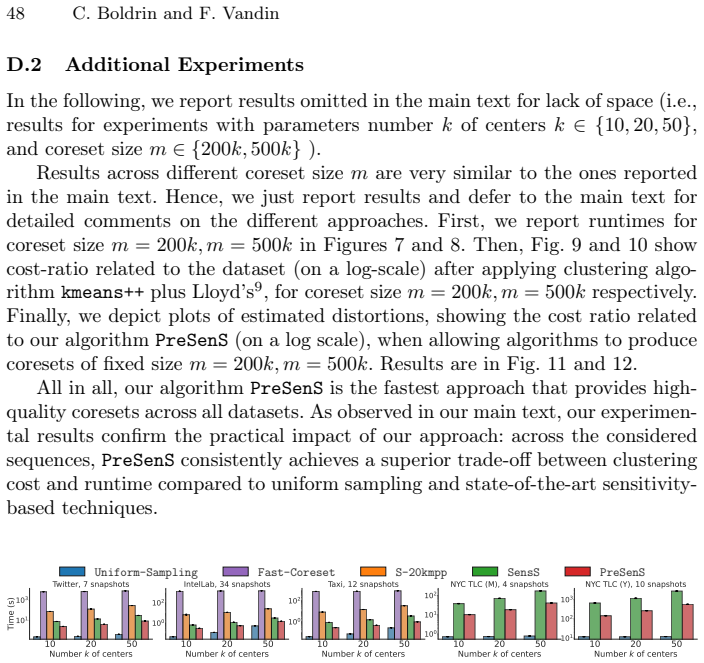
Summary. The paper introduces PreSenS, a sensitivity-sampling algorithm for Euclidean k-means coresets that replaces the usual bi-criteria approximation step with a predicted set of centers A. Theorem 2 shows that if cost(P,A) ≤ α OPT_k(P) and k ≤ |A| ≤ βk with α,β = O(polylog(k ε^{-1})), then m = Õ(k ε^{-2} min(√k, ε^{-2})) samples still yield an ε-coreset w.h.p., matching the optimal subset-coreset size of Bansal et al. Corollary 1 (via Ben-David’s statistical clustering framework) asserts that an (α,β)-bi-criteria solution computed on one large i.i.d. sample from an unknown distribution D remains an (O(α),β) solution on a later independent sample of comparable size. Experiments on five real snapshot sequences demonstrate that reusing centers from the first snapshot yields clustering costs competitive with recomputing k-means++ each time, while reducing total coreset-construction time by roughly 3.5–5×.
Significance. If the claims hold, the work supplies a practical and theoretically justified way to amortize the dominant cost of sensitivity sampling across a sequence of related datasets—an increasingly common setting (sensor streams, daily/monthly aggregates). The extension of the Bansal et al. coreset-size bound from constant-factor to polylog-factor approximations is a clean technical contribution that immediately justifies the use of noisy predictors. The transfer theorem is a careful, non-circular application of existing statistical-clustering machinery, and the experimental suite (means + 95 % CIs, multiple coreset sizes, distortion estimates, unique-point counts, publicly released C++ code) is thorough and reproducible. These strengths make the paper a solid addition to both the coreset literature and the algorithms-with-predictions literature.
minor comments (4)
- Several typographical errors appear in the main text and appendix (e.g., “unkwown”, “distorsions”, “PreSenS” inconsistently capitalized, “eO” vs. Õ). A careful proof-reading pass would improve readability.
- Figure 1 and Figure 2 use log-scale cost/distortion ratios; the absolute costs (or at least the absolute cost of the full-dataset baseline) would help readers judge practical relevance on the larger NYC TLC instances.
- Section 4.1 briefly discusses distribution drift and an additive discrepancy term, but never states an explicit quantitative bound. Adding a short corollary that makes the additive term precise would strengthen the “Relaxing the Fixed Distribution Assumption” paragraph.
- In Algorithm 1 the probability formula mixes four terms whose relative weights are fixed at 1/4; a one-sentence justification (or a pointer to the corresponding calculation in Bansal et al.) would help readers who have not memorized that paper.
Circularity Check
No significant circularity: coreset-size and transfer guarantees are derived from first-principles concentration/nets analysis and an external statistical-clustering model; predictions are an input modeling assumption, not a quantity defined by the target coreset error.
full rationale
The paper's strongest claims (Theorem 2 on coreset size under polylog-quality predicted centers, and Corollary 1 / Theorem 3 on transfer of bi-criteria centers across i.i.d. snapshots) do not reduce by construction to their inputs. Theorem 2 adapts the sensitivity-sampling analysis of Bansal et al. [4] (external FOCS 2024 work by different authors) by explicitly tracking the dependence of coreset size on the approximation factors α, β of the predicted centers A; the probability distribution P[p] is defined from A (Alg. 1), and the subsequent concentration, ring/band/type partitioning, cost-vector nets, and Gaussian chaining arguments are standard first-principles tools that do not fit parameters to the target ε-coreset error. Theorem 3 / Corollary 1 invoke the statistical clustering framework of Ben-David [5] (external) under an explicit i.i.d. same-distribution modeling assumption; the paper itself flags the limitation under distribution drift (Section 4.1) and quantifies the price of inaccurate predictions in Theorem 2 (size multiplies by β·max(1,α^{2})). Experiments evaluate on held-out later snapshots of public datasets and report degradation precisely when the prediction quality collapses (IntelLab). There is no self-definitional loop, no fitted parameter renamed as a prediction of a closely related quantity, and no load-bearing uniqueness theorem imported from the present authors. The single minor self-referential element is ordinary reuse of the same algorithmic template as the cited external sensitivity-sampling literature; it does not force the central claims. Score 1 reflects only the ordinary presence of self-citation of the algorithmic setting, not circularity of the derivation.
Assumptions & free parameters
assumptions (5)
- standard math Bernstein’s inequality and standard Gaussian max-expectation bounds (Facts 5–7)
- standard math Triangle inequality for squared Euclidean distances (Fact 4)
- domain assumption k-means admits a local and complete description scheme with constant multiplicative coverage (Ben-David 2007)
- domain assumption Successive point sets are drawn i.i.d. from a fixed unknown distribution D with OPT_{k'}(D) ≥ ν > 0
- domain assumption Distances may be assumed bounded in [0,1] (or rescaled by a constant Δ)
Cite this review
Pith. "Pith review of Sensitivity Sampling with Predictions for k-Means Clustering." pith.science (2026). https://pith.science/paper/E22USMWG
@misc{pith2026260704949,
  author       = {Pith},
  title        = {Pith review of: Sensitivity Sampling with Predictions for k-Means Clustering},
  year         = {2026},
  howpublished = {\url{https://pith.science/paper/E22USMWG}},
  note         = {Machine review of arXiv:2607.04949}
}
read the original abstract
We study the problem of k-means clustering on large datasets. The state-of-the-art for the problem is given by coresets-based approaches, which build small weighted summaries of the input and derive approximate solutions with rigorous quality guarantees from them. One of the most popular and advanced approaches to derive coresets for k-means is sensitivity sampling. However, sensitivity sampling requires to compute the importance of each input point with respect to the whole dataset over all possible choices of centers. Since the exact computation of such quantities is unfeasible, current approaches work by approximating the sensitivity values. Nevertheless, the runtime of such approaches is still impractical for large datasets. In this work, we propose to reduce the runtime of sensitivity-based approaches for k-means by leveraging predictions to approximate the importance of input points. We first formally prove that current theoretical results on coresets construction via sensitivity sampling hold for coarser approximations of sensitivities compared to the one required by existing approaches. This implies that even fairly noisy predictors can be leveraged for sensitivity-sampling approaches. We then propose a natural predictor, which applies to the common scenario where clustering is performed (over time) on a sequence of datasets from the same problem. We prove that when the datasets in the sequence come from the same (unknown) distribution, centers resulting in a low error on one dataset can be used as predictions for sensitivity sampling in subsequent datasets, with guarantees on their quality. We perform an extensive experimental evaluation showing that our approach significantly improves, in terms of clustering cost vs runtime, over uniform sampling and state-of-the-art sensitivity sampling approaches when applied to sequences of datasets.
Figures


Figures from the paper (9 more)




Reference graph
Works this paper leans on
-
[1]
Journal of Experimental Algorithmics (JEA)17, 2–1 (2012)
Ackermann,M.R.,Märtens,M.,Raupach,C.,Swierkot,K.,Lammersen,C.,Sohler, C.: Streamkm++ a clustering algorithm for data streams. Journal of Experimental Algorithmics (JEA)17, 2–1 (2012)
2012
-
[2]
Arthur, D., Vassilvitskii, S.: How slow is the k-means method? In: Proceedings of the twenty-second annual symposium on Computational geometry. pp. 144–153 (2006)
2006
-
[3]
In: Proceedings of the Eighteenth Annual ACM-SIAM Symposium on Discrete Algo- rithms
Arthur, D., Vassilvitskii, S.: k-means++: the advantages of careful seeding. In: Proceedings of the Eighteenth Annual ACM-SIAM Symposium on Discrete Algo- rithms. pp. 1027–1035. SODA ’07, Society for Industrial and Applied Mathematics, USA (2007)
2007
-
[4]
In: 2024 IEEE 65th Annual Symposium on Foundations of Computer Science (FOCS)
Bansal, N., Cohen-Addad, V., Prabhu, M., Saulpic, D., Schwiegelshohn, C.: Sensi- tivity sampling fork-means: Worst case and stability optimal coreset bounds. In: 2024 IEEE 65th Annual Symposium on Foundations of Computer Science (FOCS). pp. 1707–1723 (2024)
2024
-
[5]
Machine Learning66(2), 243–257 (2007)
Ben-David, S.: A framework for statistical clustering with constant time approxi- mation algorithms for k-median and k-means clustering. Machine Learning66(2), 243–257 (2007)
2007
-
[6]
Machine learning79(1), 151–175 (2010)
Ben-David, S., Blitzer, J., Crammer, K., Kulesza, A., Pereira, F., Vaughan, J.W.: A theory of learning from different domains. Machine learning79(1), 151–175 (2010)
2010
-
[7]
arXiv preprint arXiv:1612.00889 (2016)
Braverman, V., Feldman, D., Lang, H., Statman, A., Zhou, S.: New frameworks for offline and streaming coreset constructions. arXiv preprint arXiv:1612.00889 (2016)
arXiv 2016
-
[8]
In: Proceedings of the 2021 ACM-SIAM Symposium on Discrete Algorithms (SODA)
Braverman, V., Jiang, S.H.C., Krauthgamer, R., Wu, X.: Coresets for clustering in excluded-minor graphs and beyond. In: Proceedings of the 2021 ACM-SIAM Symposium on Discrete Algorithms (SODA). pp. 2679–2696. SIAM (2021) 18 C. Boldrin and F. Vandin
2021
Show all 40 references
-
[9]
In: 2025 IEEE 66th An- nual Symposium on Foundations of Computer Science (FOCS)
Charikar, M., Cohen-Addad, V., Gao, R., Grandoni, F., Le, E., Van Wijland, E.: An improved greedy approximation for (metric) k-means. In: 2025 IEEE 66th An- nual Symposium on Foundations of Computer Science (FOCS). pp. 233–240. IEEE (2025)
2025
-
[10]
In: Proceedings of the 54th Annual ACM SIGACT Symposium on Theory of Com- puting
Cohen-Addad, V., Esfandiari, H., Mirrokni, V., Narayanan, S.: Improved approx- imations for euclidean k-means and k-median, via nested quasi-independent sets. In: Proceedings of the 54th Annual ACM SIGACT Symposium on Theory of Com- puting. pp. 1621–1628 (2022)
2022
-
[11]
Advances in Neural In- formation Processing Systems35, 2679–2694 (2022)
Cohen-Addad, V., Green Larsen, K., Saulpic, D., Schwiegelshohn, C., Sheikh- Omar, O.A.: Improved coresets for euclideank-means. Advances in Neural In- formation Processing Systems35, 2679–2694 (2022)
2022
-
[12]
In: 2019 IEEE 60th Annual Symposium on Foundations of Computer Science (FOCS)
Cohen-Addad, V., Karthik, C.: Inapproximability of clustering in lp metrics. In: 2019 IEEE 60th Annual Symposium on Foundations of Computer Science (FOCS). pp. 519–539. IEEE (2019)
2019
-
[13]
In: Proceedings of the 54th Annual ACM SIGACT Symposium on Theory of Computing
Cohen-Addad, V., Larsen, K.G., Saulpic, D., Schwiegelshohn, C.: Towards opti- mal lower bounds for k-median and k-means coresets. In: Proceedings of the 54th Annual ACM SIGACT Symposium on Theory of Computing. pp. 1038–1051 (2022)
2022
-
[14]
In: Proceedings of the 53rd Annual ACM SIGACT Symposium on The- ory of Computing
Cohen-Addad, V., Saulpic, D., Schwiegelshohn, C.: A new coreset framework for clustering. In: Proceedings of the 53rd Annual ACM SIGACT Symposium on The- ory of Computing. pp. 169–182 (2021)
2021
-
[15]
Random Structures & Algorithms30(1-2), 226–256 (2007)
Czumaj, A., Sohler, C.: Sublinear-time approximation algorithms for clustering via random sampling. Random Structures & Algorithms30(1-2), 226–256 (2007)
2007
-
[16]
Dasgupta, S.: The hardness of k-means clustering (2008)
2008
-
[17]
accuracy tradeoffs for clustering big data
Draganov, A., Saulpic, D., Schwiegelshohn, C.: Settling time vs. accuracy tradeoffs for clustering big data. Proceedings of the ACM on Management of Data2(3), 1–25 (2024)
2024
-
[18]
In: International Conference on Learning Representations (2022)
Ergun, J.C., Feng, Z., Silwal, S., Woodruff, D., Zhou, S.: Learning-augmentedk- means clustering. In: International Conference on Learning Representations (2022)
2022
-
[19]
Sampling techniques for supervised or unsupervised tasks pp
Feldman, D.: Core-sets: Updated survey. Sampling techniques for supervised or unsupervised tasks pp. 23–44 (2020)
2020
-
[20]
In: Proceedings of the forty-third annual ACM symposium on Theory of computing
Feldman, D., Langberg, M.: A unified framework for approximating and clustering data. In: Proceedings of the forty-third annual ACM symposium on Theory of computing. pp. 569–578 (2011)
2011
-
[21]
SIAM Journal on Com- puting49(3), 601–657 (2020)
Feldman, D., Schmidt, M., Sohler, C.: Turning big data into tiny data: Constant- size coresets for k-means, pca, and projective clustering. SIAM Journal on Com- puting49(3), 601–657 (2020)
2020
-
[22]
In: Algorithms–ESA 2013: 21st Annual European Symposium, Sophia Antipolis, France, September 2-4, 2013
Fichtenberger, H., Gillé, M., Schmidt, M., Schwiegelshohn, C., Sohler, C.: Bico: Birch meets coresets for k-means clustering. In: Algorithms–ESA 2013: 21st Annual European Symposium, Sophia Antipolis, France, September 2-4, 2013. Proceedings
2013
-
[23]
pp. 481–492. Springer (2013)
2013
-
[24]
Spatial Statistics14, 491–504 (2015)
Helwig, N.E., Gao, Y., Wang, S., Ma, P.: Analyzing spatiotemporal trends in social media data via smoothing spline analysis of variance. Spatial Statistics14, 491–504 (2015)
2015
-
[25]
UCI Machine Learning Repository (2015), DOI: https://doi.org/10.24432/C5RS5J
Helwig, N.E., Gao, Y., Wang, S., Ma, P.: Twitter Geospatial Data. UCI Machine Learning Repository (2015), DOI: https://doi.org/10.24432/C5RS5J
2015 doi
-
[26]
CRC press (2015)
Hennig, C., Meila, M., Murtagh, F., Rocci, R.: Handbook of cluster analysis. CRC press (2015)
2015
-
[27]
Huang, J., Feng, Q., Huang, Z., Zhang, Z., Xu, J., Wang, J.: New algorithms for the learning-augmentedk-meansproblem.In:TheThirteenthInternationalConference on Learning Representations (2025) Sensitivity Sampling with Predictions fork-Means Clustering 19
2025
-
[28]
In: International Conference on Machine Learning
Huang, L., Jiang, S.H.C., Lou, J.: The power of uniform sampling for k-median. In: International Conference on Machine Learning. pp. 13933–13956. PMLR (2023)
2023
-
[29]
In: Proceedings of the 56th Annual ACM Symposium on Theory of Computing
Huang, L., Li, J., Wu, X.: On optimal coreset construction for euclidean (k, z)- clustering. In: Proceedings of the 56th Annual ACM Symposium on Theory of Computing. pp. 1594–1604 (2024)
2024
-
[30]
In: Proceedings of the 52nd Annual ACM SIGACT Symposium on Theory of Computing
Huang, L., Vishnoi, N.K.: Coresets for clustering in euclidean spaces: importance sampling is nearly optimal. In: Proceedings of the 52nd Annual ACM SIGACT Symposium on Theory of Computing. pp. 1416–1429 (2020)
2020
-
[31]
URL http://www
Kamath, G.: Bounds on the expectation of the maximum of samples from a gaus- sian. URL http://www. gautamkamath. com/writings/gaussian max. pdf10(20- 30), 31 (2015)
2015
-
[32]
IEEE transactions on information theory28(2), 129–137 (1982)
Lloyd, S.: Least squares quantization in pcm. IEEE transactions on information theory28(2), 129–137 (1982)
1982
-
[33]
Advances in Neural Information Processing Systems33, 16142– 16152 (2020)
Makarychev, K., Reddy, A., Shan, L.: Improved guarantees for k-means++ and k- means++ parallel. Advances in Neural Information Processing Systems33, 16142– 16152 (2020)
2020
-
[34]
In: 36th International Conference on Al- gorithmic Learning Theory (2024)
Mazzetto, A., Ceccarello, M., Pietracaprina, A., Pucci, G., Upfal, E.: Center-based approximation of a drifting distribution. In: 36th International Conference on Al- gorithmic Learning Theory (2024)
2024
-
[35]
Machine Learning56(1), 61–87 (2004)
Meyerson, A., O’callaghan, L., Plotkin, S.: A k-median algorithm with running time independent of data size. Machine Learning56(1), 61–87 (2004)
2004
-
[36]
Communications of the ACM65(7), 33–35 (2022)
Mitzenmacher, M., Vassilvitskii, S.: Algorithms with predictions. Communications of the ACM65(7), 33–35 (2022)
2022
-
[37]
UCI Machine Learning Repository (2013), dOI: https://doi.org/10.24432/C55W25
Moreira-Matias, L., Ferreira, M., Mendes-Moreira, J.: Taxi service trajectory - prediction challenge, ecml pkdd 2015. UCI Machine Learning Repository (2013), dOI: https://doi.org/10.24432/C55W25
2015 doi
-
[38]
KI-Künstliche Intel- ligenz32, 37–53 (2018)
Munteanu, A., Schwiegelshohn, C.: Coresets-methods and history: A theoreticians design pattern for approximation and streaming algorithms. KI-Künstliche Intel- ligenz32, 37–53 (2018)
2018
-
[39]
In: The Eleventh International Con- ference on Learning Representations (2023)
Nguyen, T.D., Chaturvedi, A., Nguyen, H.: Improved learning-augmented algo- rithms for k-means and k-medians clustering. In: The Eleventh International Con- ference on Learning Representations (2023)
2023
-
[40]
interact
Schwiegelshohn, C., Sheikh-Omar, O.A.: An empirical evaluation of k-means core- sets. In: 30th Annual European Symposium on Algorithms, ESA 2022. pp. 84–1. Dagstuhl Publishing (2022) 20 C. Boldrin and F. Vandin A Facts and Properties In the following section, we report some us...
2022
Reviewed July 11, 2026 · model on record in the stance chip above.
Discussion (0). Sign in to comment.