REVIEW 3 major objections 4 minor 65 references
YOLOv14: Adaptive Real-Time Object Detection for Diverse Imaging Conditions
T0 review · 3 major / 4 minor · reviewed 2026-08-10 · deepseek-v4-flash
Pith's one-line read YOLOv14 claims that a single real-time detector can keep high accuracy on fisheye, panorama, drone, and game-rendered inputs, reaching 49.1 mAP on COCO at 2.91 ms and adding +4.1 to +26.1 mAP on four cross-domain benchmarks.
desk verdict The COCO result is plausible but the cross-domain gains are train-on-test numbers, so the headline claims outrun the evidence. read the letter →
The pith
A machine-rendered reading of the paper's core claim, the machinery that carries it, and where it could break.
The reading
What carries the argument
The load-bearing mechanism is windowed Deformable Area-Attention (D-AAttn): a three-layer CNN predicts a dense two-channel offset field, and self-attention is computed inside local windows whose sampling points follow the predicted deformation, with shifted windows alternating across layers to allow cross-window information flow. A regularization term pulls the offsets toward an initialization estimated from synthetic fisheye transformations. The other three modules, Game2Real alignment (data-level stylization, AdaIN feature normalization, and a DANN-style adversarial loss), view-aware contrastive learning with adaptive temperature, and scene-adaptive augmentation routing with dynamic loss balancing, condition the same backbone on domain, viewpoint, and scene type. Together they implement the paper's hypothesis that distortion, domain shift, viewpoint, and scene diversity can be handled by input-adaptive sampling and normalization rather than by separate models per domain.
What would settle it
Run the released model on real fisheye data such as WoodScape, on real equirectangular panoramas, and on game frames from engines or titles not used for stylization-parameter estimation, measuring COCO-protocol mAP against YOLOv12s; if the reported advantages shrink to near zero or reverse, the synthetic benchmarks are not faithful proxies and the claimed generalization to real deployment conditions fails.
Extended reading notes
Core claim
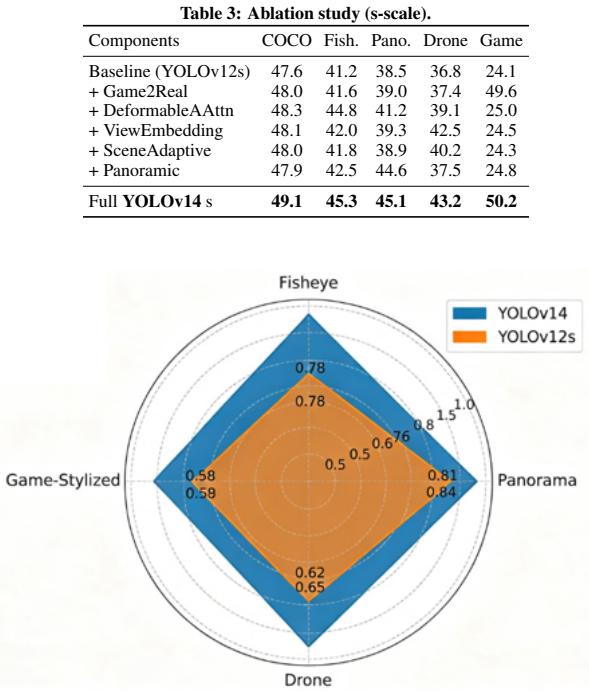
On its own terms, the paper's central discovery is that input-adaptive feature sampling and normalization can remove the implicit pinhole-camera assumption in a modern YOLO detector. YOLOv14 is claimed to surpass YOLOv12s by +1.5 mAP on COCO val2017 and to beat both the standard detector and two unsupervised domain-adaptation baselines on every one of the four cross-domain benchmarks. The mechanism is a set of four complementary modules: D-AAttn (windowed deformable area-attention with shifted windows) for geometric distortion, multi-level Game2Real alignment (data stylization, AdaIN, and adversarial confusion with progressive training) for domain shift, view-aware contrastive learning with adaptive temperature for viewpoint invariance, and scene-adaptive augmentation routing with dynamic loss weighting for scene diversity. The paper reports the combination is super-additive, with ablations showing each module contributes most on its own domain, and the full model reaches 49.1 COCO mAP at 2.91 ms on T4.
Load-bearing premise
The synthetic transformations used to build the fisheye, panorama, and game benchmarks come from the same distribution families YOLOv14 trains on, so the claimed cross-domain gains depend on those synthetic transformations faithfully representing real fisheye, panorama, and game-rendered imagery.
Editorial extensions
If this is right
- A single model can replace per-domain specialists: the same weights serve pinhole, fisheye, panorama, and drone views at 344 FPS on T4.
- Source-domain augmentation that uses target-domain visual statistics can beat UDA baselines on the constructed benchmarks, offering a different trade-off for practitioners who have a few reference images of the deployment style.
- The four components are complementary and super-additive: each ablation contributes most on its own target domain, while the full model improves on all domains at once.
- The constructed benchmark suite (COCO-Fisheye, COCO-Panorama, Game-Stylized COCO, plus VisDrone) provides a repeatable evaluation protocol with explicit box-warping and panorama-projection steps, making cross-domain detection comparisons reproducible.
- The measured overhead of the adaptive modules is 0.49 ms on T4, so the accuracy gains do not break real-time operation.
Reading between the lines
- The +26.1 mAP gain on the game benchmark is likely an upper bound for real-world game frames: the stylization parameters are estimated from reference game images of the same style used in the synthetic test set, and the paper itself notes real-game performance is lower.
- If the synthetic-to-real gap proves small, the same design pattern could extend to other non-ideal inputs such as thermal, low-light, or lidar-projected imagery by re-estimating the offset initialization and stylization statistics and adding a new entry to the scene-routing table.
- The discrete six-class view embedding (pinhole, fisheye, panoramic, drone, BEV, ground) could be generalized to a continuous pose or distortion-strength embedding, which would handle mixed or intermediate distortions more gracefully.
- The scene classifier's routing suggests a generic 'mixture of augmentations' recipe for dense prediction tasks, since the router selects per-input augmentation and loss weights rather than requiring a fixed global policy.
Editorial analysis
A structured set of objections, weighed in public.
Referee Report
Summary. The paper proposes YOLOv14, an extension of YOLOv12 with four adaptive components: windowed deformable area-attention (D-AAttn), multi-level Game2Real alignment, view-aware contrastive learning with adaptive temperature, and scene-adaptive augmentation with dynamic loss balancing. The authors report 49.1 mAP on COCO val2017 at 2.91 ms on a T4 GPU and claim substantial gains on synthetic fisheye (+4.1 mAP), panorama (+6.6 mAP), drone (+6.4 mAP), and game-stylized (+26.1 mAP) benchmarks. The paper also releases code and models.
Significance. If the cross-domain results held on independent real-world data, the integrated framework would be a meaningful step toward real-time detection under non-ideal imaging conditions. The standard COCO result is plausible and consistent with incremental YOLO-style improvements, and the paper ships a code-release commitment that supports reproducibility. However, the headline cross-domain claims rest on self-generated synthetic benchmarks whose generating distributions are used during training, and the paper itself concedes in §5 that real-game performance is lower. Consequently, the claimed generalization to fisheye, panorama, and game domains is unverified, which limits the significance of the contributions as stated.
major comments (3)
- [§3.9.1, §3.9.2, §3.9.4; §3.2 Eq. (2); §3.3; §3.5] The headline cross-domain gains on COCO-Fisheye, COCO-Panorama, and Game-Stylized COCO are measured on benchmarks generated by the same transformation families used during training, making the numbers in Table 2 train-on-test-distribution results rather than evidence of generalization. The D-AAttn offset initializer Δ_init in Eq. (2) is estimated from synthetic fisheye transformations, the GameCharacterStylization parameters in §3.3 define both the training augmentation and the test renderer, and the scene classifier in §3.5 is trained on synthetic images from these families. The paper's own Limitations section (§5) concedes that real-game performance is lower, confirming that the +26.1 mAP Game result does not transfer. Independent real-world evaluation (e.g., WoodScape for fisheye, a genuine panorama dataset, and real game footage) is required to support the abstract's claim of substantial gains.
- [§4.1 vs. Appendix A.8] The description of the UDA baselines is self-contradictory. §4.1 states that MCD and SWDA are run without the Game2Real data-level stylization to keep them as pure UDA methods, while Appendix A.8 specifies that for Game dataset evaluation SWDA uses Game stylization as its strong augmentation. Because the Game column of Table 2 is the basis for the +26.1 mAP claim, this inconsistency either handicaps SWDA unfairly or gives YOLOv14s an unfair advantage. The protocol must be stated unambiguously and the comparison rerun under a single consistent set of conditions.
- [§3.9.2 and §A.3] The COCO-Panorama construction is not a physically valid projection of a single pinhole image into a 360° equirectangular panorama: a single 640×640 perspective image cannot define the content of a 1280×640 field of view, and the sampling procedure in A.3 effectively tiles or extrapolates unknown regions. This makes the +6.6 mAP panorama gain an artifact of the specific synthetic rendering rather than a measure of performance under real equirectangular capture. A real 360° dataset with ground-truth boxes, or a well-posed generation protocol that explicitly models the scene, is needed.
minor comments (4)
- [Table 1] The YOLOv14s row is misaligned: the latency and mAP values appear concatenated as “2.9149.1344,” which obscures the reported 2.91 ms and 49.1 mAP; the table should be reformatted.
- [§5] The Limitations section mentions the SUN360 dataset as a heuristic proxy, but SUN360 is never described or evaluated in the paper; either add the corresponding experiment or remove the mention.
- [§4.4] The per-module latency sum (0.58 ms) is larger than the observed full-model increase of 0.49 ms, and the 0.09 ms difference is attributed to kernel fusion without explanation; please clarify how kernel fusion accounts for the discrepancy.
- [§3.8 and Table 3] The ablation study reports each component added to the baseline but does not report leave-one-out ablations, so the claim that the components are complementary and yield super-additive gains is not directly supported by the presented data.
Circularity Check
Cross-domain gains on fisheye and game benchmarks are self-referential: the test generators are the same transformations used to fit D-AAttn offsets and to train Game2Real stylization; COCO val2017 and VisDrone results remain independent.
-
fitted input called prediction
[§3.2 (Eq. 2) and §3.9.1]
"Loffset = λreg · 1/HW Σ∥∆i,j −∆init,i,j∥2², where ∆init is estimated from synthetic fisheye transformations and λreg = 0.01. ... We apply barrel distortion k ∈ {0.10,0.15,0.20} to COCO val2017. The transformation is rout = rin(1 + k∥rin∥2)."
Eq. 2 pulls the learned deformation field toward an initializer fit to the same synthetic fisheye barrel-distortion family that generates the COCO-Fisheye test set. The reported fisheye improvements (+4.1 mAP overall; +3.6 mAP D-AAttn ablation) are therefore measurements of a prior computed from the test-generating transform, not an independent test on real fisheye imagery; the paper cites WoodScape but does not evaluate on it.
-
self definitional
[§3.3 (Level 1), §3.9.4, Limitations]
"GameCharacterStylization applies: posterization (bit depth b∈[3,6]), unsharp masking (strength 0.5–1.0), saturation boost (×1.5–1.8), and contrast adjustment (α∈[1.2,1.8]). The parameters are estimated from a small set (N=50) of reference game images ... We apply global game-style rendering to COCO val2017 images. ... Limitations: The Game benchmark is synthetic; real-game performance is lower."
The Game-Stylized COCO benchmark is produced by the same parameterized GameCharacterStylization used as the Level-1 data-level training augmentation, with stylization parameters estimated from reference game images of the same visual family. The +26.1 mAP gain is thus a train-on-test-distribution number, not evidence of adaptation to real game-rendered inputs. The paper's own limitation states real-game performance is lower, confirming that the headline game delta is a self-generated stress test rather than an independent cross-domain prediction.
full rationale
The core COCO val2017 result (49.1 mAP) is a standard, independent benchmark comparison: the model is trained on COCO train2017 and evaluated on COCO val2017, with no circularity. The VisDrone result is also real data. However, the two headline cross-domain gains that dominate the abstract are self-referential by construction. In §3.2, Eq. (2) regularizes the deformable offsets toward Δ_init 'estimated from synthetic fisheye transformations', and the COCO-Fisheye test set is generated by the same barrel-distortion family; the reported +4.1/+3.6 fisheye improvements are therefore partly a fit to the test-generating transform. In §3.3, GameCharacterStylization defines both the training augmentation and, via §3.9.4, the Game-Stylized COCO test set; the +26.1 mAP game delta is a within-distribution synthetic result, and the paper's own limitations concede that 'real-game performance is lower'. The COCO-Panorama benchmark is also synthetic, and while the paper does not explicitly state that the panorama generator was used in training, the scene classifier is trained on 2,000 synthetic panorama images, so the panorama route is likewise not an external test. The SWDA/MCD baseline comparison is also internally inconsistent (§4.1 says they receive no Game2Real stylization, while Appendix A.8 says SWDA uses Game stylization as its strong augmentation for Game evaluation), which further weakens the game comparison. No self-citation chain or imported uniqueness theorem is load-bearing. I score 6 rather than 8 because the COCO val2017 and VisDrone results are real independent benchmarks, so only the synthetic cross-domain deltas are substantially circular.
Assumptions & free parameters
free parameters (8)
- Loss weights lambda_reg, lambda_1, lambda_2 =
0.01, 0.1 (annealed), 0.05
- Temperature schedule tau_min, tau_max, beta =
0.05, 0.5, 0.01
- Window size W_A =
8
- View embedding dimension d_emb =
64
- Game stylization parameters =
bit depth b in [3,6], unsharp 0.5-1.0, saturation x1.5-1.8, contrast alpha in [1.2,1.8]
- Fisheye distortion levels k =
0.10, 0.15, 0.20
- SphereAAttn head allocation =
4 polar heads, 8 equatorial heads
- Class-balanced sampling counts =
3 samples per class across 2-3 views
assumptions (3)
- domain assumption Synthetic transformations (barrel distortion, equirectangular projection, game stylization) applied to COCO images are faithful proxies for real fisheye, panorama, and game-rendered inputs.
- ad hoc to paper The method may use target-domain statistics at training time via source-domain augmentation.
- ad hoc to paper The D-AAttn offset initializer estimated from synthetic fisheye transformations improves performance on real fisheye inputs.
Cite this review
Pith. "Pith review of YOLOv14: Adaptive Real-Time Object Detection for Diverse Imaging Conditions." pith.science (2026). https://pith.science/paper/E27RWFSJ
@misc{pith2026260804720,
  author       = {Pith},
  title        = {Pith review of: YOLOv14: Adaptive Real-Time Object Detection for Diverse Imaging Conditions},
  year         = {2026},
  howpublished = {\url{https://pith.science/paper/E27RWFSJ}},
  note         = {Machine review of arXiv:2608.04720}
}
read the original abstract
Real-time object detectors achieve remarkable accuracy under controlled conditions, yet degrade sharply on non-ideal inputs: fisheye distortion, game-renderedcharacters, aerial viewpoints, and 360{\deg}panoramas. We present YOLOv14, a detection framework with four adaptive mechanisms designed for specific types of inputvariation:(1) Deformable Area-Attention with windowed computation and shiftedwindows for geometric distortion;(2) Multi-level Game2Real Alignment with progressive adversarial training for domain shift;(3) View-Aware Contrastive Learning with adaptive temperature for viewpoint invariance; and (4) Scene-Adaptive Augmentation with dynamic loss balancing for scene diversity. Together, YOLOv14 achieves 49.1 mAP on COCO val2017 at 2.91 ms (T4 GPU), and delivers substantial gains on fisheye (+4.1 mAP), panorama (+6.6 mAP), drone (+6.4 mAP), andour synthesized game-character benchmark (+26.1 mAP). We release code and models to facilitate reproducible research.
Figures


Figures from the paper (4 more)


Reference graph
Works this paper leans on
-
[1]
You only look once: Unified, real-time object detection
J. Redmon, S. Divvala, R. Girshick, and A. Farhadi. “You only look once: Unified, real-time object detection.” InCVPR, 2016
work page 2016
-
[2]
YOLOv8: A new state-of-the-art real-time object detection model
Ultralytics. “YOLOv8: A new state-of-the-art real-time object detection model.” https:// github.com/ultralytics/ultralytics, 2023
work page 2023
-
[3]
YOLOv12: Attention-centric real-time object detectors
Y . Tian, Q. Ye, and D. Doermann. “YOLOv12: Attention-centric real-time object detectors.” arXiv:2406.00430, 2024
arXiv 2024
-
[4]
YOLOv3: An incremental improvement
J. Redmon and A. Farhadi. “YOLOv3: An incremental improvement.”arXiv:1804.02767, 2018
arXiv 2018
-
[5]
YOLOv4: Optimal speed and accuracy of object detection
A. Bochkovskiy, C.-Y . Wang, and H.-Y . M. Liao. “YOLOv4: Optimal speed and accuracy of object detection.”arXiv:2004.10934, 2020
arXiv 2004
-
[6]
YOLOX: Exceeding YOLO series in 2021
Z. Ge, S. Liu, F. Wang, Z. Li, and J. Sun. “YOLOX: Exceeding YOLO series in 2021.” arXiv:2107.08430, 2021
arXiv 2021
-
[7]
YOLOv6: A single-stage object detection framework for industrial applications
C. Li, L. Li, H. Jiang, K. Weng, Y . Geng, L. Li, Z. Ke, Q. Li, M. Cheng, W. Nie, et al. “YOLOv6: A single-stage object detection framework for industrial applications.”arXiv:2209.02976, 2022
arXiv 2022
-
[8]
YOLOv7: Trainable bag-of-freebies sets new state-of-the-art for real-time object detectors
C.-Y . Wang, A. Bochkovskiy, and H.-Y . M. Liao. “YOLOv7: Trainable bag-of-freebies sets new state-of-the-art for real-time object detectors.” InCVPR, 2023
work page 2023
Show all 65 references
-
[9]
PP-YOLOE: An evolved version of YOLO
S. Xu, X. Wang, W. Lv, Q. Chang, C. Cui, K. Deng, G. Wang, Q. Dang, S. Du, and Y . Wei. “PP-YOLOE: An evolved version of YOLO.”arXiv:2203.16250, 2022
2022 arXiv
-
[10]
Gold-YOLO: Efficient object detector via gather-and-distribute mechanism
C. Wang, W. He, Y . Nie, J. Guo, C. Liu, Y . Wang, and K. Han. “Gold-YOLO: Efficient object detector via gather-and-distribute mechanism.” InNeurIPS, 2023
2023
-
[11]
YOLOv9: Learning what you want to learn using programmable gradient information
C.-Y . Wang, I.-H. Yeh, and H.-Y . M. Liao. “YOLOv9: Learning what you want to learn using programmable gradient information.”arXiv:2402.13616, 2024
2024 arXiv
-
[12]
YOLOv10: Real-time end-to-end object detection
A. Wang, H. Chen, L. Liu, K. Chen, Z. Lin, J. Han, and G. Ding. “YOLOv10: Real-time end-to-end object detection.”arXiv:2405.14458, 2024
2024 arXiv
-
[13]
FCOS: Fully convolutional one-stage object detection
Z. Tian, C. Shen, H. Chen, and T. He. “FCOS: Fully convolutional one-stage object detection.” InICCV, 2019
2019
-
[14]
EfficientDet: Scalable and efficient object detection
M. Tan, R. Pang, and Q. V . Le. “EfficientDet: Scalable and efficient object detection.” InCVPR, 2020
2020
-
[15]
End-to-end object detection with transformers
N. Carion, F. Massa, G. Synnaeve, N. Usunier, A. Kirillov, and S. Zagoruyko. “End-to-end object detection with transformers.” InECCV, 2020
2020
-
[16]
DINO: DETR with improved denoising anchor boxes for end-to-end object detection
H. Zhang, F. Li, S. Liu, L. Zhang, H. Su, J. Zhu, L. M. Ni, and H.-Y . Shum. “DINO: DETR with improved denoising anchor boxes for end-to-end object detection.” InICLR, 2022
2022
-
[17]
SSD: Single shot multibox detector
W. Liu, D. Anguelov, D. Erhan, C. Szegedy, S. Reed, C.-Y . Fu, and A. C. Berg. “SSD: Single shot multibox detector.” InECCV, 2016
2016
-
[18]
Feature pyramid networks for object detection
T.-Y . Lin, P. Dollár, R. Girshick, K. He, B. Hariharan, and S. Belongie. “Feature pyramid networks for object detection.” InCVPR, 2017
2017
-
[19]
Deformable DETR: Deformable transformers for end-to-end object detection
X. Zhu, W. Su, L. Lu, B. Li, X. Wang, and J. Dai. “Deformable DETR: Deformable transformers for end-to-end object detection.” InICLR, 2021
2021
-
[20]
Deformable convolutional networks
J. Dai, H. Qi, Y . Xiong, Y . Li, G. Zhang, H. Hu, and Y . Wei. “Deformable convolutional networks.” InICCV, 2017. 9
2017
-
[21]
Deformable ConvNets v2: More deformable, better results
X. Zhu, H. Hu, S. Lin, and J. Dai. “Deformable ConvNets v2: More deformable, better results.” InCVPR, 2019
2019
-
[22]
Vision transformer with deformable attention
Z. Xia, X. Pan, S. Song, L. Li, and G. Huang. “Vision transformer with deformable attention.” InCVPR, 2022
2022
-
[23]
CSWin Trans- former: A general vision transformer backbone with cross-shaped windows
X. Dong, J. Bao, D. Chen, W. Zhang, N. Yu, L. Yuan, D. Chen, and B. Guo. “CSWin Trans- former: A general vision transformer backbone with cross-shaped windows.” InCVPR, 2022
2022
-
[24]
Domain adaptive faster R-CNN for object detection in the wild
Y . Chen, W. Li, C. Sakaridis, D. Dai, and L. Van Gool. “Domain adaptive faster R-CNN for object detection in the wild.” InCVPR, 2018
2018
-
[25]
Domain-adversarial training of neural networks
Y . Ganin, E. Ustinova, H. Ajakan, P. Germain, H. Larochelle, F. Laviolette, M. Marchand, and V . Lempitsky. “Domain-adversarial training of neural networks.”JMLR, 2016
2016
-
[26]
Deep unsupervised domain adaptation for object detection
S. Li, C.-H. Lin, B. Price, S. Cohen, and H. Yang. “Deep unsupervised domain adaptation for object detection.”IEEE TPAMI, 2020
2020
-
[27]
Unpaired image-to-image translation using cycle-consistent adversarial networks
J.-Y . Zhu, T. Park, P. Isola, and A. A. Efros. “Unpaired image-to-image translation using cycle-consistent adversarial networks.” InICCV, 2017
2017
-
[28]
Maximum classifier discrepancy for unsu- pervised domain adaptation
K. Saito, K. Watanabe, Y . Ushiku, and T. Harada. “Maximum classifier discrepancy for unsu- pervised domain adaptation.” InCVPR, 2018
2018
-
[29]
Conditional adversarial domain adaptation
M. Long, Z. Cao, J. Wang, and M. I. Jordan. “Conditional adversarial domain adaptation.” In NeurIPS, 2018
2018
-
[30]
DeepJDOT: Deep joint distribution optimal transport for unsupervised domain adaptation
B. B. Damodaran, B. Kellenberger, R. Flamary, D. Tuia, and N. Courty. “DeepJDOT: Deep joint distribution optimal transport for unsupervised domain adaptation.” InECCV, 2018
2018
-
[31]
Domain generalization: A survey
K. Zhou, Z. Liu, Y . Qiao, T. Xiang, and C. C. Loy. “Domain generalization: A survey.”IEEE TPAMI, 2022
2022
-
[32]
Object detection in aerial images: A large-scale benchmark and challenges
J. Ding, N. Xue, G.-S. Xia, and D. Dai. “Object detection in aerial images: A large-scale benchmark and challenges.”IEEE TPAMI, 2021
2021
-
[33]
Remote sensing object detection meets deep learning: A survey
X. Zhang, Y . Zhou, and J. Pan. “Remote sensing object detection meets deep learning: A survey.” IEEE TGRS, 2023
2023
-
[34]
WoodScape: A multi-task, multi-camera fisheye dataset for autonomous driving
S. Yogamani, C. Hughes, J. Horgan, G. Sistu, P. Varley, D. O’Dea, M. Uricár, J. Millet, P. D. L. Rivas, S. P. K. M. et al. “WoodScape: A multi-task, multi-camera fisheye dataset for autonomous driving.” InICCV Workshops, 2019
2019
-
[35]
OmniDet: Surround view camera based multi-task perception system for autonomous driving
V . R. Kumar, S. Milz, M. Witt, H. Lutz, and C. Maier. “OmniDet: Surround view camera based multi-task perception system for autonomous driving.” InIROS, 2021
2021
-
[36]
AutoAugment: Learning augmentation strategies from data
E. D. Cubuk, B. Zoph, D. Mane, V . Vasudevan, and Q. V . Le. “AutoAugment: Learning augmentation strategies from data.” InCVPR, 2019
2019
-
[37]
RandAugment: Practical automated data augmentation with a reduced search space
E. D. Cubuk, B. Zoph, J. Shlens, and Q. V . Le. “RandAugment: Practical automated data augmentation with a reduced search space.” InCVPR Workshops, 2020
2020
-
[38]
TrivialAugment: Tuning-free yet state-of-the-art data augmentation
S. G. Müller and F. Hutter. “TrivialAugment: Tuning-free yet state-of-the-art data augmentation.” InICCV, 2021
2021
-
[39]
Training generative adversarial networks with limited data
T. Karras, M. Aittala, J. Hellsten, S. Laine, J. Lehtinen, and T. Aila. “Training generative adversarial networks with limited data.” InNeurIPS, 2020
2020
-
[40]
mixup: Beyond empirical risk mini- mization
H. Zhang, M. Cisse, Y . N. Dauphin, and D. Lopez-Paz. “mixup: Beyond empirical risk mini- mization.” InICLR, 2018
2018
-
[41]
CutMix: Regularization strategy to train strong classifiers with localizable features
S. Yun, D. Han, S. J. Oh, S. Chun, J. Choe, and Y . Yoo. “CutMix: Regularization strategy to train strong classifiers with localizable features.” InICCV, 2019
2019
-
[42]
Learning data augmentation strategies for object detection
B. Zoph, E. D. Cubuk, G. Ghiasi, T.-Y . Lin, J. Shlens, and Q. V . Le. “Learning data augmentation strategies for object detection.” InECCV, 2020. 10
2020
-
[43]
Generalized intersec- tion over union: A metric and a loss for bounding box regression
H. Rezatofighi, N. Tsoi, J. Gwak, A. Sadeghian, I. Reid, and S. Savarese. “Generalized intersec- tion over union: A metric and a loss for bounding box regression.” InCVPR, 2019
2019
-
[44]
Generalized focal loss: Learning qualified and distributed bounding boxes for dense object detection
X. Li, W. Wang, L. Wu, S. Chen, X. Hu, J. Li, J. Tang, and J. Yang. “Generalized focal loss: Learning qualified and distributed bounding boxes for dense object detection.” InNeurIPS, 2020
2020
-
[45]
Distance-IoU loss: Faster and better learning for bounding box regression
Z. Zheng, P. Wang, W. Liu, J. Li, R. Ye, and D. Ren. “Distance-IoU loss: Faster and better learning for bounding box regression.” InAAAI, 2020
2020
-
[46]
SIoU loss: More powerful learning for bounding box regression
Z. Gevorgyan. “SIoU loss: More powerful learning for bounding box regression.”arXiv, 2022
2022
-
[47]
OTA: Optimal transport assignment for object detection
Z. Ge, S. Liu, Z. Li, O. Yoshie, and J. Sun. “OTA: Optimal transport assignment for object detection.” InCVPR, 2021
2021
-
[48]
VarifocalNet: An IoU-aware dense object detector
H. Zhang, Y . Wang, F. Dayoub, and N. Sünderhauf. “VarifocalNet: An IoU-aware dense object detector.” InCVPR, 2021
2021
-
[49]
Analysis of representations for domain adaptation
S. Ben-David, J. Blitzer, K. Crammer, and F. Pereira. “Analysis of representations for domain adaptation.” InNeurIPS, 2006
2006
-
[50]
A theory of learning from different domains
S. Ben-David, J. Blitzer, K. Crammer, A. Kulesza, F. Pereira, and J. W. Vaughan. “A theory of learning from different domains.”Machine Learning, 2010
2010
-
[51]
Domain adaptation: Learning bounds and algorithms
Y . Mansour, M. Mohri, and A. Rostamizadeh. “Domain adaptation: Learning bounds and algorithms.” InCOLT, 2009
2009
-
[52]
Foundations of Machine Learning
M. Mohri, A. Rostamizadeh, and A. Talwalkar. “Foundations of Machine Learning.” MIT Press, 2nd edition, 2018
2018
-
[53]
On learning invariant representations for domain adaptation
H. Zhao, R. T. Des Combes, K. Zhang, and G. Gordon. “On learning invariant representations for domain adaptation.” InICML, 2019
2019
-
[54]
Domain adaptation in regression
C. Cortes and M. Mohri. “Domain adaptation in regression.” InALT, 2011
2011
-
[55]
Microsoft COCO: Common objects in context
T.-Y . Lin, M. Maire, S. Belongie, J. Hays, P. Perona, D. Ramanan, P. Dollár, and C. L. Zitnick. “Microsoft COCO: Common objects in context.” InECCV, 2014
2014
-
[56]
Recognizing scene viewpoint using panoramic place representation
J. Xiao, K. A. Ehinger, A. Oliva, and A. Torralba. “Recognizing scene viewpoint using panoramic place representation.” InCVPR, 2012
2012
-
[57]
VisDrone-DET2021: The vision meets drone object detection challenge results
Y . Cao, Z. He, L. Wang, W. Wang, Y . Yuan, D. Zhang, J. Zhang, P. Zhu, L. Van Gool, J. Han, et al. “VisDrone-DET2021: The vision meets drone object detection challenge results.” InICCV Workshops, 2021
2021
-
[58]
Arbitrary style transfer in real-time with adaptive instance normal- ization
X. Huang and S. Belongie. “Arbitrary style transfer in real-time with adaptive instance normal- ization.” InICCV, 2017
2017
-
[59]
DETRs beat YOLOs on real-time object detection
Y . Zhao, W. Lv, S. Xu, J. Wei, G. Wang, Q. Dang, Y . Liu, and J. Chen. “DETRs beat YOLOs on real-time object detection.” InCVPR, 2024
2024
-
[60]
Swin Transformer: Hierarchical vision transformer using shifted windows
Z. Liu, Y . Lin, Y . Cao, H. Hu, Y . Wei, Z. Zhang, S. Lin, and B. Guo. “Swin Transformer: Hierarchical vision transformer using shifted windows.” InICCV, 2021. A Additional Implementation Details A.1 Network Architecture Details Deformable Offset Network: • Input: feature map...
2021
-
[61]
Input: COCO val2017 images (5,000 images,640×640pixels)
-
[62]
Spherical projection: For each pixel (x, y)in the output equirectangular image (1280×640 ), compute spherical coordinates(θ, ϕ): θ= 2πx/1280, ϕ=πy/640−π/2.(14)
-
[63]
Boundary wrapping: x= 0 wraps to x= 1280 ; y= 0 maps to the pole (sampled from the top row)
Sampling: For each output pixel, sample the input image at coordinates (θ, ϕ)using bilinear interpolation. Boundary wrapping: x= 0 wraps to x= 1280 ; y= 0 maps to the pole (sampled from the top row)
-
[64]
The new box is the axis-aligned rectangle of the transformed corners
Bounding box transformation: Each box corner is projected to spherical coordinates and then to equirectangular coordinates. The new box is the axis-aligned rectangle of the transformed corners
-
[65]
weak" and Game stylization as
Discard boxes that fall outside the valid region after transformation. The validation split uses the original COCO val2017 indices to avoid overlap. A.4 Scene Classifier Confusion Matrix We report the confusion matrix of the scene classifier on the 2,000 held-out test images: ...
Reviewed August 10, 2026 · model on record in the stance chip above.
Discussion (0). Continue with ORCID to comment.