REVIEW 3 major objections 5 minor 226 references
Neural Field Representations of Mobile Computational Photography
T0 review · 3 major / 5 minor · reviewed 2026-08-05 · deepseek-v4-flash
Pith's one-line read A carefully structured neural field, fit at test time to raw smartphone burst captures, can recover accurate depth, separate image layers, and stitch panoramas without labeled data, pre-processing, or learned priors.
desk verdict A well-written compilation of three strong peer-reviewed papers, but not new research and the abstract overclaims what the body honestly concedes. read the letter →
The pith
A machine-rendered reading of the paper's core claim, the machinery that carries it, and where it could break.
The reading
What carries the argument
The central machinery is the neural field itself, parameterized with multiresolution hash encodings for fast training and controllable spatial frequency. Depth uses a forward-projection RGB-D model with a learned planar background plus offset; layer separation uses backward-projected rays through two alpha-composited planes, with flows given by neural spline fields whose temporal smoothness is built into a cubic Hermite spline rather than regularized; image stitching relies on a ray-sphere intersection model with a view-dependent ray-offset network and a view-dependent color network. In each case the model's structure—plane regularization, spline parameterization, or a two-stage training sch
What would settle it
Capture a long-burst of a scene whose background is a close, curved, non-planar surface with no dominant plane. If the fitted depth collapses to a plane or follows image texture instead of true geometry—the paper's own Sec. 2.9 concedes the plane is often 'more akin to a segmentation mask than depth'—the central claim that parallax alone recovers geometrically accurate depth from micro-baseline data is falsified.
Extended reading notes
Core claim
The central claim is that carefully designed neural field models can compactly represent complex geometry and lighting from in-the-wild mobile photography, outperforming state-of-the-art methods without complex pre-processing, labeled ground truth, or machine learning priors. For micro-baseline depth, a plane-plus-offset implicit depth model fit jointly with an implicit image and a low-dimensional motion model recovers geometrically accurate depth from a two-second, 42-frame RAW burst. For layer separation, a two-plane alpha-composited model whose flows are controlled by neural spline fields separates occluders, reflections, shadows, and haze from background content. For image stitching, a n
Load-bearing premise
The depth recovery assumes the scene decomposes into a single static background plane plus small foreground depth offsets, and that a hand-tuned regularization weight picks the geometrically true depth among many photometrically equivalent solutions.
Editorial extensions
If this is right
- If the depth claims hold, ordinary unstabilized phone captures become a viable source of dense, geometrically consistent depth without dedicated depth sensors or learned monocular priors.
- Layer separation from a burst could turn reflection and occlusion removal into a standard post-capture operation, with the alpha matte produced automatically.
- Neural spline fields provide a controllable flow representation that may generalize to other multi-frame fusion tasks such as denoising, deblurring, and video segmentation.
- The neural light sphere model could make interactive panorama viewing—rather than static stitched images—a practical phone feature, with real-time rendering and modest model size.
- The test-time optimization paradigm suggests that emerging sensors, such as hyperspectral or polarization imagers, could be handled without retraining on large datasets, by fitting the same kinds of self-regularized models to their raw data.
Reading between the lines
- The plane-plus-offset depth decomposition, which the paper itself notes is often a segmentation mask as much as a depth map, could be exploited more directly: the depth offset and plane can serve jointly for matting and compositing, a connection the thesis shows but leaves as an auxiliary application.
- The dependence on hand-tuned hyperparameters (plane weight, encoding sizes, spline controls) hints at a future where these are selected automatically per scene, since the thesis demonstrates per-scene optimal settings differ.
- The success of the spline flow representation on small-motion bursts suggests it could be adapted to video compression or editable video layers, where the spline's built-in temporal continuity would avoid flicker artifacts.
- Because the methods fit raw sensor data without learned priors, they could be applied to non-smartphone imaging platforms—microscopes, telescopes, drones—by providing the appropriate projection and motion models, though the thesis stops short of demonstrating this.
Editorial analysis
A structured set of objections, weighed in public.
Referee Report
Summary. The dissertation proposes neural field models fitted at test time to raw smartphone burst and panoramic captures, addressing three tasks: micro-baseline depth estimation (Ch. 2), layer separation for occlusion/reflection/shadow removal (Ch. 3), and panoramic stitching with view synthesis (Ch. 4). The central claim is that carefully designed, self-regularized neural field representations, fit directly to raw sensor data by stochastic gradient descent, outperform state-of-the-art methods without labeled data, learned priors, or complex preprocessing. Each chapter presents a forward model, a neural field parameterization, real and synthetic evaluations, and an extensive set of qualitative results and ablations. The thesis is honest about many failure modes: dynamic, textureless, distant, translucent, and reflective scenes are documented in Sec. 2.10 and Fig. 2.16, and Sec. 2.9 explicitly concedes that the plane component often behaves as a segmentation mask rather than measured depth.
Significance. If the central thesis is correct, it would establish test-time neural field fitting as a broadly applicable alternative to supervised or pipeline-based computational photography, with the practical appeal of operating on raw captures from commodity phones. The work has several genuine strengths: it ships real captured datasets, records raw sensor data with gyroscope/metadata, provides open-source capture tools and project pages, validates depth on structured-light ground-truth scans (Fig. 2.7), and includes detailed ablations of encoding size, regularization, frame count, and motion scale. The three method chapters each introduce a compact representation (depth-on-a-plane, neural spline fields, neural light sphere) that is plausible and, within the tested conditions, often qualitatively superior to baselines. However, the abstract-level claim about being 'without... machine learning priors' and generally superior is significantly stronger than what the internal evidence supports, because the depth objective is shown to be degenerate and the selected solution is chosen by hand-tuned geometric and optimization priors. The contribution is still valuable as a demonstration of what thes
major comments (3)
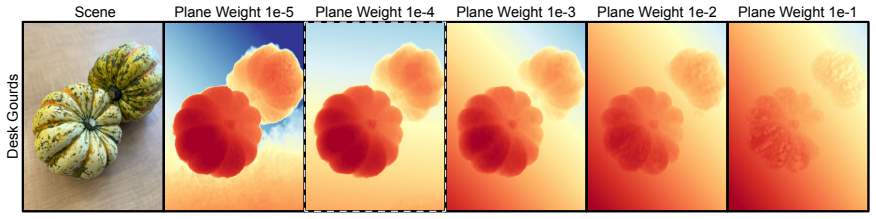
- [Sec. 2.5, Eq. (2.7), Eqs. (2.10)-(2.13), Fig. 2.11, Sec. 2.9] The central depth claim is not supported by the paper's own evidence. Fig. 2.11 shows two radically different depth maps with identical reprojection error, and Sec. 2.9 concedes that the plane component is often 'more akin to a segmentation mask than depth.' The depth model in Eq. (2.7) imposes a single plane plus ReLU offset, and the objective in Eqs. (2.10)-(2.13) with alpha_p = 1e-4 selects the solution among photometrically equivalent ones. Thus for textureless, distant, or non-planar regions, the recovered depth is not measured from parallax but assigned by a hand-tuned regularizer. This directly undercuts the abstract's claim of recovering depth 'without... machine learning priors' and 'self-regularized models.' The authors should reframe the depth contribution as prior-guided affine depth estimation, provide sensitivity of alpha_p across a broader range of scenes, and avoid claimi
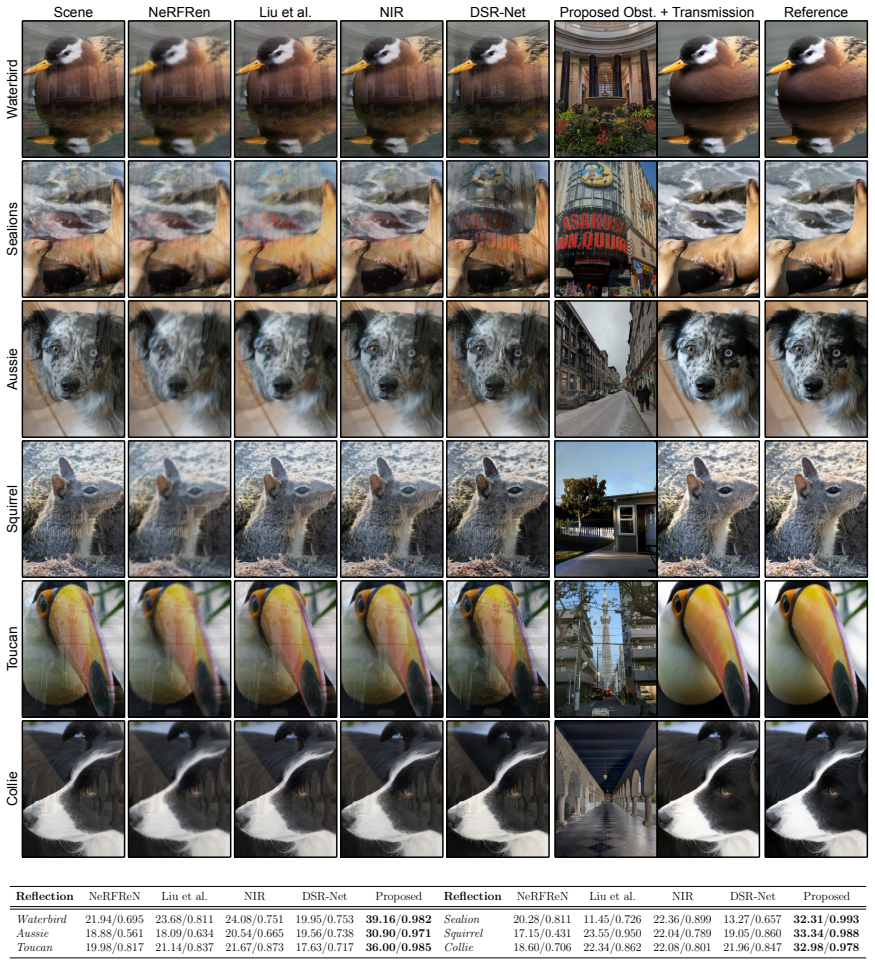
- [Sec. 2.11 and Sec. 3.6] Both synthetic benchmarks are generated under the same geometric assumptions as the proposed methods. In Sec. 2.11, synthetic scenes place a textured object in front of a tilted background plane, use the hand-shake paths measured by the authors' prior app, and render with the same small-angle camera model. In Sec. 3.6, transmission and obstruction planes are placed at Pi_z depths, composited with the same planar model and the same hand-shake data. Because the synthetic data is a special case of the model family, high quantitative scores there do not validate generalization to scenes that violate the plane-plus-offset or two-plane assumptions. The qualitative real-data results are useful, but the 'outperform SOTA' claim is not yet established for general in-the-wild captures.
- [Ch. 3, Table 3.2 and Sec. 3.6] The layer separation chapter relies on task-specific configurations that are manually selected per application: flow encoding size, number of spline control points, plane depths, alpha regularization weight, and even separate columns for occlusion, reflection, shadow, and dehazing. The authors note these are 'not prescriptive' and that all neural scene fitting has per-scene parameters, but this undermines the thesis-level claim of a single 'well-constructed, self-regularized model.' To support the strong claim, the paper would need either a demonstration that one fixed configuration works across all tasks, or a clear admission that the method requires manual per-task or per-scene tuning.
minor comments (5)
- [Abstract and Ch. 1] The phrase 'without relying on... machine learning priors' is technically about learned priors, but the method relies on hand-designed geometric priors (single-plane, spline smoothness, hash-grid resolution limits, regularization weights). Consider rewording to 'without learned priors or labeled data' and explicitly acknowledge hand-crafted regularizers.
- [Sec. 2.5, Eq. (2.10)] The notation L = L_d + alpha_p (L_p/L_d) R is confusing because L_p and L_d are already defined as losses; the ratio may be intended as a per-sample weighting. Please clarify the indexing and whether the ratio is taken pointwise or as a scalar.
- [Sec. 3.3.1] The claim that the neural spline field 'produces temporally consistent flow with no regularization' is supported mainly by the qualitative comparison in Fig. 3.2. Quantitative flow error against a reference estimator would strengthen the claim.
- [Sec. 4.4.1] The comparison to traditional image stitching is presented visually and with limited metrics. Since the chapter claims 50 FPS rendering and 80 MB model size, a benchmark table of runtime, memory, and PSNR against classic stitchers would help.
- [Throughout] There are minor typographical and formatting errors (e.g., 'frament' in Sec. 2.6, 'RA W' spacing, and the duplicated equation numbers in Ch. 4). These do not affect the science but should be cleaned up.
Circularity Check
Central derivations are self-contained, but the synthetic validation scenes are generated from the same plane/alpha-composite forward models, creating a partial validation loop.
-
other
[Sec. 3.6 Synthetic Data Generation; cf. Sec. 2.11 Synthetic Evaluation]
"These are simulated as 3D planes in space at depths Π o z and Π t z respectively – Π o z < Π t z for occluders and Π o z > Π t z for reflectors – and apply a random tilt to the planes with angle θ∈[−20 ◦,20 ◦]. To generate realistic camera motion, we record samples of natural hand tremor with a pose-capture application built on the Apple ARKit library [42]. We then apply this motion path to a projective camera model, re-sample the image planes, and alpha-composite the outputs to produce the simulated burst stack."
The synthetic ground truth is produced by the same forward model the method optimizes: two image planes at depths Π_z, re-sampled by a projective camera with hand-shake motion, then alpha-composited — matching Eq. 3.10 (ĉ=(1−α)c_t+αc_o) and the plane/flow model of Sec. 3.3.2. Similarly, the Ch2 synthetic scenes (Sec. 2.11) are a plane background plus offset objects, matching the plane-plus-offset depth model of Eq. 2.7, with motion from the authors' own prior hand-shake capture. Thus 'near ground truth' reconstruction on these scenes is guaranteed up to optimization error by construction; these benchmarks cannot independently confirm the core plane/alpha-composite assumptions. The real-data comparisons (structured-light scans, tripod reference captures) remain external, so this is a partia
full rationale
The core derivations in Chapters 2–4 are not circular: depth, layer, and panorama models are fit to raw burst/panoramic data via photometric losses with explicit, disclosed regularizers (α_p, η_α), and the depth degeneracy is acknowledged in Fig. 2.11 and Sec. 2.9 rather than hidden. Real-world validation includes independent structured-light scans (Sec. 2.6) and tripod-reference captures (Sec. 3.4), so the central claims have external support. However, the synthetic validation loops are a genuine weakness: the Ch2 synthetic long-bursts place scanned objects in front of a plane and render with the authors' own hand-shake paths, exactly the plane-plus-offset scene model of Eq. 2.7; the Ch3 synthetic bursts are generated by alpha-compositing two planes with the same projective and motion model, exactly Eq. 3.10. Success on these scenes partly reflects that the data was constructed from the method's own assumptions, so the synthetic benchmarks cannot independently validate the plane/alpha-composite priors. This is a partial circularity in validation, not in the derivation of the methods, and the independent real-data results keep the central claims from being reduced to the model's own construction. The self-citations to Chugunov et al. [42] supply empirical hand-shake measurements rather than unverified uniqueness theorems, so they are not load-bearing in a circular way.
Assumptions & free parameters
free parameters (9)
- plane regularization weight α_p =
1e-4
- rotation offset weight η_r =
1e-4 (Ch. 2), 1e-3 (Ch. 4)
- coarse-to-fine sweep constants k_min, k_max =
-100, 200
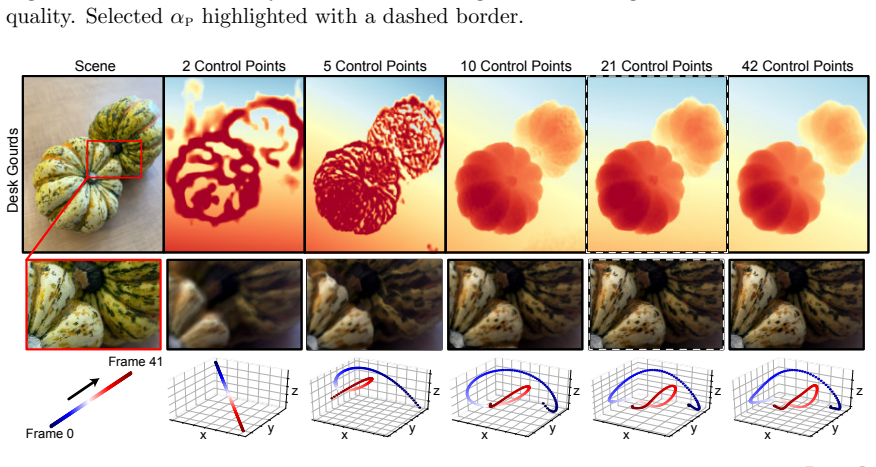
- Bezier control points N_c =
21 per curve
- depth hash encoding L_γd, N_max, T_γd =
8 levels, max 128, table 2^14
- per-task encoding sizes and loss weights (Ch. 3) =
occlusion η_α=0.02; reflection η_α=0.0; shadow η_α=2.0; flow sizes |h|=11 or 15; plane depths Π_z per task
- alpha temperature τ_σ =
not stated in available text
- ray perturbation weight η_p =
decayed to zero over stage 1
- NeuLS hash grids γ1, γ2 =
γ1: 8 levels, 4 to 112; γ2: 15 levels, 4 to 3145; table 2^19
assumptions (9)
- domain assumption Static, Lambertian scene model with known intrinsics and pinhole projection
- ad hoc to paper Background is a single plane plus foreground offset
- ad hoc to paper Plane regularization resolves the photometric degeneracy
- domain assumption Common fate: obstructing and transmitted layers move differently and can be separated by two alpha-composited planes
- ad hoc to paper Spline parametrization with low-resolution encodings prevents flow overfitting without explicit regularization
- ad hoc to paper Ray-offset plus view-dependent color on a sphere explains parallax, motion, and lighting for panorama captures
- ad hoc to paper Synthetic validation data is built under the model's own geometric assumptions
- domain assumption RAW frames are linear with known black level and shading correction
- standard math Small-angle rotation approximation holds for hand tremor
Cite this review
Pith. "Pith review of Neural Field Representations of Mobile Computational Photography." pith.science (2026). https://pith.science/paper/E2AVE4YU
@misc{pith2026250805907,
  author       = {Pith},
  title        = {Pith review of: Neural Field Representations of Mobile Computational Photography},
  year         = {2026},
  howpublished = {\url{https://pith.science/paper/E2AVE4YU}},
  note         = {Machine review of arXiv:2508.05907}
}
read the original abstract
Over the past two decades, mobile imaging has experienced a profound transformation, with cell phones rapidly eclipsing all other forms of digital photography in popularity. Today's cell phones are equipped with a diverse range of imaging technologies - laser depth ranging, multi-focal camera arrays, and split-pixel sensors - alongside non-visual sensors such as gyroscopes, accelerometers, and magnetometers. This, combined with on-board integrated chips for image and signal processing, makes the cell phone a versatile pocket-sized computational imaging platform. Parallel to this, we have seen in recent years how neural fields - small neural networks trained to map continuous spatial input coordinates to output signals - enable the reconstruction of complex scenes without explicit data representations such as pixel arrays or point clouds. In this thesis, I demonstrate how carefully designed neural field models can compactly represent complex geometry and lighting effects. Enabling applications such as depth estimation, layer separation, and image stitching directly from collected in-the-wild mobile photography data. These methods outperform state-of-the-art approaches without relying on complex pre-processing steps, labeled ground truth data, or machine learning priors. Instead, they leverage well-constructed, self-regularized models that tackle challenging inverse problems through stochastic gradient descent, fitting directly to raw measurements from a smartphone.
Figures


Figures from the paper (79 more)














Reference graph
Works this paper leans on
-
[1]
Defocus deblurring using dual-pixel data
Abdullah Abuolaim and Michael S Brown. Defocus deblurring using dual-pixel data. InEuropean Conference on Computer Vision, pages 111–126. Springer, 2020
2020
-
[2]
De-fencing and multi-focus fusion using markov random field and image inpainting.IEEE Access, 10:35992–36005, 2022
Hannan Adeel, Muhammad Mohsin Riaz, and Syed Sohaib Ali. De-fencing and multi-focus fusion using markov random field and image inpainting.IEEE Access, 10:35992–36005, 2022
2022
-
[3]
Pyramid methods in image processing.RCA engineer, 29(6):33– 41, 1984
Edward H Adelson, Charles H Anderson, James R Bergen, Peter J Burt, and Joan M Ogden. Pyramid methods in image processing.RCA engineer, 29(6):33– 41, 1984
1984
-
[4]
Interactive digital photomontage
Aseem Agarwala, Mira Dontcheva, Maneesh Agrawala, Steven Drucker, Alex Colburn, Brian Curless, David Salesin, and Michael Cohen. Interactive digital photomontage. InACM SIGGRAPH 2004 Papers, pages 294–302. 2004
2004
-
[5]
Panoramic video tex- tures
Aseem Agarwala, Ke Colin Zheng, Chris Pal, Maneesh Agrawala, Michael Co- hen, Brian Curless, David Salesin, and Richard Szeliski. Panoramic video tex- tures. InACM SIGGRAPH 2005 Papers, pages 821–827. 2005
2005
-
[6]
Nonrigid structure from motion in trajectory space.Advances in neural information processing systems, 21, 2008
Ijaz Akhter, Yaser Sheikh, Sohaib Khan, and Takeo Kanade. Nonrigid structure from motion in trajectory space.Advances in neural information processing systems, 21, 2008
2008
-
[7]
Video from stills: Lensless imaging with rolling shutter
Nick Antipa, Patrick Oare, Emrah Bostan, Ren Ng, and Laura Waller. Video from stills: Lensless imaging with rolling shutter. In2019 IEEE International Conference on Computational Photography (ICCP), pages 1–8. IEEE, 2019
2019
-
[8]
Learning neural light fields with ray-space embedding
Benjamin Attal, Jia-Bin Huang, Michael Zollh¨ ofer, Johannes Kopf, and Changil Kim. Learning neural light fields with ray-space embedding. InProceedings of the IEEE/CVF Conference on Computer Vision and Pattern Recognition, pages 19819–19829, 2022
2022
Show all 226 references
-
[9]
Matryodshka: Real-time 6dof video view synthesis using multi-sphere images
Benjamin Attal, Selena Ling, Aaron Gokaslan, Christian Richardt, and James Tompkin. Matryodshka: Real-time 6dof video view synthesis using multi-sphere images. InEuropean Conference on Computer Vision, pages 441–459. Springer, 2020. 136
2020
-
[10]
Explorable super resolution
Yuval Bahat and Tomer Michaeli. Explorable super resolution. InProceedings of the IEEE/CVF Conference on Computer Vision and Pattern Recognition, pages 2716–2725, 2020
2020
-
[11]
Depth-aware video frame interpolation
Wenbo Bao, Wei-Sheng Lai, Chao Ma, Xiaoyun Zhang, Zhiyong Gao, and Ming- Hsuan Yang. Depth-aware video frame interpolation. InProceedings of the IEEE/CVF Conference on Computer Vision and Pattern Recognition, pages 3703–3712, 2019
2019
-
[12]
Shape, illumination, and reflectance from shading.IEEE transactions on pattern analysis and machine intelligence, 37(8):1670–1687, 2014
Jonathan T Barron and Jitendra Malik. Shape, illumination, and reflectance from shading.IEEE transactions on pattern analysis and machine intelligence, 37(8):1670–1687, 2014
2014
-
[13]
Mip-nerf: A multiscale representa- tion for anti-aliasing neural radiance fields
Jonathan T Barron, Ben Mildenhall, Matthew Tancik, Peter Hedman, Ricardo Martin-Brualla, and Pratul P Srinivasan. Mip-nerf: A multiscale representa- tion for anti-aliasing neural radiance fields. InProceedings of the IEEE/CVF International Conference on Computer Vision, pages ...
2021
-
[14]
Zip-nerf: Anti-aliased grid-based neural radiance fields
Jonathan T Barron, Ben Mildenhall, Dor Verbin, Pratul P Srinivasan, and Peter Hedman. Zip-nerf: Anti-aliased grid-based neural radiance fields. In Proceedings of the IEEE/CVF International Conference on Computer Vision, pages 19697–19705, 2023
2023
-
[15]
Color imaging array.United States Patent 3,971,065, 1976
Bryce E Bayer. Color imaging array.United States Patent 3,971,065, 1976
1976
-
[16]
Om- niphotos: casual 360 vr photography.ACM Transactions on Graphics (TOG), 39(6):1–12, 2020
Tobias Bertel, Mingze Yuan, Reuben Lindroos, and Christian Richardt. Om- niphotos: casual 360 vr photography.ACM Transactions on Graphics (TOG), 39(6):1–12, 2020
2020
-
[17]
CRC press, 2021
Mario Bertero, Patrizia Boccacci, and Christine De Mol.Introduction to inverse problems in imaging. CRC press, 2021
2021
-
[18]
Deep burst super-resolution
Goutam Bhat, Martin Danelljan, Luc Van Gool, and Radu Timofte. Deep burst super-resolution. InProceedings of the IEEE/CVF Conference on Computer Vision and Pattern Recognition, pages 9209–9218, 2021
2021
-
[19]
Adabins: Depth estimation using adaptive bins
Shariq Farooq Bhat, Ibraheem Alhashim, and Peter Wonka. Adabins: Depth estimation using adaptive bins. InProceedings of the IEEE/CVF Conference on Computer Vision and Pattern Recognition, pages 4009–4018, 2021
2021
-
[20]
Color constancy using cnns
Simone Bianco, Claudio Cusano, and Raimondo Schettini. Color constancy using cnns. InProceedings of the IEEE conference on computer vision and pattern recognition workshops, pages 81–89, 2015
2015
-
[21]
Smartphone imaging technology and its applications.Advanced Optical Technologies, 10(3):145–232, 2021
Vladan Blahnik and Oliver Schindelbeck. Smartphone imaging technology and its applications.Advanced Optical Technologies, 10(3):145–232, 2021
2021
-
[22]
High-precision wafer- level optics fabrication and integration.Photonics Spectra, 2011
Jens Bliedtner, Andreas Gebhardt, and Uwe Schmidt. High-precision wafer- level optics fabrication and integration.Photonics Spectra, 2011. 137
2011
-
[23]
John Wiley & Sons, 2006
Mary L Boas.Mathematical methods in the physical sciences. John Wiley & Sons, 2006
2006
-
[24]
W. S. Boyle and G. E. Smith. Charge coupled semiconductor devices.Bell System Technical Journal, 49(4):587–593, 1970
1970
-
[25]
Brainard and Anya C
David H. Brainard and Anya C. Hurlbert. Colour vision: Understanding the- dress.Current Biology, 25(13):R551–R554, 2015
2015
-
[26]
Unprocessing images for learned raw denoising
Tim Brooks, Ben Mildenhall, Tianfan Xue, Jiawen Chen, Dillon Sharlet, and Jonathan T Barron. Unprocessing images for learned raw denoising. InProceed- ings of the IEEE/CVF conference on computer vision and pattern recognition, pages 11036–11045, 2019
2019
-
[27]
Automatic panoramic image stitching using invariant features.International journal of computer vision, 74:59–73, 2007
Matthew Brown and David G Lowe. Automatic panoramic image stitching using invariant features.International journal of computer vision, 74:59–73, 2007
2007
-
[28]
Photo statistics: How many photos are taken every day?, 2024
Matic Broz. Photo statistics: How many photos are taken every day?, 2024. Accessed: 2024-12-10
2024
-
[29]
A spatial processor model for object colour perception
Gershon Buchsbaum. A spatial processor model for object colour perception. Journal of the Franklin Institute, 310(1):1–26, 1980
1980
-
[30]
Unstructured lumigraph rendering
Chris Buehler, Michael Bosse, Leonard McMillan, Steven Gortler, and Michael Cohen. Unstructured lumigraph rendering. InProceedings of the 28th annual conference on Computer graphics and interactive techniques, pages 425–432, 2001
2001
-
[31]
A multiresolution spline with application to image mosaics.ACM Transactions on Graphics (TOG), 2(4):217–236, 1983
Peter J Burt and Edward H Adelson. A multiresolution spline with application to image mosaics.ACM Transactions on Graphics (TOG), 2(4):217–236, 1983
1983
-
[32]
Low-cost spad sensing for non-line-of-sight tracking, material classification and depth imaging
Clara Callenberg, Zheng Shi, Felix Heide, and Matthias B Hullin. Low-cost spad sensing for non-line-of-sight tracking, material classification and depth imaging. ACM Transactions on Graphics (TOG), 40(4):1–12, 2021
2021
-
[33]
Plenop- tic sampling
Jin-Xiang Chai, Xin Tong, Shing-Chow Chan, and Heung-Yeung Shum. Plenop- tic sampling. InProceedings of the 27th annual conference on Computer graphics and interactive techniques, pages 307–318, 2000
2000
-
[34]
Pyramid stereo matching network
Jia-Ren Chang and Yong-Sheng Chen. Pyramid stereo matching network. In Proceedings of the IEEE conference on computer vision and pattern recognition, pages 5410–5418, 2018
2018
-
[35]
Mvsnerf: Fast generalizable radiance field reconstruction from multi-view stereo
Anpei Chen, Zexiang Xu, Fuqiang Zhao, Xiaoshuai Zhang, Fanbo Xiang, Jingyi Yu, and Hao Su. Mvsnerf: Fast generalizable radiance field reconstruction from multi-view stereo. InProceedings of the IEEE/CVF International Conference on Computer Vision, pages 14124–14133, 2021. 138
2021
-
[36]
A simple model for intrinsic image decom- position with depth cues
Qifeng Chen and Vladlen Koltun. A simple model for intrinsic image decom- position with depth cues. InProceedings of the IEEE international conference on computer vision, pages 241–248, 2013
2013
-
[37]
View interpolation for image syn- thesis
Shenchang Eric Chen and Lance Williams. View interpolation for image syn- thesis. InProceedings of the 20th annual conference on Computer graphics and interactive techniques, pages 279–288, 1993
1993
-
[38]
The inverse problems you carry in your pocket.XRDS: Cross- roads, The ACM Magazine for Students, 31(2):44–49, 2025
Ilya Chugunov. The inverse problems you carry in your pocket.XRDS: Cross- roads, The ACM Magazine for Students, 31(2):44–49, 2025
2025
-
[39]
Neural light spheres for implicit image stitching and view synthesis
Ilya Chugunov, Amogh Joshi, Kiran Murthy, Francois Bleibel, and Felix Heide. Neural light spheres for implicit image stitching and view synthesis. InSIG- GRAPH Asia 2024 Conference Papers, pages 1–11, 2024
2024
-
[40]
Neural spline fields for burst image fusion and layer separation.Proceedings of the IEEE/CVF Conference on Computer Vision and Pattern Recognition, 2024
Ilya Chugunov, David Shustin, Ruyu Yan, Chenyang Lei, and Felix Heide. Neural spline fields for burst image fusion and layer separation.Proceedings of the IEEE/CVF Conference on Computer Vision and Pattern Recognition, 2024
2024
-
[41]
Shakes on a plane: Unsuper- vised depth estimation from unstabilized photography
Ilya Chugunov, Yuxuan Zhang, and Felix Heide. Shakes on a plane: Unsuper- vised depth estimation from unstabilized photography. InProceedings of the IEEE/CVF Conference on Computer Vision and Pattern Recognition, pages 13240–13251, 2023
2023
-
[42]
The implicit values of a good hand shake: Handheld multi-frame neural depth refinement
Ilya Chugunov, Yuxuan Zhang, Zhihao Xia, Xuaner Zhang, Jiawen Chen, and Felix Heide. The implicit values of a good hand shake: Handheld multi-frame neural depth refinement. InProceedings of the IEEE/CVF Conference on Com- puter Vision and Pattern Recognition, pages 2852–2862, 2022
2022
-
[43]
Mednerf: Medical neural radi- ance fields for reconstructing 3d-aware ct-projections from a single x-ray
Abril Corona-Figueroa, Jonathan Frawley, Sam Bond-Taylor, Sarath Betha- pudi, Hubert PH Shum, and Chris G Willcocks. Mednerf: Medical neural radi- ance fields for reconstructing 3d-aware ct-projections from a single x-ray. In2022 44th Annual International Conference of the IEE...
2022
-
[44]
Mobile computational photography: A tour.arXiv preprint arXiv:2102.09000, 2021
Mauricio Delbracio, Damien Kelly, Michael S Brown, and Peyman Milanfar. Mobile computational photography: A tour.arXiv preprint arXiv:2102.09000, 2021
2021 arXiv
-
[45]
Imagenet: A large-scale hierarchical image database
Jia Deng, Wei Dong, Richard Socher, Li-Jia Li, Kai Li, and Li Fei-Fei. Imagenet: A large-scale hierarchical image database. In2009 IEEE conference on computer vision and pattern recognition, pages 248–255. Ieee, 2009
2009
-
[46]
Depthlab: Real-time 3d interaction with depth maps for mobile augmented reality
Ruofei Du, Eric Turner, Maksym Dzitsiuk, Luca Prasso, Ivo Duarte, Jason Dourgarian, Joao Afonso, Jose Pascoal, Josh Gladstone, Nuno Cruces, et al. Depthlab: Real-time 3d interaction with depth maps for mobile augmented reality. InProceedings of the 33rd Annual ACM Symposium on...
2020
-
[47]
Claude E. Duchon. Lanczos filtering in one and two dimensions.Journal of Applied Meteorology, 18(8):1016–1022, 1979
1979
-
[48]
Depth map prediction from a single image using a multi-scale deep network
David Eigen, Christian Puhrsch, and Rob Fergus. Depth map prediction from a single image using a multi-scale deep network. pages 2366–2374, 2014
2014
-
[49]
¨Uber einen die erzeugung und verwandlung des lichtes betref- fenden heuristischen gesichtspunkt.Annalen der Physik, 17:132–148, 1905
Albert Einstein. ¨Uber einen die erzeugung und verwandlung des lichtes betref- fenden heuristischen gesichtspunkt.Annalen der Physik, 17:132–148, 1905
1905
-
[50]
Hyperdepth: Learning depth from structured light without matching
Sean Ryan Fanello, Christoph Rhemann, Vladimir Tankovich, Adarsh Kowdle, Sergio Orts Escolano, David Kim, and Shahram Izadi. Hyperdepth: Learning depth from structured light without matching. InProceedings of the IEEE Conference on Computer Vision and Pattern Recognition, page...
2016
-
[51]
Image de- fencing framework with hybrid inpainting algorithm.Signal, Image and Video Processing, 10:1193–1201, 2016
Muhammad Shahid Farid, Arif Mahmood, and Marco Grangetto. Image de- fencing framework with hybrid inpainting algorithm.Signal, Image and Video Processing, 10:1193–1201, 2016
2016
-
[52]
Morgan Kaufmann, 2002
Gerald E Farin.Curves and surfaces for CAGD: a practical guide. Morgan Kaufmann, 2002
2002
-
[53]
Deepstereo: Learning to predict new views from the world’s imagery
John Flynn, Ivan Neulander, James Philbin, and Noah Snavely. Deepstereo: Learning to predict new views from the world’s imagery. InProceedings of the IEEE conference on computer vision and pattern recognition, pages 5515–5524, 2016
2016
-
[54]
M4depth: A motion-based approach for monocular depth estimation on video sequences
Micha¨ el Fonder, Damien Ernst, and Marc Van Droogenbroeck. M4depth: A motion-based approach for monocular depth estimation on video sequences. arXiv preprint arXiv:2105.09847, 2021
2021 arXiv
-
[55]
Eric R. Fossum. Cmos active pixel image sensors: Past, present, and future. IEEE Transactions on Electron Devices, 44(10):1689–1698, 1997
1997
-
[56]
K-planes: Explicit radiance fields in space, time, and appearance
Sara Fridovich-Keil, Giacomo Meanti, Frederik Rahbæk Warburg, Benjamin Recht, and Angjoo Kanazawa. K-planes: Explicit radiance fields in space, time, and appearance. InProceedings of the IEEE/CVF Conference on Computer Vision and Pattern Recognition, pages 12479–12488, 2023
2023
-
[57]
Massively parallel multiview stereopsis by surface normal diffusion
Silvano Galliani, Katrin Lasinger, and Konrad Schindler. Massively parallel multiview stereopsis by surface normal diffusion. InProceedings of the IEEE International Conference on Computer Vision, pages 873–881, 2015
2015
-
[58]
Locally non-rigid registration for mobile hdr photography
Orazio Gallo, Alejandro Troccoli, Jun Hu, Kari Pulli, and Jan Kautz. Locally non-rigid registration for mobile hdr photography. InProceedings of the IEEE conference on computer vision and pattern recognition Workshops, pages 49–56, 2015. 140
2015
-
[59]
” double-dip”: unsuper- vised image decomposition via coupled deep-image-priors
Yosef Gandelsman, Assaf Shocher, and Michal Irani. ” double-dip”: unsuper- vised image decomposition via coupled deep-image-priors. InProceedings of the IEEE/CVF Conference on Computer Vision and Pattern Recognition, pages 11026–11035, 2019
2019
-
[60]
Monocular dynamic view synthesis: A reality check.arXiv preprint arXiv:2210.13445, 2022
Hang Gao, Ruilong Li, Shubham Tulsiani, Bryan Russell, and Angjoo Kanazawa. Monocular dynamic view synthesis: A reality check.arXiv preprint arXiv:2210.13445, 2022
2022 arXiv
-
[61]
Constructing image panora- mas using dual-homography warping
Junhong Gao, Seon Joo Kim, and Michael S Brown. Constructing image panora- mas using dual-homography warping. InCVPR 2011, pages 49–56. IEEE, 2011
2011
-
[62]
Seam-driven image stitching
Junhong Gao, Yu Li, Tat-Jun Chin, and Michael S Brown. Seam-driven image stitching. InEurographics (Short Papers), pages 45–48, 2013
2013
-
[63]
Deep burst denoising
Cl´ ement Godard, Kevin Matzen, and Matt Uyttendaele. Deep burst denoising. InProceedings of the European conference on computer vision (ECCV), pages 538–554, 2018
2018
-
[64]
See in the dark with night sight.https://blog.google/products/ pixel/see-light-night-sight/, 2018
Google. See in the dark with night sight.https://blog.google/products/ pixel/see-light-night-sight/, 2018. Accessed: 2023-10-24
2018
-
[65]
Astrophotography with night sight on pixel phones.https://blog
Google. Astrophotography with night sight on pixel phones.https://blog. research.google/2019/11/astrophotography-with-night-sight-on. html, 2019. Accessed: 2023-10-24
2019
-
[66]
The lumigraph
Steven J Gortler, Radek Grzeszczuk, Richard Szeliski, and Michael F Cohen. The lumigraph. InProceedings of the 23rd annual conference on Computer graphics and interactive techniques, pages 43–54, 1996
1996
-
[67]
Coded rolling shutter photography: Flexible space-time sampling
Jinwei Gu, Yasunobu Hitomi, Tomoo Mitsunaga, and Shree Nayar. Coded rolling shutter photography: Flexible space-time sampling. In2010 IEEE Inter- national Conference on Computational Photography (ICCP), pages 1–8. IEEE, 2010
2010
-
[68]
The relightables: Volumetric performance capture of humans with realistic relighting.ACM Transactions on Graphics (ToG), 38(6):1–19, 2019
Kaiwen Guo, Peter Lincoln, Philip Davidson, Jay Busch, Xueming Yu, Matt Whalen, Geoff Harvey, Sergio Orts-Escolano, Rohit Pandey, Jason Dourgarian, et al. The relightables: Volumetric performance capture of humans with realistic relighting.ACM Transactions on Graphics (ToG), 3...
2019
-
[69]
Nerfren: Neural radiance fields with reflections
Yuan-Chen Guo, Di Kang, Linchao Bao, Yu He, and Song-Hai Zhang. Nerfren: Neural radiance fields with reflections. InProceedings of the IEEE/CVF Confer- ence on Computer Vision and Pattern Recognition (CVPR), pages 18409–18418, June 2022
2022
-
[70]
Fully automated image de-fencing using conditional generative adversarial networks, 2019
Divyanshu Gupta, Shorya Jain, Utkarsh Tripathi, Pratik Chattopadhyay, and Lipo Wang. Fully automated image de-fencing using conditional generative adversarial networks, 2019. 141
2019
-
[71]
High- quality depth from uncalibrated small motion clip
Hyowon Ha, Sunghoon Im, Jaesik Park, Hae-Gon Jeon, and In So Kweon. High- quality depth from uncalibrated small motion clip. InProceedings of the IEEE conference on computer vision and pattern Recognition, pages 5413–5421, 2016
2016
-
[72]
Image-based 3d object reconstruction: State-of-the-art and trends in the deep learning era
Xian-Feng Han, Hamid Laga, and Mohammed Bennamoun. Image-based 3d object reconstruction: State-of-the-art and trends in the deep learning era. IEEE transactions on pattern analysis and machine intelligence, 43(5):1578– 1604, 2019
2019
-
[73]
Springer Science & Business Media, 2012
Miles Hansard, Seungkyu Lee, Ouk Choi, and Radu Patrice Horaud.Time- of-flight cameras: principles, methods and applications. Springer Science & Business Media, 2012
2012
-
[74]
SIAM, 2006
Per Christian Hansen, James G Nagy, and Dianne P O’leary.Deblurring images: matrices, spectra, and filtering. SIAM, 2006
2006
-
[75]
Cambridge University Press, USA, 2 edition, 2003
Richard Hartley and Andrew Zisserman.Multiple View Geometry in Computer Vision. Cambridge University Press, USA, 2 edition, 2003
2003
-
[76]
Cambridge university press, 2003
Richard Hartley and Andrew Zisserman.Multiple view geometry in computer vision. Cambridge university press, 2003
2003
-
[77]
Burst photography for high dynamic range and low-light imaging on mobile cameras.ACM Transac- tions on Graphics (ToG), 35(6):1–12, 2016
Samuel W Hasinoff, Dillon Sharlet, Ryan Geiss, Andrew Adams, Jonathan T Barron, Florian Kainz, Jiawen Chen, and Marc Levoy. Burst photography for high dynamic range and low-light imaging on mobile cameras.ACM Transac- tions on Graphics (ToG), 35(6):1–12, 2016
2016
-
[78]
Rolling shutter bundle adjustment
Johan Hedborg, Per-Erik Forss´ en, Michael Felsberg, and Erik Ringaby. Rolling shutter bundle adjustment. In2012 IEEE Conference on Computer Vision and Pattern Recognition, pages 1434–1441. IEEE, 2012
2012
-
[79]
Casual 3d photography.ACM Transactions on Graphics (TOG), 36(6):1–15, 2017
Peter Hedman, Suhib Alsisan, Richard Szeliski, and Johannes Kopf. Casual 3d photography.ACM Transactions on Graphics (TOG), 36(6):1–15, 2017
2017
-
[80]
Instant 3d photography.ACM Transactions on Graphics (TOG), 37(4):1–12, 2018
Peter Hedman and Johannes Kopf. Instant 3d photography.ACM Transactions on Graphics (TOG), 37(4):1–12, 2018
2018
-
[81]
Column-addressable and matrix-addressable multi-junction vcsel arrays for all electronic-scanning lidar
Eric Hegblom, Yeyu Zhu, Jun Yang, Kelvin Zhang, Benjamin Kesler, Lu- cas Morales, Matthew Peters, and Jay Skidmore. Column-addressable and matrix-addressable multi-junction vcsel arrays for all electronic-scanning lidar. InVertical-Cavity Surface-Emitting Lasers XXVI, volume 1...
2022
-
[82]
Keigo Hirakawa and Thomas W. Wolfe. Adaptive homogeneity-directed de- mosaicing algorithm. InIEEE Transactions on Image Processing, volume 14, pages 360–369. IEEE, 2005. 142
2005
-
[83]
An overview of depth cameras and range scanners based on time-of-flight technolo- gies.Machine vision and applications, 27(7):1005–1020, 2016
Radu Horaud, Miles Hansard, Georgios Evangelidis, and Cl´ ement M´ enier. An overview of depth cameras and range scanners based on time-of-flight technolo- gies.Machine vision and applications, 27(7):1005–1020, 2016
2016
-
[84]
Multilayer feedforward networks are universal approximators.Neural networks, 2(5):359–366, 1989
Kurt Hornik, Maxwell Stinchcombe, and Halbert White. Multilayer feedforward networks are universal approximators.Neural networks, 2(5):359–366, 1989
1989
-
[85]
Revisiting single image depth estimation: Toward higher resolution maps with accurate object boundaries
Junjie Hu, Mete Ozay, Yan Zhang, and Takayuki Okatani. Revisiting single image depth estimation: Toward higher resolution maps with accurate object boundaries. In2019 IEEE Winter Conference on Applications of Computer Vision (WACV), pages 1043–1051. IEEE, 2019
2019
-
[86]
Single image reflection separation via compo- nent synergy
Qiming Hu and Xiaojie Guo. Single image reflection separation via compo- nent synergy. InProceedings of the IEEE/CVF International Conference on Computer Vision (ICCV), pages 13138–13147, October 2023
2023
-
[87]
High quality structure from small motion for rolling shutter cameras
Sunghoon Im, Hyowon Ha, Gyeongmin Choe, Hae-Gon Jeon, Kyungdon Joo, and In So Kweon. High quality structure from small motion for rolling shutter cameras. InProceedings of the IEEE International Conference on Computer Vision, pages 837–845, 2015
2015
-
[88]
Calibrated rgb-d salient object detection
Wei Ji, Jingjing Li, Shuang Yu, Miao Zhang, Yongri Piao, Shunyu Yao, Qi Bi, Kai Ma, Yefeng Zheng, Huchuan Lu, et al. Calibrated rgb-d salient object detection. InProceedings of the IEEE/CVF conference on computer vision and pattern recognition, pages 9471–9481, 2021
2021
-
[89]
Micro-baseline stereo.Technical Report MSR-TR-2014–73, page 8, 2014
Neel Joshi and C Lawrence Zitnick. Micro-baseline stereo.Technical Report MSR-TR-2014–73, page 8, 2014
2014
-
[90]
Deep high dynamic range imaging of dynamic scenes.ACM Trans
Nima Khademi Kalantari, Ravi Ramamoorthi, et al. Deep high dynamic range imaging of dynamic scenes.ACM Trans. Graph., 36(4):144–1, 2017
2017
-
[91]
Layered neural atlases for consistent video editing.ACM Transactions on Graphics (TOG), 40(6):1– 12, 2021
Yoni Kasten, Dolev Ofri, Oliver Wang, and Tali Dekel. Layered neural atlases for consistent video editing.ACM Transactions on Graphics (TOG), 40(6):1– 12, 2021
2021
-
[92]
3d gaussian splatting for real-time radiance field rendering.ACM Transactions on Graphics, 42(4):1–14, 2023
Bernhard Kerbl, Georgios Kopanas, Thomas Leimk¨ uhler, and George Drettakis. 3d gaussian splatting for real-time radiance field rendering.ACM Transactions on Graphics, 42(4):1–14, 2023
2023
-
[93]
Adam: A method for stochastic optimiza- tion.arXiv preprint arXiv:1412.6980, 2014
Diederik P Kingma and Jimmy Ba. Adam: A method for stochastic optimiza- tion.arXiv preprint arXiv:1412.6980, 2014
2014 arXiv
-
[94]
Segment anything
Alexander Kirillov, Eric Mintun, Nikhila Ravi, Hanzi Mao, Chloe Rolland, Laura Gustafson, Tete Xiao, Spencer Whitehead, Alexander C Berg, Wan-Yen Lo, et al. Segment anything. InProceedings of the IEEE/CVF International Conference on Computer Vision, pages 4015–4026, 2023. 143
2023
-
[95]
The tensor algebra compiler.Proceedings of the ACM on Pro- gramming Languages, 1(OOPSLA):1–29, 2017
Fredrik Kjolstad, Shoaib Kamil, Stephen Chou, David Lugato, and Saman Amarasinghe. The tensor algebra compiler.Proceedings of the ACM on Pro- gramming Languages, 1(OOPSLA):1–29, 2017
2017
-
[96]
Time-of- flight cameras in computer graphics
Andreas Kolb, Erhardt Barth, Reinhard Koch, and Rasmus Larsen. Time-of- flight cameras in computer graphics. InComputer Graphics Forum, volume 29, pages 141–159. Wiley Online Library, 2010
2010
-
[97]
One shot 3d photography.ACM Transactions on Graphics (TOG), 39(4):76–1, 2020
Johannes Kopf, Kevin Matzen, Suhib Alsisan, Ocean Quigley, Francis Ge, Yang- ming Chong, Josh Patterson, Jan-Michael Frahm, Shu Wu, Matthew Yu, et al. One shot 3d photography.ACM Transactions on Graphics (TOG), 39(4):76–1, 2020
2020
-
[98]
Robust consistent video depth estimation
Johannes Kopf, Xuejian Rong, and Jia-Bin Huang. Robust consistent video depth estimation. InProceedings of the IEEE/CVF Conference on Computer Vision and Pattern Recognition, pages 1611–1621, 2021
2021
-
[99]
Single image fence removal using fast fourier transform
Keitaro Kume and Masaaki Ikehara. Single image fence removal using fast fourier transform. In2023 IEEE International Conference on Consumer Elec- tronics (ICCE), pages 1–5, 2023
2023
-
[100]
Real-time panoramic depth maps from omni-directional stereo images for 6 dof videos in virtual reality
Po Kong Lai, Shuang Xie, Jochen Lang, and Robert Lagani` ere. Real-time panoramic depth maps from omni-directional stereo images for 6 dof videos in virtual reality. In2019 IEEE Conference on Virtual Reality and 3D User Interfaces (VR), pages 405–412. IEEE, 2019
2019
-
[101]
3d time-of-flight distance measurement with custom solid-state image sensors in cmos/ccd-technology
Robert Lange. 3d time-of-flight distance measurement with custom solid-state image sensors in cmos/ccd-technology. 2000
2000
-
[102]
Fast dynamic 3d mr spectroscopic imaging with compressed sensing and multiband excitation pulses for hyperpolarized 13c studies.Magnetic resonance in medicine, 65(3):610–619, 2011
Peder EZ Larson, Simon Hu, Michael Lustig, Adam B Kerr, Sarah J Nelson, John Kurhanewicz, John M Pauly, and Daniel B Vigneron. Fast dynamic 3d mr spectroscopic imaging with compressed sensing and multiband excitation pulses for hyperpolarized 13c studies.Magnetic resonance in ...
2011
-
[103]
High dy- namic range and super-resolution from raw image bursts.arXiv preprint arXiv:2207.14671, 2022
Bruno Lecouat, Thomas Eboli, Jean Ponce, and Julien Mairal. High dy- namic range and super-resolution from raw image bursts.arXiv preprint arXiv:2207.14671, 2022
2022 arXiv
-
[104]
Noise2noise: Learning image restoration without clean data.arXiv preprint arXiv:1803.04189, 2018
Jaakko Lehtinen, Jacob Munkberg, Jon Hasselgren, Samuli Laine, Tero Karras, Miika Aittala, and Timo Aila. Noise2noise: Learning image restoration without clean data.arXiv preprint arXiv:1803.04189, 2018
2018 arXiv
-
[105]
Robust reflection removal with reflection-free flash-only cues
Chenyang Lei and Qifeng Chen. Robust reflection removal with reflection-free flash-only cues. InIEEE/CVF Conference on Computer Vision and Pattern Recognition (CVPR), 2021. 144
2021
-
[106]
Polarized reflection removal with perfect alignment in the wild
Chenyang Lei, Xuhua Huang, Mengdi Zhang, Qiong Yan, Wenxiu Sun, and Qifeng Chen. Polarized reflection removal with perfect alignment in the wild. InProceedings of the IEEE/CVF conference on computer vision and pattern recognition, pages 1750–1758, 2020
2020
-
[107]
Robust reflection removal with flash-only cues in the wild, 2022
Chenyang Lei, Xudong Jiang, and Qifeng Chen. Robust reflection removal with flash-only cues in the wild, 2022
2022
-
[108]
Light field rendering
Marc Levoy and Pat Hanrahan. Light field rendering. InProceedings of the 23rd Annual Conference on Computer Graphics and Interactive Techniques, SIGGRAPH ’96, page 31–42, New York, NY, USA, 1996. Association for Com- puting Machinery
1996
-
[109]
Yu Li and Michael S. Brown. Exploiting reflection change for automatic reflec- tion removal. InProceedings of the IEEE International Conference on Computer Vision (ICCV), December 2013
2013
-
[110]
Neuralangelo: High-fidelity neural surface reconstruction
Zhaoshuo Li, Thomas M¨ uller, Alex Evans, Russell H Taylor, Mathias Unberath, Ming-Yu Liu, and Chen-Hsuan Lin. Neuralangelo: High-fidelity neural surface reconstruction. InProceedings of the IEEE/CVF Conference on Computer Vi- sion and Pattern Recognition, pages 8456–8465, 2023
2023
-
[111]
Dynibar: Neural dynamic image-based rendering
Zhengqi Li, Qianqian Wang, Forrester Cole, Richard Tucker, and Noah Snavely. Dynibar: Neural dynamic image-based rendering. InProceedings of the IEEE/CVF Conference on Computer Vision and Pattern Recognition, pages 4273–4284, 2023
2023
-
[112]
Handheld mobile photography in very low light.ACM Trans
Orly Liba, Kiran Murthy, Yun-Ta Tsai, Tim Brooks, Tianfan Xue, Nikhil Kar- nad, Qiurui He, Jonathan T Barron, Dillon Sharlet, Ryan Geiss, et al. Handheld mobile photography in very low light.ACM Trans. Graph., 38(6):164–1, 2019
2019
-
[113]
Barf: Bundle-adjusting neural radiance fields
Chen-Hsuan Lin, Wei-Chiu Ma, Antonio Torralba, and Simon Lucey. Barf: Bundle-adjusting neural radiance fields. InProceedings of the IEEE/CVF In- ternational Conference on Computer Vision, pages 5741–5751, 2021
2021
-
[114]
Deep multi depth panoramas for view synthesis
Kai-En Lin, Zexiang Xu, Ben Mildenhall, Pratul P Srinivasan, Yannick Hold- Geoffroy, Stephen DiVerdi, Qi Sun, Kalyan Sunkavalli, and Ravi Ramamoorthi. Deep multi depth panoramas for view synthesis. InEuropean Conference on Computer Vision, pages 328–344. Springer, 2020
2020
-
[115]
Microsoft coco: Common ob- jects in context
Tsung-Yi Lin, Michael Maire, Serge Belongie, James Hays, Pietro Perona, Deva Ramanan, Piotr Doll´ ar, and C Lawrence Zitnick. Microsoft coco: Common ob- jects in context. InComputer Vision–ECCV 2014: 13th European Conference, Zurich, Switzerland, September 6-12, 2014, Proceedi...
2014
-
[116]
Raft-stereo: Multilevel recurrent field transforms for stereo matching.arXiv preprint arXiv:2109.07547, 2021
Lahav Lipson, Zachary Teed, and Jia Deng. Raft-stereo: Multilevel recurrent field transforms for stereo matching.arXiv preprint arXiv:2109.07547, 2021. 145
2021 arXiv
-
[117]
Learning to see through obstructions
Yu-Lun Liu, Wei-Sheng Lai, Ming-Hsuan Yang, Yung-Yu Chuang, and Jia-Bin Huang. Learning to see through obstructions. InIEEE Conference on Computer Vision and Pattern Recognition, 2020
2020
-
[118]
Semantic guided single image reflection removal, 2022
Yunfei Liu, Yu Li, Shaodi You, and Feng Lu. Semantic guided single image reflection removal, 2022
2022
-
[119]
Distinctive image features from scale-invariant keypoints.In- ternational journal of computer vision, 60:91–110, 2004
David G Lowe. Distinctive image features from scale-invariant keypoints.In- ternational journal of computer vision, 60:91–110, 2004
2004
-
[120]
Omnimatte: Associating objects and their effects in video
Erika Lu, Forrester Cole, Tali Dekel, Andrew Zisserman, William T Freeman, and Michael Rubinstein. Omnimatte: Associating objects and their effects in video. InCVPR, 2021
2021
-
[121]
Evaluation of the apple iphone 12 pro lidar for an application in geosciences.Scientific reports, 11(1):1– 9, 2021
Gregor Luetzenburg, Aart Kroon, and Anders A Bjørk. Evaluation of the apple iphone 12 pro lidar for an application in geosciences.Scientific reports, 11(1):1– 9, 2021
2021
-
[122]
Consistent video depth estimation.ACM Transactions on Graphics (TOG), 39(4):71–1, 2020
Xuan Luo, Jia-Bin Huang, Richard Szeliski, Kevin Matzen, and Johannes Kopf. Consistent video depth estimation.ACM Transactions on Graphics (TOG), 39(4):71–1, 2020
2020
-
[123]
Malvar, Li-wei He, and Ross Cutler
Henrique S. Malvar, Li-wei He, and Ross Cutler. High-quality linear inter- polation for demosaicing of bayer-patterned color images. InProceedings of IEEE International Conference on Acoustics, Speech, and Signal Processing (ICASSP), pages 485–488. IEEE, 2004
2004
-
[124]
Cooperative computation of stereo disparity: A cooperative algorithm is derived for extracting disparity information from stereo image pairs.Science, 194(4262):283–287, 1976
David Marr and Tomaso Poggio. Cooperative computation of stereo disparity: A cooperative algorithm is derived for extracting disparity information from stereo image pairs.Science, 194(4262):283–287, 1976
1976
-
[125]
Nerf in the wild: Neural radiance fields for unconstrained photo collections
Ricardo Martin-Brualla, Noha Radwan, Mehdi SM Sajjadi, Jonathan T Barron, Alexey Dosovitskiy, and Daniel Duckworth. Nerf in the wild: Neural radiance fields for unconstrained photo collections. InProceedings of the IEEE/CVF Conference on Computer Vision and Pattern Recognition...
2021
-
[126]
Long-range time-of-flight scanning sen- sor based on high-speed time-correlated single-photon counting.Applied optics, 48(32):6241–6251, 2009
Aongus McCarthy, Robert J Collins, Nils J Krichel, Ver´ onica Fern´ andez, An- drew M Wallace, and Gerald S Buller. Long-range time-of-flight scanning sen- sor based on high-speed time-correlated single-photon counting.Applied optics, 48(32):6241–6251, 2009
2009
-
[127]
Plenoptic modeling: an image-based ren- dering system
Leonard McMillan and Gary Bishop. Plenoptic modeling: an image-based ren- dering system. InProceedings of the 22nd annual conference on Computer graphics and interactive techniques, pages 39–46, 1995
1995
-
[128]
Exposure fusion: A simple and practical alternative to high dynamic range photography
Tom Mertens, Jan Kautz, and Frank Van Reeth. Exposure fusion: A simple and practical alternative to high dynamic range photography. InComputer graphics forum, volume 28, pages 161–171. Wiley Online Library, 2009. 146
2009
-
[129]
Boosting monocular depth estimation models to high-resolution via content-adaptive multi-resolution merging
S Mahdi H Miangoleh, Sebastian Dille, Long Mai, Sylvain Paris, and Yagiz Aksoy. Boosting monocular depth estimation models to high-resolution via content-adaptive multi-resolution merging. InProceedings of the IEEE/CVF Conference on Computer Vision and Pattern Recognition, pag...
2021
-
[130]
Microsoft image composite editor
Microsoft Research. Microsoft image composite editor. https://www.microsoft.com/en-us/research/product/computational- photography-applications/image-composite-editor, 2015. Version 2.0.3, released in 2015
2015
-
[131]
Burst denoising with kernel prediction networks
Ben Mildenhall, Jonathan T Barron, Jiawen Chen, Dillon Sharlet, Ren Ng, and Robert Carroll. Burst denoising with kernel prediction networks. InProceedings of the IEEE conference on computer vision and pattern recognition, pages 2502– 2510, 2018
2018
-
[132]
Nerf in the dark: High dynamic range view synthe- sis from noisy raw images
Ben Mildenhall, Peter Hedman, Ricardo Martin-Brualla, Pratul P Srinivasan, and Jonathan T Barron. Nerf in the dark: High dynamic range view synthe- sis from noisy raw images. InProceedings of the IEEE/CVF Conference on Computer Vision and Pattern Recognition, pages 16190–16199, 2022
2022
-
[133]
Nerf: Representing scenes as neural radiance fields for view synthesis
Ben Mildenhall, Pratul P Srinivasan, Matthew Tancik, Jonathan T Barron, Ravi Ramamoorthi, and Ren Ng. Nerf: Representing scenes as neural radiance fields for view synthesis. InEuropean conference on computer vision, pages 405–421. Springer, 2020
2020
-
[134]
Nerf: Representing scenes as neural radiance fields for view synthesis.Communications of the ACM, 65(1):99–106, 2021
Ben Mildenhall, Pratul P Srinivasan, Matthew Tancik, Jonathan T Barron, Ravi Ramamoorthi, and Ren Ng. Nerf: Representing scenes as neural radiance fields for view synthesis.Communications of the ACM, 65(1):99–106, 2021
2021
-
[135]
Modern aug- mented reality: Applications, trends, and future directions.arXiv preprint arXiv:2202.09450, 2022
Shervin Minaee, Xiaodan Liang, and Shuicheng Yan. Modern aug- mented reality: Applications, trends, and future directions.arXiv preprint arXiv:2202.09450, 2022
2022 arXiv
-
[136]
Dancing under the stars: video denoising in starlight
Kristina Monakhova, Stephan R Richter, Laura Waller, and Vladlen Koltun. Dancing under the stars: video denoising in starlight. InProceedings of the IEEE/CVF Conference on Computer Vision and Pattern Recognition, pages 16241–16251, 2022
2022
-
[137]
Megapixel time-gated spad image sensor for 2d and 3d imaging applications.Optica, 7(4):346–354, 2020
Kazuhiro Morimoto, Andrei Ardelean, Ming-Lo Wu, Arin Can Ulku, Ivan Michel Antolovic, Claudio Bruschini, and Edoardo Charbon. Megapixel time-gated spad image sensor for 2d and 3d imaging applications.Optica, 7(4):346–354, 2020
2020
-
[138]
Neural surface maps
Luca Morreale, Noam Aigerman, Vladimir G Kim, and Niloy J Mitra. Neural surface maps. InProceedings of the IEEE/CVF Conference on Computer Vision and Pattern Recognition, pages 4639–4648, 2021. 147
2021
-
[139]
Instant neural graphics primitives with a multiresolution hash encoding.ACM trans- actions on graphics (TOG), 41(4):1–15, 2022
Thomas Muller, Alex Evans, Christoph Schied, and Alexander Keller. Instant neural graphics primitives with a multiresolution hash encoding.ACM trans- actions on graphics (TOG), 41(4):1–15, 2022
2022
-
[140]
Real- time neural radiance caching for path tracing.arXiv preprint arXiv:2106.12372, 2021
Thomas M¨ uller, Fabrice Rousselle, Jan Nov´ ak, and Alexander Keller. Real- time neural radiance caching for path tracing.arXiv preprint arXiv:2106.12372, 2021
2021 arXiv
-
[141]
Neural image representations for multi-image fusion and layer separation
Seonghyeon Nam, Marcus A Brubaker, and Michael S Brown. Neural image representations for multi-image fusion and layer separation. InEuropean con- ference on computer vision, pages 216–232. Springer, 2022
2022
-
[142]
PhD thesis, Stanford university, 2005
Ren Ng, Marc Levoy, Mathieu Br´ edif, Gene Duval, Mark Horowitz, and Pat Hanrahan.Light field photography with a hand-held plenoptic camera. PhD thesis, Stanford university, 2005
2005
-
[143]
Regnerf: Regularizing neural radiance fields for view synthesis from sparse inputs
Michael Niemeyer, Jonathan T Barron, Ben Mildenhall, Mehdi SM Sajjadi, Andreas Geiger, and Noha Radwan. Regnerf: Regularizing neural radiance fields for view synthesis from sparse inputs. InProceedings of the IEEE/CVF Conference on Computer Vision and Pattern Recognition, page...
2022
-
[144]
Barron, Neal Wadhwa, Rahul Garg, Feng Liu, and Tianfan Xue
Simon Niklaus, Xuaner Cecilia Zhang, Jonathan T. Barron, Neal Wadhwa, Rahul Garg, Feng Liu, and Tianfan Xue. Learned dual-view reflection removal, 2020
2020
-
[145]
Total relighting: learning to relight portraits for background replacement.ACM Transactions on Graphics (TOG), 40(4):1–21, 2021
Rohit Pandey, Sergio Orts Escolano, Chloe Legendre, Christian Haene, Sofien Bouaziz, Christoph Rhemann, Paul Debevec, and Sean Fanello. Total relighting: learning to relight portraits for background replacement.ACM Transactions on Graphics (TOG), 40(4):1–21, 2021
2021
-
[146]
Image de- fencing revisited
Minwoo Park, Kyle Brocklehurst, Robert T Collins, and Yanxi Liu. Image de- fencing revisited. InComputer Vision–ACCV 2010: 10th Asian Conference on Computer Vision, Queenstown, New Zealand, November 8-12, 2010, Revised Selected Papers, Part IV 10, pages 422–434. Springer, 2011
2010
-
[147]
Nan: Noise-aware nerfs for burst-denoising
Naama Pearl, Tali Treibitz, and Simon Korman. Nan: Noise-aware nerfs for burst-denoising. InProceedings of the IEEE/CVF Conference on Computer Vision and Pattern Recognition, pages 12672–12681, 2022
2022
-
[148]
Lecture 11: Camera processing pipeline.CS231M: Mobile Computer Vision, May 2015
Kari Pulli. Lecture 11: Camera processing pipeline.CS231M: Mobile Computer Vision, May 2015
2015
-
[149]
Rethinking the pipeline of demosaicing, de- noising and super-resolution.arXiv preprint arXiv:1905.02538, 2019
Guocheng Qian, Yuanhao Wang, Chao Dong, Jimmy S Ren, Wolfgang Heidrich, Bernard Ghanem, and Jinjin Gu. Rethinking the pipeline of demosaicing, de- noising and super-resolution.arXiv preprint arXiv:1905.02538, 2019. 148
1905 arXiv
-
[150]
Infinite photorealistic worlds using procedural generation
Alexander Raistrick, Lahav Lipson, Zeyu Ma, Lingjie Mei, Mingzhe Wang, Yiming Zuo, Karhan Kayan, Hongyu Wen, Beining Han, Yihan Wang, et al. Infinite photorealistic worlds using procedural generation. InProceedings of the IEEE/CVF conference on computer vision and pattern reco...
2023
-
[151]
Vision transformers for dense prediction
Ren´ e Ranftl, Alexey Bochkovskiy, and Vladlen Koltun. Vision transformers for dense prediction. InProceedings of the IEEE/CVF International Conference on Computer Vision, pages 12179–12188, 2021
2021
-
[152]
Towards robust monocular depth estimation: Mixing datasets for zero- shot cross-dataset transfer.IEEE transactions on pattern analysis and machine intelligence, 2020
Ren´ e Ranftl, Katrin Lasinger, David Hafner, Konrad Schindler, and Vladlen Koltun. Towards robust monocular depth estimation: Mixing datasets for zero- shot cross-dataset transfer.IEEE transactions on pattern analysis and machine intelligence, 2020
2020
-
[153]
Unwrap mosaics: A new representation for video editing
Alex Rav-Acha, Pushmeet Kohli, Carsten Rother, and Andrew Fitzgibbon. Unwrap mosaics: A new representation for video editing. InACM SIGGRAPH 2008 papers, pages 1–11. 2008
2008
-
[154]
The camera obscura–a chronicle, 1982
PE Richmond. The camera obscura–a chronicle, 1982
1982
-
[155]
High-resolution image synthesis with latent diffusion models
Robin Rombach, Andreas Blattmann, Dominik Lorenz, Patrick Esser, and Bj¨ orn Ommer. High-resolution image synthesis with latent diffusion models. InProceedings of the IEEE/CVF conference on computer vision and pattern recognition, pages 10684–10695, 2022
2022
-
[156]
From coarse to fine: Robust hierarchical localization at large scale
Paul-Edouard Sarlin, Cesar Cadena, Roland Siegwart, and Marcin Dymczyk. From coarse to fine: Robust hierarchical localization at large scale. InProceed- ings of the IEEE/CVF conference on computer vision and pattern recognition, pages 12716–12725, 2019
2019
-
[157]
Superglue: Learning feature matching with graph neural networks
Paul-Edouard Sarlin, Daniel DeTone, Tomasz Malisiewicz, and Andrew Ra- binovich. Superglue: Learning feature matching with graph neural networks. InProceedings of the IEEE/CVF conference on computer vision and pattern recognition, pages 4938–4947, 2020
2020
-
[158]
High-accuracy stereo depth maps using structured light
Daniel Scharstein and Richard Szeliski. High-accuracy stereo depth maps using structured light. In2003 IEEE Computer Society Conference on Computer Vision and Pattern Recognition, 2003. Proceedings., volume 1, pages I–I. IEEE, 2003
2003
-
[159]
Structure-from-motion revis- ited
Johannes L Schonberger and Jan-Michael Frahm. Structure-from-motion revis- ited. InProceedings of the IEEE conference on computer vision and pattern recognition, pages 4104–4113, 2016
2016
-
[160]
Image processing for quality improvement.Proceedings of the IEEE, 66(12):1640–1651, 1978
William F Schreiber. Image processing for quality improvement.Proceedings of the IEEE, 66(12):1640–1651, 1978. 149
1978
-
[161]
Graf: Gen- erative radiance fields for 3d-aware image synthesis.Advances in Neural Infor- mation Processing Systems, 33:20154–20166, 2020
Katja Schwarz, Yiyi Liao, Michael Niemeyer, and Andreas Geiger. Graf: Gen- erative radiance fields for 3d-aware image synthesis.Advances in Neural Infor- mation Processing Systems, 33:20154–20166, 2020
2020
-
[162]
Rgb-d object detection and semantic segmentation for autonomous manipulation in clutter.The International Journal of Robotics Research, 37(4-5):437–451, 2018
Max Schwarz, Anton Milan, Arul Selvam Periyasamy, and Sven Behnke. Rgb-d object detection and semantic segmentation for autonomous manipulation in clutter.The International Journal of Robotics Research, 37(4-5):437–451, 2018
2018
-
[163]
Motion parallax for 360 rgbd video.IEEE Transactions on Visualization and Computer Graphics, 25(5):1817–1827, 2019
Ana Serrano, Incheol Kim, Zhili Chen, Stephen DiVerdi, Diego Gutierrez, Aaron Hertzmann, and Belen Masia. Motion parallax for 360 rgbd video.IEEE Transactions on Visualization and Computer Graphics, 25(5):1817–1827, 2019
2019
-
[164]
Layered depth images
Jonathan Shade, Steven Gortler, Li-wei He, and Richard Szeliski. Layered depth images. InProceedings of the 25th annual conference on Computer graphics and interactive techniques, pages 231–242, 1998
1998
-
[165]
Light field reflection and background separation network based on adaptive focus selection.IEEE Transactions on Computational Imaging, 9:435–447, 2023
Zeqi Shen, Shuo Zhang, and Youfang Lin. Light field reflection and background separation network based on adaptive focus selection.IEEE Transactions on Computational Imaging, 9:435–447, 2023
2023
-
[166]
The interpretation of aerial photographs.Royal United Services Institution
GJV Shepherd. The interpretation of aerial photographs.Royal United Services Institution. Journal, 70(478):279–287, 1925
1925
-
[167]
Split-aperture 2-in-1 computational cameras.ACM Transactions on Graphics (TOG), 43(4):1–19, 2024
Zheng Shi, Ilya Chugunov, Mario Bijelic, Geoffroi Cˆ ot´ e, Jiwoon Yeom, Qiang Fu, Hadi Amata, Wolfgang Heidrich, and Felix Heide. Split-aperture 2-in-1 computational cameras.ACM Transactions on Graphics (TOG), 43(4):1–19, 2024
2024
-
[168]
YiChang Shih, Dilip Krishnan, Fredo Durand, and William T. Freeman. Re- flection removal using ghosting cues. InProceedings of the IEEE Conference on Computer Vision and Pattern Recognition (CVPR), June 2015
2015
-
[169]
Rendering with concentric mosaics
Heung-Yeung Shum and Li-Wei He. Rendering with concentric mosaics. In Proceedings of the 26th annual conference on Computer graphics and interactive techniques, pages 299–306, 1999
1999
-
[170]
Construction of panoramic image mosaics with global and local alignment.International Journal of Computer Vision, 48(2):151–152, 2002
Heung-Yeung Shum and Richard Szeliski. Construction of panoramic image mosaics with global and local alignment.International Journal of Computer Vision, 48(2):151–152, 2002
2002
-
[171]
Multi-view stereo via graph cuts on the dual of an adaptive tetrahedral mesh
Sudipta N Sinha, Philippos Mordohai, and Marc Pollefeys. Multi-view stereo via graph cuts on the dual of an adaptive tetrahedral mesh. In2007 IEEE 11th International Conference on Computer Vision, pages 1–8. IEEE, 2007
2007
-
[172]
Implicit neural representations with periodic activation func- tions.Advances in neural information processing systems, 33:7462–7473, 2020
Vincent Sitzmann, Julien Martel, Alexander Bergman, David Lindell, and Gor- don Wetzstein. Implicit neural representations with periodic activation func- tions.Advances in neural information processing systems, 33:7462–7473, 2020. 150
2020
-
[173]
Deepvoxels: Learning persistent 3d feature em- beddings
Vincent Sitzmann, Justus Thies, Felix Heide, Matthias Nießner, Gordon Wet- zstein, and Michael Zollhofer. Deepvoxels: Learning persistent 3d feature em- beddings. InProceedings of the IEEE/CVF Conference on Computer Vision and Pattern Recognition, pages 2437–2446, 2019
2019
-
[174]
Andrew Stockman and Lindsay T. Sharpe. Spectral sensitivities of the human cones.Journal of the Optical Society of America A, 16(3):531–543, 1999
1999
-
[175]
Light field neural rendering
Mohammed Suhail, Carlos Esteves, Leonid Sigal, and Ameesh Makadia. Light field neural rendering. InProceedings of the IEEE/CVF Conference on Com- puter Vision and Pattern Recognition, pages 8269–8279, 2022
2022
-
[176]
Coil: Coordinate-based internal learning for tomographic imaging.IEEE Trans- actions on Computational Imaging, 7:1400–1412, 2021
Yu Sun, Jiaming Liu, Mingyang Xie, Brendt Wohlberg, and Ulugbek S Kamilov. Coil: Coordinate-based internal learning for tomographic imaging.IEEE Trans- actions on Computational Imaging, 7:1400–1412, 2021
2021
-
[177]
Resolution-robust large mask inpainting with fourier convolutions.arXiv preprint arXiv:2109.07161, 2021
Roman Suvorov, Elizaveta Logacheva, Anton Mashikhin, Anastasia Remizova, Arsenii Ashukha, Aleksei Silvestrov, Naejin Kong, Harshith Goka, Kiwoong Park, and Victor Lempitsky. Resolution-robust large mask inpainting with fourier convolutions.arXiv preprint arXiv:2109.07161, 2021
2021 arXiv
-
[178]
Image alignment and stitching: A tutorial.Foundations and Trends®in Computer Graphics and Vision, 2(1):1–104, 2007
Richard Szeliski et al. Image alignment and stitching: A tutorial.Foundations and Trends®in Computer Graphics and Vision, 2(1):1–104, 2007
2007
-
[179]
Creating full view panoramic image mosaics and environment maps
Richard Szeliski and Heung-Yeung Shum. Creating full view panoramic image mosaics and environment maps. InProceedings of the 24th annual conference on Computer graphics and interactive techniques, pages 251–258, 1997
1997
-
[180]
Compact neural graphics primitives with learned hash probing
Towaki Takikawa, Thomas M¨ uller, Merlin Nimier-David, Alex Evans, Sanja Fi- dler, Alec Jacobson, and Alexander Keller. Compact neural graphics primitives with learned hash probing. InSIGGRAPH Asia 2023 Conference Papers, pages 1–10, 2023
2023
-
[181]
Joint demosaicing and denoising of noisy bayer images with admm
Hanlin Tan, Xiangrong Zeng, Shiming Lai, Yu Liu, and Maojun Zhang. Joint demosaicing and denoising of noisy bayer images with admm. In2017 IEEE International Conference on Image Processing (ICIP), pages 2951–2955. IEEE, 2017
2017
-
[182]
Block-nerf: Scalable large scene neural view synthesis
Matthew Tancik, Vincent Casser, Xinchen Yan, Sabeek Pradhan, Ben Milden- hall, Pratul P Srinivasan, Jonathan T Barron, and Henrik Kretzschmar. Block-nerf: Scalable large scene neural view synthesis. InProceedings of the IEEE/CVF Conference on Computer Vision and Pattern Recogn...
2022
-
[183]
Fourier features let networks learn high frequency functions in low dimensional domains.Advances in Neural Information Processing Systems, 33:7537–7547, 2020
Matthew Tancik, Pratul Srinivasan, Ben Mildenhall, Sara Fridovich-Keil, Nithin Raghavan, Utkarsh Singhal, Ravi Ramamoorthi, Jonathan Barron, and Ren Ng. Fourier features let networks learn high frequency functions in low dimensional domains.Advances in Neural Information Proce...
2020
-
[184]
Nerfstudio: A modular framework for neural radiance field development
Matthew Tancik, Ethan Weber, Evonne Ng, Ruilong Li, Brent Yi, Terrance Wang, Alexander Kristoffersen, Jake Austin, Kamyar Salahi, Abhik Ahuja, et al. Nerfstudio: A modular framework for neural radiance field development. InACM SIGGRAPH 2023 Conference Proceedings, pages 1–12, 2023
2023
-
[185]
Hitnet: Hierarchical iterative tile refinement net- work for real-time stereo matching
Vladimir Tankovich, Christian Hane, Yinda Zhang, Adarsh Kowdle, Sean Fanello, and Sofien Bouaziz. Hitnet: Hierarchical iterative tile refinement net- work for real-time stereo matching. InProceedings of the IEEE/CVF Conference on Computer Vision and Pattern Recognition, pages ...
2021
-
[186]
Raft: Recurrent all-pairs field transforms for optical flow
Zachary Teed and Jia Deng. Raft: Recurrent all-pairs field transforms for optical flow. InComputer Vision–ECCV 2020: 16th European Conference, Glasgow, UK, August 23–28, 2020, Proceedings, Part II 16, pages 402–419. Springer, 2020
2020
-
[187]
Raft-3d: Scene flow using rigid-motion embeddings
Zachary Teed and Jia Deng. Raft-3d: Scene flow using rigid-motion embeddings. InProceedings of the IEEE/CVF conference on computer vision and pattern recognition, pages 8375–8384, 2021
2021
-
[188]
Multiplexed coded illumination for fourier ptychography with an led array microscope.Biomedical optics express, 5(7):2376–2389, 2014
Lei Tian, Xiao Li, Kannan Ramchandran, and Laura Waller. Multiplexed coded illumination for fourier ptychography with an led array microscope.Biomedical optics express, 5(7):2376–2389, 2014
2014
-
[189]
Bundle adjustment—a modern synthesis
Bill Triggs, Philip F McLauchlan, Richard I Hartley, and Andrew W Fitzgibbon. Bundle adjustment—a modern synthesis. InInternational workshop on vision algorithms, pages 298–372. Springer, 1999
1999
-
[190]
Yale University Press, 2020
Katie Trumpener and Tim Barringer.On the Viewing Platform: The Panorama Between Canvas and Screen. Yale University Press, 2020
2020
-
[191]
Multiframe image restoration and registration.Advance Computer Visual and Image Processing, 1:317–339, 1984
R Tsai. Multiframe image restoration and registration.Advance Computer Visual and Image Processing, 1:317–339, 1984
1984
-
[192]
The interpretation of structure from motion.Proceedings of the Royal Society of London
Shimon Ullman. The interpretation of structure from motion.Proceedings of the Royal Society of London. Series B. Biological Sciences, 203(1153):405–426, 1979
1979
-
[193]
Demon: Depth and motion net- work for learning monocular stereo
Benjamin Ummenhofer, Huizhong Zhou, Jonas Uhrig, Nikolaus Mayer, Eddy Ilg, Alexey Dosovitskiy, and Thomas Brox. Demon: Depth and motion net- work for learning monocular stereo. InProceedings of the IEEE conference on computer vision and pattern recognition, pages 5038–5047, 2017
2017
-
[194]
DeMoN: Depth and motion network for learning monocular stereo
Benjamin Ummenhofer, Huizhong Zhou, Jonas Uhrig, Nikolaus Mayer, Eddy Ilg, Alexey Dosovitskiy, and Thomas Brox. DeMoN: Depth and motion network for learning monocular stereo. 2017
2017
-
[195]
Edge-based color con- stancy.IEEE Transactions on image processing, 16(9):2207–2214, 2007
Joost Van De Weijer, Theo Gevers, and Arjan Gijsenij. Edge-based color con- stancy.IEEE Transactions on image processing, 16(9):2207–2214, 2007. 152
2007
-
[196]
Piecewise rigid scene flow
Christoph Vogel, Konrad Schindler, and Stefan Roth. Piecewise rigid scene flow. InProceedings of the IEEE International Conference on Computer Vision, pages 1377–1384, 2013
2013
-
[197]
Synthetic depth-of-field with a single-camera mobile phone.ACM Transactions on Graphics (ToG), 37(4):1–13, 2018
Neal Wadhwa, Rahul Garg, David E Jacobs, Bryan E Feldman, Nori Kanazawa, Robert Carroll, Yair Movshovitz-Attias, Jonathan T Barron, Yael Pritch, and Marc Levoy. Synthetic depth-of-field with a single-camera mobile phone.ACM Transactions on Graphics (ToG), 37(4):1–13, 2018
2018
-
[198]
Deeplens: shallow depth of field from a single image.arXiv preprint arXiv:1810.08100, 2018
Lijun Wang, Xiaohui Shen, Jianming Zhang, Oliver Wang, Zhe Lin, Chih-Yao Hsieh, Sarah Kong, and Huchuan Lu. Deeplens: shallow depth of field from a single image.arXiv preprint arXiv:1810.08100, 2018
2018 arXiv
-
[199]
Nerf–: Neural radiance fields without known camera parameters.arXiv preprint arXiv:2102.07064, 2021
Zirui Wang, Shangzhe Wu, Weidi Xie, Min Chen, and Victor Adrian Prisacariu. Nerf–: Neural radiance fields without known camera parameters.arXiv preprint arXiv:2102.07064, 2021
2021 arXiv
-
[200]
Low-divergence high-power vcsel arrays for lidar application
Mial E Warren, David Podva, Preethi Dacha, Matthew K Block, Christopher J Helms, John Maynard, and Richard F Carson. Low-divergence high-power vcsel arrays for lidar application. InVertical-Cavity Surface-Emitting Lasers XXII, volume 10552, page 105520E. International Society ...
2018
-
[201]
Single image reflection removal exploiting misaligned training data and network en- hancements
Kaixuan Wei, Jiaolong Yang, Ying Fu, David Wipf, and Hua Huang. Single image reflection removal exploiting misaligned training data and network en- hancements. InProceedings of the IEEE/CVF Conference on Computer Vision and Pattern Recognition, pages 8178–8187, 2019
2019
-
[202]
Universal discrete denoising: Known channel.IEEE Transactions on Information Theory, 51(1):5–28, 2005
Tsachy Weissman, Erik Ordentlich, Gadiel Seroussi, Sergio Verd´ u, and Marcelo J Weinberger. Universal discrete denoising: Known channel.IEEE Transactions on Information Theory, 51(1):5–28, 2005
2005
-
[203]
High performance imaging using large camera arrays
Bennett Wilburn, Neel Joshi, Vaibhav Vaish, Eino-Ville Talvala, Emilio An- tunez, Adam Barth, Andrew Adams, Mark Horowitz, and Marc Levoy. High performance imaging using large camera arrays. InACM siggraph 2005 papers, pages 765–776. 2005
2005
-
[204]
Handheld multi-frame super-resolution.ACM Transactions on Graphics (TOG), 38(4):1– 18, 2019
Bartlomiej Wronski, Ignacio Garcia-Dorado, Manfred Ernst, Damien Kelly, Michael Krainin, Chia-Kai Liang, Marc Levoy, and Peyman Milanfar. Handheld multi-frame super-resolution.ACM Transactions on Graphics (TOG), 38(4):1– 18, 2019
2019
-
[205]
Neural lens modeling
Wenqi Xian, Aljaˇ z Boˇ ziˇ c, Noah Snavely, and Christoph Lassner. Neural lens modeling. InProceedings of the IEEE/CVF Conference on Computer Vision and Pattern Recognition, pages 8435–8445, 2023
2023
-
[206]
Foreground-aware image inpainting
Wei Xiong, Jiahui Yu, Zhe Lin, Jimei Yang, Xin Lu, Connelly Barnes, and Jiebo Luo. Foreground-aware image inpainting. InProceedings of the IEEE/CVF conference on computer vision and pattern recognition, pages 5840–5848, 2019. 153
2019
-
[207]
Depth from focusing and defocusing
Yalin Xiong and Steven A Shafer. Depth from focusing and defocusing. In Proceedings of IEEE Conference on Computer Vision and Pattern Recognition, pages 68–73. IEEE, 1993
1993
-
[208]
From shading to local shape.IEEE transactions on pattern analysis and machine intelligence, 37(1):67–79, 2014
Ying Xiong, Ayan Chakrabarti, Ronen Basri, Steven J Gortler, David W Ja- cobs, and Todd Zickler. From shading to local shape.IEEE transactions on pattern analysis and machine intelligence, 37(1):67–79, 2014
2014
-
[209]
A com- putational approach for obstruction-free photography.ACM Transactions on Graphics (TOG), 34(4):1–11, 2015
Tianfan Xue, Michael Rubinstein, Ce Liu, and William T Freeman. A com- putational approach for obstruction-free photography.ACM Transactions on Graphics (TOG), 34(4):1–11, 2015
2015
-
[210]
Polynomial neural fields for subband decomposition and manipulation.Advances in Neural Information Processing Systems, 35:4401–4415, 2022
Guandao Yang, Sagie Benaim, Varun Jampani, Kyle Genova, Jonathan Bar- ron, Thomas Funkhouser, Bharath Hariharan, and Serge Belongie. Polynomial neural fields for subband decomposition and manipulation.Advances in Neural Information Processing Systems, 35:4401–4415, 2022
2022
-
[211]
S3net: A single stream structure for depth guided image relighting
Hao-Hsiang Yang, Wei-Ting Chen, and Sy-Yen Kuo. S3net: A single stream structure for depth guided image relighting. InProceedings of the IEEE/CVF Conference on Computer Vision and Pattern Recognition, pages 276–283, 2021
2021
-
[212]
Rgbd object tracking: An in-depth review.arXiv preprint arXiv:2203.14134, 2022
Jinyu Yang, Zhe Li, Song Yan, Feng Zheng, Aleˇ s Leonardis, Joni-Kristian K¨ am¨ ar¨ ainen, and Ling Shao. Rgbd object tracking: An in-depth review.arXiv preprint arXiv:2203.14134, 2022
2022 arXiv
-
[213]
Deformable sprites for unsupervised video decomposition
Vickie Ye, Zhengqi Li, Richard Tucker, Angjoo Kanazawa, and Noah Snavely. Deformable sprites for unsupervised video decomposition. InProceedings of the IEEE/CVF Conference on Computer Vision and Pattern Recognition, pages 2657–2666, 2022
2022
-
[214]
Miniaturized color-sensitive photodetectors with hybrid silicon-aluminum nanostructures.Science Advances, 8(50):eadd3868, 2022
Jaeyun Yoon, Sang-Hoon Kim, Zhiyuan Wang, Junho Lee, Chuanhong Chen, Andrea Al` u, and Junsuk Rho. Miniaturized color-sensitive photodetectors with hybrid silicon-aluminum nanostructures.Science Advances, 8(50):eadd3868, 2022
2022
-
[215]
Plenoctrees for real-time rendering of neural radiance fields
Alex Yu, Ruilong Li, Matthew Tancik, Hao Li, Ren Ng, and Angjoo Kanazawa. Plenoctrees for real-time rendering of neural radiance fields. InProceedings of the IEEE/CVF International Conference on Computer Vision, pages 5752– 5761, 2021
2021
-
[216]
pixelnerf: Neural radiance fields from one or few images
Alex Yu, Vickie Ye, Matthew Tancik, and Angjoo Kanazawa. pixelnerf: Neural radiance fields from one or few images. InProceedings of the IEEE/CVF Con- ference on Computer Vision and Pattern Recognition, pages 4578–4587, 2021
2021
-
[217]
3d reconstruction from accidental motion
Fisher Yu and David Gallup. 3d reconstruction from accidental motion. InPro- ceedings of the IEEE Conference on Computer Vision and Pattern Recognition, pages 3986–3993, 2014. 154
2014
-
[218]
As- projective-as-possible image stitching with moving dlt
Julio Zaragoza, Tat-Jun Chin, Michael S Brown, and David Suter. As- projective-as-possible image stitching with moving dlt. InProceedings of the IEEE conference on computer vision and pattern recognition, pages 2339–2346, 2013
2013
-
[219]
Squaring the circle in panoramas
Lihi Zelnik-Manor, Gabriele Peters, and Pietro Perona. Squaring the circle in panoramas. InTenth IEEE International Conference on Computer Vision (ICCV’05) Volume 1, volume 2, pages 1292–1299. IEEE, 2005
2005
-
[220]
Parallax-tolerant image stitching
Fan Zhang and Feng Liu. Parallax-tolerant image stitching. InProceedings of the IEEE Conference on Computer Vision and Pattern Recognition, pages 3262–3269, 2014
2014
-
[221]
High-speed 3d shape measurement with structured light methods: A review.Optics and Lasers in Engineering, 106:119–131, 2018
Song Zhang. High-speed 3d shape measurement with structured light methods: A review.Optics and Lasers in Engineering, 106:119–131, 2018
2018
-
[222]
Streaming quanta sensors for online, high-performance imaging and vision.arXiv preprint arXiv:2406.00859, 2024
Tianyi Zhang, Matthew Dutson, Vivek Boominathan, Mohit Gupta, and Ashok Veeraraghavan. Streaming quanta sensors for online, high-performance imaging and vision.arXiv preprint arXiv:2406.00859, 2024
2024 arXiv
-
[223]
Lay- ered depth panoramas
Ke Colin Zheng, Sing Bing Kang, Michael F Cohen, and Richard Szeliski. Lay- ered depth panoramas. In2007 IEEE Conference on Computer Vision and Pattern Recognition, pages 1–8. IEEE, 2007
2007
-
[224]
Occlusion-free scene recovery via neural radiance fields
Chengxuan Zhu, Renjie Wan, Yunkai Tang, and Boxin Shi. Occlusion-free scene recovery via neural radiance fields. 2023
2023
-
[225]
State of the art on 3d reconstruction with rgb-d cameras
Michael Zollh¨ ofer, Patrick Stotko, Andreas G¨ orlitz, Christian Theobalt, Matthias Nießner, Reinhard Klein, and Andreas Kolb. State of the art on 3d reconstruction with rgb-d cameras. InComputer graphics forum, volume 37, pages 625–652. Wiley Online Library, 2018
2018
-
[226]
Seamless image stitching by minimizing false edges.IEEE transactions on image processing, 15(4):969–977, 2006
Assaf Zomet, Anat Levin, Shmuel Peleg, and Yair Weiss. Seamless image stitching by minimizing false edges.IEEE transactions on image processing, 15(4):969–977, 2006. 155
2006
Reviewed August 5, 2026 · model on record in the stance chip above.
Discussion (0). Sign in to comment.