REVIEW 4 major objections 7 minor 74 references
MTVNet: Mapping using Transformers for Volumes -- Network for Super-Resolution with Long-Range Interactions
T0 review · 4 major / 7 minor · reviewed 2026-08-11 · deepseek-v4-flash
Pith's one-line read MTVNet uses multi-scale carrier tokens to give 3D super-resolution transformers a long-range receptive field, beating prior volumetric SR methods on large CT data.
desk verdict Solid architecture paper with honest benchmarking, but the load-bearing claim that long-range context drives the FACTS gains is under-evidenced. read the letter →
The pith
A machine-rendered reading of the paper's core claim, the machinery that carries it, and where it could break.
The reading
What carries the argument
The load-bearing mechanism is the shifting volumetric hierarchical attention transformer (SVHAT) layer coupled with carrier tokens (CATs) and multi-context network levels. CATs are small learned summaries of each attention window that are attended to globally before being concatenated back with image tokens for windowed attention, letting information travel across distant windows. Multi-scale levels with larger patch sizes at coarser scales expand the receptive field while keeping token counts low, and cross-attention merges previous-level tokens into the next level.
What would settle it
Train MTVNet on FACTS-Synth with the multi-context levels replaced by a single-level network that has the same parameter count and sees the same context (e.g., large patches at one resolution), and compare PSNR at 4x upscaling. If the single-level variant matches or beats MTVNet, the long-range-context explanation is falsified.
Extended reading notes
Core claim
The central claim is that a coarse-to-fine, multi-contextual transformer with hierarchical attention makes long-range interactions practical for volumetric super-resolution. MTVNet processes three nested volumes (L3, L2, L1) with progressively smaller patch sizes, so the coarsest level covers the widest context with few tokens; attention is computed on compact carrier tokens that summarize each window, and the resulting features are fused into finer levels by cross-attention. With the prediction area fixed, adding contextual levels lets the model consume volumes up to $128^{3}$ on a single 80 GB GPU, far beyond what the compared architectures handle. In the FACTS-Synth task the method beats all six baselines at 3x and 4x upscaling, with PSNR gains of 0.44-1.11 dB over SuperFormer and 0.70-1.79 dB over RRDBNet3D; on four brain MRI datasets it is second-best, slightly behind RRDBNet3D.
Load-bearing premise
The paper's headline result depends on the assumption that the FACTS gains are caused by the larger receptive field from the multi-context levels, but the ablation showing that multi-context helps is run on BraTS 2023, where MTVNet is not the best method, leaving parameters, patch size, and context budget as untested confounders.
Editorial extensions
If this is right
- Volumetric super-resolution can now be applied to very large 3D acquisitions such as synchrotron and whole-organ CT, where long-range structure matters.
- Transformer-based SR becomes viable on a single GPU for input volumes up to roughly 128^3, whereas prior volumetric transformers were limited to smaller contexts.
- The coarse-to-fine token-carrying scheme is a template for other volumetric tasks, e.g., segmentation, that need global context without global memory.
- On small volumes, a pure CNN (RRDBNet3D) remains competitive, so the practical benefit of the method is tied to data scale and long-range dependencies.
Reading between the lines
- The paper's own LAM analysis shows no consistent correlation between how far a model looks and its reconstruction error; a testable extension would be to ablate the multi-context levels on FACTS itself to confirm that the gains come from the receptive field rather than from extra parameters.
- Because the authors note CAT compression discards pixel-level detail, a hybrid that augments the transformer levels with a CNN detail path might improve fine-texture fidelity on FACTS-Real.
- The multi-context idea transfers naturally to 4D or temporal volumetric data, where context across frames could be carried by coarse tokens at minimal cost.
Editorial analysis
A structured set of objections, weighed in public.
Referee Report
Summary. MTVNet is a volumetric super-resolution network that processes multiple context scales with hierarchical transformers and carrier tokens. It takes a large surrounding volume at coarse resolution and progressively adds finer patches around the prediction region, using cross-attention to pass information across scales. The paper evaluates the model on four brain MRI datasets and the large-volume FACTS CT dataset against six volumetric SR baselines. MTVNet leads on FACTS-Synth (e.g., PSNR 31.57 vs 30.46 for SuperFormer at 4x) and is usually second on the smaller brain datasets, where the CNN baseline RRDBNet3D performs best. The authors attribute the FACTS gains to the enlarged receptive field enabled by the multi-context design, and they support this with ablations on BraTS 2023, memory footprint plots, and a LAM attribution study.
Significance. The paper addresses a real bottleneck in volumetric SR: the memory cost of 3D self-attention prevents transformer models from using large contexts. The proposed coarse-to-fine multi-context design is a plausible and practical way to extend the receptive field, and the reported memory footprint (Fig. 5) shows a clear advantage in processing larger inputs. The evaluation spans diverse public datasets and includes qualitative and attribution analyses, and code is released. However, the evidence for the central mechanistic claim is incomplete: the only multi-context ablation is on a dataset where the method is not the best, and the paper's own LAM analysis does not show a link between long-range input usage and performance. Statistical support for the FACTS result is also thin, with two test volumes and single runs. These issues prevent me from accepting the paper in its current form, but they are addressable with additional experiments.
major comments (4)
- [Section 4.5 / Table 2] The only ablation that isolates the multi-context component is run on BraTS 2023 at 4x upscaling, where adding multi-context to SW-MSA with CAT improves PSNR by only 0.11 dB (35.05 to 35.16). This is also a dataset on which the fully assembled MTVNet is not the best method, since RRDBNet3D reaches 35.20 PSNR in Table 1. Because the paper's headline result is the FACTS-Synth improvement (PSNR gains of 0.44-1.11 dB over SuperFormer), the causal attribution of these gains to the multi-context mechanism requires a multi-context ablation on FACTS-Synth or a comparably large-volume dataset. Without this, the connection between the architecture's long-range design and the reported FACTS margin is untested.
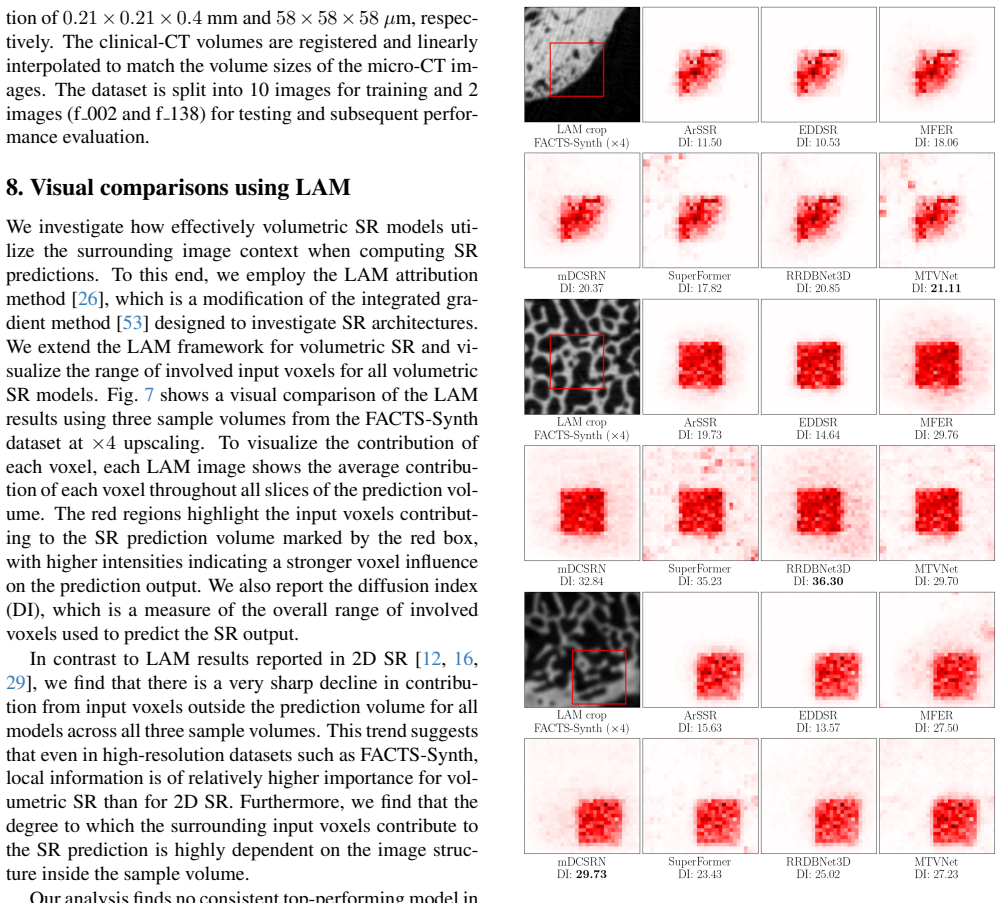
- [Supplementary Section 8 / Fig. 7] The paper's own Local Attribution Mapping results state that there is 'no consistent top-performing model in terms of DI' and 'no strong evidence correlating higher DI to higher PSNR/SSIM/NRMSE scores.' This is in direct tension with the abstract's claim that the method's advantage comes from attention over larger regions. The authors should either provide a more targeted attribution experiment that compares MTVNet with and without the multi-context levels on FACTS, or revise the mechanistic claim to acknowledge that the performance gains are not shown to be caused by the enlarged receptive field.
- [Section 4.1 / Evaluation and Table 1] The FACTS test set consists of only two volumes (f002 and f138), and all metrics in Table 1 are single-run point estimates without error bars, per-volume breakdowns, or repeated-seed statistics. Given that the 'significant margin' on FACTS-Synth is the central empirical claim of the paper, the authors should report variability estimates, such as standard deviations across seeds or per-volume scores, to demonstrate that the observed differences are not due to seed variance or the particular choice of the two test volumes.
- [Section 4.1 / Training] The MTVNet configuration uses input patch sizes of 64^3 and 128^3 for the L2 and L3 levels, while all competing models are trained with 32^3 patches. This means the comparison conflates the effect of the multi-context architecture with the effect of a larger input scope. To support the claim that the gains are due to long-range interactions rather than additional input voxels, the authors should include a control condition where a strong baseline such as RRDBNet3D or SuperFormer is trained with the same larger input patch size, or where MTVNet is evaluated with matched input sizes.
minor comments (7)
- [Title] On the first page, 'V olumes' should read 'Volumes'.
- [Section 4.3] The text says 'RDDBNet3D' but should say 'RRDBNet3D'.
- [Figure 5 caption] The garbled font-encoding sequences, such as '/uni00000014/uni00000019/...', need to be replaced with readable text in the camera-ready version.
- [Table 1] The layout makes it difficult to associate each group of numbers with its dataset and scale; please ensure clear per-dataset column headers in the final version.
- [Section 4.1] The phrase 'will be detailed' should be 'are detailed', since the supplementary material is part of the submission.
- [Supplementary Section 8] The abbreviation 'DI' (diffusion index) is not defined in the main text; please define it when it first appears or cite a reference.
- [Abstract] The statement that the method 'enables attention over larger regions than what has previously been possible' exceeds the evidence; consider softening it to 'than current volumetric transformer-based SR methods'.
Circularity Check
No significant circularity: MTVNet is an empirical benchmark paper whose claims rest on external datasets, direct measurements, and independent baselines.
full rationale
This paper makes no first-principles derivation whose output is equivalent to its input by construction. The central claim is that MTVNet outperforms six volumetric super-resolution baselines on the FACTS dataset (Table 1), and this is a direct measurement on held-out test volumes using standard metrics (PSNR/SSIM/NRMSE), not a fitted quantity renamed as a prediction. The architecture components (CATs, cyclic shifting, multi-context levels) are defined structurally in Section 3 and their contributions are probed by ablations (Table 2) on an external dataset (BraTS 2023); they are not defined in terms of the evaluation metric. The only author-overlapping citation is the FACTS dataset reference [6], which is used as an external benchmark input, not as a load-bearing theorem or as a fitted model, so it does not constitute circularity. Importantly, the supplementary LAM analysis explicitly states that the paper finds no consistent top-performing model in DI and no strong evidence correlating higher DI to higher PSNR/SSIM/NRMSE; this admission weakens the causal attribution of the gains to long-range context, but that is an evidence/correctness concern, not a circular-reasoning concern. The paper is self-contained against external benchmarks and code is provided, so the honest finding is no significant circularity.
Assumptions & free parameters
free parameters (4)
- Patch sizes per level (p3=8, p2=4, p1=2) =
8, 4, 2
- Attention window M and CAT factor c =
M=8, c=4
- Network depth (DCHAT blocks per level and SVHAT layers) =
L2: 2+3 blocks, 6 layers; L3 adds 1 block
- Learning rate schedule =
2e-4, halved at 50k, 70k, 85k, 95k iterations
assumptions (4)
- domain assumption LR/HR pairs generated by volumetric blurring followed by linear interpolation downsampling are a valid proxy for real low-resolution acquisition.
- standard math Self-attention and shifted window attention behave in 3D as they do in 2D, with the described complexity savings.
- ad hoc to paper The compared baseline models were trained fairly with adequate hyperparameters.
- domain assumption Foreground occupancy threshold of 25% for including slices in evaluation does not bias comparisons across methods.
invented entities (1)
-
Carrier tokens (CATs) in the 3D SVHAT layer
Cite this review
Pith. "Pith review of MTVNet: Mapping using Transformers for Volumes -- Network for Super-Resolution with Long-Range Interactions." pith.science (2026). https://pith.science/paper/E2L5VICF
@misc{pith2026241203379,
  author       = {Pith},
  title        = {Pith review of: MTVNet: Mapping using Transformers for Volumes -- Network for Super-Resolution with Long-Range Interactions},
  year         = {2026},
  howpublished = {\url{https://pith.science/paper/E2L5VICF}},
  note         = {Machine review of arXiv:2412.03379}
}
read the original abstract
Until now, it has been difficult for volumetric super-resolution to utilize the recent advances in transformer-based models seen in 2D super-resolution. The memory required for self-attention in 3D volumes limits the receptive field. Therefore, long-range interactions are not used in 3D to the extent done in 2D and the strength of transformers is not realized. We propose a multi-scale transformer-based model based on hierarchical attention blocks combined with carrier tokens at multiple scales to overcome this. Here information from larger regions at coarse resolution is sequentially carried on to finer-resolution regions to predict the super-resolved image. Using transformer layers at each resolution, our coarse-to-fine modeling limits the number of tokens at each scale and enables attention over larger regions than what has previously been possible. We experimentally compare our method, MTVNet, against state-of-the-art volumetric super-resolution models on five 3D datasets demonstrating the advantage of an increased receptive field. This advantage is especially pronounced for images that are larger than what is seen in popularly used 3D datasets. Our code is available at https://github.com/AugustHoeg/MTVNet
Figures


Figures from the paper (5 more)



Reference graph
Works this paper leans on
-
[1]
Aitken, Christian Ledig, Lucas Theis, Jose Ca- ballero, Zehan Wang, and Wenzhe Shi
Andrew P. Aitken, Christian Ledig, Lucas Theis, Jose Ca- ballero, Zehan Wang, and Wenzhe Shi. Checkerboard ar- tifact free sub-pixel convolution: A note on sub-pixel con- volution, resize convolution and convolution resize. ArXiv, abs/1707.02937, 2017. 4
arXiv 2017
-
[2]
Jimmy Ba, Jamie Kiros, and Geoffrey Hinton. Layer nor- malization. ArXiv e-prints, 2016. 5
work page 2016
-
[3]
Ujjwal Baid, Satyam Ghodasara, Suyash Mohan, M Bilello, E Calabrese, E Colak, K Farahani, J Kalpathy-Cramer, FC Kitamura, S Pati, et al. The rsna-asnr-miccai brats 2021 benchmark on brain tumor segmentation and radiogenomic classification. arxiv 2021. arXiv preprint arXiv:2107.02314,
arXiv 2021
-
[4]
Segmentation labels and radiomic features for the pre-operative scans of the tcga- lgg collection
Spyridon Bakas, Hamed Akbari, Aristeidis Sotiras, Michel Bilello, Martin Rozycki, Justin Kirby, John Freymann, Key- van Farahani, and Christos Davatzikos. Segmentation labels and radiomic features for the pre-operative scans of the tcga- lgg collection. The cancer imaging archive, 286, 2017
work page 2017
-
[5]
Spyridon Bakas, Hamed Akbari, Aristeidis Sotiras, Michel Bilello, Martin Rozycki, Justin S Kirby, John B Freymann, Keyvan Farahani, and Christos Davatzikos. Advancing the cancer genome atlas glioma mri collections with expert seg- mentation labels and radiomic features. Scientific data, 4(1): 1–13, 2017. 5, 1
work page 2017
-
[6]
Sophia W. Bardenfleth, Vedrana A. Dahl, Chiara Villa, Galateia Kazakia, and Anders B. Dahl. Superresolution of real-world multiscale bone ct verified with clinical bone measures. In Medical Image Understanding and Analysis , pages 160–173, Cham, 2024. Springer Nature Switzerland. 5, 1
work page 2024
-
[7]
Swin-Unet: Unet-like pure transformer for medical image segmentation
Hu Cao, Yueyue Wang, Joy Chen, Dongsheng Jiang, Xi- aopeng Zhang, Qi Tian, and Manning Wang. Swin-Unet: Unet-like pure transformer for medical image segmentation. In European conference on computer vision, pages 205–218. Springer, 2022. 2
work page 2022
-
[8]
End-to- end object detection with transformers
Nicolas Carion, Francisco Massa, Gabriel Synnaeve, Nicolas Usunier, Alexander Kirillov, and Sergey Zagoruyko. End-to- end object detection with transformers. In European confer- ence on computer vision, pages 213–229. Springer, 2020. 2
2020
Show all 74 references
-
[9]
Crossvit: Cross-attention multi-scale vision transformer for image classification
Chun-Fu Chen, Quanfu Fan, and Rameswar Panda. Crossvit: Cross-attention multi-scale vision transformer for image classification. In Proceedings of the IEEE/CVF international conference on computer vision, pages 357–366, 2021. 2
2021
-
[10]
Transunet: Transformers make strong en- coders for medical image segmentation
Jieneng Chen, Yongyi Lu, Qihang Yu, Xiangde Luo, Ehsan Adeli, Yan Wang, Le Lu, Alan Loddon Yuille, and Yuyin Zhou. Transunet: Transformers make strong en- coders for medical image segmentation. arXiv preprint arXiv:2102.04306, 2021. 2
2021 arXiv
-
[11]
Hat: Hybrid attention transformer for image restoration
Xiangyu Chen, Xintao Wang, Wenlong Zhang, Xiangtao Kong, Yu Qiao, Jiantao Zhou, and Chao Dong. Hat: Hybrid attention transformer for image restoration. arXiv preprint arXiv:2309.05239, 2023. 2
2023
-
[12]
Activating more pixels in image super- resolution transformer
Xiangyu Chen, Xintao Wang, Jiantao Zhou, Yu Qiao, and Chao Dong. Activating more pixels in image super- resolution transformer. In Proceedings of the IEEE/CVF Conference on Computer Vision and Pattern Recognition (CVPR), pages 22367–22377, 2023. 1, 2
2023
-
[13]
Efficient and ac- curate mri super-resolution using a generative adversar- ial network and 3d multi-level densely connected network
Yuhua Chen, Feng Shi, Anthony G Christodoulou, Yibin Xie, Zhengwei Zhou, and Debiao Li. Efficient and ac- curate mri super-resolution using a generative adversar- ial network and 3d multi-level densely connected network. In International conference on medical image computing a...
-
[14]
Brain MRI super resolution using 3D deep densely connected neural networks
Yuhua Chen, Yibin Xie, Zhengwei Zhou, Feng Shi, Anthony Christodoulou, and Debiao Li. Brain MRI super resolution using 3D deep densely connected neural networks. In 2018 IEEE 15th international symposium on biomedical imaging (ISBI 2018), pages 739–742. IEEE, 2018. 2, 5
2018
-
[15]
Christodoulou, Zhengwei Zhou, Feng Shi, Yibin Xie, and Debiao Li
Yuhua Chen, Anthony G. Christodoulou, Zhengwei Zhou, Feng Shi, Yibin Xie, and Debiao Li. MRI super-resolution with GAN and 3D multi-level densenet: Smaller, faster, and better. arXiv preprint arXiv:2003.01217, 2020. 1, 2, 5, 7
2003 arXiv
-
[16]
HMANet: Hybrid multi-axis aggrega- tion network for image super-resolution
Shu-Chuan Chu, Zhi-Chao Dou, Jeng-Shyang Pan, Shaowei Weng, and Junbao Li. HMANet: Hybrid multi-axis aggrega- tion network for image super-resolution. In Proceedings of the IEEE/CVF Conference on Computer Vision and Pattern Recognition (CVPR) Workshops, pages 6257–6266, 2024. 1, 2
2024
-
[17]
Conde, Ui-Jin Choi, Maxime Burchi, and Radu Timofte
Marcos V . Conde, Ui-Jin Choi, Maxime Burchi, and Radu Timofte. Swin2sr: Swinv2 transformer for compressed im- age super-resolution and restoration. In European Confer- ence on Computer Vision , pages 669–687. Springer, 2023. 2
2023
-
[18]
Image super-resolution using deep convolutional net- works
Chao Dong, Chen Change Loy, Kaiming He, and Xiaoou Tang. Image super-resolution using deep convolutional net- works. IEEE Transactions on Pattern Analysis and Machine Intelligence, 38(2):295–307, 2016. 2
2016
-
[19]
Acceler- ating the super-resolution convolutional neural network
Chao Dong, Chen Change Loy, and Xiaoou Tang. Acceler- ating the super-resolution convolutional neural network. In Computer Vision – ECCV 2016 , pages 391–407. Springer,
2016
-
[20]
An image is worth 16x16 words: Transformers for image recognition at scale
Alexey Dosovitskiy, Lucas Beyer, Alexander Kolesnikov, Dirk Weissenborn, Xiaohua Zhai, Thomas Unterthiner, Mostafa Dehghani, Matthias Minderer, Georg Heigold, Syl- vain Gelly, Jakob Uszkoreit, and Neil Houlsby. An image is worth 16x16 words: Transformers for image recognition ...
2010 arXiv
-
[21]
Brain MRI super-resolution using 3D dilated convolutional encoder–decoder network
Jinglong Du, Lulu Wang, Yulu Liu, Zexun Zhou, Zhongshi He, and Yuanyuan Jia. Brain MRI super-resolution using 3D dilated convolutional encoder–decoder network. IEEE Access, 8:18938–18950, 2020. 2
2020
-
[22]
Su- perFormer: V olumetric transformer architectures for MRI super-resolution
Cristhian Forigua, Maria Escobar, and Pablo Arbelaez. Su- perFormer: V olumetric transformer architectures for MRI super-resolution. In International Workshop on Simulation and Synthesis in Medical Imaging, pages 132–141. Springer,
-
[23]
Yunhe Gao, Mu Zhou, Ding Liu, and Dimitris N. Metaxas. A multi-scale transformer for medical image segmentation: Architectures, model efficiency, and benchmarks. arXiv preprint arXiv:2203.00131, 2022. 2
2022 arXiv
-
[24]
Adamixer: A fast-converging query-based object detector
Ziteng Gao, Limin Wang, Bing Han, and Sheng Guo. Adamixer: A fast-converging query-based object detector. 2022 IEEE/CVF Conference on Computer Vision and Pat- tern Recognition (CVPR), pages 5354–5363, 2022. 2
2022
-
[25]
Stereo-correlation and noise-distribution aware ResV oxGAN for dense slices reconstruction and noise reduction in thick low-dose CT
Rongjun Ge, Guanyu Yang, Chenchu Xu, Yang Chen, Limin Luo, and Shuo Li. Stereo-correlation and noise-distribution aware ResV oxGAN for dense slices reconstruction and noise reduction in thick low-dose CT. In Medical Image Com- puting and Computer Assisted Intervention–MICCAI 2...
2019
-
[26]
Interpreting super-resolution networks with local attribution maps
Jinjin Gu and Chao Dong. Interpreting super-resolution networks with local attribution maps. In Proceedings of the IEEE/CVF Conference on Computer Vision and Pattern Recognition (CVPR), pages 9199–9208, 2021. 2
2021
-
[27]
Roth, and Daguang Xu
Ali Hatamizadeh, Vishwesh Nath, Yucheng Tang, Dong Yang, Holger R. Roth, and Daguang Xu. Swin unetr: Swin transformers for semantic segmentation of brain tumors in mri images. In Brainlesion: Glioma, Multiple Sclerosis, Stroke and Traumatic Brain Injuries, pages 272–284, Cham,
-
[28]
Faster- ViT: Fast vision transformers with hierarchical attention
Ali Hatamizadeh, Greg Heinrich, Hongxu Yin, Andrew Tao, Jose M Alvarez, Jan Kautz, and Pavlo Molchanov. Faster- ViT: Fast vision transformers with hierarchical attention. arXiv preprint arXiv:2306.06189, 2023. 2, 4, 8, 1
2023 arXiv
-
[29]
Drct: Saving image super-resolution away from informa- tion bottleneck
Chih-Chung Hsu, Chia-Ming Lee, and Yi-Shiuan Chou. Drct: Saving image super-resolution away from informa- tion bottleneck. In Proceedings of the IEEE/CVF Confer- ence on Computer Vision and Pattern Recognition (CVPR) Workshops, pages 6133–6142, 2024. 1, 2, 4
2024
-
[30]
Weinberger
Gao Huang, Zhuang Liu, Laurens Van Der Maaten, and Kil- ian Q. Weinberger. Densely connected convolutional net- works. In 2017 IEEE Conference on Computer Vision and Pattern Recognition (CVPR), pages 2261–2269, 2017. 2
2017
-
[31]
Deep learning-based magnetic resonance image super-resolution: a survey
Zexin Ji, Beiji Zou, Xiaoyan Kui, Jun Liu, Wei Zhao, Chengzhang Zhu, Peishan Dai, and Yulan Dai. Deep learning-based magnetic resonance image super-resolution: a survey. Neural Computing and Applications , 36(21): 12725–12752, 2024. 3
2024
-
[32]
Deep learning-based magnetic resonance image super-resolution: a survey
Zexin Ji, Beiji Zou, Xiaoyan Kui, Jun Liu, Wei Zhao, Chengzhang Zhu, Peishan Dai, and Yulan Dai. Deep learning-based magnetic resonance image super-resolution: a survey. Neural Computing and Applications , pages 1–28,
-
[33]
Ct image super resolution based on improved srgan
Xuhao Jiang, Yifei Xu, Pingping Wei, and Zhuming Zhou. Ct image super resolution based on improved srgan. In 2020 5th International Conference on Computer and Communica- tion Systems (ICCCS), pages 363–367. IEEE, 2020. 1
2020
-
[34]
Kingma and Jimmy Ba
Diederik P. Kingma and Jimmy Ba. Adam: A method for stochastic optimization. CoRR, abs/1412.6980, 2014. 5
2014 arXiv
-
[35]
Multi- parametric neuroimaging reproducibility: a 3-t resource study
Bennett A Landman, Alan J Huang, Aliya Gifford, Deepti S Vikram, Issel Anne L Lim, Jonathan AD Farrell, John A Bogovic, Jun Hua, Min Chen, Samson Jarso, et al. Multi- parametric neuroimaging reproducibility: a 3-t resource study. Neuroimage, 54(4):2854–2866, 2011. 5, 1
2011
-
[36]
Aitken, Alykhan Tejani, Johannes Totz, Zehan Wang, and Wenzhe Shi
Christian Ledig, Lucas Theis, Ferenc Husz´ar, Jose Caballero, Andrew P. Aitken, Alykhan Tejani, Johannes Totz, Zehan Wang, and Wenzhe Shi. Photo-realistic single image super- resolution using a generative adversarial network. 2017 IEEE Conference on Computer Vision and Pattern...
2017
-
[37]
Rethinking multi-contrast mri super-resolution: Rectangle-window cross-attention transformer and arbitrary- scale upsampling
Guangyuan Li, Lei Zhao, Jiakai Sun, Zehua Lan, Zhan- jie Zhang, Jiafu Chen, Zhijie Lin, Huaizhong Lin, and Wei Xing. Rethinking multi-contrast mri super-resolution: Rectangle-window cross-attention transformer and arbitrary- scale upsampling. In Proceedings of the IEEE/CVF In-...
2023
-
[38]
Multi-level feature extraction and reconstruction for 3d mri image super-resolution.Computers in Biology and Medicine, 171:108151, 2024
Hongbi Li, Yuanyuan Jia, Huazheng Zhu, Baoru Han, Jing- long Du, and Yanbing Liu. Multi-level feature extraction and reconstruction for 3d mri image super-resolution.Computers in Biology and Medicine, 171:108151, 2024. 2, 5, 7
2024
-
[39]
SwinIR: Image restoration using swin transformer
Jingyun Liang, Jiezhang Cao, Guolei Sun, Kai Zhang, Luc Van Gool, and Radu Timofte. SwinIR: Image restoration using swin transformer. In Proceedings of the IEEE/CVF international conference on computer vision , pages 1833– 1844, 2021. 1, 2, 3
2021
-
[40]
Enhanced deep residual networks for single image super-resolution
Bee Lim, Sanghyun Son, Heewon Kim, Seungjun Nah, and Kyoung Mu Lee. Enhanced deep residual networks for single image super-resolution. In Proceedings of the IEEE Confer- ence on Computer Vision and Pattern Recognition (CVPR) Workshops, 2017. 2
2017
-
[41]
Swin transformer: Hierarchical vision transformer using shifted windows.2021 IEEE/CVF International Conference on Computer Vision (ICCV), pages 9992–10002, 2021
Ze Liu, Yutong Lin, Yue Cao, Han Hu, Yixuan Wei, Zheng Zhang, Stephen Lin, and Baining Guo. Swin transformer: Hierarchical vision transformer using shifted windows.2021 IEEE/CVF International Conference on Computer Vision (ICCV), pages 9992–10002, 2021. 1, 2, 3, 8
2021
-
[42]
Swin transformer v2: Scaling up capacity and resolution
Ze Liu, Han Hu, Yutong Lin, Zhuliang Yao, Zhenda Xie, Yixuan Wei, Jia Ning, Yue Cao, Zheng Zhang, Li Dong, Furu Wei, and Baining Guo. Swin transformer v2: Scaling up capacity and resolution. In International Conference on Computer Vision and Pattern Recognition (CVPR), 2022. 2...
2022
-
[43]
A novel 3d med- ical image super-resolution method based on densely con- nected network
Wei Lu, Zhijin Song, and Jinghui Chu. A novel 3d med- ical image super-resolution method based on densely con- nected network. Biomedical Signal Processing and Control, 62:102120, 2020. 2
2020
-
[44]
The multimodal brain tumor image segmentation benchmark (brats)
Bjoern H Menze, Andras Jakab, Stefan Bauer, Jayashree Kalpathy-Cramer, Keyvan Farahani, Justin Kirby, Yuliya Burren, Nicole Porz, Johannes Slotboom, Roland Wiest, et al. The multimodal brain tumor image segmentation benchmark (brats). IEEE transactions on medical imaging , 34(...
1993
-
[45]
Multi-input cardiac image super-resolution using convolu- tional neural networks
Ozan Oktay, Wenjia Bai, Matthew Lee, Ricardo Guerrero, Konstantinos Kamnitsas, Jose Caballero, Antonio de Mar- vao, Stuart Cook, Declan O’Regan, and Daniel Rueckert. Multi-input cardiac image super-resolution using convolu- tional neural networks. In Medical Image Computing an...
2016
-
[46]
Brain MRI super-resolution using deep 3d convolutional networks
Chi-Hieu Pham, Aur ´elien Ducournau, Ronan Fablet, and Franc ¸ois Rousseau. Brain MRI super-resolution using deep 3d convolutional networks. In 2017 IEEE 14th International Symposium on Biomedical Imaging (ISBI 2017), pages 197– 200, 2017. 2
2017
-
[47]
Multiscale brain mri super-resolution using deep 3d convolutional networks
Chi-Hieu Pham, Carlos Tor-D ´ıez, H´el`ene Meunier, Nathalie Bednarek, Ronan Fablet, Nicolas Passat, and Franc ¸ois Rousseau. Multiscale brain mri super-resolution using deep 3d convolutional networks. Computerized Medical Imaging and Graphics, 77:101647, 2019. 1, 2
2019
-
[48]
Sparse detr: Efficient end-to-end object detection with learnable sparsity
Byungseok Roh, Jaewoong Shin, Wuhyun Shin, and Sae- hoon Kim. Sparse detr: Efficient end-to-end object detection with learnable sparsity. ArXiv, abs/2111.14330, 2021. 2
2021 arXiv
-
[49]
Brain MRI super- resolution using 3d generative adversarial networks
Irina S ´anchez and Ver ´onica Vilaplana. Brain MRI super- resolution using 3d generative adversarial networks. ArXiv, abs/1812.11440, 2018. 2
2018 arXiv
-
[50]
Object detection with trans- formers: A review
Tahira Shehzadi, Khurram Azeem Hashmi, Didier Stricker, and Muhammad Zeshan Afzal. Object detection with trans- formers: A review. ArXiv, abs/2306.04670, 2023. 2
2023 arXiv
-
[51]
Aitken, Rob Bishop, Daniel Rueckert, and Zehan Wang
Wenzhe Shi, Jose Caballero, Ferenc Husz ´ar, Johannes Totz, Andrew P. Aitken, Rob Bishop, Daniel Rueckert, and Zehan Wang. Real-time single image and video super-resolution us- ing an efficient sub-pixel convolutional neural network.2016 IEEE Conference on Computer Vision and ...
2016
-
[52]
Deep robust residual network for super-resolution of 2d fetal brain mri
Liyao Song, Quan Wang, Ting Liu, Haiwei Li, Jiancun Fan, Jian Yang, and Bingliang Hu. Deep robust residual network for super-resolution of 2d fetal brain mri. Scientific reports, 12(1):406, 2022. 1
2022
-
[53]
Axiomatic attribution for deep networks
Mukund Sundararajan, Ankur Taly, and Qiqi Yan. Axiomatic attribution for deep networks. InInternational conference on machine learning, pages 3319–3328. PMLR, 2017. 2
2017
-
[54]
Image super-resolution using dense skip connections
Tong Tong, Gen Li, Xiejie Liu, and Qinquan Gao. Image super-resolution using dense skip connections. In2017 IEEE International Conference on Computer Vision (ICCV), pages 4809–4817, 2017. 2
2017
-
[55]
The wu-minn human connec- tome project: an overview
David C Van Essen, Stephen M Smith, Deanna M Barch, Timothy EJ Behrens, Essa Yacoub, Kamil Ugurbil, Wu- Minn HCP Consortium, et al. The wu-minn human connec- tome project: an overview. Neuroimage, 80:62–79, 2013. 5, 1
2013
-
[56]
Shazeer, Niki Parmar, Jakob Uszkoreit, Llion Jones, Aidan N
Ashish Vaswani, Noam M. Shazeer, Niki Parmar, Jakob Uszkoreit, Llion Jones, Aidan N. Gomez, Lukasz Kaiser, and Illia Polosukhin. Attention is all you need. In Neural Infor- mation Processing Systems, 2017. 4, 5
2017
-
[57]
Imaging intact human organs with local resolu- tion of cellular structures using hierarchical phase-contrast tomography
CL Walsh, P Tafforeau, WL Wagner, DJ Jafree, A Bellier, C Werlein, MP K¨uhnel, E Boller, S Walker-Samuel, JL Rober- tus, et al. Imaging intact human organs with local resolu- tion of cellular structures using hierarchical phase-contrast tomography. Nature methods, 18(12):1532–...
2021
-
[58]
3d dense convolutional neural network for fast and accurate single mr image super- resolution
Lulu Wang, Jinglong Du, Ali Gholipour, Huazheng Zhu, Zhongshi He, and Yuanyuan Jia. 3d dense convolutional neural network for fast and accurate single mr image super- resolution. Computerized Medical Imaging and Graphics , 93:101973, 2021. 2, 5, 7
2021
-
[59]
Adjacent slices feature transformer net- work for single anisotropic 3d brain mri image super- resolution
Lulu Wang, Huazheng Zhu, Zhongshi He, Yuanyuan Jia, and Jinglong Du. Adjacent slices feature transformer net- work for single anisotropic 3d brain mri image super- resolution. Biomedical Signal Processing and Control , 72: 103339, 2022. 3
2022
-
[60]
Accelerat- ing magnetic resonance imaging via deep learning
Shanshan Wang, Zhenghang Su, Leslie Ying, Xi Peng, Shun Zhu, Feng Liang, Dagan Feng, and Dong Liang. Accelerat- ing magnetic resonance imaging via deep learning. In 2016 IEEE 13th international symposium on biomedical imaging (ISBI), pages 514–517. IEEE, 2016. 1
2016
-
[61]
Transbts: Multimodal brain tumor segmen- tation using transformer
Wenxuan Wang, Chen Chen, Meng Ding, Hong Yu, Sen Zha, and Jiangyun Li. Transbts: Multimodal brain tumor segmen- tation using transformer. In Medical Image Computing and Computer Assisted Intervention – MICCAI 2021, pages 109– 119, Cham, 2021. Springer International Publishing. 2
2021
-
[62]
ESRGAN: Enhanced super-resolution generative adversarial networks
Xintao Wang, Ke Yu, Shixiang Wu, Jinjin Gu, Yihao Liu, Chao Dong, Yu Qiao, and Chen Change Loy. ESRGAN: Enhanced super-resolution generative adversarial networks. In Computer Vision – ECCV 2018 Workshops, pages 63–79. Springer, 2019. 2, 5, 7
2018
-
[63]
Ultrahigh resolution whole body photon counting computed tomography as a novel versatile tool for transla- tional research from mouse to man
Eckhard Wehrse, Laura Klein, Lukas Thomas Rotkopf, Wol- fram Stiller, M Finke, Gernot G Echner, Christin Glowa, Sarah Heinze, Christian Herbert Ziener, Heinz Peter Schlem- mer, et al. Ultrahigh resolution whole body photon counting computed tomography as a novel versatile tool...
2023
-
[64]
An arbitrary scale super- resolution approach for 3d mr images via implicit neural rep- resentation
Qing Wu, Yuwei Li, Yawen Sun, Yan Zhou, Hongjiang Wei, Jingyi Yu, and Yuyao Zhang. An arbitrary scale super- resolution approach for 3d mr images via implicit neural rep- resentation. IEEE Journal of Biomedical and Health Infor- matics, 27(2):1004–1015, 2023. 2, 3, 5, 7
2023
-
[65]
Brain mr image super-resolution via a deep convolutional neural network with multi-unit up- sampling learning
Hao Xia, Nian Cai, Huiheng Wang, Yadong Mao, Han Wang, Jian Li, and Ping Wang. Brain mr image super-resolution via a deep convolutional neural network with multi-unit up- sampling learning. Signal, Image and Video Processing, 15: 931–939, 2021. 1
2021
-
[66]
3d cross-scale feature transformer network for brain mr image super-resolution
Wanqi Zhang, Lulu Wang, Wei Chen, Yuanyuan Jia, Zhong- shi He, and Jinglong Du. 3d cross-scale feature transformer network for brain mr image super-resolution. In ICASSP 2022 - 2022 IEEE International Conference on Acoustics, Speech and Signal Processing (ICASSP), pages 1356–1360,
2022
-
[67]
Image super-resolution using very deep residual channel attention networks
Yulun Zhang, Kunpeng Li, Kai Li, Lichen Wang, Bineng Zhong, and Yun Fu. Image super-resolution using very deep residual channel attention networks. In Computer Vision – ECCV 2018, pages 294–310, Cham, 2018. Springer Interna- tional Publishing. 2, 3
2018
-
[68]
Arbitrary scale super-resolution for medical images
Jin Zhu, Chuan Tan, Junwei Yang, Guang Yang, and Pietro Lio’. Arbitrary scale super-resolution for medical images. International Journal of Neural Systems , 31(10):2150037,
-
[71]
6 provides an overview of our proposed shifting vol- umetric hierarchical attention transformer (SVHAT) layer
Details of SVHA T layer Fig. 6 provides an overview of our proposed shifting vol- umetric hierarchical attention transformer (SVHAT) layer. Our SVHAT captures global and local token dependen- cies using separate attention branches for CATs and ITEs. The CAT attention branch (s...
-
[72]
We use the T1-weighted images which feature an isotropic resolution of 0.7 mm and a vol- ume size of 320×320×256 voxels
Datasets Human Connectome Project (HCP) 1200 The HCP 1200 Subjects Data Release [55] includes struc- tural MRI scans from 1113 healthy subjects acquired using a 3T scanning platform. We use the T1-weighted images which feature an isotropic resolution of 0.7 mm and a vol- ume s...
2023
-
[73]
To this end, we employ the LAM attribution method [26], which is a modification of the integrated gra- dient method [53] designed to investigate SR architectures
Visual comparisons using LAM We investigate how effectively volumetric SR models uti- lize the surrounding image context when computing SR predictions. To this end, we employ the LAM attribution method [26], which is a modification of the integrated gra- dient method [53] desi...
-
[74]
8 shows more visual comparisons of SR predic- tions using the datasets HCP 1200, IXI, BraTS 2023, Kirby 21, FACTS-Synth and FACTS-Real at ×4 upscal- ing
More visual comparisons Fig. 8 shows more visual comparisons of SR predic- tions using the datasets HCP 1200, IXI, BraTS 2023, Kirby 21, FACTS-Synth and FACTS-Real at ×4 upscal- ing. Across the four structural brain MRI datasets, our Figure 7. LAM comparisons of SR models usin...
2023
-
[2021]
3 MTVNet: Mapping using Transformers for V olumes – Network for Super-Resolution with Long-Range Interactions Supplementary Material
PMID: 34304719. 3 MTVNet: Mapping using Transformers for V olumes – Network for Super-Resolution with Long-Range Interactions Supplementary Material
-
[2022]
Springer International Publishing. 2
Reviewed August 11, 2026 · model on record in the stance chip above.
Discussion (0). Continue with ORCID to comment.