REVIEW 4 major objections 6 minor 49 references
PROGRESSOR: A Perceptually Guided Reward Estimator with Self-Supervised Online Refinement
T0 review · 4 major / 6 minor · reviewed 2026-08-12 · deepseek-v4-flash
Pith's one-line read A self-supervised reward model trained only on unlabeled video can replace hand-designed rewards for robot reinforcement learning.
desk verdict Simulation results are credible, but the real-robot RWR weighting arithmetic doesn't support the reported success gap. read the letter →
The pith
A machine-rendered reading of the paper's core claim, the machinery that carries it, and where it could break.
The reading
What carries the argument
The progress estimator $E_\theta(o_i, o_j, o_g)$ — a shared visual encoder with MLP heads predicting $\mu$ and $\log\sigma^2$ — is trained by KL divergence against a Gaussian target centered at the frame-index ratio $\delta = |j-i|/|g-i|$, with variance bounded below by $1/(g-i)$. The reward $r_\theta = \mu - \alpha H(\mathcal{N}(\mu,\sigma^2))$ turns predicted progress into a dense scalar reward. The distinctive mechanism is adversarial online refinement ('push-back'): for frames sampled from online rollouts, the model is trained toward a shrunk prediction $\beta\mu$ ($\beta=0.9$) with a stop-gradient target, while expert triplets continue to be trained toward their true progress, so the reward explicitly penalizes states that look like non-expert behavior.
What would settle it
Run the identical DrQ-v2 setup on a task with cyclic observations (for example, stirring or turning a crank), using expert videos that revisit the same states; if PROGRESSOR's reward fails to separate progress from regress and the agent does not learn, the frame-index progress assumption is what breaks. A cheaper check is to take a single successful demonstration with temporary backtracking, compute PROGRESSOR's predicted reward at the backtracked frames, and show it rises when true progress falls.
Extended reading notes
Core claim
The central discovery is that a single task-agnostic reward model, trained only on unordered frame triplets from expert videos, can provide a dense reward signal strong enough to drive reinforcement learning from pixels. The model outputs a Gaussian distribution over progress, with mean given by the normalized frame-position ratio $\delta(o_i, o_j, o_g)=|j-i|/|g-i|$, and the reward is the predicted mean minus an entropy penalty. During online training, a push-back loss nudges predictions on non-expert rollouts toward a discounted progress value $\beta\mu$, while expert predictions are continually re-fitted, so the reward stays calibrated as the policy explores. The authors show this enables task-agnostic generalization: one model pretrained on human egocentric kitchen videos transfers zero-shot to real-robot tasks and, when used in reward-weighted regression over a mix of successful and failed demonstrations, yields higher success rates than rewards derived from R3M or VIP.
Load-bearing premise
The reward signal reduces to the assumption that every expert demonstration advances monotonically toward the goal: progress is defined by frame indices, so any successful trajectory that backtracks, pauses, or revisits states will be assigned the wrong progress regardless of network capacity.
Editorial extensions
If this is right
- A policy can be trained end-to-end from pixels with no environment reward, because the predicted progress provides dense credit assignment at every step.
- A single reward model pretrained on human video transfers across robotic tasks without task-specific fine-tuning, eliminating per-task reward engineering.
- The push-back refinement keeps the reward calibrated during exploration by continuously shrinking rewards on non-expert states, which is what makes online RL viable.
- In offline settings with noisy demonstrations, weighting behavior-cloning losses by progress rewards makes the policy resilient to failed trajectories.
Reading between the lines
- If the monotonic frame-index progress assumption is the binding constraint, PROGRESSOR should struggle on tasks where success requires revisiting states or cyclic motion; a natural extension would be a multimodal or latent progress model that can represent backtracking.
- The same progress-reward recipe could be applied to any domain with ordered video of successful executions—surgical training, sports coaching, or household chores—where the monotonicity assumption approximately holds.
- Because the reward compares the current frame to the initial and goal frames rather than to a fixed embedding, PROGRESSOR may show greater resilience to camera viewpoint changes than contrastive distance rewards; a viewpoint-transfer experiment would test this.
- A controlled stress test—training on demonstrations that include temporary backtracking and checking whether the reward peaks at the wrong time—would directly isolate the cost of the monotonicity assumption.
Editorial analysis
A structured set of objections, weighed in public.
Referee Report
Summary. The paper proposes PROGRESSOR, a reward model that predicts a Gaussian distribution over task progress for an observation triplet (initial, current, goal), using only self-supervised frame-index labels from unlabeled expert videos. During online RL, a 'push-back' loss (Eq. 7) shrinks the model's own progress predictions on non-expert rollouts to mitigate distribution shift. The authors evaluate PROGRESSOR in Meta-World with DrQ-v2, and on a real UR5 robot using reward-weighted regression ACT (RWR-ACT) trained on a mix of success and failed demonstrations, comparing against R3M and VIP reward models. The central claim is that PROGRESSOR provides dense rewards that enable learning without environment rewards or action labels.
Significance. If correct, the paper demonstrates a promising direction: a single reward model pretrained on human videos (EPIC-KITCHENS) that can be applied zero-shot to real-robot tasks, even with noisy demonstrations. The simulation results across six Meta-World tasks are generally strong and the ablations show the online refinement helps. The paper also provides qualitative reward-prediction plots and is mostly reproducible in structure. However, the real-robot success-rate claim rests on a mechanism (RWR with omega=0.1) that appears too weak to explain the reported gap from 0% (ACT) to 70-90% (PROGRESSOR-RWR-ACT) unless some quantity is misreported. Until this is reconciled, the significance of the real-robot contribution is uncertain.
major comments (4)
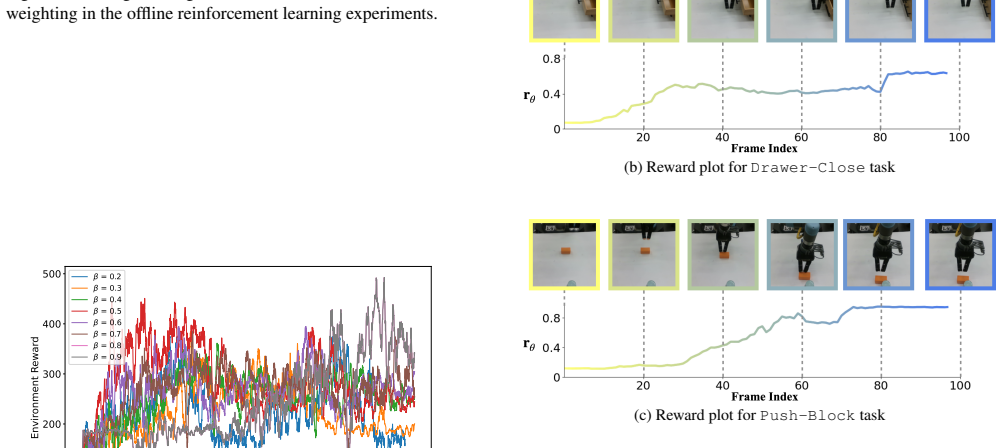
- [Section 5.2.3, Eq. (8), Figure 6] The RWR weighting as specified cannot explain the reported success-rate gap. With omega=0.1 and the reward scale shown in Figure 6 (correct vs. incorrect demonstrations differ by roughly 0.4 in Drawer-Open), the weight ratio in Eq. (8) is exp(0.1*0.4) ≈ 1.04. Even taking the largest visible gaps (about 0.6-0.8), the ratio is at most exp(0.08) ≈ 1.08. Weighting this close to uniform would make RWR-ACT nearly equivalent to vanilla ACT, yet vanilla ACT achieves 0% while PROGRESSOR-RWR-ACT achieves 70-90% on the hard tasks. Please provide the exact reward values inserted into Eq. (8), clarify whether the Figure 6 'reward prediction' is the same quantity, and either show a sensitivity analysis over omega or identify a normalization/scale that is missing. This is load-bearing for the real-robot claim.
- [Section 4.2, Eq. (7), abstract, contributions] The 'adversarial online refinement' is not adversarial. The push-back loss minimizes the KL divergence between the model's own prediction scaled by beta and the model's current prediction; there is no adversary, discriminator, or min-max objective. This is more accurately a self-distillation shrinkage regularizer toward beta*mu. The terminology overstates the method and the comparison to domain-adversarial methods (Ganin et al., Goodfellow et al.) is misleading. Please rename this component or reformulate it as a true adversarial objective, and adjust the abstract and contribution claims accordingly.
- [Eq. (2) and text below it] There is a technical inconsistency: the sentence says 'Our epsilon upper-bound of sigma_tau_k downweights...', but the formula sigma_tau_k = max(1/(g-i), epsilon) makes epsilon a lower bound (sigma is always at least epsilon), not an upper bound. The formula and the verbal description must be aligned, as this affects the variance of the KL target and the claimed robustness behavior.
- [Section 4.2 and Algorithm 1] The online push-back update is underspecified: it is not stated how the triplet (o_i, o_j, o_g) is sampled from the replay buffer/current rollouts for Eq. (7), nor what g-i represents in the online setting (episode length? current step index?). Without this definition, the push-back loss is not reproducible, which is particularly important because it is a key contribution and the ablation shows it changes performance substantially.
minor comments (6)
- [Throughout] There are numerous typos, including 'pushing back pushing back predictions' (Section 1), 'demonstratin' (Section 2), 'lloning' (Section 5.2.3), 'camere' (Supplement S9.1), 'pretrianing' (S7.1), and 'the the' (Section 1). These should be corrected.
- [Section 4.1] The text says 'See S8 for an ablation of alpha,' but Section 8 of the supplement contains simulation details only; the beta ablation is in Section 10. Please update the cross-reference.
- [Equation (8)] In the paragraph following Eq. (8), the text refers to 'uθ' while Eq. (5) defines rθ. Please make the notation consistent.
- [Figure 4 caption] The caption says '(a) The evolution of the episodic reward (b) The evolution of the success rate,' but the figure contains two rows of six panels each. Please clarify which panels correspond to which metric.
- [Section 5.1 and Supplement S8] The paper does not specify how the goal image is chosen for the Meta-World online RL experiments (e.g., whether it is the final frame of a successful expert rollout). This detail is needed for reproducibility.
- [Figure 5] Success rates are averages over 20 rollouts with no confidence intervals or raw counts. Reporting standard errors or binomial confidence intervals would strengthen the comparison.
Circularity Check
Push-back loss is self-referential by construction but not load-bearing; central progress reward is anchored to expert frame indices and evaluated externally, so no significant circularity.
-
self definitional
[Section 4.2, Eq. (7)]
"we update Eθ so that it learns to push-back the current estimation as βµτ′k with β ∈ [0, 1] as the decay factor. ... ppush-back = sg(N(βµτ′k, 1/(g−i)^2)), Lpush-back = DKL(ppush-back∥Eθ(oτ′ki, oτ′kj, oτ′kg))"
The online refinement target is defined as β times the model's own current mean prediction µ. With stop-gradient, minimizing the KL loss contracts µ toward βµ (β=0.9), so the 'push-back' carries no information beyond the model's own output scaled by a constant. This makes the refinement self-referential by construction. It is not load-bearing for the paper's main external claims (Meta-World success, real-robot success) because those are evaluated against environment/teleoperation outcomes, and the pretraining reward (Eq. 4) is anchored to frame-index progress labels. Hence a minor self-referential step rather than full circularity.
full rationale
The paper's central derivation is self-contained: Eq. (1) defines progress labels directly from frame indices in expert trajectories, Eq. (4) learns a Gaussian progress predictor against those labels, and Eq. (5) converts the predicted mean into a dense reward. The resulting policy is evaluated with external environment rewards and success rates, so no fitted constant is disguised as a prediction. The only self-referential element is the online push-back loss of Eq. (7), whose target is a scaled version of the model's own output; however, this is an explicitly stated regularizer rather than a claimed external prediction, and the paper's headline results do not rest on it alone. There are no load-bearing self-citations: the cited works (Rank2Reward, VIP, R3M, ACT, etc.) are by different authors and are used for comparison or acknowledged assumptions. The monotonic-progress assumption is stated openly and its limitation for cyclic tasks is acknowledged in Section 6, so it is a modeling assumption rather than hidden circularity. The reported difficulty in explaining the real-robot success gap from the RWR weights (Eq. 8 with ω=0.1) is a quantitative/explanatory concern, not a circularity concern. Overall, the derivation chain is not circular in any load-bearing way.
Assumptions & free parameters
free parameters (5)
- alpha =
0.4
- beta =
0.9
- epsilon =
not reported
- negative label for distractor triplets =
-1
- max frame gap =
2000
assumptions (3)
- domain assumption Expert demonstrations make monotonic progress toward the goal
- domain assumption Environment is fully observable through images
- domain assumption A single reward model can represent progress across multiple tasks
Cite this review
Pith. "Pith review of PROGRESSOR: A Perceptually Guided Reward Estimator with Self-Supervised Online Refinement." pith.science (2026). https://pith.science/paper/E3HPJIKS
@misc{pith2026241117764,
  author       = {Pith},
  title        = {Pith review of: PROGRESSOR: A Perceptually Guided Reward Estimator with Self-Supervised Online Refinement},
  year         = {2026},
  howpublished = {\url{https://pith.science/paper/E3HPJIKS}},
  note         = {Machine review of arXiv:2411.17764}
}
read the original abstract
We present PROGRESSOR, a novel framework that learns a task-agnostic reward function from videos, enabling policy training through goal-conditioned reinforcement learning (RL) without manual supervision. Underlying this reward is an estimate of the distribution over task progress as a function of the current, initial, and goal observations that is learned in a self-supervised fashion. Crucially, PROGRESSOR refines rewards adversarially during online RL training by pushing back predictions for out-of-distribution observations, to mitigate distribution shift inherent in non-expert observations. Utilizing this progress prediction as a dense reward together with an adversarial push-back, we show that PROGRESSOR enables robots to learn complex behaviors without any external supervision. Pretrained on large-scale egocentric human video from EPIC-KITCHENS, PROGRESSOR requires no fine-tuning on in-domain task-specific data for generalization to real-robot offline RL under noisy demonstrations, outperforming contemporary methods that provide dense visual reward for robotic learning. Our findings highlight the potential of PROGRESSOR for scalable robotic applications where direct action labels and task-specific rewards are not readily available.
Figures


Figures from the paper (9 more)



Reference graph
Works this paper leans on
-
[1]
Pieter Abbeel and Andrew Y . Ng. Apprenticeship learning via inverse reinforcement learning. In Pro- ceedings of the Twenty-First International Conference on Machine Learning , page 1, New York, NY , USA,
-
[2]
Learning reward functions for robotic manipulation by observ- ing humans, 2023
Minttu Alakuijala, Gabriel Dulac-Arnold, Julien Mairal, Jean Ponce, and Cordelia Schmid. Learning reward functions for robotic manipulation by observ- ing humans, 2023. 1
work page 2023
-
[3]
Human-to-robot imitation in the wild
Shikhar Bahl, Abhinav Gupta, and Deepak Pathak. Human-to-robot imitation in the wild. arXiv preprint arXiv:2207.09450, 2022. 2
arXiv 2022
-
[4]
Video pre- training (VPT): Learning to act by watching unlabeled online videos
Bowen Baker, Ilge Akkaya, Peter Zhokov, Joost Huizinga, Jie Tang, Adrien Ecoffet, Brandon Houghton, Raul Sampedro, and Jeff Clune. Video pre- training (VPT): Learning to act by watching unlabeled online videos. In Advances in Neural Information Pro- cessing Systems (NeurIPS), 2022. 2
work page 2022
-
[5]
Serena Booth, W Bradley Knox, Julie Shah, Scott Niekum, Peter Stone, and Alessandro Allievi. The perils of trial-and-error reward design: Misdesign through overfitting and invalid task specifications. In Proceedings of the National Conference on Artificial Intelligence (AAAI), 2023. 1
work page 2023
-
[6]
Scaling ego- centric vision: The EPIC-KITCHENS dataset
Dima Damen, Hazel Doughty, Giovanni Maria Farinella, Sanja Fidler, Antonino Furnari, Evangelos Kazakos, Davide Moltisanti, Jonathan Munro, Toby Perrett, Will Price, and Michael Wray. Scaling ego- centric vision: The EPIC-KITCHENS dataset. In Pro- ceedings of the European Conference on Computer Vi- sion (ECCV), 2018. 2, 6, 1
work page 2018
-
[7]
Rescaling egocentric vision: Collection, pipeline and challenges for EPIC-KITCHENS-100
Dima Damen, Hazel Doughty, Giovanni Maria Farinella, Antonino Furnari, Jian Ma, Evangelos Kazakos, Davide Moltisanti, Jonathan Munro, Toby Perrett, Will Price, and Michael Wray. Rescaling egocentric vision: Collection, pipeline and challenges for EPIC-KITCHENS-100. International Journal on Computer Vision, 130:33—-55, 2022. 6
work page 2022
-
[8]
Video predic- tion models as rewards for reinforcement learning
Alejandro Escontrela, Ademi Adeniji, Wilson Yan, Ajay Jain, Xue Bin Peng, Ken Goldberg, Youngwoon Lee, Danijar Hafner, and Pieter Abbeel. Video predic- tion models as rewards for reinforcement learning. In Advances in Neural Information Processing Systems (NeurIPS), 2024. 1, 2
work page 2024
Show all 49 references
-
[9]
Contrastive learning as goal-conditioned reinforcement learning,
Benjamin Eysenbach, Tianjun Zhang, Ruslan Salakhutdinov, and Sergey Levine. Contrastive learning as goal-conditioned reinforcement learning,
-
[10]
Guided cost learning: Deep inverse optimal con- trol via policy optimization
Chelsea Finn, Sergey Levine, and Pieter Abbeel. Guided cost learning: Deep inverse optimal con- trol via policy optimization. arXiv preprint arXiv:1603.00448, 2016. 2
2016 arXiv
-
[11]
Learning robust rewards with adversarial inverse reinforcement learning
Justin Fu, Katie Luo, and Sergey Levine. Learning robust rewards with adversarial inverse reinforcement learning. arXiv preprint arXiv:1710.11248, 2018. 2
2018 arXiv
-
[12]
Domain- adversarial training of neural networks
Yaroslav Ganin, Evgeniya Ustinova, Hana Ajakan, Pascal Germain, Hugo Larochelle, François Lavio- lette, Mario March, and Victor Lempitsky. Domain- adversarial training of neural networks. Journal of Machine Learning Research, 17(59):1–35, 2016. 4
2016
-
[13]
Generative adversarial nets
Ian Goodfellow, Jean Pouget-Abadie, Mehdi Mirza, Bing Xu, David Warde-Farley, Sherjil Ozair, Aaron Courville, and Yoshua Bengio. Generative adversarial nets. In Advances in Neural Information Processing Systems (NeurIPS), 2014. 4
2014
-
[14]
Ego4D: Around the world in 3,000 hours of egocentric video
Kristen Grauman, Andrew Westbury, Eugene Byrne, Zachary Chavis, Antonino Furnari, Rohit Girdhar, Jackson Hamburger, Hao Jiang, Miao Liu, Xingyu Liu, et al. Ego4D: Around the world in 3,000 hours of egocentric video. In Proceedings of the IEEE/CVF Conference on Computer Vision ...
2022
-
[15]
Inverse reward design
Dylan Hadfield-Menell, Smitha Milli, Pieter Abbeel, Stuart J Russell, and Anca Dragan. Inverse reward design. In Advances in Neural Information Processing Systems (NeurIPS), 2017. 1
2017
-
[16]
Deep residual learning for image recognition
Kaiming He, Xiangyu Zhang, Shaoqing Ren, and Jian Sun. Deep residual learning for image recognition. In Proceedings of the IEEE/CVF Conference on Com- puter Vision and Pattern Recognition (CVPR) , 2016. 6, 1
2016
-
[17]
Generative adver- sarial imitation learning
Jonathan Ho and Stefano Ermon. Generative adver- sarial imitation learning. In Advances in Neural Infor- mation Processing Systems (NeurIPS), 2016. 5
2016
-
[18]
Generative adversarial imitation learning
Jonathan Ho and Stefano Ermon. Generative adversarial imitation learning. arXiv preprint arXiv:1606.03476, 2016. 2
2016 arXiv
-
[19]
Diffusion reward: Learning rewards via conditional video diffusion
Tao Huang, Guangqi Jiang, Yanjie Ze, and Huazhe Xu. Diffusion reward: Learning rewards via conditional video diffusion. arXiv preprint arXiv:2312.14134, 2023. 1, 2
2023 arXiv
-
[20]
Auto-encoding variational Bayes
Diederik P Kingma and Max Welling. Auto-encoding variational Bayes. arXiv preprint arXiv:1312.6114 ,
-
[21]
In- foGAIL: Interpretable imitation learning from visual demonstrations
Yunzhu Li, Jiaming Song, and Stefano Ermon. In- foGAIL: Interpretable imitation learning from visual demonstrations. arXiv preprint arXiv:1703.08840 ,
-
[22]
VIP: Towards universal visual reward and represen- tation via value-implicit pre-training
Yecheng Jason Ma, Shagun Sodhani, Dinesh Jayara- man, Osbert Bastani, Vikash Kumar, and Amy Zhang. VIP: Towards universal visual reward and represen- tation via value-implicit pre-training. arXiv preprint arXiv:2210.00030, 2022. 7
-
[23]
9 Vip: Towards universal visual reward and representa- tion via value-implicit pre-training, 2023
Yecheng Jason Ma, Shagun Sodhani, Dinesh Jayara- man, Osbert Bastani, Vikash Kumar, and Amy Zhang. 9 Vip: Towards universal visual reward and representa- tion via value-implicit pre-training, 2023. 1, 2
2023
-
[24]
Towards theoretical understanding of inverse reinforcement learning
Alberto Maria Metelli, Filippo Lazzati, and Mar- cello Restelli. Towards theoretical understanding of inverse reinforcement learning. arXiv preprint arXiv:2304.12966, 2023. 2
2023 arXiv
-
[26]
R3M: A univer- sal visual representation for robot manipulation.arXiv preprint arXiv:2203.12601, 2022
Suraj Nair, Aravind Rajeswaran, Vikash Kumar, Chelsea Finn, and Abhinav Gupta. R3M: A univer- sal visual representation for robot manipulation.arXiv preprint arXiv:2203.12601, 2022. 1, 2
2022 arXiv
-
[27]
Advantage-weighted regression: Sim- ple and scalable off-policy reinforcement learning
Xue Bin Peng, Aviral Kumar, Grace Zhang, and Sergey Levine. Advantage-weighted regression: Sim- ple and scalable off-policy reinforcement learning. arXiv preprint arXiv:1910.00177, 2019. 7
1910 arXiv
-
[28]
Reinforcement learning by reward-weighted regression for operational space control
Jan Peters and Stefan Schaal. Reinforcement learning by reward-weighted regression for operational space control. In Proceedings of the International Confer- ence on Machine Learning (ICML) , pages 745–750,
-
[29]
DexMV: Imitation learning for dexterous manipula- tion from human videos
Yuzhe Qin, Yueh-Hua Wu, Shaowei Liu, Hanwen Jiang, Ruihan Yang, Yang Fu, and Xiaolong Wang. DexMV: Imitation learning for dexterous manipula- tion from human videos. In Proceedings of the Euro- pean Conference on Computer Vision (ECCV) , 2022. 2
2022
-
[30]
Artificial Intelli- gence: A Modern Approach
Stuart J Russell and Peter Norvig. Artificial Intelli- gence: A Modern Approach . Prentice Hall, Engle- wood Cliffs, NJ, USA, 1 edition, 1995. 1
1995
-
[31]
Time-contrastive networks: Self-supervised learning from video
Pierre Sermanet, Corey Lynch, Yevgen Chebotar, Jas- mine Hsu, Eric Jang, Stefan Schaal, and Sergey Levine. Time-contrastive networks: Self-supervised learning from video. In Proceedings of the IEEE In- ternational Conference on Robotics and Automation (ICRA), pages 1134–1141, 2018. 5
2018
-
[32]
Time-contrastive networks: Self-supervised learning from video, 2018
Pierre Sermanet, Corey Lynch, Yevgen Chebotar, Jas- mine Hsu, Eric Jang, Stefan Schaal, and Sergey Levine. Time-contrastive networks: Self-supervised learning from video, 2018. 2
2018
-
[33]
Lewis, and Andrew G
Satinder Singh, Richard L. Lewis, and Andrew G. Barto. Where do rewards come from? In Proceedings of the International Symposium on AI Inspired Biol- ogy, pages 111–116, 2010. 1
2010
-
[34]
Reinforcement Learning: An Introduction
Richard S Sutton and Andrew G Barto. Reinforcement Learning: An Introduction . MIT Press, Cambridge, MA, USA, 2 edition, 2018. 1
2018
-
[35]
DeepMind control suite
Yuval Tassa, Yotam Doron, Alistair Muldal, Tom Erez, Yazhe Li, Diego de Las Casas, David Budden, Abbas Abdolmaleki, Josh Merel, Andrew Lefrancq, Timothy Lillicrap, and Martin Riedmiller. DeepMind control suite. arXiv preprint arXiv:1801.00690, 2018. 8
2018 arXiv
-
[36]
Wozniak, Andrea Gasparri, and Danica Kragic
Michael C Welle, Nils Ingelhag, Martina Lippi, Ma- ciej K. Wozniak, Andrea Gasparri, and Danica Kragic. Quest2ROS: An app to facilitate teleoperating robots. In Proceedings of the International Workshop on Vir- tual, Augmented, and Mixed-Reality for Human-Robot Interactions, 2024. 1
2024
-
[37]
Maximum entropy deep inverse reinforcement learning, 2016
Markus Wulfmeier, Peter Ondruska, and Ingmar Pos- ner. Maximum entropy deep inverse reinforcement learning, 2016. 2
2016
-
[38]
Rank2Reward: Learning shaped reward functions from passive video
Daniel Yang, Davin Tjia, Jacob Berg, Dima Damen, Pulkit Agrawal, and Abhishek Gupta. Rank2Reward: Learning shaped reward functions from passive video. arXiv preprint arXiv:2404.14735, 2024. 1, 2, 3, 5
2024 arXiv
-
[39]
Representation matters: Offline pretraining for sequential decision making
Mengjiao Yang and Ofir Nachum. Representation matters: Offline pretraining for sequential decision making. arXiv preprint arXiv:2102.05815, 2021. 2
2021 arXiv
-
[40]
Im- age augmentation is all you need: Regularizing deep reinforcement learning from pixels
Denis Yarats, Ilya Kostrikov, and Rob Fergus. Im- age augmentation is all you need: Regularizing deep reinforcement learning from pixels. In International Conference on Learning Representations, 2021. 5
2021
-
[41]
Meta-World: A benchmark and evaluation for multi-task and meta reinforcement learning
Tianhe Yu, Deirdre Quillen, Zhanpeng He, Ryan Julian, Karol Hausman, Chelsea Finn, and Sergey Levine. Meta-World: A benchmark and evaluation for multi-task and meta reinforcement learning. In Proceedings of the Conference on Robot Learning (CoRL), 2020. 2, 5, 6, 1
2020
-
[42]
Learning to drive by watching YouTube videos: Action-conditioned contrastive policy pretraining
Qihang Zhang, Zhenghao Peng, and Bolei Zhou. Learning to drive by watching YouTube videos: Action-conditioned contrastive policy pretraining. In Proceedings of the European Conference on Com- puter Vision (ECCV), 2022. 2
2022
-
[43]
Learning fine-grained bimanual ma- nipulation with low-cost hardware
Tony Z Zhao, Vikash Kumar, Sergey Levine, and Chelsea Finn. Learning fine-grained bimanual ma- nipulation with low-cost hardware. arXiv preprint arXiv:2304.13705, 2023. 7, 2
2023 arXiv
-
[44]
Ziebart, Andrew Maas, J
Brian D. Ziebart, Andrew Maas, J. Andrew Bagnell, and Anind K. Dey. Maximum entropy inverse rein- forcement learning. In Proceedings of the 23rd Na- tional Conference on Artificial Intelligence - Volume 3, page 1433–1438. AAAI Press, 2008. 2 10 PROGRESSOR : A Perceptually Guid...
2008
-
[46]
PROGRESSOR Training Details 7.1. Architecture and Training PROGRESSOR can, in principle, be trained with any visual encoding architecture, requiring only minor modifications to the final layer to predict Gaussian parameters. In our ex- periments, we utilize the standard ResNet...
2000
-
[47]
Simulation Experiment Details In this section, we describe the tasks and the data generation process employed using the MetaWorld environment [41] for our simulation experiments. 8.1. Meta-World Tasks We took six diverse tasks from the Meta-World environ- ment [41], described ...
-
[48]
Robotic Experiment Setup The real-robot experiments are performed using a Universal Robots UR5 robot arm equipped with a Robotiq 3-Finger Gripper (Figure 8)
Real-World Robot Experiment Details 9.1. Robotic Experiment Setup The real-robot experiments are performed using a Universal Robots UR5 robot arm equipped with a Robotiq 3-Finger Gripper (Figure 8). The setup includes two RealSense cam- eras: one mounted on the robot’s wrist t...
-
[49]
The case of β = 0(PROGRESSOR with- out Push-back) is discussed in the main paper
Ablation In this section, we present an ablation study evaluating dif- ferent values of the push-back decay factor (β) while train- ing a DrQ-v2 agent on Meta-World’shammer task, using a fixed seed of 121. The case of β = 0(PROGRESSOR with- out Push-back) is discussed in the m...
-
[50]
This figure serves as an extension to Figure 7 for complete- ness
Qualitative Analysis Figure 12 presents zero-shot reward predictions from PRO- GRESSOR pretrained on the EPIC-KITCHENS dataset. This figure serves as an extension to Figure 7 for complete- ness. It includes zero-shot reward predictions for sample correct trajectories from our ...
-
[2004]
Association for Computing Machinery. 2
Reviewed August 12, 2026 · model on record in the stance chip above.
Discussion (0). Continue with ORCID to comment.