REVIEW 4 major objections 5 minor 35 references
Beam Switching Based Beam Design for High-Speed Train mmWave Communications
T0 review · 4 major / 5 minor · reviewed 2026-08-12 · deepseek-v4-flash
Pith's one-line read This paper proposes sequential beam-switch designs for high-speed train mmWave links that minimize the number of switched beams while keeping received SNR above a threshold, with the faster scheme cutting computation by 96.20%.
desk verdict A solid, well-executed beam-switching design for HST mmWave, with a conditional guarantee under perfect AoD that should be tested before relying on it. read the letter →
The pith
A machine-rendered reading of the paper's core claim, the machinery that carries it, and where it could break.
The reading
What carries the argument
The engine is the sequential subproblem (29): for beam $i$, with entry angle $\varphi_i$ fixed, maximize the exit switching angle $\varphi_{i+1}$ subject to the constant-modulus constraint on $f_i$ and the beam-gain inequalities $f_i^H A_m f_i \ge \gamma_m$ for all sampled angles in the coverage, where $\gamma_m$ is the RSNR threshold converted into a per-sample beam gain threshold in (27). The problem is handled by a two-stage loop: the first stage turns the fixed-coverage feasibility problem into a min-max optimization by penalizing RSNR violations and, in the second scheme, the constant-modulus constraint; the second stage adjusts $\varphi_{i+1}$ by bisection or a mixed monotonic-and-bisection search. The two instantiations differ in how the min-max problem is solved: SDR-DC-BiS uses semidefinite relaxation and difference-of-convex programming, while PP-PDG-MS uses a proximal-point method and a primal-dual gradient algorithm whose subproblems have closed-form solutions.
What would settle it
Re-run the far-field scenario with nonzero AoD estimation error, using the probabilistic constraint set (23) instead of (25), and count how often the realized RSNR falls below $\gamma_{\text{th}}$ at sampled train locations; if realistic $\sigma_\psi$ values (for example, comparable to a beam width) produce RSNR violations or require more beams, the central guarantee is not robust.
Extended reading notes
Core claim
The paper's central claim is that beam switching for high-speed train mmWave communications can be designed as a sequential coverage-maximization problem: with the previous switching angle fixed, each beamformer is chosen to extend the next switching angle as far as possible while keeping the beam gain at every sampled train location above the level that corresponds to the required RSNR, subject to constant-modulus phase-shifter constraints. It further claims that this subproblem can be solved by alternating a beamformer-feasibility stage and a coverage-search stage, and that the resulting PP-PDG-MS instantiation achieves essentially the same designed beam coverage as SDR-DC-BiS, with only 0.0657% narrower average coverage, while reducing computational complexity by 96.20%, making it practical for large antenna arrays and near-field train-to-base-station distances.
Load-bearing premise
The whole design assumes the base station's angle-of-departure estimate for the train is essentially exact ($\hat{\psi}_m \approx \psi_m$), so the RSNR constraints are enforced only on the nominal angles; if estimation errors are non-negligible, the guaranteed coverage may fail, and the paper notes but does not implement the probabilistic alternative.
Editorial extensions
If this is right
- A base station could predesign a small set of beams (8 in the far-field example, 14 in the near-field example) that guarantees the RSNR threshold along the whole track without collecting instantaneous channel state information at every coherence time.
- Because the beam coverage and the actual beamformer are optimized together, the RSNR instability that comes from approximating beam gain by simple functions of beam width is avoided, as the comparison against UBW, ESC, NUBW-M, and NUBW-S shows.
- The near-field experiment indicates the method can produce distance-dependent near-field beam patterns for large arrays, a regime where the semidefinite-relaxation scheme is computationally impractical.
- The 96.20% complexity reduction of PP-PDG-MS makes the optimization cheap enough that it could be run at system design time even for dense angle sampling and large antenna counts.
- Fewer switched beams mean longer dwell time per beam, which directly lowers the risk of beam misalignment during high-speed travel.
Reading between the lines
- Beyond the paper: if AoD estimation errors were taken into account through the probabilistic constraint set (23) instead of the deterministic set (25), the designed coverage boundaries would likely need to overlap more; a natural extension is to quantify how the reported 0.0657% coverage loss grows as $\sigma_\psi$ increases.
- Beyond the paper: the same sequential coverage-maximization structure could apply to curved tracks, varying train velocity, or other vehicle geometries by replacing the geometric functions $r(\psi)$ and $\psi(t)$, though the authors defer that extension.
- Beyond the paper: the 96.20% complexity reduction is a measured runtime ratio on one software and hardware setup and one parameter set; the asymptotic guarantee for PP-PDG-MS is still on the order of $\epsilon_3^{-3}$, so on different hardware or with tighter accuracy demands the speedup will vary.
- Beyond the paper: a physical testbed with a moving receiver could check whether the constant-modulus beams achieve the promised RSNR when the train's location reports include realistic jitter.
Editorial analysis
A structured set of objections, weighed in public.
Referee Report
Summary. The paper considers downlink beam switching for high-speed train mmWave links, where the base station predesigns a set of constant-modulus beams and switches among them as the train moves along a known railway geometry. The design goal is to minimize the number of switched beams needed over a predefined railway range while keeping the receiving SNR (RSNR) above a threshold. The authors formulate this as a mixed optimization over beam count, beam coverages, and beamformers, then propose a sequential approach that greedily extends coverage beam by beam. Two algorithm instantiations are given: SDR-DC-BiS, based on semidefinite relaxation, difference-of-convex programming, and bisection; and PP-PDG-MS, based on a proximal-point method, primal-dual gradient updates with closed-form subproblem solutions, and a mixed search. Simulation results show that both schemes satisfy the RSNR threshold with the same number of beams, and that PP-PDG-MS reduces the average running time by 96.20% relative to SDR-DC-BiS at a reported 0.0657% average beam-coverage degradation.
Significance. If the claims hold, the paper offers a practical and reasonably complete design pipeline for HST mmWave beam switching, with the notable strengths of a near-field-capable channel model, explicit constant-modulus handling, two scalable algorithmic routes, and closed-form updates for the primal-dual subproblems. The comparison against UBW, ESC, NUBW-M, and NUBW-S anchors the results in the existing literature and shows the advantage of jointly optimizing beam coverage and beamformer. The main caveat is that the central RSNR guarantee is established only under the perfect-AoD-estimation assumption stated in Eq. (25), and the robustness of the designed beams to estimation error is not evaluated; this tempers the strength of the abstract's unqualified QoS claim.
major comments (4)
- [§II-D, Eqs. (21)-(28)] The RSNR guarantee is established only under the perfect-estimation assumption. Eq. (21) switches beams based on the estimated AoD \hat ψ_m, while the constraints in (28) are imposed on true samples ψ_m in the nominal interval via Eq. (25). For any σ_ψ > 0, there are samples for which \hat ψ_m falls inside [φ_i, φ_{i+1}) but ψ_m does not, and the active beam is then unconstrained at that location, so the RSNR can fall below γ_th. The text notes that the schemes can be extended by replacing (25) with (23), but no such extension is implemented and no σ_ψ > 0 sensitivity study is reported. Since the abstract claims that the design keeps RSNR no lower than the threshold, the authors should either implement the robust formulation in (23) or explicitly qualify the claim as conditional on accurate AoD estimation and provide a numerical robustness assessment.
- [§VI-B, Table II] The two headline quantitative claims—96.20% complexity reduction and 0.0657% performance degradation—are reported without sufficient statistical support. The running-time comparison is based on 10 experiments per scheme, but only averages are given; no variance, per-run values, or initialization details are provided. Moreover, Table II displays only five of the nine switching angles needed to recompute the average beam coverage, so the stated 0.0657% degradation cannot be independently verified from the reported data. The authors should report standard deviations or min/max ranges, define how the average coverage difference is computed, and list all switching angles or the full coverage vector.
- [§III, Algorithm 1 and Eq. (29)] The sequential greedy approach is not shown to produce the true optimum of the original problem (26). Greedily maximizing each φ_{i+1} is a natural heuristic that would minimize N only if each subproblem were solved exactly and if feasibility is monotone in φ_{i+1}; however, both schemes use relaxations, penalties, and tolerance-based feasibility checks, and the final N is therefore an upper bound on the minimal number of beams rather than a proven minimum. The paper should either state this explicitly or provide a monotonicity/optimality argument showing that the greedy sequence achieves the optimum of (26) under the proposed feasibility checks.
- [§V-A, §V-C, Algorithm 4] Unlike Algorithm 2, which explicitly checks whether the recovered f_i is feasible for (30) at step 16, Algorithm 4 decides feasibility using the penalty-based condition U(\hat f_i^{(q*)}) + ρ_2 ≤ 0 and does not re-verify the final output against the original RSNR constraints in (28). The adaptive increase of ρ_2 is heuristic, and no proof is given that the termination point corresponds to a feasible solution of (30). Given that the paper's central objective is a QoS guarantee, the final beams should be re-checked against (30), or a theorem should be added showing that the penalty criterion with the final ρ_2 implies (28).
minor comments (5)
- [§IV-C] The title 'Complexity of SDR-DC-BS' uses 'SDR-DC-BS', which is inconsistent with the scheme name 'SDR-DC-BiS' used throughout the rest of the paper.
- [§VI-C] The phrase 'nearly falls into the far filed of the ULA' contains a typo; it should be 'far field'.
- [Eq. (80)] The notation in (80) overloads [\hat f_i]_n for both the real and imaginary parts of the complex beamformer; it would be clearer to define real and imaginary component vectors explicitly before the normalization.
- [§VI-B] The sentence describing 'the RSNR variation in the range between [−25.02, 3.59]^T and [−7.94, 6.60]^T' is confusing: the bracketed quantities appear to be HST position coordinates rather than RSNR ranges, and the phase 'RSNR variation in the range' should be reworded to state the railway segment and the RSNR fluctuation over that segment.
- [§V-B, Algorithm 3] In Algorithm 3, the variable \bar z_i^{(q)}(\bar f, μ_z) is used in step 8 before its defining expression in Eq. (73); the definition should be stated before the algorithm or the equation number should be referenced at the point of first use.
Circularity Check
No circularity: the beam designs are derived from the channel model and constraints and checked by independent simulation.
full rationale
I traced the claimed derivation chain. The central problem (26) minimizes the number of switched beams subject to constant-modulus and RSNR constraints; the sequential approach converts it into subproblem (29), maximizing beam coverage subject to the same constraints. The RSNR threshold is converted exactly through Eq. (27) from the RSNR definition in Eq. (20), with no parameter fitted to the designed beams. Algorithms 2 and 4 use feasibility checks based on those same constraints, and the simulation section independently evaluates the resulting RSNR at all sampled HST locations (Figs. 3(b), 4(b), 11(b)). No fitted input is relabeled as a prediction; no self-citation is load-bearing (references [2], [15], and [19] with overlapping authors are background context only); no known result is renamed as a new derivation. The AoD-estimation simplification in Section III, where "we assume \hat{\psi}_m \approx \psi_m and use (25) in the following sections," is an explicit limiting assumption, not a circular reduction: it replaces the probabilistic constraint set (23) with the deterministic set (25), which weakens the robustness guarantee under estimation error but does not make the output equal to an input. The reported 96.20% complexity reduction and 0.0657% coverage degradation are benchmark simulation measurements, not identities built into the formulation. Therefore no circular step is present.
Assumptions & free parameters
free parameters (6)
- ρ1 =
not specified
- ρ2 =
adaptively updated with Δρ2
- γth =
5 dB far-field, 13 dB near-field
- ε1, ε2, εφ, εmin, εmax, εt, εf =
ε1=1e-6, ε2=1e-7, εmin=0.005/0.001, εmax=0.05/0.02, εt=0.005/0.001
- w, wμ, wmax, wmin =
wμ=0.5, wmax=0.5, wmin=0.003
- Δφ =
not specified
assumptions (5)
- domain assumption Line-of-sight path dominates the signal transmission
- domain assumption Constant train speed and straight railway geometry
- domain assumption Accurate AoD estimation (ψ̂ ≈ ψ)
- domain assumption Narrowband operation (Bf ≪ fc)
- standard math Validity of second-order Taylor expansion for propagation delay
Cite this review
Pith. "Pith review of Beam Switching Based Beam Design for High-Speed Train mmWave Communications." pith.science (2026). https://pith.science/paper/E3JR5YUO
@misc{pith2026241117990,
  author       = {Pith},
  title        = {Pith review of: Beam Switching Based Beam Design for High-Speed Train mmWave Communications},
  year         = {2026},
  howpublished = {\url{https://pith.science/paper/E3JR5YUO}},
  note         = {Machine review of arXiv:2411.17990}
}
read the original abstract
For high-speed train (HST) millimeter wave (mmWave) communications, the use of narrow beams with small beam coverage needs frequent beam switching, while wider beams with small beam gain leads to weaker mmWave signal strength. In this paper, we consider beam switching based beam design, which is formulated as an optimization problem aiming to minimize the number of switched beams within a predetermined railway range subject to that the receiving signal-to-noise ratio (RSNR) at the HST is no lower than a predetermined threshold. To solve this problem, we propose two sequential beam design schemes, both including two alternately-performed stages. In the first stage, given an updated beam coverage according to the railway range, we transform the problem into a feasibility problem and further convert it into a min-max optimization problem by relaxing the RSNR constraints into a penalty of the objective function. In the second stage, we evaluate the feasibility of the beamformer obtained from solving the min-max problem and determine the beam coverage accordingly. Simulation results show that compared to the first scheme, the second scheme can achieve 96.20\% reduction in computational complexity at the cost of only 0.0657\% performance degradation.
Figures
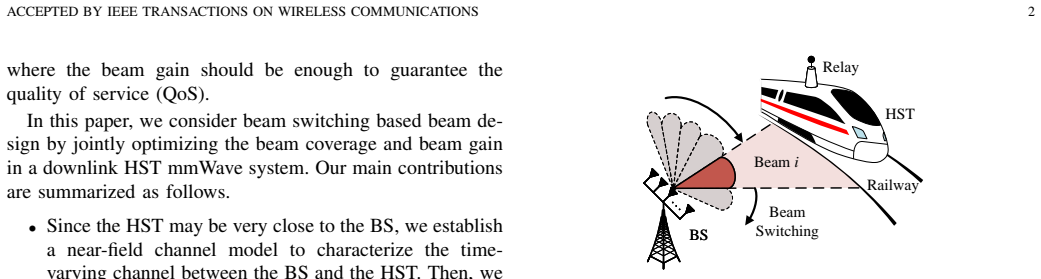


Figures from the paper (6 more)


Reference graph
Works this paper leans on
-
[1]
5G for railways: Next generation railway dedicated communications,
R. He, B. Ai, Z. Zhong, M. Yang, R. Chen, J. Ding, Z. Ma, G. Sun, and C. Liu, “5G for railways: Next generation railway dedicated communications,” IEEE Commun. Mag. , vol. 60, no. 12, pp. 130–136, Dec. 2022
work page 2022
-
[2]
Beam training and track- ing for extremely large-scale MIMO communications,
K. Chen, C. Qi, C.-X. Wang, and G. Y . Li, “Beam training and track- ing for extremely large-scale MIMO communications,” IEEE Trans. Wireless Commun., vol. 23, no. 5, pp. 5048–5062, May 2024
work page 2024
-
[3]
Optimal nonuniform steady mmWave beamforming for high-speed railway,
Y . Cui, X. Fang, Y . Fang, and M. Xiao, “Optimal nonuniform steady mmWave beamforming for high-speed railway,” IEEE Trans. V eh. Technol., vol. 67, no. 5, pp. 4350–4358, May 2018
work page 2018
-
[4]
Beam switching for millimeter wave communication to support high speed trains,
V . Va, X. Zhang, and R. W. Heath, “Beam switching for millimeter wave communication to support high speed trains,” in Proc. IEEE 82nd V eh. Technol. Conf. (VTC2015-Fall), Boston, MA, USA, Sep. 2015, pp. 1–5. ACCEPTED BY IEEE TRANSACTIONS ON WIRELESS COMMUNICATIONS 15
work page 2015
-
[5]
A train position based beam switching mechanism in high speed railway scenario,
P. Ma, D. Cai, C. Wang, M. Zhang, Q. Yu, and T. Zhou, “A train position based beam switching mechanism in high speed railway scenario,” in Proc. IEEE 9th Int. Conf. Commun. Softw. Netw. (ICCSN) , Guangzhou, China, May 2017, pp. 553–558
work page 2017
-
[6]
Efficient hybrid beamforming with anti-blockage design for high-speed railway communications,
M. Gao, B. Ai, Y . Niu, W. Wu, P. Yang, F. Lyu, and X. Shen, “Efficient hybrid beamforming with anti-blockage design for high-speed railway communications,” IEEE Trans. V eh. Technol., vol. 69, no. 9, pp. 9643– 9655, Sep. 2020
work page 2020
-
[7]
J. Li, Y . Niu, H. Wu, B. Ai, R. He, N. Wang, and S. Chen, “Throughput maximization for intelligent refracting surface assisted mmWave high- speed train communications,” IEEE Internet Things J. , vol. 11, no. 8, pp. 13 299–13 311, Apr. 2024
work page 2024
-
[8]
C. Chen, Y . Niu, B. Ai, R. He, Z. Han, Z. Zhong, N. Wang, and X. Su, “Joint design of phase shift and transceiver beamforming for intelligent reflecting surface assisted millimeter-wave high-speed railway communications,” IEEE Trans. V eh. Technol. , vol. 72, no. 5, pp. 6253–6267, May 2023
work page 2023
Show all 35 references
-
[9]
Refracting RIS-aided hybrid satellite-terrestrial relay networks: Joint beamforming design and optimization,
Z. Lin, H. Niu, K. An, Y . Wang, G. Zheng, S. Chatzinotas, and Y . Hu, “Refracting RIS-aided hybrid satellite-terrestrial relay networks: Joint beamforming design and optimization,” IEEE Trans. Aerosp. Electron. Syst., vol. 58, no. 4, pp. 3717–3724, Aug. 2022
2022
-
[10]
Adaptive non-uniform hybrid beamforming for mmWave train-to-ground communications in high-speed railway scenarios,
Y . Liu, B. Ai, Y . Niu, Z. Han, Z. Zhong, Y . Qiao, N. Wang, and G. L. St ¨uber, “Adaptive non-uniform hybrid beamforming for mmWave train-to-ground communications in high-speed railway scenarios,” IEEE Trans. V eh. Technol., vol. 72, no. 7, pp. 9085–9098, Jul. 2023
2023
-
[11]
Stable beamforming with low overhead for C/U-plane decoupled HSR wireless networks,
L. Yan, X. Fang, and Y . Fang, “Stable beamforming with low overhead for C/U-plane decoupled HSR wireless networks,” IEEE Trans. V eh. Technol., vol. 67, no. 7, pp. 6075–6086, Jul. 2018
2018
-
[12]
On millimeter wave and THz mobile radio channel for smart rail mobility,
K. Guan, G. Li, T. K ¨urner, A. F. Molisch, B. Peng, R. He, B. Hui, J. Kim, and Z. Zhong, “On millimeter wave and THz mobile radio channel for smart rail mobility,” IEEE Trans. V eh. Technol. , vol. 66, no. 7, pp. 5658–5674, Jul. 2017
2017
-
[13]
Mobility support for millimeter wave communications: Opportunities and challenges,
J. Li, Y . Niu, H. Wu, B. Ai, S. Chen, Z. Feng, Z. Zhong, and N. Wang, “Mobility support for millimeter wave communications: Opportunities and challenges,” IEEE Commun. Surveys Tuts., vol. 24, no. 3, pp. 1816– 1842, 2022
2022
-
[14]
5G high mobility wireless commu- nications: Challenges and solutions,
P. Fan, J. Zhao, and I. Chih-Lin, “5G high mobility wireless commu- nications: Challenges and solutions,” China Commun. , vol. 13, no. 2, pp. 1–13, Feb. 2016
2016
-
[15]
Two-step codeword design for millimeter wave massive MIMO systems with quantized phase shifters,
K. Chen, C. Qi, and G. Y . Li, “Two-step codeword design for millimeter wave massive MIMO systems with quantized phase shifters,” IEEE Trans. Signal Process. , vol. 68, pp. 170–180, Dec. 2019
2019
-
[16]
Towards realistic high-speed train channels at 5G millimeter-wave band—part II: Case study for paradigm implementa- tion,
K. Guan, B. Ai, B. Peng, D. He, G. Li, J. Yang, Z. Zhong, and T. K ¨urner, “Towards realistic high-speed train channels at 5G millimeter-wave band—part II: Case study for paradigm implementa- tion,” IEEE Trans. V eh. Technol., vol. 67, no. 10, pp. 9129–9144, Oct. 2018
2018
-
[17]
Data-aided Doppler compensation for high-speed railway communications over mmWave bands,
Z. Gong, C. Li, F. Jiang, and M. Z. Win, “Data-aided Doppler compensation for high-speed railway communications over mmWave bands,” IEEE Trans. Wireless Commun. , vol. 20, no. 1, pp. 520–534, Jan. 2021
2021
-
[18]
Near- field communications: A tutorial review,
Y . Liu, Z. Wang, J. Xu, C. Ouyang, X. Mu, and R. Schober, “Near- field communications: A tutorial review,” IEEE Open J. Commun. Soc. , vol. 4, pp. 1999–2049, Aug. 2023
1999
-
[19]
Near-field multiuser communications based on sparse arrays,
K. Chen, C. Qi, G. Y . Li, and O. A. Dobre, “Near-field multiuser communications based on sparse arrays,” IEEE J. Sel. Top. Signal Process., early access , pp. 1–14, Jun. 2024
2024
-
[20]
A wideband generalization of the near-field region for extremely large phased-arrays,
N. Deshpande, M. R. Castellanos, S. R. Khosravirad, J. Du, H. Viswanathan, and R. W. Heath, “A wideband generalization of the near-field region for extremely large phased-arrays,” IEEE Wireless Commun. Lett. , vol. 12, no. 3, pp. 515–519, Mar. 2023
2023
-
[21]
Reconfigurable intelligent surface empowered downlink non-orthogonal multiple access,
M. Fu, Y . Zhou, Y . Shi, and K. B. Letaief, “Reconfigurable intelligent surface empowered downlink non-orthogonal multiple access,” IEEE Trans. Commun., vol. 69, no. 6, pp. 3802–3817, Jun. 2021
2021
-
[22]
Passive beamforming for 3-D cover- age in IRS-assisted communications,
W. Ma, L. Zhu, and R. Zhang, “Passive beamforming for 3-D cover- age in IRS-assisted communications,” IEEE Wireless Commun. Lett. , vol. 11, no. 8, pp. 1763–1767, Aug. 2022
2022
-
[23]
Exact penalty and error bounds in DC programming,
H. A. Le Thi, T. Pham Dinh, and H. V . Ngai, “Exact penalty and error bounds in DC programming,” J. Glob. Optim. , vol. 52, no. 3, pp. 509–535, Mar. 2012
2012
-
[24]
A proximal difference-of-convex algorithm with extrapolation,
B. Wen, X. Chen, and T. K. Pong, “A proximal difference-of-convex algorithm with extrapolation,” Comput. Optim. Appl. , vol. 69, no. 2, pp. 297–324, Mar. 2018
2018
-
[25]
Majorization-minimization algo- rithms in signal processing, communications, and machine learning,
Y . Sun, P. Babu, and D. P. Palomar, “Majorization-minimization algo- rithms in signal processing, communications, and machine learning,” IEEE Trans. Signal Process. , vol. 65, no. 3, pp. 794–816, Feb. 2017
2017
-
[26]
Exploiting multi-layer refracting RIS-assisted receiver for HAP-SWIPT networks,
K. An, Y . Sun, Z. Lin, Y . Zhu, W. Ni, N. Al-Dhahir, K.-K. Wong, and D. Niyato, “Exploiting multi-layer refracting RIS-assisted receiver for HAP-SWIPT networks,” IEEE Trans. Wireless Commun., pp. 1–1, May 2024
2024
-
[27]
Semidefinite relaxation of quadratic optimization problems,
Z. Luo, W. Ma, A. So, Y . Ye, and S. Zhang, “Semidefinite relaxation of quadratic optimization problems,” IEEE Signal Process. Mag. , vol. 27, no. 3, pp. 20–34, May 2010
2010
-
[28]
On lower iteration complexity bounds for the saddle point problems,
J. Zhang, M. Hong, and S. Zhang, “On lower iteration complexity bounds for the saddle point problems,” Math. Program., vol. 194, no. 1-2, pp. 901–935, Jul. 2022
2022
-
[29]
Non-convex min-max optimization: Applications, chal- lenges, and recent theoretical advances,
M. Razaviyayn, T. Huang, S. Lu, M. Nouiehed, M. Sanjabi, and M. Hong, “Non-convex min-max optimization: Applications, chal- lenges, and recent theoretical advances,” IEEE Signal Process. Mag. , vol. 37, no. 5, pp. 55–66, Sep. 2020
2020
-
[30]
Proximally guided stochastic subgradient method for nonsmooth, nonconvex problems,
D. Davis and B. Grimmer, “Proximally guided stochastic subgradient method for nonsmooth, nonconvex problems,” SIAM J. Optim. , vol. 29, no. 3, pp. 1908–1930, Jan. 2019
1908
-
[31]
Stochastic model-based minimization of weakly convex functions,
D. Davis and D. Drusvyatskiy, “Stochastic model-based minimization of weakly convex functions,” SIAM J. Optim. , vol. 29, no. 1, pp. 207– 239, Jan. 2019
2019
-
[32]
Efficient algorithms for smooth minimax optimization,
K. K. Thekumparampil, P. Jain, P. Netrapalli, and S. Oh, “Efficient algorithms for smooth minimax optimization,” in Proc. Adv. Neural Inf. Process. Syst. (NeurIPS) , vol. 32, Vancouver, Canada, Dec. 2019
2019
-
[33]
Excessive gap technique in nonsmooth convex minimiza- tion,
Y. Nesterov, “Excessive gap technique in nonsmooth convex minimiza- tion,” SIAM J. Optim. , vol. 16, no. 1, pp. 235–249, Jan. 2005
2005
-
[34]
Hybrid block successive approximation for one-sided non-convex min-max problems: Algo- rithms and applications,
S. Lu, I. Tsaknakis, M. Hong, and Y . Chen, “Hybrid block successive approximation for one-sided non-convex min-max problems: Algo- rithms and applications,” IEEE Trans. Signal Process. , vol. 68, pp. 3676–3691, Apr. 2020
2020
-
[35]
Smooth minimization of non-smooth functions,
Y. Nesterov, “Smooth minimization of non-smooth functions,” Math. Program., vol. 103, no. 1, pp. 127–152, May 2005
2005
Reviewed August 12, 2026 · model on record in the stance chip above.
Discussion (0). Continue with ORCID to comment.