REVIEW 3 major objections 4 minor 33 references
ExtremeC3Net: Extreme Lightweight Portrait Segmentation Networks using Advanced C3-modules
T0 review · 3 major / 4 minor · reviewed 2026-08-14 · deepseek-v4-flash
Pith's one-line read A portrait segmentation network with only 37.7K parameters reaches 94.23 mIoU on EG1800, within about one point of a 2.08M-parameter model.
desk verdict Solid lightweight segmentation engineering with a useful data-generation and bias-annotation contribution, but the headline accuracy claim is confounded by training data and should be reworded. read the letter →
The pith
A machine-rendered reading of the paper's core claim, the machinery that carries it, and where it could break.
The reading
What carries the argument
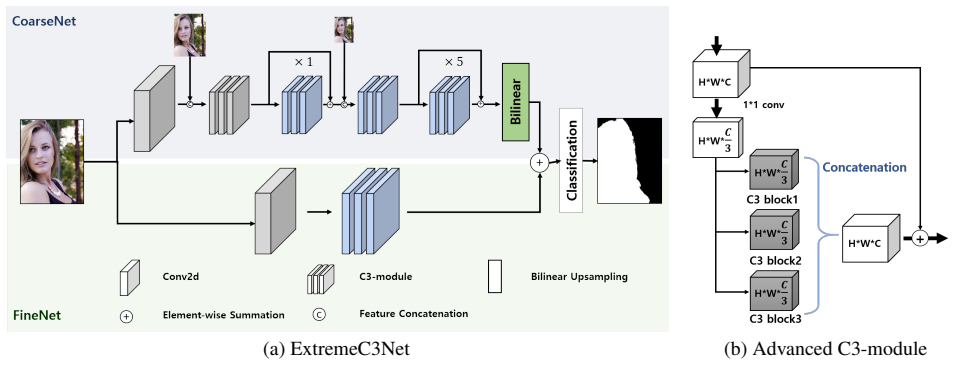
The load-bearing component is the advanced C3-module, a concentrated-comprehensive convolution block that first compresses neighboring-pixel information with asymmetric depth-wise convolutions and then applies a dilated depth-wise convolution, avoiding the information loss that a naive depth-wise dilated convolution causes. Each module uses three C3-blocks with dilation ratios that grow with depth: small ratios near the input for local features, larger ratios near the output for global features. The network is split into a deep CoarseNet branch and a shallow FineNet branch whose feature maps are summed after bilinear upsampling, which removes the need for a learned decoder. Training uses the Lovász-Softmax loss on the whole mask plus a second Lovász term on the morphological boundary, and the extra training data come from cropping a public human full-body segmentation dataset via a face detector and from pseudo-labels produced by a heavyweight segmentation model.
What would settle it
Train the same ExtremeC3Net and losses on the same 10,448 web images but with human-drawn ground-truth masks instead of the teacher's pseudo-labels; if mIoU does not rise to 94.98, the reported gain comes from the teacher's label distribution rather than from having more data.
Extended reading notes
Core claim
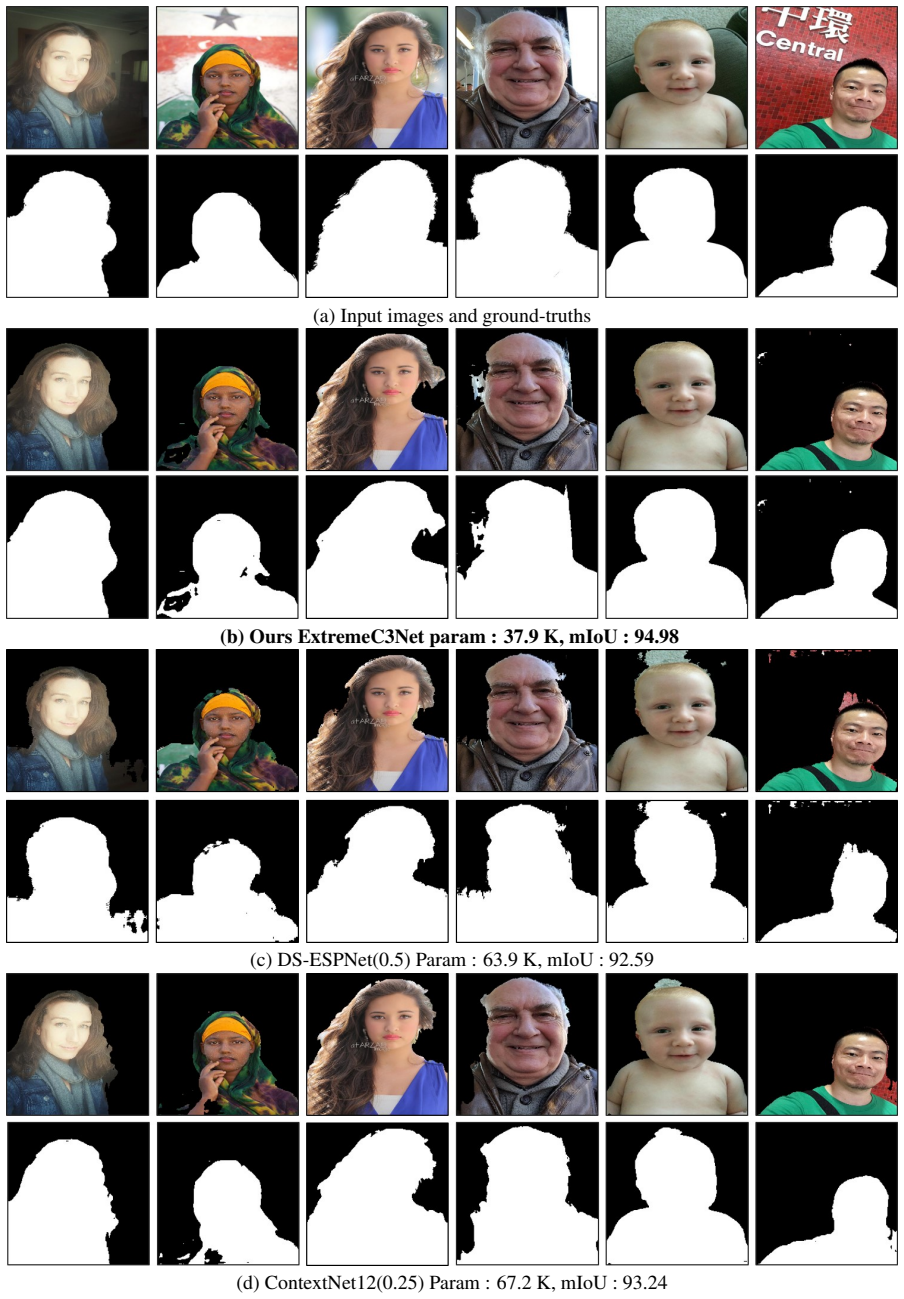
The central claim is that a two-branched network built from advanced C3-modules, with a coarse branch providing global context and a shallow fine branch preserving boundary detail, can match a heavy portrait segmentation model while using 98.2% fewer parameters and roughly half the FLOPs. Trained on EG1800 with the Lovász-Softmax loss plus a boundary-focused auxiliary loss, it scores 94.23 mIoU at 37.7K parameters; adding 10,448 generated images raises this to 94.98, versus 95.99 for the re-trained 2.08M-parameter PortraitNet. The architecture avoids deconvolution entirely, using bilinear upsampling and element-wise addition of the two branches. The paper further claims that the generated dataset improves accuracy across race, gender, and age groups and narrows the senior/child accuracy gap.
Load-bearing premise
The claim rests on the assumption that the 10,448 automatically generated training images, produced by a segmentation model fine-tuned on an undisclosed 2,500-image human dataset and only lightly checked by annotators, are accurate and unbiased enough to improve real generalization, rather than mainly matching the quirks of the EG1800 validation set.
Editorial extensions
If this is right
- At 37.7K parameters and 0.062 seconds per image on a CPU, the model is small enough to run inside a mobile face pipeline as a preprocessing step for background replacement, security checks, or face enhancement.
- Because no deconvolution is used, the architecture can be deployed on embedded platforms with limited operator support.
- Training on 10,448 generated images raises mIoU from 94.23 to 94.98 while using the same 37.7K-parameter model, suggesting that cheap pseudo-labeled data can substitute for some human annotation in portrait segmentation.
- The dilation-ratio experiment, where the reverse ordering drops accuracy to 92.33, shows that filter spacing should be matched to a kernel's depth in lightweight segmentation.
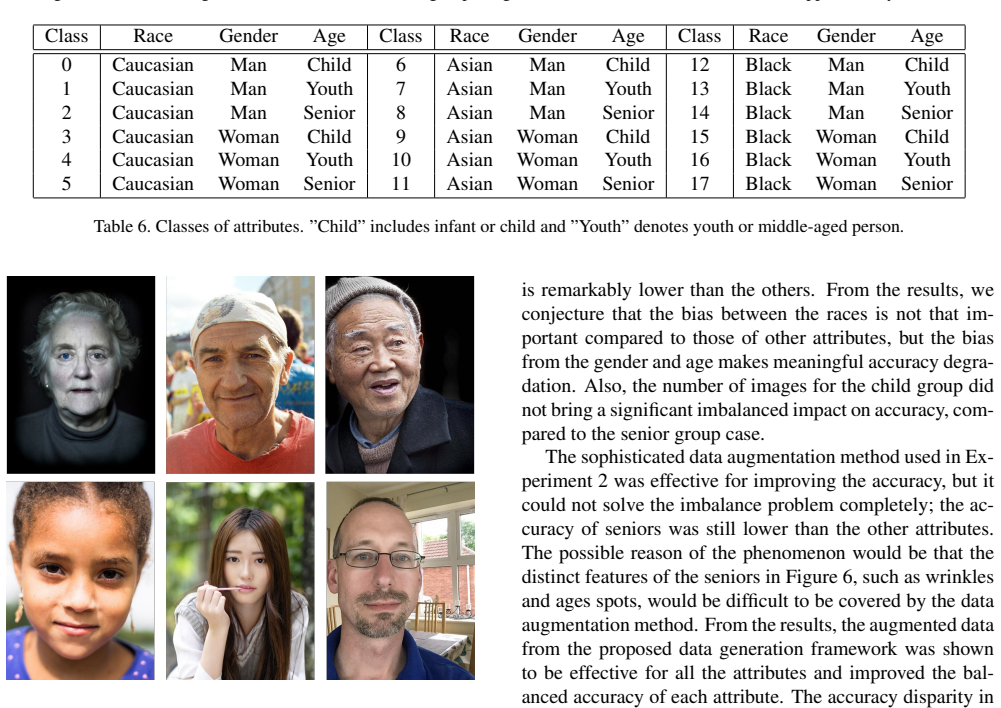
- The attribute analysis indicates that gender and age imbalance, more than race imbalance, drive accuracy differences, and the generated data reduces the age-group accuracy gap from 1.82 to 1.12 mIoU points.
Reading between the lines
- If the pseudo-label teacher's errors are not evenly distributed across demographic groups, the 94.98 result may overstate performance on populations underrepresented in EG1800; testing on a balanced multi-ethnic portrait set would clarify whether the data-generation gain transfers.
- The same recipe of two branches, position-dependent dilation ratios, and Lovász-style losses could be carried over to other binary foreground segmentation tasks such as hair or document segmentation, where the parameter budget is similarly tight.
- The paper compares FLOPs using two counting conventions, but hardware-level latency depends on memory access and operator fusion; a standardized benchmark across mobile CPUs and GPUs would be a stronger test of the reported 0.286G FLOPs figure.
- Because the generated dataset is derived from a teacher fine-tuned on proprietary data, the method's reproducibility would be strengthened by releasing the teacher's 2,500-image dataset; without it, others cannot audit the pseudo-labels' bias.
Signed reviews
Editorial analysis
A structured set of objections, weighed in public.
Referee Report
Summary. The paper proposes ExtremeC3Net, a two-branch portrait segmentation network built from a modified "advanced C3-module," with 37.7K parameters and 0.286G FLOPs. On the EG1800 test split the model is reported to reach 94.23 mIoU without extra data and 94.98 mIoU when trained with 10,448 automatically generated pseudo-labeled images, compared with 95.99 mIoU for a re-trained PortraitNet (2.08M parameters). The paper also introduces a data generation framework, reports a bias analysis of EG1800 with additional race/gender/age annotations, and claims that the model maintains accuracy within a 1% margin of the state of the art while reducing parameters by 98.2%.
Significance. If the claims are supported, the architecture itself is a useful data point for extremely lightweight portrait segmentation: a 37.7K-parameter model with competitive accuracy and low FLOPs, plus an open implementation and augmented dataset, would benefit practitioners. The bias annotation effort is also a valuable contribution to the EG1800 ecosystem. However, the central accuracy claim is currently not supported by the experimental design, because the headline comparison mixes the effect of the architecture with the effect of an 8x larger automatically generated training set and a different loss. The paper's own ablation shows that the architecture-only gap to PortraitNet is 1.76 points, not "about 1%." The attribute-level bias conclusions are also drawn from very small subgroups without uncertainty estimates. These issues are fixable, but they are load-bearing for the paper's main claims.
major comments (3)
- [Abstract; Section 1; Table 2; Table 3; Section 4.1] The headline claim of "accuracy within a 1% margin" compares ExtremeC3Net trained with the generated 10,448-image dataset (94.98 mIoU) to PortraitNet trained only on the original 1,309 available EG1800 training images (95.99 mIoU). This is not a data-matched comparison. Table 3 shows that without the pseudo-dataset, the same architecture with the proposed losses scores 94.23 mIoU, which is 1.76 points below the re-trained PortraitNet, not about 1 point. To substantiate the abstraction-level claim, the authors should either compare both models with the same training data and loss, or explicitly present the architecture-only gap as the headline. As written, the abstract's wording attributes to the architecture a gain that actually comes from the additional data and loss changes.
- [Section 4.3; Table 5] The conclusion that race bias is "not that important" compared to gender and age is based on only 11 Black validation images, and the age conclusion on only 10 Senior images. No error bars or multiple-run statistics are reported anywhere in the attribute-specific analysis. With groups this small, the observed mIoU differences across attributes (e.g., 95.84 for Black versus 93.79 for Asian, or 93.98 for Senior versus 95.10 for Child) are within the range of sampling noise. The paper should either report confidence intervals, per-image score distributions, or statistical tests, and otherwise temper the bias-related conclusions to qualitative observations.
- [Section 3.3; Section 4.1; Table 2] The generated 10,448-image dataset is produced by a DeepLabv3+ teacher fine-tuned on a proprietary 2,500-image dataset and only lightly checked by human annotators. Since the accuracy gain from this dataset is a key part of the paper's claimed 1% margin, the paper should provide evidence about the teacher's pseudo-label quality and its independence from the EG1800 validation distribution. A concrete test would be to train PortraitNet with the same generated data and the same loss function; if the mIoU gap remains around 1 point under that controlled comparison, the claim would be supported. Without such a check, the reported 94.98 mIoU cannot be cleanly attributed to the proposed architecture.
minor comments (4)
- [Throughout] There are multiple typos and formatting errors, including "datsaet" in Section 1, "unpsampling" in Figure 2, "PortriatNet" in Section 4.1, "intializing" in Section 4, "dilation ratiosd" in Section 4.2, and "3C-modules" in Section 4.2. These should be corrected in a revision.
- [Table 2] The column labeled "Paper [32]" is ambiguous: it is not clear whether the numbers in that column are the originally reported accuracies from the cited papers or the re-trained results from this work. The caption should be clarified.
- [Section 4.3] The text says "In Table 4.2" but the referenced table is numbered 5. The reference should be corrected.
- [Section 4.1] The description of the re-trained baselines (PortraitNet, BiSeNet, ENet) omits training details such as the number of epochs, optimizer settings, and input resolution. Providing these details would improve reproducibility, especially since the paper itself notes that re-training changes the reported numbers.
Circularity Check
No significant circularity: the reported accuracies are measured on the external EG1800 benchmark, and the C3 self-citation is prior published work used as a building block, not as a substitute for evidence.
full rationale
The paper's load-bearing results are empirical measurements against an external public benchmark (EG1800 validation with human ground-truth labels). The central accuracy figures (94.23 mIoU; 94.98 with the 10,448 generated images) are obtained by training a concrete architecture and reporting measured mIoU; they are not quantities defined by the paper's own equations. The advanced C3-module is based on the authors' prior work [12], but that is a published, externally available building block, and the present paper independently verifies its modified module through ablations on the same public benchmark rather than importing a uniqueness theorem or prediction. The loss in Eq. (1) is a standard Lovász-Softmax surrogate with a morphological boundary term; no fitted parameter is later renamed as a prediction. The pseudo-label data-generation pipeline (Section 3.3) uses a proprietary DeepLabv3+ teacher, but evaluation labels remain human annotations from EG1800, so the improvement is measured, not defined, by the generation method. The headline comparison to PortraitNet is not training-data-matched (PortraitNet was re-trained without the 10,448 generated images), which is a fairness/validity concern rather than a circularity one; the architecture-only ablation in Table 3 supplies independent evidence. No 'prediction' reduces by construction to an input, so the circularity burden is low.
Assumptions & free parameters
free parameters (3)
- Dilation ratio schedule in advanced C3-modules =
Table 1 (e.g., L1: [1,2,3], L5: [2,4,8])
- Boundary loss weight w in Eq (1) =
Not stated
- Number of C3-blocks per module (3 instead of 4) =
3
assumptions (3)
- domain assumption C3-module from [12] is an effective building block for lightweight segmentation and is adopted as the foundation of the advanced C3-module.
- domain assumption The DeepLabv3+ teacher model fine-tuned on a proprietary 2,500-image human segmentation dataset produces pseudo-labels accurate enough to improve training when human-checked.
- domain assumption The EG1800 validation subset of 270 images remaining after broken URLs is representative of the full validation set.
Cite this review
Pith. "Pith review of ExtremeC3Net: Extreme Lightweight Portrait Segmentation Networks using Advanced C3-modules." pith.science (2026). https://pith.science/paper/E3OU53F6
@misc{pith2026190803093,
  author       = {Pith},
  title        = {Pith review of: ExtremeC3Net: Extreme Lightweight Portrait Segmentation Networks using Advanced C3-modules},
  year         = {2026},
  howpublished = {\url{https://pith.science/paper/E3OU53F6}},
  note         = {Machine review of arXiv:1908.03093}
}
read the original abstract
Designing a lightweight and robust portrait segmentation algorithm is an important task for a wide range of face applications. However, the problem has been considered as a subset of the object segmentation problem. bviously, portrait segmentation has its unique requirements. First, because the portrait segmentation is performed in the middle of a whole process of many realworld applications, it requires extremely lightweight models. Second, there has not been any public datasets in this domain that contain a sufficient number of images with unbiased statistics. To solve the problems, we introduce a new extremely lightweight portrait segmentation model consisting of a two-branched architecture based on the concentrated-comprehensive convolutions block. Our method reduces the number of parameters from 2.1M to 37.7K (around 98.2% reduction), while maintaining the accuracy within a 1% margin from the state-of-the-art portrait segmentation method. In our qualitative and quantitative analysis on the EG1800 dataset, we show that our method outperforms various existing lightweight segmentation models. Second, we propose a simple method to create additional portrait segmentation data which can improve accuracy on the EG1800 dataset. Also, we analyze the bias in public datasets by additionally annotating race, gender, and age on our own. The augmented dataset, the additional annotations and code are available in https://github.com/HYOJINPARK/ExtPortraitSeg .
Figures


Figures from the paper (4 more)


Reference graph
Works this paper leans on
-
[1]
Y . Baek, B. Lee, D. Han, S. Yun, and H. Lee. Character region awareness for text detection. In Proceedings of the IEEE Conference on Computer Vision and Pattern Recogni- tion, pages 9365–9374, 2019
work page 2019
-
[2]
A. Bearman, O. Russakovsky, V . Ferrari, and L. Fei-Fei. Whats the point: Semantic segmentation with point super- vision. In European conference on computer vision , pages 549–565. Springer, 2016
work page 2016
-
[3]
M. Berman, A. Rannen Triki, and M. B. Blaschko. The lov´asz-softmax loss: A tractable surrogate for the optimiza- tion of the intersection-over-union measure in neural net- works. In Proceedings of the IEEE Conference on Computer Vision and Pattern Recognition, pages 4413–4421, 2018
work page 2018
-
[4]
L.-C. Chen, Y . Zhu, G. Papandreou, F. Schroff, and H. Adam. Encoder-decoder with atrous separable convolution for se- mantic image segmentation. In ECCV, 2018
work page 2018
-
[5]
F. Chollet. Xception: Deep learning with depthwise separa- ble convolutions. arXiv preprint, pages 1610–02357, 2017
work page 2017
-
[6]
T. DeVries and G. W. Taylor. Improved regularization of convolutional neural networks with cutout. arXiv preprint arXiv:1708.04552, 2017
arXiv 2017
-
[7]
Gupta, A
A. Gupta, A. Vedaldi, and A. Zisserman. Synthetic data for text localisation in natural images. In Proceedings of the IEEE Conference on Computer Vision and Pattern Recogni- tion, pages 2315–2324, 2016
2016
-
[8]
A. G. Howard, M. Zhu, B. Chen, D. Kalenichenko, W. Wang, T. Weyand, M. Andreetto, and H. Adam. Mobilenets: Effi- cient convolutional neural networks for mobile vision appli- cations. arXiv preprint arXiv:1704.04861, 2017
arXiv 2017
Show all 33 references
-
[9]
B. Jin, M. V . Ortiz Segovia, and S. Susstrunk. Webly super- vised semantic segmentation. In Proceedings of the IEEE Conference on Computer Vision and Pattern Recognition , pages 3626–3635, 2017
2017
-
[10]
J. Long, E. Shelhamer, and T. Darrell. Fully convolutional networks for semantic segmentation. In Proceedings of the IEEE conference on computer vision and pattern recogni- tion, pages 3431–3440, 2015
2015
-
[11]
Mehta, M
S. Mehta, M. Rastegari, L. Shapiro, and H. Hajishirzi. Espnetv2: A light-weight, power efficient, and general purpose convolutional neural network. arXiv preprint arXiv:1811.11431, 2018
2018 arXiv
-
[12]
H. Park, Y . Yoo, G. Seo, D. Han, S. Yun, and N. Kwak. Concentrated-comprehensive convolutions for lightweight semantic segmentation. arXiv preprint arXiv:1812.04920 , 2018
2018 arXiv
-
[13]
Paszke, A
A. Paszke, A. Chaurasia, S. Kim, and E. Culurciello. Enet: A deep neural network architecture for real-time semantic segmentation. arXiv preprint arXiv:1606.02147, 2016
2016 arXiv
-
[14]
R. P. Poudel, U. Bonde, S. Liwicki, and C. Zach. Contextnet: Exploring context and detail for semantic segmentation in real-time. arXiv preprint arXiv:1805.04554, 2018
2018 arXiv
-
[15]
R. P. Poudel, S. Liwicki, and R. Cipolla. Fast-scnn: fast semantic segmentation network. arXiv preprint arXiv:1902.04502, 2019
1902 arXiv
-
[16]
X. Qi, Z. Liu, J. Shi, H. Zhao, and J. Jia. Augmented feed- back in semantic segmentation under image level supervi- sion. In European Conference on Computer Vision , pages 90–105. Springer, 2016
2016
-
[17]
Romera, J
E. Romera, J. M. Alvarez, L. M. Bergasa, and R. Arroyo. Erfnet: Efficient residual factorized convnet for real-time semantic segmentation. IEEE Transactions on Intelligent Transportation Systems, 19(1):263–272, 2018
2018
-
[18]
A. C. L. S. Sachin Mehta, Mohammad Rastegari and H. Ha- jishirzi. Espnet: Efficient spatial pyramid of dilated convo- lutions for semantic segmentation. In ECCV, 2018
2018
-
[19]
Saleh, M
F. Saleh, M. S. Aliakbarian, M. Salzmann, L. Petersson, S. Gould, and J. M. Alvarez. Built-in foreground/background prior for weakly-supervised semantic segmentation. In Eu- ropean Conference on Computer Vision , pages 413–432. Springer, 2016
2016
-
[20]
Sandler, A
M. Sandler, A. Howard, M. Zhu, A. Zhmoginov, and L.-C. Chen. Inverted residuals and linear bottlenecks: Mobile net- works for classification, detection and segmentation. arXiv preprint arXiv:1801.04381, 2018
2018 arXiv
-
[21]
X. Shen, A. Hertzmann, J. Jia, S. Paris, B. Price, E. Shecht- man, and I. Sachs. Automatic portrait segmentation for im- age stylization. In Computer Graphics Forum, volume 35, pages 93–102. Wiley Online Library, 2016
2016
-
[22]
Szegedy, S
C. Szegedy, S. Ioffe, V . Vanhoucke, and A. A. Alemi. Inception-v4, inception-resnet and the impact of residual connections on learning. In AAAI, volume 4, page 12, 2017
2017
-
[23]
Szegedy, W
C. Szegedy, W. Liu, Y . Jia, P. Sermanet, S. Reed, D. Anguelov, D. Erhan, V . Vanhoucke, and A. Rabinovich. Going deeper with convolutions. In Proceedings of IEEE Conference on Computer Vision and Pattern Recognition (CVPR), pages 1–9, 2015
2015
-
[24]
Szegedy, V
C. Szegedy, V . Vanhoucke, S. Ioffe, J. Shlens, and Z. Wojna. Rethinking the inception architecture for computer vision. In Proceedings of IEEE Conference on Computer Vision and Pattern Recognition (CVPR), pages 2818–2826, 2016
2016
-
[25]
Y . Wei, X. Liang, Y . Chen, Z. Jie, Y . Xiao, Y . Zhao, and S. Yan. Learning to segment with image-level annotations. Pattern Recognition, 59:234–244, 2016
2016
-
[26]
Z. Wu, Y . Huang, Y . Yu, L. Wang, and T. Tan. Early hier- archical contexts learned by convolutional networks for im- age segmentation. In 2014 22nd International Conference on Pattern Recognition, pages 1538–1543. IEEE, 2014
2014
-
[27]
S. Xie, R. Girshick, P. Doll ´ar, Z. Tu, and K. He. Aggregated residual transformations for deep neural networks. In Com- puter Vision and Pattern Recognition (CVPR), 2017 IEEE Conference on, pages 5987–5995. IEEE, 2017
2017
-
[28]
Y . Yoo, D. Han, and S. Yun. Extd: Extremely tiny face detector via iterative filter reuse. arXiv preprint arXiv:1906.06579, 2019
1906 arXiv
-
[29]
C. Yu, J. Wang, C. Peng, C. Gao, G. Yu, and N. Sang. Bisenet: Bilateral segmentation network for real-time se- mantic segmentation. In Proceedings of the European Con- ference on Computer Vision (ECCV), pages 325–341, 2018
2018
-
[30]
S. Yun, D. Han, S. J. Oh, S. Chun, J. Choe, and Y . Yoo. Cut- mix: Regularization strategy to train strong classifiers with localizable features. arXiv preprint arXiv:1905.04899, 2019
1905 arXiv
-
[31]
M. D. Zeiler and R. Fergus. Visualizing and understanding convolutional networks. In European conference on com- puter vision, pages 818–833. Springer, 2014
2014
-
[32]
Zhang, X
S.-H. Zhang, X. Dong, H. Li, R. Li, and Y .-L. Yang. Por- traitnet: Real-time portrait segmentation network for mobile device. Computers & Graphics, 80:104–113, 2019
2019
-
[33]
Zhang, X
X. Zhang, X. Zhou, M. Lin, and J. Sun. Shufflenet: An extremely efficient convolutional neural network for mobile devices. arXiv preprint arXiv:1707.01083, 2017. Appendix In this supplementary material, we provide additional results and methods that we could not include due to s...
2017 arXiv
Reviewed August 14, 2026 · model on record in the stance chip above.
Discussion (0). Continue with ORCID to comment.