Circular polarization effects induced by photon-axion mixing in astrophysical environments
Pith reviewed 2026-06-27 12:38 UTC · model grok-4.3
The pith
Photon-axion mixing in magnetic fields produces circular polarization that can be used to bound the axion-photon coupling from blazar observations.
A machine-rendered reading of the paper's core claim, the machinery that carries it, and where it could break.
Core claim
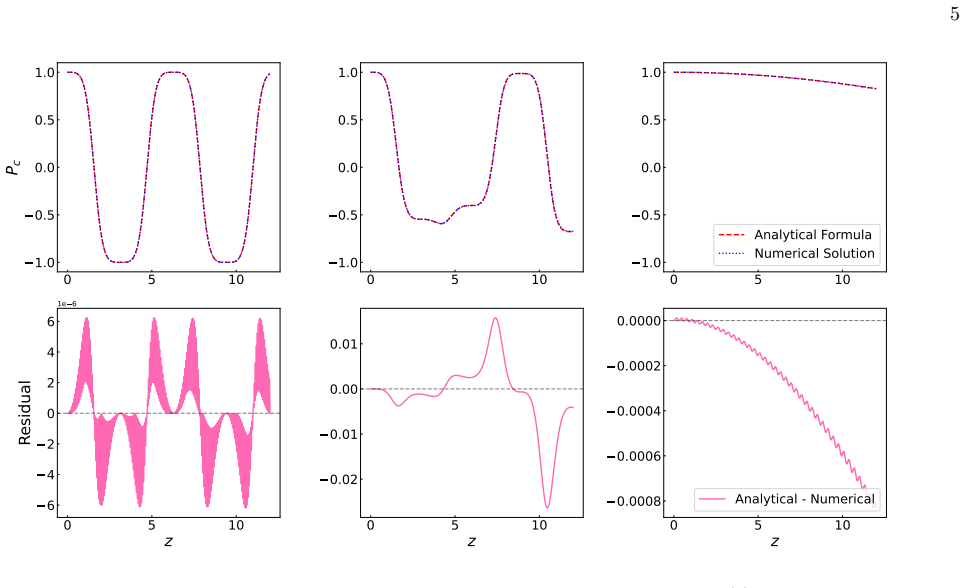
Within the single-domain approximation, the evolution equations in the chiral basis admit closed-form solutions for P_C in the resonant, strong-coupling, and weak-coupling regimes; when these solutions are evaluated for the blazar S4 0954+65 and confronted with the observed optical limit, they constrain the coupling constant g_aγγ to values no larger than 5 × 10^{-12} GeV^{-1} over the stated mass window.
What carries the argument
Single-domain magnetic-field model together with the analytic solution of the photon-axion mixing equations that yields the circular polarization degree P_C.
If this is right
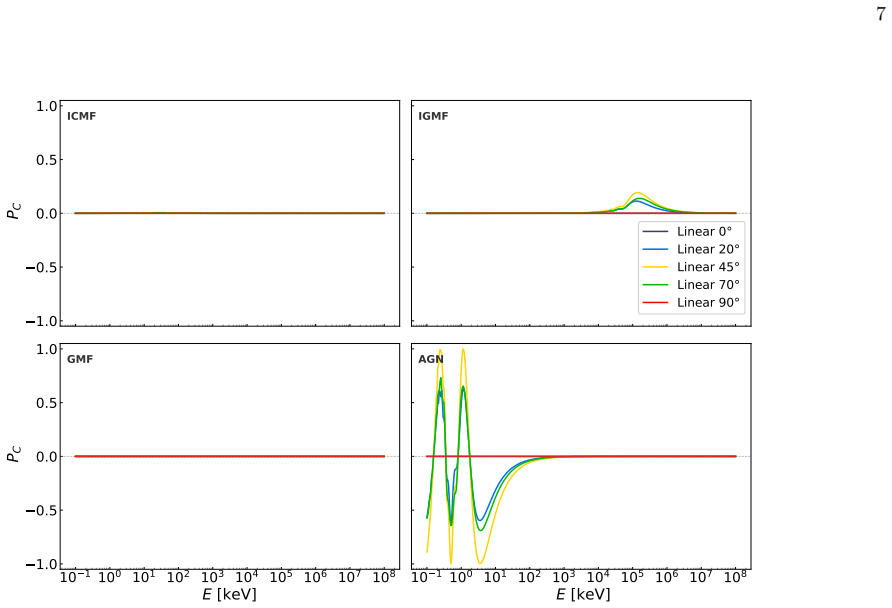
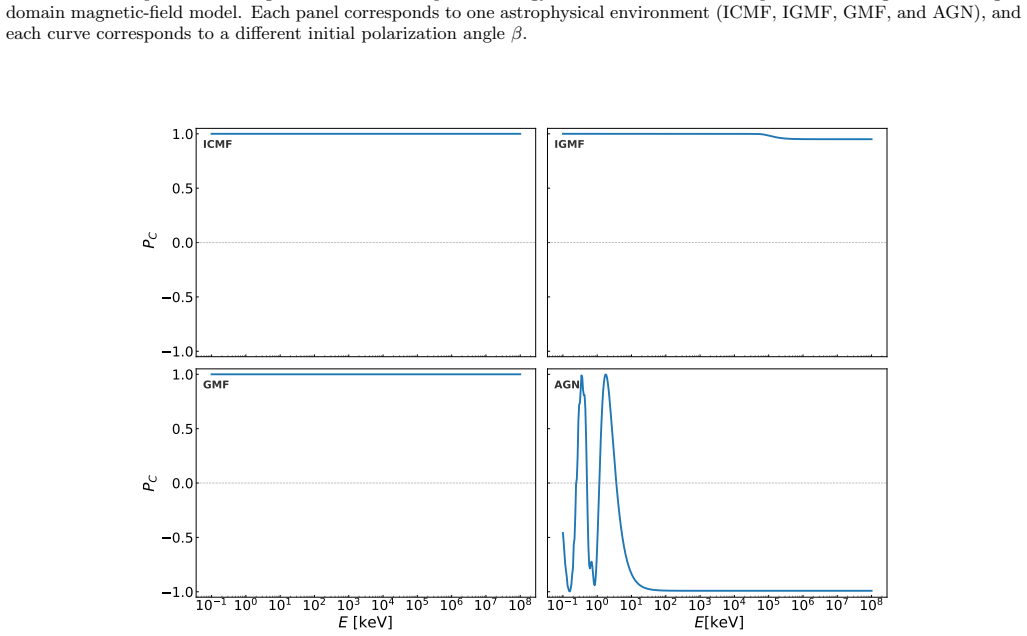
- The X-ray to MeV band offers the highest sensitivity for detecting the induced circular polarization.
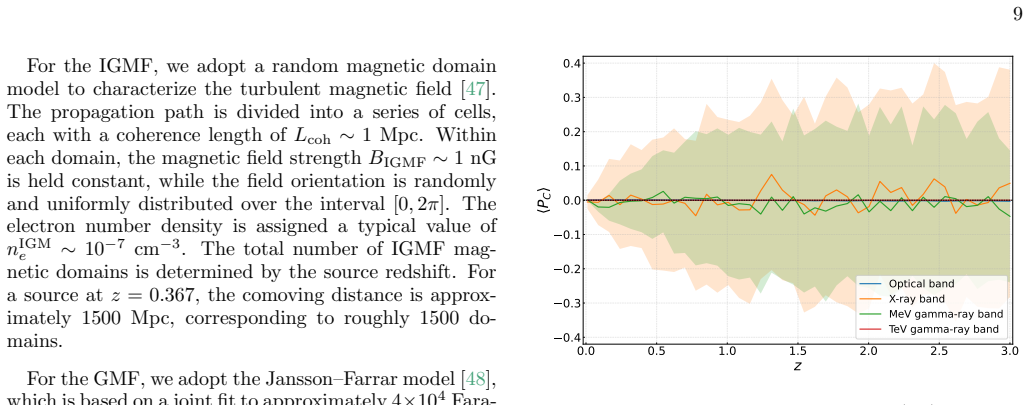
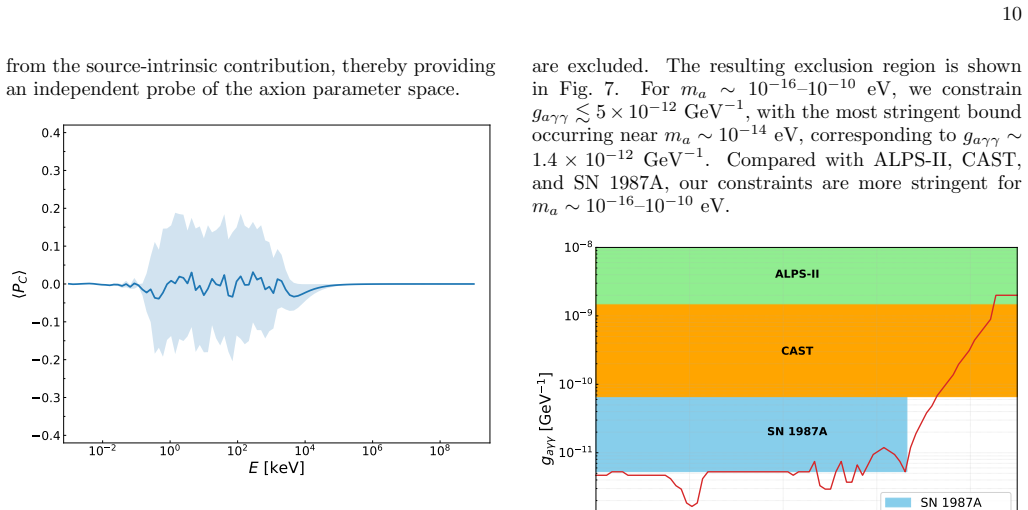
- Phase accumulation across random domains produces energy-dependent structures and redshift fluctuations in P_C.
- The strongest constraint on g_aγγ occurs near an axion mass of 10^{-14} eV.
- Circular polarization measurements supply an independent channel with lower astrophysical foreground contamination than spectral or linear-polarization searches.
Where Pith is reading between the lines
- Applying the same formalism to other blazars or to sources with tighter polarization limits could tighten the mass-dependent bounds without new instrumentation.
- If multi-domain or turbulent field models replace the single-domain approximation, the predicted P_C amplitude would change and the derived coupling limit would shift accordingly.
- Joint analysis of circular polarization with linear polarization or spectral distortions from the same source could break degeneracies between coupling strength and domain size.
Load-bearing premise
Magnetic fields along the line of sight can be treated as a sequence of uniform domains whose random orientations allow phase accumulation to be averaged when converting an observed polarization upper limit into a coupling bound.
What would settle it
A future optical measurement finding P_C greater than 0.184 percent from S4 0954+65 at the energies where the model predicts a peak would require either a larger coupling or a revision of the single-domain averaging procedure.
Figures
read the original abstract
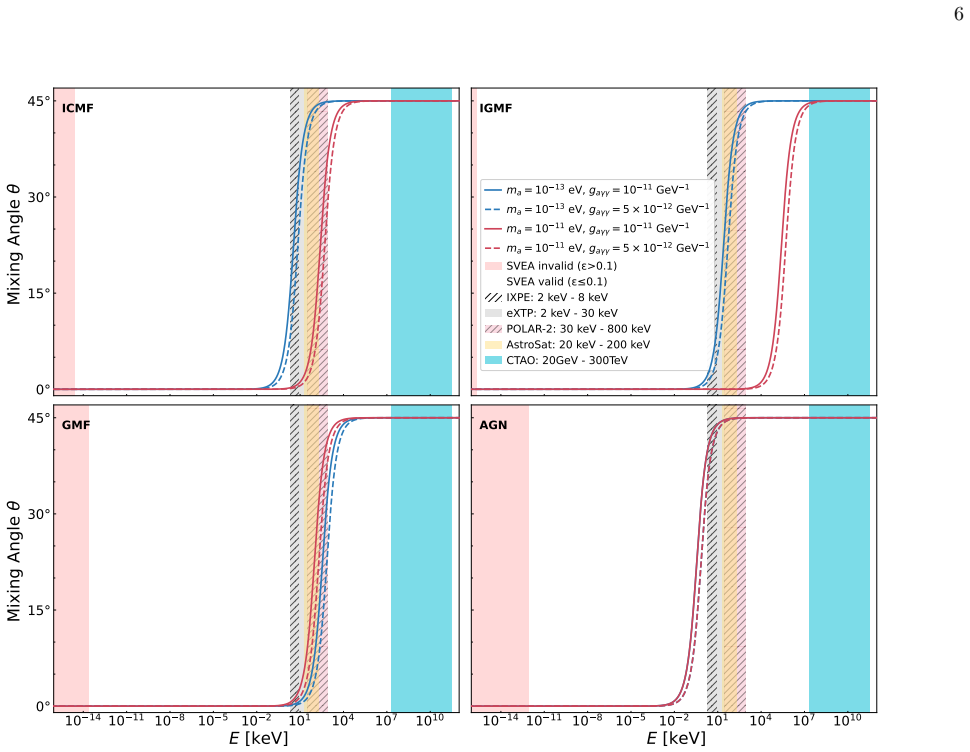
Axions and axion-like particles (ALPs) are compelling candidates for dark matter and new physics beyond the Standard Model. Photon-axion mixing in external magnetic fields modifies the photon energy spectrum and linear polarization state, and also induces circular polarization signals. Compared to spectral and linear polarization methods, circular polarization benefits from lower astrophysical background contamination, providing an independent probe for axion searches. In this work, we study the circular polarization induced by photon-axion mixing within the chiral basis framework. By analytically solving the evolution equations under the single-domain approximation, we derive an expression for the circular polarization degree P_C, applicable in the resonant, strong coupling, and weak coupling regimes. Within single-domain magnetic field models, we compare the energy-dependent circular polarization in four astrophysical environments (AGN jets, intracluster medium, intergalactic medium, and Galactic magnetic fields). We find that the X-ray to MeV band represents the most sensitive observational window. Using the blazar S4 0954+65 as a case study, phase accumulation in random magnetic domains causes the circular polarization degree to fluctuate with redshift and exhibit pronounced energy structures. Using the optical circular polarization upper limit P_C < 0.184% from this source, we constrain g_{a{\gamma}{\gamma}} <= 5 x 10^{-12} GeV^{-1} for m_a ~ 10^{-16}--10^{-10} eV, with the strongest constraint near m_a ~ 10^{-14} eV. These results establish circular polarization as a complementary axion probe.
Editorial analysis
A structured set of objections, weighed in public.
Referee Report
Summary. The manuscript derives an analytic expression for the circular polarization degree P_C induced by photon-axion mixing by solving the evolution equations under the single-domain approximation (valid in resonant, strong-coupling, and weak-coupling regimes). It compares the resulting energy-dependent P_C across AGN jets, intracluster medium, intergalactic medium, and Galactic fields, identifies the X-ray–MeV band as most sensitive, and applies a multi-domain random-phase accumulation model to the blazar S4 0954+65. Using the observational upper limit P_C < 0.184 % it obtains the bound g_{aγγ} ≤ 5 × 10^{-12} GeV^{-1} for m_a ∼ 10^{-16}–10^{-10} eV, strongest near 10^{-14} eV.
Significance. If the single-domain derivation and random-domain modeling are robust, the work supplies a complementary axion probe that exploits the low astrophysical background in circular polarization. The identification of a promising observational window and a concrete numerical limit in a mass range where other techniques are less constraining would constitute a useful addition to the ALP search literature.
major comments (2)
- [Blazar case study] Blazar case-study section: the quoted limit g_{aγγ} ≤ 5 × 10^{-12} GeV^{-1} is obtained by mapping the fixed observational threshold P_C < 0.184 % onto the fluctuating, energy-dependent P_C predicted by the random-domain phase-accumulation model. The manuscript does not demonstrate that the adopted domain size, coherence length, or redshift evolution of the jet B-field are fixed by independent data; any change in these parameters rescales the predicted P_C and directly alters the numerical bound.
- [Analytic derivation of P_C] Analytic derivation of P_C (single-domain solution): the central constraint rests on the analytic P_C expression, yet the text provides neither the explicit full set of evolution equations, the error-propagation procedure, nor a validation of how the observational limit is applied across the energy-dependent structures. Without these steps the support for the quoted numerical result cannot be verified.
minor comments (2)
- [Abstract] The abstract states that the X-ray to MeV band is the most sensitive window but does not reference the specific figure or table that quantifies this comparison across the four environments.
- [Throughout] Notation for the coupling (g_{aγγ} vs g_{aγ γ}) is inconsistent between the abstract and the constraint statement; a uniform symbol should be adopted.
Simulated Author's Rebuttal
We thank the referee for their careful reading and constructive comments on our manuscript. We address each major comment below and outline the revisions we will make.
read point-by-point responses
-
Referee: [Blazar case study] Blazar case-study section: the quoted limit g_{aγγ} ≤ 5 × 10^{-12} GeV^{-1} is obtained by mapping the fixed observational threshold P_C < 0.184 % onto the fluctuating, energy-dependent P_C predicted by the random-domain phase-accumulation model. The manuscript does not demonstrate that the adopted domain size, coherence length, or redshift evolution of the jet B-field are fixed by independent data; any change in these parameters rescales the predicted P_C and directly alters the numerical bound.
Authors: We acknowledge that the numerical bound depends on the specific magnetic domain parameters adopted for the blazar jet. These values (domain size ~10^{16} cm, coherence length, and redshift scaling) are taken from standard literature values for AGN jets based on variability and polarization observations. We agree that the bound is model-dependent and will revise the manuscript to include an explicit sensitivity analysis showing how P_C and the resulting limit scale with reasonable variations in these parameters. This will clarify the assumptions without altering the core result for the fiducial model. revision: partial
-
Referee: [Analytic derivation of P_C] Analytic derivation of P_C (single-domain solution): the central constraint rests on the analytic P_C expression, yet the text provides neither the explicit full set of evolution equations, the error-propagation procedure, nor a validation of how the observational limit is applied across the energy-dependent structures. Without these steps the support for the quoted numerical result cannot be verified.
Authors: We thank the referee for highlighting the need for greater transparency in the derivation. The manuscript solves the photon-axion evolution equations analytically in the single-domain limit to obtain P_C in the resonant, strong-coupling, and weak-coupling regimes, but the full equations and steps were referenced rather than reproduced. In the revised manuscript we will add the complete set of coupled differential equations in the chiral basis, the derivation of the analytic P_C expression, and a description of how the observational P_C upper limit is mapped onto the energy-dependent prediction, including the treatment of fluctuations and any error considerations. This will allow direct verification of the numerical bound. revision: yes
Circularity Check
No circularity: analytic derivation of P_C from mixing equations yields independent constraint from external blazar limit
full rationale
The paper solves the photon-axion evolution equations analytically under an explicit single-domain approximation to obtain P_C in resonant/strong/weak regimes, then applies the resulting forward model (with random-domain phase accumulation) to an independent observational upper limit P_C < 0.184% on S4 0954+65. This produces a mass-dependent bound on g_aγγ. No load-bearing step reduces by construction to a fit, self-definition, or self-citation chain; the modeling assumptions are stated upfront and the numerical limit is not equivalent to the input equations or parameters.
Axiom & Free-Parameter Ledger
axioms (1)
- domain assumption Single-domain approximation for the magnetic field
Reference graph
Works this paper leans on
-
[1]
i √ 2 ∆aγ B (CR −C L) +C a # , C3 =N 3
Malyshev et al. [50] improved this bound to gaγγ ∼2×10 −12 GeV−1 by stacking the gamma-ray spec- tra of active galactic nuclei behind galaxy clusters. These results are broadly comparable in magnitude to the con- straint obtained in the present work. However, spectral methods are sensitive to assumptions about the intrin- sic spectral shape of the source ...
2022
-
[2]
CP Conservation in the Presence of Instantons,
R. D. Peccei and Helen R. Quinn, “CP Conservation in the Presence of Instantons,” Phys. Rev. Lett.38, 1440– 1443 (1977)
1977
-
[3]
Peter Svrcek and Edward Witten, “Axions In String The- ory,” JHEP06, 051 (2006), arXiv:hep-th/0605206
Pith/arXiv arXiv 2006
-
[4]
Davide Cadamuro,Cosmological limits on axions and axion-like particles, Ph.D. thesis, Munich U. (2012), arXiv:1210.3196 [hep-ph]
Pith/arXiv arXiv 2012
-
[5]
Effects of nearly massless, spin-zero particles on light propaga- tion in a magnetic field,
Luciano Maiani, R Petronzio, and E Zavattini, “Effects of nearly massless, spin-zero particles on light propaga- tion in a magnetic field,” Physics Letters B175, 359–363 (1986)
1986
-
[6]
Mixing of the photon with low-mass particles,
Georg Raffelt and Leo Stodolsky, “Mixing of the photon with low-mass particles,” Phys. Rev. D37, 1237–1249 (1988)
1988
-
[7]
Importance of axion-like particles for very- high-energy astrophysics,
Marco Roncadelli, Alessandro De Angelis, and Gior- gio Galanti, “Importance of axion-like particles for very- high-energy astrophysics,” J. Phys. Conf. Ser.375, 052029 (2012), arXiv:1207.0328 [astro-ph.HE]
Pith/arXiv arXiv 2012
-
[8]
Axion-like particle effects on the polarization of cosmic high-energy gamma sources,
Nicola Bassan, Alessandro Mirizzi, and Marco Ron- cadelli, “Axion-like particle effects on the polarization of cosmic high-energy gamma sources,” JCAP05, 010 (2010), arXiv:1001.5267 [astro-ph.HE]
Pith/arXiv arXiv 2010
-
[9]
Search for invisible axion dark matter with the axion dark matter experiment,
Nick Du, N Force, R Khatiwada, E Lentz, R Ottens, LJ Rosenberg, Gray Rybka, G Carosi, N Woollett, D Bowring,et al., “Search for invisible axion dark matter with the axion dark matter experiment,” Physical review letters120, 151301 (2018)
2018
-
[10]
Any light particle search ii—technical design report,
Robin B¨ ahre, Babette D¨ obrich, Jan Dreyling-Eschweiler, Samvel Ghazaryan, Reza Hodajerdi, Dieter Horns, Friederike Januschek, E-A Knabbe, Axel Lindner, Di- eter Notz,et al., “Any light particle search ii—technical design report,” Journal of Instrumentation8, T09001– T09001 (2013)
2013
-
[11]
New cast limit on the axion-photon interaction,
V Anastassopoulos, S Aune, K Barth, A Belov, GIOVANNI Cantatore, JM Carmona, JF Castel, 14 SA Cetin, F Christensen, JI Collar,et al., “New cast limit on the axion-photon interaction,” arXiv preprint arXiv:1705.02290 (2017)
Pith/arXiv arXiv 2017
-
[12]
Constraints on axion-like particles from the gamma- ray observation of the Galactic Center,
Ben-Yang Zhu, Xiaoyuan Huang, and Peng-Fei Yin, “Constraints on axion-like particles from the gamma- ray observation of the Galactic Center,” JCAP01, 030 (2025), arXiv:2408.12234 [astro-ph.HE]
arXiv 2025
-
[13]
J´ ulia Sisk Reyn´ es, James H. Matthews, Christo- pher S. Reynolds, Helen R. Russell, Robyn N. Smith, and M. C. David Marsh, “New constraints on light axion-like particles using Chandra transmission grat- ing spectroscopy of the powerful cluster-hosted quasar H1821+643,” Mon. Not. Roy. Astron. Soc.510, 1264– 1277 (2021), arXiv:2109.03261 [astro-ph.HE]
arXiv 2021
-
[14]
Christopher S. Reynolds, M. C. David Marsh, Helen R. Russell, Andrew C. Fabian, Robyn Smith, Francesco Tombesi, and Sylvain Veilleux, “Astrophysical limits on very light axion-like particles from Chandra grating spec- troscopy of NGC 1275,” Astrophys. J.890, 59 (2020), arXiv:1907.05475 [hep-ph]
arXiv 2020
-
[15]
Axion-like particle limits from multi- messenger sources,
Ariane Dekker, Gonzalo Herrera, and Dimitrios Kantzas, “Axion-like particle limits from multi- messenger sources,” (2025), arXiv:2506.14659 [hep-ph]
Pith/arXiv arXiv 2025
-
[16]
X-ray Searches for Axions from Su- per Star Clusters,
Christopher Dessert, Joshua W. Foster, and Ben- jamin R. Safdi, “X-ray Searches for Axions from Su- per Star Clusters,” Phys. Rev. Lett.125, 261102 (2020), arXiv:2008.03305 [hep-ph]
arXiv 2020
-
[17]
Novel Constraints on Axions Produced in Pulsar Polar- Cap Cascades,
Dion Noordhuis, Anirudh Prabhu, Samuel J. Witte, Alexander Y. Chen, F´ abio Cruz, and Christoph Weniger, “Novel Constraints on Axions Produced in Pulsar Polar- Cap Cascades,” Phys. Rev. Lett.131, 111004 (2023), arXiv:2209.09917 [hep-ph]
arXiv 2023
-
[18]
Upper limit on the axion-photon coupling from magnetic white dwarf polarization,
Christopher Dessert, David Dunsky, and Benjamin R. Safdi, “Upper limit on the axion-photon coupling from magnetic white dwarf polarization,” Phys. Rev. D105, 103034 (2022), arXiv:2203.04319 [hep-ph]
arXiv 2022
-
[19]
Search for Axions in Magnetic White Dwarf Polarization at Lick and Keck Observatories,
Joshua N. Benabou, Christopher Dessert, Kishore C. Pa- tra, Thomas G. Brink, WeiKang Zheng, Alexei V. Filip- penko, and Benjamin R. Safdi, “Search for Axions in Magnetic White Dwarf Polarization at Lick and Keck Observatories,” (2025), arXiv:2504.12377 [hep-ph]
arXiv 2025
-
[20]
Polariza- tion signals from axion-photon resonant conversion in a neutron star magnetosphere,
Ningqiang Song, Liangliang Su, and Lei Wu, “Polariza- tion signals from axion-photon resonant conversion in a neutron star magnetosphere,” Phys. Rev. D111, 043025 (2025), arXiv:2402.15144 [hep-ph]
arXiv 2025
-
[21]
Polarization measurements as a probe of axion-photon coupling: A study of grb 221009a,
Boris Betancourt Kamenetskaia, Nissim Fraija, and Gonzalo Herrera, “Polarization measurements as a probe of axion-photon coupling: A study of grb 221009a,” Physical Review D111, 115008 (2025)
2025
-
[22]
Detecting ax- ionlike dark matter with linearly polarized pulsar light,
Tao Liu, George Smoot, and Yue Zhao, “Detecting ax- ionlike dark matter with linearly polarized pulsar light,” Phys. Rev. D101, 063012 (2020), arXiv:1901.10981 [astro-ph.CO]
arXiv 2020
-
[23]
Pulsar po- larization arrays,
Tao Liu, Xuzixiang Lou, and Jing Ren, “Pulsar po- larization arrays,” Physical Review Letters130, 121401 (2023)
2023
-
[24]
Pulsar Polarization Array Limits on Ultralight Axionlike Dark Matter,
Xiao Xueet al.(PPTA), “Pulsar Polarization Array Limits on Ultralight Axionlike Dark Matter,” Phys. Rev. Lett.136, 011001 (2026), arXiv:2412.02229 [astro- ph.HE]
arXiv 2026
-
[25]
Probing ultralight axion- like dark matter: A pulsar timing arrays-pulsar polar- ization arrays synergy,
Ximeng Li, Yonghao Liu, Zu-Cheng Chen, Shi Dai, Boris Goncharov, Xiao-Song Hu, Qing-Guo Huang, Tao Liu, Jing Ren, Yu-Mei Wu,et al., “Probing ultralight axion- like dark matter: A pulsar timing arrays-pulsar polar- ization arrays synergy,” Physical Review D113, 043059 (2026)
2026
-
[26]
Detecting extragalactic axion-like dark matter with polarization measurements of fast radio bursts,
Bao Wang, Xuan Yang, Jun-Jie Wei, Song-Bo Zhang, and Xue-Feng Wu, “Detecting extragalactic axion-like dark matter with polarization measurements of fast radio bursts,” Commun. Phys.8, 130 (2025), arXiv:2402.00473 [astro-ph.HE]
arXiv 2025
-
[27]
Hunting for Extragalactic Axion-like Dark Matter in a Decade-long Blazar Optical Polarimetry,
Qiu-Ju Huang, Bao Wang, Jun-Jie Wei, and Xue-Feng Wu, “Hunting for Extragalactic Axion-like Dark Matter in a Decade-long Blazar Optical Polarimetry,” (2025), arXiv:2511.05839 [astro-ph.HE]
arXiv 2025
-
[28]
Tylor Adkinset al.(POLARBEAR), “Constraints on the polarization angle oscillations of the Crab Nebula with the Simons Array and its applications to the search for axionlike particles,” Phys. Rev. D113, 043044 (2026), arXiv:2512.18882 [astro-ph.CO]
arXiv 2026
-
[29]
Photon-Axion Conversion, Magnetic Field Configuration, and Polar- ization of Photons,
Emi Masaki, Arata Aoki, and Jiro Soda, “Photon-Axion Conversion, Magnetic Field Configuration, and Polar- ization of Photons,” Phys. Rev. D96, 043519 (2017), arXiv:1702.08843 [astro-ph.CO]
Pith/arXiv arXiv 2017
-
[30]
Optical circular polarization induced by axionlike particles in blazars,
Run-Min Yao, Xiao-Jun Bi, Jin-Wei Wang, and Peng-Fei Yin, “Optical circular polarization induced by axionlike particles in blazars,” Phys. Rev. D107, 043031 (2023), arXiv:2209.14214 [astro-ph.HE]
arXiv 2023
-
[31]
Resonant Photon-Axion Mixing Driven by Dark Matter Oscillations,
Run-Min Yao, Xiao-Jun Bi, Peng-Fei Yin, and Qing-Guo Huang, “Resonant Photon-Axion Mixing Driven by Dark Matter Oscillations,” (2026), arXiv:2601.02115 [hep-ph]
arXiv 2026
-
[32]
Axion-photon conversion in stochastic magnetic fields,
Wataru Chiba, Ryusuke Jinno, and Kimihiro Nomura, “Axion-photon conversion in stochastic magnetic fields,” (2025), arXiv:2512.21108 [hep-ph]
arXiv 2025
-
[33]
Axion-like Particle Effects on Photon Polarization in High-Energy Astrophysics,
Giorgio Galanti, “Axion-like Particle Effects on Photon Polarization in High-Energy Astrophysics,” Universe10, 312 (2024), arXiv:2407.21421 [hep-ph]
arXiv 2024
-
[34]
General physical prop- erties of bright Fermi blazars,
G. Ghisellini, F. Tavecchio, L. Foschini, G. Ghirlanda, L. Maraschi, and A. Celotti, “General physical prop- erties of bright Fermi blazars,” Mon. Not. Roy. Astron. Soc.402, 497 (2010), arXiv:0909.0932 [astro-ph.CO]
Pith/arXiv arXiv 2010
-
[35]
The imaging x-ray polarimetry explorer (ixpe): Pre-launch,
Ajay Ratheesh, Alda Rubini, Alan Marscher, Alberto Manfreda, Alessandra Marrocchesi, Alessandro Brez, Alessandro Di Marco, Alessandro Paggi, Alessandro Pro- feti, Alessio Nuti,et al., “The imaging x-ray polarimetry explorer (ixpe): Pre-launch,” arXiv e-prints , arXiv–2112 (2021)
2021
-
[36]
XIPE: the X-ray Imaging Po- larimetry Explorer,
Paolo Soffittaet al., “XIPE: the X-ray Imaging Po- larimetry Explorer,” Exper. Astron.36, 523–567 (2013), arXiv:1309.6995 [astro-ph.HE]
Pith/arXiv arXiv 2013
-
[37]
Digital electronics for the eXTP large area detector,
Xianqi Wanget al., “Digital electronics for the eXTP large area detector,” Exper. Astron.60, 5 (2025)
2025
-
[38]
Response of the first POLAR-2 pro- totype to polarized beams,
Merlin Koleet al., “Response of the first POLAR-2 pro- totype to polarized beams,” JINST19, P08002 (2024), arXiv:2406.05783 [astro-ph.IM]
arXiv 2024
-
[39]
The Cadmium Zinc Telluride Im- ager on AstroSat,
V. Bhaleraoet al., “The Cadmium Zinc Telluride Im- ager on AstroSat,” J. Astrophys. Astron.38, 31 (2017), arXiv:1608.03408 [astro-ph.IM]
Pith/arXiv arXiv 2017
-
[40]
The Cherenkov Telescope Array,
Daniel Mazin (CTA Consortium), “The Cherenkov Telescope Array,” PoSICRC2019, 741 (2020), arXiv:1907.08530 [astro-ph.IM]
Pith/arXiv arXiv 2020
-
[41]
CTAO status and per- spective,
Alicia L´ opez-Oramas (CTAO), “CTAO status and per- spective,” EPJ Web Conf.319, 01002 (2025)
2025
-
[42]
Optical circular polarization of blazar S4 0954+65 during high linear polarized states,
I. Liodakiset al., “Optical circular polarization of blazar S4 0954+65 during high linear polarized states,” Astron. Astrophys.680, L11 (2023), arXiv:2311.03450 [astro- ph.HE]
arXiv 2023
-
[43]
Signatures of large-scale magnetic fields in AGN jets: transverse asymmetries,
Eric Clausen-Brown, Maxim Lyutikov, and Preeti 15 Kharb, “Signatures of large-scale magnetic fields in AGN jets: transverse asymmetries,” Mon. Not. Roy. Astron. Soc.415, 2081 (2011), arXiv:1101.5149 [astro-ph.HE]
Pith/arXiv arXiv 2081
-
[44]
Kinematics of Parsec-Scale Jets of Gamma-Ray Blazars at 43˜GHz within the VLBA-BU-BLAZAR Program,
Svetlana G. Jorstadet al., “Kinematics of Parsec-Scale Jets of Gamma-Ray Blazars at 43˜GHz within the VLBA-BU-BLAZAR Program,” Astrophys. J.846, 98 (2017), arXiv:1711.03983 [astro-ph.GA]
Pith/arXiv arXiv 2017
-
[45]
Non-stationary emission of the blazar s4 0954+ 658 over a wide range of wavelength,
AE Volvach, VS Bychkova, MG Larionov, NS Kar- dashev, LN Volvach, VV Vlasyuk, OI Spiridonova, A L¨ ahteenm¨ aki, Merja Tornikoski, MF Aller,et al., “Non-stationary emission of the blazar s4 0954+ 658 over a wide range of wavelength,” Astronomy Reports 60, 1035–1045 (2016)
2016
-
[46]
Manuel Meyer, Daniele Montanino, and Jan Conrad, “On detecting oscillations of gamma rays into axion- like particles in turbulent and coherent magnetic fields,” JCAP09, 003 (2014), arXiv:1406.5972 [astro-ph.HE]
Pith/arXiv arXiv 2014
-
[47]
Photons to axion-like particles conversion in Active Galactic Nuclei,
Fabrizio Tavecchio, Marco Roncadelli, and Giorgio Galanti, “Photons to axion-like particles conversion in Active Galactic Nuclei,” Phys. Lett. B744, 375–379 (2015), arXiv:1406.2303 [astro-ph.HE]
Pith/arXiv arXiv 2015
-
[48]
Manuel Meyer, James Davies, and Julian Kuhlmann, “gammaALPs: An open-source python package for com- puting photon-axion-like-particle oscillations in astro- physical environments,” PoSICRC2021, 557 (2021), arXiv:2108.02061 [astro-ph.HE]
arXiv 2021
-
[49]
A New Model of the Galactic Magnetic Field,
Ronnie Jansson and Glennys R. Farrar, “A New Model of the Galactic Magnetic Field,” Astrophys. J.757, 14 (2012), arXiv:1204.3662 [astro-ph.GA]
Pith/arXiv arXiv 2012
-
[50]
Ne2001. i. a new model for the galactic distribution of free electrons and its fluctuations,
James M Cordes and T Joseph W Lazio, “Ne2001. i. a new model for the galactic distribution of free electrons and its fluctuations,” arXiv preprint astro-ph/0207156 (2002)
Pith/arXiv arXiv 2002
-
[51]
Constraints on axion-like particles from active galactic nuclei seen through galaxy clusters,
Denys Malyshev, Lidiia Zadorozhna, Yuriy Bidasyuk, Andrea Santangelo, and Oleg Ruchayskiy, “Constraints on axion-like particles from active galactic nuclei seen through galaxy clusters,” Nature Astron.9, 1387–1395 (2025), arXiv:2506.02848 [astro-ph.HE]
arXiv 2025
-
[52]
Qingxiang Zhang, Feng Huang, Zhongxiang Wang, and Taotao Fang, “X-ray polarimetric features of gamma- ray bursts across varied redshifts and hints for ax- ionlike particles,” Phys. Rev. D111, 023028 (2025), arXiv:2404.07555 [astro-ph.HE]
arXiv 2025
discussion (0)
Sign in with ORCID, Apple, or X to comment. Anyone can read and Pith papers without signing in.