The Cherenkov Telescope Array
Pith reviewed 2026-05-24 18:54 UTC · model grok-4.3
The pith
The Cherenkov Telescope Array will detect gamma rays from 20 GeV to over 300 TeV with high precision using more than 100 telescopes at two sites.
A machine-rendered reading of the paper's core claim, the machinery that carries it, and where it could break.
Core claim
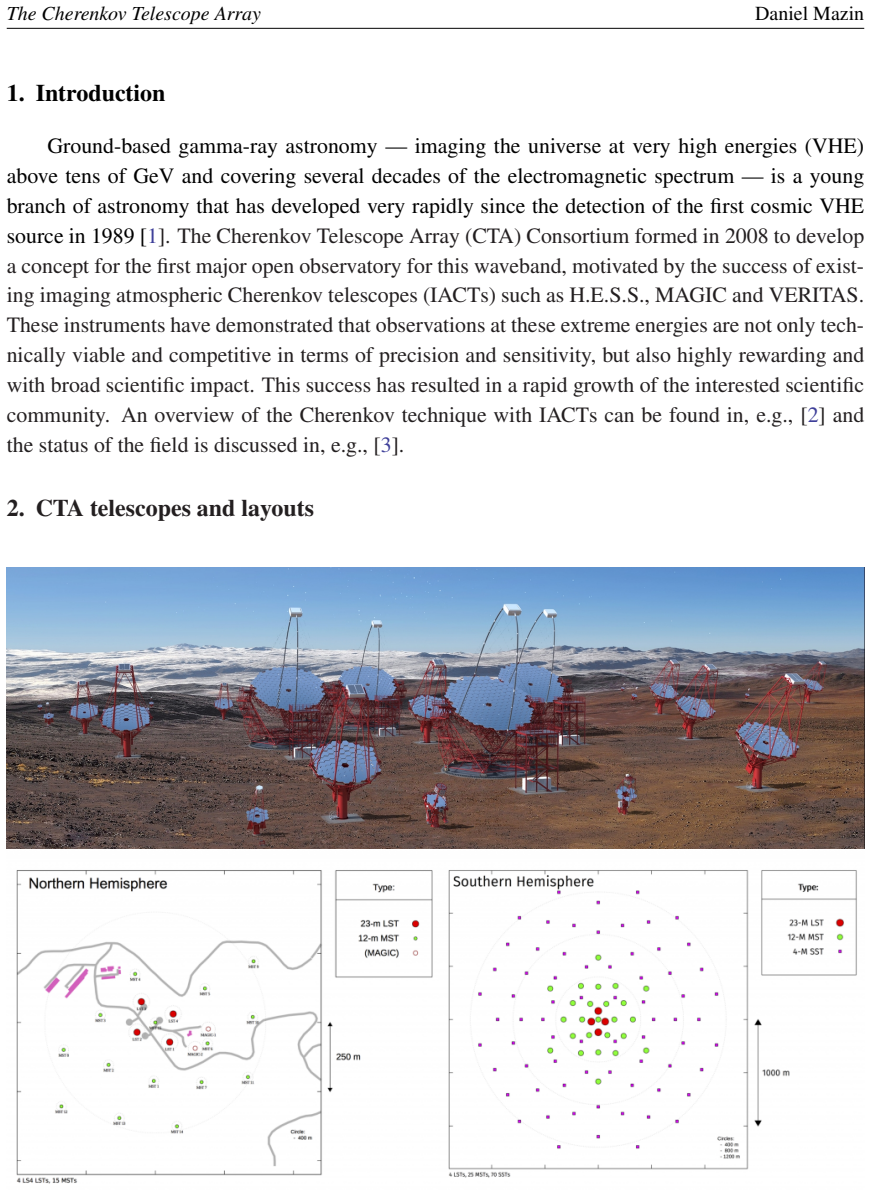
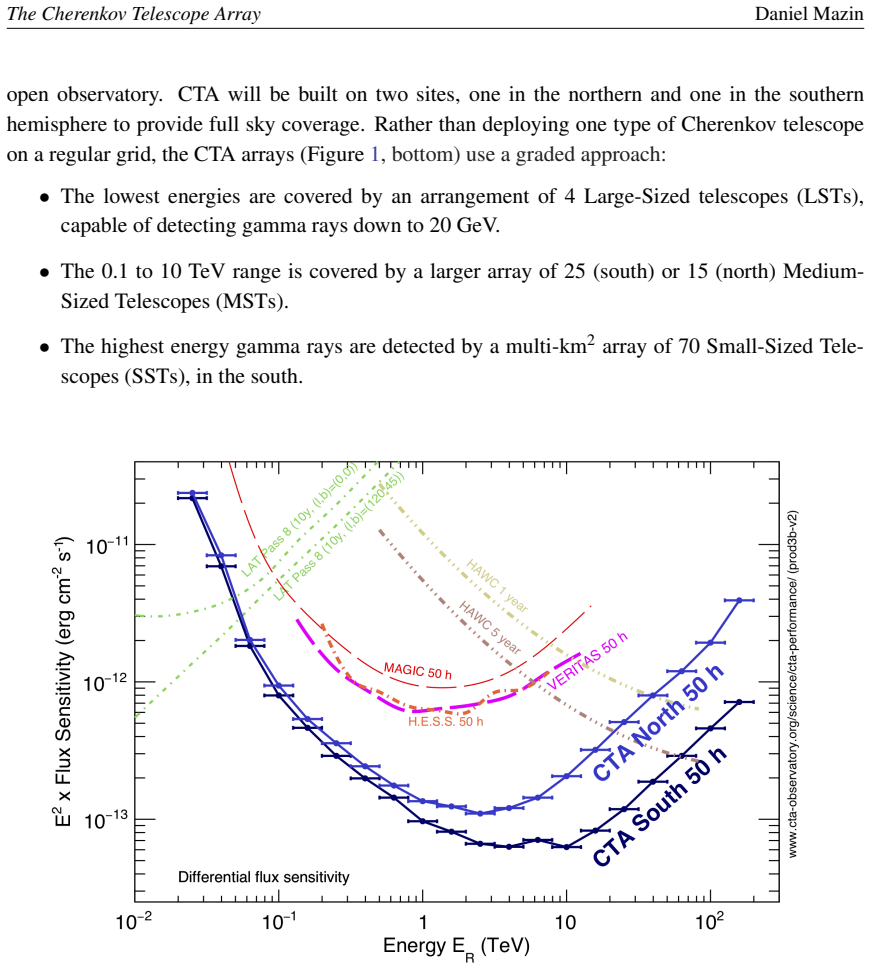
CTA will be capable of detecting gamma rays in the energy range from 20 GeV to more than 300 TeV with unprecedented precision in energy and directional reconstruction with more than 100 telescopes of three different types located in the northern hemisphere at La Palma, Spain, and in the southern at Paranal, Chile. The project is one of the largest astronomical infrastructures worldwide, will provide open data access, and will address questions in astronomy, astrophysics and fundamental physics.
What carries the argument
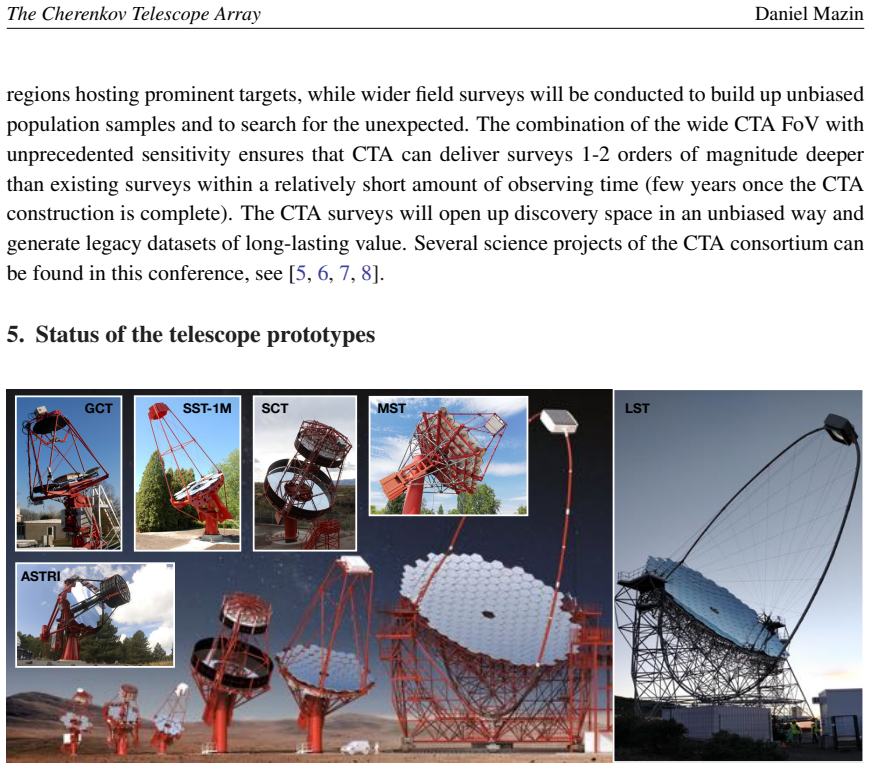
The distributed array of more than 100 Cherenkov telescopes of three different types that together sample air-shower light across the full energy band.
If this is right
- The completed array will support studies of gamma-ray sources across more than four orders of magnitude in energy.
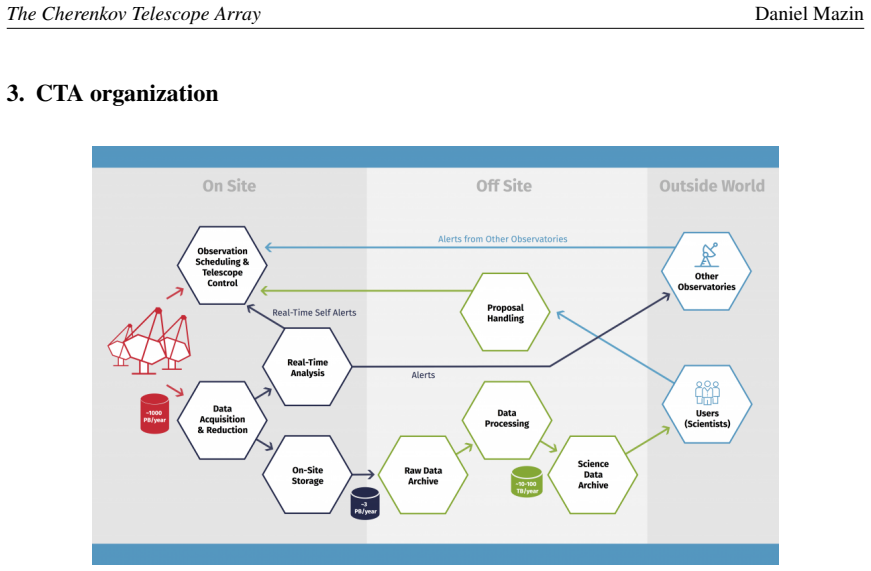
- Open data access will allow the wider community to analyze observations from both hemispheres.
- Dual-site placement will enable continuous coverage of the sky for transient and steady sources.
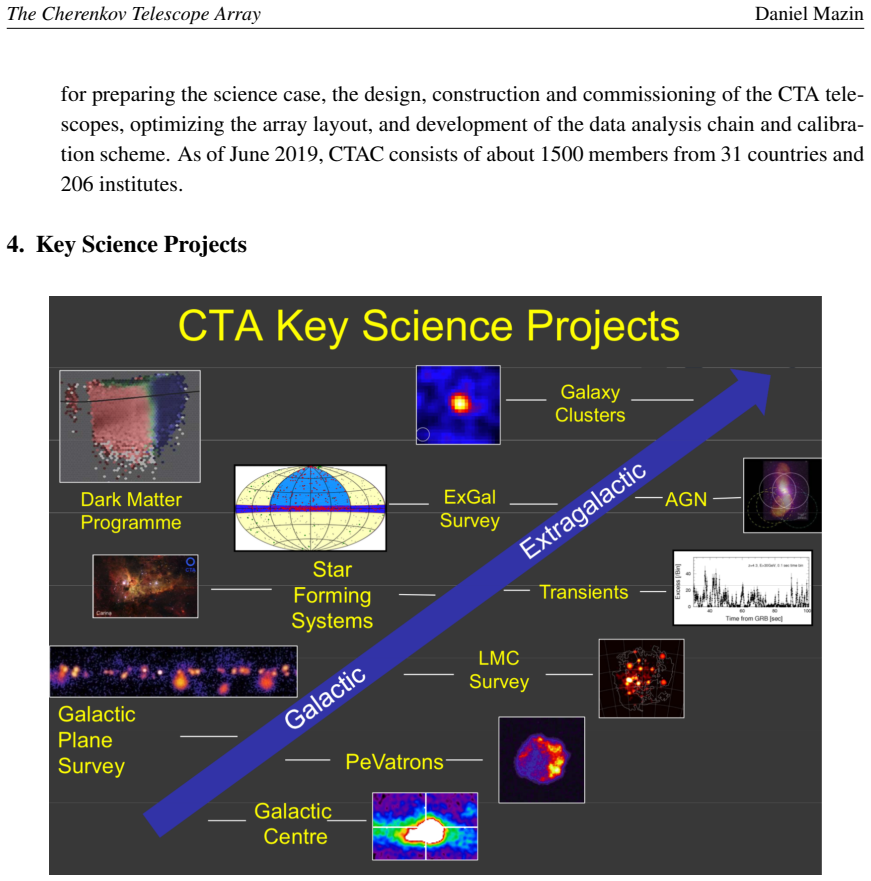
- The facility is expected to contribute to questions in fundamental physics as well as astrophysics.
Where Pith is reading between the lines
- Full-sky monitoring from two hemispheres could improve detection of rare transients that single-site arrays might miss.
- Open data policies may accelerate cross-correlation with other messengers such as neutrinos or gravitational waves.
- The three-telescope-type design trades off sensitivity at low, medium, and high energies, which could be tested by comparing early data subsets from each class.
Load-bearing premise
Construction finishes on the planned schedule and the telescope prototypes meet the design goals for energy coverage and reconstruction precision.
What would settle it
A published measurement of actual CTA energy resolution or angular resolution that falls short of the stated performance targets once the first telescopes begin science operations.
Figures
read the original abstract
The Cherenkov Telescope Array (CTA) is the next generation ground-based observatory for gamma-ray astronomy at very-high energies. It will be capable of detecting gamma rays in the energy range from 20 GeV to more than 300 TeV with unprecedented precision in energy and directional reconstruction. With more than 100 telescopes of three different types it will be located in the northern hemisphere at La Palma, Spain, and in the southern at Paranal, Chile. CTA will be one of the largest astronomical infrastructures in the world with open data access and it will address questions in astronomy, astrophysics and fundamental physics in the next decades. In this presentation we will focus on the status of the CTA construction, the status of the telescope prototypes and highlight some of the physics perspectives.
Editorial analysis
A structured set of objections, weighed in public.
Referee Report
Summary. The manuscript is a conference-style status report on the Cherenkov Telescope Array (CTA) project. It states that CTA will detect gamma rays from 20 GeV to more than 300 TeV with high precision in energy and direction using more than 100 telescopes of three types at sites in La Palma (north) and Paranal (south), emphasizes open data access, and focuses on current construction status, telescope prototype progress, and selected physics perspectives.
Significance. If the reported status and design goals are accurate, the paper supplies a concise project update on a major next-generation gamma-ray facility whose eventual operation could enable new observations in astrophysics and fundamental physics. Its primary contribution is informational rather than the presentation of new measurements or derivations.
minor comments (2)
- [Abstract] Abstract and §1: the phrase 'unprecedented precision' is used without numerical targets or references to prototype performance metrics; adding expected angular or energy resolution values (with citations to design documents) would strengthen the claim.
- The manuscript is described as a 'presentation'; if intended for journal publication, consider expanding the prototype status section with quantitative test results or timelines to make the status claims more self-contained.
Simulated Author's Rebuttal
We thank the referee for their positive assessment of the manuscript as a concise conference-style status report on the CTA project and for recommending minor revision. No major comments were provided in the report.
Circularity Check
No significant circularity
full rationale
The paper is a conference-style status report on the CTA project construction, telescope prototypes, and physics perspectives. It presents design goals and planned capabilities (energy range 20 GeV to >300 TeV, >100 telescopes at two sites) as project specifications rather than deriving them from equations or data fits within the manuscript. No load-bearing derivations, predictions, or self-citation chains appear; the central claims are descriptive of external project plans and do not reduce to internal inputs by construction.
Axiom & Free-Parameter Ledger
Forward citations
Cited by 1 Pith paper
-
Circular polarization effects induced by photon-axion mixing in astrophysical environments
Photon-axion mixing in magnetic fields induces circular polarization that constrains the axion-photon coupling to g_aγγ ≤ 5×10^{-12} GeV^{-1} for m_a ~10^{-16}--10^{-10} eV using blazar data, with peak sensitivity in ...
Reference graph
Works this paper leans on
-
[1]
Weekes T.C., Cowley M.F., Fegan D.J. et al., Observation of TeV Gamma Rays from the Crab Nebula Using the Atmospheric Cerenkov Imaging Technique, ApJ 342 379ff (1989)
work page 1989
-
[2]
de Naurois M. & Mazin D., Ground-based detectors in very-high-energy gamma-ray astronomy, Comptes rendus - Physique 16 610ff (2015)
work page 2015
-
[3]
Degrange B. & Fontaine G., Introduction to high-energy gamma-ray astronomy, Comptes rendus - Physique 16 587ff (2015)
work page 2015
-
[4]
et al., Performance of the Cherenkov Telescope Array, Proceedings of 36th ICRC 2019, this volume
Maier, G. et al., Performance of the Cherenkov Telescope Array, Proceedings of 36th ICRC 2019, this volume
work page 2019
-
[5]
Schüssler, F. et al., The Transient program of the Cherenkov Telescope Array, Proceedings of 36th ICRC 2019, this volume
work page 2019
-
[6]
Viana, A. et al., The Cherenkov Telescope Array view of the Galactic Center region, Proceedings of 36th ICRC 2019, this volume
work page 2019
-
[7]
Barres de Almeida, U. et al., Cherenkov Telescope Array Science: A multi-wavelength and multimessenger perspective, Proceedings of 36th ICRC 2019, this volume
work page 2019
-
[8]
Martinez-Huerta, H. et al., Testing cosmology and fundamental physics with the Cherenkov Telescope Array, Proceedings of 36th ICRC 2019, this volume
work page 2019
-
[9]
et al., The SST-1M project for Cherenkov Telescope Array, Proceedings of 36th ICRC 2019, this volume
Heller, M. et al., The SST-1M project for Cherenkov Telescope Array, Proceedings of 36th ICRC 2019, this volume
work page 2019
-
[10]
Pareschi, G. et al., The ASTRI program in the context of the Cherenkov Telescope Array Observatory, Proceedings of 36th ICRC 2019, this volume
work page 2019
-
[11]
Watson, J. et al., Commissioning and Performance of CHEC-S – a compact high-energy camera for the Cherenkov Telescope Array, Proceedings of 36th ICRC 2019, this volume
work page 2019
-
[12]
Glicenstein, J.-F. et al., Status of the Davies Cotton and Schwarzschild-Coude Medium-Sized Telescopes for the Cherenkov Telescope Array, Proceedings of 36th ICRC 2019, this volume
work page 2019
-
[13]
Vassiliev, V . et al.,Prototype 9.7m Schwarzschild-Couder telescope for the Cherenkov Telescope Array, Proceedings of 36th ICRC 2019, this volume
work page 2019
-
[14]
Cortina, J. et al., Status of the Large Size Telescopes of the Cherenkov Telescope Array, Proceedings of 36th ICRC 2019, this volume
work page 2019
-
[15]
Sakurai, S. et al., The calibrations of the first Large Sized Telescope of the Cherenkov Telescope Array, Proceedings of 36th ICRC 2019, this volume
work page 2019
-
[16]
S., et al., 2018, Science with the Cherenkov Telescope Array
CTA Consortium: Acharya B.S. et al., Science with the Cherenkov Telescope Arra, World Scientific Publishing, doi:10.1142/10986 (2019) 7
discussion (0)
Sign in with ORCID, Apple, or X to comment. Anyone can read and Pith papers without signing in.