REVIEW 3 major objections 6 minor 52 references
Predictive Control over Low-Altitude Wireless Networks: Joint Trajectory Design and Resource Allocation
T0 review · 3 major / 6 minor · reviewed 2026-08-06 · deepseek-v4-flash
Pith's one-line read A drone that jointly plans its trajectory, transmit power, and control commands can keep automated guided vehicles tracking precisely over short-packet wireless links with finite-blocklength outages.
desk verdict Useful engineering recipe for drone-assisted wireless control, but the certainty-equivalence gap in the cost derivation means the optimality claim needs a major fix before acceptance. read the letter →
The pith
A machine-rendered reading of the paper's core claim, the machinery that carries it, and where it could break.
The reading
What carries the argument
The load-bearing object is the expected-state dynamics of Eq. (18), which replaces the Bernoulli outage event with its probability: the next state is the nominal open-loop update plus the control contribution scaled by $(1-P_k[n])$. Because that scaling appears quadratically in the MPC cost through $G_k[n] = (1-P_k[n])^2 F_k^T Q_4 F_k + Q_5$, outage probability and control effort become directly coupled, and the control block reduces to a quadratic program. Around this core, the solution alternates three blocks: a standard QP for the control-increment sequence, projected gradient descent with backtracking for power (needed because the outage function is non-convex in power), and successive convex approximation by first-order Taylor expansion for the drone position. The convergence argument is that no block update increases the objective, and the objective is bounded below, so the iterates settle at a sub-optimal point.
What would settle it
Run Monte Carlo simulations of the closed loop with true Bernoulli drops, as in Eq. (17), under the parameters of Fig. 5, and compare the realized average control cost with the cost predicted by the mean-field model; if the gap grows as outage probability increases, the mean-field substitution is the failure point. An optimizer that explicitly accounts for the covariance term $\operatorname{tr}(Q_4\operatorname{Cov}(x))$ would beat the proposed policy whenever that gap is material.
Extended reading notes
Core claim
The central claim is that the jointly optimized control increments, transmit powers, and drone position obtained from problem (19), in its QP form (40), achieve lower control cost and lower tracking root-mean-square error than predictive PID, predictive LQR, equal-power allocation, and straight-flight drone baselines, including under abrupt AGV turns and under channel-estimation error. The mechanism is the closed-form outage probability of Nakagami-m fading with a finite-blocklength rate threshold: it enters the MPC cost through the expected-state dynamics, making the objective a sum of a quadratic term in the control block and nonlinear terms in power and position. The paper further claims the alternating algorithm converges monotonically to a sub-optimal solution with stated per-block complexity, and that a high-fidelity simulator with adverse weather reproduces the qualitative tracking advantage.
Load-bearing premise
The whole optimization treats the random outage process as if each slot were deterministic: Eq. (18) replaces the Bernoulli drop with its expectation, so the cost being minimized is $J(\mathbb{E}[x])$ rather than the stated $\mathbb{E}[J(x)]$, and the paper provides no bound on the difference.
Editorial extensions
If this is right
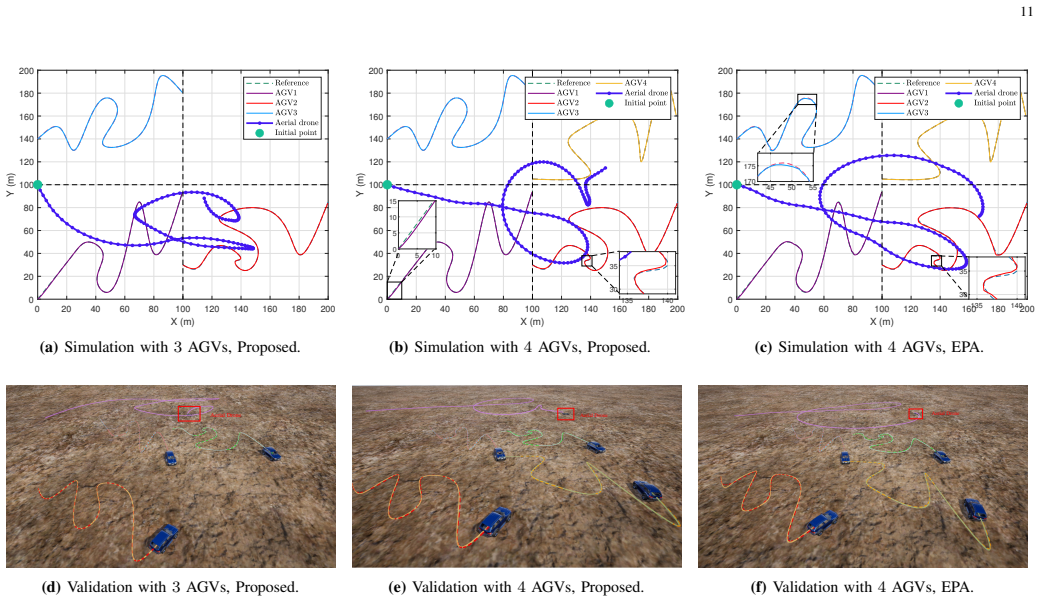
- With a receding horizon, only the first control increment is actually sent, and the paper reports that the per-slot computation stays within the sampling interval in its high-fidelity simulator.
- Control cost falls as blocklength grows and saturates at the infinite-blocklength limit, so the finite-blocklength model acts as a smooth bridge to Shannon-based designs rather than a separate regime.
- Higher rate thresholds or lower power budgets raise the outage probability, which directly inflates control cost; the paper quantifies this tradeoff at a representative time slot.
- Under equal power or a fixed drone path, tracking degrades most at sharp turns, because those baselines cannot shift resources to high-demand AGVs; the proposed joint design specifically targets those regions.
- The method preserves its advantage when channel estimation is imperfect, with the gap over baselines widening as normalized estimation error grows toward 0.3.
Reading between the lines
- The paper optimizes the expected state rather than the expected cost, so the true objective differs by an unquantified variance term; a Monte Carlo comparison with Bernoulli drops would reveal whether the gap is small in the simulated regime.
- Closed-loop stochastic stability is not established; a natural next claim is bounded mean-square error under the receding-horizon policy, which would require a Lyapunov argument over the outage random process.
- The same alternating QP structure would extend to other fading models, including Rayleigh fading with $m=1$, and to imperfect uplink estimation, provided the relevant outage or drop probability can be written in closed form.
Editorial analysis
A structured set of objections, weighed in public.
Referee Report
Summary. The paper studies downlink wireless control of multiple AGVs by a single drone under finite-blocklength transmission. It models transmission outages as Bernoulli events, replaces the stochastic state update by its expectation, and formulates a joint MPC problem over control increments, transmit powers, and drone trajectory with power and mobility constraints. The non-convex problem is transformed into a quadratic program, solved by alternating optimization using projected gradient descent and successive convex approximation, and validated by simulations and AirSim experiments. The paper claims that the proposed framework achieves robust AGV tracking and consistently outperforms Predictive PID, Predictive LQR, equal-power allocation, and straight-flight baselines.
Significance. If the technical gaps were repaired, the paper would be a useful practical contribution: it gives a closed-form Nakagami-m outage expression under FBL transmission, integrates that reliability metric into an MPC cost, and demonstrates the joint control/communication design in both synthetic simulation and AirSim. The AO decomposition into three QP-type subproblems and the reported complexity estimates are valuable for implementation. However, the central optimality claim currently rests on a certainty-equivalence step that changes the objective actually minimized, and the convergence chain is incomplete as written. These are load-bearing issues, not presentation details.
major comments (3)
- [§III-B, Eqs. (17)–(19) and (32)–(39)] Problem (19a) states the objective as E(J_n), but the derivation actually minimizes the cost evaluated at the expected state trajectory. Because the outage event multiplies the control input, the predicted state is random even at fixed power and trajectory. For a fixed control sequence, E[(χ_k−χ_{k,ref})ᵀQ4(χ_k−χ_{k,ref})] equals (E[χ_k]−χ_{k,ref})ᵀQ4(E[χ_k]−χ_{k,ref}) + tr(Q4 Cov(χ_k)), where Cov(χ_k) depends on products of Bernoulli outage/success indicators across the prediction horizon. Substituting (32) into (35) silently drops tr(Q4 Cov(χ_k)), and the factor (1−P_k)² in (37) does not capture this variance contribution. Hence problem (40) and Algorithm 2 minimize J(E[x]), not E[J(x)] as claimed in (19a), and no bound on the gap is provided. The paper should either explicitly reformulate the objective as a mean-field/certainty-equivalence cost and adjust the claims, or include the variance penalty and show how the resulting objective is optimized.
- [§IV-C, Eq. (58)] The convergence argument is not valid as written. First, the second inequality in (58) has the wrong direction if η2 denotes the objective value at p^ι: since p^ι solves problem (42), the objective value at p^ι should be no larger than the value at p^{ι−1}; if η2 instead denotes the minimal value of problem (42), then the displayed arguments (p^ι, q^{ι−1}) are misleading. Second, inequality 3 asserts that solving the linearized surrogate in (55)/(57) does not increase the original objective, but for a general non-convex function a first-order Taylor expansion is not a global upper bound. Without a proximal/regularization term or a proof of a sufficient-decrease property, the SCA step can increase J_n. Thus Eq. (58) does not establish monotone convergence of Algorithm 2 to a suboptimal solution, and the convergence claim in Section IV-C should be repaired or softened.
- [§IV-B, Proposition 1 and Eq. (27)] The outage threshold in Eq. (27) omits the bandwidth normalization. Since R_k[n] in (4) has units of bps with sub-channel bandwidth B, the equation R_k[n] = R_k^th has a solution of the form Γ_k^th = 2^{(R_k^th/B + κ*/2)}−1 (depending on the intended definition of κ*), not the expression with R_k^th alone; likewise κ* in (24) should be defined with the normalized rate R_k^th/B. In the simulations B = 1 MHz and R_k^th = 1 Mbps, so the numerical error is masked, but the claimed closed form is dimensionally wrong for general bandwidths and needs correction.
minor comments (6)
- [Algorithm 2, line 8] The termination criterion says 'fractional increase of the objective value is below ε'; for a minimization problem this should be 'fractional decrease'.
- [§IV-B, Eq. (24)] The generalized function W(ω1,ω2;μ) in (24)–(26) is used without stating the domain of convergence or how the infinite series is truncated; a brief implementable definition would make the closed form reproducible.
- [§V-A, Fig. 3] The channel-estimation-error experiment is not connected to the problem formulation; the paper states that perfect CSI is assumed afterwards. Please clarify whether the MMSE error model affects the outage probability and the optimization, or whether Fig. 3 is only a sensitivity check.
- [Section II, footnotes 2 and 3] The assumptions of ideal uplink and zero process noise should be listed explicitly as limitations in the conclusions, since the claimed robustness under 'abrupt trajectory variations' is otherwise validated only in simulation.
- [§IV-B, footnote 4] The Nakagami shape parameter m is restricted to positive integers; the paper should state whether Proposition 1 extends to non-integer m or justify why the restriction is acceptable for LAWN channels.
- [Throughout] Please proofread for typographical errors such as 'Algoithm 1' in Algorithm 2 and 'reformulated' for 'reformulates' in Section IV; these do not affect the technical content.
Circularity Check
No circularity: the paper's derivation uses external FBL/Nakagami results and standard optimization tools, and its self-citations are contextual rather than load-bearing.
full rationale
The paper's derivation chain does not reduce any claimed prediction or first-principles result to its own inputs. The closed-form outage probability in Proposition 1 is derived from the standard finite-blocklength rate expression [28] and the Nakagami-m outage result [39], both external and independently established. The QP reformulation in Eqs. (36)-(39) is an algebraic substitution of the expected predicted-state dynamics of Eq. (32) into the quadratic cost of Eq. (35); it is a model transformation, not a definitional identity that makes the output equal to the input. The MPC terminal cost in Eq. (13) is the standard discrete Riccati equation cited from [16], and the PGD and SCA solution steps cite external references [43] and [45]. Self-citations [3], [4], [21], and [23] appear only in contextual statements, such as low-altitude network surveys and the fixed-altitude assumption; none of them carries the derivation's load-bearing weight. The possible mismatch between E[J_n] and J(E[x_n]) noted in Eq. (35) is a substantive modeling or correctness concern, but it is not circularity: the algorithm optimizes the well-defined surrogate cost, and the paper does not claim that surrogate is identical to the true expected cost by construction. The claimed performance gains are validated against external benchmarks in simulation and AirSim experiments, so no fitted parameter is renamed as a prediction. Thus, no circular step can be exhibited from the paper's own equations or citations, and the appropriate score is 0.
Assumptions & free parameters
free parameters (3)
- Weighting matrices Q1, Q2 =
identity matrices (Sec. V-A)
- Nakagami fading parameter m =
m = 2 (Sec. V-A); restricted to positive integer (footnote 4)
- Prediction horizon Np =
10 (Sec. V-A)
assumptions (6)
- domain assumption Nakagami-m fading with integer m is a valid model for low-altitude A2G channels, and the outage series (20) holds only for integer m.
- domain assumption Ideal uplink channels and perfect state estimation at the drone.
- domain assumption Control system noise is neglected; Eq. (6) is deterministic.
- ad hoc to paper The Bernoulli outage process can be replaced by its expectation (1-P) in the state update (Eq. (18)), yielding J(E[x]) rather than E[J(x)].
- ad hoc to paper The first-order Taylor surrogate in Eq. (55) is an adequate convex surrogate for SCA, and its minimization does not increase the objective.
- standard math The inversion result from [38] applies, i.e., Gamma^th = 2^{Rth + kappa*/2} - 1 with Rth normalized by B.
Cite this review
Pith. "Pith review of Predictive Control over Low-Altitude Wireless Networks: Joint Trajectory Design and Resource Allocation." pith.science (2026). https://pith.science/paper/E4UXTBMV
@misc{pith2026250702374,
  author       = {Pith},
  title        = {Pith review of: Predictive Control over Low-Altitude Wireless Networks: Joint Trajectory Design and Resource Allocation},
  year         = {2026},
  howpublished = {\url{https://pith.science/paper/E4UXTBMV}},
  note         = {Machine review of arXiv:2507.02374}
}
read the original abstract
Low-altitude wireless networks (LAWNs) have been envisioned as flexible and transformative platforms for enabling delay-sensitive control applications in Internet of Things (IoT) systems. In this work, we investigate the real-time wireless control over LAWNs, where an aerial drone is employed to serve multiple mobile automated guided vehicles (AGVs) via finite blocklength (FBL) transmission. Toward this end, we adopt the model predictive control (MPC) to ensure accurate trajectory tracking, while we analyze the communication reliability using the outage probability. Subsequently, we formulate an optimization problem to jointly determine control policy, transmit power allocation, and drone trajectory by accounting for the maximum travel distance and control input constraints. To address the resultant non-convex optimization problem, we first derive the closed-form expression of the outage probability under FBL transmission. Based on this, we reformulate the original problem as a quadratic programming (QP) problem, followed by developing an alternating optimization (AO) framework. Specifically, we employ the projected gradient descent (PGD) method and the successive convex approximation (SCA) technique to achieve computationally efficient sub-optimal solutions. Furthermore, we thoroughly analyze the convergence and computational complexity of the proposed algorithm. Extensive simulations and AirSim-based experiments are conducted to validate the superiority of our proposed approach compared to the baseline schemes in terms of control performance.
Figures


Figures from the paper (2 more)

Reference graph
Works this paper leans on
-
[1]
N. H. Motlagh, T. Taleb, and O. Arouk, “Low-altitude unmanned aerial vehicles-based internet of things services: Comprehensive survey and future perspectives,” IEEE Internet Things J. , vol. 3, pp. 899–922, Dec
-
[2]
UA V-based IoT platform: A crowd surveillance use case,
N. H. Motlagh, M. Bagaa, and T. Taleb, “UA V-based IoT platform: A crowd surveillance use case,” IEEE Commun. Mag. , vol. 55, no. 2, pp. 128–134, Feb. 2017
2017
-
[3]
Low-altitude wireless networks: A survey,
J. Wu, Y . Y ang, W. Y uan, W. Liu, J. Wang, T. Mao, L. Zhou, Y . Cui, F. Liu, G. Sun et al. , “Low-altitude wireless networks: A survey,” arXiv preprint arXiv:2509.11607 , 2025
arXiv 2025
-
[4]
W. Y uan, Y . Cui, J. Wang, F. Liu, G. Sun, T. Xiang, J. Xu, S. Jin, D. Niy- ato, S. Coleri et al. , “From ground to sky: Architectures, applications, and challenges shaping low-altitude wireless networks,” arXiv preprint arXiv:2506.12308, 2025
arXiv 2025
-
[5]
Generative AI-enabled wireless communi- cations for robust low-altitude economy networking,
C. Zhao, J. Wang, R. Zhang, D. Niyato, G. Sun, H. Du, D. I. Kim, and A. Jamalipour, “Generative AI-enabled wireless communi- cations for robust low-altitude economy networking,” arXiv preprint arXiv:2502.18118, 2025
arXiv 2025
-
[6]
On the interplay between sensing and communications for UA V trajectory design,
J. Wu, W. Y uan, and L. Bai, “On the interplay between sensing and communications for UA V trajectory design,” IEEE Internet Things J. , vol. 10, no. 23, pp. 20 383–20 395, Dec. 2023
work page 2023
-
[7]
When UA Vs meet ISAC: Real- time trajectory design for secure communications,
J. Wu, W. Y uan, and L. Hanzo, “When UA Vs meet ISAC: Real- time trajectory design for secure communications,” IEEE Trans. V eh. Technol., vol. 72, no. 12, pp. 16 766–16 771, Dec. 2023
work page 2023
-
[8]
Y . Y ao, W. Xiao, P . Miao, G. Chen, H. Y ang, C.-B. Chae, and K.-K. Wong, “Uav-relay-aided secure maritime networks coexisting with satellite networks: Robust beamforming and trajectory optimization,” IEEE Trans. Wireless Commun. , p. 11, 2025. [Online]. Available: https://doi.org/10.1109/twc.2025.3596136
Show all 52 references
-
[9]
Mobile unmanned aerial vehicles (UA Vs) for energy-efficient internet of things communica- tions,
M. Mozaffari, W. Saad, M. Bennis, and M. Debbah, “Mobile unmanned aerial vehicles (UA Vs) for energy-efficient internet of things communica- tions,” IEEE Trans. Wireless Commun. , vol. 16, no. 11, pp. 7574–7589, Nov. 2017
2017
-
[10]
Joint trajectory and resource allocation design for energy-efficient secure UA V communica- tion systems,
Y . Cai, Z. Wei, R. Li, D. W. K. Ng, and J. Y uan, “Joint trajectory and resource allocation design for energy-efficient secure UA V communica- tion systems,” IEEE Trans. Commun. , vol. 68, no. 7, pp. 4536–4553, Jul. 2020
2020
-
[11]
Random 3D mobile UA V networks: Mobility modeling and coverage probability,
P . K. Sharma and D. I. Kim, “Random 3D mobile UA V networks: Mobility modeling and coverage probability,” IEEE Trans. Wireless Commun., vol. 18, no. 5, pp. 2527–2538, May 2019
2019
-
[12]
Smart and flexible manufacturing systems using autonomous guided vehicles and the internet of things,
I. Vlachos, R. M. Pascazzi, M. Ntotis, K. Spanaki, S. Despoudi, and P . Repoussis, “Smart and flexible manufacturing systems using autonomous guided vehicles and the internet of things,” Int. J. Prod. Res., vol. 62, no. 15, pp. 5574–5595, Oct. 2022
2022
-
[13]
Path tracking of an autonomous ground vehicle with different payloads by hierarchical improved fuzzy dynamic sliding-mode control,
C.-L. Hwang, C.-C. Y ang, and J. Y . Hung, “Path tracking of an autonomous ground vehicle with different payloads by hierarchical improved fuzzy dynamic sliding-mode control,” IEEE Trans. Fuzzy Syst., vol. 26, no. 2, pp. 899–914, Apr. 2018
2018
-
[14]
A comparative study of stanley, LQR and MPC controllers for path tracking application (ADAS/AD),
V . K, M. Ambalal Sheta, and V . Gumtapure, “A comparative study of stanley, LQR and MPC controllers for path tracking application (ADAS/AD),” in 2019 IEEE International Conference on Intelligent Systems and Green Technology (ICISGT) , 2019, pp. 67–674
2019
-
[15]
Mobile robot path tracking using a robust PID controller,
J. E. Normey-Rico, I. Alcalá, J. Gómez-Ortega, and E. F. Camacho, “Mobile robot path tracking using a robust PID controller,” Control Eng. Pract., vol. 9, no. 11, pp. 1209–1214, 2001
2001
-
[16]
A predictive controller for autonomous vehicle path tracking,
G. V . Raffo, G. K. Gomes, J. E. Normey-Rico, C. R. Kelber, and L. B. Becker, “A predictive controller for autonomous vehicle path tracking,” IEEE Trans. Intell. Transp. Syst. , vol. 10, no. 1, pp. 92–102, 2009
2009
-
[17]
Path planning and tracking for vehicle collision avoidance based on model predictive control with multiconstraints,
J. Ji, A. Khajepour, W. W. Melek, and Y . Huang, “Path planning and tracking for vehicle collision avoidance based on model predictive control with multiconstraints,” IEEE Trans. V eh. Technol., vol. 66, no. 2, pp. 952–964, 2016
2016
-
[18]
Path tracking control for autonomous vehicles based on an improved MPC,
H. Wang, B. Liu, X. Ping, and Q. An, “Path tracking control for autonomous vehicles based on an improved MPC,” IEEE access , vol. 7, pp. 161 064–161 073, 2019
2019
-
[19]
Effect of fuzzy PID con- troller on feedback control systems based on wireless sensor network,
A. A. Hussien, M. J. Marie, and K. S. Gaeid, “Effect of fuzzy PID con- troller on feedback control systems based on wireless sensor network,” International Journal of Electrical and Computer Engineering , vol. 10, no. 3, p. 2416, Jun. 2020
2020
-
[20]
Compensation of time-varying delay in networked control system over Wi-Fi network,
H.-C. Yi, C.-J. An, and J.-Y . Choi, “Compensation of time-varying delay in networked control system over Wi-Fi network,” International Journal of Computers Communications & Control , vol. 12, no. 3, pp. 415–428, 2017. 13
2017
-
[21]
Co-design of sensing, communications, and control for low-altitude wireless networks,
H. Jin, J. Wu, W. Y uan, F. Liu, and Y . Cui, “Co-design of sensing, communications, and control for low-altitude wireless networks,” IEEE Trans. Mob. Comput. , pp. 1–13, Jun. 2025
2025
-
[22]
Networked min–max model predictive control of constrained nonlinear systems with delays and packet dropouts,
H. Li and Y . Shi, “Networked min–max model predictive control of constrained nonlinear systems with delays and packet dropouts,” Int. J. Control, vol. 86, no. 4, pp. 610–624, Nov. 2013
2013
-
[23]
Towards dual-functional LAWN: Control-aware system design for aerodynamics-aided UA V formations,
J. Wu, W. Y uan, Q. Cheng, and H. Jin, “Towards dual-functional LAWN: Control-aware system design for aerodynamics-aided UA V formations,” submitted to IEEE J. Sel. Areas Commun. , 2025
2025
-
[24]
Rate-cost tradeoffs in control,
V . Kostina and B. Hassibi, “Rate-cost tradeoffs in control,” IEEE Trans. Autom. Control, vol. 64, no. 11, pp. 4525–4540, Nov. 2019
2019
-
[25]
Control-oriented power allocation for integrated satellite-UA V networks,
C. Lei, W. Feng, J. Wang, S. Jin, and N. Ge, “Control-oriented power allocation for integrated satellite-UA V networks,” IEEE Wireless Commun. Lett. , vol. 12, no. 5, pp. 883–887, May 2023
2023
-
[26]
Remote UGV control via practical wireless channels: A model predictive control approach,
J. Cao, S. Khan, W. Liu, Y . Li, and B. Vucetic, “Remote UGV control via practical wireless channels: A model predictive control approach,” IEEE Trans. Intell. V eh., pp. 1–13, Oct. 2024
2024
-
[27]
Optimizing resource allocation in urllc for real-time wireless control systems,
B. Chang, L. Zhang, L. Li, G. Zhao, and Z. Chen, “Optimizing resource allocation in urllc for real-time wireless control systems,” IEEE Trans. V eh. Technol., vol. 68, no. 9, pp. 8916–8927, 2019
2019
-
[28]
Channel coding rate in the finite blocklength regime,
Y . Polyanskiy, H. V . Poor, and S. V erdu, “Channel coding rate in the finite blocklength regime,” IEEE Trans. Inf. Theory , vol. 56, no. 5, pp. 2307–2359, May 2010
2010
-
[29]
Joint optimization of user scheduling, rate allocation, and beamforming for RSMA finite blocklength transmission,
J. Zhu, H. Jin, Y . He, F. Fang, W. Huang, and Z. Zhang, “Joint optimization of user scheduling, rate allocation, and beamforming for RSMA finite blocklength transmission,” IEEE Internet Things J. , vol. 11, no. 17, pp. 27 904–27 915, Sep. 2024
2024
-
[30]
Joint information- theoretic secrecy and covertness for UA V-assisted wireless transmission with finite blocklength,
P . Liu, Z. Li, J. Si, N. Al-Dhahir, and Y . Gao, “Joint information- theoretic secrecy and covertness for UA V-assisted wireless transmission with finite blocklength,” IEEE Trans. V eh. Technol., vol. 72, no. 8, pp. 10 187–10 199, Aug. 2023
2023
-
[31]
UA V - Enabled secure communication with finite blocklength,
Y . Wang, X. Zhou, Z. Zhuang, L. Sun, Y . Qian, J. Lu, and F. Shu, “UA V - Enabled secure communication with finite blocklength,” IEEE Trans. V eh. Technol., vol. 69, no. 12, pp. 16 309–16 313, Dec. 2020
2020
-
[32]
Nonlinear EH-based UA V-assisted FD IoT networks: Infinite and finite blocklength analysis,
P . Raut, K. Singh, C.-P . Li, M.-S. Alouini, and W.-J. Huang, “Nonlinear EH-based UA V-assisted FD IoT networks: Infinite and finite blocklength analysis,” IEEE Internet Things J. , vol. 8, no. 24, pp. 17 655–17 668, Dec. 2021
2021
-
[33]
A study on co-simulation digital twin with MA TLAB and AirSim for future advanced air mobil- ity,
L. Turco, J. Zhao, Y . Xu, and A. Tsourdos, “A study on co-simulation digital twin with MA TLAB and AirSim for future advanced air mobil- ity,” in 2024 IEEE Aerospace Conference , 2024, pp. 1–18
2024
-
[34]
Path tracking control for autonomous vehicles based on an improved MPC,
H. Wang, B. Liu, X. Ping, and Q. An, “Path tracking control for autonomous vehicles based on an improved MPC,” IEEE Access, vol. 7, pp. 161 064–161 073, Oct. 2019
2019
-
[35]
Effect of channel estimation errors on M-QAM with MRC and EGC in nakagami fading channels,
Y . Ma and J. Jin, “Effect of channel estimation errors on M-QAM with MRC and EGC in nakagami fading channels,” IEEE Transactions on V ehicular Technology, vol. 56, no. 3, p. 12391250, May 2007. [Online]. Available: https://doi.org/10.1109/tvt.2007.895491
2007
-
[36]
Performance analysis of amplify-and-forward cooperative communication systems with channel estimation errors over nakagami-m channels,
L. Wang, Y . Cai, J. Hu, and W. Y ang, “Performance analysis of amplify-and-forward cooperative communication systems with channel estimation errors over nakagami-m channels,” in 2011 Third International Conference on Communications and Mobile Computing. IEEE, Apr. 2011, p. 31...
2011 doi
-
[37]
MPC based power allocation for reliable wireless networked control systems,
K. Ishii, “MPC based power allocation for reliable wireless networked control systems,” IEEE Access , vol. 9, pp. 60 913–60 922, Mar. 2021
2021
-
[38]
Beamforming design for multiuser urllc with finite blocklength transmission,
S. He, Z. An, J. Zhu, J. Zhang, Y . Huang, and Y . Zhang, “Beamforming design for multiuser urllc with finite blocklength transmission,” IEEE Trans. Wireless Commun. , vol. 20, no. 12, pp. 8096–8109, Dec. 2021
2021
-
[39]
Outage analysis of RF energy harvesting cooperative communication systems over nakagami- m fading channels with integer and non-integer m,
T. M. Hoang, B. C. Nguyen, P . T. Tran, and L. T. Dung, “Outage analysis of RF energy harvesting cooperative communication systems over nakagami- m fading channels with integer and non-integer m,” IEEE Trans. V eh. Technol. , vol. 69, no. 3, p. 27852801, Mar. 2020. [Online]. A...
2020
-
[40]
Outage performance of decode-and-forward cooperative networks over nakagami-m fading with node blockage,
G. T. Djordjevic, K. Kansanen, and A. M. Cvetkovic, “Outage performance of decode-and-forward cooperative networks over nakagami-m fading with node blockage,” IEEE Trans. Wireless Commun., vol. 15, no. 9, p. 58485860, Sep. 2016. [Online]. Available: https://doi.org/10.1109/twc...
2016
-
[41]
Nocedal and S
J. Nocedal and S. J. Wright, Numerical optimization . Springer, 1999
1999
-
[42]
Convex optimization,
S. Boyd, “Convex optimization,” Cambridge UP , 2004
2004
-
[43]
Projected gradient methods for linearly constrained problems,
P . H. Calamai and J. J. Moré, “Projected gradient methods for linearly constrained problems,” Math. Program. , vol. 39, pp. 93–116, Sep
-
[44]
A unified approach for learning the parameters of sum-product networks,
H. Zhao, P . Poupart, and G. J. Gordon, “A unified approach for learning the parameters of sum-product networks,” Advances in neural information processing systems , vol. 29, 2016
2016
-
[45]
Cognitive UA V communication via joint maneuver and power control,
Y . Huang, W. Mei, J. Xu, L. Qiu, and R. Zhang, “Cognitive UA V communication via joint maneuver and power control,” IEEE Trans. Commun., vol. 67, no. 11, pp. 7872–7888, Jul. 2019
2019
-
[46]
Matlab software for disciplined convex programming, version 1.21,
M. Grant, S. Boyd, and Y . Y . CVX, “Matlab software for disciplined convex programming, version 1.21,” CVX Research, 2011
2011
-
[47]
Joint subcarrier and power allocation in NOMA: Optimal and approximate algorithms,
L. Salaün, M. Coupechoux, and C. S. Chen, “Joint subcarrier and power allocation in NOMA: Optimal and approximate algorithms,” IEEE Trans. Signal Process. , vol. 68, pp. 2215–2230, Mar. 2020
2020
-
[48]
ISAC from the sky: UA V trajectory design for joint communication and target localization,
X. Jing, F. Liu, C. Masouros, and Y . Zeng, “ISAC from the sky: UA V trajectory design for joint communication and target localization,” IEEE Trans. Wireless Commun., vol. 23, no. 10, pp. 12 857–12 872, Oct. 2024
2024
-
[49]
En- abling technologies for ultra-reliable and low latency communications: From phy and mac layer perspectives,
G. J. Sutton, J. Zeng, R. P . Liu, W. Ni, D. N. Nguyen, B. A. Jayawick- rama, X. Huang, M. Abolhasan, Z. Zhang, E. Dutkiewicz et al. , “En- abling technologies for ultra-reliable and low latency communications: From phy and mac layer perspectives,” IEEE Commun. Surv. Tutorials...
2019
-
[50]
Joint user scheduling and power allocation optimization for energy-efficient noma systems with imperfect CSI,
F. Fang, H. Zhang, J. Cheng, S. Roy, and V . C. Leung, “Joint user scheduling and power allocation optimization for energy-efficient noma systems with imperfect CSI,” IEEE J. Sel. Areas Commun. , vol. 35, no. 12, pp. 2874–2885, Dec. 2017. Haijia Jin received the B.Eng. degree i...
2017
-
[1987]
Available: https://doi.org/10.1007/BF02592073
[Online]. Available: https://doi.org/10.1007/BF02592073
-
[2016]
Available: https://api.semanticscholar.org/CorpusID: 17791330
[Online]. Available: https://api.semanticscholar.org/CorpusID: 17791330
Reviewed August 6, 2026 · model on record in the stance chip above.
Discussion (0). Sign in to comment.