REVIEW 2 major objections 5 minor 42 references
Negative excitonic diffusion in transition metal dichalcogenides
T0 review · 2 major / 5 minor · reviewed 2026-08-14 · deepseek-v4-flash
Pith's one-line read At 20 K, WS2 exciton clouds shrink instead of spreading
desk verdict A credible microscopic prediction of transient negative exciton diffusion in TMDs, clearly traced to intervalley scattering, but the parameter sensitivity deserves a serious look before the effect is treated as established. read the letter →
The pith
A machine-rendered reading of the paper's core claim, the machinery that carries it, and where it could break.
The reading
What carries the argument
The central object is the excitonic Wigner function $N^v_Q(r,t)$, a valley-resolved spatial and momentum density for excitons in state $|Q,v\rangle$, evolved by semiconductor Bloch equations in Wigner representation with intra- and intervalley exciton-phonon scattering. The argument is carried by the scattering-induced shape variation $\eta_v$, which isolates amount-preserving changes in the spatial density profile and yields a scattering-induced diffusion coefficient $D^{\rm scat}_v$. Comparing $D^{\rm scat}_v$ with the full $D_v$ shows that intervalley scattering dominates the transient features at 20 K, including the negative-diffusion window; intravalley scattering alone would give ordinary Fick diffusion.
What would settle it
Time-resolved photoluminescence imaging of hBN-encapsulated WS2 at 20 K should show the spatial width grow with a sharp diffusion peak near 8 ps, then narrow from about 30 ps onward as the cloud contracts back toward the excitation center; if the measured width only increases monotonically, or no contraction appears in the 30 to 100 ps window, the negative-diffusion prediction fails. A supporting check is the bright-dark splitting: if the $KK'$--$KK$ separation is far from the assumed 51.5 meV, the hot-dark-state pathway is energetically blocked.
Extended reading notes
Core claim
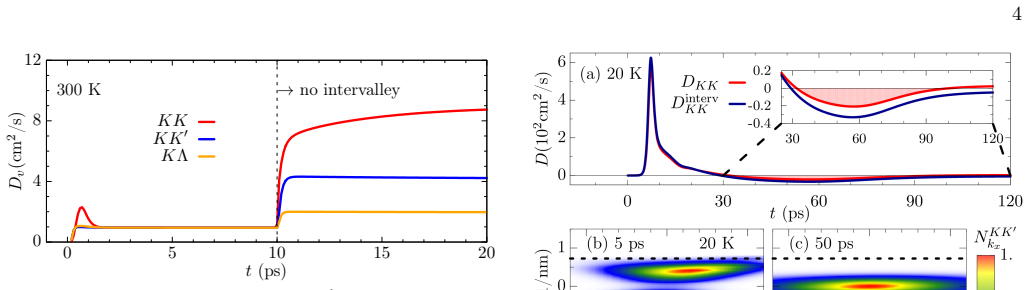
The central claim is that the spatiotemporal dynamics of excitons in hBN-encapsulated WS2 monolayers can exhibit a transient negative diffusion coefficient at low temperature. In the computed evolution at 20 K, the squared width $w^2_{KK}$ of the bright-exciton distribution increases sharply, reaches a peak diffusion around 8 ps, and then decreases between roughly 30 and 100 ps, so the directly emitted photoluminescence narrows in space. The mechanism is intervalley exciton-phonon scattering: the momentum-dark $KK'$ state lies about 51.5 meV below the bright $KK$ state and the $K\Lambda$ state about 30.5 meV below it, and incoherent dark excitons are initially created with excess energy, one intervalley phonon below the $KK$ minimum. These hot dark states have high occupation away from the excitation center, and once they absorb intervalley phonons and scatter back into $KK$, they populate the bright exciton preferentially at the tails. The paper attributes the subsequent sign change of the scattering-induced diffusion coefficient and the uphill density transfer from tails to center to this delayed back-scattering.
Load-bearing premise
The predicted back-flow relies on the assumed energy separations among the bright and momentum-dark valleys (about 51.5 and 30.5 meV) and on the intervalley phonon scattering rates taken from earlier calculations; if those valley splittings or deformation-potential couplings differ in reality, the delayed return scattering that produces negative diffusion would weaken or disappear.
Editorial extensions
If this is right
- At 20 K, time-resolved photoluminescence in hBN-encapsulated WS2 should show the bright-exciton cloud first expand quickly and then visibly narrow after roughly 30 ps.
- Negative diffusion is strongest for the lower-populated valley, because the intervalley scattering contribution scales inversely with that valley's population, leaving the heavily occupied $KK'$ dark valley smooth while $KK$ shows the contracting width.
- At 300 K, intervalley exciton-phonon scattering equilibrates all valleys before spatial separation develops, so the diffusion coefficient stays positive, valley-independent, and quickly stationary.
- At 77 K, the dynamics separates into energy, momentum, and valley thermalization phases, with valley-dependent diffusion coefficients during the transient before a common stationary regime is reached.
- The mechanism is tied to the bright-dark valley landscape and is therefore not restricted to WS2: other TMD monolayers with a bright state flanked by lower-lying momentum-dark states at suitable energy offsets should show a similar transient negative diffusion at low temperature.
Reading between the lines
- A natural extension is to test whether the same dark-state return scattering sharpens into a spatial ring or halo at higher excitation densities, where phonon winds and thermal drift could combine with, or compete against, the negative diffusion.
- Because the effect depends on the bright-dark valley splittings, strain or dielectric engineering tuned to change those separations should be able to suppress or amplify the negative diffusion; for example, a larger $KK'$--$KK$ gap would block the acoustic-phonon absorption pathway.
- The tens-of-picoseconds delay means steady-state or time-averaged diffusion measurements would miss the effect entirely; only transient spatial imaging on the 1-100 ps scale can confront the prediction.
- Recomputing the intervalley phonon couplings from first principles rather than using earlier literature values would show which TMD candidates beyond WS2 combine the right valley offsets and scattering strengths for observable negative diffusion.
Signed reviews
Editorial analysis
A structured set of objections, weighed in public.
Referee Report
Summary. The manuscript develops a quantum kinetic theory for the spatiotemporal dynamics of excitons in monolayer WS2, explicitly including the bright KK valley and the momentum-dark KK' and KΛ valleys. The authors derive an equation of motion for the excitonic Wigner function, including free propagation, radiative decay, phonon-assisted formation from coherent polarization, and intra- and intervalley exciton-phonon scattering. They solve these equations for a spatially localized optical excitation at 300 K, 77 K, and 20 K. At 20 K, they predict a transient negative diffusion of the bright KK exciton distribution: after roughly 30 ps the squared spatial width decreases, producing a narrowing of the photoluminescence spot. The mechanism is identified as intervalley scattering of hot momentum-dark excitons back into the KK valley, and a decomposition of the scattering-induced shape variation (Eq. (4) and Fig. 5) is used to support this interpretation.
Significance. If the prediction is robust, the paper reports an interesting and potentially observable phenomenon: the multi-valley dark-exciton landscape in TMDs can produce transient 'uphill' diffusion, contradicting the usual picture of monotonic exciton spreading. The result is not fitted; it emerges from the microscopic dynamics, and the proposed mechanism (back-scattering from hot dark states) is physically plausible and clearly explained. The study is well aligned with the journal's scope and could stimulate experimental work on spatiotemporal exciton dynamics. However, the quantitative prediction relies on input parameters (valley splittings and intervalley phonon couplings) that are taken from prior literature without a sensitivity analysis, and at 20 K the relevant occupation factors are exponentially sensitive to those parameters. The robustness of the central claim is therefore not yet established.
major comments (2)
- [Valley-dependent exciton diffusion / Intervalley exciton-phonon scattering (Figs. 3(c), 5)] The predicted negative diffusion is exponentially sensitive to the assumed valley splittings (51.5 meV for KK' and 30.5 meV for KΛ below KK) and to the intervalley phonon frequencies, but the manuscript provides no sensitivity or uncertainty analysis. At 20 K, the occupation of the dark states that can scatter back into KK scales approximately as exp[-(Δ - ℏω)/k_B T]; a 10 meV change in Δ alters this factor by hundreds, which could shift, shrink, or entirely eliminate the 30-100 ps negative-diffusion window shown in Fig. 3(c). The authors should quantify the robustness of the effect by varying the splittings and deformation-potential couplings within realistic uncertainties, or at minimum state the parameter range for which the prediction holds.
- [Theoretical approach, Eq. (3)] The reduction of the intravalley dynamics to Fick's law is only sketched ('By studying how the difference between N_Q^v and N_Q^{v,°} evolves [33]...'). This reduction is used to define the diffusion coefficient and to justify the decomposition of the scattering-induced diffusion in Eq. (4) and Fig. 5(a). The authors should provide a concise derivation or a precise reference for the steps, including the assumptions of local quasi-equilibrium and the relaxation-time approximation. Because the central claim concerns a transient non-Fickian regime, the limits of this reduction are directly relevant to the interpretation of the negative D_v as a diffusion coefficient.
minor comments (5)
- [Throughout] There are minor typographical issues: '1 cm/s2' should be '1 cm²/s', and 'mev' should be 'meV'.
- [Theoretical approach / Numerical details] A table of input parameters (valley splittings, phonon energies, deformation potentials, effective masses, radiative decay rate γ, and the source-term parameters) would substantially improve reproducibility and transparency.
- [Fig. 3] Please clarify the meaning of the dashed lines: do they show the squared width of the PL spatial profile or of the total KK density? The statement 'The PL (dashed lines) follows the dynamics of n_KK' is ambiguous. Also, ensure the unit labels for D_v are unambiguous (e.g., '10^2 cm²/s' versus 'cm²/s').
- [Abstract / Introduction] The phrase 'fully quantum mechanical approach' is an overstatement given the Markovian Boltzmann-type scattering used in Eq. (2); 'quantum kinetic approach' would be more precise.
- [Valley-dependent exciton diffusion] The three phases (I, II, III) indicated by background shading in Fig. 3 are described qualitatively. A quantitative criterion for the phase boundaries would help the reader connect the phases to the underlying scattering timescales.
Circularity Check
No significant circularity: the negative diffusion is an emergent result of the solved quantum-kinetic equations, not a fitted or redefined input.
full rationale
The central claim is that at 20 K the KK exciton diffusion coefficient becomes transiently negative because hot momentum-dark states (KK', KLambda) scatter back into the bright KK valley. The paper computes this by solving Eqs. (1)-(2) for the Wigner functions using scattering rates and valley splittings taken from published earlier work (refs. 11, 12) rather than by imposing a negative diffusion coefficient. The diffusion coefficient is defined in the standard way as D_v = 1/4 d(w_v^2)/dt, and the negative value is an output of the simulated dynamics, not an input. The comparison of the scattering-induced contribution D_interv with the full D in Fig. 5(a) is a decomposition of the same dynamics used to attribute the negative D to intervalley scattering; it is not an independent confirmation, but it is also not a circular derivation because no conclusion is assumed in its construction. The valley splittings, phonon energies, and deformation-potential couplings are material inputs whose uncertainty is a legitimate correctness risk, but the paper does not fit them to the predicted narrowing and does not rename a fitted parameter as a prediction. Self-citations to refs. 11, 12, and 15 supply the quantum-kinetic methodology and material parameters; they do not smuggle in the target result, invoke an author-specific uniqueness theorem, or reduce the derivation to a self-citation chain. The negative-diffusion prediction is therefore self-contained with respect to the stated equations and inputs, and no specific reduction to the paper's own inputs can be exhibited.
Assumptions & free parameters
assumptions (5)
- domain assumption Valley-resolved single-particle dispersions and effective masses from DFT (ref. 27) are accurate for WS2.
- domain assumption Intervalley exciton-phonon scattering rates Gamma from refs. 11 and 12 correctly describe low-temperature phonon absorption and emission.
- domain assumption The low-excitation limit is valid, so exciton-exciton interactions are neglected and only exciton-phonon scattering is included.
- domain assumption The exciton basis is restricted to 1s states of KK, KK', and KLambda; spin-dark and higher Rydberg states are negligible.
- domain assumption Intravalley scattering drives the Wigner function to a local thermal distribution, yielding Fick's law Eq. (3).
Cite this review
Pith. "Pith review of Negative excitonic diffusion in transition metal dichalcogenides." pith.science (2026). https://pith.science/paper/E4X6OSLA
@misc{pith2026190807735,
  author       = {Pith},
  title        = {Pith review of: Negative excitonic diffusion in transition metal dichalcogenides},
  year         = {2026},
  howpublished = {\url{https://pith.science/paper/E4X6OSLA}},
  note         = {Machine review of arXiv:1908.07735}
}
read the original abstract
While exciton relaxation in transition metal dichalcogenides (TMDs) has been intensively studied, spatial exciton propagation has received only little attention - in spite of being a key process for optoelectronics and having already shown interesting unconventional behaviours (e.g. spatial halos). Here, we study the spatiotemporal dynamics in TMDs and track the way of optically excited excitons in time, momentum, and space. In particular, we investigate the temperature-dependent exciton diffusion including the remarkable exciton landscape constituted by bright and dark states. Based on a fully quantum mechanical approach, we show at low temperatures an unexpected negative transient diffusion. This phenomenon can be traced back to the existence of dark exciton states in TMDs and is a result of an interplay between spatial exciton diffusion and intervalley exciton-phonon scattering.
Figures


Figures from the paper (2 more)

Reference graph
Works this paper leans on
- [33]
-
[1]
T. Mueller and E. Malic, npj 2D Materials and Applica- tions 2, 29 (2018)
work page 2018
-
[2]
G. Wang, A. Chernikov, M. M. Glazov, T. F. Heinz, X. Marie, T. Amand, and B. Urbaszek, Rev. Mod. Phys 90, 021001 (2018)
work page 2018
-
[3]
Xiao, G.-B
D. Xiao, G.-B. Liu, W. Feng, X. Xu, and W. Yao, Phys. Rev. Lett. 108, 196802 (2012)
2012
-
[4]
Chernikov, T
A. Chernikov, T. C. Berkelbach, H. M. Hill, A. Rigosi, Y. Li, O. B. Aslan, D. R. Reichman, M. S. Hybertsen, and T. F. Heinz, Phys. Rev. Lett. 113, 076802 (2014)
2014
-
[5]
K. He, N. Kumar, L. Zhao, Z. Wang, K. F. Mak, H. Zhao, and J. Shan, Phys. Rev. Lett 113, 026803 (2014)
work page 2014
-
[6]
H. Yu, X. Cui, X. Xu, and W. Yao, Natl. Sci. Rev. 2, 57 (2015)
2015
-
[7]
A. Steinhoff, M. Florian, M. R¨ osner, M. Lorke, T. O. Wehling, C. Gies, and F. Jahnke, 2D Mater. 3, 031006 (2016)
work page 2016
Show all 42 references
-
[8]
G. Wang, C. Robert, M. M. Glazov, F. Cadiz, E. Cour- tade, T. Amand, D. Lagarde, T. Taniguchi, K. Watan- abe, B. Urbaszek, and X. Marie, Phys. Rev. Lett. 119, 047401 (2017)
2017
-
[9]
Deilmann and K
T. Deilmann and K. S. Thygesen, Phys. Rev. B 96, 201113(R) (2017)
2017
-
[10]
Feierabend, G
M. Feierabend, G. Bergh¨ auser, A. Knorr, and E. Malic, Nat. Commun. 8, 14776 (2017)
2017
-
[11]
Selig, G
M. Selig, G. Bergh¨ auser, M. Richter, R. Bratschitsch, A. Knorr, and E. Malic, 2D Mater. 5, 035017 (2018)
2018
-
[12]
S. Brem, M. Selig, G. Berghaeuser, and E. Malic, Sci. Rep. 8, 8238 (2018)
2018
-
[13]
Niehues, R
I. Niehues, R. Schmidt, M. Dr¨ uppel, P. Marauhn, D. Christiansen, M. Selig, G. Bergh¨ auser, D. Wigger, R. Schneider, L. Braasch, R. Koch, A. Castellanos- Gomez, T. Kuhn, A. Knorr, E. Malic, M. Rohlfing, S. M. de Vasconcellos, and R. Bratschitsch, Nano Lett. 18, 1751 (2018)
2018
-
[14]
Deilmann and K
T. Deilmann and K. S. Thygesen, 2D Mater. 6, 035003 (2019)
2019
-
[15]
Merkl, F
P. Merkl, F. Mooshammer, P. Steinleitner, A. Girnghu- ber, K. Lin, P. Nagler, J. Holler, C. Sch¨ uller, J. Lupton, T. Korn, S. Ovesen, S. Brem, E. Malic, and R. Huber, Nat. Mater. 18, 691 (2019)
2019
-
[16]
Kumar, Q
N. Kumar, Q. Cui, F. Ceballos, D. He, Y. Wang, and H. Zhao, Nanoscale 6, 4915 (2014)
2014
-
[17]
Mouri, Y
S. Mouri, Y. Miyauchi, M. Toh, W. Zhao, G. Eda, and K. Matsuda, Phys. Rev. B 90, 155449 (2014)
2014
-
[18]
J. He, D. He, Y. Wang, Q. Cui, F. Ceballos, and H. Zhao, Nanoscale 7, 9526 (2015)
2015
-
[19]
Kato and T
T. Kato and T. Kaneko, ACS Nano 10, 9687 (2016)
2016
-
[20]
L. Yuan, T. Wang, T. Zhu, M. Zhou, and L. Huang, J. Phys. Chem. Lett. 8, 3371 (2017)
2017
-
[21]
Cadiz, C
F. Cadiz, C. Robert, E. Courtade, M. Manca, L. Mar- tinelli, T. Taniguchi, K. Watanabe, T. Amand, A. Rowe, D. Paget, B. Urbaszek, and X. Marie, Appl. Phys. Lett. 112, 152106 (2018)
2018
-
[22]
Kulig, J
M. Kulig, J. Zipfel, P. Nagler, S. Blanter, C. Sch¨ uller, T. Korn, N. Paradiso, M. M. Glazov, and A. Chernikov, Phys. Rev. Lett. 120, 207401 (2018)
2018
-
[23]
M. M. Glazov, Phys. Rev. B 100, 045426 (2019)
2019
-
[24]
Perea-Caus´ ın, S
R. Perea-Caus´ ın, S. Brem, R. Rosati, R. Jago, M. Kulig, J. D. Ziegler, J. Zipfel, A. Chernikov, and E. Malic, arXiv:1906.02084 (2019)
2019 arXiv
-
[25]
Steininger, A
F. Steininger, A. Knorr, P. Thomas, and S. W. Koch, Z. Phys. B 103, 45 (1997)
1997
-
[26]
Knorr, F
A. Knorr, F. Steininger, B. Hanewinkel, S. Kuckenburg, P. Thomas, and S. W. Koch, Phys. Stat. Sol. (b) 206, 139 (1998)
1998
-
[27]
Korm´ anyos, G
A. Korm´ anyos, G. Burkard, M. Gmitra, J. Fabian, V. Z´ olyomi, N. D. Drummond, and V. Fal’ko, 2D Mater. 2, 022001 (2015)
2015
-
[28]
Haug and S
H. Haug and S. W. Koch, Quantum Theory of the Op- tical and Electronic Properties of Semiconductors: Fifth Edition (World Scientific Publishing Company, 2009)
2009
-
[29]
Selig, G
M. Selig, G. Bergh¨ auser, A. Raja, P. Nagler, C. Sch¨ uller, T. F. Heinz, T. Korn, A. Chernikov, E. Malic, and A. Knorr, Nat. Commun. 7, 13279 (2016)
2016
-
[30]
Rossi and T
F. Rossi and T. Kuhn, Rev. Mod. Phys 74, 895 (2002)
2002
-
[31]
Kira and S
M. Kira and S. W. Koch, Prog. Quantum Electron. 30, 155 (2006)
2006
-
[32]
Malic and A
E. Malic and A. Knorr, Graphene and Carbon Nanotubes: Ultrafast Optics and Relaxation Dynamics (Wiley, John & Sons, 2013)
2013
-
[34]
R. Jago, R. Perea-Caus´ ın, S. Brem, and E. Malic, Nanoscale 11, 10017 (2019)
2019
-
[35]
S. Brem, A. Ekman, D. Christiansen, F. Katsch, M. Selig, C. Robert, X. Marie, B. Urbaszek, A. Knorr, and E. Malic, arXiv:1904.04711 (2019)
2019 arXiv
-
[36]
Rosati and F
R. Rosati and F. Rossi, Appl. Phys. Lett. 103, 113105 (2013)
2013
-
[37]
Rosati and F
R. Rosati and F. Rossi, Phys. Rev. B 89, 205415 (2014)
2014
-
[38]
H. Zhao, B. D. Don, S. Moehl, H. Kalt, K. Ohkawa, and D. Hommel, Phys. Rev. B 67, 035306 (2003)
2003
-
[39]
H. Zhao, B. D. Don, G. Schwartz, and H. Kalt, Phys. Rev. Lett. 94, 137402 (2005)
2005
-
[40]
P. K. Gupta and A. R. Cooper, Physica 54, 39 (1971)
1971
-
[41]
M. B. Wolf and D. London, Geochim. Cosmochim. Acta 58, 4127 (1994)
1994
-
[42]
Lauerer, T
A. Lauerer, T. Binder, C. Chmelik, E. Miersemann, J. Haase, D. M. Ruthven, and J. K¨ arger, Nat. Commun. 6, 7697 (2015)
2015
Reviewed August 14, 2026 · model on record in the stance chip above.
Discussion (0). Continue with ORCID to comment.