REVIEW 5 major objections 4 minor 56 references
Improving atomic force microscopy structure discovery via style-translation
T0 review · 5 major / 4 minor · reviewed 2026-08-05 · deepseek-v4-flash
Pith's one-line read By translating simulated AFM images into experimental style with a CycleGAN, the paper shows that structure discovery models trained on the translated images predict local water structure on real experimental AFM images significantly better
desk verdict A careful CycleGAN style-transfer study for AFM that convincingly closes the image-level sim-to-exp gap, but the headline claim of better structure discovery rests on an evaluation that is partly circular because the reference distributions come from the same simulated configuration set used for training. read the letter →
The pith
A machine-rendered reading of the paper's core claim, the machinery that carries it, and where it could break.
The reading
What carries the argument
The load-bearing machinery is a cycle-consistent generative adversarial network (CycleGAN) acting as an unpaired image-to-image translator. Two generators, GU (simulation-to-experiment) and GV (experiment-to-simulation), are trained with adversarial losses, a cycle-consistency loss (translating and returning should recover the original image), and an identity loss (inputs already in the target style should pass through unchanged). The forward generator GU is applied slice-by-slice to 3D simulated AFM images to produce experimental-style training volumes. The paper also builds a separate evaluation machinery: a 'machine expert' binary classifier scores image authenticity, Wasserstein distance
What would settle it
An experimental AFM dataset on which the atomic structure is independently determined (for example, by another high-resolution technique or by a system with a known surface registry) would settle the claim: the style-translated model should recover more of the independently known atoms—especially lower-layer species—than the pure-simulation baseline. The paper itself notes that style-translated models suppress low-lying atoms, so a case where independently confirmed lower-layer molecules are systematically missed would falsify the claim that style translation improves structure discovery rathe
Extended reading notes
Core claim
The paper's central claim is that the simulation-to-experiment 'style gap'—the noise, artefacts, and subtle distortions present in real AFM images but absent in particle-probe-model simulations—degrades the structure discovery model trained on simulation only, and that reducing this gap in the training data recovers much of the lost performance. The authors train a CycleGAN on unpaired sets of 729 simulated and 728 experimental 2D AFM slices; the forward generator GU maps simulated slices to experimental style, and the stacked 3D volumes are used to train structure discovery models. On six real experimental AFM images of water on Au(111), models trained on style-translated (and hybrid style-
Load-bearing premise
The load-bearing premise is that closeness to the simulation-derived reference distributions of local structural properties measures structure discovery accuracy; if those distributions do not track the true (unknown) experimental atomic structure—they are computed from the same simulated configuration set that made the training images—the reported gains could partly reflect conformity to the training prior rather than better structure recovery.
Editorial extensions
If this is right
- Training structure discovery models on style-translated simulated AFM images yields better agreement with reference structural distributions on real experimental inputs than training on pure simulation.
- Handcrafted perturbations (Gaussian noise, cutout, gradient background) barely shift the authenticity distribution and produce only narrow performance gains, whereas the learned style translation reduces both Wasserstein and FID distances to the experimental domain.
- The reverse generator GV acts as an image denoiser, removing noise and artefacts from experimental images, which the paper suggests as a separate practical application.
- A hybrid dataset combining style translation with handcrafted perturbations gives the most balanced improvement across the six structural metrics.
- The distribution-based evaluation scheme offers a way to assess structure discovery performance on experimental data without ground-truth atomic structures.
Reading between the lines
- The evaluation's reference distributions come from the same simulated configuration set that generated the training images, so part of the reported 'improvement' may reflect better conformity to the training prior rather than truer recovery of the unknown experimental structure; a direct test would require experimental images with independently known atomic structures.
- The paper notes a generalisation-versus-sensitivity trade-off: style-translated models ignore weak signals from lower-layer molecules, so future work could attach per-atom confidence scores to predictions, a direction the authors flag.
- The same unpaired style-translation recipe should transfer to other scanning probe modalities (STM) and other adsorbate/substrate systems, wherever simulation-trained models meet unlabelled experimental images.
- Since the structural-property distributions are used only for evaluation here, turning them into training constraints is a natural extension that the paper itself raises as an open question.
Editorial analysis
A structured set of objections, weighed in public.
Referee Report
Summary. The paper addresses the simulation-to-experiment gap in machine-learning-based structure discovery from AFM images. The authors train a CycleGAN to translate simulated 3D AFM images (represented as 2D slices) into an experimental style, then train structure-prediction models on the translated images. They evaluate these models on real experimental AFM images using distributional comparisons of local structural properties (dOO, dOH, θHOH, θZOH, hydrogen-bond geometry, tetrahedral order) against reference distributions derived from the same simulated configuration set M used to generate all training labels. The paper reports that style-translated training data yield improved structural-property distributions relative to a baseline trained on pure simulation, and concludes that style translation improves structure discovery on real experimental inputs.
Significance. If the central claim is valid, the work offers a practical route to leveraging unlabeled experimental AFM images for training structure discovery models, which would be valuable for the microscopy and ML communities. The paper has several strengths: the style-gap reduction itself is convincingly demonstrated through authenticity-score shifts, Wasserstein distance, and FID (Fig. 3); the study includes multiple distributional metrics, 10 independent replicas per configuration, and detailed supporting information; and the authors commit to releasing code and data. The approach of evaluating without ground-truth atomic structures is thoughtful and clearly motivated. However, the central claim of improved structure discovery rests on an evaluation that is partially circular with respect to the training data, and the paper's own supporting information documents a known sensitivity loss for lower-layer molecules. These issues must be addressed before the conclusion can be considered established.
major comments (5)
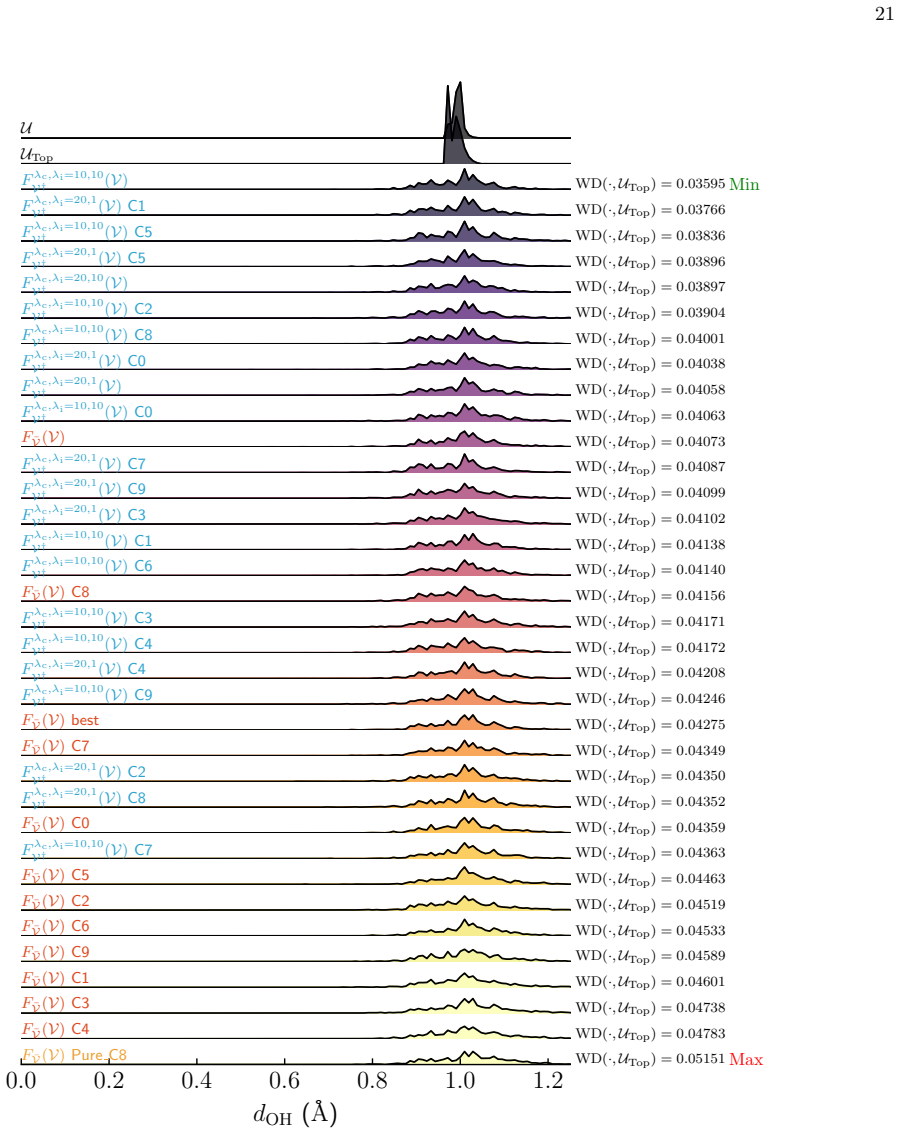
- [§V, Fig. 7] The evaluation of structure-discovery performance is circular with respect to the training data. The reference theoretical target distributions in Fig. 7 are explicitly obtained from the top-layer water molecules of configuration set M, which is the same set used to generate every training image and label (Fig. 4, Section IV). Thus the metrics measure how well the predicted structures reproduce the training-set statistics, not how accurately the model recovers the unknown experimental atomic structure. A model that outputs structures near the M prior will score well regardless of image content. The forward PPM comparisons in the SI (Figs. 8–11) are also described as 'appear similar' across models, so they do not discriminate. To substantiate the headline claim, an independent evaluation is needed: e.g., a held-out simulation set with different physics, a known experimental crystal struct
- [SI, Fig. 15 and §V] The paper's own supporting information documents that style-translated models systematically miss lower-layer water molecules, creating a spurious peak in θZOH near 170°. Yet the main-text evaluation (Fig. 7) aggregates across properties with min-max normalization and does not prominently report this failure. Since the missed lower-layer molecules are a known limitation directly tied to the style-translation pipeline, the claim of 'significantly better performance on real experimental inputs' is overstated. The authors should either restrict the claim to top-layer properties explicitly, or provide evidence that the distributional agreement correlates with true structure recovery despite the missed molecules.
- [§IV, Fig. 4E] The style translator is applied independently to each 2D slice of the simulated AFM image, and the translated slices are then stacked to form a 3D experimental-style image. The paper does not validate that slice-wise independent translation preserves the vertical consistency of the 3D AFM signal. Since the structure-discovery model consumes 3D images, any slice-independent artifacts or noise correlations introduced by the generator could alter the apparent height-dependent features and thus affect predictions. This assumption is load-bearing for the method; an ablation or validation (e.g., comparing vertical profiles before and after translation) would strengthen the paper.
- [§IV and §V] The attribution of improved performance to the learned style translation is not fully isolated from generic augmentation. Handcrafted perturbations also improve some metrics (Fig. 7A), and the hybrid model performs best, suggesting that added stochasticity or regularization may account for part of the gain. The paper compares against handcrafted perturbations but does not control for the intensity or amount of added noise. An ablation that matches the perturbation strength between handcrafted and style-translated images, or a test with noise level as a hyperparameter, would clarify whether the improvement is due to 'style' or simply to data augmentation.
- [Fig. 7 and Materials and Methods] The performance scores in Fig. 7 use min-max normalization across all models in the computational experiments, and the reported error bars are standard errors over replicas. No statistical significance tests or effect sizes are provided. For some properties (e.g., tetrahedral order parameters), the authors state that gains are not evident. Without significance testing, it is difficult to assess whether the reported improvements are robust or within replica noise. Reporting confidence intervals or pairwise significance tests for each property would make the evaluation more rigorous.
minor comments (4)
- [Fig. 3 caption and §III] 'Handcrafted permutations' should be 'handcrafted perturbations' (also in the text near Fig. 3C).
- [Eq. (1)] The variables m and n are used for both domain sizes and batch sizes; this is confusing. Use distinct notation (e.g., M_batch, N_batch).
- [References] References [33] and [47] are the same arXiv paper; [34] and [47] also overlap. These duplication issues should be cleaned up.
- [§V, Fig. 7] The radar charts are visually dense and the normalization procedure is not intuitive from the figure alone. Adding a caption note or a table with the actual normalized distances would improve readability.
Circularity Check
Structure-discovery evaluation is partially circular: Fig. 7's reference distributions are computed from the same configuration set M that supplies every training label, so the reported improvement partly measures agreement with the training prior, not recovery of experimental structure.
-
fitted input called prediction
[Section V, 'Performance evaluations based on distributional distances' (Fig. 7 discussion)]
"The reference theoretical target distributions in Fig. 7 are obtained from the top-layer water molecules in the configuration set M as shown in Fig. 6."
The structure-discovery models are trained on samples (u,m) and (v~,m) whose atomic labels m all come from configuration set M (Section IV: 'we use bilayer water configurations M ...' and 'Each training sample (u,m) contains ... its corresponding atomic configuration m'). The Fig. 7 evaluation then scores models by the distance between predicted local structural distributions and 'reference theoretical target distributions' taken from the top layer of that same set M. Thus a model that reproduces M's top-layer statistics, whether by learning the training labels or by omitting lower-layer molecules that the reference excludes, scores well regardless of whether it recovered the unknown experimental structure. The headline claim of 'significantly better performance on real experimental inputs
full rationale
The paper's style-translation step is evaluated with FID/WD and a machine-expert classifier; although the classifier is a learned metric, it is not load-bearing for the central structure-discovery claim. The central claim, however, rests on Fig. 7, and that evaluation is partially circular: the reference distributions are computed from the same configuration set M that provides all training labels. The PPM re-simulation checks in the SI are qualitative ('the recovered AFM images from all three models appear similar') and do not discriminate between models. The SI also concedes that style-translated models are more conservative and miss lower-layer molecules, which distorts metrics like theta_ZOH relative to the top-layer-only reference. These facts do not make the whole paper circular, since real experimental inputs are used and distributional plausibility is a meaningful sanity check, but the quantitative evidence for 'significantly better performance on real experimental inputs' is weakened by the shared M between training and evaluation. Score 6 reflects partial circularity in the evaluation loop, not fabrication or intentional circular reasoning.
Assumptions & free parameters
free parameters (4)
- CycleGAN cycle-consistency weight lambda_c =
main results use 20; sweep includes 10, 30, 50, 80
- CycleGAN identity loss weight lambda_i =
main results use 1; sweep includes 0, 6, 10
- Structural evaluation cutoffs and criteria =
dOO cutoff 3.5 Å; dOH cutoff 1.25 Å; H-bond dOdOa < 3.5 Å and angle > 120 degrees; tetrahedral neighbor cutoff 3.5 Å
- MMD Gaussian kernel bandwidth sigma =
not specified
assumptions (5)
- domain assumption Simulated and experimental AFM images differ only by a style gap that can be removed while preserving atomic-structure information relevant to inverse prediction.
- domain assumption The probe particle model is an adequate forward model from atomic configurations to AFM images.
- domain assumption Reference local structural distributions from the simulated water set M, specifically the top layer UTop, are the correct physical target for experimental water on Au(111).
- ad hoc to paper Applying the 2D style translator independently to each height slice and stacking preserves 3D AFM consistency.
- domain assumption The structure-discovery model architecture and training parameters from prior work [17,18] transfer unchanged to style-translated images.
Cite this review
Pith. "Pith review of Improving atomic force microscopy structure discovery via style-translation." pith.science (2026). https://pith.science/paper/E55IAL64
@misc{pith2026250902240,
  author       = {Pith},
  title        = {Pith review of: Improving atomic force microscopy structure discovery via style-translation},
  year         = {2026},
  howpublished = {\url{https://pith.science/paper/E55IAL64}},
  note         = {Machine review of arXiv:2509.02240}
}
read the original abstract
Atomic force microscopy (AFM) is a key tool for characterising nanoscale structures, with functionalised tips now offering detailed images of the atomic structure. In parallel, AFM simulations using the particle probe model provide a cost-effective approach for rapid AFM image generation. Using state-of-the-art machine learning models and substantial simulated datasets, properties such as molecular structure, electrostatic potential, and molecular graph can be predicted from AFM images. However, transferring model performance from simulated to experimental AFM images poses challenges due to the subtle variations in real experimental data compared to the seemingly flawless simulations. In this study, we explore style translation to augment simulated images and improve the predictive performance of machine learning models in surface property analysis. We reduce the style gap between simulated and experimental AFM images and demonstrate the method's effectiveness in enhancing structure discovery models through local structural property distribution comparisons. This research presents a novel approach to improving the efficiency of machine learning models in the absence of labelled experimental data.
Figures


Figures from the paper (17 more)




Reference graph
Works this paper leans on
-
[1]
Machine expert training. We first train a binary classifier, referred to as a machine expert, that takes a 2D AFM image as the input and outputs an authenticity score s ∈ [0, 1]. This classifier is trained on the datasets using two kinds of labelled data: one consisting of simu- lated AFM images labelled with s = 0 and another con- sisting of experimental...
-
[2]
Authenticity distribution shift after style translation. We apply the forward generator GU to the set U , producing the style-translated image set ˜V = GU (U ). This set is then evaluated using the machine ex- pert to obtain the authenticity distribution ρ ˜V (s). As shown in Fig. 3E, the distribution ρ ˜V (s) closely aligns with ρV (s), demonstrating tha...
-
[3]
Quantitative evaluation with distribution met- rics. To quantitatively assess the style similarity, we compute the Wasserstein Distance (also known as Earth Mover’s Distance) [33–35] WD(·∥V) between the authen- ticity distributions of the translated/perturbed sets and the experimental distributions V. Additionally, we mea- sure the corresponding Fr´ echet...
-
[4]
R. Garc ´ ıa and R. P´ erez, Dynamic atomic force mi- croscopy methods, Surface Science Reports 47, 197 (2002)
work page 2002
-
[5]
Gaussian 2. Cutout 3. GradientBG 4. Combination 5. Salt & Pepper Handcrafted perturbations FIG. 3. T ranslating AFM image styles and comparing domain shifts using authenticity and distribution metrics. (A) Simulated AFM images translated into experimental style using generator GU . ( B) Experimental AFM images translated into simulation style using genera...
-
[6]
Exp. AFM (far) 2. Exp. AFM (close) 3. Pure Simulation 4. Handcrafted 5. Style Translated 6. Hybrid FIG. 5. Atomic configuration predictions from experimental AFM images using structure discovery models trained on different datasets. Models trained on four types of images, including pure simulated AFM imagesU, handcrafted perturbed images ¯V, style transla...
-
[7]
F. J. Giessibl, Advances in atomic force microscopy, Re- views of Modern Physics 75, 949–983 (2003)
work page 2003
-
[8]
F. J. Giessibl, Atomic force microscopy with qplus sen- sors, MRS Bulletin 49, 492–502 (2024)
work page 2024
Show all 56 references
-
[9]
Martin, C
Y. Martin, C. C. Williams, and H. K. Wickramasinghe, Atomic force microscope–force mapping and profiling on a sub 100- ˚A scale, Journal of Applied Physics 61, 4723–4729 (1987). 13
1987
-
[10]
Oinonen, A
N. Oinonen, A. V. Yakutovich, A. Gallardo, M. Ondr´ aˇ cek, P. Hapala, and O. Krejˇ c ´ ı, Advancing scanning probe microscopy simulations: A decade of development in probe-particle models, Computer Physics Communications 305, 109341 (2024)
2024
-
[11]
Barth, A
C. Barth, A. S. Foster, C. R. Henry, and A. L. Shluger, Recent trends in surface characterization and chemistry with high-resolution scanning force methods, Advanced Materials 23, 477–501 (2010)
2010
-
[12]
Gross, F
L. Gross, F. Mohn, N. Moll, G. Meyer, R. Ebel, W. M. Abdel-Mageed, and M. Jaspars, Organic structure de- termination using atomic-resolution scanning probe mi- croscopy, Nature Chemistry 2, 821–825 (2010)
2010
-
[13]
Albrecht, N
F. Albrecht, N. Pavliˇ cek, C. Herranz-Lancho, M. Ruben, and J. Repp, Characterization of a surface reaction by means of atomic force microscopy, Journal of the Amer- ican Chemical Society 137, 7424–7428 (2015)
2015
-
[14]
Hapala, G
P. Hapala, G. Kichin, C. Wagner, F. S. Tautz, R. Temirov, and P. Jel ´ ınek, Mechanism of high-resolution STM/AFM imaging with functionalized tips, Physical Review B 90, 10.1103/physrevb.90.085421 (2014)
2014 doi
-
[15]
Hapala, R
P. Hapala, R. Temirov, F. S. Tautz, and P. Jel ´ ınek, Origin of high-resolution IETS-STM images of organic molecules with functionalized tips, Physical Review Letters 113, 10.1103/physrevlett.113.226101 (2014)
2014 doi
-
[16]
Kurki, N
L. Kurki, N. Oinonen, and A. S. Foster, Automated struc- ture discovery for scanning tunneling microscopy, ACS Nano 18, 11130–11138 (2024)
2024
-
[17]
Heggemann, Y
J. Heggemann, Y. S. Ranawat, O. Krejˇ c ´ ı, A. S. Foster, and P. Rahe, Differences in molecular adsorption emanat- ing from the (2 × 1) reconstruction of calcite(104), The Journal of Physical Chemistry Letters 14, 1983 (2023)
1983
-
[18]
S. Cai, J. S. Jestil¨ a, P. Liljeroth, and A. S. Foster, Direct imaging of chirality transfer induced by glycosidic bond stereochemistry in carbohydrate self-assemblies, Journal of the American Chemical Society 147, 9341 (2025)
2025
-
[19]
Alldritt, P
B. Alldritt, P. Hapala, N. Oinonen, F. Urtev, O. Krejci, F. F. Canova, J. Kannala, F. Schulz, P. Liljeroth, and A. S. Foster, Automated structure discovery in atomic force microscopy, Science Advances 6, eaay6913 (2020), https://www.science.org/doi/pdf/10.1126/sciadv.aay6913
2020 doi
-
[20]
B. Tang, Y. Song, M. Qin, Y. Tian, Z. W. Wu, Y. Jiang, D. Cao, and L. Xu, Machine learning-aided atomic structure identification of interfacial ionic hy- drates from afm images, National Science Review 10, 10.1093/nsr/nwac282 (2022)
2022 doi
-
[21]
Z. Zhu, J. Lu, F. Zheng, C. Chen, Y. Lv, H. Jiang, Y. Yan, A. Narita, K. M¨ ullen, X. Wang, and Q. Sun, A deep-learning framework for the automated recog- nition of molecules in scanning-probe-microscopy im- ages, Angewandte Chemie International Edition 61, 10.1002/anie.202213...
2022 doi
-
[22]
Carracedo-Cosme and R
J. Carracedo-Cosme and R. P´ erez, Molecular identifica- tion with atomic force microscopy and conditional gener- ative adversarial networks, npj Computational Materials 10, 10.1038/s41524-023-01179-1 (2024)
2024 doi
-
[23]
Oinonen, L
N. Oinonen, L. Kurki, A. Ilin, and A. S. Foster, Molecule graph reconstruction from atomic force microscope im- ages with machine learning, MRS Bulletin47, 895 (2022)
2022
-
[24]
Priante, N
F. Priante, N. Oinonen, Y. Tian, D. Guan, C. Xu, S. Cai, P. Liljeroth, Y. Jiang, and A. S. Foster, Structure discov- ery in atomic force microscopy imaging of ice, ACS Nano 10.1021/acsnano.3c10958 (2024)
2024 doi
-
[25]
Gonz´ alez Lastre, P
M. Gonz´ alez Lastre, P. Pou, M. Wiche, D. Ebeling, A. Schirmeisen, and R. P´ erez, Molecular identifica- tion via molecular fingerprint extraction from atomic force microscopy images, Journal of Cheminformatics 16, 10.1186/s13321-024-00921-1 (2024)
2024 doi
-
[26]
Carracedo-Cosme, C
J. Carracedo-Cosme, C. Romero-Mu˜ niz, P. Pou, and R. P´ erez, Molecular identification from afm images using the iupac nomenclature and attribute multimodal recur- rent neural networks, ACS Applied Materials & Inter- faces 15, 22692–22704 (2023)
2023
-
[27]
Carracedo-Cosme, C
J. Carracedo-Cosme, C. Romero-Mu˜ niz, and R. P´ erez, A deep learning approach for molecular classification based on afm images, Nanomaterials 11, 1658 (2021)
2021
-
[28]
Isola, J.-Y
P. Isola, J.-Y. Zhu, T. Zhou, and A. A. Efros, Image-to- image translation with conditional adversarial networks, in Computer Vision and Pattern Recognition (CVPR), 2017 IEEE Conference on(2017)
2017
-
[29]
Khan, C.-H
A. Khan, C.-H. Lee, P. Y. Huang, and B. K. Clark, Lever- aging generative adversarial networks to create realistic scanning transmission electron microscopy images, npj Computational Materials 9, 10.1038/s41524-023-01042-3 (2023)
2023 doi
-
[30]
Z. Zhu, J. Lu, S. Yuan, Y. He, F. Zheng, H. Jiang, Y. Yan, and Q. Sun, Automated generation and analysis of molec- ular images using generative artificial intelligence models, The Journal of Physical Chemistry Letters15, 1985–1992 (2024)
1985
-
[31]
Huang, Z
B. Huang, Z. Li, and J. Li, An artificial intelligence atomic force microscope enabled by machine learning, Nanoscale 10, 21320–21326 (2018)
2018
-
[32]
J.-Y. Zhu, T. Park, P. Isola, and A. A. Efros, Unpaired image-to-image translation using cycle-consistent adver- sarial networks, in Computer Vision (ICCV), 2017 IEEE International Conference on(2017)
2017
-
[33]
I. J. Goodfellow, J. Pouget-Abadie, M. Mirza, B. Xu, D. Warde-Farley, S. Ozair, A. Courville, and Y. Bengio, Generative adversarial nets, in Advances in Neural Infor- mation Processing Systems, Vol. 27, edited by Z. Ghahra- mani, M. Welling, C. Cortes, N. Lawrence, and K. Wein...
2014
-
[35]
Q. Liu, J. Xu, R. Jiang, and W. H. Wong, Density estimation using deep generative neural networks, Pro- ceedings of the National Academy of Sciences 118, 10.1073/pnas.2101344118 (2021)
2021 doi
-
[36]
FID( ·∥V) between the distributions of different im- age sets and the distribution of the authentic experi- mental image set V. Unlike the Wasserstein distance WD(·|V), which uses features from a lightweight, AFM- specific model (the machine expert), FID is based on fea- tures...
-
[37]
Z. Yao, J. Su, and S.-T. Yau, Manifold fitting with cy- clegan, Proceedings of the National Academy of Sciences 121, e2311436121 (2024)
2024
-
[38]
Sandfort, K
V. Sandfort, K. Yan, P. J. Pickhardt, and R. M. Sum- mers, Data augmentation using generative adversarial networks (cyclegan) to improve generalizability in ct seg- mentation tasks, Scientific Reports 9, 10.1038/s41598- 019-52737-x (2019)
2019 doi
-
[39]
J. Wang, Q. J. Wu, and F. Pourpanah, Dc-cyclegan: Bidirectional ct-to-mr synthesis from unpaired data, Computerized Medical Imaging and Graphics 108, 102249 (2023)
2023
-
[40]
Weng, From gan to wgan, lilianweng.github.io (2017)
L. Weng, From gan to wgan, lilianweng.github.io (2017)
2017
-
[41]
Herrmann, Wasserstein gan and the kantorovich- rubinstein duality, vincentherrmann.github.io (2017)
V. Herrmann, Wasserstein gan and the kantorovich- rubinstein duality, vincentherrmann.github.io (2017). 14
2017
-
[42]
Heusel, H
M. Heusel, H. Ramsauer, T. Unterthiner, B. Nessler, and S. Hochreiter, Gans trained by a two time-scale up- date rule converge to a local nash equilibrium (2018), arXiv:1706.08500 [cs.LG]
2018 arXiv
-
[43]
Szegedy, V
C. Szegedy, V. Vanhoucke, S. Ioffe, J. Shlens, and Z. Wo- jna, Rethinking the inception architecture for computer vision (2015), arXiv:1512.00567 [cs.CV]
2015 arXiv
-
[44]
Russakovsky, J
O. Russakovsky, J. Deng, H. Su, J. Krause, S. Satheesh, S. Ma, Z. Huang, A. Karpathy, A. Khosla, M. Bern- stein, A. C. Berg, and L. Fei-Fei, ImageNet Large Scale Visual Recognition Challenge, International Journal of Computer Vision (IJCV) 115, 211 (2015)
2015
-
[45]
J. Hong, Y. Tian, T. Liang, X. Liu, Y. Song, D. Guan, Z. Yan, J. Guo, B. Tang, D. Cao, J. Guo, J. Chen, D. Pan, L.-M. Xu, E.-G. Wang, and Y. Jiang, Imaging surface structure and premelting of ice ih with atomic resolution, Nature 630, 375–380 (2024)
2024
-
[46]
Y. R. Shen and V. Ostroverkhov, Sum-frequency vibra- tional spectroscopy on water interfaces: Polar orientation of water molecules at interfaces, Chemical Reviews 106, 1140–1154 (2006)
2006
-
[47]
F. Tang, T. Ohto, T. Hasegawa, W. J. Xie, L. Xu, M. Bonn, and Y. Nagata, Definition of free o–h groups of water at the air–water interface, Journal of Chemical Theory and Computation 14, 357–364 (2017)
2017
-
[48]
X. Du, W. Shao, C. Bao, L. Zhang, J. Cheng, and F. Tang, Revealing the molecular structures of α- al2o3(0001)–water interface by machine learning based computational vibrational spectroscopy, The Journal of Chemical Physics 161, 10.1063/5.0230101 (2024)
2024 doi
-
[49]
Offei-Danso, A
A. Offei-Danso, A. Hassanali, and A. Rodriguez, High- dimensional fluctuations in liquid water: Combining chemical intuition with unsupervised learning, Journal of Chemical Theory and Computation 18, 3136–3150 (2022)
2022
-
[50]
E. D. Donkor, A. Laio, and A. Hassanali, Do machine- learning atomic descriptors and order parameters tell the same story? the case of liquid water, Journal of Chemical Theory and Computation 19, 4596–4605 (2023)
2023
-
[51]
CHAU and A
P.-L. CHAU and A. J. HARDWICK, A new order param- eter for tetrahedral configurations, Molecular Physics 93, 511–518 (1998)
1998
-
[52]
Dubou´ e-Dijon and D
E. Dubou´ e-Dijon and D. Laage, Characterization of the local structure in liquid water by various order pa- rameters, The Journal of Physical Chemistry B 119, 8406–8418 (2015)
2015
-
[53]
Arjovsky, S
M. Arjovsky, S. Chintala, and L. Bottou, Wasserstein gan (2017), arXiv:1701.07875 [stat.ML]
2017 arXiv
-
[54]
Mathiasen and F
A. Mathiasen and F. Hvilshøj, Backpropagating through fr´ echet inception distance (2021), arXiv:2009.14075 [cs.LG]
2021 arXiv
-
[55]
G. J. Sz´ ekely and M. L. Rizzo, Energy statistics: A class of statistics based on distances, Journal of Statistical Planning and Inference 143, 1249 (2013)
2013
-
[56]
Gretton, K
A. Gretton, K. M. Borgwardt, M. J. Rasch, B. Sch¨ olkopf, and A. Smola, A kernel two-sample test, Journal of Ma- chine Learning Research 13, 723 (2012)
2012
-
[57]
Paszke, S
A. Paszke, S. Gross, F. Massa, A. Lerer, J. Bradbury, G. Chanan, T. Killeen, Z. Lin, N. Gimelshein, L. Antiga, A. Desmaison, A. K¨ opf, E. Yang, Z. DeVito, M. Rai- son, A. Tejani, S. Chilamkurthy, B. Steiner, L. Fang, J. Bai, and S. Chintala, Pytorch: an imperative style, high...
2019
Reviewed August 5, 2026 · model on record in the stance chip above.
Discussion (0). Sign in to comment.