REVIEW 4 major objections 5 minor 45 references
Implicit Neural Representation for Video Restoration
T0 review · 4 major / 5 minor · reviewed 2026-08-07 · deepseek-v4-flash
Pith's one-line read A network trained only on clean ×4 video pairs claims to upscale at any scale and denoise zero-shot.
desk verdict Admitted per-video fine-tuning in the conclusion guts the zero-shot and arbitrary-scale claims; the 44 dB numbers are fits, not predictions. read the letter →
The pith
A machine-rendered reading of the paper's core claim, the machinery that carries it, and where it could break.
The reading
What carries the argument
The load-bearing object is a multi-resolution implicit hash encoding over a 6-dimensional coordinate-texture space. For each target high-resolution coordinate, the network retrieves 64 neighboring hash-table features, combines them with learned adaptive weights, refines features from coarse to fine with a top-down attention mechanism, and decodes the result to RGB. Because the map from coordinates to RGB is continuous, the same weights can be queried at any upscaling factor; a pixel-error amplified loss additionally up-weights low-error pixels so fine detail is not smoothed away by MSE.
What would settle it
Run the published evaluation protocol exactly as described in Section 4.2 but disable any per-video fine-tuning before testing; if the ×2 and ×8 PSNR values on Vid4 exceed the baselines by the reported margins, the zero-shot claim stands, and if they fall to baseline levels, the claim is falsified.
Extended reading notes
Core claim
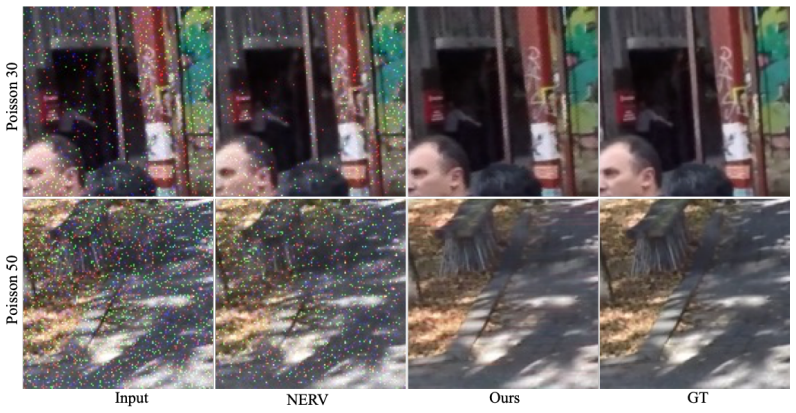
The paper's central claim is that VR-INR is a single network that performs both arbitrary-scale video super-resolution and zero-shot denoising after being trained only on clean ×4 LR-HR pairs. The authors argue that representing video as a continuous function over a 6-dimensional spatial-temporal-texture space, with features read from a multi-resolution hash table and decoded by an MLP, is what lets the same model answer queries at ×2 through ×32 and remove unseen noise without retraining or motion estimation. They support this with quantitative comparisons showing large PSNR/SSIM advantages over VideoINR, VRT, IART, and SAVSR at in-distribution ×4 and out-of-distribution ×2/×8, and with zero-shot denoising results on DAVIS (e.g., around 31.5 dB at σ=30 versus roughly 19.9 dB for the strongest baseline).
Load-bearing premise
The load-bearing premise is that the reported generalization comes from the single ×4-trained network; the conclusion says VR-INR is fine-tuned per video with clean LR-HR pairs, and if that per-video adaptation is required to reach the reported PSNR values, the zero-shot and arbitrary-scale claims would instead describe test-time fitting.
Editorial extensions
If this is right
- Video super-resolution systems could serve arbitrary user-selected zoom factors from one trained model, eliminating per-scale retraining and model zoo maintenance.
- Denoising could be obtained as a byproduct of clean-data super-resolution training, reducing the need for paired noisy and clean video data.
- The flow-free design avoids optical-flow failures on occlusions and large motion, simplifying the restoration pipeline.
- The pixel-error amplified loss is a transferable training objective for any coordinate-based reconstruction task where standard MSE over-smooths edges and textures.
Reading between the lines
- The conclusion mentions per-video fine-tuning with clean LR-HR pairs, so the public numbers should be reported both with and without that adaptation to separate learned generalization from test-time fitting; this distinction is an open question the paper leaves implicit.
- If the scale generalization is genuine, it likely comes from the multiresolution hash grids acting as a scale-aware dictionary; training the same architecture at multiple scales would be a natural stress test, since multi-scale training should improve the arbitrary-scale curve if the single-scale prior is already saturated.
- Zero-shot denoising may be an emergent bias of the coordinate decoder toward smooth, low-frequency outputs; measuring output high-frequency energy on noisy inputs, or adding a small noise-removal head, would clarify the mechanism.
Editorial analysis
A structured set of objections, weighed in public.
Referee Report
Summary. The paper proposes VR-INR, an implicit neural representation framework for video restoration, claiming that a single network trained only on clean LR-HR pairs at a fixed ×4 upscaling factor generalizes to arbitrary unseen super-resolution scales and performs zero-shot denoising. The method combines hierarchical spatial-temporal-texture encoding, multi-resolution hash embedding, a top-down attention mechanism, and a proposed pixel-error amplified loss. Experiments on Vid4, REDS4, GOPRO, and DAVIS report large improvements over prior video super-resolution and denoising baselines. However, the conclusion states that VR-INR is fine-tuned per video using clean LR-HR pairs, which directly contradicts the abstract and inference sections' claims of no additional training and zero-shot generalization.
Significance. If the central claim were valid—a single model trained only on clean ×4 pairs that generalizes to arbitrary scales and unseen noise—the contribution would be significant for video restoration. The proposed architecture and loss may contain useful ideas. However, the admitted per-video fine-tuning in Sec. 5 undermines the central generalization claim: the reported evaluations may measure per-sequence fitting rather than the behavior of a once-trained model. The reported PSNR values (e.g., 44.21 dB on Vid4 ×4, 46.93 dB in the ablation) are implausibly high relative to published SOTA, and the experimental section does not describe a protocol that would make them reproducible. The paper does not ship code, checkpoints, or detailed experimental settings, and the internal inconsistency between the abstract and conclusion is load-bearing rather than cosmetic.
major comments (4)
- [Section 5 (Conclusion)] The conclusion states: 'By fine-tuning per video using only clean LR–HR pairs, VR-INR adapts to each sequence's unique content and noise characteristics.' This directly contradicts the abstract and Sec. 3.5, which claim operation 'without additional training' and 'zero-shot denoising.' If the model is fine-tuned on each test video, the reported results are fitted values for each sequence, not generalization of a model trained once on clean ×4 pairs. The paper must specify precisely which parameters are trained once and which are optimized per video, and must re-run the evaluation without any test-time adaptation to support the stated central claim.
- [Section 4.2, Table 1] The reported PSNR values are far outside the range of published video super-resolution results. For example, the paper reports 44.21 dB on Vid4 ×4 and 42.00 dB on DAVIS ×4, whereas typical SOTA on Vid4 ×4 is around 28 dB and SA-VSR (a strong arbitrary-scale method) is reported at 30.95 dB ×2 and 24.50 dB ×4 in the paper's own table. No error bars, number of test clips, or train/test separation are provided. The experimental section does not describe whether the reported numbers come from the once-trained model or from per-video fine-tuning. Without this information, the comparison with baselines is uninterpretable.
- [Section 4.3, Table 4] The ablation study reports 46.93 dB PSNR on DAVIS ×4, which is 4.93 dB higher than the 42.00 dB reported for the same dataset and scale in Table 1. If the higher number arises from per-video fine-tuning in the ablation while Table 1 uses a single fixed model, the paper must clarify this; if not, the inconsistency suggests that the reported metrics are not reproducible from the described experimental settings. The paper should report the evaluation protocol for each table explicitly.
- [Section 4.2, 'Compared with SOTAs'] The baselines (VideoINR, VRT, IART, SA-VSR) are evaluated without any fine-tuning at unseen scales or noise levels, while VR-INR is fine-tuned per video according to Sec. 5. This creates an unfair comparison: the numbers attributed to VR-INR may reflect test-time adaptation that the baselines are not allowed. The paper must either evaluate all methods under the same protocol (i.e., no per-video fine-tuning) or separate results into 'zero-shot' and 'fine-tuned' conditions.
minor comments (5)
- [Section 3.5, Eq. (17)] Equation (17) contains malformed notation with nested and garbled parentheses that make the expression unreadable; it should be rewritten with clear definitions of all subterms.
- [Throughout] The dataset name 'DA VIS' should be 'DAVIS' (as in the DAVIS challenge reference), and the method name 'NERV' in Table 3 and related text should be 'NeRV'.
- [Section 4.2, Dataset paragraph] The sentence 'For DA VIS and GOPRO, we first resized the video frames to 256 × 256 pixels, which served as the HR ground truth' is unclear about the generation of LR inputs; specify the exact downsampling procedure used to produce LR frames from the HR ground truth.
- [Section 4.3, PEA-loss hyperparameters] The text claims that the PEA-loss hyperparameters τ, ε, and δ have little impact within small ranges, but no quantitative ablation table is provided for these values. The selected values (τ=0.01, ε=0.005, δ=0.001, α=5) should be supported by a table or at least a figure.
- [Section 5, Conclusion] The conclusion claims the method is 'computationally efficient' and 'simplifies the restoration pipeline,' but no runtime, parameter count, or FLOPs comparisons are given anywhere in the paper.
Circularity Check
Admitted per-video fine-tuning in Sec. 5 turns the 'zero-shot' and 'unseen scale' results into per-sequence fitted values, so the central predictions reduce by construction.
-
fitted input called prediction
[Section 5 (Conclusion), contradicted by Abstract and Section 3.5]
"By fine-tuning per video using only clean LR–HR pairs, VR-INR adapts to each sequence's unique content and noise characteristics, delivering superior PSNR and SSIM on Vid4, REDS4, GOPRO, and DA VIS—even under unseen noise levels."
The abstract claims VR-INR 'is trained only on a single upscaling factor (×4)' and performs 'zero-shot denoising on noisy input, despite never having seen noisy data during training'; Sec. 3.5 adds that it does so 'without additional training.' The conclusion, however, states the actual evaluation protocol is per-video fine-tuning with clean LR-HR pairs of each test sequence. Fine-tuning on the same video's clean HR frames (and, for denoising, on the same video's noisy LR paired with clean HR) means every reported PSNR/SSIM is produced by a model adapted to that exact sequence, not by the once-trained ×4 network.
full rationale
The central claim is that a single model trained only on clean ×4 LR-HR pairs generalizes to arbitrary scales and denoises zero-shot. The paper's own conclusion discloses that the model is fine-tuned per test video using clean LR-HR pairs, which is supervised test-time adaptation on the evaluation sequence. This directly contradicts the abstract and Sec. 3.5 claims of 'without additional training' and 'never having seen noisy data.' The quantitative results (e.g., 44.21 dB on Vid4 ×4, 31.50 dB zero-shot denoising) are implausible for a once-trained model and are consistent with per-sequence fitting. Related Work cites the authors' own prior per-video INR fitting work [1] as the denoising mechanism, and the conclusion confirms that mechanism is load-bearing; the 'zero-shot' novelty label is thus a renaming of per-video fitting. No other circularity was found in the architecture or loss derivation, but the core empirical claim reduces to the fitted values by the paper's own protocol, so the circularity score is high.
Assumptions & free parameters
free parameters (5)
- reconstruction mask threshold (tau) =
0.01
- boosting error threshold (epsilon) =
0.005
- boosting constant (delta) =
0.001
- boosting weight factor (alpha) =
5
- feature code length (F) =
3 in method, 6 in ablation
assumptions (3)
- domain assumption Bicubic upsampling of the LR input provides a suitable initialization from which the hash table and MLPs can learn to reconstruct HR details.
- ad hoc to paper A per-video hash table can memorize a video's content and that this memorization is what the reported PSNR measures.
- domain assumption The 6-dimensional STT code, including 3 texture features, is a sufficient representation for all video content.
Cite this review
Pith. "Pith review of Implicit Neural Representation for Video Restoration." pith.science (2026). https://pith.science/paper/E5X7YNJU
@misc{pith2026250605488,
  author       = {Pith},
  title        = {Pith review of: Implicit Neural Representation for Video Restoration},
  year         = {2026},
  howpublished = {\url{https://pith.science/paper/E5X7YNJU}},
  note         = {Machine review of arXiv:2506.05488}
}
abstract
High-resolution (HR) videos play a crucial role in many computer vision applications. Although existing video restoration (VR) methods can significantly enhance video quality by exploiting temporal information across video frames, they are typically trained for fixed upscaling factors and lack the flexibility to handle scales or degradations beyond their training distribution. In this paper, we introduce VR-INR, a novel video restoration approach based on Implicit Neural Representations (INRs) that is trained only on a single upscaling factor ($\times 4$) but generalizes effectively to arbitrary, unseen super-resolution scales at test time. Notably, VR-INR also performs zero-shot denoising on noisy input, despite never having seen noisy data during training. Our method employs a hierarchical spatial-temporal-texture encoding framework coupled with multi-resolution implicit hash encoding, enabling adaptive decoding of high-resolution and noise-suppressed frames from low-resolution inputs at any desired magnification. Experimental results show that VR-INR consistently maintains high-quality reconstructions at unseen scales and noise during training, significantly outperforming state-of-the-art approaches in sharpness, detail preservation, and denoising efficacy.
Figures


Figures from the paper (14 more)


Reference graph
Works this paper leans on
-
[1]
Unsupervised coordinate-based video denoising
Mary Aiyetigbo, Dineshchandar Ravichandran, Reda Chalhoub, Peter Kalivas, Feng Luo, and Nianyi Li. Unsupervised coordinate-based video denoising. In 2024 IEEE International Conference on Image Processing (ICIP), pages 1438–1444. IEEE, 2024
work page 2024
-
[2]
Basicvsr: The search for essential components in video super-resolution and beyond
Kelvin CK Chan, Xintao Wang, Ke Yu, Chao Dong, and Chen Change Loy. Basicvsr: The search for essential components in video super-resolution and beyond. In Proceedings of the IEEE/CVF conference on computer vision and pattern recognition, pages 4947–4956, 2021
work page 2021
-
[3]
Basicvsr++: Improving video super-resolution with enhanced propagation and alignment
Kelvin CK Chan, Shangchen Zhou, Xiangyu Xu, and Chen Change Loy. Basicvsr++: Improving video super-resolution with enhanced propagation and alignment. In Proceedings of the IEEE/CVF conference on computer vision and pattern recognition, pages 5972–5981, 2022
work page 2022
-
[4]
Learning continuous image representation with local implicit image function
Yinbo Chen, Sifei Liu, and Xiaolong Wang. Learning continuous image representation with local implicit image function. In Proceedings of the IEEE/CVF Conference on Computer Vision and Pattern Recognition, pages 8628–8638, 2021
work page 2021
-
[5]
Videoinr: Learning video implicit neural representation for continuous space-time super- resolution
Zeyuan Chen, Yinbo Chen, Jingwen Liu, Xingqian Xu, Vidit Goel, Zhangyang Wang, Humphrey Shi, and Xiaolong Wang. Videoinr: Learning video implicit neural representation for continuous space-time super- resolution. In Proceedings of the IEEE/CVF Conference on Computer Vision and Pattern Recognition, pages 2047–2057, 2022
work page 2022
-
[6]
Nerv: Neural representations for videos
Zhengyu Chen, Hexiang Wu, and Yuan-Fang Wang. Nerv: Neural representations for videos. In Advances in Neural Information Processing Systems, 2021
work page 2021
-
[7]
Learning spatial adaptation and temporal coherence in diffusion models for video super-resolution
Zhikai Chen, Fuchen Long, Zhaofan Qiu, Ting Yao, Wengang Zhou, Jiebo Luo, and Tao Mei. Learning spatial adaptation and temporal coherence in diffusion models for video super-resolution. In Proceedings of the IEEE/CVF Conference on Computer Vision and Pattern Recognition, pages 9232–9241, 2024
work page 2024
-
[8]
Distilling information with super-resolution for video surveillance
Marco Cristani, Dong Seon Cheng, Vittorio Murino, and Donato Pannullo. Distilling information with super-resolution for video surveillance. In Proceedings of the ACM 2nd international workshop on Video surveillance & sensor networks, pages 2–11, 2004
work page 2004
Show all 45 references
-
[9]
Super-resolution in medical imaging
Hayit Greenspan. Super-resolution in medical imaging. The computer journal, 52(1):43–63, 2009
2009
-
[10]
Hnerv: A hybrid neural representation for videos
Rui Han, Zhengyu Chen, and Yuan-Fang Wang. Hnerv: A hybrid neural representation for videos. In Proceedings of the IEEE/CVF Conference on Computer Vision and Pattern Recognition, pages 18966– 18975, 2022
2022
-
[11]
Recurrent back-projection network for video super-resolution
Muhammad Haris, Gregory Shakhnarovich, and Norimichi Ukita. Recurrent back-projection network for video super-resolution. In Proceedings of the IEEE/CVF conference on computer vision and pattern recognition, pages 3897–3906, 2019
2019
-
[12]
Video super-resolution via bidirectional recurrent convolutional networks
Yan Huang, Wei Wang, and Liang Wang. Video super-resolution via bidirectional recurrent convolutional networks. IEEE transactions on pattern analysis and machine intelligence, 40(4):1015–1028, 2017
2017
-
[13]
Tempdiff: Enhancing temporal-awareness in latent diffusion for real-world video super-resolution
Qin Jiang, Qing Lin Wang, Li Hua Chi, Xin Hai Chen, Qing Yang Zhang, Richard Zhou, Zheng Qiu Deng, Jin Sheng Deng, Bin Bing Tang, Shao He Lv, et al. Tempdiff: Enhancing temporal-awareness in latent diffusion for real-world video super-resolution. Computer Graphics Forum, 43(7)...
2024
-
[14]
Deep video super-resolution network using dynamic upsampling filters without explicit motion compensation
Younghyun Jo, Seoung Wug Oh, Jaeyeon Kang, and Seon Joo Kim. Deep video super-resolution network using dynamic upsampling filters without explicit motion compensation. In Proceedings of the IEEE conference on computer vision and pattern recognition, pages 3224–3232, 2018
2018
-
[15]
Video super-resolution with convolutional neural networks
Armin Kappeler, Seunghwan Yoo, Qiqin Dai, and Aggelos K Katsaggelos. Video super-resolution with convolutional neural networks. IEEE transactions on computational imaging, 2(2):109–122, 2016
2016
-
[16]
A review of the deep learning methods for medical images super resolution problems
Yufei Li, Bruno Sixou, and Francois Peyrin. A review of the deep learning methods for medical images super resolution problems. Irbm, 42(2):120–133, 2021
2021
-
[17]
Savsr: arbitrary-scale video super-resolution via a learned scale-adaptive network
Zekun Li, Hongying Liu, Fanhua Shang, Yuanyuan Liu, Liang Wan, and Wei Feng. Savsr: arbitrary-scale video super-resolution via a learned scale-adaptive network. In Proceedings of the AAAI Conference on Artificial Intelligence, volume 38, pages 3288–3296, 2024
2024
-
[18]
Vrt: A video restoration transformer
Jingyun Liang, Jiezhang Cao, Yuchen Fan, Kai Zhang, Rakesh Ranjan, Yawei Li, Radu Timofte, and Luc Van Gool. Vrt: A video restoration transformer. IEEE Transactions on Image Processing, 2024. 10
2024
-
[19]
Recurrent video restoration transformer with guided deformable attention
Jingyun Liang, Yuchen Fan, Xiaoyu Xiang, Rakesh Ranjan, Eddy Ilg, Simon Green, Jiezhang Cao, Kai Zhang, Radu Timofte, and Luc V Gool. Recurrent video restoration transformer with guided deformable attention. Advances in Neural Information Processing Systems, 35:378–393, 2022
2022
-
[20]
A bayesian approach to adaptive video super resolution
Ce Liu and Deqing Sun. A bayesian approach to adaptive video super resolution. In The 24th IEEE Conference on Computer Vision and Pattern Recognition, CVPR 2011, Colorado Springs, CO, USA, 20-25 June 2011, pages 209–216. IEEE Computer Society, 2011
2011
-
[21]
Vsrdiff: Learning inter-frame temporal coherence in diffusion model for video super-resolution
Linlin Liu, Lele Niu, Jun Tang, and Yong Ding. Vsrdiff: Learning inter-frame temporal coherence in diffusion model for video super-resolution. IEEE Access, 2025
2025
-
[22]
Stadnet: Spatial-temporal attention-guided dual-path network for cardiac cine mri super- resolution
Jun Lyu, Shuo Wang, Yapeng Tian, Jing Zou, Shunjie Dong, Chengyan Wang, Angelica I Aviles-Rivero, and Jing Qin. Stadnet: Spatial-temporal attention-guided dual-path network for cardiac cine mri super- resolution. Medical Image Analysis, 94:103142, 2024
2024
-
[23]
Instant neural graphics primitives with a multiresolution hash encoding
Thomas Müller, Alex Evans, Christoph Schied, and Alexander Keller. Instant neural graphics primitives with a multiresolution hash encoding. ACM Transactions on Graphics, 41(4):102:1–102:15, 2022
2022
-
[24]
Ntire 2019 challenge on video deblurring and super-resolution: Dataset and study
Seungjun Nah, Sungyong Baik, Seokil Hong, Gyeongsik Moon, Sanghyun Son, Radu Timofte, and Kyoung Mu Lee. Ntire 2019 challenge on video deblurring and super-resolution: Dataset and study. In Proceedings of the IEEE/CVF conference on computer vision and pattern recognition works...
2019
-
[25]
Deep multi-scale convolutional neural network for dynamic scene deblurring
Seungjun Nah, Tae Hyun Kim, and Kyoung Mu Lee. Deep multi-scale convolutional neural network for dynamic scene deblurring. In 2017 IEEE Conference on Computer Vision and Pattern Recognition, CVPR 2017, Honolulu, HI, USA, July 21-26, 2017, pages 257–265. IEEE Computer Society, 2017
2017
-
[26]
Super-resolution image reconstruction: a technical overview
Sung Cheol Park, Min Kyu Park, and Moon Gi Kang. Super-resolution image reconstruction: a technical overview. IEEE Signal Processing Magazine, 20(3):21–36, 2003
2003
-
[27]
The 2017 davis challenge on video object segmentation
Jordi Pont-Tuset, Federico Perazzi, Sergi Caelles, Pablo Arbeláez, Alex Sorkine-Hornung, and Luc Van Gool. The 2017 davis challenge on video object segmentation. arXiv preprint arXiv:1704.00675, 2017
2017 arXiv
-
[28]
Frame-recurrent video super-resolution
Mehdi SM Sajjadi, Raviteja Vemulapalli, and Matthew Brown. Frame-recurrent video super-resolution. In Proceedings of the IEEE conference on computer vision and pattern recognition, pages 6626–6634, 2018
2018
-
[29]
Rethinking alignment in video super-resolution transformers
Shuwei Shi, Jinjin Gu, Liangbin Xie, Xintao Wang, Yujiu Yang, and Chao Dong. Rethinking alignment in video super-resolution transformers. Advances in Neural Information Processing Systems, 35:36081–36093, 2022
2022
-
[30]
Con- volutional lstm network: A machine learning approach for precipitation nowcasting
Xingjian Shi, Zhourong Chen, Hao Wang, Dit-Yan Yeung, Wai-Kin Wong, and Wang-chun Woo. Con- volutional lstm network: A machine learning approach for precipitation nowcasting. Advances in neural information processing systems, 28, 2015
2015
-
[31]
Martel, Alexander W
Vincent Sitzmann, Julien N.P. Martel, Alexander W. Bergman, David B. Lindell, and Gordon Wetzstein. Implicit neural representations with periodic activation functions. In Advances in Neural Information Processing Systems, volume 33, pages 7462–7473, 2020
2020
-
[32]
Srinivasan, Ben Mildenhall, Sara Fridovich-Keil, Neel Raghavan, Utkarsh Singhal, Ravi Ramamoorthi, Jonathan T
Matthew Tancik, Pratul P. Srinivasan, Ben Mildenhall, Sara Fridovich-Keil, Neel Raghavan, Utkarsh Singhal, Ravi Ramamoorthi, Jonathan T. Barron, and Ren Ng. Fourier features let networks learn high frequency functions in low dimensional domains. In Advances in Neural Informati...
2020
-
[33]
Tdan: Temporally-deformable alignment network for video super-resolution
Yapeng Tian, Yulun Zhang, Yun Fu, and Chenliang Xu. Tdan: Temporally-deformable alignment network for video super-resolution. In Proceedings of the IEEE/CVF conference on computer vision and pattern recognition, pages 3360–3369, 2020
2020
-
[34]
Deep image prior
Dmitry Ulyanov, Andrea Vedaldi, and Victor Lempitsky. Deep image prior. InProceedings of the IEEE conference on computer vision and pattern recognition, pages 9446–9454, 2018
2018
-
[35]
Edvr: Video restoration with enhanced deformable convolutional networks
Xintao Wang, Kelvin CK Chan, Ke Yu, Chao Dong, and Chen Change Loy. Edvr: Video restoration with enhanced deformable convolutional networks. In Proceedings of the IEEE/CVF conference on computer vision and pattern recognition workshops, pages 0–0, 2019
2019
-
[36]
Video dehazing via a multi-range temporal alignment network with physical prior
Jiaqi Xu, Xiaowei Hu, Lei Zhu, Qi Dou, Jifeng Dai, Yu Qiao, and Pheng-Ann Heng. Video dehazing via a multi-range temporal alignment network with physical prior. In Proceedings of the IEEE/CVF Conference on Computer Vision and Pattern Recognition, pages 18053–18062, 2023. 11
2023
-
[37]
Enhancing video super-resolution via implicit resampling-based alignment
Kai Xu, Ziwei Yu, Xin Wang, Michael Bi Mi, and Angela Yao. Enhancing video super-resolution via implicit resampling-based alignment. In Proceedings of the IEEE/CVF Conference on Computer Vision and Pattern Recognition, pages 2546–2555, 2024
2024
-
[38]
Motion-guided latent diffusion for temporally consistent real-world video super-resolution
Xi Yang, Chenhang He, Jianqi Ma, and Lei Zhang. Motion-guided latent diffusion for temporally consistent real-world video super-resolution. In European Conference on Computer Vision, pages 224–242. Springer, 2025
2025
-
[39]
Omniscient video super-resolution
Peng Yi, Zhongyuan Wang, Kui Jiang, Junjun Jiang, Tao Lu, Xin Tian, and Jiayi Ma. Omniscient video super-resolution. In Proceedings of the IEEE/CVF international conference on computer vision, pages 4429–4438, 2021
2021
-
[40]
Inflation with diffusion: Efficient temporal adaptation for text-to-video super-resolution
Xin Yuan, Jinoo Baek, Keyang Xu, Omer Tov, and Hongliang Fei. Inflation with diffusion: Efficient temporal adaptation for text-to-video super-resolution. In Proceedings of the IEEE/CVF Winter Conference on Applications of Computer Vision, pages 489–496, 2024
2024
-
[41]
Super-resolution reconstruction for multi-angle remote sensing images considering resolution differences
Hongyan Zhang, Zeyu Yang, Liangpei Zhang, and Huanfeng Shen. Super-resolution reconstruction for multi-angle remote sensing images considering resolution differences. Remote Sensing, 6(1):637–657, 2014
2014
-
[42]
Feature consistency-based style transfer for landscape images using dual-channel attention
Qiang Zhang, Shuai Wang, and Dong Cui. Feature consistency-based style transfer for landscape images using dual-channel attention. IEEE Access, 2024
2024
-
[43]
Avernet: All-in-one video restoration for time-varying unknown degradations
Haiyu Zhao, Lei Tian, Xinyan Xiao, Peng Hu, Yuanbiao Gou, and Xi Peng. Avernet: All-in-one video restoration for time-varying unknown degradations. Advances in Neural Information Processing Systems, 37:127296–127316, 2024
2024
-
[44]
Upscale-a-video: Temporal-consistent diffusion model for real-world video super-resolution
Shangchen Zhou, Peiqing Yang, Jianyi Wang, Yihang Luo, and Chen Change Loy. Upscale-a-video: Temporal-consistent diffusion model for real-world video super-resolution. InProceedings of the IEEE/CVF Conference on Computer Vision and Pattern Recognition, pages 2535–2545, 2024. 1...
2024
-
[45]
These comparisons span video super-resolution tasks at scale factors of ×2, ×4, and ×8, producing outputs at a resolution of 256×256
datasets. These comparisons span video super-resolution tasks at scale factors of ×2, ×4, and ×8, producing outputs at a resolution of 256×256. As illustrated in Figure 8, our model demonstrates superior preservation of fine textures and structural details on the REDS4 dataset...
Reviewed August 7, 2026 · model on record in the stance chip above.
Discussion (0). Sign in to comment.