REVIEW 3 major objections 3 minor 22 references
From Markovian actions to Anosov flows
T0 review · 3 major / 3 minor · reviewed 2026-08-01 · deepseek-v4-flash
Pith's one-line read An orientation-preserving group action on a bifoliated plane comes from a topological Anosov flow on a closed orientable 3-manifold exactly when it preserves a strong Markovian family of rectangles.
desk verdict The paper gives the cleanest converse yet for Barbot-Fenley: orientation-preserving strong Markovian actions are exactly what come from topological Anosov flows, with the corner-condition reduction the one step I want referees to push on. read the letter →
The pith
A machine-rendered reading of the paper's core claim, the machinery that carries it, and where it could break.
The reading
What carries the argument
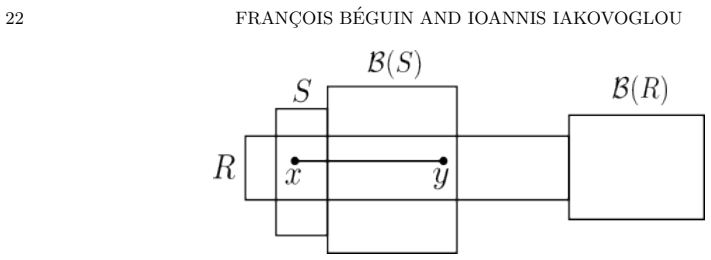
The load-bearing object is a strong Markovian family: a ρ-invariant collection of rectangles (trivially bifoliated disks) covering the plane, with finitely many group orbits, the Markovian intersection axiom (two rectangles meet in a horizontal subrectangle of one and a vertical subrectangle of the other), a strong finite return axiom (every small quadrant germ is contained in a triple intersection R ∩ R_h ∩ R_v), and an expansivity axiom (nested rectangle chains collapse to a single leaf). Within such a family, the 'big brother' B(R) of a rectangle R is defined as the unique rectangle intersecting R exactly along R's positive unstable boundary and minimal for this property; its existence (T
What would settle it
Exhibit a strong Markovian action (satisfying Definition 2.13) for which no invariant strong Markovian family satisfies the corner condition—for instance, a family whose every refinement forces a periodic point into the interior of a rectangle boundary—or, more directly, a strong Markovian family satisfying the corner condition for which the 'big brother' rectangle of Theorem-Definition 3.4 is not unique or does not exist (Remark 3.5 indicates this can happen without the corner condition). Such an example would contradict the claim that every strong Markovian action arises from an Anosov flow.
Extended reading notes
Core claim
The central claim is Theorem 1.5: given an orientation-preserving strong Markovian action ρ of a torsion-free countable group G on a bifoliated plane (P, F^s, F^u) that preserves a strong Markovian family R satisfying the corner condition, there exists a closed orientable 3-manifold M with a topological Anosov flow Φ such that the bifoliated plane of Φ is isomorphic to (P, F^s, F^u), the π1(M)-action on that plane is conjugate to ρ, and the projection of the lift of a reduced Markov partition of Φ is exactly R. Since every strong Markovian action admits a family satisfying the corner condition (Proposition 2.26), the advertised conclusion follows: orientation-preserving strong Markovian acti
Load-bearing premise
The proof's load-bearing premise is Proposition 2.26: that every strong Markovian action admits a strong Markovian family satisfying the corner condition (no periodic point lies in the interior of a rectangle boundary component); if this cutting construction fails to preserve the strong Markovian axioms for some action, the main theorem would be proved only under the extra corner-condition hypothesis.
Editorial extensions
If this is right
- Every orientation-preserving strong Markovian action is realized by a topological Anosov flow on some closed orientable 3-manifold, so the finite rectangle combinatorics of a strong Markovian family completely determine the flow up to orbital equivalence.
- The preserved strong Markovian family is precisely the projection of the lift of a reduced Markov partition of the flow, so Markov partitions can be reconstructed directly from planar data.
- The construction works without assuming dense orbits or preservation of the orientations of the invariant foliations; the non-orientation-preserving case is handled by a fixed-point-free orbit-equivalence involution.
- The same methods are stated to extend to actions preserving singular foliations, producing pseudo-Anosov flows; the authors defer that generalization to a subsequent work.
- The theorem gives the converse to the known fact that every topological Anosov flow yields a strong Markovian action on its bifoliated plane, closing the circle between plane combinatorics and 3-dimensional dynamics.
Reading between the lines
- An implicit consequence is that Anosov flows up to orbital equivalence can be encoded as finite equivalence classes of strong Markovian families, suggesting a purely combinatorial (symbolic) classification of such flows.
- The corner-condition cutting procedure hints at a normal-form theorem: every strong Markovian family can be refined so periodic points lie exactly at rectangle corners; because Proposition 2.26 is what removes the corner hypothesis from Theorem 1.5, verifying that cutting preserves the strong Markovian axioms in all cases is the key checkpoint.
- The big-brother minimality resembles a deterministic 'next rectangle' rule; a testable extension is that the directed graph of rectangles with first-generation predecessor/successor relations forms a finite-state coding of the flow's return map.
- The non-fully-orientable construction suggests that flows with orientation-reversing symmetries arise as quotients of orientation-preserving ones by a free involution, which may yield new examples by taking such quotients of known Anosov flows.
Editorial analysis
A structured set of objections, weighed in public.
Referee Report
Summary. The paper claims a converse to the Barbot–Fenley construction: every orientation-preserving strong Markovian action on a bifoliated plane is realized by a topological Anosov flow on a closed orientable 3-manifold, and the preserved Markovian family lifts to a reduced Markov partition. The proof constructs the space W+ of positively oriented stable segments, proves that the group action on W+ is free, properly discontinuous, and cocompact in the fully orientable case, and obtains the flow as the quotient flow. A separate section treats non-fully orientable actions by passing to the index-two subgroup G+ that preserves the orientations of both foliations, constructing an involution on the resulting manifold, and taking a quotient. The corner condition appearing in Theorem 1.5 is supposedly removed by a cutting procedure in Proposition 2.26.
Significance. If the proof can be completed, this is a substantial contribution: it gives a purely planar/action-theoretic characterization of orbit spaces of topological Anosov flows, without assuming transitivity or preservation of foliation orientations, and it strengthens the strong-Markovian-family formalism to a two-way correspondence that includes Markov partitions. The construction is explicit, and many intermediate results—W+ ≅ R^3, the big-brother theorem, the cocompactness argument, and the cluster-separation procedure—are worked out in detail. The main reservations are the unverified corner-condition reduction and the heavy dependence on results imported from unpublished or very recent preprints by the second author.
major comments (3)
- [§2.6, Proposition 2.26] The proof verifies the Markovian intersection axiom for the cut family S in detail, but for the strong finite return and expansivity axioms it says only 'it is not difficult to check'. This is the sole step that lets Theorem 1.5 and the advertised equivalence apply to all strong Markovian actions rather than only those admitting a corner-condition family. The transfer is not automatic: after cutting a rectangle along an F^u-leaf through a periodic point, a nested sequence of vertical subrectangles of a cut rectangle could have intersection a proper subsegment of the F^u-leaf of that cut rectangle, violating Definition 2.13(4); and the strong finite return axiom requires an explicit argument for germs lying on the cut leaves. Please supply a complete verification of both axioms, or state Theorem 1.5 with the corner condition as an explicit hypothesis.
- [§2.5–2.6 (Theorems 2.22, Lemmas 2.15–2.18, 2.23)] Several load-bearing results are imported from [Ia2], listed as an unpublished arXiv preprint, and from [Ia]. Theorem 2.22(1) is used for freeness of eρ in Proposition 3.3 and for the absence of periodic rectangles in Section 5; Theorem 2.22(2)–(4) controls periodic points and gives the contraction/expansion used in Proposition 3.8 and Proposition 2.26; Lemmas 2.15–2.18 provide the predecessor/successor calculus throughout. Since these proofs are not reproduced, the referee cannot fully verify the foundation of the paper. Please either include the statements and proofs of these results, or make the dependence explicit and ensure the cited works are available in a verifiable form.
- [§6.1, Proposition 6.1] The reduction to the fully orientable case depends on the existence of a lift ef0 of ρ(h) to W+ satisfying π∘ef0 = ρ(h)∘π, invoked from [Ba1, Prop. 1.36]. This is a delicate point because for h ∈ G−G+ the orientation of F^s is reversed, whereas the fibers of π are the positive F^s rays. The reader needs more than the bare reference: either a precise statement adapted to the present conventions, or a short verification that such a lift exists. Without this, the non-fully orientable part of Theorem 1.5 is not established.
minor comments (3)
- [§6.2, (6.15)–(6.16)] The notation is overloaded: eR is used both for the original lifted rectangles and for the new invariant rectangles eRinv. Please use distinct notation for the two families to avoid confusion.
- [References] Reference [Ia3] contains a typo: 'Markov parititions' should be 'Markov partitions'.
- [Proposition 2.26, final paragraph] The paragraph says the construction can be repeated 'finitely many times', but the proof only performs one cut in the F^s direction and one in the F^u direction. If iteration is intended, please state it explicitly and justify termination.
Circularity Check
Construction is independent, but the advertised iff characterization and several load-bearing dynamical lemmas are imported from the second author's prior work.
-
self citation load bearing
[Section 2.6, Theorem 2.22 and Lemma 2.23; used throughout Sections 3–6]
"Theorem 2.22 (Theorem 1.5, Lemmas 3.3 and 3.6, [Ia2]). Let ρ:G→Homeo(P) be a strong Markovian action on the bifoliated plane (P,F^s,F^u) preserving a strong Markovian family R. We have that: (1) For every R∈R and every g∈G, if ρ(g)(R)=R, then g=e."
The proof of Theorem 1.5 relies on Theorem 2.22 and Lemma 2.23 for freeness and proper discontinuity of the W^+-action, for Proposition 2.26 (corner-condition reduction), and for the big-brother/cocompactness arguments. These results are not proved in this paper but are cited to [Ia2], an unpublished work by the second author. The advertised 'if and only if' characterization also uses Proposition 2.14, citing [Ia], for the Anosov-flow-to-Markovian direction. Thus the central claim is partly carried by a self-citation chain, though the forward construction itself is not fitted or definitionally circular.
full rationale
The construction of the Anosov flow from a strong Markovian family is a genuine derivation: W^+ is built from positively oriented F^s-segments, the flow is the fiber foliation of the projection π, and the stable/unstable foliations together with expansivity are verified using the strong Markovian family axioms. No fitted parameter is later renamed as a prediction, and no step assumes the existence of the target flow. So the paper is not circular in the sense of 'prediction reduces to input by construction'. The main circularity concern is the heavy reliance on the second author's earlier works. Proposition 2.14 (Anosov flows produce strong Markovian families) is cited to [Ia], and Theorem 2.22 plus Lemma 2.23 (periodic-point structure, topological contraction/expansion) are cited to [Ia2]. These are load-bearing: they are used to prove Prop. 2.26, freeness and proper discontinuity, the existence of big brothers, cocompactness, and the Anosov verification. They are not proved or machine-checked in the present manuscript, so the self-citation burden is real. However, these cited results are parameter-free theorems about strong Markovian actions, not restatements of the target flow; the central construction still has independent mathematical content. Separately, the proof of Proposition 2.26 leaves the strong finite return and expansivity axioms for the cut family to the sentence 'it is not difficult to check'. This is an omitted verification rather than a circular step, but it means the advertised removal of the corner-condition hypothesis rests on the least secure internal link. Overall, the derivation is not circular by definition or by fit, but it is not fully self-contained and leans on self-citations in a load-bearing way.
Assumptions & free parameters
assumptions (5)
- domain assumption Theorem 2.22 ([Ia2]): strong Markovian actions have saddle-type periodic points, unique periodic point on each periodic leaf, and topological contraction/expansion along separatrices.
- domain assumption Lemma 2.15 and Lemmas 2.17-2.18 ([Ia]): predecessors/successors of first generation are finite, well-defined, and generate a partial order.
- domain assumption Barbot's Proposition 1.36 ([Ba1]): a homeomorphism of the bifoliated plane that conjugates the action lifts to a self-orbit equivalence of the associated flow.
- standard math Whitney's Theorem 27A ([Whi]): every C^0 foliation of the plane is the orbit foliation of a continuous flow.
- domain assumption Theorem-Def 2.7 (Barbot-Fenley): the orbit space of a topological Anosov flow is a bifoliated plane and π1(M) acts on it preserving foliations.
Cite this review
Pith. "Pith review of From Markovian actions to Anosov flows." pith.science (2026). https://pith.science/paper/E64SGDBZ
@misc{pith2026260725604,
  author       = {Pith},
  title        = {Pith review of: From Markovian actions to Anosov flows},
  year         = {2026},
  howpublished = {\url{https://pith.science/paper/E64SGDBZ}},
  note         = {Machine review of arXiv:2607.25604}
}
abstract
In this paper, we establish a necessary and sufficient condition for a group action on a bifoliated plane to arise from a topological Anosov flow supported by an orientable $3$-manifold. More precisely, we show that a group action on a non-singular bifoliated plane arises from such a flow if and only if it is an orientation preserving strong Markovian action, that is, an orientation preserving action of the plane preserving a family of rectangles satisfying suitable Markov-type properties. Furthermore, we prove that this family of rectangles can be lifted to a Markov partition of the associated flow.
Figures


Figures from the paper (9 more)




Reference graph
Works this paper leans on
-
[1]
G\'eom\'etrie transverse des flots d’Anosov, Thesis, Ecole Normale Sup\'erieure de Lyon (1992)
Thierry Barbot. G\'eom\'etrie transverse des flots d’Anosov, Thesis, Ecole Normale Sup\'erieure de Lyon (1992)
1992
-
[2]
De l’hyperbolique au globalement hyperbolique, Habilitation à diriger des recherches, Université Claude Bernard - Lyon I
Thierry Barbot. De l’hyperbolique au globalement hyperbolique, Habilitation à diriger des recherches, Université Claude Bernard - Lyon I. (2005)
2005
-
[3]
Orbit equivalences for Pseudo-Anosov flows, Inventiones mathematicae, Vol
Thomas Barthelmé, Steven Frankel, Kathryn Mann. Orbit equivalences for Pseudo-Anosov flows, Inventiones mathematicae, Vol. 240, pp. 1119–1192 (2025)
2025
-
[4]
Thomas Barthelmé, Christian Bonatti, Kathryn Mann Non-transitive pseudo-Anosov flows, arXiv: 2411.03586
-
[5]
Reconstructing flows from the orbit space, arXiv:2509.01594
Thomas Barthelmé, Sergio Fenley, Kathryn Mann. Reconstructing flows from the orbit space, arXiv:2509.01594
-
[6]
Pseudo-Anosov flows: a plane approach, arXiv:2509.15375
Thomas Barthelmé, Kathryn Mann. Pseudo-Anosov flows: a plane approach, arXiv:2509.15375
-
[7]
Theory of Lie groups, Princeton Univ
Claude Chevalley. Theory of Lie groups, Princeton Univ. Press (1946)
1946
-
[8]
Anosov flows in 3-manifolds, Ann
Sergio Fenley. Anosov flows in 3-manifolds, Ann. of Math., Vol. 139, No. 1, pp. 79-115 (1994)
1994
Show all 22 references
-
[9]
Quasigeodesic flows in hyperbolic 3-manifolds, Topology, Vol
Sergio Fenley, Lee Mosher. Quasigeodesic flows in hyperbolic 3-manifolds, Topology, Vol. 40, No. 3, pp. 503-537 (2001)
2001
-
[10]
Markovian families for pseudo-Anosov flows, arXiv:2509.19530
Ioannis Iakovoglou. Markovian families for pseudo-Anosov flows, arXiv:2509.19530
-
[11]
London Math
Ioannis Iakovoglou, A new combinatorial invariant characterizing Anosov flows on 3-manifolds, J. London Math. Soc., Vol. 113 (2026)
2026
-
[12]
Ioannis Iakovoglou, Markovian actions are Anosov-like, arXiv:2606.19246
-
[13]
Markov parititions for non-transitive pseudo-Anosov flows, Comptes Rendus Mathématique (accepted 2024)
Ioannis Iakovoglou. Markov parititions for non-transitive pseudo-Anosov flows, Comptes Rendus Mathématique (accepted 2024)
2024
-
[14]
Nonsingular expansive flows on 3-manifolds and foliations with circle prong singularities, Japan
Takashi Inaba and Shigenori Matsumoto. Nonsingular expansive flows on 3-manifolds and foliations with circle prong singularities, Japan. J. Math.Vol. 16, No. 2 (1990)
1990
-
[15]
Taylor, A characterization of pseudo-Anosov orbit spaces via bifoliated planes, arXiv:2606.16588
Kathryn Mann and Samuel J. Taylor, A characterization of pseudo-Anosov orbit spaces via bifoliated planes, arXiv:2606.16588
-
[16]
Lee Mosher, Laminations and flows transverse to finite depth foliations, manuscript available online here https://homepages.warwick.ac.uk/ masgar/Maths/1996lamina-tions and flows transverse to finite depth foliations OCRed.pdf
-
[17]
Survey on aspherical manifolds, arXiv:0902.2480
Wolfgang Lueck. Survey on aspherical manifolds, arXiv:0902.2480
-
[18]
M. Ratner. Markov partitions for C-flows on 3-dimensional manifolds, Mat. Zametki, Vol. 6, No. 6, pp. 693-704 (1969)
1969
-
[19]
P. Scott. The geometries of 3-manifolds, Bull. London Math. Soc., Vol.15, No.5, pp. 401–487 (1983)
1983
-
[20]
Hyperbolic models of transitive topologically Anosov flows in dimension three, Annales Scientifiques de l'École Normale Supérieure, Series 4, Vol
Mario Shannon. Hyperbolic models of transitive topologically Anosov flows in dimension three, Annales Scientifiques de l'École Normale Supérieure, Series 4, Vol. 58, No. 5, pp. 1243--1318 (2025)
2025
-
[21]
V. V. Solodov. Topological problems in the theory of dynamical systems, Uspekhi Mat. Nauk, Volume 46, Issue 4, pp.107 134 (1991)
1991
-
[22]
Hassler Whitney, Regular families of curves, Annals of Mathematics, No.34 (1933)
1933
Reviewed August 1, 2026 · model on record in the stance chip above.
Discussion (0). Continue with ORCID to comment.