REVIEW 3 major objections 4 minor 81 references
Resource-Efficient Simulations of Particle Scattering on a Digital Quantum Computer
T0 review · 3 major / 4 minor · reviewed 2026-08-06 · deepseek-v4-flash
Pith's one-line read Tensor networks shrink the quantum circuits needed for particle-scattering simulation by a factor of 3.2, and the resulting 40-qubit hardware runs match theory within error bars.
desk verdict A genuinely useful hybrid quantum-classical scattering demo on 40 qubits, with honest resource tables and a known but addressable soft spot in the deep-circuit ZNE extrapolation. read the letter →
The pith
A machine-rendered reading of the paper's core claim, the machinery that carries it, and where it could break.
The reading
What carries the argument
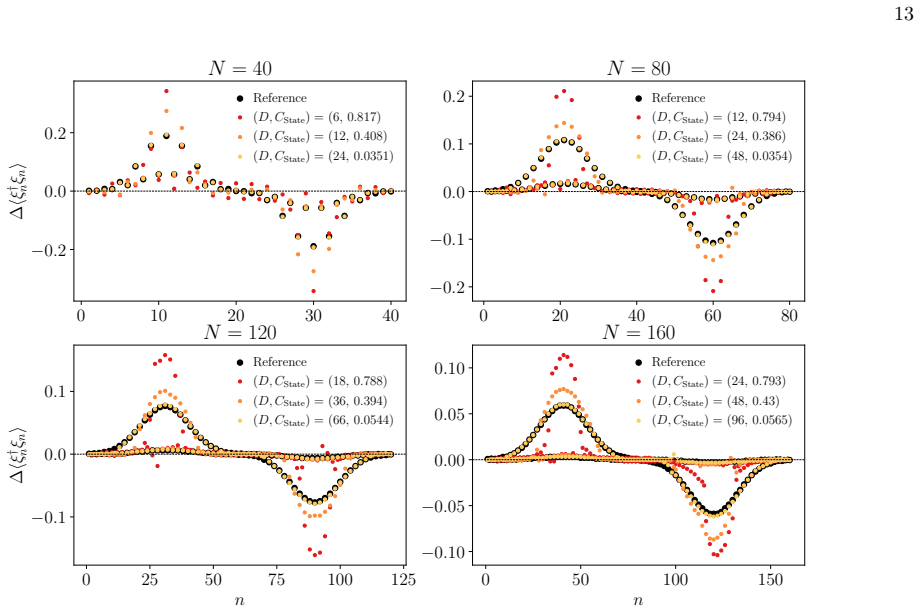
The mechanism that carries the argument is MPS-based variational circuit compilation. A target state is encoded as a matrix product state, or a target unitary as a matrix product operator, and a one-dimensional brickwork circuit of SU(4) gates is optimized by sweeping through the gates and replacing each one with the polar decomposition of its environment tensor. For state preparation the cost is the infidelity between $\langle\psi_{\text{Targ}}|V_1(\theta)|0\rangle$ and the target; for time evolution it is the Hilbert-Schmidt error between $V_2(\theta)$ and the MPO representation of $e^{-iHt}$. This turns the classically simulable low-entanglement part of the dynamics into a short-depth circuit, and the same tool compresses each evolution step below the depth of second-order Trotterization.
What would settle it
A decisive check is to rerun the deepest 40-qubit case, (m,g)=(0.4,0.7) at t=26, while varying the set of noise factors used in the extrapolation: the paper itself reports that fitting only odd factors systematically underestimates the MPS value at this time, and at the largest factor the state is fully depolarized. If a non-exponential mitigation method, or a fit that excludes the fully depolarized point, moves the corrected densities outside the quoted error bars at several sites, the late-time accuracy claim would be refuted.
Extended reading notes
Core claim
On the paper's own terms, the central claim is that the full scattering dynamics of fermion and antifermion wave packets in the interacting Thirring model can be accurately simulated on a 40-qubit digital quantum computer. The device is not asked to simulate the whole process: a classical MPS computation prepares the state $e^{-iHt_0}|\psi_0\rangle$ just before the collision, a variationally optimized circuit $V_1$ prepares that state on the chip, and each subsequent evolution step $e^{-iHt}$ is applied through a compressed brickwork circuit $V_2$ that has lower approximation error than an equal-depth second-order Trotter step. With readout mitigation, Pauli twirling, and exponential zero-noise extrapolation, the corrected hardware measurements of fermion densities match high-accuracy MPS references within error bars at all sites and time slices, and the three parameter sets show the distinct behaviors of pass-through, partial repulsion, and strong reflection.
Load-bearing premise
The deepest hardware results depend on the assumption that after Pauli twirling the chip's noise behaves like random Pauli errors, so that each measured expectation value decays exponentially as the noise factor is amplified and the fitted exponential through the five noise levels recovers the true zero-noise value.
Editorial extensions
If this is right
- For the three parameter sets (m,g)=(0.2,0.4), (0.4,0.5), (0.4,0.7), the MPS-optimized circuits have total CNOT depths 90, 96, and 96, compared with 268, 331, and 313 for the conventional approach, an average reduction factor of 3.2.
- After zero-noise extrapolation, the hardware fermion densities match the MPS references within error bars at all sites and time slices for the 40-qubit simulations.
- On 80 qubits, the wave-packet state-preparation circuit uses 25 CNOT layers instead of 249, a factor-of-10 reduction, indicating the compilation scheme scales beyond exact state-vector simulation.
- The same tensor-network compression pipeline transfers to other (1+1)D lattice models such as the Schwinger model, and the paper expects it to combine with more advanced error mitigation to reach 100 qubits and longer times.
Reading between the lines
- Beyond the paper's own runs, the depth-reduction factor is likely parameter-dependent: the 3.2x average is computed for wave packets that start with low entanglement, and a fairer stress test would apply the same pipeline to inelastic or multi-particle scattering where post-collision entanglement grows faster.
- The hand-off time $t_0$ is chosen where MPS is still cheap; an implicit prediction is that moving $t_0$ later increases the required depth of $V_1$ smoothly, and tracking that growth would show at what system size the quantum hardware genuinely outperforms the MPS reference.
- The paper's error-mitigation reliance suggests an extension: replace exponential zero-noise extrapolation with probabilistic error amplification or cancellation on the same circuits and compare the corrected densities, which would isolate the circuit-compression contribution from the noise-model assumption.
Editorial analysis
A structured set of objections, weighed in public.
Referee Report
Summary. This paper develops a hybrid classical-quantum strategy for simulating fermion-antifermion scattering in the lattice Thirring model. The early-time, low-entanglement dynamics are computed with matrix-product-state (MPS) methods, and the state at a switch time t0 is compiled into a shallow circuit by variational tensor-network optimization. The remaining time evolution is implemented with variationally compressed circuits that approximate e^{-iHt} segments, yielding a claimed average circuit-depth reduction of about 3.2 relative to conventional Givens-rotation wave-packet preparation plus second-order Trotterization. Hardware runs on the IBM Heron processor ibm_fez are reported for 40-qubit dynamics in three parameter regimes, using Pauli twirling, dynamical decoupling, readout error mitigation, and zero-noise extrapolation (ZNE); the corrected hardware densities are compared against MPS references. An 80-qubit wave-packet state-preparation demonstration is also presented. The paper concludes that the full scattering dynamics can be accurately simulated on 40 qubits with current devices.
Significance. If the claims hold, the paper makes a useful contribution to the practical toolkit for real-time lattice field theory simulations on near-term hardware. The resource arithmetic in Table I and Eq. (13) is transparent and checkable; the MPS-based variational compilation is demonstrated at up to 160 qubits in classical simulation; and the hardware results include honest, time-growing error bars rather than cherry-picked single-time data. The three parameter regimes show qualitatively distinct scattering behaviors (transmission, partial repulsion, reflection) with post-mitigation agreement to the MPS reference across sites, which is a nontrivial end-to-end demonstration. The main caveats are that the accuracy of the deepest circuits depends on an unvalidated exponential ZNE model, the MPS reference itself lacks a convergence study, and the headline 3.2x depth reduction is not obtained at a fixed total simulation accuracy. These are load-bearing because the central claim is quantitative accuracy on hardware and a resource improvement over conventional circuits.
major comments (3)
- [Section IV A and Appendix D (Fig. 13)] The claim that the 40-qubit hardware runs "accurately simulate the full scattering dynamics" rests on the ZNE extrapolation for the deepest executed circuits. Figure 13(b) shows that at t = 26, the G = 5 point is fully depolarized, and an exponential fit over odd factors only systematically underestimates the MPS reference, while the chosen fit over G = {1,2,3,4,5} agrees. The paper justifies the choice of fit family and factor subset only by agreement at one site (n = 16) and two time slices; it does not validate the exponential model on a known noiseless expectation value for the actual 1872-gate circuit. Please add a robustness analysis—for example, comparing ZNE results for all sites and time slices under several fit subsets, or cross-checking the deepest circuits with an independent mitigation method such as PEC/TEM or a noise-model-based extrapolation—or explicitly soften the "accurately simulate" claim to reflect the model dependence of the extrapolation.
- [Section III B and all MPS comparisons (Figs. 7, 8, 14)] Every hardware validation is made against an MPS reference computed with TEBD using bond dimension chi = 150, a second-order timestep dt = 0.25, and truncation 10^-8, but no convergence study is provided. If this reference is biased for the post-collision states, agreement with it does not establish accuracy of the hardware results. Please provide a convergence check—for instance, show the fermion densities at the latest times (t = 26 for the strongest coupling) for increasing chi (e.g., 200 and 250) and smaller dt (e.g., 0.125), or cite prior benchmarks that establish convergence for these parameters and observables.
- [Section III D, Eq. (13), and Table I] The claimed 3.2x average reduction in circuit depth does not hold the total simulation accuracy fixed. The optimized state-preparation circuit V1 only approximately prepares the target state (the infidelity values in Fig. 4 are nonzero), whereas the conventional Givens-rotation construction in the comparison prepares the wave-packet state exactly (up to the truncation described in Appendix C). Likewise, the optimized time-evolution segments and the conventional Trotterization are compared at a per-segment error of roughly CUni = 0.01, but the accumulated error over the full scattering time is not quantified for either pipeline. Please provide the per-segment and total approximation errors for both approaches, or rephrase the claim as a depth reduction for fixed per-segment approximation error rather than for fixed end-to-end accuracy.
minor comments (4)
- [Abstract and Section IV B] The abstract says hardware implementations on up to 80 qubits, while the classical circuit-compilation scalability study in Section III B uses up to 160 qubits; please state explicitly in the abstract or introduction that the 160-qubit results are classical demonstrations only.
- [Appendix D, last paragraph] There is a typo in the sentence "we use use this method"; it should read "we use this method."
- [Section IV B and Fig. 9] Figure 9 shows several sites where ZNE does not improve over unmitigated data, and the CP-symmetry averaging appears to be essential for the claimed agreement. Please state explicitly how many of the 80 sites are improved by CP averaging and whether the remaining outliers are included in the final comparison.
- [General] The manuscript does not include a data or code availability statement. Given the reproducibility value of the circuit depths, noise factors, and MPS reference settings, please add one or make the data available in a repository.
Circularity Check
No significant circularity: hardware targets are fixed by the Hamiltonian, and the MPS/MPO references are independent of the hardware output; self-citations are methodological, not load-bearing.
full rationale
The derivation chain is self-contained. The physical target is the Hamiltonian in Eq. (9), and the MPS/MPO references (|ψ(t0)> from DMRG and TEBD, e^{-iHt} from high-accuracy MPO Trotterization) are computed from that Hamiltonian, not from the measured hardware expectation values. The variational circuits are optimized against these fixed targets via the cost functions in Eqs. (10) and (12), so the circuit parameters are classically determined inputs; the hardware runs then provide independent measurements. Agreement between ZNE-corrected hardware data and the MPS benchmark in Figs. 7, 8, and 14 is therefore not enforced by construction: a biased exponential ZNE fit or unmitigated noise could, and locally does, deviate from the reference (Appendix D, Fig. 13). The Appendix D choice to include all noise factors G={1,2,3,4,5} is validated for consistency with the MPS value at one probe point (n=16), but the extrapolated values at all other sites and time slices are not fitted to the benchmark; this is model selection, not a parameter fit renamed as a prediction. The 3.2x depth reduction is a direct comparison of explicit resource counts (Table I, Eq. (13)) rather than a circular ratio. Self-citations (Ref. [34] for the wave-packet construction and the conventional baseline, Ref. [51] for the tensor-network circuit optimizer) are accompanied by the necessary equations in the paper and are used as tools and baselines, not as unverified uniqueness or existence theorems; hence they do not make the central claim circular. The stated limitations—odd-G ZNE underestimating at t=26, full depolarization at G=5 (Appendix D), and the acknowledged feasibility of classical MPS at the current system sizes (Sec. V)—are robustness and scope concerns, not circularity.
Assumptions & free parameters
free parameters (5)
- Wave packet parameters =
mu_c_k = 4 x 2pi/N, mu_d_k = -4 x 2pi/N, sigma_k = 2pi/N, mu_c_n = N/4, mu_d_n = 3N/4 - 1
- Switch time t0 between classical MPS and quantum hardware =
t0 in {11, 18, 16} for (m,g) in {(0.2,0.4), (0.4,0.5), (0.4,0.7)}
- Variational circuit depths V1 and V2 =
V1: 30-36 CNOT layers; V2: 15 CNOT layers (12 reported in Table I)
- ZNE noise factors and exponential fit subset =
G = {1,2,3,4,5} for 40 qubits; G = {1,3,5,7} for 80 qubits; all factors included in the fit
- Reference MPS numerical settings =
TEBD 2nd-order timestep 0.25, SVD truncation 10^-8, max bond dimension 150 (state) and 128 (MPO); DMRG ground state…
assumptions (5)
- domain assumption The staggered Kogut-Susskind lattice Hamiltonian (Eq. 1) with Jordan-Wigner mapping (Eqs. 8-9) faithfully represents the Thirring model dynamics of interest.
- domain assumption Noninteracting momentum-space wave packet operators (Eqs. 5-7) give a good approximation to the interacting scattering states for g up to 0.7.
- domain assumption The MPS computations (DMRG ground state, TEBD evolution, MPO Trotterization of e^{-iHt}) are effectively exact references for validation.
- domain assumption After Pauli twirling, device noise is a stochastic Pauli channel for which an exponential-in-G zero-noise extrapolation is valid.
- domain assumption Open boundary conditions are negligible for the chosen wave packet localizations at N = 40 and N = 80.
Cite this review
Pith. "Pith review of Resource-Efficient Simulations of Particle Scattering on a Digital Quantum Computer." pith.science (2026). https://pith.science/paper/E6JDCYNQ
@misc{pith2026250717832,
  author       = {Pith},
  title        = {Pith review of: Resource-Efficient Simulations of Particle Scattering on a Digital Quantum Computer},
  year         = {2026},
  howpublished = {\url{https://pith.science/paper/E6JDCYNQ}},
  note         = {Machine review of arXiv:2507.17832}
}
read the original abstract
We develop and demonstrate methods for simulating the scattering of particle wave packets in the interacting Thirring model on digital quantum computers, with hardware implementations on up to 80 qubits. We identify low-entanglement time slices of the scattering dynamics and exploit their efficient representation by tensor networks. Circuit compression based on matrix product state techniques yields on average a reduction by a factor of 3.2 in circuit depth compared to conventional approaches, allowing longer evolution times to be evaluated with higher fidelity on contemporary quantum processors. Utilizing zero-noise extrapolation in combination with Pauli twirling, on quantum hardware we accurately simulate the full scattering dynamics on 40 qubits, and further demonstrate the wave packet state-preparation on 80 qubits.
Figures


Figures from the paper (11 more)




Reference graph
Works this paper leans on
-
[34]
E. J. Gustafson and H. Lamm, Toward quantum simula- tions of Z2 gauge theory without state preparation, Phys. Rev. D 103, 054507 (2021)
work page 2021
-
[51]
S.-H. Lin, R. Dilip, A. G. Green, A. Smith, and F. Poll- mann, Real-and imaginary-time evolution with com- pressed quantum circuits, PRX Quantum 2, 010342 (2021)
work page 2021
-
[1]
O. Bruning, H. Burkhardt, and S. Myers, The Large Hadron Collider, Prog. Part. Nucl. Phys. 67, 705 (2012)
work page 2012
-
[2]
Rx(✓) Rx(⇡ 2) Rz(⇡ 2)Rx(⇡
-
[3]
Rz(✓) Rx(⇡ 2)Rz(⇡ 2) σ+4 σ−0σz0σz1σz2σz3 FIG. 12. Illustration of the circuit for simulating scattering using the conventional approach.The example shows an 8-qubit system, where the gray box represents the VQE ansatz UGS to prepare the vacuum state. The following red and blue boxes represent the gates implementing the Givens rotation to create fermion an...
-
[4]
C. Alexandrou, Hadron properties from lattice QCD, Journal of Physics: Conference Series 562, 012007 (2014)
work page 2014
-
[5]
M. Harrison, S. G. Peggs, and T. Roser, The RHIC ac- celerator, Ann. Rev. Nucl. Part. Sci. 52, 425 (2002)
work page 2002
- [6]
Show all 81 references
-
[7]
R. A. Brice˜ no, J. J. Dudek, and R. D. Young, Scatter- ing processes and resonances from lattice qcd, Reviews of Modern Physics 90, 10.1103/revmodphys.90.025001 17 (2018)
2018 doi
-
[8]
Luscher, Volume Dependence of the Energy Spectrum in Massive Quantum Field Theories
M. Luscher, Volume Dependence of the Energy Spectrum in Massive Quantum Field Theories. 2. Scattering States, Commun. Math. Phys. 105, 153 (1986)
1986
-
[9]
Luscher, Two particle states on a torus and their re- lation to the scattering matrix, Nucl
M. Luscher, Two particle states on a torus and their re- lation to the scattering matrix, Nucl. Phys. B 354, 531 (1991)
1991
-
[10]
Or´ us, Tensor networks for complex quantum systems, Nature Reviews Physics 1, 538 (2019)
R. Or´ us, Tensor networks for complex quantum systems, Nature Reviews Physics 1, 538 (2019)
2019
-
[11]
M. T. Hansen and S. R. Sharpe, Lattice qcd and three- particle decays of resonances, Annual Review of Nuclear and Particle Science 69, 65–107 (2019)
2019
-
[12]
Davoudi, W
Z. Davoudi, W. Detmold, P. Shanahan, K. Orginos, A. Parre˜ no, M. J. Savage, and M. L. Wagman, Nuclear matrix elements from lattice qcd for electroweak and beyond-standard-model processes, Physics Reports 900, 1–74 (2021)
2021
-
[13]
M. C. Ba˜ nuls, K. Cichy, J. I. Cirac, K. Jansen, S. K¨ uhn, and H. Saito, Towards overcoming the Monte Carlo sign problem with tensor networks, EPJ Web Conf. 137, 04001 (2017)
2017
-
[14]
Vidal, Efficient classical simulation of slightly entan- gled quantum computations, Phys
G. Vidal, Efficient classical simulation of slightly entan- gled quantum computations, Phys. Rev. Lett. 91, 147902 (2003)
2003
-
[15]
M. C. Ba˜ nuls, K. Cichy, J. I. Cirac, K. Jansen, and S. K¨ uhn, Density induced phase transitions in the schwinger model: A study with matrix product states, Phys. Rev. Lett. 118, 071601 (2017)
2017
-
[16]
Funcke, K
L. Funcke, K. Jansen, and S. K¨ uhn, Topological vacuum structure of the schwinger model with matrix product states, Phys. Rev. D 101, 054507 (2020)
2020
-
[17]
Buyens, S
B. Buyens, S. Montangero, J. Haegeman, F. Verstraete, and K. Van Acoleyen, Finite-representation approxima- tion of lattice gauge theories at the continuum limit with tensor networks, Phys. Rev. D 95, 094509 (2017)
2017
-
[18]
Kawauchi, Hikaru and Takeda, Shinji, Loop-TNR analy- sis of CP(1) model with theta term, EPJ Web Conf 175, 11015 (2018)
2018
-
[19]
of Ref. [34]. C †(ϕc) ∼ N/2−1X n=0 ξ† n ˜ϕc n = V ( ˜ϕc n)ξ† 0V †( ˜ϕc n), D†(ϕd) ∼ N −1X n=N/2 ξn ˜ϕd n = V ( ˜ϕd∗ n )ξN/2V †( ˜ϕd∗ n ), (C1) Here use a simplification compared with Eq. (6): the fermionic wave packet is defined only on the first half of the lattice with its t...
-
[20]
Silvi, E
P. Silvi, E. Rico, M. Dalmonte, F. Tschirsich, and S. Montangero, Finite-density phase diagram of a (1+1)- d non-abelian lattice gauge theory with tensor networks, Quantum 1, 9 (2017)
2017
-
[21]
Magnifico, T
G. Magnifico, T. Felser, P. Silvi, and S. Montangero, Lat- tice quantum electrodynamics in (3+1)-dimensions at fi- nite density with tensor networks, Nat. Commun. 12, 3600 (2021), publisher: Springer Science and Business Media LLC
2021
-
[22]
Nakayama, L
K. Nakayama, L. Funcke, K. Jansen, Y.-J. Kao, and S. K¨ uhn, Phase structure of thecp(1) model in the pres- ence of a topological θ-term, Phys. Rev. D 105, 054507 (2022)
2022
-
[23]
Funcke, K
L. Funcke, K. Jansen, and S. K¨ uhn, Exploring the cp- violating dashen phase in the schwinger model with ten- sor networks, Phys. Rev. D 108, 014504 (2023)
2023
-
[24]
E. Itou, A. Matsumoto, and Y. Tanizaki, DMRG study of the theta-dependent mass spectrum in the 2-flavor Schwinger model, J. High Energy Phys. 2024 (9), 155
2024
-
[25]
Pichler, M
T. Pichler, M. Dalmonte, E. Rico, P. Zoller, and S. Mon- tangero, Real-time dynamics in u(1) lattice gauge theo- ries with tensor networks, Phys. Rev. X6, 011023 (2016)
2016
-
[26]
Rigobello, S
M. Rigobello, S. Notarnicola, G. Magnifico, and S. Mon- tangero, Entanglement generation in 1+1d QED scatter- ing processes, Phys. Rev. D 104, 114501 (2021)
2021
-
[27]
Papaefstathiou, J
I. Papaefstathiou, J. Knolle, and M. C. Ba˜ nuls, Real-time scattering in the lattice schwinger model, Phys. Rev. D 111, 014504 (2025)
2025
-
[28]
Belyansky, S
R. Belyansky, S. Whitsitt, N. Mueller, A. Fahimniya, E. R. Bennewitz, Z. Davoudi, and A. V. Gorshkov, High- energy collision of quarks and mesons in the schwinger model: From tensor networks to circuit qed, Phys. Rev. Lett. 132, 091903 (2024)
2024
-
[29]
Paveˇ si´ c, D
L. Paveˇ si´ c, D. Jaschke, and S. Montangero, Constrained dynamics and confinement in the two-dimensional quan- tum ising model, Phys. Rev. B 111, L140305 (2025)
2025
-
[30]
H. F. Trotter, On the product of semi-groups of opera- tors, Proceedings of the American Mathematical Society 10, 545 (1959)
1959
-
[31]
Suzuki, General theory of fractal path integrals with applications to many-body theories and statistical physics, Journal of Mathematical Physics 32, 400 (1991)
M. Suzuki, General theory of fractal path integrals with applications to many-body theories and statistical physics, Journal of Mathematical Physics 32, 400 (1991)
1991
-
[32]
Miessen, P
A. Miessen, P. J. Ollitrault, F. Tacchino, and I. Taver- nelli, Quantum algorithms for quantum dynamics, Na- ture Computational Science 3, 25 (2023)
2023
-
[33]
Turro, K
F. Turro, K. A. Wendt, S. Quaglioni, F. Pederiva, and A. Roggero, Evaluation of phase shifts for non- relativistic elastic scattering using quantum computers (2024), arXiv:2407.04155 [quant-ph]
2024 arXiv
-
[35]
Gustafson, Y
E. Gustafson, Y. Zhu, P. Dreher, N. M. Linke, and Y. Meurice, Real-time quantum calculations of phase shifts using wave packet time delays, Phys. Rev. D 104, 054507 (2021)
2021
-
[36]
Di Meglio, K
A. Di Meglio, K. Jansen, I. Tavernelli, C. Alexandrou, S. Arunachalam, C. W. Bauer, K. Borras, S. Carrazza, A. Crippa, V. Croft, et al., Quantum computing for high- energy physics: State of the art and challenges, Prx quan- tum 5, 037001 (2024)
2024
-
[37]
Y. Chai, A. Crippa, K. Jansen, S. K¨ uhn, V. R. Pascuzzi, F. Tacchino, and I. Tavernelli, Fermionic wave packet scattering: a quantum computing approach, Quantum 9, 1638 (2025)
2025
-
[38]
Davoudi, C.-C
Z. Davoudi, C.-C. Hsieh, and S. V. Kadam, Scattering wave packets of hadrons in gauge theories: Preparation on a quantum computer, Quantum 8, 1520 (2024)
2024
-
[39]
R. C. Farrell, M. Illa, A. N. Ciavarella, and M. J. Sav- age, Quantum simulations of hadron dynamics in the schwinger model using 112 qubits, Phys. Rev. D 109, 114510 (2024)
2024
-
[40]
N. A. Zemlevskiy, Scalable quantum simulations of scattering in scalar field theory on 120 qubits, arXiv:2411.02486 , (2024)
2024 arXiv
-
[41]
R. C. Farrell, N. A. Zemlevskiy, M. Illa, and J. Preskill, Digital quantum simulations of scattering in quantum field theories using w states (2025), arXiv:2505.03111 [quant-ph]
2025
-
[42]
Davoudi, C.-C
Z. Davoudi, C.-C. Hsieh, and S. V. Kadam, Quantum computation of hadron scattering in a lattice gauge the- ory (2025), arXiv:2505.20408 [quant-ph]
2025 arXiv
-
[43]
Y. Chai, Y. Guo, and S. K¨ uhn, Towards Quantum Simu- lation of Meson Scattering in a Z2 Lattice Gauge Theory (2025), arXiv:2505.21240 [quant-ph]
2025 arXiv
-
[44]
Schuhmacher, G.-X
J. Schuhmacher, G.-X. Su, J. J. Osborne, A. Gandon, J. C. Halimeh, and I. Tavernelli, Observation of hadron scattering in a lattice gauge theory on a quantum com- puter (2025), arXiv:2505.20387 [quant-ph]
2025 arXiv
-
[45]
Joshi, J
R. Joshi, J. C. Louw, M. Meth, J. J. Osborne, K. Mato, G.-X. Su, M. Ringbauer, and J. C. Halimeh, Probing hadron scattering in lattice gauge theories on qudit quan- tum computers (2025), arXiv:2507.12614 [quant-ph]
2025 arXiv
-
[46]
Berezutskii, A
A. Berezutskii, A. Acharya, R. Ellerbrock, J. Gray, R. Haghshenas, Z. He, A. Khan, V. Kuzmin, M. Liu, D. Lyakh, et al. , Tensor networks for 18 quantum computing, arXiv preprint arXiv:2503.08626 10.48550/arXiv.2503.08626 (2025)
2025 doi
-
[47]
Dborin, F
J. Dborin, F. Barratt, V. Wimalaweera, L. Wright, and A. G. Green, Matrix product state pre-training for quan- tum machine learning, Quantum Science and Technology 7, 035014 (2022)
2022
-
[48]
M. S. Rudolph, J. Chen, J. Miller, A. Acharya, and A. Perdomo-Ortiz, Decomposition of matrix product states into shallow quantum circuits, Quantum Science and Technology 9, 015012 (2023)
2023
- [49]
-
[50]
Anselme Martin, T
B. Anselme Martin, T. Ayral, F. Jamet, M. J. Ranˇ ci´ c, and P. Simon, Combining matrix product states and noisy quantum computers for quantum simulation, Phys- ical Review A 109, 062437 (2024)
2024
-
[52]
Robertson, A
N. Robertson, A. Akhriev, J. Vala, and S. Zhuk, Ap- proximate quantum compiling for quantum simulation: A tensor network based approach, ACM Transactions on Quantum Computing 6, 1 (2025)
2025
-
[53]
Causer, F
L. Causer, F. Jung, A. Mitra, F. Pollmann, and A. Gammon-Smith, Scalable simulation of nonequilib- rium quantum dynamics via classically optimized unitary circuits, Physical Review Research 6, 033062 (2024)
2024
-
[54]
Gibbs and L
J. Gibbs and L. Cincio, Deep circuit compression for quantum dynamics via tensor networks, Quantum 9, 1789 (2025)
2025
-
[55]
Mc Keever and M
C. Mc Keever and M. Lubasch, Classically optimized hamiltonian simulation, Physical review research 5, 023146 (2023)
2023
-
[56]
Mc Keever and M
C. Mc Keever and M. Lubasch, Towards adiabatic quan- tum computing using compressed quantum circuits, PRX quantum 5, 020362 (2024)
2024
-
[57]
I. N. M. Le, S. Sun, and C. B. Mendl, Rieman- nian quantum circuit optimization based on matrix product operators, arXiv preprint arXiv:2501.08872 10.48550/arXiv.2501.08872 (2025)
2025 doi
- [58]
-
[59]
W. E. Thirring, A soluble relativistic field theory, Annals of Physics 3, 91 (1958)
1958
-
[60]
M. C. Ba˜ nuls, K. Cichy, Y.-J. Kao, C.-J. D. Lin, Y.-P. Lin, and D. T.-L. Tan, Phase structure of the (1 + 1)- dimensional massive thirring model from matrix product states, Phys. Rev. D 100, 094504 (2019)
2019
-
[61]
Kogut and L
J. Kogut and L. Susskind, Hamiltonian formulation of wilson’s lattice gauge theories, Phys. Rev. D 11, 395 (1975)
1975
-
[62]
Susskind, Lattice fermions, Phys
L. Susskind, Lattice fermions, Phys. Rev. D 16, 3031 (1977)
1977
-
[63]
Algorithms for entanglement renormalization, Physical Review B—Condensed Matter and Materials Physics 79, 144108 (2009)
2009
-
[64]
Shirakawa, H
T. Shirakawa, H. Ueda, and S. Yunoki, Automatic quan- tum circuit encoding of a given arbitrary quantum state, Physical Review Research 6, 043008 (2024)
2024
-
[65]
Schollw¨ ock, The density-matrix renormalization group in the age of matrix product states, Annals of physics 326, 96 (2011)
U. Schollw¨ ock, The density-matrix renormalization group in the age of matrix product states, Annals of physics 326, 96 (2011)
2011
-
[66]
Fishman, S
M. Fishman, S. White, and E. M. Stoudenmire, The iten- sor software library for tensor network calculations, Sci- Post Physics Codebases , 004 (2022)
2022
-
[67]
Vidal, Efficient simulation of one-dimensional quan- tum many-body systems, Physical review letters 93, 040502 (2004)
G. Vidal, Efficient simulation of one-dimensional quan- tum many-body systems, Physical review letters 93, 040502 (2004)
2004
-
[68]
van den Berg, Z
E. van den Berg, Z. K. Minev, and K. Temme, Model-free readout-error mitigation for quantum expectation values, Phys. Rev. A 105, 032620 (2022)
2022
-
[69]
J. J. Wallman and J. Emerson, Noise tailoring for scalable quantum computation via randomized compiling, Phys. Rev. A 94, 052325 (2016)
2016
-
[70]
Temme, S
K. Temme, S. Bravyi, and J. M. Gambetta, Error mitiga- tion for short-depth quantum circuits, Phys. Rev. Lett. 119, 180509 (2017)
2017
-
[71]
S. Endo, S. C. Benjamin, and Y. Li, Practical quantum error mitigation for near-future applications, Phys. Rev. X 8, 031027 (2018)
2018
-
[72]
Zhang, Y
S. Zhang, Y. Lu, K. Zhang, W. Chen, Y. Li, J.-N. Zhang, and K. Kim, Error-mitigated quantum gates exceeding physical fidelities in a trapped-ion system, Nature Com- munications 11, 10.1038/s41467-020-14376-z (2020)
2020 doi
-
[73]
J. Sun, X. Yuan, T. Tsunoda, V. Vedral, S. C. Ben- jamin, and S. Endo, Mitigating realistic noise in practi- cal noisy intermediate-scale quantum devices, Phys. Rev. Appl. 15, 034026 (2021)
2021
- [74]
-
[75]
I. M. Burbano, M. A. Carrillo, R. Urek, A. N. Ciavarella, and R. A. Brice˜ no, Real-time estimators for scattering observables: A full account of finite volume errors for quantum simulation (2025), arXiv:2506.06511 [hep-lat]
2025
-
[76]
Li and S
Y. Li and S. C. Benjamin, Efficient variational quantum simulator incorporating active error minimization, Phys. Rev. X 7, 021050 (2017)
2017
-
[77]
Kandala, K
A. Kandala, K. Temme, A. D. C´ orcoles, A. Mezzacapo, J. M. Chow, and J. M. Gambetta, Error mitigation ex- tends the computational reach of a noisy quantum pro- cessor, Nature 567, 491–495 (2019)
2019
-
[78]
Giurgica-Tiron, Y
T. Giurgica-Tiron, Y. Hindy, R. LaRose, A. Mari, and W. J. Zeng, Digital zero noise extrapolation for quantum error mitigation, in 2020 IEEE International Conference on Quantum Computing and Engineering (QCE) (IEEE,
2020
-
[79]
V. R. Pascuzzi, A. He, C. W. Bauer, W. A. de Jong, and B. Nachman, Computationally efficient zero-noise extrapolation for quantum-gate-error mitigation, Phys. Rev. A 105, 042406 (2022)
2022
-
[80]
Y. Kim, C. J. Wood, T. J. Yoder, S. T. Merkel, J. M. Gambetta, K. Temme, and A. Kandala, Scalable error mitigation for noisy quantum circuits produces competi- tive expectation values, Nature Physics 19, 752 (2023)
2023
-
[81]
Javadi-Abhari, M
A. Javadi-Abhari, M. Treinish, K. Krsulich, C. J. Wood, J. Lishman, J. Gacon, S. Martiel, P. D. Nation, L. S. Bishop, A. W. Cross, B. R. Johnson, and J. M. Gambetta, Quantum computing with Qiskit (2024), arXiv:2405.08810 [quant-ph]
2024 arXiv
Reviewed August 6, 2026 · model on record in the stance chip above.
Discussion (0). Sign in to comment.