A Geometric Design Principle for mathbb{Z}₂ Topological Phases in Twisted Triangular-Lattice Bilayers
Pith reviewed 2026-06-27 06:13 UTC · model grok-4.3
The pith
Twisted triangular-lattice bilayers create an emergent honeycomb moiré lattice that supports a quantum spin Hall phase with nontrivial Z2 invariant.
A machine-rendered reading of the paper's core claim, the machinery that carries it, and where it could break.
Core claim
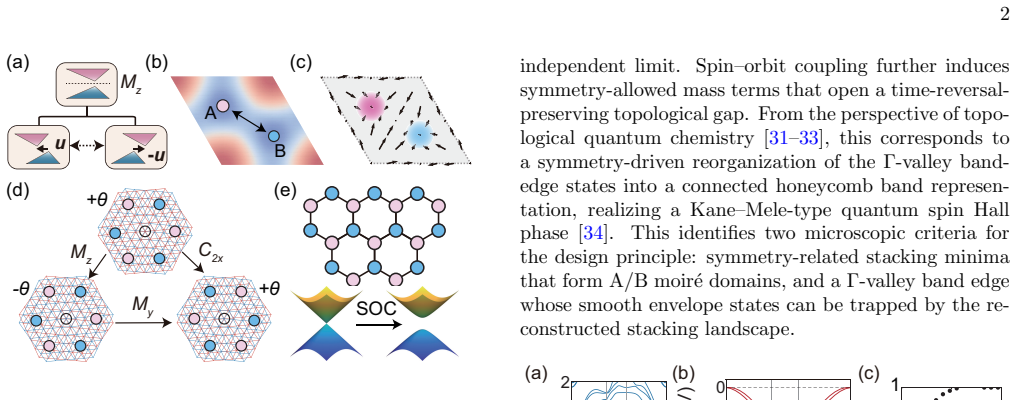
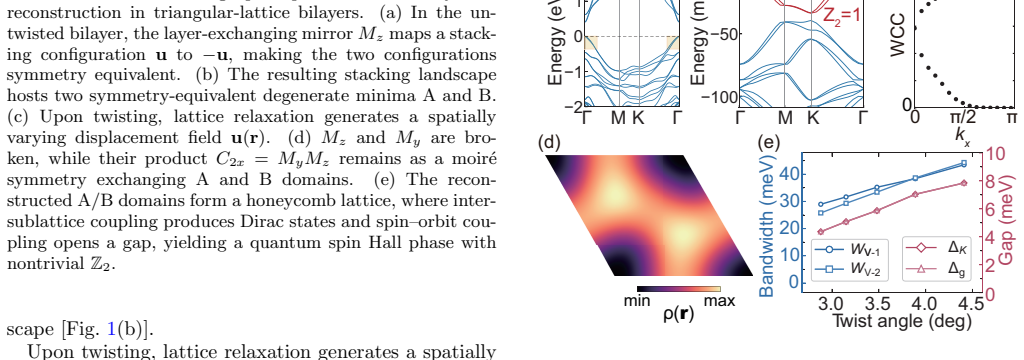
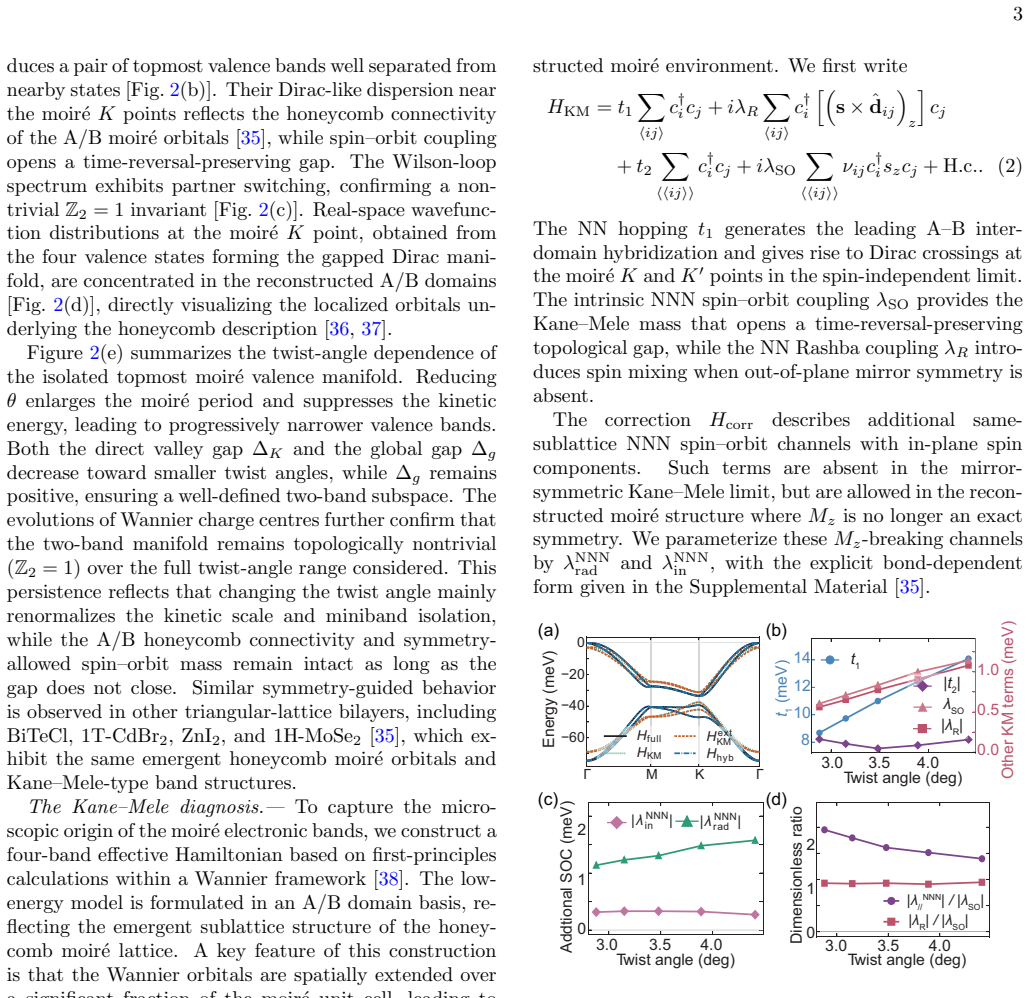
Triangular-lattice bilayers with symmetry-related stacking minima provide a geometric route to an emergent honeycomb moiré lattice. Band-edge states derived from the untwisted Γ valley are trapped by the reconstructed stacking landscape, forming A/B moiré orbitals whose inter-domain coupling generates Dirac crossings. Spin-orbit coupling opens a topological gap, yielding an effective Kane-Mele description and a quantum spin Hall phase characterized by a nontrivial Z2 invariant.
What carries the argument
Symmetry-related stacking minima in twisted triangular bilayers that reconstruct the landscape to trap Γ-valley states into A/B moiré orbitals on an emergent honeycomb lattice.
If this is right
- The Z2 topological phase is robust across a broad range of twist angles in Janus BiTeBr.
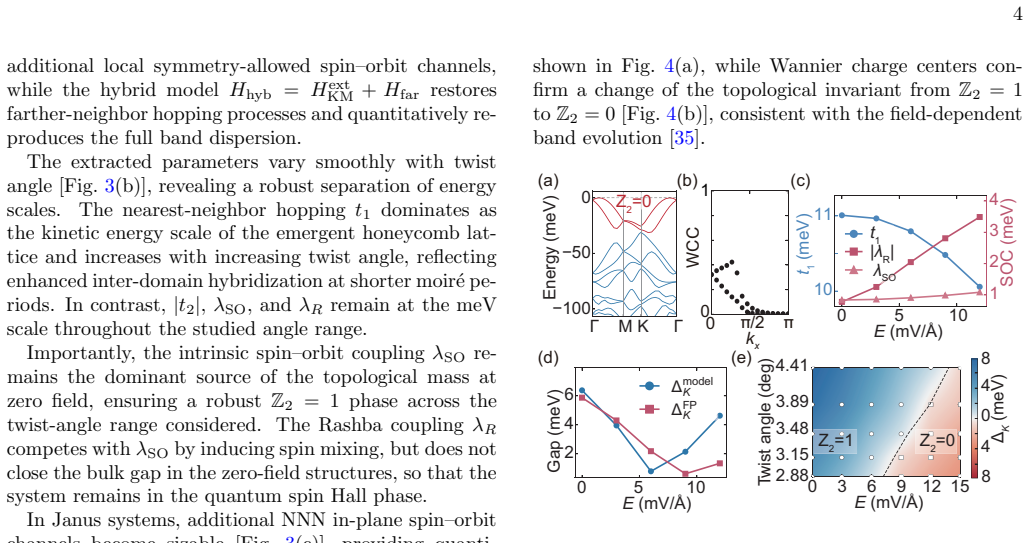
- An electric field can drive a transition out of the topological phase.
- The principle applies to other representative triangular-lattice bilayers.
- It enables tunable moiré quantum spin Hall materials.
Where Pith is reading between the lines
- Similar stacking symmetries in other lattices might produce analogous topological phases without requiring specific material properties.
- Measuring the edge conductance or spin polarization in fabricated twisted bilayers could test the QSH nature directly.
- The design could be combined with other moiré engineering techniques for more complex topological states.
Load-bearing premise
Band-edge states from the untwisted Γ valley are trapped by the reconstructed stacking landscape to form A/B moiré orbitals whose inter-domain coupling generates Dirac crossings that spin-orbit coupling gaps into a nontrivial Z2 Kane-Mele phase.
What would settle it
First-principles calculations for twisted Janus BiTeBr showing no Dirac crossings or a trivial Z2 invariant at any twist angle.
Figures
read the original abstract
Twisted van der Waals bilayers provide a versatile platform for moir\'{e} electronic states, yet a transferable symmetry-based principle for time-reversal-invariant $\mathbb{Z}_2$ moir\'{e} bands has remained largely missing. Here we show that triangular-lattice bilayers with symmetry-related stacking minima provide a geometric route to an emergent honeycomb moir\'{e} lattice. Band-edge states derived from the untwisted $\Gamma$ valley are trapped by the reconstructed stacking landscape, forming A/B moir\'{e} orbitals whose inter-domain coupling generates Dirac crossings. Spin--orbit coupling opens a topological gap, yielding an effective Kane--Mele description and a quantum spin Hall phase characterized by a nontrivial $\mathbb{Z}_2$ invariant. First-principles calculations for Janus BiTeBr confirm the robustness of this phase over a broad twist-angle range and demonstrate an electric-field-driven topological transition. Representative triangular-lattice bilayers further establish this symmetry-based design principle as a broadly applicable route to tunable moir\'{e} quantum spin Hall materials.
Editorial analysis
A structured set of objections, weighed in public.
Referee Report
Summary. The manuscript proposes a geometric design principle for realizing time-reversal-invariant Z2 topological phases in twisted bilayers of triangular-lattice materials. Symmetry-related stacking minima are argued to reconstruct the moiré landscape into an emergent honeycomb lattice; Γ-valley band-edge states localize into A/B moiré orbitals whose inter-domain hopping produces Dirac crossings. Spin-orbit coupling then opens a gap, mapping the system onto an effective Kane-Mele model with nontrivial Z2 invariant (quantum spin Hall phase). First-principles calculations on Janus BiTeBr are presented to demonstrate robustness across twist angles and an electric-field-driven topological transition; the principle is asserted to apply broadly to other triangular-lattice bilayers.
Significance. If the effective-model mapping and Z2 calculations hold without uncontrolled corrections from the continuous stacking potential, the work supplies a symmetry-based, material-independent route to tunable moiré quantum spin Hall systems. This would be a useful addition to the moiré-topology literature, particularly because it identifies a geometric motif (symmetry-related minima) rather than relying on fine-tuned parameters or specific valley physics.
major comments (2)
- [mechanism description (abstract and § describing the emergent honeycomb lattice)] The central claim that inter-domain coupling of Γ-derived A/B orbitals necessarily produces Dirac crossings subsequently gapped by SOC into a Kane-Mele model with nontrivial Z2 rests on an assumption that is not guaranteed by symmetry alone. Continuous variation of the stacking registry across domain walls can generate longer-range hoppings, orbital mixing, or Fermi-level shifts that either gap the crossings or alter the topological character. The manuscript must supply an explicit effective-Hamiltonian derivation (including the form of the inter-orbital hopping and any next-nearest-neighbor terms) that demonstrates these corrections are negligible or topologically inconsequential.
- [first-principles section on BiTeBr] The first-principles confirmation for BiTeBr is presented as external verification rather than a fit, yet the manuscript does not report the computed Z2 invariant, the size of the SOC gap relative to the moiré bandwidth, or convergence checks with respect to twist angle and k-point sampling. Without these quantitative results it is impossible to assess whether the claimed robustness over a broad twist-angle range is supported by the data.
minor comments (2)
- Notation for the emergent A/B orbitals and the effective Kane-Mele parameters should be defined explicitly with reference to the underlying atomic orbitals or Wannier functions.
- Figure captions for the stacking-energy landscape and band structures should state the twist angle, the functional used, and whether spin-orbit coupling is included.
Simulated Author's Rebuttal
We thank the referee for the constructive comments, which help clarify the presentation of our geometric design principle. We address each major point below and will revise the manuscript accordingly.
read point-by-point responses
-
Referee: [mechanism description (abstract and § describing the emergent honeycomb lattice)] The central claim that inter-domain coupling of Γ-derived A/B orbitals necessarily produces Dirac crossings subsequently gapped by SOC into a Kane-Mele model with nontrivial Z2 rests on an assumption that is not guaranteed by symmetry alone. Continuous variation of the stacking registry across domain walls can generate longer-range hoppings, orbital mixing, or Fermi-level shifts that either gap the crossings or alter the topological character. The manuscript must supply an explicit effective-Hamiltonian derivation (including the form of the inter-orbital hopping and any next-nearest-neighbor terms) that demonstrates these corrections are negligible or topologically inconsequential.
Authors: We agree that an explicit effective-Hamiltonian derivation is required to rigorously establish that corrections from the continuous stacking potential remain topologically inconsequential. The current manuscript relies on symmetry arguments and numerical evidence from the emergent honeycomb lattice, but does not present the full tight-binding form. In the revised version we will add a dedicated section deriving the leading inter-orbital (nearest-neighbor) hopping from the A/B moiré orbitals, together with estimates of next-nearest-neighbor and longer-range terms obtained by integrating the stacking-dependent potential across domain walls. We will show that these corrections are smaller than the SOC gap by at least an order of magnitude within the relevant twist-angle window and do not change the Z2 invariant. revision: yes
-
Referee: [first-principles section on BiTeBr] The first-principles confirmation for BiTeBr is presented as external verification rather than a fit, yet the manuscript does not report the computed Z2 invariant, the size of the SOC gap relative to the moiré bandwidth, or convergence checks with respect to twist angle and k-point sampling. Without these quantitative results it is impossible to assess whether the claimed robustness over a broad twist-angle range is supported by the data.
Authors: We acknowledge that the first-principles section lacks the quantitative metrics needed to substantiate the robustness claim. In the revision we will report (i) the Z2 invariant obtained from parity eigenvalues at time-reversal invariant momenta for multiple twist angles, (ii) the SOC-induced gap size normalized to the moiré bandwidth, and (iii) explicit convergence tests with respect to k-point density and supercell size. These additions will allow direct assessment of the topological phase stability. revision: yes
Circularity Check
No circularity: geometric principle derived from symmetry and verified externally
full rationale
The derivation chain begins from the symmetry properties of triangular-lattice bilayers with symmetry-related stacking minima, leading to an emergent honeycomb moiré lattice, trapping of Γ-valley states into A/B orbitals, Dirac crossings from inter-domain coupling, and a Kane-Mele phase with nontrivial Z2 after SOC. This sequence is presented as a first-principles geometric consequence without any quoted equations or steps that define the Z2 invariant or Dirac points in terms of themselves, fit parameters to the target data, or rely on load-bearing self-citations. First-principles calculations on Janus BiTeBr and other bilayers function as independent verification across twist angles rather than input definitions. The mechanism is therefore self-contained against external benchmarks.
Axiom & Free-Parameter Ledger
axioms (2)
- domain assumption Symmetry-related stacking minima in triangular-lattice bilayers reconstruct the landscape to trap Γ-valley states into A/B moiré orbitals on an emergent honeycomb lattice
- standard math Spin-orbit coupling opens a topological gap at the Dirac crossings yielding an effective Kane-Mele model with nontrivial Z2 invariant
Reference graph
Works this paper leans on
-
[1]
S. Carr, S. Fang, and E. Kaxiras, Electronic-structure methods for twisted moir´ e layers, Nat. Rev. Mater.5, 748 (2020)
2020
-
[2]
E. Y. Andrei, D. K. Efetov, P. Jarillo-Herrero, A. H. MacDonald, K. F. Mak, T. Senthil, E. Tutuc, A. Yazdani, and A. F. Young, The marvels of moir´ e materials, Nat. Rev. Mater.6, 201 (2021)
2021
-
[3]
D. M. Kennes, M. Claassen, L. Xian, A. Georges, A. J. Millis, J. Hone, C. R. Dean, D. Basov, A. N. Pasupathy, and A. Rubio, Moir´ e heterostructures as a condensed- matter quantum simulator, Nat. Phys.17, 155 (2021)
2021
-
[4]
Bistritzer and A
R. Bistritzer and A. H. MacDonald, Moir´ e bands in twisted double-layer graphene, Proc. Natl. Acad. Sci. 108, 12233 (2011)
2011
-
[5]
Y. Cao, V. Fatemi, S. Fang, K. Watanabe, T. Taniguchi, E. Kaxiras, and P. Jarillo-Herrero, Unconventional super- conductivity in magic-angle graphene superlattices, Na- ture556, 43 (2018)
2018
-
[6]
Zhang, Y
Z. Zhang, Y. Wang, K. Watanabe, T. Taniguchi, K. Ueno, E. Tutuc, and B. J. LeRoy, Flat bands in twisted bilayer transition metal dichalcogenides, Nat. Phys.16, 1093 (2020)
2020
-
[7]
Y. Cao, D. Rodan-Legrain, O. Rubies-Bigorda, J. M. Park, K. Watanabe, T. Taniguchi, and P. Jarillo-Herrero, Tunable correlated states and spin-polarized phases in twisted bilayer–bilayer graphene, Nature583, 215 (2020)
2020
-
[8]
Wang, E.-M
L. Wang, E.-M. Shih, A. Ghiotto, L. Xian, D. A. Rhodes, C. Tan, M. Claassen, D. M. Kennes, Y. Bai, B. Kim, et al., Correlated electronic phases in twisted bilayer transition metal dichalcogenides, Nat. Mater.19, 861 (2020)
2020
-
[9]
F. Wu, T. Lovorn, E. Tutuc, I. Martin, and A. Mac- Donald, Topological insulators in twisted transition metal dichalcogenide homobilayers, Phys. Rev. Lett.122, 086402 (2019)
2019
-
[10]
Y. Zeng, Z. Xia, K. Kang, J. Zhu, P. Kn¨ uppel, C. Vaswani, K. Watanabe, T. Taniguchi, K. F. Mak, and J. Shan, Thermodynamic evidence of fractional Chern insulator in moir´ e MoTe2, Nature622, 69 (2023)
2023
-
[11]
J. Cai, E. Anderson, C. Wang, X. Zhang, X. Liu, W. Holtzmann, Y. Zhang, F. Fan, T. Taniguchi, K. Watanabe, et al., Signatures of fractional quantum anomalous Hall states in twisted MoTe2, Nature622, 63 (2023)
2023
-
[12]
F. Xu, Z. Sun, T. Jia, C. Liu, C. Xu, C. Li, Y. Gu, K. Watanabe, T. Taniguchi, B. Tong, et al., Observa- tion of integer and fractional quantum anomalous Hall effects in twisted bilayer MoTe2, Phys. Rev. X13, 031037 (2023)
2023
-
[13]
Zhang, C
X.-W. Zhang, C. Wang, X. Liu, Y. Fan, T. Cao, and D. Xiao, Polarization-driven band topology evolution in twisted MoTe 2 and WSe 2, Nat. Commun.15, 4223 (2024)
2024
-
[14]
Wang, X.-W
C. Wang, X.-W. Zhang, X. Liu, Y. He, X. Xu, Y. Ran, T. Cao, and D. Xiao, Fractional Chern insulator in twisted bilayer MoTe 2, Phys. Rev. Lett.132, 036501 (2024)
2024
-
[15]
Redekop, C
E. Redekop, C. Zhang, H. Park, J. Cai, E. Anderson, O. Sheekey, T. Arp, G. Babikyan, S. Salters, K. Watan- abe, et al., Direct magnetic imaging of fractional Chern insulators in twisted MoTe 2, Nature635, 584 (2024)
2024
-
[16]
Y. Jia, J. Yu, J. Liu, J. Herzog-Arbeitman, Z. Qi, H. Pi, N. Regnault, H. Weng, B. A. Bernevig, and Q. Wu, Moir´ e fractional Chern insulators. I. First-principles calcula- tions and continuum models of twisted bilayer MoTe 2, Phys. Rev. B109, 205121 (2024)
2024
-
[17]
Y. Xia, Z. Han, K. Watanabe, T. Taniguchi, J. Shan, and K. F. Mak, Superconductivity in twisted bilayer WSe 2, Nature637, 833 (2025)
2025
-
[18]
C. Xu, N. Mao, T. Zeng, and Y. Zhang, Multiple Chern bands in twisted MoTe2 and possible non-Abelian states, Phys. Rev. Lett.134, 066601 (2025)
2025
-
[19]
Y. Guo, J. Pack, J. Swann, L. Holtzman, M. Cothrine, K. Watanabe, T. Taniguchi, D. G. Mandrus, K. Barmak, J. Hone, et al., Superconductivity in 5.0°twisted bilayer 6 WSe2, Nature637, 839 (2025)
2025
-
[20]
H. Tang, S. Carr, and E. Kaxiras, Geometric origins of topological insulation in twisted layered semiconductors, Phys. Rev. B104, 155415 (2021)
2021
- [21]
-
[22]
K. Yang, Z. Xu, Y. Feng, F. Schindler, Y. Xu, Z. Bi, B. A. Bernevig, P. Tang, and C.-X. Liu, Topological minibands and interaction driven quantum anomalous Hall state in topological insulator based moir´ e heterostructures, Nat. Commun.15, 2670 (2024)
2024
-
[23]
Y. Liu, E. Angerhofer, K. Yang, C.-X. Liu, and J. Yu, Symmetry-enforced moir´ e topology, arXiv preprint arXiv:2509.06906 (2025)
arXiv 2025
-
[24]
S. Carr, D. Massatt, S. Fang, P. Cazeaux, M. Luskin, and E. Kaxiras, Twistronics: Manipulating the electronic properties of two-dimensional layered structures through their twist angle, Phys. Rev. B95, 075420 (2017)
2017
-
[25]
Stern, Fractional topological insulators: a pedagogical review, Annu
A. Stern, Fractional topological insulators: a pedagogical review, Annu. Rev. Condens. Matter Phys7, 349 (2016)
2016
-
[26]
K. Kang, B. Shen, Y. Qiu, Y. Zeng, Z. Xia, K. Watan- abe, T. Taniguchi, J. Shan, and K. F. Mak, Evidence of the fractional quantum spin hall effect in moir´ e MoTe2, Nature628, 522 (2024)
2024
-
[27]
B. A. Bernevig, T. L. Hughes, and S.-C. Zhang, Quantum spin Hall effect and topological phase transition in HgTe quantum wells, science314, 1757 (2006)
2006
-
[28]
Zhang, C.-X
H. Zhang, C.-X. Liu, X.-L. Qi, X. Dai, Z. Fang, and S.- C. Zhang, Topological insulators in Bi 2Se3, Bi 2Te3 and Sb2Te3 with a single Dirac cone on the surface, Nat. Phys.5, 438 (2009)
2009
-
[29]
Galanakis, P
I. Galanakis, P. Dederichs, and N. Papanikolaou, Ori- gin and properties of the gap in the half-ferromagnetic Heusler alloys, Phys. Rev. B66, 134428 (2002)
2002
-
[30]
C. J. Bartel, C. Sutton, B. R. Goldsmith, R. Ouyang, C. B. Musgrave, L. M. Ghiringhelli, and M. Scheffler, New tolerance factor to predict the stability of perovskite oxides and halides, Sci. Adv.5, eaav0693 (2019)
2019
-
[31]
Bradlyn, L
B. Bradlyn, L. Elcoro, J. Cano, M. G. Vergniory, Z. Wang, C. Felser, M. I. Aroyo, and B. A. Bernevig, Topological quantum chemistry, Nature547, 298 (2017)
2017
-
[32]
Kruthoff, J
J. Kruthoff, J. de Boer, J. van Wezel, C. L. Kane, and R.-J. Slager, Topological classification of crystalline insu- lators through band structure combinatorics, Phys. Rev. X7, 041069 (2017)
2017
-
[33]
Z. Song, T. Zhang, Z. Fang, and C. Fang, Quantitative mappings between symmetry and topology in solids, Nat. Commun.9, 3530 (2018)
2018
-
[34]
C. L. Kane and E. J. Mele, Quantum spin Hall effect in graphene, Phys. Rev. Lett.95, 226801 (2005)
2005
-
[35]
Electric-field- induced phase transitions are discussed for BiTeBr
Supplementary Materials include computational meth- ods, additional electronic band structures, model Hamil- tonian analyses, and the topological properties of repre- sentative moir´ e two-dimensional materials. Electric-field- induced phase transitions are discussed for BiTeBr
-
[36]
Angeli and A
M. Angeli and A. H. MacDonald, Γ valley transition metal dichalcogenide moir´ e bands, Proc. Natl. Acad. Sci. 118, e2021826118 (2021)
2021
-
[37]
X. Xu, H. Wang, and L. Yang, Twisted type-II Rashba homobilayers: A platform for tunable topological moir´ e flat bands, Adv. Funct. Mater.35, 2425454 (2025)
2025
-
[38]
Marzari, A
N. Marzari, A. A. Mostofi, J. R. Yates, I. Souza, and D. Vanderbilt, Maximally localized Wannier functions: Theory and applications, Rev. Mod. Phys.84, 1419 (2012)
2012
-
[39]
Z. Meng, T. Lang, S. Wessel, F. Assaad, and A. Mura- matsu, Quantum spin liquid emerging in two-dimensional correlated Dirac fermions, Nature464, 847 (2010)
2010
-
[40]
Hohenadler, Z
M. Hohenadler, Z. Meng, T. Lang, S. Wessel, A. Mu- ramatsu, and F. Assaad, Quantum phase transitions in the Kane-Mele-Hubbard model, Phys. Rev. B85, 115132 (2012)
2012
-
[41]
Rachel, Interacting topological insulators: a review, Rep
S. Rachel, Interacting topological insulators: a review, Rep. Prog. Phys.81, 116501 (2018)
2018
-
[42]
parity anomaly
F. D. M. Haldane, Model for a quantum Hall effect with- out Landau levels: Condensed-matter realization of the “parity anomaly”, Phys. Rev. Lett.61, 2015 (1988)
2015
-
[43]
Y. Wang, H. Wu, G. T. McCandless, J. Y. Chan, and M. N. Ali, Quantum states and intertwining phases in kagome materials, Nat. Rev. Phys.5, 635 (2023)
2023
-
[44]
H. Pi, Y. H. Kwan, H. Hu, Y. Jiang, D. C˘ alug˘ aru, J. Shan, K. F. Mak, M. M. Ugeda, D. K. Efetov, M. G. Vergniory, et al., Engineering topological flat bands in Γ-valley moir´ e systems with Ising-type SOC: twisted 1T- ZrS2 and 1T-SnSe2, arXiv:2605.13984 (2026)
Pith/arXiv arXiv 2026
discussion (0)
Sign in with ORCID, Apple, or X to comment. Anyone can read and Pith papers without signing in.