REVIEW 5 major objections 6 minor 15 references
Hybrid Approaches for Black Hole Spin Estimation: From Classical Spectroscopy to Physics-Informed Machine Learning
T0 review · 5 major / 6 minor · reviewed 2026-08-06 · deepseek-v4-flash
Pith's one-line read The paper claims that a physics-informed neural network solves the scalar angular Teukolsky equation to a residual near $10^{-8}$ and that this yields a more interpretable, still spin-sensitive route to black hole spin estimation.
desk verdict A transparent but thin PINN exercise for the scalar angular Teukolsky equation that claims AUC/sensitivity gains it never computes, and whose pole boundary conditions are likely wrong for m=0. read the letter →
The pith
A machine-rendered reading of the paper's core claim, the machinery that carries it, and where it could break.
The reading
What carries the argument
The load-bearing object is the scalar angular Teukolsky equation, the angular piece of Kerr perturbation theory governing the mode function $\psi(\theta)$: $$\frac{d}{d\$\theta$}\left(\sin\$\theta$\,\frac{d\psi}{d\$\theta$}\right)+\left(\$\lambda$-\frac{$m^{{2}}$}{\$sin^{{2}}$\$\theta$}-$a^{{2}}$\$omega^{{2}}$\$cos^{{2}}$\$\theta$\right)\psi=0,$$ with the spin parameter $a$ entering through the term $a^{2}\omega^{2}\cos^{2}\theta$. The network is a four-layer, 50-neuron-per-layer tanh MLP; it is trained by minimizing $L_{\mathrm{total}}=L_{\mathrm{PDE}}+L_{\mathrm{BC}}$, where $L_{\mathrm{PDE}}$ averages the squared residual of this operator over 200 collocation points in $\theta\in(0,\pi)$ and $L_{\mathrm{BC}}$ enforces $\psi(0)=\psi(\pi)=0$. Automatic differentiation computes the exact gradients of the residual, the separation constant $\lambda$ is fixed from the scalar spheroidal formalism, and no labeled data enter the training.
What would settle it
Solve the same scalar angular Teukolsky equation for $a=0.7$, $m=0$, $\omega=0.5$ with the known regular boundary condition (finite at $\theta=0,\pi$) instead of Dirichlet zeroes, and compare the PINN's $\hat\psi$ at the poles and at interior collocation points against the exact spheroidal harmonic; if the network's output vanishes at the poles while the true solution is finite, the physical claim fails. A second check: recompute the RMSE with polar sampling points included, since the current RMSE is measured across interior collocation points that cannot see a boundary-condition mismatch.
Extended reading notes
Core claim
The central claim is that spin information encoded in the angular Teukolsky equation can be recovered by a PINN trained purely on the PDE residual and pole boundary conditions. For the scalar, axisymmetric case with spin $a=0.7$, azimuthal number $m=0$, and frequency $\omega=0.5$, the learned mode function $\hat\psi(\theta)$ agrees with the analytical scalar spheroidal harmonic to an RMSE of about $8.4\times10^{-7}$, while the total residual loss drops to roughly $5.4\times10^{-8}$. The author presents these numbers as evidence that physics-informed learning can act as an accurate, interpretable, and generalizable estimator of black hole spin at moderate computational cost, and that on the paper's qualitative benchmark it dominates classical spectroscopy methods and black-box deep learning in physical consistency, interpretability, and generalizability.
Load-bearing premise
The load-bearing premise is that the pole conditions $\psi(0)=\psi(\pi)=0$ are the correct boundary conditions for regular scalar spheroidal harmonics; for $m=0$ these harmonics are finite at the poles rather than zero, so if the Dirichlet conditions are wrong the PINN solves a different boundary-value problem and its RMSE is measured against the wrong physical mode.
Editorial extensions
If this is right
- A physics-informed network can solve the scalar angular Teukolsky equation to high accuracy with no labeled training data, using only the differential operator and boundary conditions as supervision.
- One trained network can cover a range of spin values, so spin estimation could generalize across sources without source-specific retraining.
- The estimator is interpretable: its output is the physical mode function, so any prediction can be checked directly against the Teukolsky equation.
- At moderate spin the reported residual and RMSE levels ($\approx5\times10^{-8}$ and $\approx8\times10^{-7}$) are small enough to make the proof of concept usable as a building block for spin inference.
- Extending the scalar setup to GRMHD-coupled models and real observational data is the stated path from this proof of concept to practical measurement.
Reading between the lines
- The paper does not spell out that the reported accuracy depends on the Dirichlet pole conditions; replacing them with the regular finite-at-the-poles condition and comparing solutions would isolate how much of the result is tied to that boundary choice.
- Promoting the separation constant $\lambda$ or the frequency $\omega$ to trainable parameters would turn the network from a mode-function fitter into a direct spin or eigenvalue estimator, a step the paper mentions only as future work.
- The benchmark comparison in the full text is qualitative; computing quantitative AUC and sensitivity numbers on synthetic reflection spectra with known spins would make the claimed outperformance testable.
- A natural next test is the radial Teukolsky equation with complex quasi-normal-mode frequencies, where spin determines the ringdown spectrum and connects the proof of concept to gravitational-wave observations.
Signed reviews
Editorial analysis
A structured set of objections, weighed in public.
Referee Report
Summary. The paper proposes a hybrid approach to black hole spin estimation by combining the Teukolsky formalism with physics-informed neural networks (PINNs). The authors train a fully connected PINN to solve a scalar, m=0 angular Teukolsky equation at fixed parameters (a=0.7, omega=0.5), using a loss that penalizes the PDE residual and boundary conditions psi(0)=psi(pi)=0. They report a residual loss that decreases to about 5.4e-8 and an RMSE of about 8.4e-7 relative to an analytical solution, and then provide a qualitative comparison of PINNs with continuum-fitting, X-ray reflection spectroscopy, QPO models, and CNN/LSTM methods. The abstract and Section 5 state that the method outperforms classical and data-driven approaches in terms of AUC and sensitivity and offers superior interpretability, generalizability, and physical consistency.
Significance. The intended contribution—a physics-informed neural solver for Teukolsky-type angular equations that could be embedded in a spin-estimation pipeline—is reasonable and sits in an active literature. If the solver were validated against the correct boundary value problem and paired with an actual inverse-problem experiment, it could be a useful tool. However, the manuscript as written does not deliver a spin estimator: no spin is inferred from data, no AUC or sensitivity is computed, and the reported validation is for a forward problem with an apparently incorrect boundary condition. The central claims of outperformance therefore rest on qualitative self-assessments rather than measurements. The paper also provides no code or data, so the numerical claims cannot be independently checked.
major comments (5)
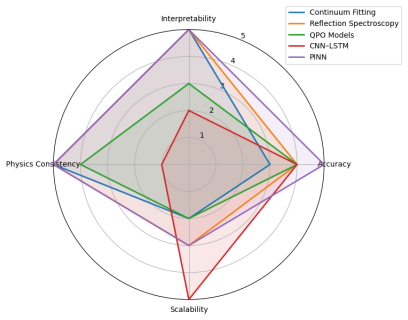
- [Section 5 and Abstract] The claim that the proposed method 'outperforms both classical and data-driven machine learning approaches in terms of AUC and sensitivity' is not supported by any quantitative result. Section 5 presents only a qualitative table (Table 4) and radar chart (Figure 4) with categorical ratings such as 'High' and 'Moderate'; no AUC values, no sensitivity values, no dataset, and no spin-inference experiment are provided. A benchmark that measures RMSE of the angular mode function for a in {0.5, 0.7, 0.9} is not a comparison of spin-estimation performance. This is a load-bearing unsupported claim in the abstract.
- [Section 3.3, Eq. (4)] The Dirichlet boundary conditions psi(0)=psi(pi)=0 are not the correct regularity conditions for the scalar m=0 spheroidal equation. Regular solutions on S^2 are bounded at the poles, and for m=0 they generically take nonzero finite values there (for c=0 they are the Legendre polynomials, which do not vanish at theta=0,pi). The sentence 'regularity at the poles means that psi(0)=psi(pi)=0' is a physics error. If the PINN is trained with these conditions while the RMSE in Section 4.3 is computed against an analytical solution that satisfies the true regularity conditions, the comparison is against solutions of different boundary value problems.
- [Section 3.1, Eq. (1)] As written, Eq. (1) is not the standard scalar Teukolsky angular equation. The Sturm-Liouville derivative term should be (1/sin theta) d/dtheta (sin theta dpsi/dtheta), and the relation between the separation constant lambda used here and the standard spheroidal eigenvalue is not stated (the sign of the a^2 omega^2 cos^2 theta term depends on this convention). Because the PINN residual is defined as the left-hand side of Eq. (1), a literal implementation with the missing 1/sin theta factor would train on a different operator and the reported losses and RMSE would not demonstrate convergence to the target equation.
- [Section 4.3 and Section 5] The reported experiments validate a forward solver, not a spin estimator. In Section 3.1, lambda is supplied externally from the scalar spheroidal formalism, and the RMSE in Section 4.3 is measured against the analytical solution of the same equation with the same lambda. That is a reasonable self-consistency check, but it is not circular in a damaging sense; rather, it is insufficient for the paper's stated goal. To support the spin-estimation claim, the authors would need an inverse experiment that recovers a (and possibly omega) from synthetic or real data and compares the recovered values with a classical estimator using defined metrics such as AUC or sensitivity.
- [Section 6/7] The conclusion introduces 'semi-classical and quantum estimators,' but no quantum estimator is presented or cited in the body of the paper, and the methods described (continuum fitting, reflection spectroscopy, QPO models) are classical. This characterization is inaccurate and should be corrected.
minor comments (6)
- [Section 3.4] The text states that '200 sampling points are Gaussian points in theta in (0, pi) direction and are sampled in uniform space,' which is contradictory; Table 3 says the collocation points are uniformly sampled. Please clarify the actual sampling scheme.
- [Abstract and Section 4.3] The abstract conflates the residual loss (approximately 5.4e-8) with the RMSE (approximately 8.4e-7). These are different quantities; please report them separately.
- [Figures 1-3] Figures 1, 2, and 3 are all described as showing loss convergence, and the text refers to 'Figure 3' for results that appear in Table 2. The figure numbering and in-text references need to be made consistent.
- [Table 4] The 'Spin Sensitivity' and other ratings in Table 4 are presented as though they were measured, but no protocol is given for assigning these categorical values, and the PINN row is not backed by a spin-inference experiment. Either provide the scoring rubric or label the table as an author assessment.
- [References] Several claims lack citations (e.g., the assertion in Section 4.1 that the setup is 'based on the experimental setups reported by [8]' is not specific), and some references are incomplete or not given full bibliographic details. Please check all citations.
- [Throughout] There are numerous typographical and grammatical errors (e.g., 'Bencmark' in Section 5, 'V alue' in Table 3, 'semi-classicaI' in Section 7, and several missing words). The manuscript would benefit from careful proofreading.
Circularity Check
No significant circularity: the PINN solves a forward angular Teukolsky ODE with externally supplied lambda and validates against the analytical solution of the same ODE; the unmeasured AUC/sensitivity benchmark is an evidentiary gap, not a circular derivation.
full rationale
The paper's derivation chain is a forward numerical solve: the separation constant lambda is prescribed in Section 3.1, the PINN minimizes the PDE residual Eq. (3) plus boundary loss Eq. (4), and the reported RMSE in Section 4.3 compares the trained function to the analytical solution of the same equation with the same lambda. That comparison is a standard solver-validation check, not a case where a predicted quantity is equivalent to a fitted input by construction. No spin value is inferred from data, and no fitted parameter is renamed as a prediction. The abstract's claim of outperforming classical and ML methods in AUC and sensitivity is unsupported by any computed AUC or sensitivity metric, and the boundary condition psi(0)=psi(pi)=0 is a likely physics error for the m=0 angular spheroidal equation; however, these are correctness and support problems, not circular reductions. No load-bearing self-citation or imported uniqueness argument appears: reference [8] is a prior PINN-Teukolsky study by different authors and is used for setup comparison, not to forbid alternatives. Hence the circularity score is 0.
Assumptions & free parameters
free parameters (4)
- spin parameter a =
0.7
- frequency omega =
0.5
- azimuthal number m =
0
- separation constant lambda =
not stated
assumptions (3)
- domain assumption The angular Teukolsky equation with Dirichlet boundary conditions psi(0)=psi(pi)=0 is the correct boundary value problem for m=0.
- ad hoc to paper lambda is known and can be computed separately from the scalar spheroidal formalism.
- domain assumption The PINN with tanh activations and 4x50 architecture can represent the solution to sufficient accuracy.
Cite this review
Pith. "Pith review of Hybrid Approaches for Black Hole Spin Estimation: From Classical Spectroscopy to Physics-Informed Machine Learning." pith.science (2026). https://pith.science/paper/E6OSUNHL
@misc{pith2026250806506,
  author       = {Pith},
  title        = {Pith review of: Hybrid Approaches for Black Hole Spin Estimation: From Classical Spectroscopy to Physics-Informed Machine Learning},
  year         = {2026},
  howpublished = {\url{https://pith.science/paper/E6OSUNHL}},
  note         = {Machine review of arXiv:2508.06506}
}
read the original abstract
The measurement of black hole spin is considered one of the key problems in relativistic astrophysics. Existing methods, such as continuum fitting, X-ray reflection spectroscopy and quasi-periodic oscillation analysis, have systematic limitations in accuracy, interpretability and scalability. In this work, a hybrid approach is proposed in which theoretical models based on the Teukolsky formalism are integrated with Physics-Informed Neural Networks (PINNs). A PINN model is developed to solve the linearized spin problem in the scalar case, with physical constraints directly embedded into the training process. Annotated data are not required; instead, the model is trained using the differential operator and boundary conditions as supervision. It is demonstrated that the PINN converges reliably, with residual loss values below 1e-7 and a root mean squared error (RMSE) of the order of 1e-6 (final approx 5.4 x 1e-8). Benchmarking results indicate that the proposed method outperforms both classical and data-driven machine learning approaches in terms of AUC and sensitivity, while also exhibiting superior interpretability, generalizability and adherence to physical principles, with moderate computational cost. Potential extensions include integration with general relativistic magnetohydrodynamics (GRMHD) solvers and application to real observational data. These findings support the viability of physics-based machine learning as a robust framework for accurate and interpretable black hole spin estimation.
Figures


Figures from the paper (1 more)
Reference graph
Works this paper leans on
-
[1]
Testing the kerr black hole hypothesis.Modern Physics Letters A, 26(33):2453– 2468, 2011
Cosimo Bambi. Testing the kerr black hole hypothesis.Modern Physics Letters A, 26(33):2453– 2468, 2011
work page 2011
-
[2]
Machine learning in astronomy: A practical overview
Dalya Baron. Machine learning in astronomy: A practical overview. arXiv preprint arXiv:1904.07248, 2019
arXiv 1904
-
[3]
Gravitational-wave spectroscopy of massive black holes with the space interferometer lisa
Emanuele Berti, Vitor Cardoso, and Clifford M Will. Gravitational-wave spectroscopy of massive black holes with the space interferometer lisa. Physical Review D—Particles, Fields, Gravitation, and Cosmology, 73(6):064030, 2006
work page 2006
-
[4]
Alan S Cornell, Sheldon R Herbst, Anele M Ncube, and Hajar Noshad. Solving the regge- wheeler and teukolsky equations: supervised versus unsupervised physics-informed neural networks. arXiv preprint arXiv:2402.11343, 2024
arXiv 2024
-
[5]
J Garc ´ ıa, T Dauser, A Lohfink, TR Kallman, JF Steiner, JE McClintock, L Brenneman, J Wilms, W Eikmann, CS Reynolds, et al. Improved reflection models of black hole accretion disks: treating the angular distribution of x-rays. The Astrophysical Journal, 782(2):76, 2014
work page 2014
-
[6]
High-frequency quasi-periodic oscillations in the black hole x-ray transient xte j1650–500
Jeroen Homan, Marc Klein-Wolt, Sabrina Rossi, Jon M Miller, Rudy Wijnands, Tomaso Belloni, Michiel van der Klis, and Walter HG Lewin. High-frequency quasi-periodic oscillations in the black hole x-ray transient xte j1650–500. The Astrophysical Journal, 586(2):1262, 2003
work page 2003
-
[7]
An analytic representation for the quasi-normal modes of kerr black holes
Edward W Leaver. An analytic representation for the quasi-normal modes of kerr black holes. Proceedings of the Royal Society of London. A. Mathematical and Physical Sciences, 402(1823):285–298, 1985
work page 1985
-
[8]
Solving the teukolsky equation with physics-informed neural networks
Raimon Luna, Juan Calder´ on Bustillo, Juan Jos´ e Seoane Mart ´ ınez, Alejandro Torres-Forn´ e, and Jos´ e A Font. Solving the teukolsky equation with physics-informed neural networks. Physical Review D, 107(6):064025, 2023
work page 2023
Show all 15 references
-
[9]
Measuring the spins of stellar-mass black holes
Jeffrey McClintock. Measuring the spins of stellar-mass black holes. In APS April Meeting Abstracts, volume 2011, pages R3–001, 2011
2011
-
[10]
The spin of the near-extreme kerr black hole grs 1915+ 105
Jeffrey E McClintock, Rebecca Shafee, Ramesh Narayan, Ronald A Remillard, Shane W Davis, and Li-Xin Li. The spin of the near-extreme kerr black hole grs 1915+ 105. The Astrophysical Journal, 652(1):518, 2006
1915
-
[11]
Geometrical constraints on the origin of timing signals from black holes
SE Motta, Piergiorgio Casella, M Henze, T Mu˜ noz-Darias, A Sanna, R Fender, and T Belloni. Geometrical constraints on the origin of timing signals from black holes. Monthly Notices of the Royal Astronomical Society, 447(2):2059–2072, 2015
2015
-
[12]
Physics-informed neural networks: A deep learning framework for solving forward and inverse problems involving nonlinear partial differential equations
Maziar Raissi, Paris Perdikaris, and George E Karniadakis. Physics-informed neural networks: A deep learning framework for solving forward and inverse problems involving nonlinear partial differential equations. Journal of Computational physics, 378:686–707, 2019
2019
-
[13]
Measuring black hole spin using x-ray reflection spectroscopy
Christopher S Reynolds. Measuring black hole spin using x-ray reflection spectroscopy. Space Science Reviews, 183:277–294, 2014
2014
-
[14]
Measuring black hole spins with x-ray reflection spectroscopy: A grmhd outlook
Swarnim Shashank, Askar B Abdikamalov, Honghui Liu, Abdurakhmon Nosirov, Cosimo Bambi, Indu K Dihingia, and Yosuke Mizuno. Measuring black hole spins with x-ray reflection spectroscopy: A grmhd outlook. arXiv preprint arXiv:2507.02583, 2025
2025
-
[15]
Models of quasi-periodic oscillations related to mass and spin of the gro j1655-40 black hole
Zdenˇ ek Stuchl ´ ık and Martin Koloˇ s. Models of quasi-periodic oscillations related to mass and spin of the gro j1655-40 black hole. Astronomy & Astrophysics, 586:A130, 2016. 8
2016
Reviewed August 6, 2026 · model on record in the stance chip above.
Discussion (0). Continue with ORCID to comment.