REVIEW 4 major objections 6 minor 16 references
BGD-based Adam algorithm for time-domain equalizer in PAM-based optical interconnects
T0 review · 4 major / 6 minor · reviewed 2026-08-14 · deepseek-v4-flash
Pith's one-line read Batch-gradient Adam equalizer trains PAM8 taps on 300 samples
desk verdict A modest but honest application of Adam to FFE training in PAM8, with a real experiment; the global-optimality claim is overreach and key tuning parameters are missing. read the letter →
The pith
A machine-rendered reading of the paper's core claim, the machinery that carries it, and where it could break.
The reading
What carries the argument
The central object is Algorithm 1, the BGD-based Adam update loop for FFE taps. It forms an $(M-N+1)$-by-$N$ received-sample matrix $\mathbf{R}$, a transmitted training vector $\mathbf{Y}$, and the MSE cost $J(\boldsymbol{\omega})=\frac{1}{M-N+1}(\mathbf{R}\boldsymbol{\omega}-\mathbf{Y})^T(\mathbf{R}\boldsymbol{\omega}-\mathbf{Y})$, whose gradient is $\mathbf{G}_t=\frac{2}{M-N+1}\mathbf{R}^T(\mathbf{R}\boldsymbol{\omega}_{t-1}-\mathbf{Y})$. The Adam machinery maintains exponentially decaying first- and second-moment estimates $\mathbf{m}_t$ and $\mathbf{v}_t$, bias-corrects them with $1-\beta_1^t$ and $1-\beta_2^t$, and updates taps as $\boldsymbol{\omega}_t=\boldsymbol{\omega}_{t-1}-\theta\,\hat{\mathbf{m}}_t/(\sqrt{\hat{\mathbf{v}}_t}+\epsilon)$. This update is what carries the central claim: the per-tap adaptive step sizes are credited with fast, stable, precise convergence, while the batch update over the full training block is credited with reaching the global optimum of the convex MSE surface.
What would settle it
Repeat the 120-Gbit/s PAM8 training experiment holding all parameters fixed except Adam's step size $\theta$, sweeping it from roughly 0.001 to 0.5, and record the number of iterations to a fixed MSE target. If the iteration count varies substantially across the sweep, or if a step-size-optimized LMS with 300 training samples matches the BGD-based Adam BER, then the claimed speed and sample-efficiency advantages would be shown to be tuning-dependent rather than intrinsic to batch-gradient Adam.
Extended reading notes
Core claim
On the paper's own terms, the discovery is that Adam's adaptive step-size mechanism transfers cleanly from stochastic machine-learning optimization to batch training of an FFE. Because the FFE's MSE cost is a convex quadratic in the tap vector, the paper argues that updating from all stored training samples, rather than sample-by-sample as LMS and RLS do, sidesteps local minima and gives stable descent. The Adam moment estimates and bias correction then shrink the effective step size in later iterations, allowing a precise final tap setting with low MSE. Experimentally, the paper reports that BGD-based Adam reaches an MSE near 0.1 after 100 iterations, requires 300 training samples to match RLS's BER and beat LMS's with 1200 samples, and yields a roughly 1-dB sensitivity gain over LMS at the 7% FEC limit. The paper concludes that this makes BGD-based Adam a promising TDE training method for future PAM-based optical interconnects.
Load-bearing premise
The reported speed and sample-efficiency advantages depend on unstated choices for Adam's step size $\theta$ and the post-filter coefficient $\alpha$, so the reader cannot tell whether the results reflect the method itself or the tuning chosen for this particular experiment.
Editorial extensions
If this is right
- BGD-based Adam FFE reaches an MSE near 0.1 after about 100 iterations, whereas LMS and RLS in the same setup have not converged after 200 iterations.
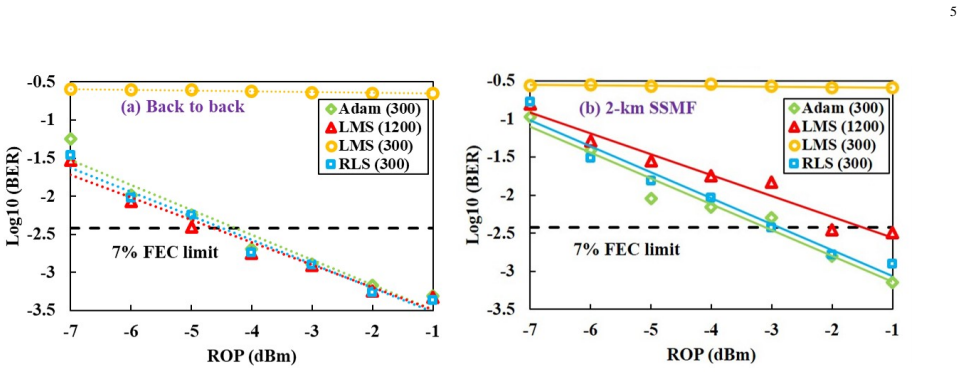
- With 300 training samples, BGD-based Adam matches the BER of RLS with 300 samples and beats LMS with 1200 samples, both back-to-back and after 2 km of SSMF.
- At the 7% FEC limit, BGD-based Adam achieves roughly 1 dB better receiver sensitivity than LMS, indicating more tolerance to limited bandwidth and noise.
- The training complexity is $N[2(M-N+1)+9]I$, lying between LMS and RLS, and the matrix-based updates permit parallel implementation that can accelerate training.
- The post-filter plus MLSD removes the extra ISI that the post filter introduces, so the equalized PAM8 signal can be detected at 120 Gbit/s.
Reading between the lines
- Editorial extension: because the FFE MSE cost is a convex quadratic, the global-optimality part of the claim is a property of batch descent on that surface, not of Adam itself; Adam's real contribution here is faster, smoother approach to that global optimum.
- Editorial extension: the paper compares iteration counts but not wall-clock time per iteration; on serial hardware the $O(N^2)$-per-iteration matrix product could erase the convergence advantage, so the practical benefit is tied to parallel execution.
- Editorial extension: the same BGD-based Adam update could be applied with a mini-batch of received samples instead of the full block, trading memory for iteration count, and to nonlinear equalizers where the cost surface is not convex and the local-trap claim would be non-trivial.
- Editorial extension: since the results depend on two unreported tuning constants $\theta$ and $\alpha$, publishing their values would let other groups test whether the advantage persists across step-size sweeps.
Signed reviews
Editorial analysis
A structured set of objections, weighed in public.
Referee Report
Summary. The paper proposes applying the Adam optimization algorithm in batch (BGD) mode to train the tap coefficients of a feed-forward equalizer for short-reach PAM8 optical interconnects. The authors formulate the MSE cost function, derive the gradient expression in Eq. (4), present Algorithm 1 for the BGD-Adam update, and report experimental results at 120 Gbit/s over 2-km SSMF. The experiments compare MSE convergence and BER versus received optical power for BGD-Adam, LMS, and RLS, and a complexity comparison is given in Eqs. (12)-(14). The paper claims that BGD-Adam achieves globally optimal taps without local-minimum trapping, converges fast and stably, uses fewer training samples than LMS, and is more efficient due to parallel matrix operations.
Significance. If the claims are supported, the paper would be a useful application of a well-known optimizer to an important equalization problem in short-reach optical links. The gradient derivation in Eq. (4) is correct, the complexity formula in Eqs. (12)-(14) is explicit, and the experimental setup is realistic and clearly described. The main value is the experimental demonstration that batch Adam can train FFE taps successfully in a 120-Gbit/s PAM8 system. However, the global-convergence guarantee is asserted without proof, and the experimental comparison omits key tuning parameters, so the strength of the central claims currently exceeds what the manuscript demonstrates.
major comments (4)
- [Section II, after Eq. (10)] The statement that BGD-based Adam is 'guaranteed to converge to globally optimal solution for convex error function' is not established by the manuscript or by the cited survey. Convexity alone does not imply convergence of the fixed-step Adam update in Algorithm 1; standard Adam convergence results require additional conditions such as decaying step sizes, bounded gradients, or similar assumptions. Please either provide a precise convergence theorem for Algorithm 1 with the exact assumptions used, or weaken the claim to an empirical observation. This is load-bearing because the abstract's 'globally optimal tap coefficients' claim rests on this sentence.
- [Section IV, Fig. 3 and Section III, Eq. (11)] The experimental comparison varies two parameters at once: BGD-Adam and RLS use 300 training samples while LMS uses 1200. The conclusion that BGD-Adam is 'more efficient' than LMS is therefore not separable from the choice of training length, and no study of sensitivity to training length is given. In addition, the critical hyperparameters are not reported: the step size θ in Algorithm 1, the post-filter coefficient α in Eq. (11), the LMS step size, and the RLS forgetting factor. Without these values, the reported BER and MSE curves cannot be reproduced, and the reader cannot tell whether the good performance reflects the method or the particular tuning.
- [Section IV, Fig. 2] The convergence comparison in Fig. 2 is misleading because one BGD-Adam iteration processes M training samples, whereas one LMS or RLS iteration processes one sample. The claim that LMS/RLS 'cannot converge even after 200 iterations' while BGD-Adam converges after 100 iterations therefore compares different numbers of training samples per iteration. Please plot convergence against the total number of training samples consumed, or against wall-clock time, so that the 'fast and stable convergence' claim can be assessed fairly.
- [Abstract and Section IV, Eqs. (12)-(14) and Table I] The efficiency claim is not fully supported by the reported complexity data. The formulas show CBGD-Adam > CLMS, so the statement that BGD-Adam is 'more efficient than conventional serial algorithms, such as LMS' relies entirely on unquantified parallel processing. The paper does not report runtime, parallel speedup, or any hardware-specific benchmark. Please either provide such measurements or explicitly restrict the efficiency claim to the parallel implementation and state that serial computational complexity remains higher than LMS.
minor comments (6)
- [Title of Section II] The word 'Principle' in the section title should be 'Principle'.
- [Algorithm 1] Algorithm 1 has an 'end while' on line 8 but no corresponding 'while' statement; please specify the iteration loop explicitly.
- [Eq. (1)] The sentence 'where x are the received training samples' should be 'where x_i are the received training samples' for clarity.
- [Section II, paragraph after Eq. (10)] The phrases 'Its acknowledged' and 'Its very possible' contain grammatical errors and should be corrected.
- [Section II, paragraph after Eq. (10)] The phrase 'field programmable gata array' contains a typo; it should be 'field programmable gate array'.
- [Section IV, Fig. 2] The MSE plots in Fig. 2 would be easier to interpret if the axes were labeled and the definition of 'iteration' for LMS and RLS were stated in the caption or text.
Circularity Check
No significant circularity: the optimizer and objective are externally defined, and the central claim is an experimental comparison.
full rationale
The paper's derivation chain does not reduce any prediction to its inputs. Algorithm 1 is a direct transcription of the standard Adam update (Kingma and Ba) applied to batch gradients, and Eq. (3) defines the MSE cost as a convex quadratic in the tap vector; the global-convergence claim is therefore an imported convex-optimization statement, not a renaming of a fitted parameter. The experimental results in Section IV compare BER versus ROP for BGD-based Adam, LMS, and RLS using measured data, so no fitted constant is later reported as a prediction. The only self-citation is Ref. [16] for the computational-complexity expression (Eq. 12), and that complexity comparison is not load-bearing for the central equalization claim; it is also independently checkable arithmetic. Undisclosed tuning parameters (step size theta and post-filter alpha) and the unsupported strength of the global-convergence assertion are reproducibility and correctness concerns, not circularity, because nothing in the paper defines the outcome in terms of those parameters by construction.
Assumptions & free parameters
free parameters (5)
- Step size θ =
Not reported
- Number of FFE taps N =
181
- Training sample length M =
300 for BGD-Adam and RLS, 1200 for LMS
- Iteration count I =
120
- Post-filter tap coefficient α =
Not reported
assumptions (4)
- standard math The MSE cost J(ω) in Eq. (3) is convex for the linear FFE, so a unique global minimum exists.
- domain assumption Adam with the stated updates (Eqs. 6-10) converges to the global minimum of the MSE cost.
- domain assumption The experimental setup described in Section III is sufficient for 120-Gbit/s PAM8 transmission and offline DSP.
- domain assumption Parallel matrix operations will make BGD-Adam faster in wall-clock time than serial LMS/RLS implementations.
Cite this review
Pith. "Pith review of BGD-based Adam algorithm for time-domain equalizer in PAM-based optical interconnects." pith.science (2026). https://pith.science/paper/E7DMEPD3
@misc{pith2026190804116,
  author       = {Pith},
  title        = {Pith review of: BGD-based Adam algorithm for time-domain equalizer in PAM-based optical interconnects},
  year         = {2026},
  howpublished = {\url{https://pith.science/paper/E7DMEPD3}},
  note         = {Machine review of arXiv:1908.04116}
}
read the original abstract
To the best of our knowledge, for the first time, we propose adaptive moment estimation (Adam) algorithm based on batch gradient descent (BGD) to design a time-domain equalizer (TDE) for PAM-based optical interconnects. Adam algorithm has been widely applied in the fields of artificial intelligence. For TDE, BGD-based Adam algorithm can obtain globally optimal tap coefficients without being trapped in locally optimal tap coefficients. Therefore, fast and stable convergence can be achieved by BGD-based Adam algorithm with low mean square error. Meanwhile, BGD-based Adam algorithm is implemented by parallel processing, which is more efficient than conventional serial algorithms, such as least mean square and recursive least square algorithms. The experimental results demonstrate that BGD-based Adam feed-forward equalizer works well in 120-Gbit/s PAM8 optical interconnects. In conclusion, BGD-based Adam algorithm shows great potential for converging the tap coefficients of TDE in future optical interconnects.
Figures


Reference graph
Works this paper leans on
-
[1]
Recent advances in optical technologies for data centers: a review,
Q. Cheng, M. Bahadori, M. Glick, S. Rumley, and K. Bergman, “Recent advances in optical technologies for data centers: a review,” Optica. 5, 1354-1370 (2018)
work page 2018
-
[2]
G. Chen, J. Du, L. Sun, W. Zhang, K. Xu, X. Chen, G. T. Reed, and Z. He, “Nonlinear distortion mitigation by machine learning of svm classification for pam-4 and pam-8 modulated optical interconnection,” J. Light. Technol. 36, 650-657 (2018)
work page 2018
-
[3]
N.-P. Diamantopoulos, W. Kobayashi, H. Nishi, K. Takeda, T. Kakitsuka, and S. Matsuo, “Amplifierless pam-4/pam-8 transmissions in o-bandusing a directly modulated laser for optical data-center interconnects,” Opt. letters 44, 9-12 (2019). 6
work page 2019
-
[4]
Single-lane 180 gbit/s pam-4 signal transmission over 2 km ssmf for short-reach applications,
Q. Zhang, N. Stojanovic, C. Prodaniuc, C. Xie, M. Koenigsmann, and P. Laskowski, “Single-lane 180 gbit/s pam-4 signal transmission over 2 km ssmf for short-reach applications,” Opt. letters 41, 4449-4452 (2016)
work page 2016
-
[5]
Machine learning: Trends, perspectives,and prospects,
M. I. Jordan and T. M. Mitchell, “Machine learning: Trends, perspectives,and prospects,” Science 349, 255-260 (2015)
work page 2015
-
[6]
Adaptive subgradient methods for online learning and stochastic optimization,
J. Duchi, E. Hazan, and Y . Singer, “Adaptive subgradient methods for online learning and stochastic optimization,” J. Mach. Learn. Res. 12, 2121-2159 (2011)
work page 2011
-
[7]
Adadelta: an adaptive learning rate method,
M. D. Zeiler, “Adadelta: an adaptive learning rate method,” arXivpreprint arXiv:1212.5701 (2012)
arXiv 2012
-
[8]
Adam: A method for stochastic optimization,
D. P. Kingma and J. Ba, “Adam: A method for stochastic optimization,” arXiv preprint arXiv:1412.6980 (2014)
arXiv 2014
Show all 16 references
-
[9]
A few useful things to know about machine learning
P. M. Domingos, “A few useful things to know about machine learning.” Commun. acm 55,78-87 (2012)
2012
-
[10]
The tradeoffs of large scale learning,
L. Bottou and O. Bousquet, “The tradeoffs of large scale learning,” in Advances in neural information processing systems, (2008), pp.161-168
2008
-
[11]
Goodfellow, Y
I. Goodfellow, Y . Bengio, and A. Courville, Deep learning (MIT press, 2016)
2016
-
[12]
An overview of gradient descent optimization algorithms,
S. Ruder, “An overview of gradient descent optimization algorithms,” arXiv preprint arXiv:1609.04747 (2016)
2016 arXiv
-
[13]
The numpy array:a structure for efficient numerical computation,
S. Van Der Walt, S. C. Colbert, and G. Varoquaux, “The numpy array:a structure for efficient numerical computation,” Comput.Sci. & Eng. 13, 22 (2011)
2011
-
[14]
64-bit floating-point fpga matrix multiplication,
Y . Dou, S. Vassiliadis, G. K. Kuzmanov, and G. N. Gaydadjiev, “64-bit floating-point fpga matrix multiplication,” in Proceedings of the 2005ACM/SIGDA 13th international symposium on Field-programmablegate arrays, (ACM, 2005), pp. 86-95
2005
-
[15]
Digital signal processing for short-reach optical communications: a review of current technologies and future trends,
K. Zhong, X. Zhou, J. Huo, C. Yu, C. Lu, and A. P. T. Lau, “Digital signal processing for short-reach optical communications: a review of current technologies and future trends,” J. Light. Technol. 36, 377-400 (2018)
2018
-
[16]
Joint fde and mlsd algorithm for 56-gbit/s optical ftn-pam4 system using 10g-class optics,
J. Zhou, Y . Qiao, X. Huang, C. Yu, Q. Cheng, X. Tang, M. Guo, W. Liu,and Z. Li, “Joint fde and mlsd algorithm for 56-gbit/s optical ftn-pam4 system using 10g-class optics,” J. Light. Technol. 37, 3343-3350 (2019)
2019
Reviewed August 14, 2026 · model on record in the stance chip above.
Discussion (0). Continue with ORCID to comment.