REVIEW 4 major objections 5 minor 42 references
From Local Learning to Global Prediction Through Layered Surprise Cascades
T0 review · 4 major / 5 minor · reviewed 2026-08-08 · deepseek-v4-flash
Pith's one-line read A recurrent Forward-Forward variant with an inverted objective produces bottom-up cascades of cancellation for expected inputs and amplification for surprising ones, without error neurons or weight symmetry.
desk verdict A real Forward-Forward variant with a clean three-factor Hebbian derivation and an interesting but unproven bottom-up cascade claim; the cortical comparison needs controls and statistics before the strong conclusions hold. read the letter →
The pith
A machine-rendered reading of the paper's core claim, the machinery that carries it, and where it could break.
The reading
What carries the argument
The load-bearing object is the layer-wise softplus margin objective $L_i=\sigma\left((-1)^\eta\left(x_i^\top x_i-\theta\right)\right)$, where $\sigma(z)=\log(1+e^z)$, the binary $\eta$ is a global gating signal ($0$ for a matching image–label pair, $1$ for a mismatch), and $\theta$ is an activity threshold. Minimizing this objective pushes each layer's L2 activity below threshold for positive data and above threshold for negative data. The recurrent dynamics combine bottom-up, top-down, and lateral drives at every layer, and gradient descent on the objective yields an update that factorizes into a global gate, a post-synaptic factor, and a pre-synaptic factor—the three-factor Hebbian form. This objective-plus-dynamics combination is what turns a purely local learning rule into a layered cancellation cascade.
What would settle it
In the model, after a stimulus–outcome association is well learned, predictable stimuli should evoke reduced activity first in lower-order visual areas and only later in higher-order ones. Simultaneous recordings from V1 through higher visual areas in mice during a learned prediction task would settle this: if suppression begins in higher areas or appears simultaneously, the central claim fails.
Extended reading notes
Core claim
The central claim is that predictive representations and surprise responses can emerge purely from hierarchical contrastive learning. In the IFF model, label information is clamped at the top and sensory input at the bottom, yet learned cancellation of expected activity begins in early layers and propagates upward, while mismatched inputs evoke an amplified, sustained rise in activity that also starts low and spreads up. The authors show that the local learning rule is a three-factor Hebbian update—a global binary gate times a post-synaptic factor times a pre-synaptic factor—and that a stationary solution is the cancellation of the three synaptic drive currents at each layer, $W_i\hat{x}_i + F_i\hat{x}_{i-1} + B_i\hat{x}_{i+1}=0$. They further report that the resulting cascade matches the bottom-up rise and fall of neural activity recorded across five mouse visual areas during full-field flashes.
Load-bearing premise
The load-bearing premise is that the overall magnitude of a layer's activity is a faithful measure of surprise, and that showing an image with the wrong label is the same kind of mismatch the cortex detects. If real surprise cannot be reduced to that scalar, or if top-down signals do not act like the clamped labels, the central conclusion does not follow.
Editorial extensions
If this is right
- Hierarchical predictive coding can be implemented without error-coding neurons, symmetric weights, or backpropagation: only local contrastive updates and one global scalar signal are required.
- The bottom-up ordering of cancellation—not the top-down location of the label—determines when each layer's activity drops, so the model predicts that learned suppression of expected stimuli should also cascade from lower to higher visual areas.
- Because the update is a three-factor Hebbian rule, the model implies a concrete role for neuromodulatory gating: disrupting the global gate should selectively impair learned suppression of expected inputs.
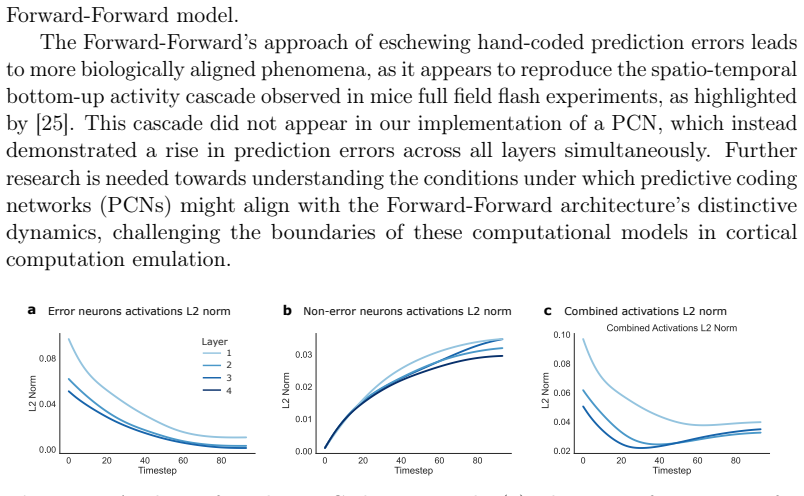
- A classical predictive coding network, run for comparison, does not produce this surprise/cancellation cascade, suggesting the two model families make distinguishable dynamical predictions.
- The same local rule applied to a five-layer network reaches 95 percent test accuracy on MNIST, so the predictive behavior does not come at the cost of task performance.
Reading between the lines
- The dependency on the L2 norm could be probed by replacing it with other aggregate statistics of layer activity (sparseness, variance, or max activation); if the bottom-up cascade survives such changes, the result is about contrastive cancellation rather than the specific norm.
- Because the appendix suggests closing the loop by making the gate depend on instantaneous surprise, an unsupervised variant of IFF is a natural next step: the label could be replaced by the network's own prediction of the next timestep.
- The same mechanism may transfer to temporal prediction: clamping a future frame or event instead of a class label would test whether the bottom-up cascade of cancellation is a general signature of predictive processing rather than a MNIST-specific artifact.
- The toy amplitude–orientation model implies the cascade does not depend on the high dimensionality of MNIST; one could test this directly on natural images or continuous stimuli to see whether the hierarchy still orders suppression bottom-up.
Editorial analysis
A structured set of objections, weighed in public.
Referee Report
Summary. The manuscript introduces the Inverted Forward-Forward (IFF) model, a five-layer recurrent network trained with a local contrastive objective that penalizes high activity for matching input–label pairs and rewards high activity for mismatched pairs. It reports that after training on MNIST the network shows a bottom-up cascade of cancellation for positive pairs and of surprise for negative pairs, analyzes the alignment of forward/backward/lateral components, derives the learning rule as a three-factor Hebbian update, and compares the cascade qualitatively with flash-evoked responses in the Allen Visual Coding Neuropixels dataset. The paper concludes with two experimental predictions about learned suppression.
Significance. If the cascade claims were established, this would be a valuable bridge between local contrastive learning and hierarchical predictive coding, with the notable strengths of a locally computable objective, an explicit three-factor Hebbian gradient derivation (Eqs. 3–4), an available code repository, and falsifiable predictions. The main significance is therefore conditional: the central empirical phenomenon is currently only qualitatively supported, and the neural comparison does not yet test the model's own construct of surprise.
major comments (4)
- [2.1, Eq. (1), Figs. 2b/3a] Eq. (1) directly assigns the loss σ(||x||² - θ) for positive samples and σ(θ - ||x||²) for negative samples, so the observation in Figs. 2b and 3a that positive activity is low and negative activity is high is a readout of the training objective, not an emergent prediction. Please reframe the text so that the claimed emergence concerns the temporal ordering and layer-wise structure, and specify exactly which features of Fig. 3a are not forced by the objective. The current abstract and Section 2.3 present the suppression/amplification itself as a finding.
- [2.4, Figs. 3b-c, 4b] The bottom-up ordering of cancellation/surprise is the load-bearing novel claim, but it is established only by visual inspection of activity curves and cosine similarities without statistical tests or control architectures. Because the image is clamped at the bottom and the label at the top, propagation delays alone predict earlier changes in lower layers. Please report a quantitative ordering metric (e.g., latency-to-peak or time-to-half-max), with confidence intervals or permutation tests, and compare against at least (i) a random-weight untrained network with the same dynamics, (ii) a version with the label clamped at the bottom rather than the top, and (iii) a version with no learning. Without these controls, Predictions 1 and 2 in the Discussion are not yet grounded.
- [Appendix E, Fig. 11, Eq. (E.2)] The comparison with the Allen Visual Coding Neuropixels data does not test the model's central quantity: flash-evoked responses are sensory transients, not prediction-error or mismatch signals, whereas the model was trained on label–image mismatch. The normalization in Eq. (E.2) rescales each region's baseline and peak to common values, which can manufacture the appearance of a synchronized cascade across regions. Moreover, the Spearman hierarchy correlations in Figs. 10e-f are reported without permutation or bootstrap significance values. Please either restrict the neural claim to transient response ordering and support it with raw or minimally normalized responses, or analyze a dataset with a genuine expectancy-violation condition.
- [2.6 / Appendix A] The section title states that the rule 'converges to synaptic drive cancellation', but the derivation only shows that W_i x_i + F_i x_{i-1} + B_i x_{i+1} = 0 is a stationary solution of the one-step gradient update. It does not prove convergence or stability, nor show that trained networks actually reach this state. Please soften the claim to 'admits cancellation as a stationary solution' or add a convergence analysis. In addition, the 'bistable dynamics' of η(t') is in fact a deterministic Kronecker-delta assignment at each timestep, not a dynamical system, so the wording in Section 2.6 should be corrected.
minor comments (5)
- [Fig. 3] Panels b and c are described as 'visualizing the cancellation cascade' but the axes are not labeled; please add axis labels and mark the label presentation time (t = 10) consistently across panels.
- [Appendix D.1, Fig. 10] The toy model is called 'phenomenological' and its connection to the IFF network is qualitative; this caveat should be stated in the main text where Fig. 10 is discussed, not only in the appendix.
- [2.2] The training description mentions a stopgrad operation without defining it; please define stopgrad and state explicitly whether it is applied during inference as well as training.
- [3.1] The analogy between η and neuromodulation is useful, but the Appendix A sentence about 'bistable switching-like dynamics' should not imply that the present model implements such dynamics, since η is assigned deterministically rather than evolving.
- [2.2 / Eq. (1)] The activity margin θ and the phase durations (10 and 15 timesteps) are fixed without sensitivity analysis; please report at least a small ablation for θ and for the phase duration ratio, since the cascade ordering may depend on these timescales.
Circularity Check
The reported 'surprise signal' is the training objective by construction; only the cascade ordering is emergent, and the paper lacks controls to separate it from signal-propagation delays.
-
self definitional
[Section 2.1, Model Design (surprise operationalization)]
"This activity magnitude serves as a proxy for compatibility between the label (top input) and the data (bottom input). Higher activity magnitudes suggest a mismatch or 'surprise,' while lower magnitudes imply consistency between the two inputs."
The paper defines 'surprise' as the L2 norm of layer activity and then trains Eq. (1) to minimize that norm for positive data and maximize it for negative data. Therefore any observation that mismatched pairs produce high L2 norms and matched pairs produce low L2 norms is true by definition plus the loss, not an emergent property discovered in the model. The cortical comparison and both experimental predictions inherit this operationalization, so the 'surprise signaling' component of the central claim reduces to the training objective.
-
self definitional
[Section 2.3, 'Hierarchical emergence of surprise and cancellation signal']
"By analyzing layer activity via L2 norm over time, we were able to confirm that the model learned to dynamically suppress neural activity across both layers and time whenever the input image matched the respective label (fig. 2b). The difference between negative and positive activations showed a clear divergence upon label presentation (fig. 2b)."
This 'confirmation' is a direct readout of the contrastive objective in Eq. (1): positive samples incur loss sigma(||x||^2 - theta) and negative samples incur sigma(theta - ||x||^2), so minimizing the loss forces exactly the reported divergence. The result is statistically forced by the training procedure rather than an independent prediction. The genuinely non-trivial claim is the layer-wise ordering of the divergence, which Eq. (1) does not encode, but the paper does not unconfound that ordering from input-propagation delays or report random-weight baselines.
full rationale
The paper's central 'surprise signaling' claim is partially circular. Section 2.1 defines surprise as layer-activity magnitude, and Eq. (1) is a per-layer loss that directly drives positive-sample L2 norms below a threshold and negative-sample L2 norms above it. Consequently, Figures 2b and 3a's positive-versus-negative divergence is the optimized contrastive margin, not an emergent cortical-like phenomenon. This is a by-construction component of the main claim. The bottom-up cascade ordering in Section 2.4 is not forced by Eq. (1), since every layer shares the same objective and no ordering penalty appears; that part has independent content. However, the paper reports no control (e.g., random weights, label clamped at the bottom, or shuffled layer roles) to show the ordering is learned rather than a trivial consequence of input being injected at the bottom and the label at the top, and Appendix D concedes the mechanism is 'difficult to isolate or prove.' The neural comparison in Section E is external evidence, not circular, but it is an acknowledged proxy (model trained on semantic mismatch versus flash-evoked transients) and the normalization aligns baselines and peaks without permutation statistics, which is a robustness limitation rather than circularity. There is no load-bearing self-citation chain: the Forward-Forward and three-factor Hebbian citations are external and the Hebbian equivalence is a direct gradient computation. Overall, one key 'prediction' reduces by construction, while the remaining cascade-ordering claim is underdetermined rather than circular, giving a partial circularity score of 6.
Assumptions & free parameters
free parameters (4)
- activity margin theta =
not reported
- phase durations (10 presentation, 15 processing timesteps) =
10 and 15
- training hyperparameters (lr=5e-5, batch=500, 700 neurons/layer, 5 layers, Leaky ReLU, RMSProp) =
lr 5e-5, batch 500, 700x5, Leaky ReLU
- label clamping weight scale =
not reported
assumptions (5)
- domain assumption Layer-wise L2 activity norm is a valid proxy for surprise or prediction error.
- domain assumption A globally broadcast binary signal eta is biologically plausible and does not undermine locality.
- domain assumption Full-field flash responses in mouse visual cortex can stand in for predictive surprise despite the task mismatch.
- domain assumption The five visual areas VISp, VISl, VISal, VISpm, VISam map cleanly onto the model's five layers.
- ad hoc to paper Gradient descent on the local softplus margin loss with stopgrad is an acceptable model of online synaptic learning.
Cite this review
Pith. "Pith review of From Local Learning to Global Prediction Through Layered Surprise Cascades." pith.science (2026). https://pith.science/paper/E7FGXQDO
@misc{pith2026260805481,
  author       = {Pith},
  title        = {Pith review of: From Local Learning to Global Prediction Through Layered Surprise Cascades},
  year         = {2026},
  howpublished = {\url{https://pith.science/paper/E7FGXQDO}},
  note         = {Machine review of arXiv:2608.05481}
}
read the original abstract
Hierarchical predictive coding proposes a compelling hypothesis of brain computation, suggesting that the cortex builds layered predictions to minimize surprise. Yet most models rely on error-coding neurons or generative modeling of unclear biological plausibility. Here, we examine a biologically plausible framework in which the functional goals of predictive coding emerge from local contrastive learning and simple activity cancellation. Building on recent machine learning advances, we present a recurrent variant of the Forward-Forward (FF) algorithm with an inverted objective that increases activity for negative data. This setup yields predictive representations across layers, capturing hallmark features of cortical computation such as top-down modulation and surprise signaling. Our results suggest that key principles of predictive coding can emerge from simple, local learning rules, offering a new bridge between neuroscience and machine learning.
Figures


Figures from the paper (9 more)




Reference graph
Works this paper leans on
-
[1]
Daniel M. Wolpert, R.C. Miall, and Mitsuo Kawato. Internal mod- els in the cerebellum.Trends in cognitive sciences, 2(9):338–347,
-
[2]
Mitsuo Kawato. Internal models for motor control and trajectory plan- ning.Current opinion in neurobiology, 9(6):718–727, 1999. URL https: //www.sciencedirect.com/science/article/pii/S0959438899000288? casa_token=4-yYDedK9_8AAAAA:JagChpbOID-Lg21iEfnobU0W1yZHGx_ eyZ79KtM5K6j-NkoL3z69DSVRrmgzUhPvLg1aNNmzHsNj. Publisher: Elsevier
work page 1999
- [3]
-
[4]
Linxing Preston Jiang and Rajesh P.N. Rao. Predictive coding theories of cortical function. Oxford University Press, November 2022. doi: 10.1093/ acrefore/9780190264086.013.328. URL https://doi.org/10.1093/acrefore/ 9780190264086.013.328
arXiv 2022
-
[5]
Linxing Preston Jiang and Rajesh P. N. Rao. Dynamic predictive coding: A model of hierarchical sequence learning and prediction in the neocortex. PLOS Computational Biology, 20(2):e1011801, February 2024. ISSN 1553-
work page 2024
-
[6]
PredictiveCoding: TowardsaFutureofDeepLearningbeyondBack- propagation?, February 2022
Beren Millidge, Tommaso Salvatori, Yuhang Song, Rafal Bogacz, and Thomas Lukasiewicz. PredictiveCoding: TowardsaFutureofDeepLearningbeyondBack- propagation?, February 2022. URLhttps://arxiv.org/abs/2202.09467v1
arXiv 2022
-
[7]
Danielle S. Bassett and Olaf Sporns. Network neuroscience.Nature neuroscience, 20(3):353–364, 2017. URL https://www.nature.com/articles/nn.4502. Pub- lisher: Nature Publishing Group US New York
work page 2017
-
[8]
Charles D. Gilbert and Wu Li. Top-down influences on visual processing. Nature Reviews Neuroscience, 14(5):350–363, May 2013. ISSN 1471-0048. doi: 10.1038/nrn3476
Show all 42 references
-
[9]
Rebecca Jordan and Georg B. Keller. Opposing influence of top-down and bottom-up input on excitatory layer 2/3 neurons in mouse primary visual cortex.Neuron, 108(6):1194–1206.e5, December 2020. ISSN 08966273. doi: 10.1016/j.neuron.2020.09.024
2020 doi
-
[10]
A large-scale circuit mechanism for hierarchical dynamical processing in the primate cortex.Neuron, 88(2):419–431, 2015
Rishidev Chaudhuri, Kenneth Knoblauch, Marie-Alice Gariel, Henry Kennedy, and Xiao-Jing Wang. A large-scale circuit mechanism for hierarchical dynamical processing in the primate cortex.Neuron, 88(2):419–431, 2015. URLhttps:// www.cell.com/neuron/pdf/S0896-6273(15)00765-5.pdf....
2015
-
[11]
Khan and Sonja B
Adil G. Khan and Sonja B. Hofer. Contextual signals in visual cor- tex.Current Opinion in Neurobiology, 52:131–138, 2018. URL https: //www.sciencedirect.com/science/article/pii/S0959438818300825? casa_token=xIXteX3UtOgAAAAA:jgedYEVdm7FxHu6zV8-YxvKg_ 7nKGt73wzlHmrNIunlgUgKFzvmP...
2018
-
[12]
Fahey, Jacob Reimer, Stelios M
Emmanouil Froudarakis, Paul G. Fahey, Jacob Reimer, Stelios M. Smirnakis, Edward J. Tehovnik, and Andreas S. Tolias. The Visual Cortex in Context. Annual Review of Vision Science, 5(1):317–339, September 2019. ISSN 2374- 4642, 2374-4650. doi: 10.1146/annurev-vision-091517-0344...
2019 doi
-
[13]
Grob- lewski, Shawn Olsen, Christof Koch, and Anton Arkhipov
Alex Piet, Nick Ponvert, Douglas Ollerenshaw, Marina Garrett, Peter A. Grob- lewski, Shawn Olsen, Christof Koch, and Anton Arkhipov. Behavioral strategy shapes activation of the Vip-Sst disinhibitory circuit in visual cortex.bioRxiv, pages 2023–04, 2023. URLhttps://www.biorxiv...
2023 doi
-
[14]
Price, Karl J
Andrea Mechelli, Cathy J. Price, Karl J. Friston, and Alumit Ishai. Where bottom-up meets top-down: neuronal interactions during perception and imagery. Cerebral cortex, 14(11):1256–1265, 2004. URL https://academic.oup.com/ cercor/article-abstract/14/11/1256/331439. Publisher:...
2004
-
[15]
Frontal cortex and the hierarchical control of behavior.Trends in cognitive sciences, 22(2):170–188, 2018
David Badre and Derek Evan Nee. Frontal cortex and the hierarchical control of behavior.Trends in cognitive sciences, 22(2):170–188, 2018. URL https: //www.cell.com/trends/cognitive-sciences/fulltext/S1364-6613%2817% 2930245-0?elsca1=etoc&%3Belsca2=email&%3Belsca3=1364-6...
2018
-
[16]
Rajesh PN Rao and D.H. Ballard. Predictive coding in the visual cortex: a functional interpretation of some extra-classical receptive-field effects.Na- ture neuroscience, 2(1):79–87, 1999. URLhttps://www.nature.com/articles/ nn0199_79. Publisher: Nature Publishing Group
1999
-
[17]
Lillicrap, Daniel Cownden, Douglas B
Timothy P. Lillicrap, Daniel Cownden, Douglas B. Tweed, and Colin J. Akerman. Random synaptic feedback weights support error backpropagation for deep learning.Nature Communications, 7(1):13276, November 2016. ISSN 2041-
2016
-
[18]
Representation learning with contrastive predictive coding, 2019
Aaron van den Oord, Yazhe Li, and Oriol Vinyals. Representation learning with contrastive predictive coding, 2019. URLhttps://arxiv.org/abs/1807.03748
2019 arXiv
-
[19]
A simple framework for contrastive learning of visual representations, 2020
Ting Chen, Simon Kornblith, Mohammad Norouzi, and Geoffrey Hinton. A simple framework for contrastive learning of visual representations, 2020. URL https://arxiv.org/abs/2002.05709
2020 arXiv
-
[20]
Momentum contrast for unsupervised visual representation learning, 2020
Kaiming He, Haoqi Fan, Yuxin Wu, Saining Xie, and Ross Girshick. Momentum contrast for unsupervised visual representation learning, 2020. URL https: //arxiv.org/abs/1911.05722
2020 arXiv
-
[21]
Richemond, Elena Buchatskaya, Carl Doersch, Bernardo Avila Pires, Zhao- han Daniel Guo, Mohammad Gheshlaghi Azar, Bilal Piot, Koray Kavukcuoglu, Rémi Munos, and Michal Valko
Jean-Bastien Grill, Florian Strub, Florent Altché, Corentin Tallec, Pierre H. Richemond, Elena Buchatskaya, Carl Doersch, Bernardo Avila Pires, Zhao- han Daniel Guo, Mohammad Gheshlaghi Azar, Bilal Piot, Koray Kavukcuoglu, Rémi Munos, and Michal Valko. Bootstrap your own laten...
2020 arXiv
-
[22]
The Forward-Forward Algorithm: Some Preliminary Investigations, December 2022
Geoffrey Hinton. The Forward-Forward Algorithm: Some Preliminary Investigations, December 2022. URL http://arxiv.org/abs/2212.13345. arXiv:2212.13345 [cs]
2022 arXiv
-
[23]
The Predictive Forward-Forward Algorithm, April 2023
Alexander Ororbia and Ankur Mali. The Predictive Forward-Forward Algorithm, April 2023. URLhttp://arxiv.org/abs/2301.01452. arXiv:2301.01452 [cs]
2023 arXiv
-
[24]
Learning Spiking Neural Systems with the Event-Driven Forward-Forward Process, March 2023
Alexander Ororbia. Learning Spiking Neural Systems with the Event-Driven Forward-Forward Process, March 2023. URL http://arxiv.org/abs/2303. 18187. arXiv:2303.18187 [cs]
2023 arXiv
-
[25]
Siegle, Xiaoxuan Jia, Séverine Durand, Sam Gale, Corbett Ben- nett, Nile Graddis, Greggory Heller, Tamina K
Joshua H. Siegle, Xiaoxuan Jia, Séverine Durand, Sam Gale, Corbett Ben- nett, Nile Graddis, Greggory Heller, Tamina K. Ramirez, Hannah Choi, Jen- nifer A. Luviano, et al. Survey of spiking in the mouse visual system re- veals functional hierarchy.Nature, 592(7852):86–92, 2021....
2021
-
[26]
Marina Garrett, Peter Groblewski, Alex Piet, Doug Ollerenshaw, Farzaneh Najafi, Iryna Yavorska, Adam Amster, Corbett Bennett, Michael Buice, Shiella Caldejon, Linzy Casal, Florence D’Orazi, Scott Daniel, Saskia EJ de Vries, Daniel Kapner, 28 Justin Kiggins, Jerome Lecoq, Peter...
2023
-
[27]
The combination of Hebbian and predictive plasticity learns invariant object representations in deep sensory net- works.Nature Neuroscience, 26(11):1906–1915, November 2023
Manu Srinath Halvagal and Friedemann Zenke. The combination of Hebbian and predictive plasticity learns invariant object representations in deep sensory net- works.Nature Neuroscience, 26(11):1906–1915, November 2023. ISSN 1546-1726. doi: 10.1038/s41593-023-01460-y. URL https:...
1906 doi
-
[28]
A Normative and Biologically Plausible Algorithm for Independent Component Analysis
Yanis Bahroun, Dmitri B Chklovskii, and Anirvan M Sengupta. A Normative and Biologically Plausible Algorithm for Independent Component Analysis
-
[29]
Learning with three factors: modulating Hebbian plasticity with errors.Current Opinion in Neu- robiology, 46:170–177, October 2017
Łukasz Kuśmierz, Takuya Isomura, and Taro Toyoizumi. Learning with three factors: modulating Hebbian plasticity with errors.Current Opinion in Neu- robiology, 46:170–177, October 2017. ISSN 0959-4388. doi: 10.1016/j.conb. 2017.08.020. URL https://www.sciencedirect.com/science/...
2017 doi
-
[30]
Colin Bredenberg, Benjamin S. H. Lyo, Eero P. Simoncelli, and Cristina Savin. Impression learning: Online representation learning with synaptic plasticity. November 2021. URLhttps://openreview.net/forum?id=MAorPaLqam_
2021
-
[31]
Kernelized information bottleneck leads to biologically plausible 3-factor Hebbian learning in deep networks
Roman Pogodin and Peter Latham. Kernelized information bottleneck leads to biologically plausible 3-factor Hebbian learning in deep networks. InAdvances in Neural Information Processing Systems, volume 33, pages 7296–7307. Curran Associates, Inc., 2020. URLhttps://proceedings....
2020
-
[32]
Portes, Christian Schmid, and James M
Jacob P. Portes, Christian Schmid, and James M. Murray. Distinguishing Learning Rules with Brain Machine Interfaces, October 2022. URL http: //arxiv.org/abs/2206.13448. arXiv:2206.13448 [cs]
2022 arXiv
-
[33]
A solution to the learning dilemma for recurrent networks of spiking neurons.Nature Communications, 11(1):3625, July 29
Guillaume Bellec, Franz Scherr, Anand Subramoney, Elias Hajek, Darjan Salaj, Robert Legenstein, and Wolfgang Maass. A solution to the learning dilemma for recurrent networks of spiking neurons.Nature Communications, 11(1):3625, July 29
-
[34]
Local online learning in recurrent networks with random feedback.eLife, 8:e43299, May 2019
James M Murray. Local online learning in recurrent networks with random feedback.eLife, 8:e43299, May 2019. ISSN 2050-084X. doi: 10.7554/eLife. 43299. URLhttps://doi.org/10.7554/eLife.43299. Publisher: eLifeSciences Publications, Ltd
2019 doi
-
[35]
Acetylcholine as a neuromodulator: cholinergic signaling shapes nervous system function and behavior.Neuron, 76(1):116–129, 2012
Marina R Picciotto, Michael J Higley, and Yann S Mineur. Acetylcholine as a neuromodulator: cholinergic signaling shapes nervous system function and behavior.Neuron, 76(1):116–129, 2012
2012
-
[36]
Vogels, H Sprekeler, F Zenke, C Clopath, and W Gerstner
T.P. Vogels, H Sprekeler, F Zenke, C Clopath, and W Gerstner. Inhibitory plasticity balances excitation and inhibition in sensory pathways and memory networks.Science, 334(6062):1569–1573, 2011. doi: 10.1126/science.1211095
2011 doi
-
[37]
Homeostatic plasticity in the developing nervous system.Nature Reviews Neuroscience, 5(2):97–107, 2004
Gina G Turrigiano and Sacha B Nelson. Homeostatic plasticity in the developing nervous system.Nature Reviews Neuroscience, 5(2):97–107, 2004. doi: 10.1038/ nrn1327
2004
-
[38]
Neural activity and the dynamics of central nervous system development.Nature Neuroscience, 7(4):327–332, 2004
Jackie Yuanyuan Hua and Stephen J Smith. Neural activity and the dynamics of central nervous system development.Nature Neuroscience, 7(4):327–332, 2004. doi: 10.1038/nn1218. 30
2004 doi
-
[1723]
URL https://www.nature.com/articles/ ncomms13276
doi: 10.1038/ncomms13276. URL https://www.nature.com/articles/ ncomms13276. Number: 1 Publisher: Nature Publishing Group
-
[1998]
Publisher: Elsevier
URL https://www.cell.com/trends/cognitive-sciences/fulltext/ S1364-6613(98)01221-2. Publisher: Elsevier
-
[2020]
doi: 10.1038/s41467-020-17236-y
ISSN 2041-1723. doi: 10.1038/s41467-020-17236-y. URL https://www. nature.com/articles/s41467-020-17236-y. Number: 1 Publisher: Nature Publishing Group
-
[7358]
URL http://dx.doi.org/10.1371/ journal.pcbi.1011801
doi: 10.1371/journal.pcbi.1011801. URL http://dx.doi.org/10.1371/ journal.pcbi.1011801. 26
Reviewed August 8, 2026 · model on record in the stance chip above.
Discussion (0). Continue with ORCID to comment.