REVIEW 3 major objections 4 minor 141 references
Herwig 7 with the Lund String Model: Tuning and Comparative Hadronization Studies
T0 review · 3 major / 4 minor · reviewed 2026-08-05 · deepseek-v4-flash
Pith's one-line read The paper demonstrates that Pythia's Lund string hadronization, combined with colour reconnection, can be embedded in Herwig 7 and tuned into a general-purpose 'LH Tune' that performs competitively with Herwig's native cluster model and Pyt
desk verdict A real, citable artifact — the first hadron-collider string tune inside Herwig with colour reconnection — but the abstract oversells it, and the unexplained 73.5% run attrition in the final tuning stage is the main thing to fix. read the letter →
The pith
A machine-rendered reading of the paper's core claim, the machinery that carries it, and where it could break.
The reading
What carries the argument
The load-bearing object is the extended TheP8I interface, which bridges Herwig 7's ThePEG event framework to Pythia 8's hadronization classes. It converts showered Herwig events into Pythia-readable colour singlet systems, then runs Pythia's StringFragmentation, with new access to ColourReconnection and JunctionSplitting parameters so that colour reconnection can be tuned from within Herwig. On top of that, the Professor polynomial-response-surface method supplies the tuning machinery: a weighted chi-squared fit over sampled parameter points, applied in four sequential stages under a decoupling assumption.
What would settle it
Take the same data sets and tune all parameters simultaneously, or in a different order, and compare predictions on untuned LHC distributions; if the alternative tune moves by more than the quoted uncertainties or systematically beats the LH Tune on held-out observables such as identified strange-baryon yields at 7 TeV, the decoupling assumption is falsified. A cheaper check is to evaluate the Professor response surface at the LH Tune parameter point against direct generator runs to see whether the polynomial interpolation was accurate there.
Extended reading notes
Core claim
The central claim is that a modern Lund string model, including the QCD-based colour reconnection scheme needed for hadron-collider final states, is fully usable inside Herwig 7 and can be tuned to collider data at the same quality as the generator's native cluster model. The evidence is the LH Tune: fragmentation and final-state-radiation parameters are fit first to LEP event shapes and multiplicities, then flavour parameters to particle multiplicities, then initial-state radiation and intrinsic transverse momentum to Z-boson production at the LHC, and finally multiple-parton-interaction and colour-reconnection parameters to minimum-bias and underlying-event data at 0.9, 1.8, 7, and 13 TeV.
Load-bearing premise
The tuning assumes the four groups of parameters—fragmentation, flavour, initial-state radiation/intrinsic kT, and multiple-parton-interaction/colour reconnection—are independent enough that fixing each group in sequence does not bias the result, and that the polynomial response surface interpolates the true generator response accurately.
Editorial extensions
If this is right
- Herwig 7.4 ships the LH Tune, so string-model predictions in Herwig become a standard, maintained option rather than a custom patch.
- With the shower held fixed, differences between cluster and string predictions directly quantify hadronization-model uncertainty for event shapes, multiplicities, underlying event, and beyond.
- The interface exposes colour-reconnection parameters to Herwig users, making the QCD-based colour reconnection scheme available for studies of top-pair final states and other colour-reconnection-sensitive processes.
- The LH Tune can be used at energies from 50 GeV up to 13 TeV, covering lower-energy experiments such as STAR as well as LHC analyses.
- The separately tuned initial- and final-state radiation couplings come out nearly equal, suggesting they could be unified in a future tune.
Reading between the lines
- If the decoupling assumption holds, the same four-stage strategy could be applied to any hadronization model plugged into Herwig, turning model choice into a tunable dimension of systematic uncertainty.
- The paper leaves implicit that its interface also opens the door to testing newer Pythia hadronization variants—thermodynamical fragmentation, string shoving, hyperfine-split string breaks—inside Herwig without changing the shower.
- The identified-particle spectra at 7 TeV, which no tune describes within 50 percent, suggest that flavour parameters tuned at LEP do not fully transfer to the LHC environment; a hadron-collider flavour extension of the LH Tune would be the natural next step.
- A simultaneous full-dimensional tune, once computationally affordable, would provide both a cross-check of the LH Tune and a Hessian-style error set for it.
Editorial analysis
A structured set of objections, weighed in public.
Referee Report
Summary. The paper interfaces the Pythia 8 Lund string hadronization model and its QCD-based colour reconnection scheme with Herwig 7's angular-ordered parton shower through an extended TheP8I interface. Using Rivet and Professor, the authors perform a four-stage sequential tune of fragmentation, flavour, ISR/intrinsic-kT, and MPI/CR parameters against LEP, Tevatron, and LHC data, yielding the 'LH Tune'. They compare this tune with Herwig's default cluster tune, Pythia 8's Monash tune, and an earlier string-model autotune across many observables, including some not used in the fit. The abstract and Section 3.1 claim that the LH Tune 'shows good performance across a wide range of observables' and is competitive with existing tunes; the tune will be included in Herwig 7.4.
Significance. If confirmed, this work provides the community with a validated general-purpose string-hadronization tune inside Herwig, enabling controlled comparisons of hadronization models with a fixed parton shower. The paper's strengths are its use of standard, reproducible tuning tools (Rivet/Professor), its explicit reporting of some failures (Section 4.2.2 pseudorapidity, Section 4.2.3 flavour spectra), and the planned public release of the interface patch. The four-stage tuning methodology is conventional and the paper contains a large body of plots that qualitatively support the central claim. However, the central claim rests on the reliability of the Professor interpolation and on the decoupling assumption, both of which receive only limited scrutiny in the manuscript.
major comments (3)
- [Section 3.1.2] The final tuning stage samples 1000 parameter vectors but only 265 'valid' runs are used for the Professor interpolation. No explanation is given for the 73.5% attrition. If invalid runs (crashes, timeouts, unphysical events) correlate with parameter values, the surviving points are not a uniform sample of the intended hypercube, and the response surface—and hence the optimum—may be biased. This concern is reinforced by the LH Tune values m0 = 2.87 GeV and junctionCorrection = 4.55, both sitting near the upper edges of their ranges (0.1–3 GeV and 0.05–5, respectively). The authors should quantify the causes of invalid runs, show the parameter-space distribution of valid vs. invalid points, and provide robustness checks such as repeated Professor fits on subsets, direct generator validation at the reported optimum, and sensitivity studies to the parameter ranges.
- [Section 3.1.1] The four-stage sequential tuning rests on the assumption, stated as 'we expect this assumption to hold', that fragmentation, flavour, ISR/kT, and MPI/CR parameter groups decouple. No numerical test of this decoupling is presented. Strong cross-group correlations could lead to a biased parameter set and would invalidate the generalization claim. The authors should test the assumption, for example by scanning MPI/CR parameters at fixed fragmentation/flavour values and checking LEP event-shape and multiplicity observables, or by comparing the sequential tune with a joint fit on a representative subset of observables. Without such checks, the 'good performance' claim is not fully supported.
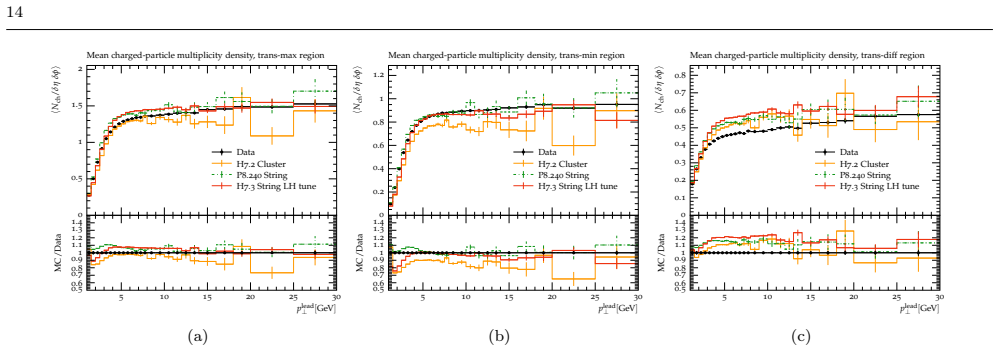
- [Sections 4.1–4.2 and Abstract] Many of the plots used to demonstrate good performance (Figs. 4–6, 8–9, 11, 18–23) are exactly the observables included in the Professor fit; these cannot independently validate the tune. The paper does include validation plots (Figs. 7, 10, 12, 13, 15, 24–25) and reasonably discusses them, but it does not provide quantitative goodness-of-fit measures (e.g., chi2/ndf) for either fitted or validation observables. In addition, Section 4.2.3 reports that none of the tunes describes the LHC flavour data well, with discrepancies up to 50%, and Section 4.2.2 reports that the LH Tune is 'farthest from the data' for the pseudorapidity distribution. These limitations should be reconciled with the abstract's 'good performance across a wide range of observables' by an explicit, quantitative summary of validation performance.
minor comments (4)
- [Section 4.2.2, near Fig. 12] The text says observables in Fig. 12 use tracks with pT > 500 GeV and the 13 TeV distributions in Fig. 11 use pT > 100 GeV; these should be 500 MeV and 100 MeV. The same unit error appears in the Fig. 12 caption.
- [Figure 13 caption] The caption contains a typo: 'ALTAS' should be 'ATLAS'.
- [Figure 14 caption (e)] The caption describes the observable as the 'number of Λ and Λbar mesons'; Λ is a baryon, not a meson.
- [Fig. 3 and Eq. (4)] The power-law form in Eq. (4) is an assumed parametric form, and the red curve in Fig. 3 is a fit of that form. The statement that this 'demonstrates the intrinsic power law' is too strong, especially because the individual energy tunes share other parameters. Please soften the wording and present parameter uncertainties for the power-law fit.
Circularity Check
One power-law 'demonstration' reduces to its own fitted ansatz; the central tuning claim retains independent validation.
-
fitted input called prediction
[Section 3.1.2, Eq. (4), Fig. 3]
"This parameter has been removed from the list of free parameters in [119] and set to follow a power law governed by the three parameters. ... Fig. 3 shows a red curve for the new LH Tune along with the individual pmin⊥(s) points obtained from fully independent tunes at four different energies. ... the individual points lie very close to the curve obtained from the LH Tune, thus demonstrating the intrinsic power law that it obeys."
Eq. (4) defines pmin⊥(s) as a power law with fitted parameters c, b, and pmin⊥,0. The 'points' in Fig. 3 are not direct measurements but evaluations of the same assumed power-law form using each single-energy tune's fitted parameters. The red curve is likewise the LH Tune's own power-law parametrization. The agreement between points and curve is therefore a consistency check of the imposed ansatz, not an independent demonstration that the energy evolution obeys a power law. The claimed 'intrinsic power law' is an input assumption (taken from [119]) rather than a derived result.
full rationale
This is a tuning paper, so many successful comparisons against LEP and LHC data are expected to reproduce the fitted observables. The paper is transparent about this: Figs. 5, 6, 8, 9, 11 and the appendix figures are explicitly described as included in the tuning interpolation, while Figs. 7, 10, 12, 13 and 15 are presented as unweighted validation observables. Those held-out comparisons provide genuine independent evidence for the LH Tune's generalization, so the central claim is not circular. The only concrete reduction found is the pmin⊥(s) power-law discussion in Section 3.1.2, where the power-law form is imposed in Eq. (4), fitted to each tune, and then presented as 'demonstrating the intrinsic power law.' That step is circular by construction but does not affect the main comparative hadronization conclusions. There are no load-bearing self-citation chains or imported uniqueness theorems; the cited previous work supplies tuning strategies and parametrizations but the validation is external to the fitted values.
Assumptions & free parameters
free parameters (31)
- alphaS_FSR (Herwig FSR coupling at MZ) =
0.126
- pmin_perp (FSR infrared cutoff) =
1.03 GeV
- aLund (Lund fragmentation a) =
0.75
- bLund (Lund fragmentation b) =
0.90 GeV^-2
- sigma (Gaussian pT kick width) =
0.31 GeV
- aExtraSQuark =
0.18
- aExtraDiquark =
0.05
- rFactC =
0.68
- rFactB =
1.27
- probStoUD =
0.19
- probQQtoQ =
0.08
- probSQtoQQ =
0.99
- probQQ1toQQ0 =
0.02
- etaSup =
0.51
- etaPrimeSup =
0.18
- popcornRate =
0.73
- mesonUDvector =
0.33
- mesonSvector =
0.68
- mesonCvector =
1.07
- mesonBvector =
1.85
- alphaS_ISR (Herwig ISR coupling at MZ) =
0.124
- kT (intrinsic primordial kT) =
1.304 GeV
- Power c (MPI pmin exponent) =
0.23
- pmin_perp_0 (MPI threshold scale) =
3.13 GeV
- Offset b (MPI energy offset) =
530.5 GeV
- mu2 (MPI regularization) =
1.14 GeV^-2
- ladderMult =
0.57
- ladderbFactor =
0.97
- Rdiff =
0.21
- m0 (CR lower mass bound) =
2.87 GeV
- junctionCorrection (CR junction mass scale) =
4.55
assumptions (7)
- domain assumption Lund string model and its Pythia 8 implementation are a valid description of hadronization
- domain assumption Herwig 7 AOPS correctly generates the perturbative initial and final state
- ad hoc to paper Fragmentation and flavour parameter groups decouple from each other and from MPI/CR parameters
- domain assumption Professor polynomial response surfaces interpolate the true generator response over the sampled hypercubes
- domain assumption Pythia QCD-based colour reconnection [81] is needed and valid inside Herwig
- domain assumption CT14LO PDFs are adequate for the LO event generation
- domain assumption Linear confinement V(r) = kappa*r with kappa ~ 1 GeV/fm anchors the string picture
Cite this review
Pith. "Pith review of Herwig 7 with the Lund String Model: Tuning and Comparative Hadronization Studies." pith.science (2026). https://pith.science/paper/E7HVVG33
@misc{pith2026250902348,
  author       = {Pith},
  title        = {Pith review of: Herwig 7 with the Lund String Model: Tuning and Comparative Hadronization Studies},
  year         = {2026},
  howpublished = {\url{https://pith.science/paper/E7HVVG33}},
  note         = {Machine review of arXiv:2509.02348}
}
read the original abstract
The modelling of the formation of colour-singlet hadrons from coloured partons, known as Hadronization, is crucial for generating realistic events in Monte Carlo Event Generators. Due to limited understanding of the non-perturbative regime, physically motivated phenomenological hadronization models with tunable parameters are used and later tuned to the experimental data. Modern Monte Carlo generators primarily employ one of two hadronization models: the Lund string model, which is the default in Pythia, and the cluster model, which is the default in Herwig and Sherpa. In this work, we combine the Lund string hadronization model, as implemented in Pythia 8, with Herwig 7 using TheP8I interface. We tune the string model with Herwig 7's Angular Ordered Parton Shower (AOPS) to lepton and hadron collision data, resulting in the Les Houches Tune (LH Tune), which shows good performance across a wide range of observables. The LH Tune will be included in the Herwig 7.4 release. This development enables a direct comparative study of the two hadronization models within Herwig, both interfaced with the Angular Ordered Parton Shower, which serves as the main motivation behind this work.
Figures


Figures from the paper (22 more)




Reference graph
Works this paper leans on
-
[1]
Bellm et al.,Herwig 7.0/Herwig++ 3.0 release note, Eur
J. Bellm et al.,Herwig 7.0/Herwig++ 3.0 release note, Eur. Phys. J. C76 (2016) 196, [1512.01178]
arXiv 2016
-
[2]
Bellm et al.,Herwig 7.2 release note, Eur
J. Bellm et al.,Herwig 7.2 release note, Eur. Phys. J. C80 (2020) 452, [1912.06509]
arXiv 2020
-
[3]
Bewick et al.,Herwig 7.3 release note, Eur
G. Bewick et al.,Herwig 7.3 release note, Eur. Phys. J. C84 (2024) 1053, [2312.05175]
arXiv 2024
-
[4]
T. Sjöstrand, S. Ask, J. R. Christiansen, R. Corke, N. Desai, P. Ilten et al.,An introduction to PYTHIA 8.2, Comput. Phys. Commun. 191 (2015) 159–177, [1410.3012]
arXiv 2015
-
[5]
Bierlich et al.,A comprehensive guide to the physics and usage of PYTHIA 8.3, SciPost Phys
C. Bierlich et al.,A comprehensive guide to the physics and usage of PYTHIA 8.3, SciPost Phys. Codeb.2022 (2022) 8, [2203.11601]
arXiv 2022
-
[6]
T. Gleisberg, S. Hoeche, F. Krauss, M. Schonherr, S. Schumann, F. Siegert et al.,Event generation with SHERPA 1.1, JHEP 02 (2009) 007, [0811.4622]
arXiv 2009
-
[7]
Bothmann et al.,Event Generation with Sherpa 2.2, SciPost Phys
Sherpacollaboration, E. Bothmann et al.,Event Generation with Sherpa 2.2, SciPost Phys. 7 (2019) 034, [1905.09127]
arXiv 2019
-
[8]
Bothmann et al.,Event generation with Sherpa 3, JHEP 12 (2024) 156, [2410.22148]
Sherpacollaboration, E. Bothmann et al.,Event generation with Sherpa 3, JHEP 12 (2024) 156, [2410.22148]
arXiv 2024
Show all 141 references
-
[9]
Höche, F
S. Höche, F. Krauss and D. Reichelt,The Alaric parton shower for hadron colliders, Phys. Rev. D111 (2025) 094032, [2404.14360]
2025 arXiv
-
[10]
Ferrario Ravasio, K
S. Ferrario Ravasio, K. Hamilton, A. Karlberg, G. P. Salam, L. Scyboz and G. Soyez,Parton Showering with Higher Logarithmic Accuracy for Soft Emissions, Phys. Rev. Lett.131 (2023) 161906, [2307.11142]
2023 arXiv
-
[11]
Schumann and F
S. Schumann and F. Krauss,A Parton shower algorithm based on Catani-Seymour dipole factorisation, JHEP 03 (2008) 038, [0709.1027]
2008 arXiv
-
[12]
Nagy and D
Z. Nagy and D. E. Soper,Parton showers with quantum interference, JHEP 09 (2007) 114, [0706.0017]
2007 arXiv
-
[13]
Nagy and D
Z. Nagy and D. E. Soper,Effects of subleading color in a parton shower, JHEP 07 (2015) 119, [1501.00778]
2015 arXiv
-
[14]
Bewick, S
G. Bewick, S. Ferrario Ravasio, P. Richardson and M. H. Seymour,Initial state radiation in the Herwig 7 angular-ordered parton shower, JHEP 01 (2022) 026, [2107.04051]
2022 arXiv
-
[15]
J.-B. Lee, M. R. Masouminia, M. H. Seymour and U.-k. Yang,Generalized angular-order parton showers in Herwig 7, JHEP 08 (2024) 064, [2312.13125]
2024 arXiv
-
[16]
Fischer, S
N. Fischer, S. Prestel, M. Ritzmann and P. Skands,Vincia for Hadron Colliders, Eur. Phys. J. C76 (2016) 589, [1605.06142]
2016 arXiv
-
[17]
A. H. Hoang, S. Plätzer and D. Samitz,On the Cutoff Dependence of the Quark Mass Parameter in Angular Ordered Parton Showers, JHEP 10 (2018) 200, [1807.06617]
2018 arXiv
-
[18]
Holguin, J
J. Holguin, J. R. Forshaw and S. Plätzer,Improvements on dipole shower colour, Eur. Phys. J. C81 (2021) 364, [2011.15087]
2021 arXiv
-
[19]
Frixione and B
S. Frixione and B. R. Webber,Correcting for cutoff dependence in backward evolution of QCD parton showers, JHEP 03 (2024) 150, [2309.15587]
2024 arXiv
-
[20]
J. R. Forshaw, S. Plätzer and F. T. González,Exact colour evolution for jet observables, 2502.12133
-
[21]
Frixione and B
S. Frixione and B. R. Webber,Matching NLO QCD computations and parton shower simulations, JHEP 06 (2002) 029, [hep-ph/0204244]
2002 arXiv
-
[22]
Nason,A New method for combining NLO QCD with shower Monte Carlo algorithms, JHEP 11 (2004) 040, [hep-ph/0409146]
P. Nason,A New method for combining NLO QCD with shower Monte Carlo algorithms, JHEP 11 (2004) 040, [hep-ph/0409146]
2004 arXiv
-
[23]
Frixione, P
S. Frixione, P. Nason and C. Oleari,Matching NLO QCD computations with Parton Shower simulations: the POWHEG method, JHEP 11 (2007) 070, [0709.2092]
2007 arXiv
-
[24]
Alioli, P
S. Alioli, P. Nason, C. Oleari and E. Re,A general framework for implementing NLO calculations in shower Monte Carlo programs: the POWHEG BOX, JHEP 06 (2010) 043, [1002.2581]
2010 arXiv
-
[25]
Alioli, P
S. Alioli, P. Nason, C. Oleari and E. Re,NLO vector-boson production matched with shower in POWHEG, JHEP 07 (2008) 060, [0805.4802]
2008 arXiv
-
[26]
Alioli, P
S. Alioli, P. Nason, C. Oleari and E. Re,NLO Higgs boson production via gluon fusion matched with shower in POWHEG, JHEP 04 (2009) 002, [0812.0578]
2009 arXiv
-
[27]
Alioli, P
S. Alioli, P. Nason, C. Oleari and E. Re,NLO single-top production matched with shower in POWHEG: s- and t-channel contributions, JHEP 09 (2009) 111, [0907.4076]
2009 arXiv
-
[28]
Hamilton,A positive-weight next-to-leading order simulation of weak boson pair production, JHEP 01 (2011) 009, [1009.5391]
K. Hamilton,A positive-weight next-to-leading order simulation of weak boson pair production, JHEP 01 (2011) 009, [1009.5391]
2011 arXiv
-
[29]
Plätzer and S
S. Plätzer and S. Gieseke,Dipole Showers and Automated NLO Matching in Herwig++, Eur. Phys. J. C72 (2012) 2187, [1109.6256]
2012 arXiv
-
[30]
Höche, F
S. Höche, F. Krauss, M. Schönherr and F. Siegert,A critical appraisal of NLO+PS matching methods, JHEP 09 (2012) 049, [1111.1220]
2012 arXiv
-
[31]
Nason and B
P. Nason and B. Webber,Next-to-Leading-Order Event Generators, Ann. Rev. Nucl. Part. Sci.62 (2012) 187–213, [1202.1251]
2012 arXiv
-
[32]
Frederix, E
R. Frederix, E. Re and P. Torrielli,Single-top t-channel hadroproduction in the four-flavour scheme with POWHEG and aMC@NLO, JHEP 09 (2012) 130, [1207.5391]
2012 arXiv
-
[33]
Heinrich, S
G. Heinrich, S. P. Jones, M. Kerner, G. Luisoni and E. Vryonidou,NLO predictions for Higgs boson pair production with full top quark mass dependence matched to parton showers, JHEP 08 (2017) 088, [1703.09252]
2017 arXiv
-
[34]
Jones and S
S. Jones and S. Kuttimalai,Parton Shower and NLO-Matching uncertainties in Higgs Boson Pair Production, JHEP 02 (2018) 176, [1711.03319]
2018 arXiv
-
[35]
Cormier, S
K. Cormier, S. Plätzer, C. Reuschle, P. Richardson and S. Webster,Parton showers and matching uncertainties in top quark pair production with Herwig 7, Eur. Phys. J. C79 (2019) 915, [1810.06493]
2019 arXiv
-
[36]
rep., CERN, Geneva, 2023
ATLAScollaboration, Studies on the improvement of the matching uncertainty definition in top-quark processes simulated with Powheg+Pythia 8, tech. rep., CERN, Geneva, 2023
2023
-
[37]
Jadach, A
S. Jadach, A. Kusina, W. Płaczek, M. Skrzypek and M. Sławinska,Inclusion of the QCD next-to-leading order corrections in the quark-gluon Monte Carlo shower, Phys. Rev. D87 (2013) 034029, [1103.5015]
2013 arXiv
-
[38]
Jadach, W
S. Jadach, W. Płaczek, S. Sapeta, A. Siódmok and M. Skrzypek,Matching NLO QCD with parton shower in Monte Carlo scheme — the KrkNLO method, JHEP 10 (2015) 052, [1503.06849]
2015 arXiv
-
[39]
Jadach, G
S. Jadach, G. Nail, W. Płaczek, S. Sapeta, A. Siódmok and M. Skrzypek,Monte Carlo simulations of Higgs-boson production at the LHC with the KrkNLO method, Eur. Phys. J. C77 (2017) 164, [1607.06799]
2017 arXiv
-
[40]
Sarmah, A
P. Sarmah, A. Siódmok and J. Whitehead,KrkNLO matching for colour-singlet processes, 2409.16417
-
[41]
Frixione, S
S. Frixione, S. Amoroso and S. Mrenna,Matrix element corrections in the Pythia8 parton shower in the context of matched simulations at next-to-leading order, Eur. Phys. J. C83 (2023) 970, [2308.06389]. 34
2023 arXiv
-
[42]
W. T. Giele, D. A. Kosower and P. Z. Skands,A simple shower and matching algorithm, Phys. Rev. D78 (2008) 014026, [0707.3652]
2008 arXiv
-
[43]
T. Chen, T. M. Figy and S. Plätzer,NLO multijet merging for Higgs production beyond the VBF approximation, Eur. Phys. J. C 82 (2022) 704, [2109.03730]
2022 arXiv
-
[44]
Bellm, S
J. Bellm, S. Gieseke and S. Plätzer,Merging NLO Multi-jet Calculations with Improved Unitarization, Eur. Phys. J. C78 (2018) 244, [1705.06700]
2018 arXiv
-
[45]
Bothmann, M
E. Bothmann, M. Schönherr and S. Schumann,Reweighting QCD matrix-element and parton-shower calculations, Eur. Phys. J. C 76 (2016) 590, [1606.08753]
2016 arXiv
-
[46]
Mrenna and P
S. Mrenna and P. Skands,Automated Parton-Shower Variations in Pythia 8, Phys. Rev. D94 (2016) 074005, [1605.08352]
2016 arXiv
-
[47]
Bellm, S
J. Bellm, S. Plätzer, P. Richardson, A. Siódmok and S. Webster,Reweighting Parton Showers, Phys. Rev. D94 (2016) 034028, [1605.08256]
2016 arXiv
-
[48]
Bellm, G
J. Bellm, G. Nail, S. Plätzer, P. Schichtel and A. Siódmok,Parton Shower Uncertainties with Herwig 7: Benchmarks at Leading Order, Eur. Phys. J. C76 (2016) 665, [1605.01338]
2016 arXiv
-
[49]
Argyropoulos and T
S. Argyropoulos and T. Sjöstrand,Effects of color reconnection ont¯t final states at the LHC, JHEP 11 (2014) 043, [1407.6653]
2014 arXiv
-
[50]
Freytsis, P
M. Freytsis, P. Harris, A. Hinzmann, I. Moult, N. Tran and C. Vernieri,Prospects for a Measurement of theW Boson Mass in the All-Jets Final State at Hadron Colliders, JHEP 02 (2019) 003, [1807.07454]
2019 arXiv
-
[51]
Hou et al.,Reconstruction of Monte Carlo replicas from Hessian parton distributions, JHEP 03 (2017) 099, [1607.06066]
T.-J. Hou et al.,Reconstruction of Monte Carlo replicas from Hessian parton distributions, JHEP 03 (2017) 099, [1607.06066]
2017 arXiv
-
[52]
Johnson and D
M. Johnson and D. Maître,Strong coupling constant extraction from high-multiplicity Z+jets observables, Phys. Rev. D97 (2018) 054013, [1711.01408]
2018 arXiv
-
[53]
Fischer and T
N. Fischer and T. Sjöstrand,Thermodynamical String Fragmentation, JHEP 01 (2017) 140, [1610.09818]
2017 arXiv
-
[54]
Ferreres-Solé and T
S. Ferreres-Solé and T. Sjöstrand,The space–time structure of hadronization in the Lund model, Eur. Phys. J. C78 (2018) 983, [1808.04619]
2018 arXiv
-
[55]
Gieseke, P
S. Gieseke, P. Kirchgaeßer, S. Plätzer and A. Siodmok,Colour Reconnection from Soft Gluon Evolution, JHEP 11 (2018) 149, [1808.06770]
2018 arXiv
-
[56]
Plätzer,Colour evolution and infrared physics, JHEP 07 (2023) 126, [2204.06956]
S. Plätzer,Colour evolution and infrared physics, JHEP 07 (2023) 126, [2204.06956]
2023 arXiv
-
[57]
Bierlich, S
C. Bierlich, S. Chakraborty, G. Gustafson and L. Lönnblad,Setting the string shoving picture in a new frame, JHEP 03 (2021) 270, [2010.07595]
2021 arXiv
-
[58]
Bierlich, S
C. Bierlich, S. Chakraborty, G. Gustafson and L. Lönnblad,Hyperfine splitting effects in string hadronization, Eur. Phys. J. C 82 (2022) 228, [2201.06316]
2022 arXiv
-
[59]
Chakraborty and L
S. Chakraborty and L. Lönnblad,Impact of string interactions on the space–time evolution of hadronic vertices, Eur. Phys. J. C 83 (2023) 464, [2207.14186]
2023 arXiv
-
[60]
Bierlich, G
C. Bierlich, G. Gustafson, L. Lönnblad and H. Shah,The dynamic hadronization of charm quarks in heavy-ion collisions, Eur. Phys. J. C 84 (2024) 231, [2309.12452]
2024 arXiv
-
[61]
Bierlich, G
C. Bierlich, G. Gustafson, L. Lönnblad and A. Tarasov,Effects of Overlapping Strings in pp Collisions, JHEP 03 (2015) 148, [1412.6259]
2015 arXiv
-
[62]
Kerbizi and L
A. Kerbizi and L. Lönnblad,Extending StringSpinner to handle vector-meson spin, Comput. Phys. Commun.292 (2023) 108886, [2305.05058]
2023 arXiv
-
[63]
A. H. Hoang, O. L. Jin, S. Plätzer and D. Samitz,Matching hadronization and perturbative evolution: the cluster model in light of infrared shower cutoff dependence, JHEP 07 (2025) 005, [2404.09856]
2025 arXiv
-
[64]
M. R. Masouminia and P. Richardson,Hadronization and decay of excited heavy hadrons in Herwig 7, JHEP 07 (2024) 278, [2312.02757]
2024 arXiv
-
[65]
G. S. Chahal and F. Krauss,Cluster Hadronisation in Sherpa, SciPost Phys. 13 (2022) 019, [2203.11385]
2022 arXiv
-
[66]
Gieseke, S
S. Gieseke, S. Kiebacher, S. Plätzer and J. Priedigkeit,Phenomenological constraints of the building blocks of the cluster hadronization model, 2505.14542
-
[67]
Ghosh, X
A. Ghosh, X. Ju, B. Nachman and A. Siodmok,Towards a deep learning model for hadronization, Phys. Rev. D106 (2022) 096020, [2203.12660]
2022 arXiv
-
[68]
Ilten, T
P. Ilten, T. Menzo, A. Youssef and J. Zupan,Modeling hadronization using machine learning, SciPost Phys. 14 (2023) 027, [2203.04983]
2023 arXiv
-
[69]
J. Chan, X. Ju, A. Kania, B. Nachman, V. Sangli and A. Siodmok,Fitting a deep generative hadronization model, JHEP 09 (2023) 084, [2305.17169]
2023 arXiv
-
[70]
J. Chan, X. Ju, A. Kania, B. Nachman, V. Sangli and A. Siodmok,Integrating particle flavor into deep learning models for hadronization, Phys. Rev. D111 (2025) 116015, [2312.08453]
2025 arXiv
-
[71]
Bierlich, P
C. Bierlich, P. Ilten, T. Menzo, S. Mrenna, M. Szewc, M. K. Wilkinson et al.,Reweighting Monte Carlo predictions and automated fragmentation variations in Pythia 8, SciPost Phys. 16 (2024) 134, [2308.13459]
2024 arXiv
-
[72]
Heller, P
N. Heller, P. Ilten, T. Menzo, S. Mrenna, B. Nachman, A. Siodmok et al.,Rejection Sampling with Autodifferentiation – Case study: Fitting a Hadronization Model, 2411.02194
-
[73]
Bierlich, P
C. Bierlich, P. Ilten, T. Menzo, S. Mrenna, M. Szewc, M. K. Wilkinson et al.,Describing hadronization via histories and observables for Monte-Carlo event reweighting, SciPost Phys. 18 (2025) 054, [2410.06342]
2025 arXiv
-
[74]
Bierlich, P
C. Bierlich, P. Ilten, T. Menzo, S. Mrenna, M. Szewc, M. K. Wilkinson et al.,Towards a data-driven model of hadronization using normalizing flows, SciPost Phys. 17 (2024) 045, [2311.09296]
2024 arXiv
-
[75]
B. Assi, C. Bierlich, P. Ilten, T. Menzo, S. Mrenna, M. Szewc et al.,Characterizing the hadronization of parton showers using the HOMER method, 2503.05667
-
[76]
Andersson, G
B. Andersson, G. Gustafson, G. Ingelman and T. Sjöstrand,Parton Fragmentation and String Dynamics, Phys. Rept. 97 (1983) 31–145
1983
-
[77]
B. R. Webber,A QCD Model for Jet Fragmentation Including Soft Gluon Interference, Nucl. Phys. B 238 (1984) 492–528
1984
-
[78]
Sjöstrand,The PYTHIA Event Generator: Past, Present and Future, Comput
T. Sjöstrand,The PYTHIA Event Generator: Past, Present and Future, Comput. Phys. Commun.246 (2020) 106910, [1907.09874]
2020 arXiv
-
[79]
Marchesini and B
G. Marchesini and B. R. Webber,Monte Carlo Simulation of General Hard Processes with Coherent QCD Radiation, Nucl. Phys. B 310 (1988) 461–526
1988
-
[80]
Catani, B
S. Catani, B. R. Webber and G. Marchesini,QCD coherent branching and semiinclusive processes at large x, Nucl. Phys. B 349 (1991) 635–654
1991
-
[81]
J. R. Christiansen and P. Z. Skands,String Formation Beyond Leading Colour, JHEP 08 (2015) 003, [1505.01681]. 35
2015 arXiv
-
[82]
Bellm and L
J. Bellm and L. Gellersen,High dimensional parameter tuning for event generators, Eur. Phys. J. C80 (2020) 54, [1908.10811]
2020 arXiv
-
[83]
La Cagnina, K
S. La Cagnina, K. Kröninger, S. Kluth and A. Verbytskyi,A Bayesian tune of the Herwig Monte Carlo event generator, JINST 18 (2023) P10033, [2302.01139]
2023 arXiv
-
[84]
M. G. Bowler,e+ e- Production of Heavy Quarks in the String Model, Z. Phys. C 11 (1981) 169
1981
-
[85]
’t Hooft,A Planar Diagram Theory for Strong Interactions, Nucl
G. ’t Hooft,A Planar Diagram Theory for Strong Interactions, Nucl. Phys. B 72 (1974) 461
1974
-
[86]
Amati and G
D. Amati and G. Veneziano,Preconfinement as a Property of Perturbative QCD, Phys. Lett. B83 (1979) 87–92
1979
-
[87]
Bähr et al.,Herwig++ Physics and Manual, Eur
M. Bähr et al.,Herwig++ Physics and Manual, Eur. Phys. J. C58 (2008) 639–707, [0803.0883]
2008 arXiv
-
[88]
Lönnblad,ThePEG, Pythia7, herwig++ and Ariadne, Nucl
L. Lönnblad,ThePEG, Pythia7, herwig++ and Ariadne, Nucl. Instrum. Meth. A559 (2006) 246–248
2006
-
[89]
Lönnblad,THEPEG: Toolkit for High Energy Physics event generation, inHERA and the LHC: 4th Workshop on the Implications of HERA for LHC Physics, pp
L. Lönnblad,THEPEG: Toolkit for High Energy Physics event generation, inHERA and the LHC: 4th Workshop on the Implications of HERA for LHC Physics, pp. 733–736, 3, 2009. DOI
2009
-
[90]
TheP8I: an interface between the Pythia8 and the ThePEG toolkit
L. Lönnblad et al., “TheP8I: an interface between the Pythia8 and the ThePEG toolkit.”
-
[91]
Buckley, J
A. Buckley, J. Butterworth, D. Grellscheid, H. Hoeth, L. Lönnblad, J. Monk et al.,Rivet user manual, Comput. Phys. Commun. 184 (2013) 2803–2819, [1003.0694]
2013 arXiv
-
[92]
Bierlich, A
C. Bierlich, A. Buckley, J. Butterworth, C. H. Christensen, L. Corpe, D. Grellscheid et al.,Robust Independent Validation of Experiment and Theory: Rivet version 3, SciPost Phys. 8 (2020) 026
2020
-
[93]
Bierlich, A
C. Bierlich, A. Buckley, J. M. Butterworth, C. Gutschow, L. Lonnblad, T. Procter et al.,Robust independent validation of experiment and theory: Rivet version 4 release note, SciPost Phys. Codeb.36 (2024) 1, [2404.15984]
2024 arXiv
-
[94]
Buckley, H
A. Buckley, H. Hoeth, H. Lacker, H. Schulz and J. E. von Seggern,Systematic event generator tuning for the LHC, Eur. Phys. J. C 65 (2010) 331–357, [0907.2973]
2010 arXiv
-
[95]
P. Z. Skands,Tuning Monte Carlo Generators: The Perugia Tunes, Phys. Rev. D82 (2010) 074018, [1005.3457]
2010 arXiv
-
[96]
Skands, S
P. Skands, S. Carrazza and J. Rojo,Tuning PYTHIA 8.1: the Monash 2013 Tune, Eur. Phys. J. C74 (2014) 3024, [1404.5630]
2013 arXiv
-
[97]
Abreu et al.,Tuning and test of fragmentation models based on identified particles and precision event shape data, Z
DELPHI collaboration, P. Abreu et al.,Tuning and test of fragmentation models based on identified particles and precision event shape data, Z. Phys. C 73 (1996) 11–60
1996
-
[98]
Ackerstaff et al.,Measurements of flavor dependent fragmentation functions in Z0 –> q anti-q events, Eur
OPALcollaboration, K. Ackerstaff et al.,Measurements of flavor dependent fragmentation functions in Z0 –> q anti-q events, Eur. Phys. J. C7 (1999) 369–381, [hep-ex/9807004]
1999 arXiv
-
[99]
Amsler et al.,Review of Particle Physics, Phys
Particle Data Group collaboration, C. Amsler et al.,Review of Particle Physics, Phys. Lett. B667 (2008) 1–1340
2008
-
[100]
A Study of the b-Quark Fragmentation Function with the DELPHI Detector at LEP I
G. Barker, E. Ben-Haim, M. Feindt, U. Kerzel, P. Roudeau, L. Ramler et al., “A Study of the b-Quark Fragmentation Function with the DELPHI Detector at LEP I.” DELPHI-2002-069 CONF 603, 2002
2002
-
[101]
Dulat, T.-J
S. Dulat, T.-J. Hou, J. Gao, M. Guzzi, J. Huston, P. Nadolsky et al.,New parton distribution functions from a global analysis of quantum chromodynamics, Phys. Rev. D93 (2016) 033006, [1506.07443]
2016 arXiv
-
[102]
Buckley, J
A. Buckley, J. Ferrando, S. Lloyd, K. Nordström, B. Page, M. Rüfenacht et al.,LHAPDF6: parton density access in the LHC precision era, Eur. Phys. J. C75 (2015) 132, [1412.7420]
2015 arXiv
-
[103]
Aad et al.,Measurement of theZ/γ∗ boson transverse momentum distribution inpp collisions at √s = 7 TeV with the ATLAS detector, JHEP 09 (2014) 145, [1406.3660]
ATLAScollaboration, G. Aad et al.,Measurement of theZ/γ∗ boson transverse momentum distribution inpp collisions at √s = 7 TeV with the ATLAS detector, JHEP 09 (2014) 145, [1406.3660]
2014 arXiv
-
[104]
Aad et al.,Measurement of angular correlations in Drell-Yan lepton pairs to probe Z/gamma* boson transverse momentum at sqrt(s)=7 TeV with the ATLAS detector, Phys
ATLAScollaboration, G. Aad et al.,Measurement of angular correlations in Drell-Yan lepton pairs to probe Z/gamma* boson transverse momentum at sqrt(s)=7 TeV with the ATLAS detector, Phys. Lett. B720 (2013) 32–51, [1211.6899]
2013 arXiv
-
[105]
Chatrchyan et al.,Measurement of the Rapidity and Transverse Momentum Distributions ofZ Bosons in pp Collisions at √s = 7 TeV, Phys
CMS collaboration, S. Chatrchyan et al.,Measurement of the Rapidity and Transverse Momentum Distributions ofZ Bosons in pp Collisions at √s = 7 TeV, Phys. Rev. D85 (2012) 032002, [1110.4973]
2012 arXiv
-
[106]
Aamodt et al.,Transverse momentum spectra of charged particles in proton-proton collisions at√s = 900~GeV with ALICE at the LHC, Phys
ALICE collaboration, K. Aamodt et al.,Transverse momentum spectra of charged particles in proton-proton collisions at√s = 900~GeV with ALICE at the LHC, Phys. Lett. B693 (2010) 53–68, [1007.0719]
2010 arXiv
-
[107]
Aad et al.,Measurements of underlying-event properties using neutral and charged particles inpp collisions at 900 GeV and 7 TeV with the ATLAS detector at the LHC, Eur
ATLAScollaboration, G. Aad et al.,Measurements of underlying-event properties using neutral and charged particles inpp collisions at 900 GeV and 7 TeV with the ATLAS detector at the LHC, Eur. Phys. J. C71 (2011) 1636, [1103.1816]
2011 arXiv
-
[108]
Aad et al.,Charged-particle multiplicities in pp interactions measured with the ATLAS detector at the LHC, New J
ATLAScollaboration, G. Aad et al.,Charged-particle multiplicities in pp interactions measured with the ATLAS detector at the LHC, New J. Phys.13 (2011) 053033, [1012.5104]
2011 arXiv
-
[109]
Aad et al.,Charged-particle multiplicities inpp interactions at √s = 900 GeV measured with the ATLAS detector at the LHC, Phys
ATLAScollaboration, G. Aad et al.,Charged-particle multiplicities inpp interactions at √s = 900 GeV measured with the ATLAS detector at the LHC, Phys. Lett. B688 (2010) 21–42, [1003.3124]
2010 arXiv
-
[110]
Aad et al.,Measurement of underlying event characteristics using charged particles in pp collisions at √s = 900GeV and 7 TeV with the ATLAS detector, Phys
ATLAScollaboration, G. Aad et al.,Measurement of underlying event characteristics using charged particles in pp collisions at √s = 900GeV and 7 TeV with the ATLAS detector, Phys. Rev. D83 (2011) 112001, [1012.0791]
2011 arXiv
-
[111]
Acosta et al.,Soft and Hard Interactions inp¯p Collisions at √s = 1800-GeV and 630-GeV, Phys
CDF collaboration, D. Acosta et al.,Soft and Hard Interactions inp¯p Collisions at √s = 1800-GeV and 630-GeV, Phys. Rev. D 65 (2002) 072005
2002
-
[112]
Alexopoulos et al.,The role of double parton collisions in soft hadron interactions, Phys
T. Alexopoulos et al.,The role of double parton collisions in soft hadron interactions, Phys. Lett. B435 (1998) 453–457
1998
-
[113]
F. Abe, D. Amidei, G. Apollinari, G. Ascoli, M. Atac, P. Auchincloss et al.,Pseudorapidity distributions of charged particles produced inpp interactions as √s = 630 and 1800 gev, Phys. Rev. D41 (Apr, 1990) 2330–2333
1990
-
[114]
Abe et al.,Transverse Momentum Distributions of Charged Particles Produced in¯pp Interactions at√s = 630 GeV and 1800 GeV, Phys
CDF collaboration, F. Abe et al.,Transverse Momentum Distributions of Charged Particles Produced in¯pp Interactions at√s = 630 GeV and 1800 GeV, Phys. Rev. Lett.61 (1988) 1819
1988
-
[115]
Affolder et al.,Charged Jet Evolution and the Underlying Event inp¯p Collisions at 1.8 TeV, Phys
CDF collaboration, T. Affolder et al.,Charged Jet Evolution and the Underlying Event inp¯p Collisions at 1.8 TeV, Phys. Rev. D 65 (2002) 092002
2002
-
[116]
Aamodt et al.,Charged-particle multiplicity measurement in proton-proton collisions at√s = 7 TeV with ALICE at LHC, Eur
ALICE collaboration, K. Aamodt et al.,Charged-particle multiplicity measurement in proton-proton collisions at√s = 7 TeV with ALICE at LHC, Eur. Phys. J. C68 (2010) 345–354, [1004.3514]
2010 arXiv
-
[117]
Aaboud et al.,Charged-particle distributions at low transverse momentum in√s = 13 TeV pp interactions measured with the ATLAS detector at the LHC, Eur
ATLAScollaboration, M. Aaboud et al.,Charged-particle distributions at low transverse momentum in√s = 13 TeV pp interactions measured with the ATLAS detector at the LHC, Eur. Phys. J. C76 (2016) 502, [1606.01133]
2016 arXiv
-
[118]
ATLAScollaboration, M. Aaboud et al.,Measurement of charged-particle distributions sensitive to the underlying event in√s = 13 TeV proton-proton collisions with the ATLAS detector at the LHC, JHEP 03 (2017) 157, [1701.05390]
2017 arXiv
-
[119]
Bellm, S
J. Bellm, S. Gieseke and P. Kirchgaesser,Improving the description of multiple interactions in Herwig, Eur. Phys. J. C80 (2020) 469, [1911.13149]
2020 arXiv
-
[120]
Abe et al.,Measurement of the b quark fragmentation function in Z0 decays, Phys
SLD collaboration, K. Abe et al.,Measurement of the b quark fragmentation function in Z0 decays, Phys. Rev. D65 (2002) 092006, [hep-ex/0202031]
2002 arXiv
-
[121]
Achard et al.,Studies of hadronic event structure ine+e− annihilation from 30-GeV to 209-GeV with the L3 detector, Phys
L3 collaboration, P. Achard et al.,Studies of hadronic event structure ine+e− annihilation from 30-GeV to 209-GeV with the L3 detector, Phys. Rept. 399 (2004) 71–174, [hep-ex/0406049]
2004 arXiv
-
[122]
Barate et al.,Studies of quantum chromodynamics with the ALEPH detector, Phys
ALEPH collaboration, R. Barate et al.,Studies of quantum chromodynamics with the ALEPH detector, Phys. Rept. 294 (1998) 1–165. 36
1998
-
[123]
Aad et al.,Charged-particle distributions in√s = 13 TeV pp interactions measured with the ATLAS detector at the LHC, Phys
ATLAScollaboration, G. Aad et al.,Charged-particle distributions in√s = 13 TeV pp interactions measured with the ATLAS detector at the LHC, Phys. Lett. B758 (2016) 67–88, [1602.01633]
2016 arXiv
-
[124]
Aad et al.,Rapidity gap cross sections measured with the ATLAS detector inpp collisions at √s = 7 TeV, Eur
ATLAScollaboration, G. Aad et al.,Rapidity gap cross sections measured with the ATLAS detector inpp collisions at √s = 7 TeV, Eur. Phys. J. C72 (2012) 1926, [1201.2808]
2012 arXiv
-
[125]
Adam et al.,Measurement of pion, kaon and proton production in proton–proton collisions at√s = 7 TeV, Eur
ALICE collaboration, J. Adam et al.,Measurement of pion, kaon and proton production in proton–proton collisions at√s = 7 TeV, Eur. Phys. J. C75 (2015) 226, [1504.00024]
2015 arXiv
-
[126]
Khachatryan et al.,Strange Particle Production inpp Collisions at √s = 0.9 and 7 TeV, JHEP 05 (2011) 064, [1102.4282]
CMS collaboration, V. Khachatryan et al.,Strange Particle Production inpp Collisions at √s = 0.9 and 7 TeV, JHEP 05 (2011) 064, [1102.4282]
2011 arXiv
-
[127]
Chatrchyan, V
CMS Collaboration collaboration, S. Chatrchyan, V. Khachatryan, A. M. Sirunyan, A. Tumasyan, W. Adam, T. Bergauer et al.,Measurement of neutral strange particle production in the underlying event in proton-proton collisions at√s = 7 TeV , Phys. Rev. D88 (Sep, 2013) 052001
2013
-
[128]
ALICE collaboration, B. B. Abelev et al.,Production of Σ(1385)± and Ξ(1530)0 in proton-proton collisions at√s = 7 TeV, Eur. Phys. J. C75 (2015) 1, [1406.3206]
2015 arXiv
-
[129]
Aaij et al.,Measurement of the inclusiveϕ cross-section inpp collisions at √s = 7 TeV, Phys
LHCb collaboration, R. Aaij et al.,Measurement of the inclusiveϕ cross-section inpp collisions at √s = 7 TeV, Phys. Lett. B 703 (2011) 267–273, [1107.3935]
2011 arXiv
-
[130]
Adams et al.,Identified hadron spectra at large transverse momentum in p+p and d+Au collisions at s(NN)**(1/2) = 200-GeV, Phys
STARcollaboration, J. Adams et al.,Identified hadron spectra at large transverse momentum in p+p and d+Au collisions at s(NN)**(1/2) = 200-GeV, Phys. Lett. B637 (2006) 161–169, [nucl-ex/0601033]
2006 arXiv
-
[131]
STARcollaboration, B. I. Abelev et al.,Systematic Measurements of Identified Particle Spectra inpp, d+ Au and Au+Au Collisions from STAR, Phys. Rev. C 79 (2009) 034909, [0808.2041]
2009 arXiv
-
[132]
UA5 collaboration, G. J. Alner et al.,Scaling of Pseudorapidity Distributions at c.m. Energies Up to 0.9-TeV, Z. Phys. C 33 (1986) 1–6
1986
-
[133]
UA5 collaboration, R. E. Ansorge et al.,Charged Particle Multiplicity Distributions at 200-GeV and 900-GeV Center-Of-Mass Energy, Z. Phys. C 43 (1989) 357
1989
-
[134]
Albajar et al.,A Study of the General Characteristics ofp¯p Collisions at √s = 0.2-TeV to 0.9-TeV, Nucl
UA1 collaboration, C. Albajar et al.,A Study of the General Characteristics ofp¯p Collisions at √s = 0.2-TeV to 0.9-TeV, Nucl. Phys. B 335 (1990) 261–287
1990
-
[135]
Behring et al.,Flavoured jet algorithms: a comparative study, 2506.13449
A. Behring et al.,Flavoured jet algorithms: a comparative study, 2506.13449
-
[136]
U. S. Qureshi, R. Kunnawalkam Elayavalli, L. Mozarsky, H. Caines and I. Mooney,A New Herwig7 Underlying Event Tune: from RHIC to LHC Energies, 2411.16897
-
[137]
Bellm, C
J. Bellm, C. B. Duncan, S. Gieseke, M. Myska and A. Siódmok,Spacetime colour reconnection in Herwig 7, Eur. Phys. J. C 79 (2019) 1003, [1909.08850]
2019 arXiv
-
[138]
Kiebacher,On The Phenomenology Of Hadronization And Colour Reconnection
S. Kiebacher,On The Phenomenology Of Hadronization And Colour Reconnection. PhD thesis, Institut für Theoretische Physik (ITP), 2, 2025. 10.5445/IR/1000179268
2025
-
[139]
ATLAS Pythia 8 tunes to7 TeV data
ATLAS collaboration, “ATLAS Pythia 8 tunes to7 TeV data.” ATL-PHYS-PUB-2014-021, 2014
2014
-
[140]
Dasgupta and G
M. Dasgupta and G. P. Salam,Event shapes in e+ e- annihilation and deep inelastic scattering, J. Phys. G 30 (2004) R143, [hep-ph/0312283]
2004 arXiv
-
[141]
Aad et al.,Measurement of event shapes at large momentum transfer with the ATLAS detector inpp collisions at √s = 7 TeV, Eur
ATLAScollaboration, G. Aad et al.,Measurement of event shapes at large momentum transfer with the ATLAS detector inpp collisions at √s = 7 TeV, Eur. Phys. J. C72 (2012) 2211, [1206.2135]
2012 arXiv
Reviewed August 5, 2026 · model on record in the stance chip above.
Discussion (0). Sign in to comment.