REVIEW 4 major objections 6 minor 56 references
Constrained Non-negative Matrix Factorization for Guided Topic Modeling of Minority Topics
T0 review · 4 major / 6 minor · reviewed 2026-08-07 · deepseek-v4-flash
Pith's one-line read A single seed list plus two constraints recovers rare topics other models miss.
desk verdict A plausible new seeded-NMF variant for minority-topic discovery, but the W constraint quietly assumes minority content only appears in documents containing exact seed words, and the synthetic evaluation probably never tests that assumption. read the letter →
The pith
A machine-rendered reading of the paper's core claim, the machinery that carries it, and where it could break.
The reading
What carries the argument
The load-bearing object is the pair of inequality constraints on the two NMF factors. The constraint $g_{1,ik}(W)=W_{ik}-W_{\max}\le 0$ applies only to documents that contain no seed words and to minority-topic columns, so vocabulary outside the seed list cannot push minority prevalence upward. The constraint $g_{2,k}(H)=\theta_{\min}-\frac{\sum_{j'\in S_I} H_{kj'}}{\sum_{j'=1}^{N} H_{kj'}}\le 0$ anchors each minority topic to the seed content collectively, without dictating which seed words belong to which topic. Optimization minimizes the generalized KL divergence subject to these constraints through a Lagrangian; setting the Lagrangian gradients to zero gives multiplicative updates for $W$, $H$ and for the Lagrange multipliers $\lambda$ and $\mu$, each update being a ratio of the positive and negative parts of the gradient, which preserves non-negativity.
What would settle it
Build a synthetic corpus whose injected minority topics use synonyms and paraphrases that are deliberately absent from the supplied seed list, with ground-truth labels known. If the constrained NMF at $W_{\max}=10^{-9}$ assigns those documents to minority topics no better than an unconstrained NMF does (purity and NMI near baseline), the coverage assumption behind the W constraint fails.
Extended reading notes
Core claim
The paper's central claim is that a constrained NMF can separate data-driven minority topics from majority topics without topic-level supervision. The expert supplies one seed list and two scalars: a cap $W_{\max}$ on minority-topic prevalence in documents that contain no seed words, and a floor $\theta_{\min}$ on the total share of seed words in each minority topic's word distribution. From a Lagrangian of the generalized KL divergence under these constraints, Karush-Kuhn-Tucker stationarity yields multiplicative update rules for $W$, $H$ and the Lagrange multipliers $\lambda$ and $\mu$; the authors argue these updates guarantee the constraints are satisfied. Empirically, the method gives the best clustering and closest topic-word distributions to ground truth on the synthetic benchmark, and it produces coherent mental-health topics in real YouTube comments. The authors also note that convergence theorems for the constrained updates are left to future work and that automated topic-quality metrics can be misaligned with semantic value.
Load-bearing premise
The load-bearing assumption is that a document containing none of the seed words has essentially no minority content: with $W_{\max}$ set to $10^{-9}$, such documents are forced to near-zero prevalence in every minority topic, so any minority theme expressed in vocabulary outside the seed list is excluded by construction.
Editorial extensions
If this is right
- Domain experts can guide discovery of rare content with a single seed list, without pre-specifying how that content divides into subtopics.
- Low-prevalence themes can be modeled even when the seed words themselves are not prominent within the minority topics, because the constraints are only on aggregate seed-word share.
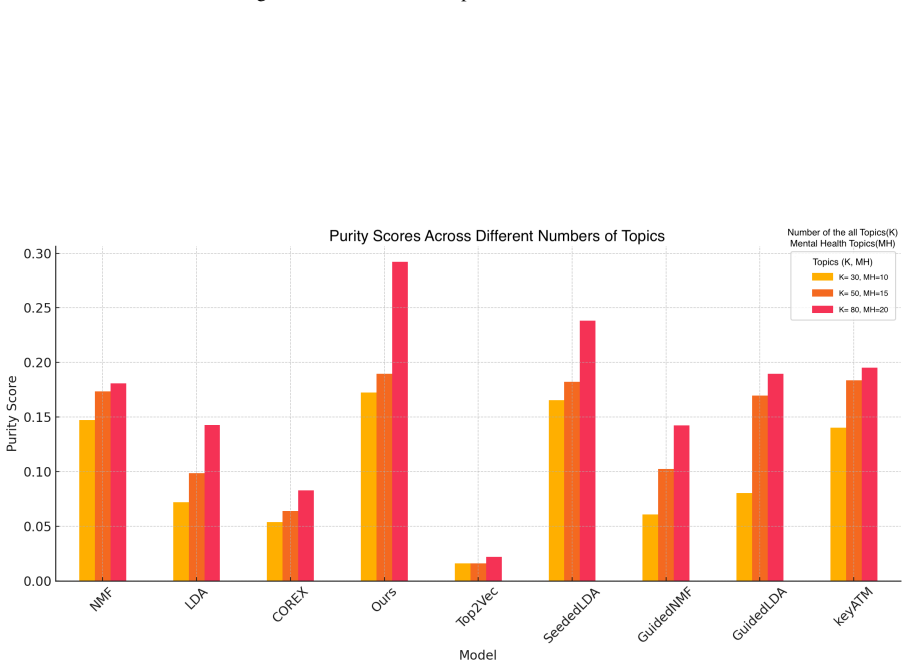
- On the synthetic benchmark the method beats both unsupervised and seed-guided baselines on purity, NMI, and Jensen-Shannon divergence, and its relative edge grows as the number of total and minority topics increases.
- The constrained formulation works on any non-negative document-term matrix, so the same pair of constraints transfers to other imbalanced corpora beyond the mental-health case study.
Reading between the lines
- A diagnostic reading of the W constraint: documents without seed words that still receive minority prevalence after fitting are exactly the cases where the seed list is incomplete; reporting them could serve as an active-learning signal for vocabulary expansion.
- If the seed list has imperfect coverage, the fixed $W_{\max}=10^{-9}$ will suppress minority content expressed through paraphrase or slang; a testable extension is to set $W_{\max}$ from a small validation set or to relax it for documents whose embeddings are close to seed words.
- The same KKT-style derivation should transfer to other constrained matrix-factorization settings where one factor needs elementwise upper bounds and another needs row-wise concentration constraints, such as source separation with labeled anchors.
Editorial analysis
A structured set of objections, weighed in public.
Referee Report
Summary. The paper proposes a constrained non-negative matrix factorization (NMF) method for guided topic modeling of minority topics. The user provides a single seed word list for the minority domain (e.g., mental health). Two inequality constraints are introduced: g1 (Eq. 1) caps the prevalence of minority topics in documents that contain no seed words, and g2 (Eq. 2) requires each minority topic to devote at least a fraction theta_min of its word mass to seed words. The model is fitted by minimizing a generalized KL divergence under these constraints, with multiplicative updates for W and H derived from KKT conditions and gradient-ascent updates for Lagrange multipliers. Experiments on a synthetic dataset report higher NMI, purity, and lower JSD than several baselines, and a case study on Finnish YouTube comments yields interpretable mental-health topics. The paper also provides an appendix with detailed derivations, ablations, and additional results.
Significance. If the method works as claimed, it offers a practical way to inject domain knowledge through a single seed list without topic-level supervision or predefined topic divisions. The idea of separating minority and majority topics with soft prevalence constraints is sensible and could be useful for analyzing low-prevalence themes in large text collections. The paper includes a thorough derivation appendix and compares against a broad set of baselines, which are strengths. However, the empirical evaluation is weakened by a likely overlap between the synthetic injected vocabulary and the seed list, and the theoretical claims about guaranteed constraint satisfaction and nonnegativity are stronger than what is actually proven. The method's simplicity and interpretability, if the issues are addressed, would make it a solid contribution to guided topic modeling.
major comments (4)
- [Section 4] The statement "Our updates derived using KKT conditions guarantee constraints are satisfied" is not supported. The KKT conditions are used only to derive stationarity conditions; the constraints are enforced via Lagrange multipliers updated by gradient ascent (Eqs. 12-13), with no convergence proof. The paper itself concedes that convergence is unproven and that constraints are not satisfied at every iteration. At best, the update rules are KKT-inspired and empirically satisfy constraints at convergence. This overclaim should be removed or explicitly qualified.
- [Appendix A.8, Eq. (21) and Algorithm 2] The update rule for H_kj in Eq. (21) has a denominator containing mu_k * (Num_k/Den_k^2 - delta_{j in S_I}/Den_k), which can be negative for seed columns j when mu_k is large. Consequently, nonnegativity of H is not guaranteed, contradicting the claim in Section 4 that the updates retain nonnegativity of W and H. The alternate rule in Eq. (22) does guarantee nonnegativity, but it is not the rule used in the experiments or in Algorithm 2. The paper should either adopt Eq. (22) as the default or provide a bound on mu_k that keeps the denominator in Eq. (21) positive.
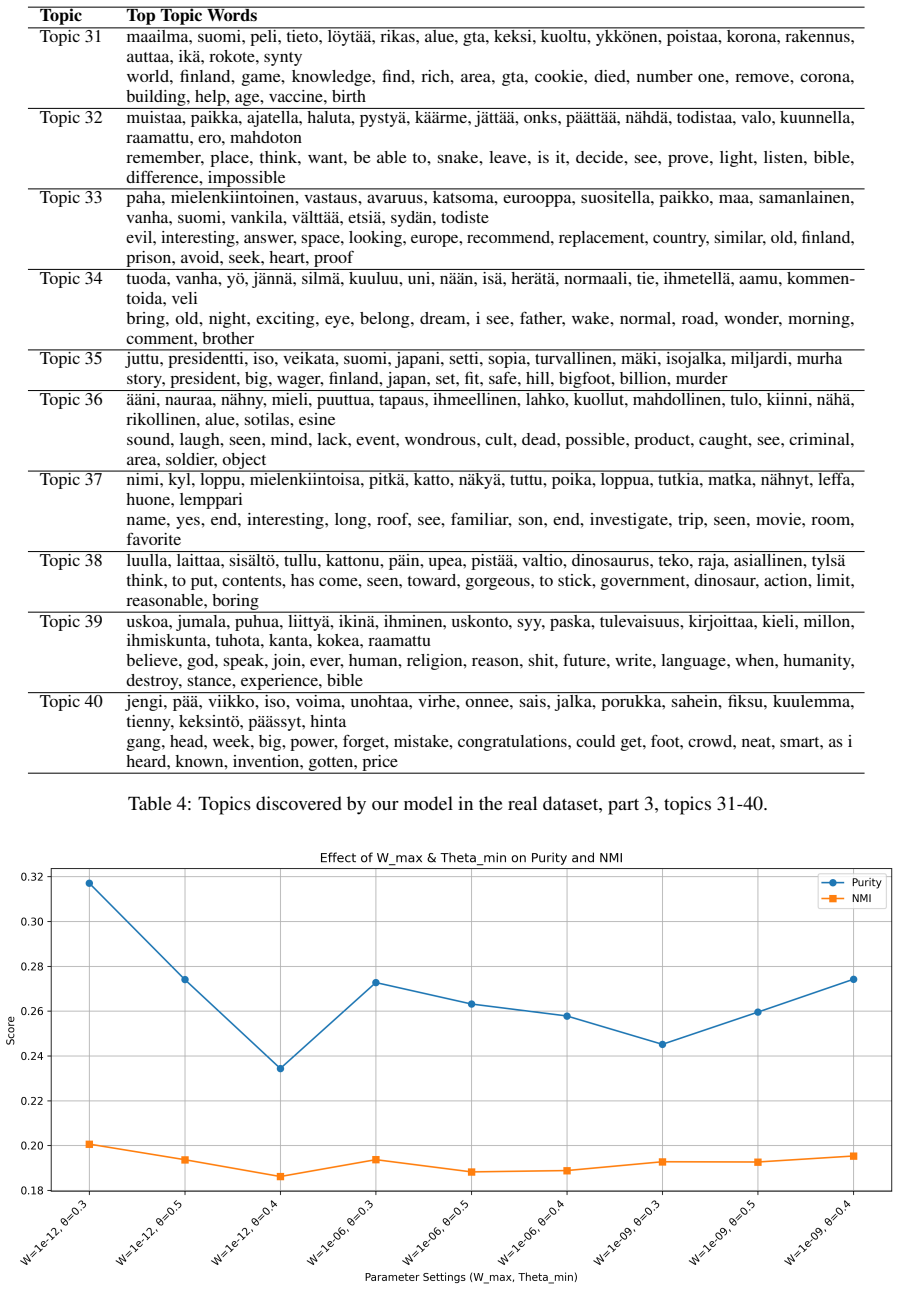
- [Section 5.1 and Appendix A.11, Eq. (1)] The constraint Wmax = 1e-9 encodes the assumption that documents without any seed word have essentially zero prevalence in minority topics. The synthetic data is generated by injecting words from a predefined 18-topic vocabulary, but the paper does not report how much this injected vocabulary overlaps with the user-provided seed list. If the overlap is high, then almost all minority documents contain seed words, I0 contains few minority documents, and the constraint's harmful effect is never exercised. The paper's claim that the seed list need not be comprehensive is thus undermined by the extreme Wmax value. The authors should report the overlap rate and add a synthetic condition where minority content is expressed through non-seed or paraphrased vocabulary.
- [Section 5.2, focused purity] The customized purity metric divides by sum_k delta(count(y_k, k) > 0) * count(k), which excludes clusters that contain no minority documents from the denominator. As written, a method that places minority documents into pure clusters and splits the rest arbitrarily can achieve a high score without meaningful separation of minority documents. This makes the reported purity improvements hard to interpret. Please also report standard purity (computed over all documents) or provide a rationale for excluding background-only clusters.
minor comments (6)
- [Section 1] The roadmap sentence says "Section 5.3 gives results and A.12 findings"; the appendix reference should be to "Section A.12".
- [Eq. (3) and Section 3.2] The Lagrangian is written as lambda * g1(W) + mu * g2(H), but the subsequent derivation treats g1 and g2 as sums of per-element constraints with individual multipliers. Please make the notation consistent, e.g., by writing explicit sums over i,k from the start.
- [Tables 2-5] The description says the real-dataset topics are split across four tables, but it is not stated how the 50 topics are partitioned across these tables; adding the topic ranges in each caption would improve clarity.
- [Appendix A.12] The text refers to "Section 6 of the main paper" when discussing results; the relevant section is Section 5.3.
- [Appendix A.13] Error bars are reported only for KL divergence across the 10 runs, not for NMI or purity. Since the main claims are about NMI/purity, reporting their mean and standard deviation would strengthen the robustness argument.
- [Appendix A.11] The seed word list is said to be available in a GitHub repository, but the repository is not named in the manuscript text; please provide a non-anonymous link or include the seed list in the supplement so that the experiments are reproducible.
Circularity Check
No demonstrated circularity: the constraints are explicit modeling assumptions and the synthetic benchmark overlap is not shown, so no load-bearing step reduces to its own inputs.
full rationale
I walked the paper's derivation chain. The method minimizes generalized KL divergence under two inequality constraints: g1 caps minority-topic prevalence in documents containing no seed words (Eq. 1), and g2 requires a minimum total seed-word share in each minority topic (Eq. 2). These are stated modeling assumptions, not quantities fitted from the data and then relabeled as predictions. The multiplicative updates are derived from KKT stationarity conditions and the constraint gradients; the update rules follow algebraically from the Lagrangian and are not circular. The synthetic evaluation is generated by injecting words from predefined mental-health topics, and the model is evaluated against those injected labels. A possible circularity would arise if the injected vocabulary were identical to the seed list used in Eq. 1, because then documents labeled as minority are exactly those permitted to carry minority prevalence. However, the paper does not state that the injected words are the seed words; it describes the synthetic topics as having 'related Finnish words' and the seed list as a separate collection of mental-health terms. Without a quoted or equation-level reduction showing that the ground-truth minority labels are equivalent to seed-list membership by construction, the concern is an experimental-validity risk rather than an exhibited circularity. The paper also explicitly acknowledges limitations: automatic coherence-style measures 'risk being misaligned or biased,' and convergence theorems are 'left to future work.' Those are honest caveats, not circular reasoning. I therefore find no load-bearing circular step and score the paper 0.
Assumptions & free parameters
free parameters (4)
- Wmax =
1e-9
- theta_min =
0.4
- eta (learning rate) =
0.001
- K_MH =
one-third of K
assumptions (5)
- standard math Standard NMF with generalized KL divergence is an appropriate generative model for document-term counts.
- ad hoc to paper Documents without any seed word should have near-zero prevalence of minority topics.
- ad hoc to paper Each minority topic must concentrate at least theta_min=0.4 of its word mass on the seed list.
- standard math KKT conditions describe the optimum of the constrained NMF problem and the proposed multiplicative updates approach it.
- domain assumption The injected words in the synthetic corpus are covered by the seed word list.
Cite this review
Pith. "Pith review of Constrained Non-negative Matrix Factorization for Guided Topic Modeling of Minority Topics." pith.science (2026). https://pith.science/paper/E7WJYSSO
@misc{pith2026250516493,
  author       = {Pith},
  title        = {Pith review of: Constrained Non-negative Matrix Factorization for Guided Topic Modeling of Minority Topics},
  year         = {2026},
  howpublished = {\url{https://pith.science/paper/E7WJYSSO}},
  note         = {Machine review of arXiv:2505.16493}
}
read the original abstract
Topic models often fail to capture low-prevalence, domain-critical themes, so-called minority topics, such as mental health themes in online comments. While some existing methods can incorporate domain knowledge, such as expected topical content, methods allowing guidance may require overly detailed expected topics, hindering the discovery of topic divisions and variation. We propose a topic modeling solution via a specially constrained NMF. We incorporate a seed word list characterizing minority content of interest, but we do not require experts to pre-specify their division across minority topics. Through prevalence constraints on minority topics and seed word content across topics, we learn distinct data-driven minority topics as well as majority topics. The constrained NMF is fitted via Karush-Kuhn-Tucker (KKT) conditions with multiplicative updates. We outperform several baselines on synthetic data in terms of topic purity, normalized mutual information, and also evaluate topic quality using Jensen-Shannon divergence (JSD). We conduct a case study on YouTube vlog comments, analyzing viewer discussion of mental health content; our model successfully identifies and reveals this domain-relevant minority content.
Figures


Figures from the paper (6 more)




Reference graph
Works this paper leans on
-
[1]
Rania Albalawi, Tet Hin Yeap, and Morad Benyoucef. 2020. https://api.semanticscholar.org/CorpusID:220497670 Using topic modeling methods for short-text data: A comparative analysis . Frontiers in Artificial Intelligence, 3
work page 2020
-
[2]
Dimitar Angelov. 2020. https://api.semanticscholar.org/CorpusID:221246303 Top2vec: Distributed representations of topics . ArXiv, abs/2008.09470
arXiv 2020
-
[3]
Michael W. Berry, Murray Browne, Amy N. Langville, V. Paul Pauca, and Robert J. Plemmons. 2007. https://doi.org/10.1016/j.csda.2006.11.006 Algorithms and applications for approximate nonnegative matrix factorization . Computational Statistics & Data Analysis, 52(1):155--173
-
[4]
Federico Bianchi, Silvia Terragni, and Dirk Hovy. 2021 a . https://doi.org/10.18653/v1/2021.acl-short.96 Pre-training is a hot topic: Contextualized document embeddings improve topic coherence . In Proceedings of the 59th Annual Meeting of the Association for Computational Linguistics and the 11th International Joint Conference on Natural Language Process...
-
[5]
Federico Bianchi, Silvia Terragni, Dirk Hovy, Debora Nozza, and Elisabetta Fersini. 2021 b . https://doi.org/10.18653/v1/2021.eacl-main.143 Cross-lingual contextualized topic models with zero-shot learning . In Proceedings of the 16th Conference of the European Chapter of the Association for Computational Linguistics: Main Volume, pages 1676--1683, Online...
-
[6]
David M. Blei, Andrew Y. Ng, and Michael I. Jordan. 2003. Latent D irichlet allocation. J. Mach. Learn. Res., 3(null):993–1022
work page 2003
- [7]
-
[8]
Dallas Card, Chenhao Tan, and Noah A. Smith. 2018. https://doi.org/10.18653/v1/P18-1189 Neural models for documents with metadata . In Proceedings of the 56th Annual Meeting of the Association for Computational Linguistics (Volume 1: Long Papers), pages 2031--2040, Melbourne, Australia. Association for Computational Linguistics
Show all 56 references
-
[9]
Jonathan Chang, Sean Gerrish, Chong Wang, Jordan Boyd-graber, and David Blei. 2009. https://proceedings.neurips.cc/paper_files/paper/2009/file/f92586a25bb3145facd64ab20fd554ff-Paper.pdf Reading tea leaves: How humans interpret topic models . In Advances in Neural Information P...
2009
-
[10]
Yong Chen, Hui Zhang, Rui Liu, Zhiwen Ye, and Jianying Lin. 2019. Experimental explorations on short text topic mining between LDA and NMF based schemes. Knowledge-Based Systems, 163:1--13
2019
-
[11]
D Manning Christopher, Raghavan Prabhakar, and Schutze Hinrich. 2008. Introduction to information retrieval
2008
-
[12]
Mrinal Das, Suparna Bhattacharya, Chiranjib Bhattacharyya, and Gopinath Kanchi. 2013. https://proceedings.mlr.press/v28/das13.html Subtle topic models and discovering subtly manifested software concerns automatically . In Proceedings of the 30th International Conference on Mac...
2013
-
[13]
Mrinal Das and Gaurav Jain. 2024. Human guided multi-proportions topic model for rare event detection without using labels. In Intelligent Systems and Applications, pages 368--385, Cham. Springer Nature Switzerland
2024
-
[14]
Roman Egger and Joanne Yu. 2022. https://api.semanticscholar.org/CorpusID:248530058 A topic modeling comparison between LDA , NMF , T op2 V ec, and BERT opic to demystify T witter posts . Frontiers in Sociology, 7
2022
-
[15]
Jacob Eisenstein, Amr Ahmed, and Eric P Xing. 2011. Sparse additive generative models of text. In Proceedings of the 28th international conference on machine learning (ICML-11), pages 1041--1048
2011
-
[16]
Shusei Eshima, Kosuke Imai, and Tomoya Sasaki. 2023. https://doi.org/10.1111/ajps.12779 Keyword‐assisted topic models . American Journal of Political Science, 68
2023 doi
-
[17]
Lorenzo Finesso and Peter Spreij. 2006. https://doi.org/10.1016/j.laa.2005.11.012 Nonnegative matrix factorization and I -divergence alternating minimization . Linear Algebra and its Applications, 416(2–3):270–287
2006 doi
-
[18]
Gallagher, Kyle Reing, David C
Ryan J. Gallagher, Kyle Reing, David C. Kale, and Greg Ver Steeg. 2016. https://api.semanticscholar.org/CorpusID:18449288 Anchored correlation explanation: Topic modeling with minimal domain knowledge . Transactions of the Association for Computational Linguistics, 5:529--542
2016
-
[19]
Benyamin Ghojogh, Ali Ghodsi, Fakhri Karray, and Mark Crowley. 2021. KKT conditions, first-order and second-order optimization, and distributed optimization: tutorial and survey. arXiv preprint arXiv:2110.01858
2021 arXiv
-
[20]
Edward F Gonzalez and Yin Zhang. 2005. Accelerating the lee-seung algorithm for non-negative matrix factorization. Dept. Comput. & Appl. Math., Rice Univ., Houston, TX, Tech. Rep. TR-05-02, pages 1--13
2005
-
[21]
Maarten Grootendorst. 2022. Bertopic: Neural topic modeling with a class-based tf-idf procedure. arXiv preprint arXiv:2203.05794
2022 arXiv
-
[22]
Jamie Haddock, Lara Kassab, Sixian Li, Alona Kryshchenko, Rachel Grotheer, Elena Sizikova, Chuntian Wang, Thomas Merkh, R. W. M. A. Madushani, Miju Ahn, Deanna Needell, and Kathryn Leonard. 2020. https://api.semanticscholar.org/CorpusID:223953533 Semi-supervised NMF models for...
2020 arXiv
-
[23]
Thomas Hofmann. 1999. https://doi.org/10.1145/312624.312649 Probabilistic latent semantic indexing . In Proceedings of the 22nd Annual International ACM SIGIR Conference on Research and Development in Information Retrieval, SIGIR '99, page 50–57, New York, NY, USA. Association...
1999
-
[24]
Alexander Hoyle, Pranav Goel, Andrew Hian-Cheong, Denis Peskov, Jordan Boyd-Graber, and Philip Resnik. 2021. Is automated topic model evaluation broken? the incoherence of coherence. Advances in neural information processing systems, 34:2018--2033
2021
-
[25]
Jagadeesh Jagarlamudi, Hal Daum \'e III, and Raghavendra Udupa. 2012. Incorporating lexical priors into topic models. In Proceedings of the 13th Conference of the European Chapter of the Association for Computational Linguistics, pages 204--213
2012
-
[26]
Yuheng Jia, Sam Kwong, Junhui Hou, and Wenhui Wu. 2020. https://doi.org/10.1109/TNNLS.2019.2933223 Semi-supervised non-negative matrix factorization with dissimilarity and similarity regularization . IEEE Transactions on Neural Networks and Learning Systems, 31(7):2510--2521
2020
-
[27]
Yuheng Jia, Hui Liu, Junhui Hou, and Sam Kwong. 2021. https://doi.org/10.1109/TCYB.2020.2969684 Semisupervised adaptive symmetric non-negative matrix factorization . IEEE Transactions on Cybernetics, 51(5):2550--2562
2021
-
[28]
James M. Joyce. 2011. https://api.semanticscholar.org/CorpusID:37718089 Kullback- L eibler divergence . In International Encyclopedia of Statistical Science
2011
-
[29]
Kenneth Lange. 2013. https://doi.org/10.1007/978-1-4614-5838-8_5 Karush-Kuhn-Tucker Theory , pages 107--135. Springer New York, New York, NY
2013 doi
-
[30]
Daniel Lee and H Sebastian Seung. 2000. Algorithms for non-negative matrix factorization. Advances in neural information processing systems, 13
2000
-
[31]
Dongha Lee, Jiaming Shen, SeongKu Kang, Susik Yoon, Jiawei Han, and Hwanjo Yu. 2022 a . Taxocom: Topic taxonomy completion with hierarchical discovery of novel topic clusters. In Proceedings of the ACM Web Conference 2022, pages 2819--2829
2022
-
[32]
Dongha Lee, Jiaming Shen, Seonghyeon Lee, Susik Yoon, Hwanjo Yu, and Jiawei Han. 2022 b . Topic taxonomy expansion via hierarchy-aware topic phrase generation. arXiv preprint arXiv:2211.01981
2022 arXiv
-
[33]
Hyekyoung Lee, Jiho Yoo, and Seungjin Choi. 2010. https://doi.org/10.1109/LSP.2009.2027163 Semi-supervised nonnegative matrix factorization . IEEE Signal Processing Letters, 17:4--7
2010
-
[34]
J. W. Leech. 1965. https://doi.org/10.1007/978-94-010-9169-5_3 The Lagrangian Formulation , pages 17--25. Springer Netherlands, Dordrecht
1965 doi
-
[35]
Chew, Longxiu Huang, Benjamin Jarman, and Deanna Needell
Pengyu Li, Christine Tseng, Yaxuan Zheng, Joyce A. Chew, Longxiu Huang, Benjamin Jarman, and Deanna Needell. 2022. https://doi.org/10.3390/a15050136 Guided semi-supervised non-negative matrix factorization . Algorithms, 15(5)
2022 doi
-
[36]
Chih-Jen Lin. 2007. https://doi.org/10.1109/TNN.2007.895831 On the convergence of multiplicative update algorithms for nonnegative matrix factorization . IEEE Transactions on Neural Networks, 18(6):1589--1596
2007
-
[37]
Yang Lin, Xin Gao, Xu Chu, Yasha Wang, Junfeng Zhao, and Chao Chen. 2023. Enhancing neural topic model with multi-level supervisions from seed words. In Findings of the Association for Computational Linguistics: ACL 2023, pages 13361--13377
2023
-
[38]
Lindstrom, Xiaofu Ding, Feng Liu, Anand Somayajula, and Deanna Needell
Michael R. Lindstrom, Xiaofu Ding, Feng Liu, Anand Somayajula, and Deanna Needell. 2022. https://api.semanticscholar.org/CorpusID:254877130 Continuous semi-supervised nonnegative matrix factorization . Algorithms, 16:187
2022
-
[39]
Jiyuan Liu, Hegang Chen, Chunjiang Zhu, and Yanghui Rao. 2024. Unsupervised hierarchical topic modeling via anchor word clustering and path guidance. In Findings of the Association for Computational Linguistics: EMNLP 2024, pages 7505--7517
2024
-
[40]
Adewale Obadimu, Esther Mead, and Nitin Agarwal. 2019. Identifying latent toxic features on Y ou T ube using non-negative matrix factorization. In The Ninth International Conference on Social Media Technologies, Communication, and Informatics, IEEE
2019
-
[41]
Duy-Tung Pham, Thien Trang Nguyen Vu, Tung Nguyen, Linh Van Ngo, Duc Anh Nguyen, and Thien Huu Nguyen. 2024. https://doi.org/10.18653/v1/2024.findings-emnlp.457 N euro M ax: Enhancing neural topic modeling via maximizing mutual information and group topic regularization . In F...
2024 doi
-
[42]
Gerard Salton and Christopher Buckley. 1988. https://doi.org/10.1016/0306-4573(88)90021-0 Term-weighting approaches in automatic text retrieval . Information Processing & Management, 24(5):513--523
1988 doi
-
[43]
Suzanna Sia, Ayush Dalmia, and Sabrina J. Mielke. 2020. https://doi.org/10.18653/v1/2020.emnlp-main.135 Tired of topic models? clusters of pretrained word embeddings make for fast and good topics too! In Proceedings of the 2020 Conference on Empirical Methods in Natural Langua...
2020 doi
-
[44]
Akash Srivastava and Charles Sutton. 2017. https://api.semanticscholar.org/CorpusID:29842525 Autoencoding variational inference for topic models . In International Conference on Learning Representations
2017
-
[45]
Greg Ver Steeg and A. G. Galstyan. 2014. https://api.semanticscholar.org/CorpusID:14240005 Discovering structure in high-dimensional data through correlation explanation . In Neural Information Processing Systems
2014
-
[46]
Joshua Vendrow, Jamie Haddock, Elizaveta Rebrova, and Deanna Needell. 2021. https://doi.org/10.1109/ICASSP39728.2021.9413656 On a guided nonnegative matrix factorization . In ICASSP 2021 - 2021 IEEE International Conference on Acoustics, Speech and Signal Processing (ICASSP), ...
2021
-
[47]
Yu-Xiong Wang and Yu-Jin Zhang. 2013. https://doi.org/10.1109/TKDE.2012.51 Nonnegative matrix factorization: A comprehensive review . IEEE Transactions on Knowledge and Data Engineering, 25(6):1336--1353
2013 doi
-
[48]
Xiaobao Wu, Xinshuai Dong, Thong Thanh Nguyen, and Anh Tuan Luu. 2023. Effective neural topic modeling with embedding clustering regularization. In International Conference on Machine Learning, pages 37335--37357. PMLR
2023
-
[49]
Xiaobao Wu, Thong Nguyen, and Anh Tuan Luu. 2024 a . https://api.semanticscholar.org/CorpusID:267297321 A survey on neural topic models: Methods, applications, and challenges . ArXiv, abs/2401.15351
2024 arXiv
-
[50]
Xiaobao Wu, Thong Thanh Nguyen, Delvin Ce Zhang, William Yang Wang, and Anh Tuan Luu. 2024 b . https://openreview.net/forum?id=7t6aq0Fa9D FAST opic: Pretrained transformer is a fast, adaptive, stable, and transferable topic model . In The Thirty-eighth Annual Conference on Neu...
2024
-
[51]
Yu Zhang, Yunyi Zhang, Martin Michalski, Yucheng Jiang, Yu Meng, and Jiawei Han. 2023. https://doi.org/10.1145/3539597.3570475 Effective seed-guided topic discovery by integrating multiple types of contexts . In Proceedings of the Sixteenth ACM International Conference on Web ...
2023
-
[52]
Zhong-Yuan Zhang. 2012. Nonnegative matrix factorization: models, algorithms and applications. Data Mining: Foundations and Intelligent Paradigms: Volume 2: Statistical, Bayesian, Time Series and other Theoretical Aspects, pages 99--134
2012
-
[53]
He Zhao, Dinh Phung, Viet Huynh, Yuan Jin, Lan Du, and Wray Buntine. 2021 a . Topic modelling meets deep neural networks: A survey. arXiv preprint arXiv:2103.00498
2021 arXiv
-
[54]
He Zhao, Dinh Phung, Viet Huynh, Trung Le, and Wray Buntine. 2021 b . https://openreview.net/forum?id=Oos98K9Lv-k Neural topic model via optimal transport . In International Conference on Learning Representations
2021
-
[55]
online" 'onlinestring :=
ENTRY address archivePrefix author booktitle chapter edition editor eid eprint eprinttype howpublished institution journal key month note number organization pages publisher school series title type volume year doi pubmed url lastchecked label extra.label sort.label short.list...
-
[56]
write newline
" write newline "" before.all 'output.state := FUNCTION n.dashify 't := "" t empty not t #1 #1 substring "-" = t #1 #2 substring "--" = not "--" * t #2 global.max substring 't := t #1 #1 substring "-" = "-" * t #2 global.max substring 't := while if t #1 #1 substring * t #2 gl...
Reviewed August 7, 2026 · model on record in the stance chip above.
Discussion (0). Sign in to comment.