REVIEW 3 major objections 4 minor 51 references
Learning to Demodulate from Few Pilots via Offline and Online Meta-Learning
T0 review · 3 major / 4 minor · reviewed 2026-08-14 · deepseek-v4-flash
Pith's one-line read Meta-learning can train a demodulator that adapts to a new device's channel and distortions from a single pilot, outperforming both training from scratch and joint training on all past data.
desk verdict A solid meta-learning-for-demodulation paper whose online pilot-selection scheme is the real novelty; the few-pilot gains are shown only under matched training/test distributions. read the letter →
The pith
A machine-rendered reading of the paper's core claim, the machinery that carries it, and where it could break.
The reading
What carries the argument
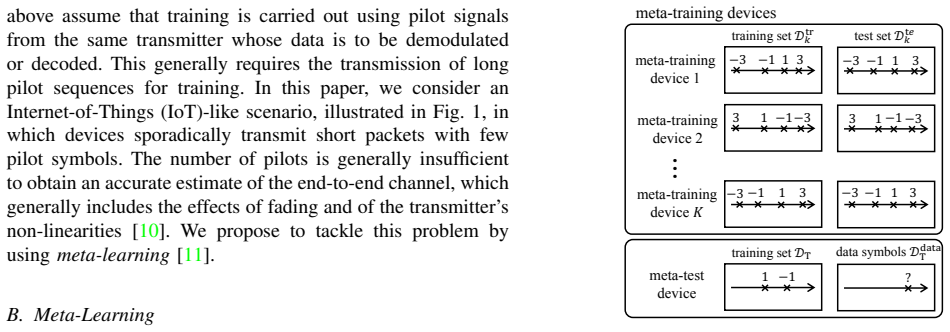
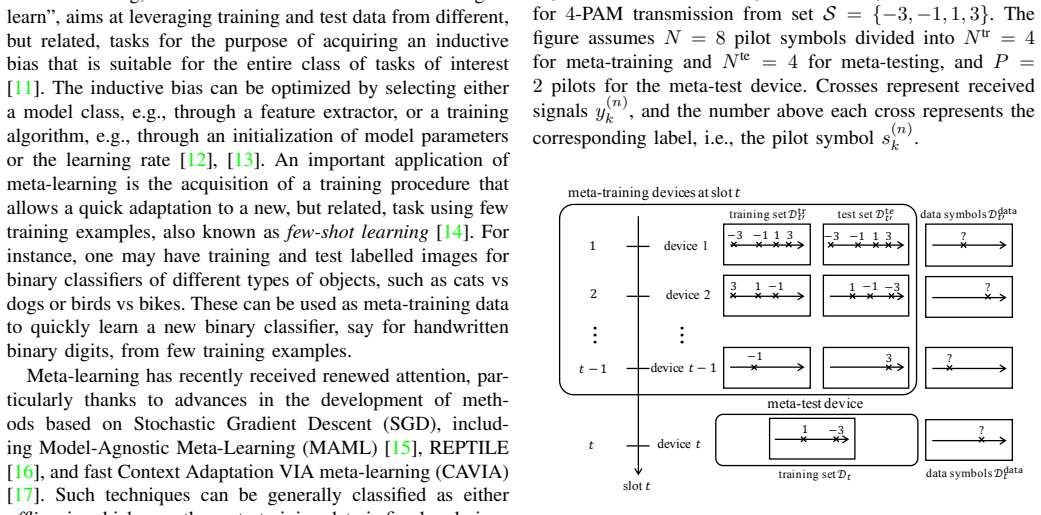
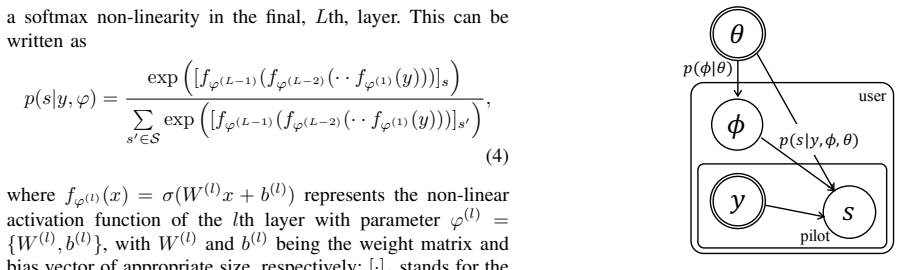
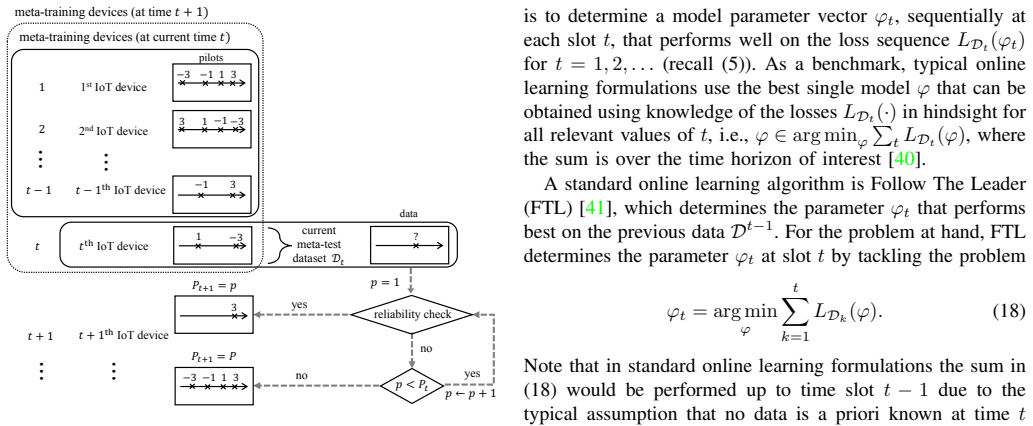
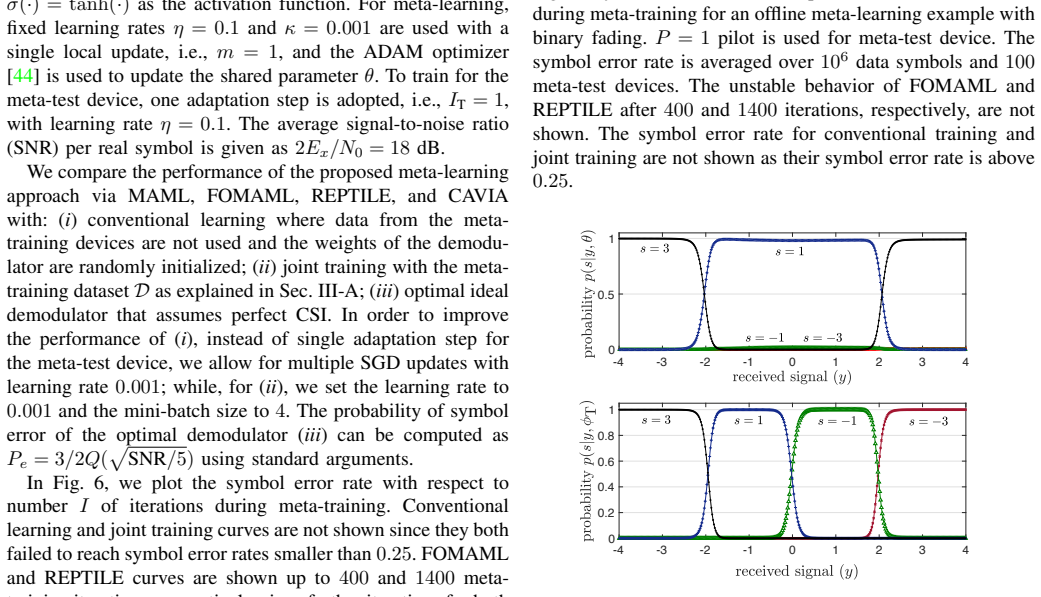
The load-bearing mechanism is gradient-based meta-learning: instead of training a single demodulator on all past data, the receiver learns a shared parameter vector $\theta$ such that one or a few gradient steps on a new device's own pilots produce a well-adapted demodulator. MAML implements this by treating the demodulator weights themselves as the per-device context and running a few stochastic-gradient-descent (SGD) updates from $\theta$; CAVIA keeps $\theta$ fixed and instead adapts a small context vector $\varphi$ that is concatenated to the received signal as an extra input. The paper unifies these schemes through an expectation-maximization view of a graphical model in which $\theta$ is the shared parameter and $\varphi$ is a per-user latent variable estimated by gradient descent. In the online setting, the shared parameter is updated from all past slots and a reliability check on the demodulated data decides the number of pilots to request from the next device.
What would settle it
Train a meta-initialization on devices with I/Q amplitude imbalance in [0, 0.15] and phase imbalance in [0°, 15°], then evaluate it on a new device with amplitude imbalance 0.5 and phase imbalance 40° using the same number of pilots. If the symbol error rate is no better than training from a random initialization on that device's own pilots, the central relatedness assumption fails.
Extended reading notes
Core claim
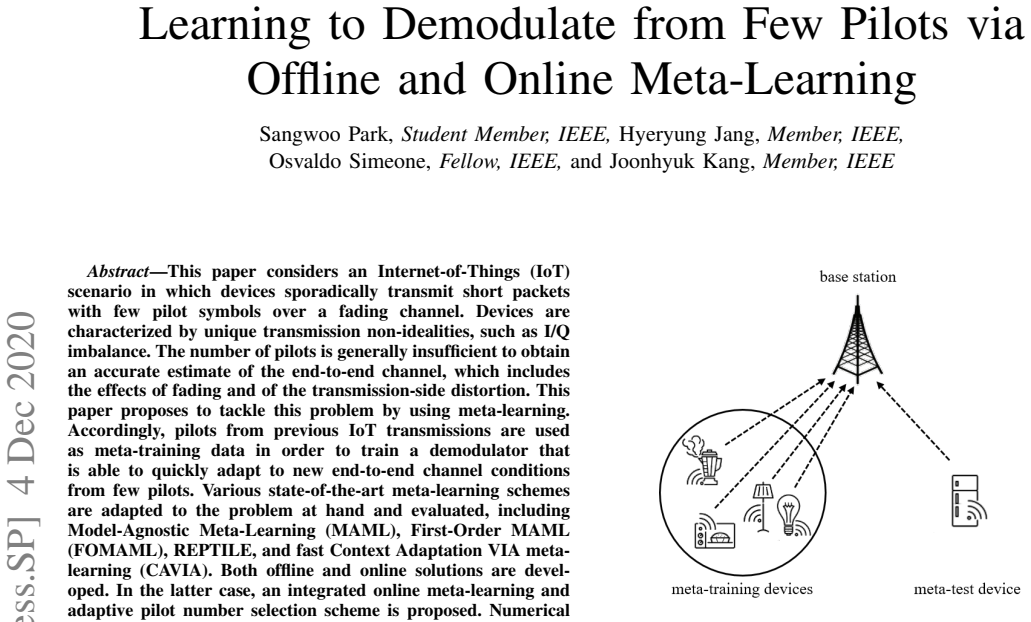
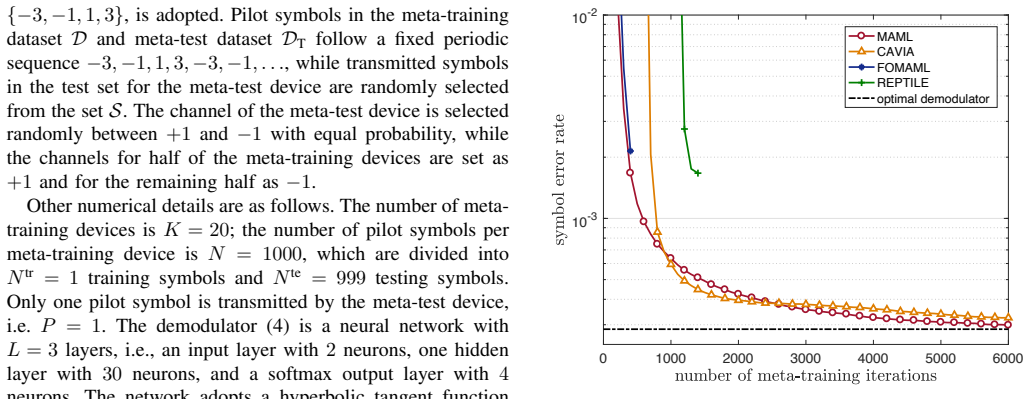
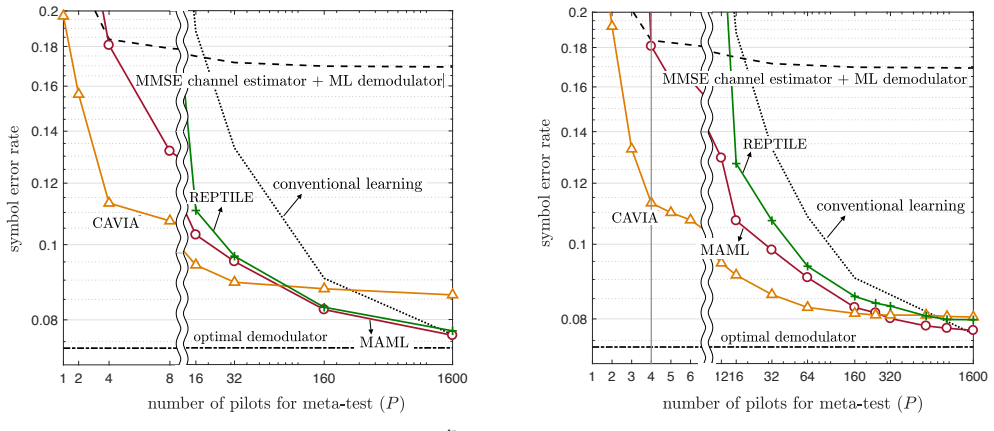
The paper's central claim is that a demodulator can be meta-trained on pilot symbols harvested from previous IoT transmitters so that, when a new device appears, a very small number of its own pilots suffices to specialize the demodulator to that device's end-to-end channel, including Rayleigh fading and the device's idiosyncratic I/Q imbalance. In the simplest experiment, with binary fading and exactly one pilot for the new device, both MAML and CAVIA approach the symbol error rate of the optimal demodulator that has perfect channel knowledge. In the more realistic 16-QAM (16-point quadrature-amplitude-modulation) Rayleigh-fading scenario with I/Q imbalance, MAML and CAVIA outperform a conventional minimum-mean-square-error (MMSE) channel-estimation baseline that ignores the imbalance, while conventional training from a random initialization and joint training on all pooled prior pilots fail to transfer knowledge. The paper also claims that an online version, which accumulates past devices as meta-training data and adaptively selects the number of pilots per slot, reduces pilot overhead with negligible degradation of the demodulator's error rate.
Load-bearing premise
The new device's radio distortions must follow the same statistical pattern as the distortions of the devices used to train the shared starting point; otherwise the learned starting point can be worse than a random one.
Editorial extensions
If this is right
- With enough meta-training devices, a receiver can approach the ideal-demodulator error rate from a single pilot, so per-device training sequences can be nearly eliminated.
- Meta-learning beats both conventional training from scratch and joint training on all previous pilots, which shows that prior transmissions are useful only when treated as separate tasks rather than pooled into one dataset.
- CAVIA is the better scheme when pilots are extremely scarce, while MAML becomes preferable once more pilots or more meta-training devices are available.
- The online meta-learner can cut the average number of pilots per device while keeping symbol error rate nearly unchanged, by requesting only as many pilots as the reliability check requires.
- In I/Q-impaired links, meta-learning also outperforms an MMSE channel estimator followed by a maximum-likelihood demodulator, because the meta-trained demodulator implicitly captures the distortion distribution instead of ignoring it.
Reading between the lines
- A testable extension would apply the same task decomposition to other per-device impairments, such as phase noise, amplifier nonlinearity, or carrier-frequency offset, since the machinery only needs a distribution over device-specific distortions.
- If the reliability check in the online scheme uses demodulator confidence rather than a CRC or decoder feedback, an overconfident demodulator could request too few pilots; swapping in a decoder-based check is a natural improvement.
- For non-stationary device populations, the offline meta-initialization should degrade exactly when the distortion distribution drifts, so an online meta-learner that discounts old devices is a plausible remedy worth testing.
- The EM interpretation suggests that Bayesian or variational versions of CAVIA and MAML, which keep uncertainty over the context vector, should inherit the few-pilot gains while being more robust to unusual new devices.
Signed reviews
Editorial analysis
A structured set of objections, weighed in public.
Referee Report
Summary. The paper considers an IoT scenario in which devices transmit short packets with few pilots, and the end-to-end channel includes device-specific transmitter non-idealities such as I/Q imbalance. The authors propose to use meta-learning to train a demodulator that can adapt to a new device from very few pilots, using prior transmissions from other devices as meta-training data. They adapt four offline meta-learning algorithms (MAML, FOMAML, REPTILE, CAVIA), provide a unified EM-style interpretation, and extend the framework to an online setting with adaptive pilot number selection. Numerical experiments in Rayleigh fading with I/Q imbalance show that MAML and CAVIA can approach the performance of an optimal demodulator with one pilot in a simple binary-fading example and outperform an MMSE-based conventional scheme in more realistic 16-QAM setups. The paper also presents an adaptive pilot-number-selection mechanism and reports a pilot-overhead reduction with limited degradation.
Significance. If the claims hold, this is a useful and timely application of meta-learning to a practical communications problem. The paper's strengths include a clear problem formulation, a comprehensive comparison of several meta-learning algorithms, extensive numerical experiments, and publicly available code at https://github.com/kclip/meta-demodulator. The online adaptive-pilot-number-selection scheme is a sensible contribution to reduce overhead. The results are interesting for the signal-processing and communications community, and the paper is generally well written. The main qualification is that the empirical evidence is obtained under a matched meta-train/meta-test distribution, while the paper's own discussion acknowledges that the learned inductive bias can degrade performance when that assumption is violated.
major comments (3)
- [Sec. V-B and V-C, Figs. 8-12] The experiments establish the few-pilot advantage only under exact distribution matching between meta-training and meta-test devices. In Sec. V-B all channels are Rayleigh with h_k ~ CN(0,1) and I/Q imbalance parameters are drawn from the same Beta(5,2)-scaled model for both meta-training and meta-test; Sec. V-C uses the same simulator in every slot. No experiment applies the learned initialization to a device whose channel or distortion statistics differ from the training population. The paper acknowledges in Sec. V-B that with sufficient pilots 'the inductive bias inferred by meta-training can hence cause a performance degradation,' but the condition for failure is defined only by pilot count, not by distribution mismatch. The central claim should be stated as conditional on task relatedness, and ideally tested with a mismatched-distribution experiment (e.g., different I/Q imbalance range, different SNR, or different fading model).
- [Fig. 6 and Fig. 8] The central comparison against conventional learning and joint training is presented selectively. In Fig. 6, the conventional-learning and joint-training curves are omitted entirely because their SER exceeded 0.25, and in Fig. 8 all schemes worse than MMSE are omitted. FOMAML and REPTILE curves in Fig. 6 are truncated at 400 and 1400 iterations because of instability. This prevents the reader from seeing the magnitude of the advantage over the baselines and the full relative behavior of the meta-learning variants. The authors should report the omitted values in a table or in the text, and show the truncated curves' behavior at least up to the point where they diverge.
- [Sec. IV-D, Algorithm 4, Fig. 12] The adaptive pilot number selection relies on a reliability threshold applied to the demodulator's maximum softmax value on the payload (Eq. 20). The threshold is a free parameter; Fig. 12 shows the resulting trade-off curves for selected thresholds but does not provide a principled choice or a sensitivity analysis. The conclusion that the scheme 'reduces the pilot overhead with negligible performance degradation' is not quantified against a full-pilot baseline, so the 'negligible' claim is not established. Please add a quantitative comparison (e.g., SER degradation relative to using P=32 pilots in every slot) and state how the threshold would be set in practice.
minor comments (4)
- [Eq. (13)] In Eq. (13), the notation is ambiguous; it should be written as θ ← θ - κ Σ_{k=1}^K ∇_{φ_k} L_{D_k^{te}}(φ_k) to clarify that the gradient is with respect to the adapted parameter φ_k for each task.
- [Algorithm 1 and Algorithm 2] In Algorithm 1 and Algorithm 2, the returned meta-training iterate is described as minimizing Σ_{k∈K'} L_{D_k^{te}}(θ), but the loss is evaluated at the adapted parameters φ_k (or at θ for CAVIA); this should be made consistent with the equations in Section III.
- [Fig. 8 caption] The caption for Fig. 8 says 'N_tr + N_te = 3200 pilots' while the text states N=3200; the notation should be harmonized.
- [Abstract and Introduction] The abstract states that the paper 'proposes to tackle this problem by using meta-learning,' but most of the algorithms are imported from the prior literature. The novelty lies in the application, the online integration, and the adaptive pilot selection; the text would benefit from an explicit statement of which components are new versus adapted.
Circularity Check
No circularity: the few-pilot demodulation results are empirical comparisons against independent baselines, with algorithms imported from external references and no prediction that reduces by construction to its inputs.
full rationale
The paper's central claim is that meta-learning enables a demodulator to adapt to a new device from few pilots. This is supported by numerical experiments comparing MAML, FOMAML, REPTILE, CAVIA, conventional training, joint training, and an MMSE-based model demodulator on synthetically generated Rayleigh fading channels with I/Q imbalance. The algorithms themselves are taken from external prior work ([15], [16], [17], [18]) and adapted, not derived from the paper's own assumptions in a way that would encode the results. The EM-based 'unified view' in Sec. III-B is explicitly introduced as an interpretation and is not used to derive the numerical gains. The online adaptive pilot selection is a proposed heuristic evaluated against non-adaptive baselines, and its reliability check uses the demodulator's own loss (20), but the reported pilot-overhead reduction is an experimental outcome, not a quantity that equals the check by construction. The paper does contain self-citations ([1], [22], [23]) and discloses that results were partially presented in [1], but these citations do not supply the measured curves or force the conclusions; the experimental data are generated fresh with independent baselines. The load-bearing premise of task relatedness is stated as an assumption (Sec. I-B) and is also acknowledged as a potential limitation in Sec. V-B, where the paper notes that with enough pilots conventional learning can outperform meta-learning because the inductive bias can cause degradation. This admission is a limitation, not evidence of circular reasoning. No step in the derivation chain defines a predicted quantity in terms of an input that already contains it, nor does any fitted parameter get renamed as a prediction. Therefore the appropriate finding is no significant circularity.
Assumptions & free parameters
free parameters (1)
- reliability threshold =
0.1 for CAVIA; 0.05 for MAML; swept over (0, 0.01, 0.05, 0.1, 0.15)
assumptions (4)
- domain assumption Quasi-static fading channel y = h x + z with AWGN and block-constant h.
- domain assumption Pilots and data symbols follow the same constellation and are subject to the same transmitter non-idealities.
- domain assumption Meta-training and meta-test devices are drawn from the same task distribution.
- domain assumption I/Q imbalance follows the Tandur-Moonen model (3) with Beta(5,2) parameters.
Cite this review
Pith. "Pith review of Learning to Demodulate from Few Pilots via Offline and Online Meta-Learning." pith.science (2026). https://pith.science/paper/E7Z2KMTH
@misc{pith2026190809049,
  author       = {Pith},
  title        = {Pith review of: Learning to Demodulate from Few Pilots via Offline and Online Meta-Learning},
  year         = {2026},
  howpublished = {\url{https://pith.science/paper/E7Z2KMTH}},
  note         = {Machine review of arXiv:1908.09049}
}
read the original abstract
This paper considers an Internet-of-Things (IoT) scenario in which devices sporadically transmit short packets with few pilot symbols over a fading channel. Devices are characterized by unique transmission non-idealities, such as I/Q imbalance. The number of pilots is generally insufficient to obtain an accurate estimate of the end-to-end channel, which includes the effects of fading and of the transmission-side distortion. This paper proposes to tackle this problem by using meta-learning. Accordingly, pilots from previous IoT transmissions are used as meta-training data in order to train a demodulator that is able to quickly adapt to new end-to-end channel conditions from few pilots. Various state-of-the-art meta-learning schemes are adapted to the problem at hand and evaluated, including Model-Agnostic Meta-Learning (MAML), First-Order MAML (FOMAML), REPTILE, and fast Context Adaptation VIA meta-learning (CAVIA). Both offline and online solutions are developed. In the latter case, an integrated online meta-learning and adaptive pilot number selection scheme is proposed. Numerical results validate the advantages of meta-learning as compared to training schemes that either do not leverage prior transmissions or apply a standard joint learning algorithms on previously received data.
Figures
Figures from the paper (7 more)


Reference graph
Works this paper leans on
-
[1]
Learning how to demodulate from few pilots via meta-learning,
S. Park, H. Jang, O. Simeone, and J. Kang, “Learning how to demodulate from few pilots via meta-learning,” in Proc. IEEE Signal Processing Advances in Wireless Commun. (SPAWC), Cannes, France, July 2019
work page 2019
-
[2]
Short packets over block-memoryless fading channels: Pilot-assisted or noncoherent transmission?
J. ¨Ostman, G. Durisi, E. G. Str ¨om, M. C. Cos ¸kun, and G. Liva, “Short packets over block-memoryless fading channels: Pilot-assisted or noncoherent transmission?” IEEE Trans. Commun. , vol. 67, no. 2, pp. 1521–1536, Feb. 2019
work page 2019
-
[3]
Applications of neural networks to digital communications–a survey,
M. Ibnkahla, “Applications of neural networks to digital communications–a survey,” Signal Processing , vol. 80, no. 7, pp. 1185–1215, July 2000
work page 2000
-
[4]
A very brief introduction to machine learning with ap- plications to communication systems,
O. Simeone, “A very brief introduction to machine learning with ap- plications to communication systems,” IEEE Trans. Cognitive Commun. and Netw., vol. 4, no. 4, pp. 648–664, Nov. 2018
work page 2018
-
[5]
Equalisation of satellite mo- bile channels with neural network techniques,
S. Bouchired, D. Roviras, and F. Castani ´e, “Equalisation of satellite mo- bile channels with neural network techniques,” Space Communications, vol. 15, no. 4, pp. 209–220, 1998/1999
work page 1998
-
[6]
An introduction to deep learning for the physical layer,
T. O’Shea and J. Hoydis, “An introduction to deep learning for the physical layer,”IEEE Trans. Cognitive Commun. and Netw., vol. 3, no. 4, pp. 563–575, Dec. 2017
work page 2017
-
[7]
Deep learning based communication over the air,
S. D ¨orner, S. Cammerer, J. Hoydis, and S. ten Brink, “Deep learning based communication over the air,” IEEE Journal of Selected Topics in Signal Processing, vol. 12, no. 1, pp. 132–143, 2017
work page 2017
-
[8]
Adaptive Neural Signal Detection for Massive MIMO
M. Khani, M. Alizadeh, J. Hoydis, and P. Fleming, “Adaptive neural signal detection for massive MIMO,” arXiv preprint arXiv:1906.04610 , 2019
work page Pith review arXiv 1906
Show all 51 references
-
[9]
Hastie, R
T. Hastie, R. Tibshirani, and J. Friedman, The Elements Of Statistical Learning: Data Mining, Inference, and Prediction , 2nd ed. New York: Springer, 2009
2009
-
[10]
On the robustness of spatial modulation to I/Q imbalance,
A. G. Helmy, M. Di Renzo, and N. Al-Dhahir, “On the robustness of spatial modulation to I/Q imbalance,” IEEE Commun. Letters , vol. 21, no. 7, pp. 1485–1488, July 2017
2017
-
[11]
Lifelong learning algorithms,
S. Thrun, “Lifelong learning algorithms,” in Learning to Learn. Springer, 1998, pp. 181–209
1998
-
[12]
Recasting gradient-based meta-learning as hierarchical bayes,
E. Grant, C. Finn, S. Levine, T. Darrell, and T. Griffiths, “Recasting gradient-based meta-learning as hierarchical bayes,” arXiv preprint arXiv:1801.08930, 2018
2018 arXiv
-
[13]
From Learning to Meta-Learning: Reduced Training Overhead and Complexity for Communication Sys- tems,
O. Simeone, S. Park, and J. Kang, “From Learning to Meta-Learning: Reduced Training Overhead and Complexity for Communication Sys- tems,” in Proc. 6G Wireless Summit , Lapland, Finland, Mar. 2020
2020
-
[14]
Matching networks for one shot learning,
O. Vinyals, C. Blundell, T. Lillicrap, K. Kavukcuoglu, and D. Wierstra, “Matching networks for one shot learning,” in Proc. Advances in Neural Information Processing Systems (NIPS) , pp. 3630–3638, Barcelona, Spain, Dec. 2016
2016
-
[15]
Model-agnostic meta-learning for fast adaptation of deep networks,
C. Finn, P. Abbeel, and S. Levine, “Model-agnostic meta-learning for fast adaptation of deep networks,” arXiv preprint arXiv:1703.03400 , 2017
2017 arXiv
-
[16]
On first-order meta-learning algorithms,
A. Nichol, J. Achiam, and J. Schulman, “On first-order meta-learning algorithms,” arXiv preprint arXiv:1803.02999 , 2018
2018 arXiv
-
[17]
Fast context adaptation via meta-learning,
L. Zintgraf, K. Shiarli, V . Kurin, K. Hofmann, and S. Whiteson, “Fast context adaptation via meta-learning,” in Proc. International Conference on Machine Learning (ICML) , pp. 7693–7702, Long Beach, California, June 2019
2019
-
[18]
Online meta- learning,
C. Finn, A. Rajeswaran, S. Kakade, and S. Levine, “Online meta- learning,” arXiv preprint arXiv:1902.08438 , 2019
1902 arXiv
-
[19]
Mind: Model independent neural decoder,
Y . Jiang, H. Kim, H. Asnani, and S. Kannan, “Mind: Model independent neural decoder,” in Proc. IEEE Signal Processing Advances in Wireless Commun. (SPAWC), Cannes, France, July 2019
2019
-
[20]
RoemNet: Robust meta learning based channel estimation in OFDM systems,
H. Mao, H. Lu, Y . Lu, and D. Zhu, “RoemNet: Robust meta learning based channel estimation in OFDM systems,” in Proc IEEE Int. Conf. Commun. (ICC), Shanghai, China, May 2019
2019
-
[21]
Deep Transfer Learning Based Downlink Channel Prediction for FDD Massive MIMO Systems,
Y . Yang, F. Gao, Z. Zhong, B. Ai, and A. Alkhateeb, “Deep Transfer Learning Based Downlink Channel Prediction for FDD Massive MIMO Systems,” arXiv preprint arXiv:1912.12265 , 2019
1912 arXiv
-
[22]
Meta-learning to communicate: Fast end-to-end training for fading channels,
S. Park, O. Simeone, and J. Kang, “Meta-learning to communicate: Fast end-to-end training for fading channels,” in Proc. IEEE 45th Int. Conf. Acoustics, Speech, and Signal Processing (ICASSP) , Barcelona, Spain, May 2020
2020
-
[23]
End-to-End Fast Training of Communication Links Without a Channel Model via Online Meta- Learning,
S. Park, O. Simeone, and J. Kang, “End-to-End Fast Training of Communication Links Without a Channel Model via Online Meta- Learning,” arXiv preprint arXiv:2003.01479 , 2020
2003 arXiv
-
[24]
Deep HyperNetwork-Based MIMO Detection,
M. Goutay, F. A. Aoudia, and J. Hoydis, “Deep HyperNetwork-Based MIMO Detection,” arXiv preprint arXiv:2002.02750 , 2020
2002 arXiv
-
[25]
M-QAM-OFDM system performance in the presence of a nonlinear amplifier and phase noise,
E. Costa and S. Pupolin, “M-QAM-OFDM system performance in the presence of a nonlinear amplifier and phase noise,” IEEE Trans. Commun., vol. 50, no. 3, pp. 462–472, Mar. 2002. 13
2002
-
[26]
On the performance of standard- independent I/Q imbalance compensation in OFDM direct-conversion receivers,
M. Windisch and G. Fettweis, “On the performance of standard- independent I/Q imbalance compensation in OFDM direct-conversion receivers,” in Proc. IEEE European Signal Processing Conference , pp. 1–5, Antalya, Turkey, Sep. 2005
2005
-
[27]
Joint adaptive compensation of transmitter and receiver IQ imbalance under carrier frequency offset in OFDM- based systems,
D. Tandur and M. Moonen, “Joint adaptive compensation of transmitter and receiver IQ imbalance under carrier frequency offset in OFDM- based systems,” IEEE Trans. Signal Processing , vol. 55, no. 11, pp. 5246–5252, Nov. 2007
2007
-
[28]
C. M. Bishop, Pattern recognition and machine learning. Springer, 2006
2006
-
[29]
A brief introduction to machine learning for engineers,
O. Simeone, “A brief introduction to machine learning for engineers,” Foundations and Trends in Signal Processing, vol. 12, no. 3-4, pp. 200– 431, 2018
2018
-
[30]
Goodfellow, Y
I. Goodfellow, Y . Bengio, and A. Courville, Deep Learning. MIT Press, 2016
2016
-
[31]
Koller and N
D. Koller and N. Friedman, Probabilistic Graphical Models: Principles and Techniques. MIT Press, 2009
2009
-
[32]
Amortized bayesian meta-learning,
S. Ravi and A. Beatson, “Amortized bayesian meta-learning,” in Proc. International Conference on Learning Representations (ICLR) , New Orleans, United States, May 2019
2019
-
[33]
Meta- learning probabilistic inference for prediction,
J. Gordon, J. Bronskill, M. Bauer, S. Nowozin, and R. Turner, “Meta- learning probabilistic inference for prediction,” in Proc. International Conference on Learning Representations (ICLR) , New Orleans, United States, May 2019
2019
-
[34]
Uncertainty in model- agnostic meta-learning using variational inference,
C. Nguyen, T.-T. Do, and G. Carneiro, “Uncertainty in model- agnostic meta-learning using variational inference,” arXiv preprint arXiv:1907.11864, 2019
1907 arXiv
-
[35]
How to train your MAML,
A. Antoniou, H. Edwards, and A. Storkey, “How to train your MAML,” arXiv preprint arXiv:1810.09502 , 2018
2018 arXiv
-
[36]
Efficient backprop,
Y . A. LeCun, L. Bottou, G. B. Orr, and K.-R. M ¨uller, “Efficient backprop,” in Neural Networks: Tricks of the Trade . pp. 9–48, Springer, 2012
2012
-
[37]
Accelerated conjugate gradient algorithm with finite differ- ence Hessian/vector product approximation for unconstrained optimiza- tion,
N. Andrei, “Accelerated conjugate gradient algorithm with finite differ- ence Hessian/vector product approximation for unconstrained optimiza- tion,” Journal of Computational and Applied Mathematics , vol. 230, no. 2, pp. 570–582, Aug. 2009
2009
-
[38]
Explaining and harnessing adversarial examples,
I. J. Goodfellow, J. Shlens, and C. Szegedy, “Explaining and harnessing adversarial examples,” arXiv preprint arXiv:1412.6572 , 2014
2014 arXiv
-
[39]
Advances and open problems in federated learning,
P. Kairouz et al., “Advances and open problems in federated learning,” arXiv preprint arXiv:1912.04977 , 2019
1912 arXiv
-
[40]
Online learning and online convex optimization,
S. Shalev-Shwartz, “Online learning and online convex optimization,” Foundations and Trends in Machine Learning , vol. 4, no. 2, pp. 107– 194, 2012
2012
-
[41]
Approximation to bayes risk in repeated play,
J. Hannan, “Approximation to bayes risk in repeated play,” Contributions to the Theory of Games , vol. 3, pp. 97–139, 1957
1957
-
[42]
Adaptive pilot pattern for OFDM systems,
O. Simeone and U. Spagnolini, “Adaptive pilot pattern for OFDM systems,” in Proc IEEE Int. Conf. Commun. (ICC) , pp. 978–982, Paris, France, June 2004
2004
-
[43]
A primer on 3GPP narrowband Internet of Things,
Y .-P. E. Wang, et al., “A primer on 3GPP narrowband Internet of Things,” IEEE Commun. Mag. , vol. 55, no. 3, pp. 117–123, Mar. 2017
2017
-
[44]
Adam: A method for stochastic optimization,
D. P. Kingma and J. Ba, “Adam: A method for stochastic optimization,” arXiv preprint arXiv:1412.6980 , 2014
2014 arXiv
-
[45]
Improving generalization performance by switching from ADAM to SGD,
N. S. Keskar and R. Socher, “Improving generalization performance by switching from ADAM to SGD,” arXiv preprint arXiv:1712.07628 , 2017
2017 arXiv
-
[46]
Meta-learning by adjusting priors based on extended PAC-Bayes theory,
R. Amit and R. Meir, “Meta-learning by adjusting priors based on extended PAC-Bayes theory,” arXiv preprint arXiv:1711.01244 , 2017
2017 arXiv
-
[47]
Information-centric grant-free access for IoT fog networks: Edge vs cloud detection and learning,
R. Kassab, O. Simeone, and P. Popovski, “Information-centric grant-free access for IoT fog networks: Edge vs cloud detection and learning,” arXiv preprint arXiv:1907.05182 , 2019
1907 arXiv
-
[48]
Online supervised learning for traffic load prediction in framed-ALOHA networks,
N. Jiang, Y . Deng, O. Simeone, and A. Nallanathan, “Online supervised learning for traffic load prediction in framed-ALOHA networks,” IEEE Commun. Letters, vol. 23, no. 10, pp. 1778–1782, Oct. 2019
2019
-
[49]
Compressive sensing with prior support quality information and application to massive MIMO channel estima- tion with temporal correlation,
X. Rao and V . K. N. Lau, “Compressive sensing with prior support quality information and application to massive MIMO channel estima- tion with temporal correlation,” IEEE Trans. Signal Processing, vol. 63, no. 18, pp. 4914-4924, Sept.15, 2015
2015
-
[50]
Spatially common sparsity based adaptive channel estimation and feedback for FDD massive MIMO,
Z. Gao, L. Dai, Z. Wang and S. Chen, “Spatially common sparsity based adaptive channel estimation and feedback for FDD massive MIMO,” IEEE Trans. Signal Processing , vol. 63, no. 23, pp. 6169-6183, Dec.1, 2015
2015
-
[51]
What every computer scientist should know about floating-point arithmetic,
D. Goldberg, “What every computer scientist should know about floating-point arithmetic,” ACM Computing Surveys (CSUR) , vol. 23, no. 1, pp. 5–48, 1991. Sangwoo Park (Student Member, IEEE) received his B.S. degree in physics in 2014 and the M.S.E degree in electrical engineerin...
1991
Reviewed August 14, 2026 · model on record in the stance chip above.
Discussion (0). Continue with ORCID to comment.