REVIEW 4 major objections 5 minor 55 references
The mass splitting among the isospin multiplets of light vector mesons
T0 review · 4 major / 5 minor · reviewed 2026-08-14 · deepseek-v4-flash
Pith's one-line read A full one-loop chiral calculation predicts the charged K* is 2.91 MeV lighter than the neutral K*, favoring the hadroproduction mass measurement over the tau-decay value.
desk verdict A technically serious unitarized-ChPT calculation of the K* mass splitting that lands on 2.9 MeV, but the quoted error bar does not cover its main model uncertainty. read the letter →
The pith
A machine-rendered reading of the paper's core claim, the machinery that carries it, and where it could break.
The reading
What carries the argument
The machinery is the SU(3) chiral perturbation theory Lagrangian with an isospin-breaking mass matrix (separate bare masses for $\pi^+$, $\pi^0$, $K^+$, $K^0$, and $\eta$) and a covariant derivative that couples photons to charged pseudoscalars, together with the coupled-channel inverse amplitude method, whose unitarized amplitude is $T = T_2 [T_2 - T_4]^{-1} T_2$. The paper keeps the full one-loop $O(p^4)$ chiral amplitudes and the tree-level electromagnetic amplitudes, and drops the one-loop electromagnetic diagrams, replacing their forward-peak effect by an angular cutoff $\theta_{\min} = 30^\circ$ fixed by the measured $\rho^0-\rho^+$ splitting. The poles of the unitarized partial waves in the $(I,J) = (1,1)$ and $(1/2,1)$ channels generate the $\rho$ and $K^*$ resonances, and isospin breaking enters through the different charged and neutral pseudoscalar masses and the electromagnetic terms.
What would settle it
A high-precision measurement of the charged $K^*$ pole from $K^-\pi^0$ or $\tau$ decays, with uncertainty below about 1 MeV, would settle it: if the $K^{*0}-K^{*+}$ mass difference comes out within 1 MeV of zero, the predicted 2.91 MeV splitting fails.
Extended reading notes
Core claim
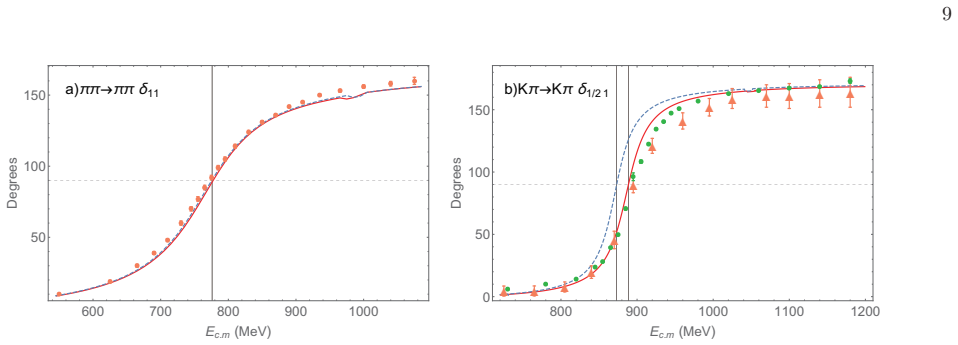
On the paper's own terms, the central discovery is that a single unitary coupled-channel calculation, fitted to the neutral P-wave pi pi and K pi phase shifts, predicts a large charged-neutral K* mass difference, $m_{K^{*0}} - m_{K^{*+}} = 2.91^{+1.43}_{-1.41}$ MeV, while the rho splitting stays small, $m_{\rho^0} - m_{\rho^+} = 0.05^{+2.04}_{-1.33}$ MeV. The authors read this as supporting the hadroproduction value of the charged K* mass (about 891.7 MeV) over the tau-decay value (about 895.5 MeV), and as evidence that the long-standing K* mass-splitting puzzle can be understood from chiral dynamics once isospin breaking and electromagnetic effects are included. They also show that the refitted low-energy constants, especially $L_1$ through $L_5$, are much more sharply determined once the isospin-breaking terms are separated out.
Load-bearing premise
The prediction depends on approximating the electromagnetic contribution by simple photon-exchange diagrams plus one angular cutoff, tuned so the calculated $\rho^0-\rho^+$ splitting matches experiment, and on neglecting all one-loop electromagnetic diagrams; if this approximation is wrong at the level of about one MeV, the central $K^*$ splitting changes.
Editorial extensions
If this is right
- The charged $K^*$ is predicted to be about 2.9 MeV lighter than the neutral $K^*$, matching the hadroproduction average and not the tau-decay average.
- The $\rho^0 - \rho^+$ splitting comes out very small, consistent with the measured value and with the absence of leading electromagnetic effects in the $\pi^+\pi^0$ channel.
- The low-energy constants $L_1$ through $L_5$ are pinned down far more tightly when isospin breaking is included, because the splitting terms absorb what would otherwise look like parameter error.
- Precision phase-shift measurements in charged channels, especially $K^-\pi^0$, become a direct experimental test of the predicted splitting.
- The success would show that dynamically generated vector mesons, produced purely from meson-meson scattering, can carry the correct isospin-breaking pattern without introducing explicit vector-meson fields.
Reading between the lines
- If the prediction survives, the common quark-model estimate $m_{K^0}-m_{K^+} \approx m_{K^{*0}}-m_{K^{*+}}$ would need to be revised downward, since the paper's splitting is closer to 2.9 MeV than to 4 MeV.
- A complete calculation of the neglected electromagnetic one-loop diagrams is the most direct internal test; if they shift the $K^*$ splitting by more than about 1 MeV, the angular-cutoff approximation would have to be revisited.
- The same framework could be extended to extract isospin splittings of other dynamically generated resonances, such as the light scalars, where data are poorer and the electromagnetic treatment would face similar cutoff issues.
- A production-independent pole extraction from high-statistics tau data would also determine whether the current tau-decay average hides a line-shape or background effect.
Signed reviews
Editorial analysis
A structured set of objections, weighed in public.
Referee Report
Summary. The paper extends the coupled-channel inverse amplitude method (IAM) with SU(3) chiral perturbation theory to include strong isospin breaking and electromagnetic contributions in P-wave pi-pi and K-pi scattering. The authors re-fit the low-energy constants to experimental phase shifts, extract pole masses for rho0, rho+, K*0, and K*+, and predict m_K*0 - m_K*+ = 2.91^{+1.43}_{-1.41} MeV, favoring the hadroproduction value over the tau-decay value. They also reproduce the near-zero rho0 - rho+ mass difference. The central claim is that a full one-loop ChPT calculation with isospin breaking can resolve the longstanding K* mass-splitting puzzle.
Significance. If the prediction is correct, it would resolve a long-standing experimental puzzle and demonstrate that dynamically generated vector mesons can accommodate isospin breaking in a nonperturbative unitarized framework. The paper's concrete strengths are the explicit analytic one-loop amplitudes for eight independent processes with mass-splitting terms, a careful re-fit that produces very small errors for L1-L5, and a self-consistency check against the measured rho mass difference. However, the central prediction is conditioned on an electromagnetic treatment that is not at the same order as the rest of the calculation, on a hard angular cutoff calibrated to the rho splitting, and on a quoted uncertainty that does not include these dominant model uncertainties.
major comments (4)
- [Sec. II, Fig. 2 and text after Eq. (11)] The manuscript labels the calculation 'full one-loop' but explicitly computes only the tree-level EM diagrams (a) and (b), omitting the one-loop EM diagrams (c)-(g) with the statement that the EM coupling is small. With e^2 counted as O(p^2), these omitted diagrams are O(p^4), the same order as the retained pure-chiral one-loop amplitudes. The central result is a 2.9 MeV difference of two poles, so an omitted EM loop contribution of order 1 MeV is not negligible a priori. Please either compute or bound these diagrams with an estimate, or revise the claim to 'tree-level EM contributions' and enlarge the uncertainty accordingly.
- [Sec. IV, theta_min calibration and Table II] The cutoff theta_min = 30 degrees is fixed by requiring that the dynamically generated rho0 and rho+ masses reproduce m_rho0 - m_rhoplus = -0.7 +/- 0.8 MeV. This is a calibration to the rho channel, not a parameter derived from the EFT, and the same cutoff enters the K* prediction. The quoted errors in Table II come from Monte Carlo sampling over the fitted LEC errors with theta_min held fixed, so they do not include the cutoff uncertainty. A sensitivity scan in theta_min (for example 20-40 degrees) or an explicit estimate of the cutoff dependence is needed before the central K* splitting can be considered robust.
- [Table I, footnote on Lr9, and Sec. IV text] There is a direct inconsistency about Lr9. The text states that Lr9 is fitted and that its error absorbs the uncertainty from the fixed theta_min, while Table I footnotes that the value of Lr9 is taken from Ref. [25]. Since the EM tree amplitudes depend linearly on Lr9 and this term contributes directly to the isospin splitting, it must be clarified whether Lr9 is fitted, fixed, or adopted from an external fit, and the corresponding uncertainty must be propagated in a well-defined way.
- [Sec. IV, chi^2 discussion] The fit is reported to have chi^2/d.o.f = 20.17, which indicates that the two K-pi phase-shift data sets are mutually inconsistent. The authors note the discrepancy between Refs. [48] and [52] but do not quantify how this inconsistency affects the extracted K* poles. A systematic check using only the high-precision data of Ref. [52], or a treatment of the data-set disagreement as a source of systematic error, would substantially strengthen the central claim.
minor comments (5)
- [Title and general text] There are several typographical errors, including 'vec tor' in the title, 'ACKOWLEDGMENTS' for 'ACKNOWLEDGMENTS', 'FeynClac' for 'FeynCalc', and 'neural' for 'neutral' in Sec. II.
- [Abstract and Sec. V] The phrase 'full one-loop ChPT calculation' overstates the EM treatment described in Sec. II, since EM one-loop diagrams are omitted. The wording should be adjusted to match what is actually computed.
- [Eq. (30) and Appendix notation] The process in Eq. (30) is written with lowercase 'k+k-' rather than K+K-, and the Appendix sometimes interchanges m2p and m2_pi notation; this makes the amplitudes harder to follow and should be standardized.
- [Fig. 5 uncertainty bands] The Monte Carlo procedure is described only briefly: 50 sample points are declared sufficient at the 99% confidence level. Please specify how chi^2_min is defined and whether the 50-point sample was checked for stability.
- [Table II] The extracted K*0 mass 893.45 MeV differs from the PDG value 895.81 MeV by about 2.4 MeV, which is larger than the quoted uncertainties; the statement that they agree within uncertainties would benefit from an explicit caveat that this difference is driven by the phase-shift fit.
Circularity Check
The central K* splitting is not directly fitted, but the rho splitting 'self-consistent check' is a fitted-input restatement, and the K* error bar omits the theta_min calibration uncertainty.
-
fitted input called prediction
[Sec. IV, paragraphs on the theta_min constraint and on the rho 'self-consistent check' after Table II]
"Its value is constrained by requiring that the dynamically generated charged and neutral ρ mesons in the ππ scattering have the difference within the experimental range of mρ0− mρ± = −0.7± 0.8 MeV [ 1]. This constraint yields θmin = 30 ◦. ... As a self-consistent check of our formalism, we also extract mρ 0− mρ ± = 0 .050+2. 04 −1. 33 MeV which is consistent with the experimental value: mρ 0− mρ ± =−0.7± 0.8 MeV [ 1], although the exact sign cannot be determined here."
The parameter θmin is not derived from the EFT; it is adjusted until the ρ0/ρ+ pole difference falls inside the experimental mρ0−mρ+ window. The later 'extraction' of mρ0−mρ+ and its consistency with experiment is therefore a restatement of the calibration condition rather than an independent validation. The central K* prediction is not reduced to the rho splitting, but it uses the same calibrated θmin in the EM amplitudes, and the quoted error band is generated by Monte Carlo sampling of the fitted LECs with θmin held fixed, so the dominant EM regulator uncertainty is not propagated into the central claim.
full rationale
The central claim mK*0−mK*+ = 2.91 MeV is not directly fitted: it is obtained from IAM poles after fitting the LECs to π+π− and K+π− phase shifts, with the isospin-breaking pseudoscalar masses entering the amplitudes. The only element that reduces to an input is the ρ splitting 'self-consistent check': θmin is fixed by requiring the ρ0/ρ+ poles to lie in the experimental mρ0−mρ+ range, so the subsequent quoted agreement of the extracted mρ0−mρ+ with experiment is tautological. The K* splitting is not forced to equal the ρ splitting and depends on the full coupled-channel amplitude; however, it inherits the θmin calibration as a model input, and the quoted asymmetric error is generated with θmin held fixed, so the EM cutoff uncertainty is not included in the error budget. No load-bearing self-citation appears: the cited chiral/unitarization framework is from other authors. On balance, the circularity is partial and located in the validation of the ρ sector rather than in the central K* prediction.
Assumptions & free parameters
free parameters (3)
- Lr_1...Lr_9 (low-energy constants) =
Table I values, e.g., Lr_1 = 0.54e-3, Lr_5 = 2.00e-3, Lr_9 = 3.96e-3
- theta_min (Coulomb forward-angle cutoff) =
30 degrees
- renormalization scale mu =
770 MeV
assumptions (6)
- domain assumption ChPT power counting: pseudoscalar mesons are Goldstone bosons, quark masses and e^2 count as O(p^2), and LECs absorb UV divergences.
- domain assumption The inverse amplitude method unitarization formula T = T2 [T2 - T4]^-1 T2 restores unitarity and dynamically generates resonances as poles.
- domain assumption Vector mesons rho and K* are dynamical states generated by meson-meson scattering, not explicit fields in the Lagrangian.
- ad hoc to paper EM one-loop diagrams in Fig. 2(c-g) are negligible compared with EM tree contributions.
- ad hoc to paper The forward Coulomb divergence can be regulated by a physical angular cutoff theta_min, fixed to 30 degrees.
- domain assumption Decay constants of charged and neutral pseudoscalars are equal: f_pi0 = f_pi+ and f_K0 = f_K+.
Cite this review
Pith. "Pith review of The mass splitting among the isospin multiplets of light vector mesons." pith.science (2026). https://pith.science/paper/EA7BI7XM
@misc{pith2026190805003,
  author       = {Pith},
  title        = {Pith review of: The mass splitting among the isospin multiplets of light vector mesons},
  year         = {2026},
  howpublished = {\url{https://pith.science/paper/EA7BI7XM}},
  note         = {Machine review of arXiv:1908.05003}
}
abstract
By including the strong isospin symmetry breaking effects and the electromagnetic contributions between the pseudoscalar mesons, we calculate the phase shifts of the $P$-wave $\pi\pi$ and $K\pi$ scattering up to $\mathcal{O}(p^4)$ in the framework of the SU(3) chiral perturbation theory (ChPT) and coupled channel inverse amplitude method. We re-fit the low energy constants with the present meson-meson scattering data and derive the mass differences for the charged and neutral iso-multiplets of $\rho$ and $K^{*}$. Our results show that the mass difference between $\rho^\pm$ and $\rho^0$ is very small while the mass difference between the charged and neutral $K^*$ can reach a relatively large value of $m_{K^{*0}}-m_{K^{*+}}= 2.91^{+1.43}_{-1.41}$ MeV. This full one-loop ChPT calculation would shed some light towards a better understanding of the long-standing puzzle about the $K^*$ mass splitting.
Figures


Figures from the paper (2 more)


Reference graph
Works this paper leans on
-
[25]
J. Bijnens and P. Talavera, JHEP 0203, 046 (2002) doi:10.1088/1126-6708/2002/03/046 [hep-ph/ 0203049]
-
[48]
A. Gomez Nicola and J. R. Pelaez, Phys. Rev. D 65, 054009 (2002) doi:10.1103/PhysRevD.65.054009 [hep-ph/ 0109056]
-
[52]
P. Estabrooks, R. K. Carnegie, A. D. Martin, W. M. Dunwoo die, T. A. Lasinski and D. W. G. S. Leith, Nucl. Phys. B 133, 490 (1978). doi:10.1016/0550-3213(78)90238-9
-
[1]
M. Tanabashi et al. [ParticleDataGroup], Phys. Rev. D 98, no. 3, 030001 (2018). doi:10.1103/PhysRevD.98.030001
-
[2]
M. Ablikim et al. [BESIII Collaboration], Phys. Rev. D 94, no. 3, 032001 (2016) doi:10.1103/PhysRevD.94.032001 [arXiv:1512.08627 [hep-ex]]
arXiv 2016
-
[3]
P. del Amo Sanchez et al. [BaBar Collaboration], Phys. Rev. D 83, 072001 (2011) doi:10.1103/PhysRevD.83.072001 [arXiv:1012.1810 [hep-ex]]
arXiv 2011
-
[4]
Dalitz plot analysis of the D^+ -> K^-pi^+pi^+ decay
G. Bonvicini et al. [CLEO Collaboration], Phys. Rev. D 78, 052001 (2008) doi:10.1103/PhysRevD.78.052001 [arXiv:0802.4214 [hep-ex]]
work page Pith review arXiv 2008
-
[5]
We note that for π+π−→ K +K −, the parameter dependence of the O(p4) amplitude on Lr 6, 8 is in a correlated form, i.e. 2 Lr 6 + Lr
Show all 55 references
-
[6]
Aguilar-Benitez, R
M. Aguilar-Benitez, R. L. Eisner and J. B. Kinson, Phys. R ev. D 4, 2583 (1971). doi:10.1103/PhysRevD.4.2583
1971 doi
-
[7]
Aguilar-Benitez et al
M. Aguilar-Benitez et al. , Nucl. Phys. B 141, 101 (1978). doi:10.1016/0550-3213(78)90336-X
1978 doi
-
[8]
This means that these three constants are process-depende nt
For π+π0→ π+π0 there is only one term of O(p4) which is proportional to L7(m2 π 0− m2 π + ). This means that these three constants are process-depende nt. In our fitting procedure we have only two processes with experimental data to constrain the param eters. The large errors w...
-
[9]
Epifanov et al
D. Epifanov et al. [Belle Collaboration], Phys. Lett. B 654, 65 (2007) doi:10.1016/j.physletb.2007.08.045 [arXiv:0 706.2231 [hep-ex]]
2007 doi
-
[10]
H. R. Rubinstein, Phys. Rev. Lett. 17, 41 (1966). doi:10.1103/PhysRevLett.17.41
1966 doi
-
[11]
Barash, L
N. Barash, L. Kirsch, D. Miller and T. H. Tan, Phys. Rev. 156, 1399 (1967). doi:10.1103/PhysRev.156.1399
1967 doi
-
[12]
Harari, Phys
H. Harari, Phys. Rev. 139, B1323(1965)
1965
-
[13]
Isgur and G
N. Isgur and G. Karl, Phys. Rev. D 19, 2653 (1979) Erratum: [Phys. Rev. D 23, 817 (1981)]. 42 doi:10.1103/PhysRevD.23.817.2, 10.1103/PhysRevD.19.2653
1979 doi
-
[14]
De Rujula, H
A. De Rujula, H. Georgi and S. L. Glashow, Phys. Rev. D 12, 147 (1975). doi:10.1103/PhysRevD.12.147
1975 doi
-
[15]
Isgur and G
N. Isgur and G. Karl, Phys. Rev. D 18, 4187 (1978). doi:10.1103/PhysRevD.18.4187
1978 doi
-
[16]
Godfrey and N
S. Godfrey and N. Isgur, Phys. Rev. D 32, 189 (1985). doi:10.1103/PhysRevD.32.189
1985 doi
-
[17]
Isgur, Phys
N. Isgur, Phys. Rev. D 21, 779 (1980) Erratum: [Phys. Rev. D 23, 817 (1981)]. doi:10.1103/PhysRevD.21.779, 10.1103/PhysRevD.23.817.4
1980 doi
-
[18]
Godfrey and N
S. Godfrey and N. Isgur, Phys. Rev. D 34, 899 (1986). doi:10.1103/PhysRevD.34.899
1986 doi
-
[19]
D. N. Gao, M. L. Yan and B. A. Li, Phys. Rev. D 56, 4115 (1997) doi:10.1103/PhysRevD.56.4115 [hep-ph/9611 297]
1997 doi
-
[20]
Manohar and H
A. Manohar and H. Georgi, Nucl. Phys. B 234, 189 (1984). doi:10.1016/0550-3213(84)90231-1
1984 doi
-
[21]
D. N. Gao and M. L. Yan, Chin. Phys. C 32, 862 (2008) doi:10.1088/1674-1137/32/11/002 [arXiv:071 0.2810 [hep-ph]]
2008 doi
-
[22]
Bijnens, P
J. Bijnens, P. Gosdzinsky and P. Talavera, Nucl. Phys. B 501, 495 (1997) doi:10.1016/S0550-3213(97)00391-X [hep- ph/9704212]
1997
-
[23]
D. N. Gao and M. L. Yan, Eur. Phys. J. A 3, 293 (1998) doi:10.1007/s100500050180 [hep-ph/9801210]
1998 arXiv
-
[24]
E. E. Jenkins, A. V. Manohar and M. B. Wise, Phys. Rev. Let t. 75, 2272 (1995) doi:10.1103/PhysRevLett.75.2272 [hep- ph/9506356]
1995
-
[26]
Bijnens, P
J. Bijnens, P. Gosdzinsky and P. Talavera, JHEP 9801, 014 (1998) doi:10.1088/1126-6708/1998/01/014 [hep-ph/ 9708232]
1998 doi
-
[27]
Bijnens and G
J. Bijnens and G. Ecker, Ann. Rev. Nucl. Part. Sci. 64, 149 (2014) doi:10.1146/annurev-nucl-102313-025528 [arXiv:1405.6488 [hep-ph]]
2014 arXiv
-
[28]
Weinberg, Physica A 96, no
S. Weinberg, Physica A 96, no. 1-2, 327 (1979). doi:10.1016/0378-4371(79)90223-1
1979 doi
-
[29]
J. A. Oller, E. Oset and J. R. Pelaez, Phys. Rev. D 59, 074001 (1999) Erratum: [Phys. Rev. D 60, 099906 (1999)] Er- ratum: [Phys. Rev. D 75, 099903 (2007)] doi:10.1103/PhysRevD.59.074001, 10.110 3/PhysRevD.60.099906, 10.1103/Phys- RevD.75.099903 [hep-ph/9804209]
1999 arXiv
-
[30]
Guerrero and J
F. Guerrero and J. A. Oller, Nucl. Phys. B 537, 459 (1999) Erratum: [Nucl. Phys. B 602, 641 (2001)] doi:10.1016/S0550- 3213(01)00103-1, 10.1016/S0550-3213(98)00663-4 [hep-p h/9805334]
1999
-
[31]
Gasser and H
J. Gasser and H. Leutwyler, Nucl. Phys. B 250, 517 (1985). doi:10.1016/0550-3213(85)90493-6
1985 doi
-
[32]
Gasser and H
J. Gasser and H. Leutwyler, Annals Phys. 158, 142 (1984). doi:10.1016/0003-4916(84)90242-2
1984 doi
-
[33]
Gasser and H
J. Gasser and H. Leutwyler, Nucl. Phys. B 250, 465 (1985). doi:10.1016/0550-3213(85)90492-4
1985 doi
-
[34]
Dobado and J
A. Dobado and J. R. Pelaez, Phys. Rev. D 47, 4883 (1993) doi:10.1103/PhysRevD.47.4883 [hep-ph/9301 276]
1993 doi
-
[35]
Gasser and H
J. Gasser and H. Leutwyler, Nucl. Phys. B 250, 539 (1985). doi:10.1016/0550-3213(85)90494-8
1985 doi
-
[36]
Dobado, M
A. Dobado, M. J. Herrero and T. N. Truong, Phys. Lett. B 235, 134 (1990). doi:10.1016/0370-2693(90)90109-J
1990 doi
-
[37]
P. C. Bruns, L. Greil and A. Sch¨ afer, Phys. Rev. D 88, 114503 (2013) doi:10.1103/PhysRevD.88.114503 [arXiv:1 309.3976 [hep-ph]]
2013 doi
-
[38]
Dobado and J
A. Dobado and J. R. Pelaez, Phys. Rev. D 56, 3057 (1997) doi:10.1103/PhysRevD.56.3057 [hep-ph/9604 416]
1997 doi
-
[39]
J. A. Oller and E. Oset, Nucl. Phys. A 620, 438 (1997) Erratum: [Nucl. Phys. A 652, 407 (1999)] doi:10.1016/S0375- 9474(99)00427-3, 10.1016/S0375-9474(97)00160-7 [hep-p h/9702314]
1997
-
[40]
Nieves and E
J. Nieves and E. Ruiz Arriola, Nucl. Phys. A 679, 57 (2000) doi:10.1016/S0375-9474(00)00321-3 [hep-ph/9 907469]
2000 doi
-
[41]
Nieves and E
J. Nieves and E. Ruiz Arriola, Phys. Rev. D 63, 076001 (2001) doi:10.1103/PhysRevD.63.076001 [hep-ph/ 0008034]
2001 doi
-
[42]
Nieves and E
J. Nieves and E. Ruiz Arriola, Phys. Lett. B 455, 30 (1999) doi:10.1016/S0370-2693(99)00461-X [nucl-th/ 9807035]
1999 doi
-
[43]
Bernard, N
V. Bernard, N. Kaiser and U. G. Meissner, Nucl. Phys. B 364, 283 (1991). doi:10.1016/0550-3213(91)90586-M
1991 doi
-
[44]
J. A. Oller, E. Oset and J. R. Pelaez, Phys. Rev. Lett. 80, 3452 (1998) doi:10.1103/PhysRevLett.80.3452 [hep-ph/9 803242]
1998 doi
-
[45]
Bernard, N
V. Bernard, N. Kaiser and U. G. Meissner, Nucl. Phys. B 357, 129 (1991). doi:10.1016/0550-3213(91)90461-6
1991 doi
-
[46]
Mertig, M
R. Mertig, M. Bohm and A. Denner, Comput. Phys. Commun. 64, 345 (1991). doi:10.1016/0010-4655(91)90130-D
1991 doi
-
[47]
B. A. Li, D. n. Gao and M. l. Yan, Phys. Rev. D 58, 094031 (1998) doi:10.1103/PhysRevD.58.094031 [hep-ph/ 9803431]
1998 doi
-
[49]
S. D. Protopopescu et al. , Phys. Rev. D 7, 1279 (1973). doi:10.1103/PhysRevD.7.1279
1973 doi
-
[50]
Shtabovenko, R
V. Shtabovenko, R. Mertig and F. Orellana, Comput. Phys . Commun. 207, 432 (2016) doi:10.1016/j.cpc.2016.06.008 [arXiv:1601.01167 [hep-ph]]
2016 arXiv
-
[51]
Mercer et al
R. Mercer et al. , Nucl. Phys. B 32, 381 (1971). doi:10.1016/0550-3213(71)90483-4
1971 doi
-
[53]
James, CERN-D-506, CERN-D506
F. James, CERN-D-506, CERN-D506
-
[54]
Scherer and M
S. Scherer and M. R. Schindler, Lect. Notes Phys. 830, pp.1 (2012). doi:10.1007/978-3-642-19254-8
2012 doi
-
[891]
Symmetries and the Emergen ce of Structure in QCD
66 ± 0. 26 (hadroproduced) V. SUMMAR Y In the framework of chiral perturbation theory and the coupled c hannel inverse amplitude method, we do a full calculation of the P -wave ππ and Kπ scattering amplitudes up to O(p4) including the strong isospin breaking effects and EM cont...
Reviewed August 14, 2026 · model on record in the stance chip above.
Discussion (0). Continue with ORCID to comment.