REVIEW 5 major objections 4 minor 1 cited by
Multicrossmodal Automated Agent for Integrating Diverse Materials Science Data
T0 review · 5 major / 4 minor · reviewed 2026-08-07 · deepseek-v4-flash
Pith's one-line read A coordinated team of specialized LLM agents can fuse microscope images, simulation videos, tables, and literature into one research answer, without retraining any underlying model, reaching 85% Recall@1 retrieval and a +35% gain in…
desk verdict A plausible multi-agent system whose headline numbers cannot be audited from Table 2, and which needs a reproducible evaluation before it can be believed. read the letter →
The pith
A machine-rendered reading of the paper's core claim, the machinery that carries it, and where it could break.
The reading
What carries the argument
The load-bearing mechanism is a coordinated multi-agent pipeline: each modality-specific agent (image, video, text-from-web, PDF, and CSV) is prompted to project its outputs into a shared embedding space, and a Fusion Agent runs a simulated cross-attention dialogue among those agents, collects each agent's confidence score, and uses a gating prompt to weight and merge the contributions. The dynamic gating and the cross-attention prompting are the components that make the fusion work; the paper's ablation says removing either one degrades retrieval accuracy and integrated coverage. The system is built on standard agent-orchestration and LLM tools, but the claimed novelty is the prompt-and-gating strategy that obtains cross-modal reasoning without changing any foundation-model weights.
What would settle it
Re-annotate the four simulation videos and the SEM-500 images with a second independent expert team, pre-register the list of unique information elements before generating any reports, and re-run the full pipeline; if Recall@1 drops to within the 78–82% range of the comparison models or the coverage gain ceases to exceed the baselines, the central claim would be refuted.
Extended reading notes
Core claim
The paper's central claim is that cross-modal integration in materials science can be achieved by orchestration rather than by training a new multimodal model. A Unified Team Agent parses each query and delegates to modality-specific agents—web literature, PDF, image, video, and CSV—that produce embeddings in a shared space through domain-adapted prompts. A Fusion Agent then runs cross-attention-style prompting among the agents, collects their self-evaluated confidence scores, and applies a lightweight gating prompt that assigns dynamic weights before concatenating the outputs into either retrieval results or a unified narrative. The paper reports 85% Recall@1 on cross-modal retrieval, 0.82 cosine similarity between paired image and text embeddings, and a +35% gain in integrated coverage, exceeding all three comparison models in Table 2, and states that removing either the cross-attention prompting or the gating stage causes notable drops in accuracy and coverage.
Load-bearing premise
The load-bearing premise is that the ground-truth video event annotations, expert SEM captions, and the counting protocol for unique information elements are accurate and consistent enough that the reported 85% Recall@1 and +35% coverage advantages reflect real system behavior rather than annotation or scoring artifacts.
Editorial extensions
If this is right
- A researcher could submit one query with an SEM image, a CSV of measurements, and related papers, and receive a single report that links visual features, numeric trends, and literature claims.
- Because no foundation-model weights are modified, adapting the agent to a new materials domain means changing prompts, plugins, and benchmarks, not retraining large models.
- The architecture can be extended with new modality-specific agents, so data types such as spectroscopy or diffraction could be added without redesigning the team.
- The coverage metric gives a quantitative way to measure how much integrated reporting adds beyond single-modality summaries, a gap that existing property-prediction benchmarks do not directly assess.
- The reported ablation results imply that both the cross-attention prompting and the gating stage are necessary; dropping either reduces retrieval accuracy and coverage.
Reading between the lines
- A natural stress test would be to run the same prompt-and-gating pipeline on a larger, independently annotated multimodal materials corpus, since the paper's benchmark is small (four videos, 500 SEM images, 400 CSV rows, 300 literature snippets) and the reported gains could shrink with more data.
- Because the coverage metric counts 'unique information elements' by a protocol that the paper does not fully specify, recomputing it from a pre-registered fact list with two annotators would check whether the +35% gain is robust.
- Replacing the dynamic gating prompt with a simple fixed average of the same agent embeddings would isolate whether dynamic weighting itself, rather than sharing context across agents, produces the accuracy difference.
- The paper frames active learning as future work; if integrated agents are meant to act as digital researchers, a concrete next step would be letting the agent request missing measurements or propose the next simulation, and measuring whether that changes discovery outcomes.
Editorial analysis
A structured set of objections, weighed in public.
Referee Report
Summary. The paper proposes a prompt-only multi-agent LLM framework for integrating diverse materials-science data (simulation videos, microscopy images, CSV tables, and literature). Specialized agents process each modality and project outputs into a shared embedding space; a fusion agent with a dynamic gating prompt combines them, without fine-tuning foundation-model weights. The authors validate the approach on a small simulation-video benchmark, an SEM-500 plus CSV and literature suite, and two qualitative case studies, reporting a retrieval accuracy of 85%, captioning accuracy of 85%, modality-alignment cosine similarity of 0.82, and a +35% integrated-coverage improvement over baselines in Table 2.
Significance. If the performance claims were properly supported, the system would be a useful contribution: it demonstrates an architecture that can combine video, image, text, and tabular data through agent orchestration and prompt-level fusion, and it avoids expensive fine-tuning of underlying models. The modular design and the released code repository are strengths. However, the central comparative claim rests on an evaluation that is not currently reproducible or auditable: the metrics in Table 2 are partly undefined, the query and ground-truth protocols are absent, no variance or sample-size information is given, and the tuning procedure overlaps with the evaluation benchmarks. The significance of the work cannot be assessed until these issues are resolved.
major comments (5)
- [Table 2, Section 3] The headline retrieval claim is not auditable: the paper does not state how many retrieval queries were run, what the query set was, what the ground-truth video segments or image/text items were, or which K is used. The abstract reports 85% Recall@1, but Table 2 only reports a single 'Cross-modal Retrieval Accuracy (Recall@K)' value. No error bars, confidence intervals, sample sizes, or significance tests are given, so the differences among 85%, 80%, 82%, and 78% cannot be separated from noise. Please provide the full evaluation protocol and per-query results.
- [Section 2.3, Table 2] The metric 'Image Captioning Accuracy' in Table 2 is not defined in Section 2.3, which defines BLEU-4 and CIDEr for image captioning. The reported 85% therefore cannot be interpreted. The authors should either report BLEU-4 and CIDEr with reference details and score distributions, or define the accuracy metric operationally and justify its use.
- [Section 3, Section 2] The paragraph after Table 2 states that the agent achieves 'materials-specific tuning' by tailoring prompts, plugins, and gating parameters to materials-science data and benchmarks, and the same benchmarks are then used for the comparison. This selection effect means the reported gains may reflect tuning to the evaluation set. In addition, Section 2 claims that ablation studies confirm the cross-attention prompting and gating stages are critical, but no ablation results are reported anywhere in the paper. Please provide a held-out evaluation set or a sensitivity analysis over prompt and gating choices, and include the missing ablation results.
- [Section 2.1.1, Section 2.3, Table 1] The 'Integrated Coverage (∆Coverage)' metric depends on 'unique information elements,' but the paper never defines what counts as an information element, how elements are extracted from integrated versus single-modality reports, or how duplicates across modalities are identified. Without this counting protocol, the +35% coverage value in Table 2 is not reproducible. Please define the unit of counting, give example extractions, and, if human annotation was used, report inter-annotator agreement.
- [Section 3, case studies] The two case studies are presented as evidence of expert-level performance, but the 'expert reviewers confirmed' and 'human evaluators noted' statements are anecdotal. No evaluation rubric, number of evaluators, independent scoring, or comparison against baseline outputs is reported. These case studies should be either formally evaluated or clearly separated from the quantitative benchmark claims.
minor comments (4)
- [Section 2.3] The phrase 'As discussed in Table 1' is awkward, since Table 1 is introduced in the same section; please reference the table at its first use and integrate the metric definitions into the text.
- [Introduction, reference [24]] Reference [24] is cited as evidence that large multimodal models like GPT-4 can interpret images and text, but [24] is a review of multimodal explainable AI, not the GPT-4 technical report. Please cite the actual model or a more directly relevant source.
- [Table 2] Table 2 reports cosine similarity values to two decimal places without any measure of dispersion; please add at least the number of pairs and, ideally, confidence intervals or standard deviations.
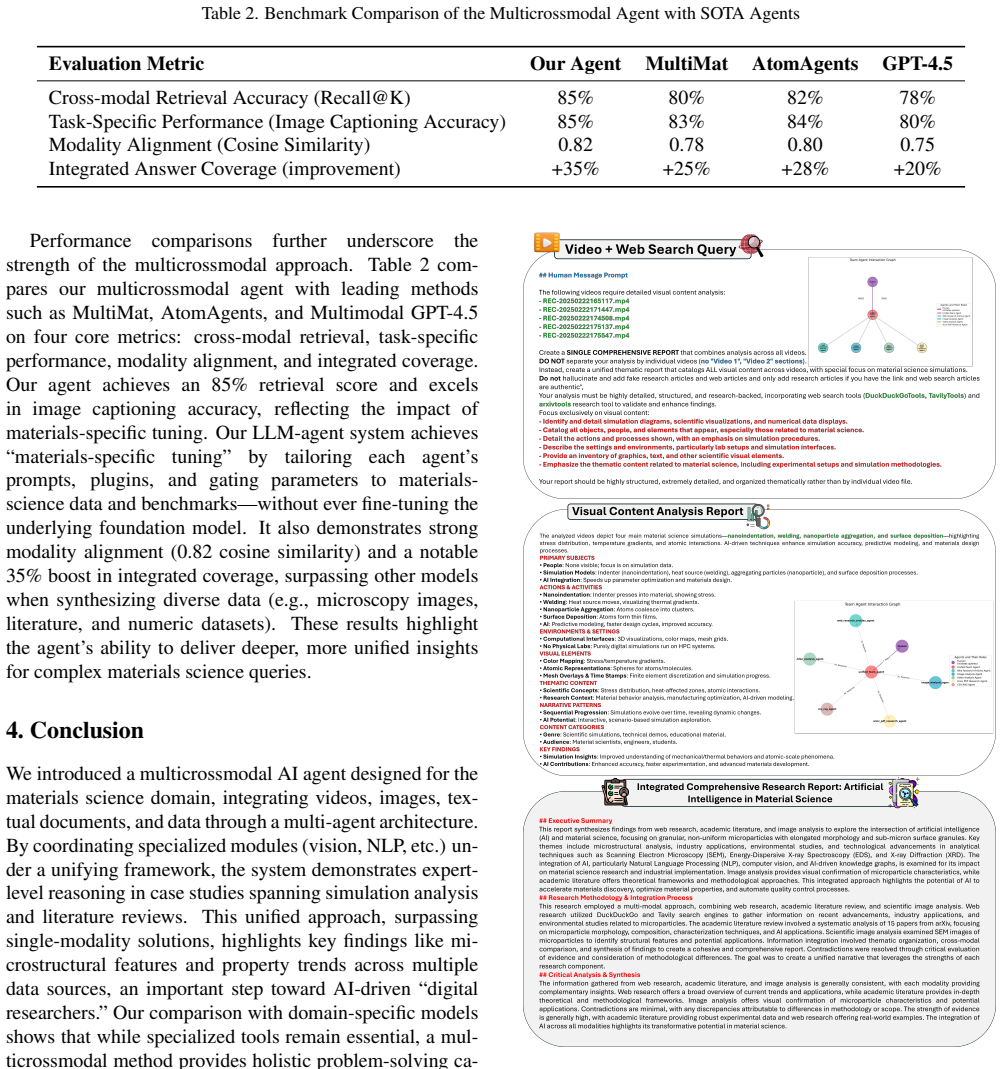
- [Figure 4] The sample reports in Figure 4 are described as visual corroboration, but the figure is only referenced in passing. Please ensure the figure is legible, and label which output corresponds to which agent or query.
Circularity Check
Benchmark-tuned prompts and gating parameters are evaluated on the same benchmarks, making the reported 85% Recall@1 and +35% coverage gains a tuned-measurement rather than an independent prediction.
-
fitted input called prediction
[Section 3, paragraph after Table 2 (with Table 2 and Section 2.1 benchmark suite)]
"Our LLM-agent system achieves “materials-specific tuning” by tailoring each agent’s prompts, plugins, and gating parameters to materials-science data and benchmarks—without ever fine-tuning the underlying foundation model."
The benchmark suite described in Section 2.1 is used both as the tuning target and as the evaluation set. Section 3 explicitly states that prompts, plugins, and gating parameters were tailored to materials-science data and benchmarks, and Table 2 then reports the agent's 85% Recall@1 and +35% coverage on those same benchmarks. No held-out split, separate test set, or out-of-distribution evaluation is described, so the claimed 'substantial gains' are measurements on the tuning distribution rather than independent predictions. The reported advantage over zero-shot baselines is therefore not evidence of generalization but is partly an artifact of benchmark-specific adaptation.
full rationale
The paper does not present a formal first-principles derivation; its central claims are empirical benchmark numbers. The one load-bearing circular step is in the evaluation protocol: Section 3 says the agent's 'materials-specific tuning' is achieved by tailoring prompts, plugins, and gating parameters to materials-science data and benchmarks, and Table 2 reports the resulting 85% Recall@1, 85% captioning accuracy, 0.82 cosine similarity, and +35% coverage on those same benchmarks. Because the tuned components were set using the same benchmark suite on which performance is claimed, the reported gains are not statistically independent predictions; they are measurements on the tuning distribution. This fits the 'fitted input called prediction' pattern, though it is a mild version because the tuning is qualitative and no numeric fitted parameters are disclosed. The paper also contains several self-citations (e.g., [2]-[5], [30], [31]), but these are contextual perspective citations, not load-bearing evidence for the benchmark claims, so they do not increase the circularity score. Other issues, such as the undefined 'Image Captioning Accuracy' metric, missing sample sizes and error bars in Table 2, and the unspecified counting protocol for 'unique information elements,' are auditability flaws rather than circularity and are not counted in this score.
Assumptions & free parameters
free parameters (2)
- Domain-adapted prompt templates and plugins =
not reported
- Dynamic gating weights and confidence calibration =
not reported
assumptions (4)
- domain assumption The four self-built simulation videos and SEM-500 images are representative and correctly annotated.
- domain assumption Cosine similarity between image and text embeddings measures meaningful cross-modal alignment.
- domain assumption Pretrained LLMs (Gemini, DeepSeek, Llama) provide reliable OCR and scientific summarization without domain fine-tuning.
- domain assumption Counting 'unique information elements' in reports is an objective procedure.
Cite this review
Pith. "Pith review of Multicrossmodal Automated Agent for Integrating Diverse Materials Science Data." pith.science (2026). https://pith.science/paper/EARKK5NW
@misc{pith2026250515132,
  author       = {Pith},
  title        = {Pith review of: Multicrossmodal Automated Agent for Integrating Diverse Materials Science Data},
  year         = {2026},
  howpublished = {\url{https://pith.science/paper/EARKK5NW}},
  note         = {Machine review of arXiv:2505.15132}
}
read the original abstract
We introduce a multicrossmodal LLM-agent framework motivated by the growing volume and diversity of materials-science data ranging from high-resolution microscopy and dynamic simulation videos to tabular experiment logs and sprawling literature archives. While recent AI efforts have accelerated individual tasks such as property prediction or image classification, they typically treat each modality in isolation, leaving rich cross-modal correlations unexplored and forcing researchers to perform laborious manual integration. Moreover, existing multimodal foundation models often require expensive retraining or fine-tuning on domain data, and current multi-agent systems in materials informatics address only narrow subtasks. To overcome these obstacles, we design a coordinated team of specialized LLM agents, each equipped with domain-adapted prompts and plugins that project their outputs into a shared embedding space. A dynamic gating mechanism then weights and merges these insights, enabling unified reasoning over heterogeneous inputs without ever modifying the underlying LLM weights. We validate our approach on challenging case studies and demonstrate substantial gains in retrieval accuracy (85%), captioning fidelity, and integrated coverage (35%) compared to single-modality and zero-shot baselines. Our work paves the way for AI digital researchers capable of bridging data silos and accelerating the materials-discovery cycle. The code is available at https://github.com/adibgpt/Multicrossmodal-Autonomous-Materials-Science-Agent.
Figures


Figures from the paper (1 more)
Forward citations
Cited by 1 Pith paper
-
Position: Collaborative Agentic AI Needs Interoperability Across Ecosystems
A position paper proposing minimal web-based standards, the Web of Agents, to prevent fragmentation in collaborative agentic AI ecosystems.
Reference graph
Works this paper leans on
-
[1]
Mehrad Ansari, Jeffrey Watchorn, Carla E. Brown, and Joseph S. Brown. dziner: Rational inverse design of ma- terials with ai agents. ArXiv, 2024. 1
work page 2024
-
[2]
Drug discovery agent: An automated vision detection system for drug-cell interactions
Adib Bazgir and Yuwen Zhang. Drug discovery agent: An automated vision detection system for drug-cell interactions. In 1st CVPR Workshop on Computer Vision For Drug Dis- covery (CVDD): Where are we and What is Beyond?, 2025. 2
work page 2025
-
[3]
Adib Bazgir, Yuwen Zhang, et al. Matagent: A human-in- the-loop multi-agent llm framework for accelerating the ma- terial science discovery cycle. In AI for Accelerated Materi- als Design-ICLR 2025, 2025
work page 2025
-
[4]
Agentichypothesis: A sur- vey on hypothesis generation using llm systems
Adib Bazgir, Yuwen Zhang, et al. Agentichypothesis: A sur- vey on hypothesis generation using llm systems. In Towards Agentic AI for Science: Hypothesis Generation, Comprehen- sion, Quantification, and Validation, 2025
work page 2025
-
[5]
Adib Bazgir, Yuwen Zhang, et al. Proteinhypothesis: A physics-aware chain of multi-agent rag llm for hypothesis generation in protein science. In Towards Agentic AI for Sci- ence: Hypothesis Generation, Comprehension, Quantifica- tion, and Validation, 2025
work page 2025
-
[6]
Anthony K. Cheetham and Ram Seshadri. Artificial intelli- gence driving materials discovery? perspective on the arti- cle: Scaling deep learning for materials discovery. Nature Communications, 36(8), 2024. 2
work page 2024
-
[7]
Garcia, Marc Botifoll, Oscar Avalos-Ovando, Jordi Arbiol, and Aitor Mugarza
Emigdio Ch ´avez-Angel, Martin Børstad Eriksen, Alejan- dro Castro-Alvarez, Jose H. Garcia, Marc Botifoll, Oscar Avalos-Ovando, Jordi Arbiol, and Aitor Mugarza. Applied artificial intelligence in materials science and material de- sign. AIS, 13(2400986), 2025. 1
work page 2025
-
[8]
An overview on the role of artificial intelligence in modern advancements of material science
Mayukh Das, Teresa Castillo Perez, Dasharathraj Shetty, Pa- van Hiremath, Nithesh Naik, and Ritesh Bhat. An overview on the role of artificial intelligence in modern advancements of material science. ES, 5(1183), 2024. 2
work page 2024
Show all 31 references
-
[9]
Alireza Ghafarollahi and Markus J. Buehler. Atomagents: Alloy design and discovery through physics-aware multi- modal multi-agent artificial intelligence. ArXiv, 2024. 1, 3
2024
-
[10]
Grossman
Sheng Gong, Shuo Wang, Taishan Zhu, Yang Shao-Horn, and Jeffrey C. Grossman. Multimodal machine learning for materials science: composition-structure bimodal learning for experimentally measured properties. ArXiv, 2023. 1
2023
-
[11]
The llama 3 herd of models
Aaron Grattafiori, Abhimanyu Dubey, Abhinav Jauhri, Ab- hinav Pandey, Abhishek Kadian, Ahmad Al-Dahle, Aiesha Letman, Akhil Mathur, Alan Schelten, Alex Vaughan, et al. The llama 3 herd of models. arXiv preprint arXiv:2407.21783, 2024. 2
2024 arXiv
-
[12]
Accelerating the design and discovery of tribocorrosion-resistant metals by interfac- ing multiphysics modeling with machine learning and ge- netic algorithms
Yucong Gu, Kaiwen Wang, Zhengyu Zhang, Yi Yao, Zim- ing Xin, Wenjun Cai, and Lin Li. Accelerating the design and discovery of tribocorrosion-resistant metals by interfac- ing multiphysics modeling with machine learning and ge- netic algorithms. npj, 9(7), 2025. 1
2025
-
[13]
Deepseek-r1: Incentivizing reasoning capability in llms via reinforcement learning
Daya Guo, Dejian Yang, Haowei Zhang, Junxiao Song, Ruoyu Zhang, Runxin Xu, Qihao Zhu, Shirong Ma, Peiyi Wang, Xiao Bi, et al. Deepseek-r1: Incentivizing reasoning capability in llms via reinforcement learning. arXiv preprint arXiv:2501.12948, 2025. 2
2025 arXiv
-
[14]
Kalinin, Steven R
Cristiano Malica, Kostya Novoselov, Amanda S Barnard, Sergei V . Kalinin, Steven R. Spurgeon, Karsten Reuter, Maite Alducin, V olker L. Deringer, Gabor Csanyi, Nicola Marzari, Shirong Huang, Gianaurelio Cuniberti, Qiushi Deng, Pablo Ordej ´on, Ivan Cole, Kamal Choudhary, Kedar...
2025
-
[15]
Langchain v0
Vasilios Mavroudis. Langchain v0. 3. Preprints, 2024. 2
2024
-
[16]
Multimodal learn- ing for materials
Viggo Moro, Charlotte Loh, Rumen Dangovski, Ali Gho- rashi, Andrew Ma, Zhuo Chen, Samuel Kim, Peter Y Lu, Thomas Christensen, and Marin Soljaˇci´c. Multimodal learn- ing for materials. arXiv preprint arXiv:2312.00111 , 2023. 3
2023 arXiv
-
[17]
Lu, Thomas Christensen, and Marin Soljaˇci´c
Viggo Moro, Charlotte Loh, Rumen Dangovski, Ali Gho- rashi, Andrew Ma, Zhuo Chen, Samuel Kim, Peter Y . Lu, Thomas Christensen, and Marin Soljaˇci´c. Multimodal foun- dation models for material property prediction and discovery. ArXiv, 2025. 1
2025
-
[18]
Doan, Heather Job, Lily A
Juran Noh, Hieu A. Doan, Heather Job, Lily A. Robertson, Lu Zhang, Rajeev S. Assary, Karl Mueller, Vijayakumar Mu- rugesan, and Yangang Liang. An integrated high-throughput robotic platform and active learning approach for accelerated discovery of optimal electrolyte formulati...
2024
-
[19]
Pyzer-Knapp, Jed W
Edward O. Pyzer-Knapp, Jed W. Pitera, Peter W. J. Staar, Seiji Takeda, Teodoro Laino, Daniel P. Sanders, James Sex- ton, John R. Smith, and Alessandro Curioni. Accelerating materials discovery using artificial intelligence, high perfor- mance computing and robotics. ArXiv, 2022
2022
-
[20]
Accelerating materials discovery: combinato- rial synthesis, high-throughput characterization, and compu- tational advances
Khurram Shahzad, Andrei Ionut Mardare, and Achim Wal- ter Hassel. Accelerating materials discovery: combinato- rial synthesis, high-throughput characterization, and compu- tational advances. STAM, 4(1), 2023. 2
2023
-
[21]
Accelerating materials dis- covery for polymer solar cells: Data-driven insights enabled by natural language processing
Pranav Shetty, Aishat Adeboye, Sonakshi Gupta, Chao Zhang, and Rampi Ramprasad. Accelerating materials dis- covery for polymer solar cells: Data-driven insights enabled by natural language processing. CM, 36(16), 2024. 1
2024
-
[22]
Consequences of the turing test: Openai’s gpt- 4.5
Ajit Singh. Consequences of the turing test: Openai’s gpt- 4.5. Available at SSRN 5205937, 2025. 3
2025
-
[23]
Mark, and Herman J
David Van Der Spoel, Erik Lindahl, Berk Hess, Gerrit Groenhof, Alan E. Mark, and Herman J. C. Berendsen. Gro- macs: fast, flexible, and free. Journal of computational chemistry, 26(16):1701–1718, 2005. 3
2005
-
[24]
A review of mul- timodal explainable artificial intelligence: Past, present and future
Shilin Sun, Wenbin An, Feng Tian, Fang Nan, Qidong Liu, Jun Liu, Nazaraf Shah, and Ping Chen. A review of mul- timodal explainable artificial intelligence: Past, present and future. ArXiv, 2024. 1
2024
-
[25]
Gemini: a family of highly capable multimodal models
Gemini Team, Rohan Anil, Sebastian Borgeaud, Jean- Baptiste Alayrac, Jiahui Yu, Radu Soricut, Johan Schalkwyk, Andrew M Dai, Anja Hauth, Katie Millican, et al. Gemini: a family of highly capable multimodal models. arXiv preprint arXiv:2312.11805, 2023. 2
2023 arXiv
-
[26]
Lammps-a flexible simulation tool for particle-based materials modeling at the atomic, meso, and continuum scales
Aidan P Thompson, H Metin Aktulga, Richard Berger, Dan S Bolintineanu, W Michael Brown, Paul S Crozier, Pieter J In’t Veld, Axel Kohlmeyer, Stan G Moore, Trung Dac Nguyen, et al. Lammps-a flexible simulation tool for particle-based materials modeling at the atomic, meso, and c...
2022
-
[27]
Agent ai with langgraph: A modular framework for enhancing machine translation using large language models
Jialin Wang and Zhihua Duan. Agent ai with langgraph: A modular framework for enhancing machine translation using large language models. arXiv preprint arXiv:2412.03801 ,
-
[28]
Crystalline material discovery in the era of artificial intelligence
Zhenzhong Wang, Haowei Hua, Wanyu Lin, Ming Yang, and Kay Chen Tan. Crystalline material discovery in the era of artificial intelligence. ArXiv, 2025. 1
2025
-
[29]
Explor- ing high-performance viscosity index improver polymers via high-throughput molecular dynamics and explainable ai.npj, 11(52), 2025
Rui Zhou, Luyao Bao, Weifeng Bu, and Feng Zhou. Explor- ing high-performance viscosity index improver polymers via high-throughput molecular dynamics and explainable ai.npj, 11(52), 2025. 1
2025
-
[30]
Reflections from the 2024 large language model (llm) hackathon for applications in materials science and chem- istry
Yoel Zimmermann, Adib Bazgir, Zartashia Afzal, Fariha Agbere, Qianxiang Ai, Nawaf Alampara, Alexander Al- Feghali, Mehrad Ansari, Dmytro Antypov, Amro Aswad, et al. Reflections from the 2024 large language model (llm) hackathon for applications in materials science and chem- i...
2024 arXiv
-
[31]
34 examples of llm applications in materi- als science and chemistry: Towards automation, assistants, agents, and accelerated scientific discovery
Yoel Zimmermann, Adib Bazgir, Alexander Al-Feghali, Mehrad Ansari, L Catherine Brinson, Yuan Chiang, Defne Circi, Min-Hsueh Chiu, Nathan Daelman, Matthew L Evans, et al. 34 examples of llm applications in materi- als science and chemistry: Towards automation, assistants, agent...
2025 arXiv
Reviewed August 7, 2026 · model on record in the stance chip above.
Discussion (0). Continue with ORCID to comment.