Data-driven exploration of the neutron ³P₂ pairing gap using Cassiopeia A neutron star observational data: Direct chi² minimization
Pith reviewed 2026-05-21 20:33 UTC · model grok-4.3
The pith
Cassiopeia A cooling data favors a larger PBF emissivity factor q of 0.4 or higher for the neutron 3P2 pairing gap.
A machine-rendered reading of the paper's core claim, the machinery that carries it, and where it could break.
Core claim
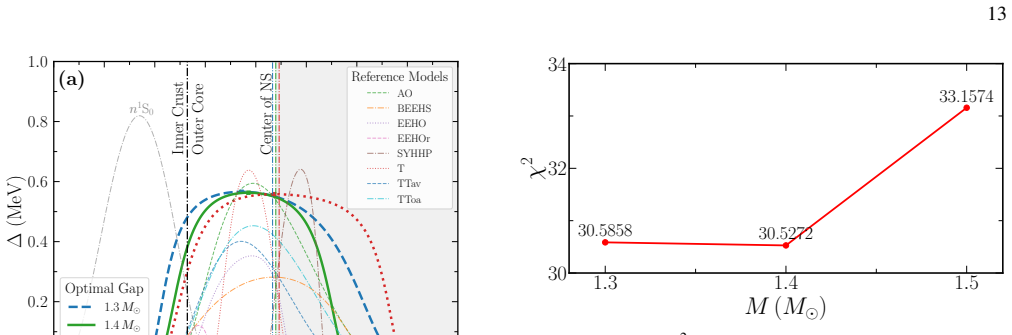
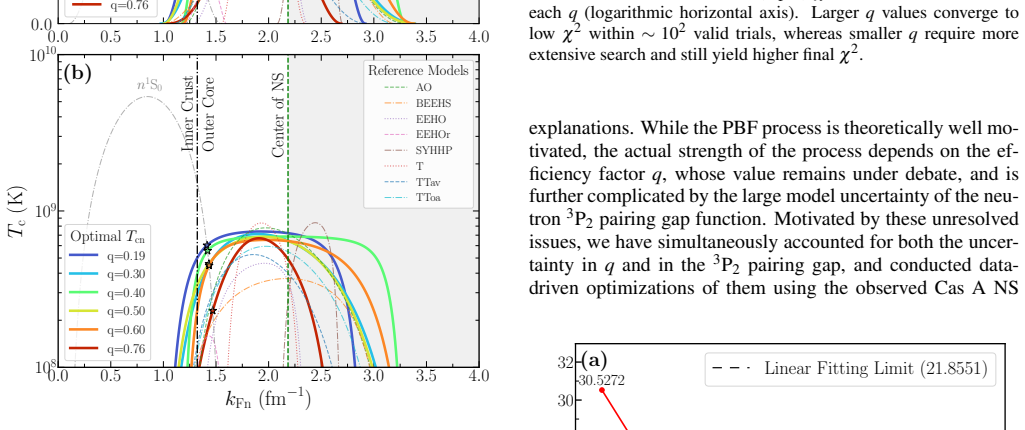
Within a fixed cooling calculation that uses the BSk24 equation of state and holds neutron-star mass, envelope composition, and age offset constant, direct chi-squared minimization against Cassiopeia A data yields optimized neutron 3P2 gaps whose maximum amplitude is approximately 0.5--0.6 MeV. Raising the PBF emissivity parameter q produces smoother and more localized gap and critical-temperature profiles; models with q greater than or equal to 0.4 reproduce the observed cooling rate inside the 1 sigma interval, whereas the baseline q near 0.19 lies near the 3 sigma level.
What carries the argument
A four-parameter gap parametrization in which each parameter directly sets the amplitude, peak location, width, and asymmetry of the neutron 3P2 pairing gap; the form is optimized by tree-structured Parzen estimator followed by Nelder-Mead refinement to match Cas A temperature data.
If this is right
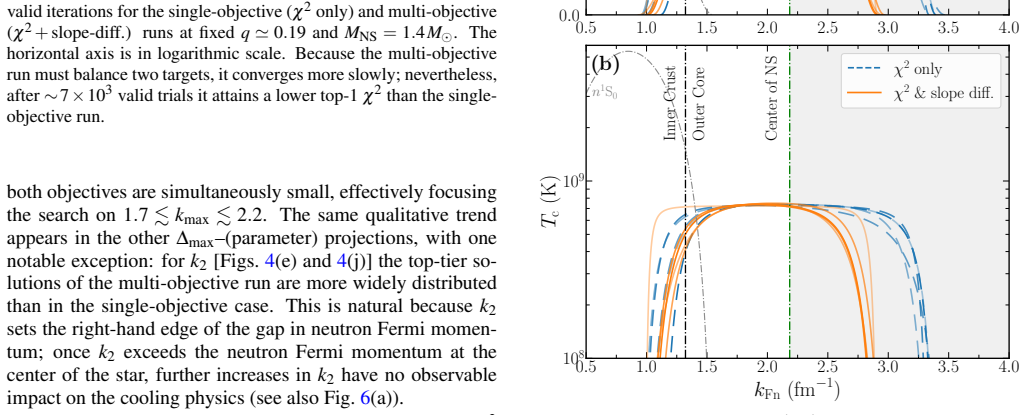
- For a 1.4 solar-mass star the optimized gap becomes smoother and more localized as q increases, improving agreement with the observed decline rate.
- Single-objective chi-squared minimization reaches a lower chi-squared value than the multi-objective formulation explored in the same setup.
- The baseline theoretical value q approximately 0.19 is disfavored at roughly 3 sigma under the fixed cooling assumptions.
- Physically reasonable gap amplitudes of 0.5--0.6 MeV emerge consistently across the optimized solutions.
Where Pith is reading between the lines
- If the preference for larger q survives when mass and equation-of-state uncertainties are included, microscopic calculations of the PBF process in superfluid neutron matter may need revision.
- The same parametrization and optimization pipeline could be applied to cooling curves of other isolated neutron stars to test whether the preferred gap shape changes with stellar mass.
- Allowing envelope composition or age offset to vary simultaneously with q would likely broaden the acceptable range of gap parameters and should be checked before claiming a definitive constraint.
Load-bearing premise
The entire analysis is performed inside one fixed cooling model that keeps neutron-star mass, envelope composition, equation of state, and age offset unchanged while only varying q and the four gap parameters.
What would settle it
A new temperature measurement for Cas A that falls outside the cooling track produced by any gap with 0.5--0.6 MeV peak amplitude when q is set at or above 0.4, or a calculation showing that allowing the neutron-star mass or equation of state to vary moves the best-fit q back below 0.3.
Figures







read the original abstract
The rapid cooling observed in the Cassiopeia~A neutron star (Cas~A NS) is one of the most stringent tests for neutron-star cooling theory. While Cooper-pair breaking and formation (PBF) neutrino emission is a leading candidate, uncertainties remain regarding the PBF efficiency factor $q$ and the neutron ${}^{3}\mathrm{P}_{2}$ pairing gap. This work explores in a data-driven manner how the optimized gap shape responds to variations of the PBF emissivity parameter $q$ within a fixed cooling setup. We introduce a novel gap parametrization, in which each parameter carries direct physical meaning and controls the gap amplitude, peak location, width, and asymmetry. Using a Fortran-based cooling code and the BSk24 equation of state, we perform parameter-space exploration guided by the Cas~A NS data. Global optimization is carried out with Optuna's tree-structured Parzen estimator, followed by local refinement using the Nelder--Mead method. The optimized solutions yield physically reasonable gaps with peak amplitudes $\Delta_{\max}\approx0.5$--$0.6~\mathrm{MeV}$. Although the multi-objective formulation explores the parameter space more broadly, the single-objective $\chi^{2}$-only optimization achieves the lowest $\chi^{2}$. For $M_{\mathrm{NS}}=1.4\,M_{\odot}$, increasing $q$ drives the optimized gap and critical-temperature profiles toward smoother and more localized shapes, improving consistency with the observed trend. Models with $q\gtrsim0.4$ reproduce the decline rate within the $1\sigma$ confidence interval, whereas the baseline case $q\simeq0.19$ lies near the $3\sigma$ level. Our results suggest larger effective PBF emissivities than the baseline estimate, although robust constraints on $q$ require future Bayesian inference including uncertainties in mass, envelope composition, equation of state, pairing microphysics, and age offset. (Shortened due to the arXiv abstract length limit.)
Editorial analysis
A structured set of objections, weighed in public.
Referee Report
Summary. The manuscript introduces a physically motivated parametrization of the neutron 3P2 pairing gap (amplitude, peak location, width, asymmetry) and performs direct χ² minimization against the Cas A cooling data inside a fixed neutron-star cooling model (M_NS=1.4 M_⊙, BSk24 EOS, fixed envelope composition and age offset). Global optimization via Optuna’s tree-structured Parzen estimator followed by Nelder–Mead refinement is used to explore the joint dependence on the PBF efficiency factor q and the four gap parameters. The central result is that q ≳ 0.4 yields decline rates inside the 1σ observational interval while the baseline q ≃ 0.19 lies near 3σ; the optimized gaps have peak amplitudes Δ_max ≈ 0.5–0.6 MeV. The authors note that robust constraints on q will require future Bayesian analyses that marginalize over mass, EOS, envelope, and age uncertainties.
Significance. If the reported preference for q ≳ 0.4 survives variation of the fixed inputs, the work supplies a concrete, data-driven indication that the effective PBF emissivity in the 3P2 channel may be higher than the conventional estimate and demonstrates a transparent, physically interpretable gap parametrization together with reproducible optimization machinery. The explicit acknowledgment that the present fixed-setup results are provisional and the call for a full Bayesian treatment are positive features.
major comments (2)
- [Results] Results section (paragraph beginning “For M_NS=1.4 M_⊙”): the claim that q ≳ 0.4 reproduces the observed decline rate within 1σ while q ≃ 0.19 lies near 3σ is obtained exclusively inside one fixed cooling configuration. Because the Cas A temperature trajectory is known to be sensitive to modest changes in mass, envelope composition, and age offset, the reported χ² improvement for larger q could be an artifact of the particular fixed choices rather than a robust indication of PBF emissivity; a limited sensitivity study varying at least one of these quantities is required to substantiate the central claim.
- [Method] Optimization procedure (description of single- vs. multi-objective runs): although the single-objective χ² minimization is stated to achieve the lowest χ², the manuscript does not quantify how the additional objectives in the multi-objective formulation alter the posterior volume or the location of the χ² minimum; this information is needed to assess whether the reported preference for smoother, more localized gaps at high q is an artifact of the single-objective formulation.
minor comments (2)
- [Abstract] The abstract states that the multi-objective formulation “explores the parameter space more broadly” yet the single-objective run gives the lowest χ²; a short clarifying sentence on the precise definition of the multi-objective loss would remove ambiguity.
- [Introduction] Notation: the symbol q is introduced as the “PBF emissivity parameter” but its precise relation to the microscopic matrix element (e.g., whether it multiplies the phase-space factor or the gap-dependent suppression) is not restated in the main text; a one-sentence reminder would aid readers.
Simulated Author's Rebuttal
We thank the referee for the thoughtful and constructive report. The comments highlight important aspects of the fixed-setup analysis and the optimization procedure. We address each major comment below and describe the revisions we will implement to strengthen the manuscript.
read point-by-point responses
-
Referee: [Results] Results section (paragraph beginning “For M_NS=1.4 M_⊙”): the claim that q ≳ 0.4 reproduces the observed decline rate within 1σ while q ≃ 0.19 lies near 3σ is obtained exclusively inside one fixed cooling configuration. Because the Cas A temperature trajectory is known to be sensitive to modest changes in mass, envelope composition, and age offset, the reported χ² improvement for larger q could be an artifact of the particular fixed choices rather than a robust indication of PBF emissivity; a limited sensitivity study varying at least one of these quantities is required to substantiate the central claim.
Authors: We agree that the reported preference for q ≳ 0.4 is obtained within a single fixed cooling configuration (M_NS = 1.4 M_⊙, BSk24 EOS, fixed envelope and age offset) and that the Cas A cooling trajectory is sensitive to variations in these inputs. The manuscript already states that robust constraints on q will require future Bayesian analyses that marginalize over mass, EOS, envelope composition, and age uncertainties. To directly address the referee’s concern, we will add a limited sensitivity study in the revised manuscript. Specifically, we will vary the age offset within its observational uncertainty range while keeping other inputs fixed, recompute the optimized gap parameters and χ² values for several q, and show that the preference for q ≳ 0.4 and the associated decline-rate improvement remain qualitatively unchanged. This addition will substantiate the central claim under modest variations without requiring a full re-analysis of all parameters. revision: yes
-
Referee: [Method] Optimization procedure (description of single- vs. multi-objective runs): although the single-objective χ² minimization is stated to achieve the lowest χ², the manuscript does not quantify how the additional objectives in the multi-objective formulation alter the posterior volume or the location of the χ² minimum; this information is needed to assess whether the reported preference for smoother, more localized gaps at high q is an artifact of the single-objective formulation.
Authors: We thank the referee for pointing out the need for quantitative comparison. The manuscript already notes that the single-objective χ²-only optimization yields the lowest χ² while the multi-objective formulation explores the parameter space more broadly. In the revised version we will add explicit quantification: we will report the χ² values attained by the best-fit parameters from both the single-objective and multi-objective runs, together with a brief description of the shift in the location of the χ² minimum and the change in the explored volume of gap-parameter space. This will demonstrate that the smoother, more localized gaps favored at high q are not an artifact of the single-objective choice but are reinforced by the fact that the single-objective run achieves the global lowest χ². revision: yes
Circularity Check
No significant circularity; explicit data-driven fit to Cas A observations
full rationale
The manuscript performs direct χ² minimization (via Optuna + Nelder-Mead) of a four-parameter gap shape plus the PBF factor q against the fixed cooling trajectory for M_NS=1.4 M_⊙ and BSk24 EOS. This is an open fitting exercise whose outputs are the optimized parameters themselves; the paper does not present any first-principles derivation, uniqueness theorem, or renamed prediction that reduces to its own inputs by construction. Comparison of χ² for q≳0.4 versus the baseline q≃0.19 is simply the numerical outcome of that minimization inside the chosen setup. No self-citation chain, ansatz smuggling, or self-definitional step is load-bearing for the central numerical result.
Axiom & Free-Parameter Ledger
free parameters (5)
- gap amplitude
- peak location
- width
- asymmetry
- q
axioms (2)
- domain assumption BSk24 equation of state
- domain assumption Fixed cooling setup
Lean theorems connected to this paper
-
IndisputableMonolith/Cost/FunctionalEquation.leanwashburn_uniqueness_aczel unclear?
unclearRelation between the paper passage and the cited Recognition theorem.
We introduce a novel gap parametrization... Δ(kFx,T=0) = Δ_max (kFx−k0)²(kFx−k2)² / [...] ; optimization with Optuna TPE followed by Nelder-Mead; q varied in {0.19,0.30,...0.76} at fixed M_NS=1.4 M_⊙, BSk24 EOS
-
IndisputableMonolith/Foundation/AlphaDerivationExplicit.leanalphaProvenanceCert unclear?
unclearRelation between the paper passage and the cited Recognition theorem.
Models with q≳0.4 reproduce the decline rate within the 1σ confidence interval, whereas the baseline case q≃0.19 lies near the 3σ level
What do these tags mean?
- matches
- The paper's claim is directly supported by a theorem in the formal canon.
- supports
- The theorem supports part of the paper's argument, but the paper may add assumptions or extra steps.
- extends
- The paper goes beyond the formal theorem; the theorem is a base layer rather than the whole result.
- uses
- The paper appears to rely on the theorem as machinery.
- contradicts
- The paper's claim conflicts with a theorem or certificate in the canon.
- unclear
- Pith found a possible connection, but the passage is too broad, indirect, or ambiguous to say the theorem truly supports the claim.
Reference graph
Works this paper leans on
-
[1]
The upper (lower) equation corresponds to the energy balance (transport)
Basic equations and assumptions The thermal evolution (or cooling) of neutron stars can be described by the following equations: d Le2Φ dr =− 4πr 2eΦ p 1−2Gm/c 2r CV dT dt +e Φ (Qν −Q h) , (16) d TeΦ dr =− 1 λ · LeΦ 4πr 2p 1−2Gm/c 2r ,(17) whereLandTdenote luminosity and temperature, respec- tively. The upper (lower) equation corresponds to the energy bal...
-
[2]
(16) and (17) must be discretized and solved
Implementation of a computational code for neutron star cooling For the numerical computation of neutron star cooling, Eqs. (16) and (17) must be discretized and solved. First, to simplify the form of these equations, we introduce the red- shifted temperature and luminosity, T≡e ΦT,L≡e 2ΦL, and define the baryon number coordinate a= 4πr 2nB drp 1−2Gm/c 2r...
-
[3]
Cas A NS observational data We use the observational data of the Cas A NS mea- sured withChandraACIS-S over the past 20 years, as re- ported in Ref. [8]. The dataset includes both GRADED ob- servations (14 epochs from 2000 to 2019) and FAINT ob- servations (4 epochs from 2006 to 2020), for a total of 18 epochs with comprehensive temporal coverage. Through...
work page 2000
-
[4]
TPE algorithm The TPE algorithm belongs to the family of Bayesian op- timization methods that build probabilistic models of the ob- jective function to guide the search process. Unlike traditional Bayesian optimization that modelsp(y|x)directly, TPE mod- els the conditional distributionsp(x|y)using TPE. Given a set of observationsD={(x 1,y 1), . . . ,(xn,...
-
[5]
Multi-objective extension For our cooling optimization problem, we employ a multi- objective variant of TPE that simultaneously optimizes two objectives: (1) minimizing the chi-squared (χ 2) statistic be- tween theoretical and observational cooling curves, and (2) minimizing the difference between theoretical and observed cooling rates. The multi-objectiv...
-
[6]
Implementation and constraints for optimization Our optimization procedure operates within the parameter bounds specified in Table II in Sec. II A. For each trial, we first sample parameter values and verify that they satisfy the physical constraints: 0.35≤β≤0.65 for the gap maximum position and the mathematically derived bounds forαgiven in Eq. (10). Onl...
work page 2000
-
[7]
and CCDK [51] models, respectively, all cooling curves 10 1.5 2.0 2.5 3.0 0.5 1.0 1.5 ∆max (a) 0 1 2 3 4 5 0.5 1.0 1.5 (b) −10−5 0 5 0.5 1.0 1.5 (c) 1.0 1.5 2.0 2.5 0.5 1.0 1.5 (d) 1.5 2.0 2.5 3.0 3.5 0.5 1.0 1.5 (e) 1.5 2.0 2.5 3.0 kmax 0.5 1.0 1.5 ∆max (f ) 0 1 2 3 4 5 w−1 0.5 1.0 1.5 (g) −10−5 0 5 α 0.5 1.0 1.5 (h) 1.0 1.5 2.0 2.5 k0 0.5 1.0 1.5 (i) 1....
-
[8]
John P. Hughes, Cara E. Rakowski, David N. Burrows, and Patrick O. Slane. Nucleosynthesis and mixing in cassiopeia a. The Astrophysical Journal, 528(2):L109, dec 1999
work page 1999
-
[9]
Robert A. Fesen, Molly C. Hammell, Jon Morse, Roger A. Chevalier, Kazimierz J. Borkowski, Michael A. Dopita, Christopher L. Gerardy, Stephen S. Lawrence, John C. Ray- mond, and Sidney van den Bergh. The Expansion Asymmetry and Age of the Cassiopeia A Supernova Remnant.The Astro- physical Journal, 645(1):283–292, July 2006
work page 2006
-
[10]
G. G. Pavlov and G. J. M. Luna. A dedicated chandra acis observation of the central compact object in the cassiopeia a supernova remnant.The Astrophysical Journal, 703(1):910, sep 2009
work page 2009
-
[11]
Craig O. Heinke and Wynn C. G. Ho. Direct observation of the cooling of the cassiopeia a neutron star.The Astrophysical Journal, 719(2):L167–L171, August 2010
work page 2010
-
[12]
K. G. Elshamouty, C. O. Heinke, G. R. Sivakoff, W. C. G. Ho, P. S. Shternin, D. G. Yakovlev, D. J. Patnaude, and L. David. Measuring the cooling of the neutron star in cassiopeia a with all chandra x-ray observatory detectors.The Astrophysical Journal, 777(1):22, oct 2013
work page 2013
-
[13]
B. Posselt and G. G. Pavlov. Upper limits on the rapid cool- ing of the central compact object in cas a.The Astrophysical Journal, 864(2):135, sep 2018
work page 2018
-
[14]
B. Posselt and G. G. Pavlov. The Cooling of the Central Compact Object in Cas A from 2006 to 2020.Astrophys. J., 932(2):83, June 2022
work page 2006
-
[15]
Peter S. Shternin, Dmitry D. Ofengeim, Craig O. Heinke, and Wynn C. G. Ho. Constraints on neutron star superflu- idity from the cooling neutron star in Cassiopeia A using all Chandra ACIS-S observations.Mon. Not. Roy. Astron. Soc., 518(2):2775–2793, 2022
work page 2022
-
[16]
Shu-Hua Yang, Chun-Mei Pi, and Xiao-Ping Zheng. Rapid cooling of neutron star in cassiopeia a and r-mode damping in the core.The Astrophysical Journal, 735(2):L29, June 2011
work page 2011
-
[17]
Rodrigo Negreiros, Stefan Schramm, and Fridolin Weber. Im- pact of rotation-driven particle repopulation on the thermal evo- lution of pulsars.Physics Letters B, 718(4–5):1176–1180, Jan- uary 2013
work page 2013
-
[18]
D. Blaschke, H. Grigorian, D. N. V oskresensky, and F. We- ber. Cooling of the neutron star in cassiopeia a.Phys. Rev. C, 85:022802, Feb 2012
work page 2012
-
[19]
D. Blaschke, H. Grigorian, and D. N. V oskresensky. Nuclear medium cooling scenario in light of new cas a cooling data and the 2MJ pulsar mass measurements.Phys. Rev. C, 88:065805, Dec 2013
work page 2013
-
[20]
G. Taranto, G. F. Burgio, and H.-J. Schulze. Cassiopeia a and direct urca cooling.Monthly Notices of the Royal Astronomical Society, 456(2):1451–1458, 12 2015
work page 2015
-
[21]
A. Bonanno, M. Baldo, G. F. Burgio, and V . Urpin. The neutron star in cassiopeia a: equation of state, superfluidity, and joule heating.Astronomy & Astrophysics, 561:L5, January 2014
work page 2014
-
[22]
Rapid cooling of the cassiopeia a neutron star due to superfluid quantum criticality, 2024
Hao-Fu Zhu, Guo-Zhu Liu, and Xufen Wu. Rapid cooling of the cassiopeia a neutron star due to superfluid quantum criticality, 2024
work page 2024
-
[23]
Lev B. Leinson. Axion mass limit from observations of the neu- tron star in cassiopeia a.Journal of Cosmology and Astroparti- cle Physics, 2014(08):031–031, August 2014
work page 2014
-
[24]
Lev B. Leinson. Impact of axions on the cassiopea a neutron star cooling.Journal of Cosmology and Astroparticle Physics, 2021(09):001, September 2021
work page 2021
-
[25]
Axion cooling of neutron stars.Phys
Armen Sedrakian. Axion cooling of neutron stars.Phys. Rev. D, 93:065044, Mar 2016
work page 2016
-
[26]
Axion cooling of neutron stars
Armen Sedrakian. Axion cooling of neutron stars. ii. beyond hadronic axions.Phys. Rev. D, 99:043011, Feb 2019
work page 2019
-
[27]
Koichi Hamaguchi, Natsumi Nagata, Keisuke Yanagi, and Ji- aming Zheng. Limit on the axion decay constant from the cool- ing neutron star in cassiopeia a.Physical Review D, 98(10), November 2018
work page 2018
-
[28]
Tsuneo Noda, Masa-aki Hashimoto, Nobutoshi Yasutake, Toshiki Maruyama, Toshitaka Tatsumi, and Masayuki Fuji- moto. Cooling of compact stars with color superconducting phase in quark–hadron mixed phase.The Astrophysical Jour- nal, 765(1):1, feb 2013
work page 2013
-
[29]
Sedrakian, Armen. Rapid cooling of cassiopeia a as a phase transition in dense qcd.Astronomy & Astrophysics, 555:L10, 2013
work page 2013
-
[30]
Armen Sedrakian. Cooling compact stars and phase transitions in dense qcd.The European Physical Journal A, 52(3), March 2016
work page 2016
-
[31]
A.Y . Potekhin and D.G. Yakovlev. Urca cooling of the neutron star in the cassiopeia a supernova remnant.Journal of High Energy Astrophysics, 49:100441, 2026
work page 2026
-
[32]
E. Flowers, M. Ruderman, and P. Sutherland. Neutrino pair emission from finite-temperature neutron superfluid and the cooling of young neutron stars.The Astrophysical Journal, 205:541–544, April 1976
work page 1976
-
[33]
A.V . Senatorov and D.N. V oskresensky. Collective excitations in nucleonic matter and the problem of cooling of neutron stars. Physics Letters B, 184(2):119–124, 1987
work page 1987
-
[34]
Neutrino emission from neutron stars.Physics Reports, 354(1–2):1–155, November 2001
D Yakovlev. Neutrino emission from neutron stars.Physics Reports, 354(1–2):1–155, November 2001
work page 2001
-
[35]
Springer International Publishing, 2018
Andreas Schmitt and Peter Shternin.Reaction Rates and Trans- port in Neutron Stars, page 455–574. Springer International Publishing, 2018
work page 2018
-
[36]
L.B. Leinson and A. Pérez. Vector current conservation and neutrino emission from singlet-paired baryons in neutron stars. Physics Letters B, 638(2–3):114–118, July 2006
work page 2006
-
[37]
Lattimer, Madappa Prakash, and An- drew W
Dany Page, James M. Lattimer, Madappa Prakash, and An- drew W. Steiner. Neutrino emission from cooper pairs and minimal cooling of neutron stars.The Astrophysical Journal, 707(2):1131, dec 2009
work page 2009
-
[38]
NSCool: Neutron star cooling code.https: //www.astroscu.unam.mx/neutrones/NSCool/,
Dany Page. NSCool: Neutron star cooling code.https: //www.astroscu.unam.mx/neutrones/NSCool/,
-
[39]
Astrophysics Source Code Library, record ascl:1609.009
-
[40]
Peter S. Shternin, Dmitry G. Yakovlev, Craig O. Heinke, Wynn C. G. Ho, and Daniel J. Patnaude. Cooling neutron star in the cassiopeia a supernova remnant: evidence for superfluidity in the core.Monthly Notices of the Royal Astronomical Society: Letters, 412(1):L108–L112, 03 2011
work page 2011
-
[41]
M J P Wijngaarden, Wynn C G Ho, Philip Chang, Craig O Heinke, Dany Page, Mikhail Beznogov, and Daniel J Pat- naude. Diffusive nuclear burning in cooling simulations and application to new temperature data of the cassiopeia a neu- tron star.Monthly Notices of the Royal Astronomical Society, 484(1):974–988, January 2019
work page 2019
-
[42]
L. B. Leinson. Neutrino emission from triplet pairing of neu- trons in neutron stars.Physical Review C, 81(2), February 2010
work page 2010
-
[43]
Wynn C G Ho, Yue Zhao, Craig O Heinke, D L Kaplan, Pe- ter S Shternin, and M J P Wijngaarden. X-ray bounds on cool- ing, composition, and magnetic field of the cassiopeia a neutron star and young central compact objects.Monthly Notices of the 20 Royal Astronomical Society, 506(4):5015–5029, July 2021
work page 2021
-
[44]
We will often express to theseqvalues simply as 0.76 and 0.19, respectively, although precise values involve smaller digits
-
[45]
Lev B Leinson. Hybrid cooling of the cassiopeia a neu- tron star.Monthly Notices of the Royal Astronomical Society, 511(4):5843–5848, February 2022
work page 2022
-
[46]
Shternin, Marcello Baldo, and Pawel Haensel
Peter S. Shternin, Marcello Baldo, and Pawel Haensel. In- medium enhancement of the modified urca neutrino reaction rates.Physics Letters B, 786:28–34, November 2018
work page 2018
-
[47]
Wynn C. G. Ho, Khaled G. Elshamouty, Craig O. Heinke, and Alexander Y . Potekhin. Tests of the nuclear equation of state and superfluid and superconducting gaps using the cassiopeia a neutron star.Phys. Rev. C, 91:015806, Jan 2015
work page 2015
-
[48]
A. D. Kaminker, P. Haensel, and D. G. Yakovlev. Nucleon su- perfluidity vs. observations of cooling neutron stars.Astronomy & Astrophysics, 373(2):L17–L20, July 2001
work page 2001
-
[49]
T. L. Ainsworth, J. Wambach, and D. Pines. Effective interac- tions and superfluid energy gaps for low density neutron matter. Physics Letters B, 222(2):173–178, May 1989
work page 1989
-
[50]
J. M. C. Chen, J. W. Clark, R. D. Davé, and V . V . Khodel. Pairing gaps in nucleonic superfluids.Nuclear Physics A, 555(1):59–89, April 1993
work page 1993
-
[51]
L. G. Cao, U. Lombardo, and P. Schuck. Screening effects in superfluid nuclear and neutron matter within brueckner theory. Phys. Rev. C, 74:064301, Dec 2006
work page 2006
-
[52]
S. Gandolfi, A. Yu. Illarionov, F. Pederiva, K. E. Schmidt, and S. Fantoni. Equation of state of low-density neutron matter, and the 1S0 pairing gap.Phys. Rev. C, 80:045802, Oct 2009
work page 2009
-
[53]
S. Gandolfi, A. Yu. Illarionov, S. Fantoni, F. Pederiva, and K. E. Schmidt. Equation of state of superfluid neutron matter and the calculation of the 1s0 pairing gap.Phys. Rev. Lett., 101:132501, Sep 2008
work page 2008
-
[54]
J. Margueron, H. Sagawa, and K. Hagino. Effective pairing interactions with isospin density dependence.Phys. Rev. C, 77:054309, May 2008
work page 2008
-
[55]
H.-J. Schulze, J. Cugnon, A. Lejeune, M. Baldo, and U. Lom- bardo. Medium polarization effects on neutron matter superflu- idity.Physics Letters B, 375(1):1–8, 1996
work page 1996
-
[56]
Achim Schwenk, Bengt Friman, and Gerald E. Brown. Renor- malization group approach to neutron matter: quasiparticle in- teractions, superfluid gaps and the equation of state.Nuclear Physics A, 713(1-2):191–216, January 2003
work page 2003
-
[57]
J. Wambach, T.L. Ainsworth, and D. Pines. Quasiparticle in- teractions in neutron matter for applications in neutron stars. Nuclear Physics A, 555(1):128–150, 1993
work page 1993
-
[58]
L. Amundsen and E. Østgaard. Superfluidity of neutron matter: (i). singlet pairing.Nuclear Physics A, 437(2):487–508, 1985
work page 1985
-
[59]
Ø. Elgarøy, L. Engvik, M. Hjorth-Jensen, and E. Osnes. Model- space approach to 1s0 neutron and proton pairing in neutron star matter with the bonn meson-exchange potentials.Nuclear Physics A, 604(4):466–490, 1996
work page 1996
- [60]
-
[61]
M. Baldo and H.-J. Schulze. Proton pairing in neutron stars. Phys. Rev. C, 75:025802, Feb 2007
work page 2007
- [62]
-
[63]
Ø. Elgarøy, L. Engvik, M. Hjorth-Jensen, and E. Osnes. Su- perfluidity inβ-stable neutron star matter.Phys. Rev. Lett., 77:1428–1431, Aug 1996
work page 1996
- [64]
-
[65]
L. Amundsen and E. Østgaard. Superfluidity of neutron matter: (ii). triplet pairing.Nuclear Physics A, 442(1):163–188, 1985
work page 1985
- [66]
-
[67]
Ø. Elgarøy, L. Engvik, M. Hjorth-Jensen, and E. Osnes. Triplet pairing of neutrons inβ-stable neutron star matter.Nuclear Physics A, 607(4):425–441, 1996
work page 1996
-
[68]
Superfluid state in neutron star matter
Tatsuyuki Takatsuka. Superfluid state in neutron star matter. iii: Tensor coupling effect in 3p2 energy gap.Progress of Theoret- ical Physics, 47(3):1062–1064, 03 1972
work page 1972
-
[69]
Tatsuyuki Takatsuka and Ryozo Tamagaki. Baryon superfluid- ity and neutrino emissivity of neutron stars.Progress of Theo- retical Physics, 112(1):37–72, July 2004
work page 2004
- [70]
-
[71]
F. Douchin and P. Haensel. A unified equation of state of dense matter and neutron star structure.Astronomy & Astrophysics, 380:151–167, 2001
work page 2001
-
[72]
N. K. Glendenning and S. A. Moszkowski. Reconciliation of neutron-star masses and binding of theλin hypernuclei.Phys- ical Review Letters, 67(18):2414–2417, 1991
work page 1991
- [73]
-
[74]
J. M. Pearson, N. Chamel, A. Y . Potekhin, A. F. Fantina, C. Ducoin, A. K. Dutta, and S. Goriely. Unified equa- tions of state for cold non-accreting neutron stars with brus- sels–montreal functionals – i. role of symmetry energy.Monthly Notices of the Royal Astronomical Society, 481(3):2994–3026, September 2018. Erratum inMon. Not. R. Astron. Soc.486(1),...
-
[75]
J. R. Oppenheimer and G. M. V olkoff. On massive neutron cores.Phys. Rev., 55:374–381, Feb 1939
work page 1939
-
[76]
A. Y . Potekhin. Analytical representations of unified equations of state of neutron star matter.http://www.ioffe.ru/ astro/NSG/BSk/. Accessed: 2025-08-11
work page 2025
-
[77]
J M Pearson, N Chamel, A Y Potekhin, A F Fantina, C Ducoin, A K Dutta, and S Goriely. Unified equations of state for cold non-accreting neutron stars with brussels–montreal functionals – i. role of symmetry energy.Monthly Notices of the Royal Astronomical Society, 481(3):2994–3026, 09 2018
work page 2018
-
[78]
James J. Condon and Scott M. Ransom. Essential radio as- tronomy: Chapter 6 — pulsars.https://www.cv.nrao. edu/~sransom/web/Ch6.html. Accessed: 2025-09-18
work page 2025
-
[79]
O. Y . Gnedin, D. G. Yakovlev, and A. Y . Potekhin. Thermal relaxation in young neutron stars.Monthly Notices of the Royal Astronomical Society, 324(3):725–736, June 2001
work page 2001
-
[80]
Potekhin, A. Y . and Chabrier, G. Magnetic neutron star cooling and microphysics.Astronomy & Astrophysics, 609:A74, 2018
work page 2018
discussion (0)
Sign in with ORCID, Apple, or X to comment. Anyone can read and Pith papers without signing in.