REVIEW 4 major objections 10 minor 19 references
Copy-Enhanced Heterogeneous Information Learning for Dialogue State Tracking
T0 review · 4 major / 10 minor · reviewed 2026-08-14 · deepseek-v4-flash
Pith's one-line read CEDST generates all dialogue-state values, including values absent from the ontology, by copying spans from the conversation and reading ontology-aware slot-specific memories, and it reports state-of-the-art joint-goal accuracy on WoZ2…
desk verdict A plausible DST architecture with a copy mechanism, but the unknown-value evaluation only tests verbatim copying of closed-set values, so the central claim is overstated. read the letter →
The pith
A machine-rendered reading of the paper's core claim, the machinery that carries it, and where it could break.
The reading
What carries the argument
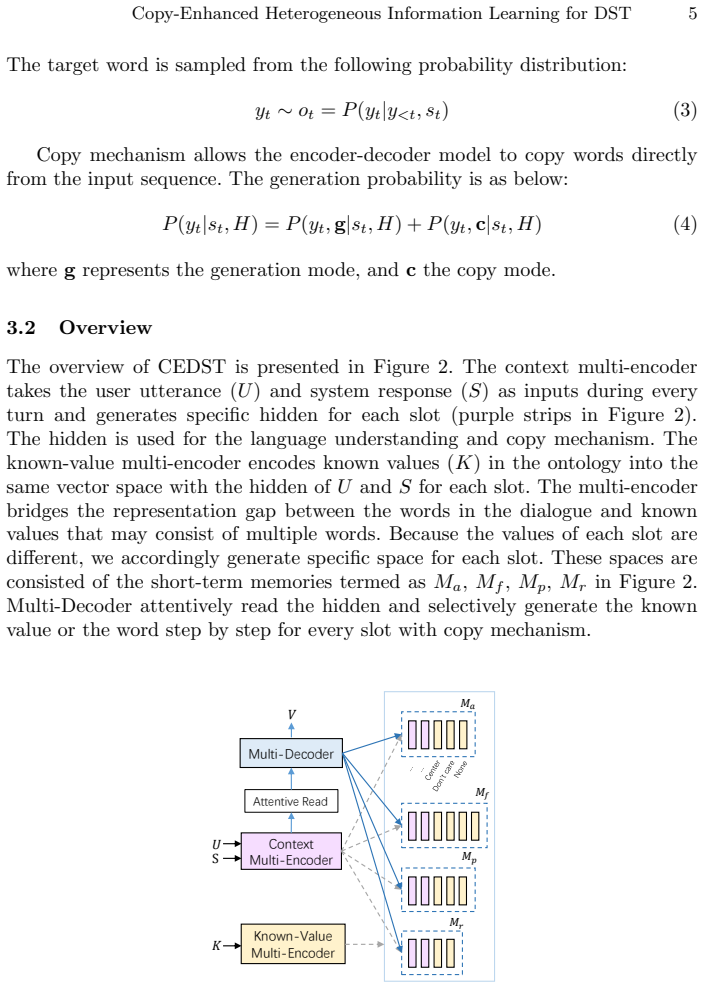
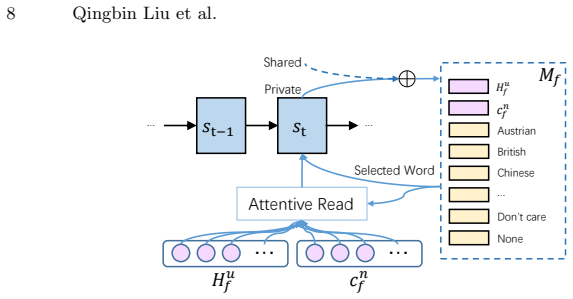
The mechanism is a copy-augmented multiple encoder-decoder. A context multi-encoder runs a private and a shared BiLSTM with self-attention for each slot to produce per-slot memories $M_a$, $M_f$, $M_p$, and $M_r$; a known-value multi-encoder maps ontology values and special values such as 'none' and 'don't care' into the same slot-specific spaces. The multi-decoder combines private and shared LSTM decoders and, for each slot, computes a distribution over copying a word from the dialogue and generating a value from ontology memory; for multi-value slots it selects all candidates above a threshold in one step. This carries the argument by letting known and unknown values be produced from one unified distribution, with no hand-crafted normalization list.
What would settle it
A test set of genuinely novel slot values, such as restaurant names, cuisine words, or area names never appearing in training, would settle it: if CEDST's accuracy on those values stays near its masked-value results, the unknown-value claim is sound; if it drops sharply, the masking protocol overestimates generalization.
Extended reading notes
Core claim
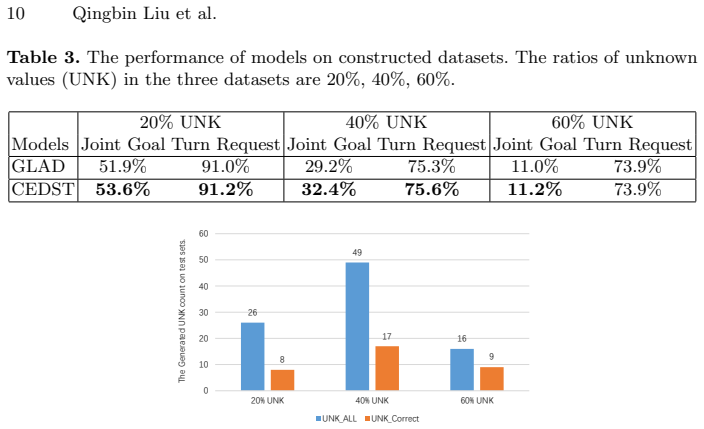
The central claim is that all possible slot values, including values never seen in training, can be generated by copying words from the dialogue context or generating them from ontology-aware memory. CEDST does this with multiple encoders that map dialogue and known ontology values into one space per slot, and multiple decoders that read those reduced spaces; the copy mechanism decides at the first decoding step whether to emit a known value from the ontology or copy an unknown value word-by-word from the utterance. In experiments, CEDST achieves 89.6% joint-goal accuracy on WoZ2 and 100% on both food and location slots in bAbI's out-of-vocabulary test, outperforming the pointer-network baseline, and improves joint-goal accuracy on constructed datasets with 20%, 40%, and 60% masked unknown values.
Load-bearing premise
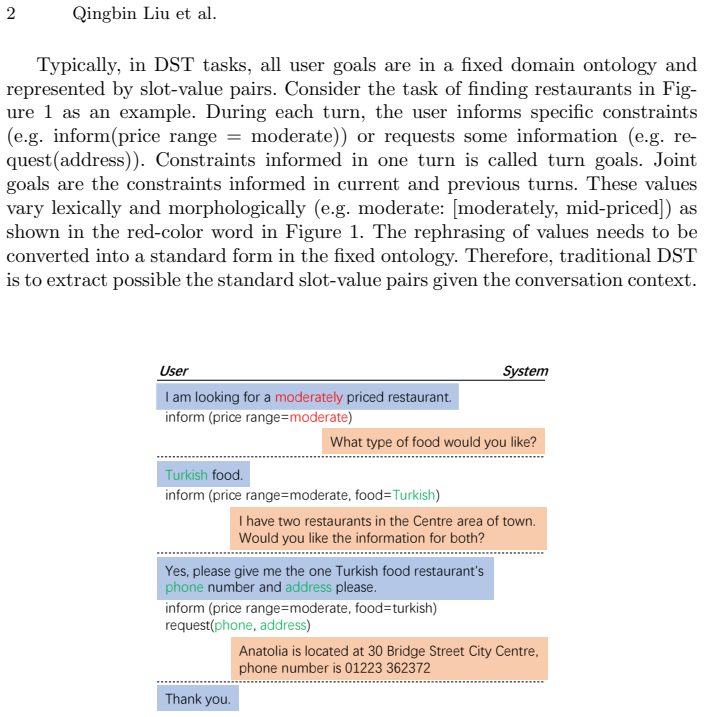
The load-bearing premise is that randomly masking known WoZ2 values and treating them as 'unknown' replicates how genuinely new out-of-ontology values behave, so the measured copy performance is evidence of real generalization rather than an artifact of masked vocabulary.
Editorial extensions
If this is right
- State tracking no longer needs an exhaustive candidate ontology or a hand-written normalization list, because values can be copied in normalized form from dialogue or ontology.
- Decomposing the state space into per-slot private and shared representations improves joint-goal accuracy on WoZ2 over the shared-only architecture (89.6% versus 85.8% when the multi-encoder is removed).
- Copying from dialogue context is what enables unknown values; removing the copy mechanism and utterance hidden degrades joint-goal accuracy on the 40% unknown-value dataset from 32.4% to 29.4%.
- The approach handles both single-value and multi-value slots within one architecture, selecting all values above a threshold for request slots.
- On bAbI's out-of-vocabulary test, copying from the utterance reaches 100% food and location accuracy, matching or beating a pointer network trained with targeted feature dropout.
Reading between the lines
- The paper's unknown-value evaluation masks known WoZ2 values; a stricter test would use values whose surface forms never appear anywhere in training, and performance on truly novel forms may be lower than the 20–60% masking results suggest.
- The same copy-plus-multi-encoder design could transfer to other tasks with open vocabularies and heterogeneous inputs, such as slot filling for natural-language understanding, where values like dates or song titles must be extracted from context rather than selected from a fixed set.
- Combining the copy mechanism with a discriminative candidate-set scorer could yield a hybrid that keeps the generative model's flexibility while letting a reranker validate copied spans against dialogue context, potentially improving precision on copied unknown values.
Signed reviews
Editorial analysis
A structured set of objections, weighed in public.
Referee Report
Summary. The paper proposes CEDST, a sequence-to-sequence dialogue state tracking model that combines a copy mechanism with multiple private/shared encoders and decoders. The model decomposes the state space into slot-specific memories formed from the user utterance, system response/actions, and the ontology, and it generates each slot value either by selecting a known ontology value or by copying a span from the dialogue. The authors evaluate on WoZ2, bAbI Task 5, and WoZ2-based datasets constructed by masking 20%, 40%, or 60% of known values from the training ontology. They report joint-goal accuracy of 89.6% on WoZ2, perfect or near-perfect results on bAbI for p=0, and small improvements over GLAD on the constructed datasets, and conclude that CEDST can generate all possible values including unknown values.
Significance. If the central claim holds, the paper offers a practical generative DST that removes the need for hand-crafted normalization lists and handles values outside a fixed ontology, a real bottleneck for scalable dialogue systems. The multi-encoder-decoder decomposition is a reasonable way to reduce a large state space, and the bAbI out-of-vocabulary results show that the copy mechanism can extract previously unseen values when they are directly mentioned in the dialogue. The paper is also transparent about the architecture and includes ablations. However, the main evidence for the 'all possible values' claim rests on constructed datasets in which 'unknown' values are masked closed-set values, and the copy mechanism can only emit verbatim spans from the input; the results therefore demonstrate a narrower capability than the abstract claims, and the experimental support is thin: single-run numbers, small margins over GLAD, and an incomplete bAbI table.
major comments (4)
- [Section 3.4, Eqs. (19)-(20); Section 4.1] The central claim that CEDST 'can effectively generate all possible values including unknown values' is not supported for genuinely out-of-ontology values. In the copy mode, the output distribution is defined over the memory entries M, so the model can only emit a contiguous span that appears verbatim in the dialogue or a value from the ontology; there is no mechanism to map a surface variant such as 'moderately' to the canonical 'moderate' when that canonical string is absent from both the dialogue and the ontology. In the constructed datasets, 'unknown' values are randomly selected known WoZ2 values whose lexical and embedding statistics remain in-distribution, and the reported correct-UNK ratios in Figure 4 are therefore upper bounds for realistic open-vocabulary values that may be multiword, paraphrased, or partially covered by GloVe. I recommend either evaluating on truly novel values with canonicalization requirements or substantially tempering the generalization claim.
- [Section 4.3, Tables 1 and 2] CEDST results are reported as single runs without error bars, while the strongest baseline, GLAD, is reported as 88.1±0.4 on WoZ2 joint goal; the 1.5-point margin for CEDST is within a plausible noise range, so the state-of-the-art claim is not statistically established. In Table 2, the p=0.1 columns for CEDST on both Food and Location are missing (shown as dashes), even though the text claims CEDST outperforms PtrNet; this makes the comparison incomplete and prevents verification of the claim for that setting.
- [Section 4.4, Table 3] The gains over GLAD on the constructed datasets are 1.7, 3.2, and 0.2 percentage points for the 20%, 40%, and 60% UNK conditions, respectively, with no significance or variance information. At 60% UNK, CEDST is essentially at the floor (11.2% vs. 11.0% for GLAD). The conclusion that CEDST achieves state-of-the-art performance on the constructed datasets is therefore not strongly supported by the reported numbers.
- [Section 4.5, '- copy' ablation] The '- copy' ablation removes the copy mechanism and the utterance hidden from the memory M simultaneously, so it cannot isolate the contribution of the copy mechanism. The observed degradation could be due to removing the utterance memory rather than to the copy mechanism itself, weakening the stated conclusion that 'copy mechanism generates unknown values effectively.'
minor comments (10)
- [Section 4.4] The text refers to 'Table 2' when presenting the constructed-dataset results, but the actual table is numbered Table 3; the cross-reference should be corrected.
- [Table 2] The p=0.1 columns for CEDST should be completed or an explicit explanation should be given for their absence.
- [Title and Section 3] The paper uses 'Copy-Enhanced' in the title and abstract but 'copy-augmented' in the body; the terminology should be made consistent.
- [Section 4.1] The phrase 'Selected values are seamed as unknown values' contains a typo; it should presumably read 'treated as unknown values'.
- [Section 2.1] The word 'fratures' in the first paragraph is a typo for 'features'.
- [Figure 2] Figure 2 contains an unexplained Fourier-series expression for P(y_t|M_a); this looks like a leftover placeholder and should be removed or properly explained.
- [Section 3.4] For the multi-value request slot, the paper says predicted values can be obtained with 'some simple segmentation rules' but never specifies these rules; because they affect the reported request accuracy, they should be described.
- [Section 4.1] The description 'API calls in Task 5 of the bAbI dataset is regarded as the state' is grammatically unclear and should be rewritten to specify how dialogue states are derived from the API calls.
- [Section 4.3] The 'simple rule' for integrating turn goals into joint goals is a hand-crafted component; the paper should state whether the reported results are sensitive to this rule, especially since it is not part of the multi-decoder.
- [Figure 4] The definition of 'generated unknown values' in Figure 4 is not precise; it should state whether these counts are per-slot predictions, joint states, or something else.
Circularity Check
No significant circularity: CEDST is an empirical learning system evaluated on held-out data against independent baselines; the constructed unknown-value datasets raise external-validity concerns but do not make the derivation circular.
full rationale
This is an empirical learning paper rather than a claimed derivation from first principles. CEDST is trained on WoZ2, bAbI, and constructed UNK datasets with standard train/test splits, and the headline results are measured on held-out test inputs. The copy mechanism (Section 3.4, Eqs. 19-22) defines the output distribution over dialogue and ontology memory entries, but this is a model architecture choice, not a parameter fitted to the evaluation labels. The constructed datasets (Section 4.1) randomly mask known WoZ2 values in the training set, which tests the model's ability to handle values unseen during training; this is a legitimate experimental construction, though it may not fully capture the difficulty of genuinely novel out-of-ontology values. That limitation concerns external validity and generalization, not circularity. The only hand-set number, the 0.5 threshold in multi-value decoding, applies to the request slot and is not load-bearing for the joint-goal results. No load-bearing self-citation, no imported uniqueness theorem, and no fitted-input-disguised-as-prediction pattern were found. The paper compares against independent published baselines and reports ablations, so the central empirical claims do not reduce to the paper's own inputs by construction.
Assumptions & free parameters
free parameters (2)
- multi-value threshold =
0.5
- joint goal integration rule =
hand-crafted heuristic
assumptions (4)
- standard math LSTM, softmax attention, and copy mechanism operate as standard sequence models.
- domain assumption Most slot values in WoZ2 (claimed 82%) can be copied verbatim from the dialogue.
- ad hoc to paper Masking known values in the training set simulates unknown values in test.
- domain assumption The first decoding step decides whether to generate from ontology or copy from dialogue, and this is sufficient for multi-word values.
Cite this review
Pith. "Pith review of Copy-Enhanced Heterogeneous Information Learning for Dialogue State Tracking." pith.science (2026). https://pith.science/paper/ECFGBQOS
@misc{pith2026190807705,
  author       = {Pith},
  title        = {Pith review of: Copy-Enhanced Heterogeneous Information Learning for Dialogue State Tracking},
  year         = {2026},
  howpublished = {\url{https://pith.science/paper/ECFGBQOS}},
  note         = {Machine review of arXiv:1908.07705}
}
read the original abstract
Dialogue state tracking (DST) is an essential component in task-oriented dialogue systems, which estimates user goals at every dialogue turn. However, most previous approaches usually suffer from the following problems. Many discriminative models, especially end-to-end (E2E) models, are difficult to extract unknown values that are not in the candidate ontology; previous generative models, which can extract unknown values from utterances, degrade the performance due to ignoring the semantic information of pre-defined ontology. Besides, previous generative models usually need a hand-crafted list to normalize the generated values. How to integrate the semantic information of pre-defined ontology and dialogue text (heterogeneous texts) to generate unknown values and improve performance becomes a severe challenge. In this paper, we propose a Copy-Enhanced Heterogeneous Information Learning model with multiple encoder-decoder for DST (CEDST), which can effectively generate all possible values including unknown values by copying values from heterogeneous texts. Meanwhile, CEDST can effectively decompose the large state space into several small state spaces through multi-encoder, and employ multi-decoder to make full use of the reduced spaces to generate values. Multi-encoder-decoder architecture can significantly improve performance. Experiments show that CEDST can achieve state-of-the-art results on two datasets and our constructed datasets with many unknown values.
Figures
Figures from the paper (1 more)
Reference graph
Works this paper leans on
-
[1]
CoRR abs/1409.0473 (2014), http://arxiv.org/abs/ 1409.0473
Bahdanau, D., Cho, K., Bengio, Y.: Neural machine translation by jointly learning to align and translate. CoRR abs/1409.0473 (2014), http://arxiv.org/abs/ 1409.0473
arXiv 2014
-
[2]
Bordes, A., Weston, J.: Learning end-to-end goal-oriented dialog. CoRR (2016)
work page 2016
-
[3]
Dhingra, B., Li, L., Li, X., Gao, J., Chen, Y.N., Ahmed, F., Deng, L.: Towards end-to-end reinforcement learning of dialogue agents for information access. In: Proceedings of ACL. pp. 484–495 (2017)
work page 2017
-
[4]
Gu, J., Lu, Z., Li, H., Li, V.O.: Incorporating copying mechanism in sequence-to- sequence learning. In: Proceedings of ACL. pp. 1631–1640 (2016)
work page 2016
-
[5]
arXiv preprint arXiv:1611.01587 (2016)
Hashimoto, K., Xiong, C., Tsuruoka, Y., Socher, R.: A joint many-task model: Growing a neural network for multiple nlp tasks. arXiv preprint arXiv:1611.01587 (2016)
arXiv 2016
-
[6]
Henderson, M., Thomson, B., Young, S.: Word-based dialog state tracking with recurrent neural networks. In: Proceedings of SIGDIAL. pp. 292–299 (2014)
work page 2014
-
[7]
arXiv preprint arXiv:1207.0580 (2012)
Hinton, G.E., Srivastava, N., Krizhevsky, A., Sutskever, I., Salakhutdinov, R.R.: Improving neural networks by preventing co-adaptation of feature detectors. arXiv preprint arXiv:1207.0580 (2012)
arXiv 2012
-
[8]
Hochreiter, S., Schmidhuber, J.: Long short-term memory. Neural computation pp. 1735–1780 (1997)
work page 1997
Show all 19 references
-
[9]
arXiv preprint arXiv:1412.6980 (2014)
Kingma, D.P., Ba, J.: Adam: A method for stochastic optimization. arXiv preprint arXiv:1412.6980 (2014)
2014 arXiv
-
[10]
In: Proceedings of ACL
Mrkˇ si´ c, N.,´O S´ eaghdha, D., Wen, T.H., Thomson, B., Young, S.: Neural belief tracker: Data-driven dialogue state tracking. In: Proceedings of ACL. pp. 1777– 1788 (2017)
2017
-
[11]
In: Proceedings of EMNLP
Pennington, J., Socher, R., Manning, C.: Glove: Global vectors for word represen- tation. In: Proceedings of EMNLP. pp. 1532–1543 (2014)
2014
-
[12]
In: Proceedings of EACL
Perez, J., Liu, F.: Dialog state tracking, a machine reading approach using memory network. In: Proceedings of EACL. pp. 305–314 (2017)
2017
-
[13]
CoRR abs/1712.10224 (2017)
Rastogi, A., Hakkani-T¨ ur, D., Heck, L.P.: Scalable multi-domain dialogue state tracking. CoRR abs/1712.10224 (2017)
2017 arXiv
-
[14]
Machine Learn- ing Research pp
Srivastava, N., Hinton, G., Krizhevsky, A., Sutskever, I., Salakhutdinov, R.: Dropout: a simple way to prevent neural networks from overfitting. Machine Learn- ing Research pp. 1929–1958 (2014)
2014
-
[15]
In: Proceedings of NIPS
Sutskever, I., Vinyals, O., Le, Q.V.: Sequence to sequence learning with neural networks. In: Proceedings of NIPS. pp. 3104–3112 (2014)
2014
-
[16]
In: Proceedings of EACL
Wen, T.H., Vandyke, D., Mrkˇ si´ c, N., Gasic, M., Rojas Barahona, L.M., Su, P.H., Ultes, S., Young, S.: A network-based end-to-end trainable task-oriented dialogue system. In: Proceedings of EACL. pp. 438–449 (2017)
2017
-
[17]
In: Proceedings of ACL
Xu, P., Hu, Q.: An end-to-end approach for handling unknown slot values in dia- logue state tracking. In: Proceedings of ACL. pp. 1448–1457 (2018)
2018
-
[18]
In: Proceedings of ISCA (2014)
Xu, P., Sarikaya, R.: Targeted feature dropout for robust slot filling in natural language understanding. In: Proceedings of ISCA (2014)
2014
-
[19]
In: Proceedings of ACL
Zhong, V., Xiong, C., Socher, R.: Global-locally self-attentive encoder for dialogue state tracking. In: Proceedings of ACL. pp. 1458–1467 (2018)
2018
Reviewed August 14, 2026 · model on record in the stance chip above.
Discussion (0). Continue with ORCID to comment.