REVIEW 4 major objections 3 minor 64 references
The light-by-light contribution to the muon g-2 within the nonlocal chiral quark model with vector and axial-vector mesons
T0 review · 4 major / 3 minor · reviewed 2026-08-16 · deepseek-v4-flash
Pith's one-line read Including vector and axial-vector mesons leaves the muon g-2 hadronic light-by-light term at $(157\pm10.6)\times10^{-11}$.
desk verdict The vector-meson dressing calculation is solid and the effect is tiny, but the headline total is not yet a complete prediction: the error bar is internally inconsistent, the strange sector is imported from an older model, and the negative pion loop is missing. read the letter →
The pith
A machine-rendered reading of the paper's core claim, the machinery that carries it, and where it could break.
The reading
What carries the argument
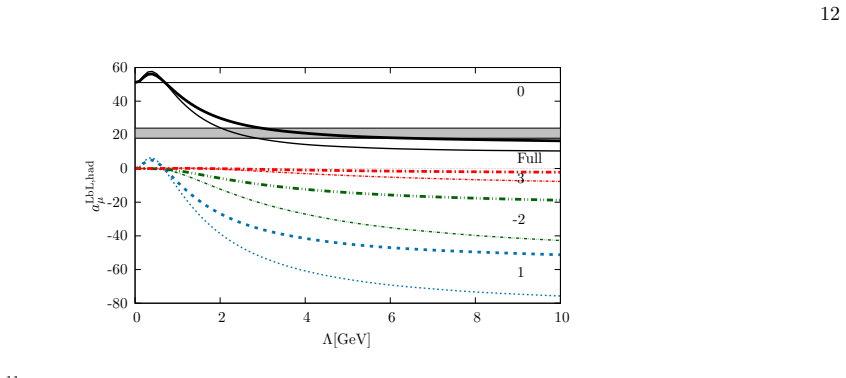
The calculation rests on gauge-invariant nonlocal vertices generated by a path-ordered exponential phase factor attached to each quark field, which produces quark-antiquark-photon and meson-quark-antiquark-photon vertices with any number of photons. In the vector sector, every photon-quark vertex is dressed by a transverse $\rho(\omega)\to\gamma$ transition encoded in the function $C_{\gamma V}(q^2)$ together with the transverse projector; since $C_{\gamma V}(0)=0$, the vector mesons appear only on internal lines, and the light-by-light amplitude receives at most three vector-meson exchanges. The four-rank polarization tensor is built from the quark box plus the nonlocal multiphoton vertices, and the muon anomaly is extracted with the standard projection formula reduced to a three-dimensional integral. A local limit with constituent quark mass $m_Q=300$ MeV serves as a cross-check, recovering the expected combinatorial coefficients $-3$, $3$, and $-1$ for one-, two-, and three-exchange diagrams.
What would settle it
Recompute the strange quark loop and the $\eta$, $\eta'$, $f_0(980)$, and $a_0(980)$ exchange contributions with the vector- and axial-vector-dressed vertices used elsewhere in this paper; if that block shifts by more than about five units, the quoted $157\pm10.6$ is no longer the model's answer. Alternatively, a lattice or dispersion measurement of the hadronic light-by-light contribution below about $135\times10^{-11}$ with an uncertainty below $5$ would exclude the central value at more than two standard deviations.
Extended reading notes
Core claim
The paper establishes that, in the nonlocal chiral quark model with scalar-pseudoscalar and vector-axial-vector channels, the hadronic light-by-light contribution to the muon anomalous magnetic moment is $a_\mu^{\mathrm{HLbL}}=(157\pm10.6)\times10^{-11}$. The non-strange quark loop alone is about $96\times10^{-11}$; adding the $\pi$, $\sigma$, $a_1$, and $f_1$ exchange contributions gives an SU(2) value of $150\pm9.6$ at the preferred dynamical mass $m_d=310$ MeV, where both the $\rho$ and $a_1$ masses can be reproduced. The strange-particle pieces ($\eta$, $\eta'$, $f_0(980)$, $a_0(980)$, and the strange quark loop) are added from the earlier model without spin-1 mesons. The genuinely new ingredient, the dressing of internal photons by $\rho(\omega)\to\gamma$ transitions, contributes only $-2.9$, $0.09$, and $0.001$ (in units of $10^{-11}$) for one, two, and three vector-meson exchanges at that point.
Load-bearing premise
The final total assumes that the strange-quark and strange-meson contributions ($\eta$, $\eta'$, $f_0(980)$, $a_0(980)$, strange loop) computed in the model without vector and axial-vector mesons stay essentially unchanged when spin-1 mesons are introduced, and can simply be added on.
Editorial extensions
If this is right
- If the quoted total is right, the earlier scalar-pseudoscalar estimate of $168\times10^{-11}$ was already within about one standard deviation of the extended-model value, so the nonlocal framework is stable under this extension.
- Vector-meson dressing of internal photons is a sub-3-unit effect, so future calculations in the same model can safely keep only the quark loop and one-vector-meson corrections.
- Including the axial-vector mesons $a_1$ and $f_1$ does not destabilize the sum; near $m_d=310$ MeV the total is nearly independent of the ratio $G_2/G_1$.
- The central value $157\times10^{-11}$ is larger than recent lattice and dispersive determinations; if the newer lattice-based hadronic vacuum polarization is used, the residual gap to experiment narrows no matter which light-by-light value is adopted.
Reading between the lines
- Editorial inference: recomputing the strange-sector contributions inside the extended model is the immediate test; a shift of even a few units in that block would move the quoted total outside its error bar.
- Editorial inference: the rapid convergence of the one-, two-, and three-exchange series suggests that truncating at one vector-meson exchange is safe for other observables in this model, such as hadronic vacuum polarization.
- Editorial inference: the larger central value compared with lattice and dispersive results points to the missing pion-loop contribution, a $1/N_c$ correction expected to be negative, as the most likely single mechanism to bring the prediction down; calculating that loop in the nonlocal framework would be decisive.
- Editorial inference: the local-limit cross-check, in which all vector-meson exchanges combine to minus the quark loop, could be turned into a general consistency condition for any nonlocal model with vector mesons.
Signed reviews
Editorial analysis
A structured set of objections, weighed in public.
Referee Report
Summary. This paper computes the hadronic light-by-light (HLbL) contribution to the muon anomalous magnetic moment in the nonlocal chiral quark model extended with vector and axial-vector mesons. The main new effect, the dressing of internal photon lines by intermediate ρ(ω) exchanges, is found to be tiny: at md = 310 MeV the one-, two-, and three-vector-meson-exchange contributions are -2.9, 0.09, and 0.001 (in units of 10^-11), respectively. The non-strange quark loop is reported as (96±9.1)×10^-11 in Section V (the abstract quotes 96±15.4), the SU(2) total including meson exchanges is 150±9.6, and adding strange-particle contributions from Ref. [28] gives the final result a_mu^HLbL = (157±10.6)×10^-11 in Eq. (16). The result is compared with lattice, dispersive, DSE, and AdS/QCD determinations in Fig. 9.
Significance. If the quoted result survives closer scrutiny, the paper's main message is that extending the nonlocal quark model to spin-1 mesons leaves the HLbL value essentially unchanged and that the vector-meson dressing of internal photons is negligible, in contrast to the large reduction found in the early ENJL estimate. The numerical procedure is supported by useful cross-checks in Appendix B, including local limits and comparisons with VMD and ENJL dressings, and the authors explicitly identify the main formal limitation (the missing pion loop). However, the central value in Eq. (16) is not a complete model prediction: the strange-sector contributions are imported from the model without vector mesons, and the pion-loop contribution is omitted and acknowledged to be negative. The paper is therefore a valuable model study with conditional impact on the current g-2 discussion.
major comments (4)
- [Section V, after Fig. 8] The final total in Eq. (16) is obtained by adding the strange-particle contributions (η, η′, f0(980), a0(980), and the strange quark loop) from the model without spin-1 mesons [28] under the assumption that they "will not change much" after introducing vector–axial-vector fields. This is an uncomputed assumption: the paper does not recompute these diagrams in the V-AV model or estimate the associated uncertainty. Since these contributions amount to roughly 7×10^-11, a moderate relative change would shift the central value of Eq. (16) by more than the quoted ±10.6 uncertainty. The total should either be recomputed in the extended model or presented with an explicit caveat and an appropriate uncertainty.
- [Section VI, final paragraphs] The paper explicitly states that the mean-field calculation does not include the pion-loop contribution, a subleading 1/Nc term, and that this contribution is known to be negative [7,53]. Because the pion loop can plausibly shift the result by tens of 10^-11, the value 157±10.6 in Eq. (16) is not a complete model prediction and the comparison with lattice and dispersive values in Fig. 9 is incomplete. The authors acknowledge this limitation in the text, but the abstract and Section V present Eq. (16) without this caveat. An estimate of the pion-loop contribution, or at least a quantitative bound, is needed before the total can be meaningfully compared with other determinations.
- [Abstract and Section V] The abstract quotes the non-strange quark loop as (96±15.4)×10^-11, while Section V reports 96±9.1 for the same quantity at md = 310 MeV. The error 15.4 does not appear anywhere in the body of the paper; the text instead gives 105±9.1 for the range-averaged loop and 96±9.1 for the chosen point. This inconsistency makes the error budget of the headline numbers internally untraceable and must be corrected.
- [Section V, uncertainty derivation] The quoted uncertainties for the central values at md = 310 MeV (9.1 for the loop, 9.6 for the SU(2) total) appear to be inherited from the range-averaging procedure over md from 200 to 350 MeV rather than derived at the chosen point. At md = 310 MeV the spread between the G2/G1 = -0.08 and -0.14 curves is about 3 units for the quark loop, so the origin of the ±9.1 error bar is unclear. The paper should state explicitly how each error quoted in Eq. (16) and in the preceding values is computed.
minor comments (3)
- [Section V, Fig. 8 discussion] In the sentence "the contributions to the ratio of −0.08 from quark loops and mesons are 99 and 51," the phrase "the ratio of −0.08" should likely read "the parameter set with G2/G1 = −0.08"; please rephrase for clarity.
- [Appendix B] In the sentence "the value of the vector meson correction will be small if Λ ∼ 1 GeV," the word "if" should likely be "for"; please check the intended meaning.
- [Section II, Eq. (1)] Equation (1) is typeset in a way that is hard to read, with the coupling constants and field terms not cleanly separated; please re-typeset to improve readability.
Circularity Check
No circular reduction: the HLbL value is computed from parameters fixed to meson observables, with only a minor non-load-bearing self-citation for the strange-sector input.
full rationale
The derivation is self-contained in the required sense. Model parameters (md, G1, G2, f) are fixed by the gap equation and by meson masses in the authors' earlier work [29], not by the muon g-2 value; the paper never fits the target quantity. Section IV evaluates the four-rank polarization tensor from the model vertices, and the vector-meson dressing contributions (-2.9, 0.09, 0.001 at md=310 MeV, Section V and Figs. 5-7) are computed outputs, not fitted inputs. The only self-referential input is the strange-particle contribution (eta, eta', f0(980), a0(980), strange quark loop), which is imported from [28] without recomputation: 'we can assume that the strange-particle contribution will not change much after the introduction of vector–axial-vector fields, and add to our estimate the strange-particle contribution in model without spin-1 mesons [28].' This is an explicitly flagged assumption and a self-citation, and it enters the quoted total (16) at roughly the 7x10^-11 level, but it is not a constructional identity: the new claims (small vector dressing, non-strange loop 96±9.1) do not reduce to it. The paper also openly states in Section VI that the mean-field calculation omits the pion-loop (1/Nc) contribution, known to be negative [7,53]; that is a limitation on completeness, not circularity, since no parameter was adjusted to absorb it. An internal inconsistency in the quoted uncertainty (abstract says 96±15.4, Section V says 96±9.1) is a traceability issue rather than circular reasoning. Overall, no predicted quantity is equivalent by definition to an input, and the central new results stand independently of the borrowed strange-sector numbers.
Assumptions & free parameters
free parameters (4)
- md (dynamical quark mass) =
310 MeV (central value)
- G1 (pseudoscalar-scalar coupling) =
Not stated numerically; enters via the gap equation
- G2 (vector-axial coupling) =
Not stated numerically; ratio G2/G1 between -0.08 and -0.14
- Nonlocal form factor width Lambda =
Not explicitly given in this paper
assumptions (4)
- domain assumption The nonlocal chiral quark model with a Gaussian form factor and parameters fitted to meson observables adequately approximates low-energy QCD for this calculation.
- domain assumption The leading-order 1/Nc (mean-field) approximation is used; pion-loop and other subleading 1/Nc corrections are neglected.
- ad hoc to paper Strange-particle contributions from the model without vector mesons [28] remain unchanged in the vector-axial-vector model.
- domain assumption Only one vector meson can attach at a nonlocal quark vertex, so at most three vector meson exchanges contribute to the LbL tensor.
Cite this review
Pith. "Pith review of The light-by-light contribution to the muon g-2 within the nonlocal chiral quark model with vector and axial-vector mesons." pith.science (2026). https://pith.science/paper/ECITPNE5
@misc{pith2026250413588,
  author       = {Pith},
  title        = {Pith review of: The light-by-light contribution to the muon g-2 within the nonlocal chiral quark model with vector and axial-vector mesons},
  year         = {2026},
  howpublished = {\url{https://pith.science/paper/ECITPNE5}},
  note         = {Machine review of arXiv:2504.13588}
}
read the original abstract
The hadronic light-by-light contribution to the muon anomalous magnetic moment is calculated in the framework of a nonlocal quark model with scalar-pseudoscalar and vector-axial-vector channels. The effect of the dressing of internal photons by vector mesons is found to be tiny. As a result, the contribution from the non-strange quark loop is a_{\mu}^{HLbL,Loop}=( 96+-15.4)x10^{-11}. The total value, including meson exchanges and the contribution of strange particles, is a_{\mu}^{HLbL}=( 157+-10.6)x10^{-11}.
Figures


Figures from the paper (9 more)



Reference graph
Works this paper leans on
-
[28]
M. Hoferichter, P. Stoffer, and M. Zillinger, Phys. Rev. Lett. 134, 061902 (2025), arXiv:2412.00190 [hep-ph]
arXiv 2025
-
[1]
X. Fan, T. G. Myers, B. A. D. Sukra, and G. Gabrielse, Phys. Rev. Lett. 130, 071801 (2023), arXiv:2209.13084 [physics.atom-ph]
arXiv 2023
-
[2]
in an identical way. In Fig. 10, the behavior of the additional dressed function related to the VMD result is shown for the ENJL model and F (Q2),f (Q/ √ 2)F (Q2) for the nonlocal model, for a set with md = 310 MeV. One can see that the VMD, ENJL, and nonlocal models produce the same sign of the correction, and the result of the nonlocal model is suppress...
-
[3]
D. P. Aguillard et al. (Muon g-2), Phys. Rev. Lett. 131, 161802 (2023), arXiv:2308.06230 [hep-ex]
arXiv 2023
-
[4]
D. Hanneke, S. Fogwell, and G. Gabrielse, Phys. Rev. Lett. 100, 120801 (2008), arXiv:0801.1134 [physics.atom-ph]
arXiv 2008
-
[5]
R. H. Parker, C. Yu, W. Zhong, B. Estey, and H. M¨ uller, Science 360, 191 (2018), arXiv:1812.04130 [physics.atom-ph]
arXiv 2018
-
[6]
P. Mohr, D. Newell, B. Taylor, and E. Tiesinga 10.48550/ARXIV.2409.03787 (2024), arXiv:2409.03787 [hep-ph]
- [7]
Show all 64 references
-
[8]
Morel, Z
L. Morel, Z. Yao, P. Clad´ e, and S. Guellati-Kh´ elifa, Nature588, 61 (2020)
2020
-
[9]
Boccaletti, S
A. Boccaletti, S. Borsanyi, M. Davier, Z. Fodor, F. Frech, A. Gerardin, D. Giusti, A. Y. Kotov, L. Lellouch, T. Lippert, A. Lupo, B. Malaescu, S. Mutzel, A. Portelli, A. Risch, M. Sjo, F. Stokes, K. K. Szabo, B. C. Toth, G. Wang, and Z. Zhang 10.48550/ARXIV.2407.10913 (2024), ...
- [10]
-
[11]
Aubin, T
C. Aubin, T. Blum, M. Golterman, and S. Peris, in 39th International Symposium on Lattice Field Theory (arXiv, 2022) arXiv:2211.12057 [hep-lat]
2022 arXiv
-
[12]
Borsanyi et al
S. Borsanyi et al. , Nature 593, 51 (2021), arXiv:2002.12347 [hep-lat]. 13 -50 -40 -30 -20 -10 0 10−3 10−2 10−1 100 101 1/3 -2/3 3 1+2+3 -local limit aLbL,had µ M2 V /M2 ρ FIG. 12. (in units 10 −11) The LbL contribution from diagrams with additional vector meson vertices to th...
2021 arXiv
-
[13]
G. Wang, T. Draper, K.-F. Liu, and Y.-B. Yang (chiQCD), (2022), arXiv:2204.01280 [hep-lat]
2022 arXiv
- [14]
-
[15]
Lehner and A
C. Lehner and A. S. Meyer, Phys. Rev. D 101, 074515 (2020), arXiv:2003.04177 [hep-lat]
2020 arXiv
- [16]
-
[17]
Bazavov et al
A. Bazavov et al. (Fermilab Lattice, HPQCD,, MILC), Phys. Rev. D 107, 114514 (2023), arXiv:2301.08274 [hep-lat]
2023 arXiv
- [18]
-
[19]
Bijnens, E
J. Bijnens, E. Pallante, and J. Prades, Nucl. Phys. B 474, 379 (1996)
1996
-
[20]
F. V. Ignatov et al. (CMD-3), Phys. Rev. D 109, 112002 (2024), arXiv:2302.08834 [hep-ex]
2024
-
[21]
Knecht and A
M. Knecht and A. Nyffeler, Phys. Rev. D65, 073034 (2002)
2002
-
[22]
Hayakawa, T
M. Hayakawa, T. Kinoshita, and A. I. Sanda, Phys. Rev. D 54, 3137 (1996), arXiv:hep-ph/9601310 [hep-ph]
1996 arXiv
-
[23]
E.-H. Chao, R. J. Hudspith, A. G´ erardin, J. R. Green, and H. B. Meyer, Eur. Phys. J. C82, 664 (2022), arXiv:2204.08844 [hep-lat]
2022 arXiv
-
[24]
White paper
and (BMWc) [25], phenomenological estimations :“White paper” 2020 [7], dispersive formalism (HSZ2025)[26], “Glasgow consensus” [46], DSE&BSE studies [30], AdS/QCD result for different models [27]. In the current approach, the QCD asymptotics are automatically fulfilled by diag...
2020
-
[25]
Jegerlehner and A
F. Jegerlehner and A. Nyffeler, Phys. Rept. 477, 1 (2009), arXiv:0902.3360 [hep-ph]
2009 arXiv
-
[26]
T. Blum, N. Christ, M. Hayakawa, T. Izubuchi, L. Jin, C. Jung, C. Lehner, and C. Tu, arXiv:2304.04423 [hep-lat] (2023)
2023 arXiv
- [27]
- [29]
-
[30]
A. E. Dorokhov, A. E. Radzhabov, and A. S. Zhevlakov, Eur. Phys. J. C 75, 417 (2015), arXiv:1502.04487 [hep-ph]
2015 arXiv
-
[31]
A. E. Radzhabov, A. S. Zhevlakov, A. P. Martynenko, and F. A. Martynenko, Phys. Rev. D 108, 014033 (2023), arXiv:2301.12641 [hep-ph]
2023 arXiv
-
[32]
Goecke, C
T. Goecke, C. S. Fischer, and R. Williams, Phys. Rev. D 87, 034013 (2013), arXiv:1210.1759 [hep-ph]
2013 arXiv
-
[33]
A. E. Dorokhov and L. Tomio, Phys. Rev. D 62, 014016 (2000)
2000
-
[34]
M. K. Volkov, Sov. J. Part. Nucl. 17, 186 (1986)
1986
-
[35]
U. G. Meissner, Phys. Rept. 161, 213 (1988)
1988
-
[36]
B. S. DeWitt, Phys. Rev. 125, 2189 (1962)
1962
-
[37]
Mandelstam, Annals Phys
S. Mandelstam, Annals Phys. 19, 1 (1962)
1962
-
[38]
Terning, Phys
J. Terning, Phys. Rev. D44, 887 (1991)
1991
-
[39]
J. S. Ball and T.-W. Chiu, Phys. Rev. D22, 2542 (1980)
1980
-
[40]
R. S. Plant and M. C. Birse, Nucl. Phys. A 628, 607 (1998)
1998
-
[41]
A. E. Dorokhov and W. Broniowski, Eur. Phys. J. C 32, 79 (2003), hep-ph/0305037
2003 arXiv
-
[42]
S. J. Brodsky and J. D. Sullivan, Phys. Rev. 156, 1644 (1967)
1967
-
[43]
Dorokhov, A
A. Dorokhov, A. Radzhabov, and A. Zhevlakov, Eur. Phys. J. C 72, 2227 (2012), arXiv:1204.3729 [hep-ph]
2012 arXiv
-
[44]
Jegerlehner, The Anomalous Magnetic Moment of the Muon , Vol
F. Jegerlehner, The Anomalous Magnetic Moment of the Muon , Vol. 274 (Springer, Cham, 2017) pp. 1–693
2017
-
[45]
Colangelo, M
G. Colangelo, M. Hoferichter, M. Procura, and P. Stoffer, J. High Energy Phys. 2015 (09), 074, arXiv:1506.01386 [hep-ph]
2015 arXiv
-
[46]
Colangelo, M
G. Colangelo, M. Hoferichter, M. Procura, and P. Stoffer, J. High Energy Phys. 2017 (04), 161, arXiv:1702.07347 [hep-ph]
2017 arXiv
-
[47]
Dorokhov, A
A. Dorokhov, A. Radzhabov, and A. Zhevlakov, Eur. Phys. J. C 71, 1702 (2011), arXiv:1103.2042 [hep-ph]
2011 arXiv
-
[48]
Prades, E
J. Prades, E. de Rafael, and A. Vainshtein, Adv. Ser. Direct. High Energy Phys. 20, 303 (2009), arXiv:0901.0306 [hep-ph]. 14
2009 arXiv
-
[49]
Danilkin, C
I. Danilkin, C. F. Redmer, and M. Vanderhaeghen, Prog. Part. Nucl. Phys. 107, 20 (2019), arXiv:1901.10346 [hep-ph]
2019 arXiv
-
[50]
Nedelko, A
S. Nedelko, A. Nikolskii, and V. Voronin, J. Phys. G 49, 035003 (2022), arXiv:2109.00949 [hep-ph]
2022 arXiv
-
[51]
Bijnens, N
J. Bijnens, N. Hermansson-Truedsson, and A. Rodr´ ıguez-S´ anchez, JHEP03, 094, arXiv:2411.09578 [hep-ph]
-
[52]
Leutgeb and A
J. Leutgeb and A. Rebhan, Phys. Rev. D 101, 114015 (2020), arXiv:1912.01596 [hep-ph]
2020 arXiv
-
[53]
Cappiello, O
L. Cappiello, O. Cat` a, G. D’Ambrosio, D. Greynat, and A. Iyer, Phys. Rev. D 102, 016009 (2020), arXiv:1912.02779 [hep-ph]
2020 arXiv
-
[54]
S. Wu, C. Shen, and H. Song, (2021), arXiv:2104.13250 [nucl-th]
2021 arXiv
-
[55]
Miramontes, A
A. Miramontes, A. Bashir, K. Raya, and P. Roig, Phys. Rev. D 105, 074013 (2022), arXiv:2112.13916 [hep-ph]
2022 arXiv
-
[56]
Radzhabov, D
A. Radzhabov, D. Blaschke, M. Buballa, and M. Volkov, Phys. Rev. D 83, 116004 (2011), arXiv:1012.0664 [hep-ph]
2011 arXiv
- [57]
- [58]
-
[59]
E.-H. Chao, R. J. Hudspith, A. G´ erardin, J. R. Green, H. B. Meyer, and K. Ottnad, Eur. Phys. J. C 81, 651 (2021), arXiv:2104.02632 [hep-lat]
2021 arXiv
-
[60]
Bernard, A
V. Bernard, A. H. Blin, B. Hiller, Y. P. Ivanov, A. A. Osipov, and U.-G. Meissner, Annals Phys. 249, 499 (1996)
1996
-
[61]
Grozin, Comput
A. Grozin, Comput. Phys. Commun. 283, 108590 (2023), arXiv:2207.01351 [hep-ph]
2023 arXiv
-
[62]
Bijnens, E
J. Bijnens, E. Pallante, and J. Prades, Phys. Rev. Lett. 75, 1447 (1995)
1995
- [63]
-
[64]
Maris and P
P. Maris and P. C. Tandy, Phys. Rev. C 61, 045202 (2000), arXiv:nucl-th/9910033
2000 arXiv
Reviewed August 16, 2026 · model on record in the stance chip above.
Discussion (0). Continue with ORCID to comment.