REVIEW 1 major objections 2 minor 27 references
Josephson and Spin Currents in Coupled Polariton Condensates
T0 review · 1 major / 2 minor · reviewed 2026-07-03 · grok-4.3
Pith's one-line read In closed networks of coupled polariton condensates, spin-conserving and TE-TM spin-flip tunneling together produce circulating particle currents and hidden spin counterflows.
desk verdict Analytical current expressions for triangle and square plaquettes are concrete and new, but the energy-minimization step for finding states is a real concern in driven-dissipative systems. read the letter →
The pith
A machine-rendered reading of the paper's core claim, the machinery that carries it, and where it could break.
The reading
What carries the argument
The interplay of spin-conserving tunneling and TE-TM-induced spin-flip tunneling, which together generate the circulating currents and spin counterflows used to label equilibrium phases from energy-minimized stationary states.
What would settle it
Direct measurement of edge-resolved particle and spin currents in a fabricated equilateral triangle or square plaquette of polariton condensates, compared against the analytical expressions derived from energy minimization.
Extended reading notes
Core claim
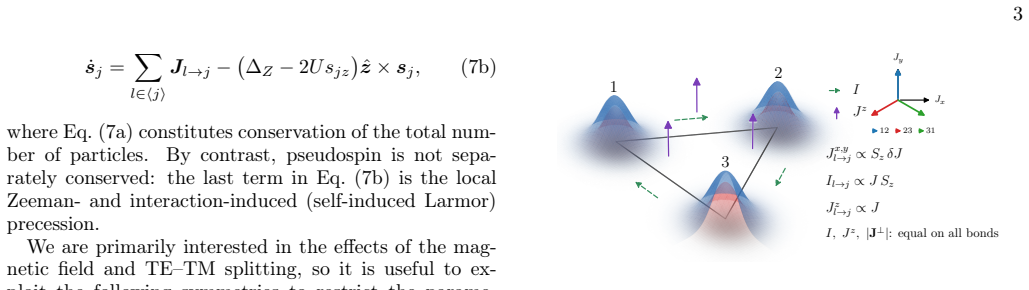
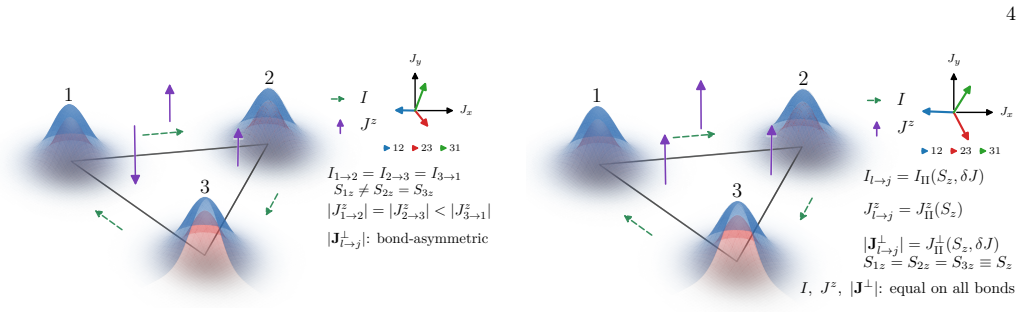
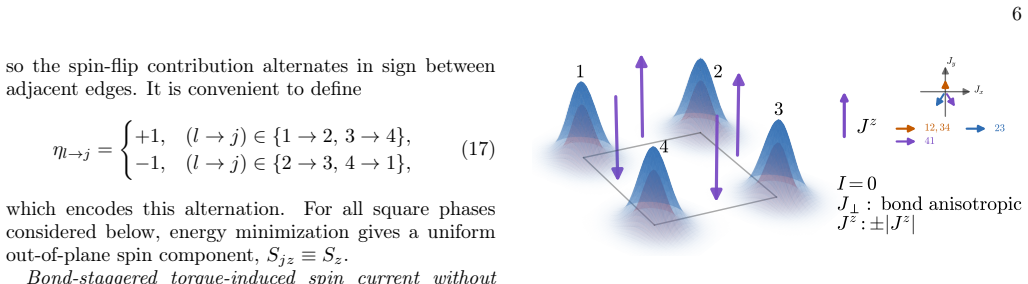
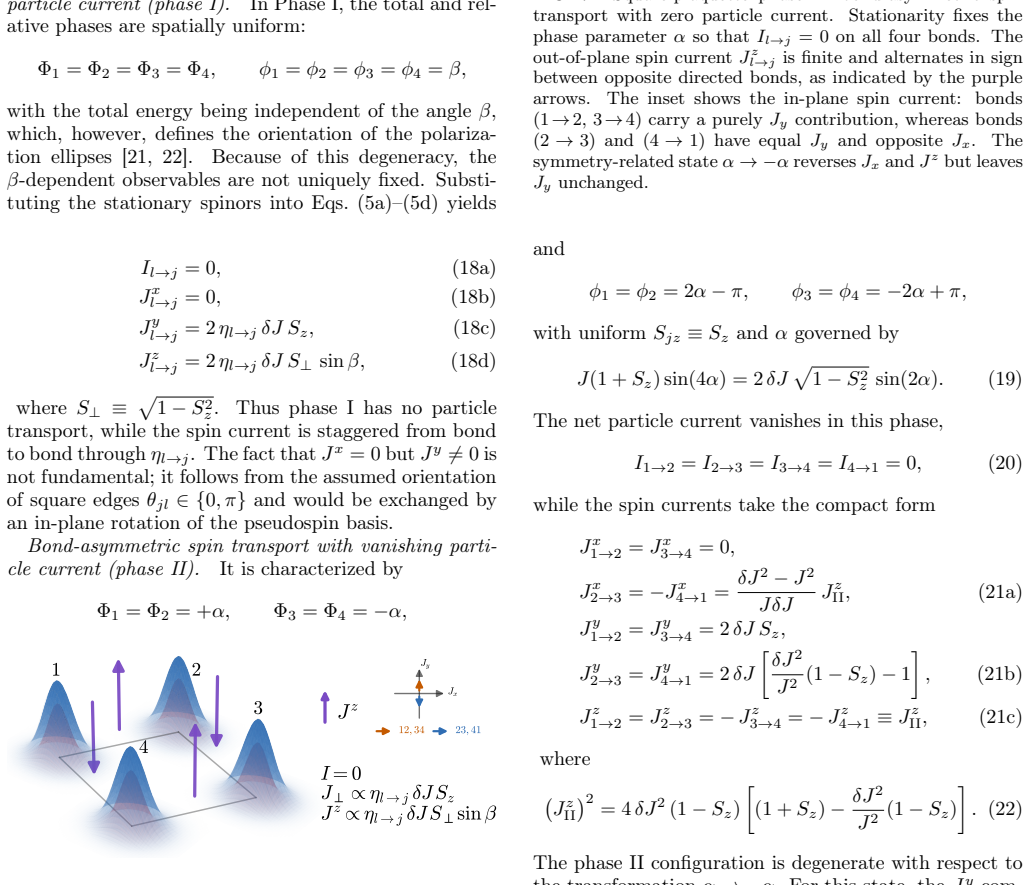
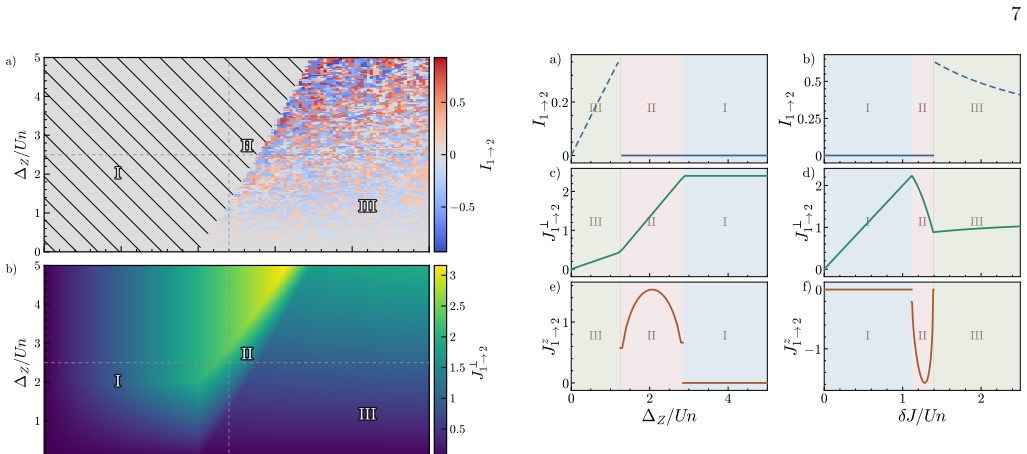
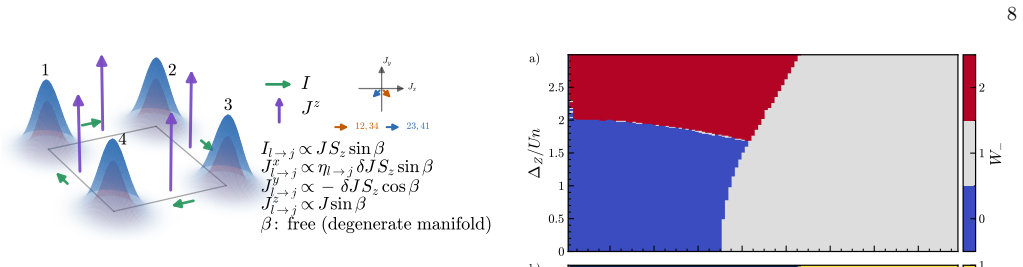
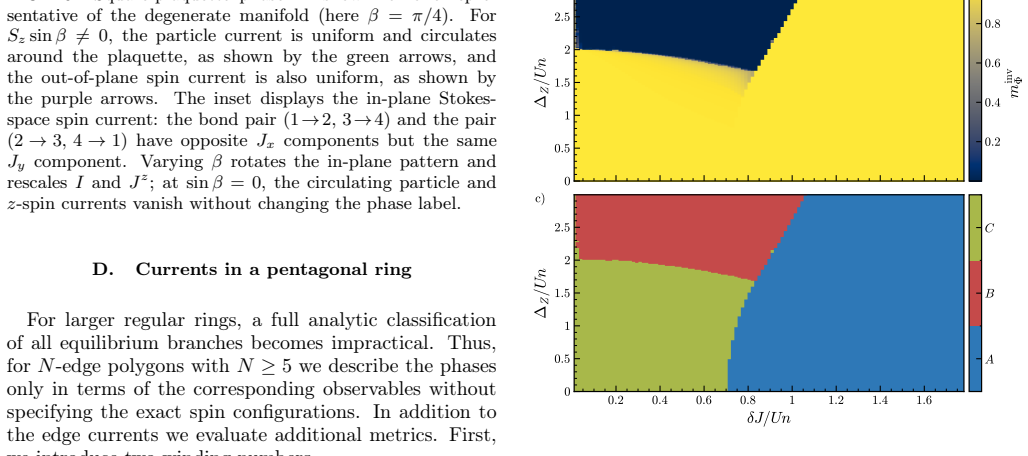
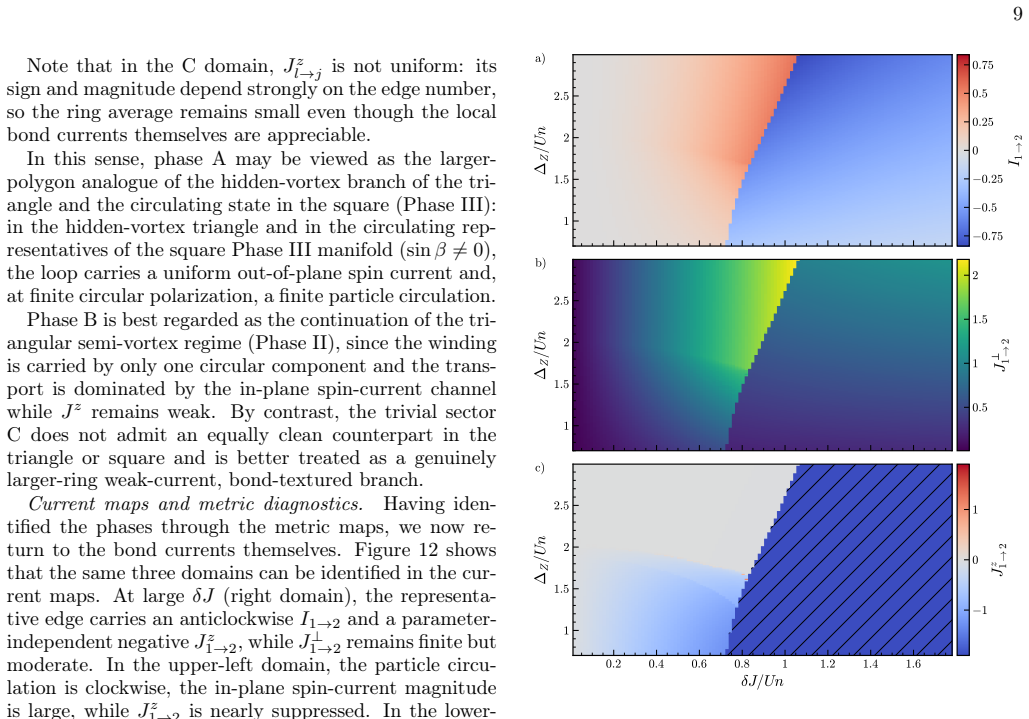
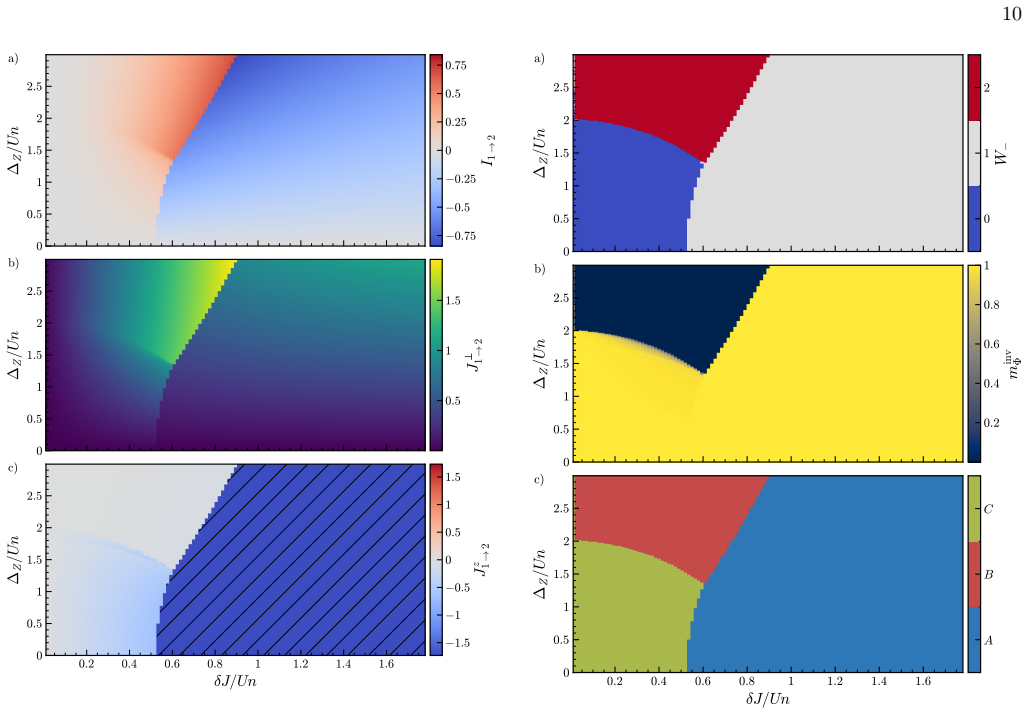
In closed geometries of coupled spinor exciton-polariton condensates, spin-conserving tunneling and TE-TM-induced spin-flip tunneling combine to generate circulating particle currents, hidden spin counterflows, and bond-dependent spin-current patterns. For the minimal geometries of an equilateral triangle and a square plaquette, analytical expressions for edge-resolved currents follow from stationary configurations obtained by energy minimization. Particle, in-plane spin, and out-of-plane spin currents then partition the parameter plane and provide direct signatures of the equilibrium phases; the same current-resolved diagnostics applied to larger rings show that winding numbers and a branch
Load-bearing premise
Stationary configurations obtained by energy minimization accurately represent the physical equilibrium states whose currents are computed analytically.
Editorial extensions
If this is right
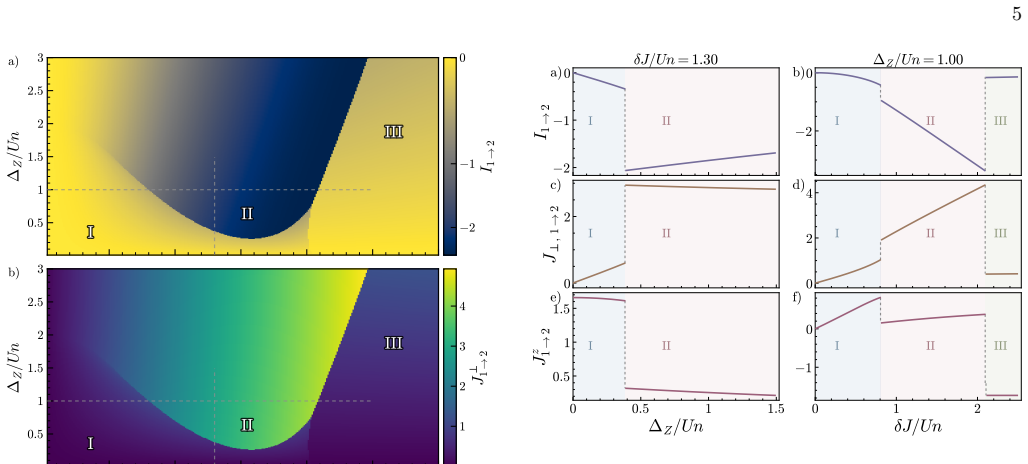
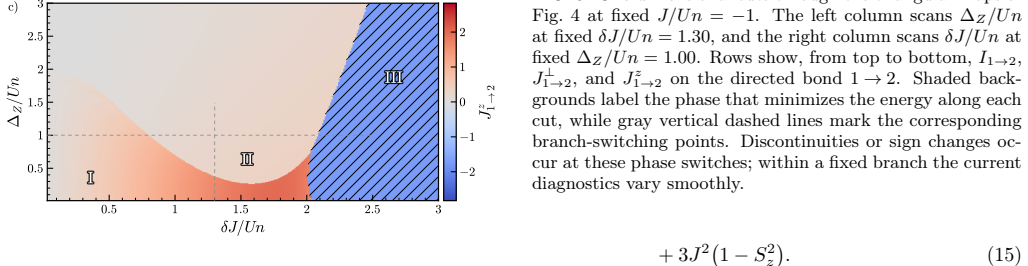
- Particle, in-plane spin, and out-of-plane spin currents partition the parameter plane into regions that correspond to distinct equilibrium phases.
- Bond-dependent spin-current patterns and hidden spin counterflows serve as direct experimental signatures of those phases.
- In larger polygonal rings, winding numbers together with a branch-invariant common-phase coherence metric organize the phase structure.
- The same current diagnostics apply uniformly from minimal plaquettes to extended rings.
Reading between the lines
- The current patterns could function as an indirect probe for identifying phase boundaries in experiments without requiring direct imaging of the condensate phase.
- The diagnostic approach might extend to time-dependent or driven regimes where stationary assumptions no longer hold.
- Similar current signatures could appear in other Josephson-coupled spinor systems that possess both conserving and spin-flip channels.
Signed reviews
Editorial analysis
A structured set of objections, weighed in public.
Referee Report
Summary. The paper analyzes particle and spin currents in networks of coupled spinor exciton-polariton condensates arranged as plaquettes and regular polygonal rings. In closed geometries, it claims that spin-conserving and TE-TM-induced spin-flip tunnelling generate circulating particle currents, hidden spin counterflows, and bond-dependent spin-current patterns. For minimal geometries (equilateral triangle and square plaquette), analytical expressions for edge-resolved currents are derived from stationary configurations obtained by energy minimization; these currents are shown to partition the parameter plane as signatures of equilibrium phases. The analysis is extended to larger rings using winding numbers and a branch-invariant common-phase coherence metric to organize the phase structure.
Significance. If the central results hold, the work provides current-resolved diagnostics that could serve as direct experimental signatures of phases in polariton networks, extending Josephson physics to spinor systems with TE-TM coupling. The derivation of analytical expressions for currents in minimal geometries is a strength, as is the systematic partitioning of the parameter plane and the extension to rings via topological and coherence metrics.
major comments (1)
- [Abstract; minimal geometries section] Abstract and section on minimal geometries: the derivation of currents from stationary configurations obtained by energy minimization assumes that these states coincide with the physical equilibria of the driven-dissipative system. However, exciton-polariton condensates are open systems whose steady states are fixed by continuous pumping and decay; the time-independent driven-dissipative Gross-Pitaevskii equation does not in general coincide with critical points of a closed-system energy functional. This assumption is load-bearing for all reported circulating currents, hidden spin counterflows, and bond-dependent patterns, yet no justification, comparison to the full driven-dissipative equations, or error analysis is provided.
minor comments (2)
- Notation for the TE-TM spin-flip tunnelling term and the definition of edge-resolved currents should be introduced with explicit equations in the main text rather than deferred.
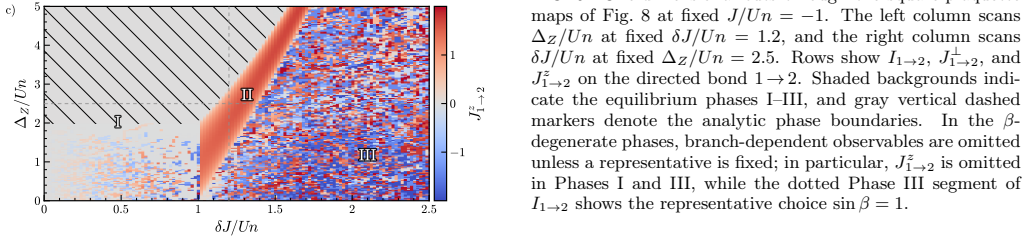
- Figure captions for the parameter-plane partitions should explicitly state the range of parameters scanned and the numerical method used to obtain the energy minima.
Simulated Author's Rebuttal
We thank the referee for the careful reading and constructive comments. Below we address the single major comment point by point.
read point-by-point responses
-
Referee: [Abstract; minimal geometries section] Abstract and section on minimal geometries: the derivation of currents from stationary configurations obtained by energy minimization assumes that these states coincide with the physical equilibria of the driven-dissipative system. However, exciton-polariton condensates are open systems whose steady states are fixed by continuous pumping and decay; the time-independent driven-dissipative Gross-Pitaevskii equation does not in general coincide with critical points of a closed-system energy functional. This assumption is load-bearing for all reported circulating currents, hidden spin counterflows, and bond-dependent patterns, yet no justification, comparison to the full driven-dissipative equations, or error analysis is provided.
Authors: We agree that the manuscript relies on an approximation whose validity requires explicit discussion. In the coherent regime of interest (strong tunneling and interactions relative to decay), the phase-locked stationary states obtained from energy minimization coincide with the steady states of the driven-dissipative equations when the pump and loss rates are spatially uniform and balanced; the resulting currents, which depend only on the relative phases and densities, are therefore robust. Nevertheless, the referee is correct that no justification or comparison is currently provided. We will revise the manuscript to add a short paragraph (in the introduction and/or methods) that states the regime of validity, cites literature where the conservative approximation has been benchmarked against the open-system dynamics for similar Josephson problems, and notes that quantitative differences may appear at high decay rates. No error analysis against the full driven-dissipative equations will be added, as that lies beyond the scope of the present work. revision: yes
Circularity Check
No circularity detected
full rationale
The provided abstract and excerpts describe obtaining stationary configurations via energy minimization and then deriving analytical current expressions from them, with no equations, self-citations, or reductions exhibited that would make any claimed prediction equivalent to its inputs by construction. No self-definitional steps, fitted inputs renamed as predictions, or load-bearing self-citation chains appear in the text. The derivation is presented as proceeding from the model to currents without the specific circular patterns enumerated; any concerns about driven-dissipative validity are correctness issues outside the circularity analysis.
Assumptions & free parameters
Cite this review
Pith. "Pith review of Josephson and Spin Currents in Coupled Polariton Condensates." pith.science (2026). https://pith.science/paper/ECKNKI5M
@misc{pith2026260702265,
  author       = {Pith},
  title        = {Pith review of: Josephson and Spin Currents in Coupled Polariton Condensates},
  year         = {2026},
  howpublished = {\url{https://pith.science/paper/ECKNKI5M}},
  note         = {Machine review of arXiv:2607.02265}
}
read the original abstract
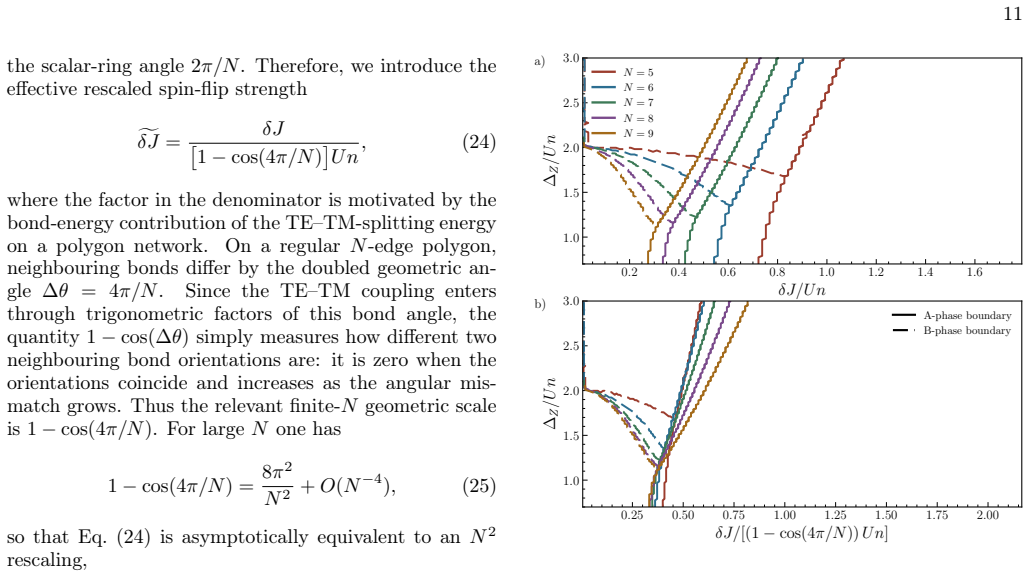
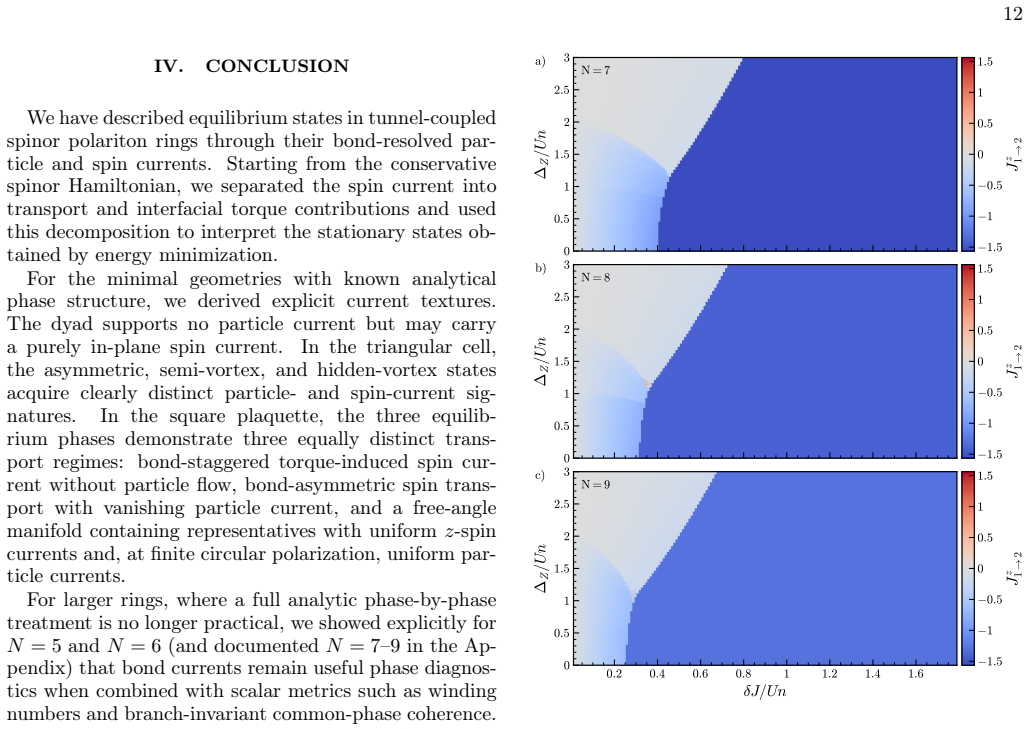
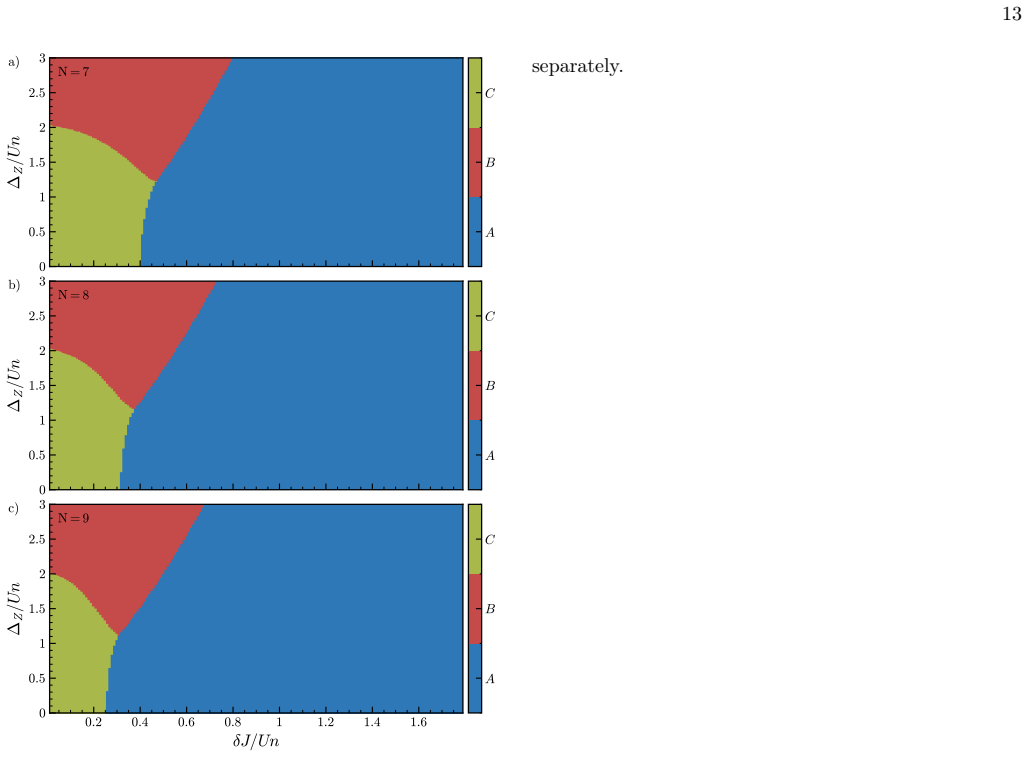
We analyze particle and spin currents in networks of coupled spinor exciton-polariton condensates arranged as plaquettes and regular polygonal rings. In closed geometries, spin-conserving and TE-TM-induced spin-flip tunnelling combine to generate circulating particle currents, hidden spin counterflows, and bond-dependent spin-current patterns. For the minimal geometries - an equilateral triangle, and a square plaquette - we derive analytical expressions for edge-resolved currents from stationary configurations obtained by energy minimization. We then show how particle, in-plane spin, and out-of-plane spin currents partition the parameter plane and provide direct signatures of the equilibrium phases. Finally, we apply the same current-resolved diagnostics to larger rings, where winding numbers and a branch-invariant common-phase coherence metric organize the resulting phase structure.
Figures
Figures from the paper (12 more)
Reference graph
Works this paper leans on
-
[1]
M. Greiner, O. Mandel, T. Esslinger, T. W. Hänsch, and I. Bloch, Nature415, 39 (2002)
work page 2002
-
[2]
I. M. Georgescu, S. Ashhab, and F. Nori, Rev. Mod. Phys.86, 153 (2014)
work page 2014
-
[3]
A. Periwal, E. S. Cooper, P. Kunkel, J. F. Wienand, E. J. Davis, and M. Schleier-Smith, Nature600, 630 (2021)
work page 2021
- [4]
- [5]
-
[6]
J. Q. You and F. Nori, Nature474, 589 (2011)
work page 2011
- [7]
-
[8]
S. Alyatkin, J. D. Töpfer, A. Askitopoulos, H. Sigurds- son, and P. G. Lagoudakis, Phys. Rev. Lett.124, 207402 (2020)
work page 2020
Show all 27 references
-
[9]
Dovzhenko, D
D. Dovzhenko, D. Aristov, L. Pickup, H. Sigurðsson, and P. Lagoudakis, Phys. Rev. B108, L161301 (2023)
2023
-
[10]
J. D. Töpfer, I. Chatzopoulos, H. Sigurdsson, T. Cook- son, Y. G. Rubo, and P. G. Lagoudakis, Optica8, 106 (2021)
2021
-
[11]
N. Y. Kim, K. Kusudo, C. Wu, N. Masumoto, A. Löffler, S. Höfling, N. Kumada, L. Worschech, A. Forchel, and Y. Yamamoto, Nat. Phys.7, 681 (2011)
2011
-
[12]
Milićević, T
M. Milićević, T. Ozawa, P. Andreakou, I. Carusotto, T. Jacqmin, E. Galopin, A. Lemaitre, L. Le Gratiet, I. Sagnes, J. Bloch, and A. Amo, 2D Mater.2, 034012 (2015)
2015
-
[13]
Klembt, T
S. Klembt, T. H. Harder, O. A. Egorov, K. Winkler, R. Ge, M. A. Bandres, M. Emmerling, L. Worschech, T. C. H. Liew, M. Segev, C. Schneider, and S. Höfling, Nature562, 552 (2018)
2018
-
[14]
Fischer, S
M.Dusel, S.Betzold, O.A.Egorov, S.Klembt, J.Ohmer, U. Fischer, S. Höfling, and C. Schneider, Nat. Commun. 11, 2863 (2020)
2020
-
[15]
Pickup, H
L. Pickup, H. Sigurdsson, J. Ruostekoski, and P. Lagoudakis, Nat. Commun.11, 4431 (2020)
2020
-
[16]
Georgakilas, R
I. Georgakilas, R. Mirek, D. Urbonas, M. Forster, U. Scherf, R. F. Mahrt, and T. Stöferle, Sci. Adv.11, eadt8645 (2025)
2025
-
[17]
J. D. Plumhof, T. Stöferle, L. Mai, U. Scherf, and R. F. Mahrt, Nat. Mater.13, 247 (2014)
2014
-
[18]
R. Su, S. Ghosh, J. Wang, S. Liu, C. Diederichs, T. C. Liew, and Q. Xiong, Nat. Phys.16, 301 (2020)
2020
-
[19]
Carusotto and C
I. Carusotto and C. Ciuti, Rev. Mod. Phys.85, 299 (2013)
2013
-
[20]
A. V. Kavokin, J. J. Baumberg, G. Malpuech, and F. P. Laussy,Microcavities(Oxford University Press, 2017)
2017
-
[21]
Kudlis, D
A. Kudlis, D. Novokreschenov, and I. A. Shelykh, Phys. Rev. Lett.135, 116903 (2025)
2025
-
[22]
I. Y. Chestnov, A. Kudlis, A. V. Nalitov, and I. A. She- lykh, Phys. Rev. B112, 115311 (2025)
2025
-
[23]
Beattie, S
S. Beattie, S. Moulder, R. J. Fletcher, and Z. Hadzibabic, Phys. Rev. Lett.110, 025301 (2013)
2013
-
[24]
Pickup, J
L. Pickup, J. D. Töpfer, H. Sigurdsson, and P. G. Lagoudakis, Phys. Rev. B103, 155302 (2021)
2021
-
[25]
Töpfer, P.Cilibrizzi, W.Langbein,andP.G.Lagoudakis, Nat
N.G.Berloff, M.Silva, K.Kalinin, A.Askitopoulos, J.D. Töpfer, P.Cilibrizzi, W.Langbein,andP.G.Lagoudakis, Nat. Mater.16, 1120 (2017)
2017
-
[26]
Y. Sun, P. Wen, Y. Yoon, G. Liu, M. Steger, L. N. Pfeif- fer, K. West, D. W. Snoke, and K. A. Nelson, Phys. Rev. Lett.118, 016602 (2017)
2017
-
[27]
H.Alnatah, Q.Yao, J.Beaumariage, S.Mukherjee, M.C. Tam, Z. Wasilewski, K. West, K. Baldwin, L. N. Pfeiffer, and D. W. Snoke, Sci. Adv.10, eadk6960 (2024)
2024
Reviewed July 3, 2026 · model on record in the stance chip above.
Discussion (0). Continue with ORCID to comment.