REVIEW 4 major objections 7 minor 38 references
Transformer Based Building Boundary Reconstruction using Attraction Field Maps
T0 review · 4 major / 7 minor · reviewed 2026-08-06 · deepseek-v4-flash
Pith's one-line read The paper claims that Decoupled-PolyGCN, a two-stage pipeline combining a transformer-based detector with attraction field maps and graph-convolutional refinement, reconstructs building footprints as regularized polygons and outperforms…
desk verdict Plausible method with a credible ablation, but the missing evaluation protocol makes the headline SOTA claim unverifiable; needs major revision and code release before the numbers can be trusted. read the letter →
The pith
A machine-rendered reading of the paper's core claim, the machinery that carries it, and where it could break.
The reading
What carries the argument
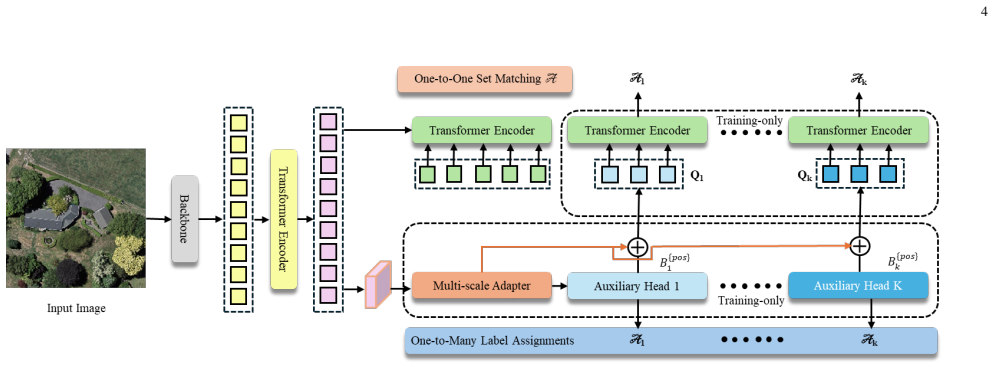
The central mechanism is the attraction field map (AFM): a per-pixel vector field that directs each pixel toward the nearest building boundary, used both as supervision and as a feature channel that gives the graph convolutional network orientation information. The other load-bearing pieces are the decoupled CO-DETR detector, a feature augmentation module that fuses predicted vertex and edge logits with multi-scale backbone features, and dynamic polygon initialization from mask contours plus classified convex and concave corners, followed by three steps of GCN vertex refinement with orthogonality loss.
What would settle it
Re-run all three methods with the same codebase, loss weights, and AP/AR computation (including the same IoU threshold and vertex-matching rule) on identical train/test splits of WHU and SpaceNet-2; if the AP gap between Decoupled-PolyGCN and HiSup drops below the claimed 6 points on WHU, the central state-of-the-art claim collapses.
Extended reading notes
Core claim
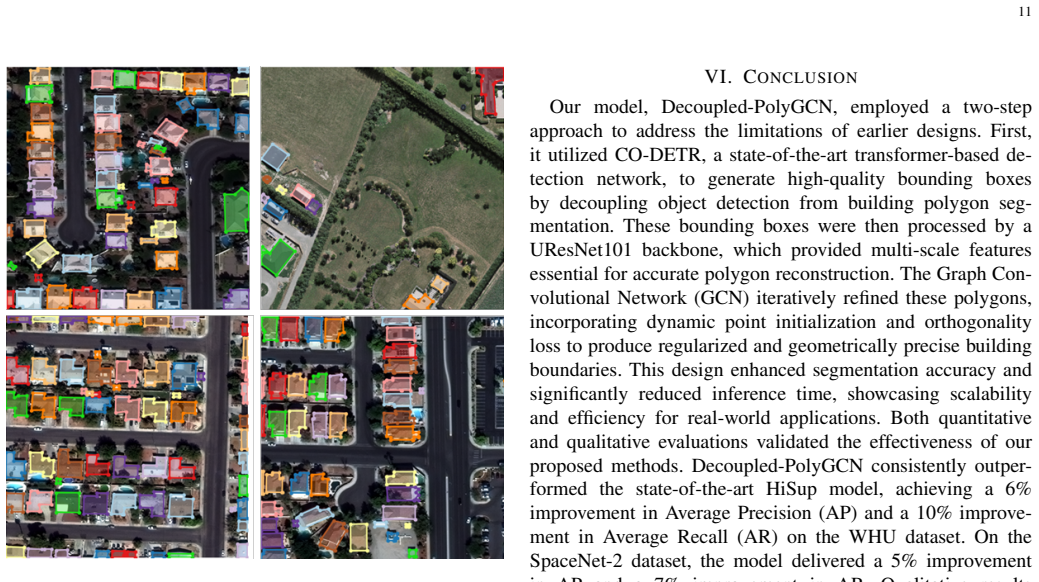
Decoupled-PolyGCN improves building boundary reconstruction by decoupling detection from polygonal segmentation: a CO-DETR detector supplies high-quality bounding boxes, a UResNet101 backbone with three heads (segmentation, attraction field map, and corners) produces localized features, and a three-step graph convolutional network refines a dynamically initialized polygon, with an orthogonality loss enforcing architectural regularity. The paper reports consistent gains over its own ablations, from R-PolyGCN through RO-PolyGCN, FAE-PolyGCN, and AT-PolyGCN, and reports margins of 6% AP and 10% AR over HiSup on WHU and 5% AP and 7% AR on SpaceNet-2.
Load-bearing premise
The reported margins assume that the comparison tables were produced under identical metric definitions, training schedules, data splits, and post-processing across all methods; if HiSup or PolyMapper ran under different AP/AR thresholds or preprocessing, the 5–6% AP advantage could shrink or disappear.
Editorial extensions
If this is right
- If the reported numbers hold, the method beats the previous best (HiSup) on WHU by 6 AP points and 10 AR points, and on SpaceNet-2 Vegas by 5 AP points and 7 AR points.
- The ablation tables imply that each added module contributes visibly: the feature augmentation module raises AP for small buildings by about 8 points, the attraction field map raises AP for large buildings by about 14 points, and dynamic graph initialization raises AP by about 30 points for buildings with more than 16 vertices on SpaceNet-2.
- The two-stage design, with a transformer detector feeding a segmentation-and-GCN pipeline, reduces reliance on low-resolution backbone features and, per the authors, shortens inference time relative to earlier approaches.
- On densely packed scenes where adjacent buildings share corners, the improved detection boxes and corner-aware initialization reduce the merging of separate buildings into single polygons.
- The method can be applied to diverse building sizes, vertex counts, and proximity conditions without retuning, though performance varies by building size and complexity.
Reading between the lines
- Editorial inference: the reported per-size and per-vertex analyses suggest the largest gains come from better detection and initialization rather than from the GCN refinement itself; a clean experiment that replaces the dynamic initialization with a fixed 16-vertex polygon for all buildings would test whether the refinement steps are the main driver.
- Editorial inference: the decoupled detector (CO-DETR) is a generic component; if detection quality is indeed the bottleneck, the same AFM-plus-GCN refinement could be paired with other detection backbones to improve their polygon outputs, which the paper does not test.
- Editorial inference: the orthogonality loss is a geometric prior that could transfer to other regularized polygon prediction tasks such as road footprint extraction or cadastral parcels; one could measure its standalone effect by adding it to an existing polygon predictor without the other modules.
- Editorial inference: because the paper evaluates on only two cities (Vegas and Christchurch), the claim of robustness across geographic regions would be stronger if tested on the Paris, Shanghai, and Khartoum subsets of SpaceNet-2, which are part of the same dataset but not used here.
Editorial analysis
A structured set of objections, weighed in public.
Referee Report
Summary. The paper proposes Decoupled-PolyGCN, a two-stage building footprint extraction method. Stage one uses CO-DETR to detect buildings and produce bounding boxes; stage two crops regions of interest, runs a UResNet101 backbone with mask, attraction-field-map (AFM), and convex/concave corner heads, initializes polygons dynamically from mask contours and corner predictions, and refines the vertices with three iterative GCN passes under an orthogonality loss. Experiments on SpaceNet-2 (Vegas) and WHU report higher AP/AR than HiSup and than the authors' earlier R-PolyGCN variants, and the paper claims state-of-the-art performance on those benchmarks.
Significance. If the reported numbers are reproducible, the contribution is potentially useful: the decoupled detection step, the AFM orientation cues, and the dynamic graph initialization are sensible design choices, and the modular ablation sequence is a strength. The paper uses public benchmarks and compares against recognized baselines, so the headline claim is not forced by construction. However, the empirical core is currently not checkable: the evaluation protocol is unspecified, no error bars or significance tests are given, no code is released, and the loss definitions contain inconsistencies. The claimed gains over HiSup therefore cannot be validated in the present form. The potential significance is real but contingent on a substantial reporting overhaul.
major comments (4)
- [V-C, Tables III and IV; V-B] The central SOTA claim is unverifiable because the evaluation protocol is not specified. The paper never states how AP and AR are computed for polygon outputs, the IoU threshold or vertex matching rule, the test split, tile size, training schedule, or post-processing; it also does not state whether the HiSup, PolyMapper, and FrameField rows in Tables III and IV were produced by running those methods under the same pipeline or were taken from their original papers under potentially different metric conventions. Without this information, the reported 5-6 percentage-point margins over HiSup cannot be checked. Please specify the exact protocol, report variance over at least three seeds, and ideally release evaluation code and model weights.
- [IV, Eqs. (2)-(4); IV-E] The training objective is not reproducible as written. Equation (2) is described in the text as an L1 loss but is written as a squared L2 norm; Eq. (3) has a summation typo ('NX'); Eq. (4) uses L(Pj) without defining the per-polygon orthogonality term; and the loss-component weights, despite the text saying they were 'extensively' tuned, are never given. Since Tables I and II attribute performance gains to individual modules, the unspecified weighting makes it impossible to determine whether an improvement comes from the module itself or from loss re-balancing.
- [V-C; Abstract; Conclusion] Percentage changes are consistently misreported. For example, 45.7 to 65.7 is described as a '20% improvement' in AP, but this is 20 percentage points and a relative improvement of about 44%; likewise, 52.5 to 57.8 is 5.3 percentage points (about 10% relative), not 5%. All such statements must be corrected to distinguish percentage points from percent change, in the abstract, the results section, and the conclusion.
- [V-D, Incomplete or Erroneous Annotations] The manuscript explicitly states that 'the results presented in all tables within this thesis include evaluations conducted with the incorrect annotations.' This is a data-quality confound: if ground-truth labels are known to be incorrect, AP/AR values are not a clean measure of method quality, and the effect on the baselines may differ from the effect on the proposed model. The authors should quantify how many such annotations exist, where they occur, and provide a sensitivity analysis (e.g., results with and without those annotations) rather than leaving them as a blanket inclusion.
minor comments (7)
- [Acknowledgments] The acknowledgments section contains the placeholder text 'This should be a simple paragraph' and must be completed or removed.
- [V-D] The phrase 'within this thesis' indicates the manuscript is a lightly edited thesis chapter; the text should be adapted for a journal submission.
- [II, Literature Review] The citation 'Multiple Networks [?], [30]' contains an unresolved '[?]' placeholder, and reference [30] is listed as CornerRegNet; the sentence needs to be rewritten with the intended citations.
- [V-C] There is a duplicated word 'capabilities capabilities' in the paragraph discussing Table I.
- [V-B, Vector-Based Metrics] The MaxTangent metric is described qualitatively but no closed-form equation is given, and the variables N_P and N_Q in Eq. (7) are not defined.
- [Throughout] The spelling 'DeCoupled-PolyGCN' and 'Decoupled-PolyGCN' is used inconsistently; please choose one convention.
- [Figure captions] Figure captions such as 'Fig. 1. CODETR' are too terse; each figure should have a sentence describing what is shown.
Circularity Check
No significant circularity: the reported SOTA margins are benchmark comparisons against external methods, not predictions forced by the paper's own equations or self-citations.
full rationale
The central quantitative claim is an external benchmark comparison: Decoupled-PolyGCN vs HiSup, PolyMapper, FrameField and Mask R-CNN on SpaceNet-2 and WHU (Tables III and IV). These baselines are independent of the present model; none of the reported AP/AR values are defined in terms of the model's own outputs or fitted parameters. The internal ablation tables (I and II) compare successive versions of the authors' own architecture (R-PolyGCN, RO-PolyGCN, FAE-PolyGCN, AT-PolyGCN, Decoupled-PolyGCN), but these are controlled incremental experiments, not 'predictions' that reduce to their inputs by construction. The AFM, GCN vertex refinement, dynamic polygon initialization and orthogonality loss are trained against ground-truth supervision and evaluated with external metrics; no equation in Sec. IV defines a reported quantity in terms of the same reported quantity. Self-citations to R-PolyGCN, CornerRegNet and PolyAttractNet are used as baseline/motivation and for module setup, but the headline SOTA claim does not depend on those citations being true. Non-circularity concerns exist: the AP/AR protocol is unspecified, the paper mislabels percentage-point differences as percentages (e.g., 45.7 to 65.7 called a 20% improvement), and there is a missing citation marker '[?]' in the literature review. These are reproducibility/correctness issues, not circularity, and do not change the verdict.
Assumptions & free parameters
free parameters (3)
- Loss component weights (Lmask, LAFM, L1, Lortho) =
not reported
- Vertex count for fixed polygon initialization =
16 chosen for general cases after testing 8, 32, 96
- Convex/concave corner thresholds and NMS settings =
not reported
assumptions (3)
- domain assumption SpaceNet-2 and WHU ground-truth annotations are sufficiently accurate to train and evaluate the method.
- domain assumption CO-DETR bounding boxes at inference are accurate enough that RoI cropping preserves the buildings for polygon refinement.
- domain assumption The AP/AR/PoLiS/MTA metrics, as implemented by the authors, match the standard definitions used in the cited comparisons.
Cite this review
Pith. "Pith review of Transformer Based Building Boundary Reconstruction using Attraction Field Maps." pith.science (2026). https://pith.science/paper/ECVM7JO6
@misc{pith2026250717038,
  author       = {Pith},
  title        = {Pith review of: Transformer Based Building Boundary Reconstruction using Attraction Field Maps},
  year         = {2026},
  howpublished = {\url{https://pith.science/paper/ECVM7JO6}},
  note         = {Machine review of arXiv:2507.17038}
}
read the original abstract
In recent years, the number of remote satellites orbiting the Earth has grown significantly, streaming vast amounts of high-resolution visual data to support diverse applications across civil, public, and military domains. Among these applications, the generation and updating of spatial maps of the built environment have become critical due to the extensive coverage and detailed imagery provided by satellites. However, reconstructing spatial maps from satellite imagery is a complex computer vision task, requiring the creation of high-level object representations, such as primitives, to accurately capture the built environment. While the past decade has witnessed remarkable advancements in object detection and representation using visual data, primitives-based object representation remains a persistent challenge in computer vision. Consequently, high-quality spatial maps often rely on labor-intensive and manual processes. This paper introduces a novel deep learning methodology leveraging Graph Convolutional Networks (GCNs) to address these challenges in building footprint reconstruction. The proposed approach enhances performance by incorporating geometric regularity into building boundaries, integrating multi-scale and multi-resolution features, and embedding Attraction Field Maps into the network. These innovations provide a scalable and precise solution for automated building footprint extraction from a single satellite image, paving the way for impactful applications in urban planning, disaster management, and large-scale spatial analysis. Our model, Decoupled-PolyGCN, outperforms existing methods by 6% in AP and 10% in AR, demonstrating its ability to deliver accurate and regularized building footprints across diverse and challenging scenarios.
Figures


Figures from the paper (3 more)


Reference graph
Works this paper leans on
-
[1]
Ji, S., Wei, S. & Lu, M. A scale robust convolutional neural network for automatic building extraction from aerial and satellite imagery. International Journal Of Remote Sensing.40, 3308-3322 (2019)
work page 2019
-
[2]
Wei, S., Ji, S. & Lu, M. Toward automatic building footprint delineation from aerial images using CNN and regularization.IEEE Transactions On Geoscience And Remote Sensing.58, 2178-2189 (2019)
work page 2019
-
[3]
Deng, W., Shi, Q. & Li, J. Attention-gate-based encoder–decoder network for automatical building extraction.IEEE Journal Of Selected Topics In Applied Earth Observations And Remote Sensing.14pp. 2611-2620 (2021)
work page 2021
-
[4]
Zhou, D., Wang, G., He, G., Yin, R., Long, T., Zhang, Z., Chen, S. & Luo, B. A large-scale mapping scheme for urban building from Gaofen-2 images using deep learning and hierarchical approach.IEEE Journal Of Selected Topics In Applied Earth Observations And Remote Sensing.14 pp. 11530-11545 (2021)
work page 2021
- [5]
-
[6]
Zhang, Z., Guo, W., Yu, W. & Yu, W. Multi-task fully convolutional networks for building segmentation on SAR image.The Journal Of Engineering.2019, 7074-7077 (2019)
work page 2019
-
[7]
Yuan, J. Learning building extraction in aerial scenes with convolutional networks.IEEE Transactions On Pattern Analysis And Machine Intelli- gence.40, 2793-2798 (2017)
work page 2017
-
[8]
Girard, N., Smirnov, D., Solomon, J. & Tarabalka, Y . Regularized building segmentation by frame field learning.IGARSS 2020-2020 IEEE International Geoscience And Remote Sensing Symposium. pp. 1805-1808 (2020)
work page 2020
Show all 38 references
-
[9]
& Xia, G
Xu, B., Xu, J., Xue, N. & Xia, G. HiSup: Accurate polygonal mapping of buildings in satellite imagery with hierarchical supervision.ISPRS Journal Of Photogrammetry And Remote Sensing.198pp. 284-296 (2023) 12
2023
-
[10]
& Torr, P
Xue, N., Bai, S., Wang, F., Xia, G., Wu, T., Zhang, L. & Torr, P. Learning regional attraction for line segment detection.IEEE Transactions On Pattern Analysis And Machine Intelligence.43, 1998-2013 (2019)
2019
-
[11]
& Zhang, L
Xue, N., Bai, S., Wang, F., Xia, G., Wu, T. & Zhang, L. Learning attrac- tion field representation for robust line segment detection.Proceedings Of The IEEE/CVF Conference On Computer Vision And Pattern Recognition. pp. 1595-1603 (2019)
2019
-
[12]
& Zhu, X
Shi, Y ., Li, Q. & Zhu, X. Building footprint extraction with graph con- volutional network.IGARSS 2019-2019 IEEE International Geoscience And Remote Sensing Symposium. pp. 5136-5139 (2019)
2019
-
[13]
& Zhu, X
Li, Q., Shi, Y ., Huang, X. & Zhu, X. Building footprint generation by integrating convolution neural network with feature pairwise conditional random field (FPCRF).IEEE Transactions On Geoscience And Remote Sensing.58, 7502-7519 (2020)
2020
-
[14]
& Stilla, U
Marmanis, D., Schindler, K., Wegner, J., Galliani, S., Datcu, M. & Stilla, U. Classification with an edge: Improving semantic image segmentation with boundary detection.ISPRS Journal Of Photogrammetry And Remote Sensing.135pp. 158-172 (2018)
2018
-
[15]
& Dengel, A
Bischke, B., Helber, P., Folz, J., Borth, D. & Dengel, A. Multi- task learning for segmentation of building footprints with deep neural networks.2019 IEEE International Conference On Image Processing (ICIP). pp. 1480-1484 (2019)
2019
-
[16]
& Tuia, D
V olpi, M. & Tuia, D. Deep multi-task learning for a geographically regularized semantic segmentation of aerial images.ISPRS Journal Of Photogrammetry And Remote Sensing.144pp. 48-60 (2018)
2018
-
[17]
& Shibasaki, R
Wu, G., Shao, X., Guo, Z., Chen, Q., Yuan, W., Shi, X., Xu, Y . & Shibasaki, R. Automatic building segmentation of aerial imagery using multi-constraint fully convolutional networks.Remote Sensing.10, 407 (2018)
2018
-
[18]
& Urtasun, R
Cheng, D., Liao, R., Fidler, S. & Urtasun, R. Darnet: Deep active ray network for building segmentation.Proceedings Of The IEEE/CVF Conference On Computer Vision And Pattern Recognition. pp. 7431-7439 (2019)
2019
-
[19]
& Terzopoulos, D
Kass, M., Witkin, A. & Terzopoulos, D. Snakes: Active contour models. International Journal Of Computer Vision.1, 321-331 (1988)
1988
-
[20]
& Jia, J
Zhao, H., Shi, J., Qi, X., Wang, X. & Jia, J. Pyramid scene parsing network.Proceedings Of The IEEE Conference On Computer Vision And Pattern Recognition. pp. 2881-2890 (2017)
2017
-
[21]
& Fraundorfer, F
Zorzi, S. & Fraundorfer, F. Regularization of building boundaries in satellite images using adversarial and regularized losses.IGARSS 2019- 2019 IEEE International Geoscience And Remote Sensing Symposium. pp. 5140-5143 (2019)
2019
-
[22]
& Fraundorfer, F
Zorzi, S., Bittner, K. & Fraundorfer, F. Machine-learned regularization and polygonization of building segmentation masks.2020 25th Interna- tional Conference On Pattern Recognition (ICPR). pp. 3098-3105 (2021)
2021
-
[23]
& Kang, M
Jung, H., Choi, H. & Kang, M. Boundary enhancement semantic segmentation for building extraction from remote sensed image.IEEE Transactions On Geoscience And Remote Sensing.60pp. 1-12 (2021)
2021
-
[24]
& Tarabalka, Y
Girard, N. & Tarabalka, Y . End-to-end learning of polygons for remote sensing image classification.IGARSS 2018-2018 IEEE International Geoscience And Remote Sensing Symposium. pp. 2083-2086 (2018)
2018
-
[25]
& Fidler, S
Castrejon, L., Kundu, K., Urtasun, R. & Fidler, S. Annotating object instances with a polygon-rnn.Proceedings Of The IEEE Conference On Computer Vision And Pattern Recognition. pp. 5230-5238 (2017)
2017
-
[26]
& Fidler, S
Acuna, D., Ling, H., Kar, A. & Fidler, S. Efficient interactive annotation of segmentation datasets with polygon-rnn++.Proceedings Of The IEEE Conference On Computer Vision And Pattern Recognition. pp. 859-868 (2018)
2018
-
[27]
& Lucchi, A
Li, Z., Wegner, J. & Lucchi, A. Topological map extraction from over- head images.Proceedings Of The IEEE/CVF International Conference On Computer Vision. pp. 1715-1724 (2019)
2019
-
[28]
Long Short-term Memory.Neural Computation MIT- Press
Hochreiter, S. Long Short-term Memory.Neural Computation MIT- Press. (1997)
1997
-
[29]
& Fraundorfer, F
Zorzi, S., Bazrafkan, S., Habenschuss, S. & Fraundorfer, F. Polyworld: Polygonal building extraction with graph neural networks in satellite images.Proceedings Of The IEEE/CVF Conference On Computer Vision And Pattern Recognition. pp. 1848-1857 (2022)
2022
-
[30]
& Sohn, G
Sheikholeslami, M., Kamran, M., Wichmann, A. & Sohn, G. CornerReg- Net: Building Segmentation from Overhead Imagery Using Oriented Corners in Deep Networks.IGARSS 2024-2024 IEEE International Geoscience And Remote Sensing Symposium. pp. 4642-4647 (2024)
2024
-
[31]
& Sohn, G
Moein Sheikholeslami, M., Kamran, M., Wichmann, A. & Sohn, G. Enhancing Polygonal Building Segmentation via Oriented Corners.ArXiv E-prints. pp. arXiv-2407 (2024)
2024
-
[32]
& Sohn, G
Zhao, K., Kamran, M. & Sohn, G. BOUNDARY REGULARIZED BUILDING FOOTPRINT EXTRACTION FROM SATELLITE IMAGES USING DEEP NEURAL NETWORKS.ISPRS Annals Of The Pho- togrammetry, Remote Sensing And Spatial Information Sciences.2pp. 617-624 (2020)
2020
-
[33]
& Sohn, G
Kamran, M. & Sohn, G. PolyAttractNet.ISPRS Archive Of The Pho- togrammetry, Remote Sensing And Spatial Information Sciences.2pp. 617-624 (2025)
2025
-
[34]
& Zagoruyko, S
Carion, N., Massa, F., Synnaeve, G., Usunier, N., Kirillov, A. & Zagoruyko, S. End-to-end object detection with transformers.European Conference On Computer Vision. pp. 213-229 (2020)
2020
-
[35]
& Shum, H
Zhang, H., Li, F., Liu, S., Zhang, L., Su, H., Zhu, J., Ni, L. & Shum, H. Dino: Detr with improved denoising anchor boxes for end-to-end object detection.ArXiv Preprint ArXiv:2203.03605. (2022)
2022 arXiv
-
[36]
& Zhang, L
Liu, S., Li, F., Zhang, H., Yang, X., Qi, X., Su, H., Zhu, J. & Zhang, L. Dab-detr: Dynamic anchor boxes are better queries for detr.ArXiv Preprint ArXiv:2201.12329. (2022)
2022 arXiv
-
[37]
& Guo, B
Liu, Z., Lin, Y ., Cao, Y ., Hu, H., Wei, Y ., Zhang, Z., Lin, S. & Guo, B. Swin transformer: Hierarchical vision transformer using shifted windows. Proceedings Of The IEEE/CVF International Conference On Computer Vision. pp. 10012-10022 (2021)
2021
-
[38]
& Liu, Y
Zong, Z., Song, G. & Liu, Y . DETRs with collaborative hybrid assign- ments training. arXiv 2022.ArXiv Preprint ArXiv:2211.12860.4(2022) VII. BIOGRAPHYSECTION Muhammad Kamranholds a PhD from York Uni- versity in Earth and Space Science and Engineering. He has a background in A...
2022 arXiv
Reviewed August 6, 2026 · model on record in the stance chip above.
Discussion (0). Sign in to comment.