REVIEW 3 major objections 3 minor 29 references
Text-Guided Token Communication for Wireless Image Transmission
T0 review · 3 major / 3 minor · reviewed 2026-08-06 · deepseek-v4-flash
Pith's one-line read This paper claims that a shared text caption, combined with masked-token inpainting, lets a $1/96$-bandwidth token system beat ADJSCC on perceptual and semantic metrics above 0 dB SNR without retraining.
desk verdict Text guidance is a real twist on TokCom, but the paper's headline bandwidth claim ignores the free caption side information, so the ADJSCC comparison doesn't support what the abstract promises. read the letter →
The pith
A machine-rendered reading of the paper's core claim, the machinery that carries it, and where it could break.
The reading
What carries the argument
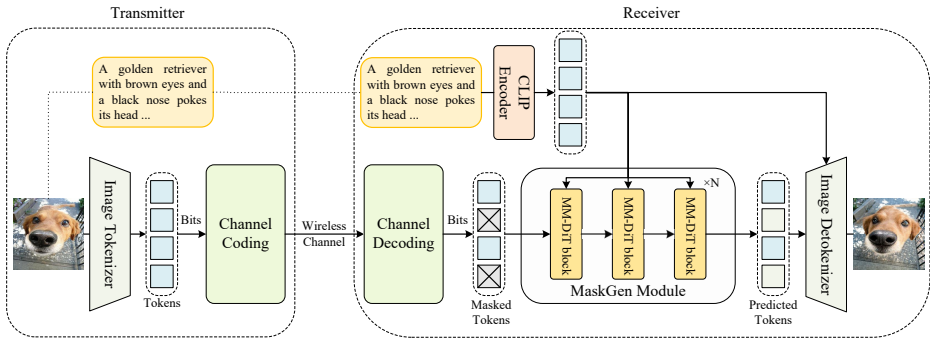
The central object is the text-guided masked generative model (MaskGen) combined with the shared caption. A text-aware image tokenizer converts the image into 128 one-dimensional tokens; after polar decoding, CRC failures define which token positions are unreliable. MaskGen conditions on the CLIP-embedded caption and iteratively predicts the masked tokens, after which a text-aware detokenizer renders the image. The caption itself is assumed to be common prior knowledge, so it never enters the transmitted symbol count, which is what keeps the reported bandwidth ratio at $R=1/96$.
What would settle it
Transmit the caption itself over the same channel with the same coding scheme, count its symbols in the bandwidth ratio, and compare end-to-end LPIPS and CLIP similarity against ADJSCC at equal total bandwidth; if the text-guided system no longer wins, the headline gain rests on free side information.
Extended reading notes
Core claim
The paper's central claim is that a text caption shared by transmitter and receiver can act as a semantic side channel that converts transmission errors into a masked-token inpainting problem. The transmitter tokenizes the image into 128 discrete indices, polar-encodes them in packages of 8 tokens with 11-bit CRCs, and sends 4-QAM symbols over an AWGN channel at bandwidth ratio $R=1/96$. The receiver runs SCL decoding, uses CRC failures to build a mask, and lets a pre-trained text-guided masked generative model predict the missing tokens, with the caption embedded through a CLIP encoder. On ImageNet, this system outperforms ADJSCC at $R=1/48$ on LPIPS and CLIP similarity for SNRs above 0 dB, while having lower PSNR, and it mitigates the cliff effect below 0 dB. The paper also reports that longer captions help most when the channel is poor, that image-token corruption dominates text-token corruption, and that the pipeline transfers to Flickr without retraining.
Load-bearing premise
The system assumes the transmitter and receiver already share an accurate textual description of the image, and that this description costs nothing to communicate.
Editorial extensions
If this is right
- At SNR above 0 dB, the system beats ADJSCC operating at twice its bandwidth ratio while itself using $R=1/96$ on LPIPS and CLIP similarity.
- Longer, more detailed captions improve reconstruction quality, with the largest gains at low SNR, so caption length can be treated as a tunable semantic resource.
- Image-token errors degrade reconstruction far more than text-token errors, motivating unequal error protection that favors visual tokens.
- The pipeline generalizes to unseen datasets such as Flickr without retraining, requiring only adjustments to channel-coding parameters for new channel conditions.
- Text-guided token prediction mitigates the cliff effect at low SNRs, keeping reconstruction quality from collapsing abruptly as the channel worsens.
Reading between the lines
- Beyond the paper: if the caption is not free side information, the end-to-end bandwidth ratio should include its transmission cost; charging even a compact text transmission could close much of the reported gap over ADJSCC.
- Beyond the paper: the reported asymmetry between image and text token errors motivates adaptive unequal error protection, assigning stronger channel codes or more retransmissions to image tokens than to the caption.
- Beyond the paper: a natural stress test is to feed wrong or vague captions; the system's gain in semantic preservation would likely shrink or vanish when the shared text no longer matches the image.
Editorial analysis
A structured set of objections, weighed in public.
Referee Report
Summary. The paper proposes a text-guided token communication system for wireless image transmission. The transmitter tokenizes a 256x256 RGB image with the TA-TiTok tokenizer into 128 discrete tokens, protects them with 5G NR polar coding and 4-QAM, and transmits over an AWGN channel. The receiver decodes the tokens, masks those that fail CRC, and uses a pretrained MaskGen model conditioned on a text description to predict the masked tokens before detokenization. The text description is generated offline with Molmo-7B. Experiments on ImageNet and Flickr compare the method with ADJSCC, reporting better LPIPS and CLIP similarity at SNRs above 0 dB, a bandwidth ratio of R=1/96, mitigation of the cliff effect, and no need for retraining. The central claim, however, depends on text side information that is not included in the bandwidth ratio and is generated from the original image, which the paper itself partly acknowledges when it says the fair primary comparison is against ADJSCC at R=1/48.
Significance. If the performance claims were established under a fair bandwidth and side-information accounting, the idea of combining pretrained multimodal foundation models with channel coding for generative semantic communication would be timely and of interest to the semantic-communications community. The paper has concrete strengths: it builds on standard 5G NR polar codes, uses publicly available pretrained components, provides ablations on caption length and modality error rates, and reports that no scenario-specific retraining is needed. However, the headline claim of outperforming ADJSCC at R=1/96 is not supported as submitted because the text side information is not charged to the bandwidth, and the CLIP similarity metric is partly aligned with the same text conditioning. These issues are load-bearing for the paper's central quantitative claims, but they are addressable with additional experiments and a more careful framing.
major comments (3)
- [Section II.C, Eq. (3); Section III.B] The bandwidth ratio R in Eq. (3) counts only transmitted modulation symbols and excludes the text description, yet Section II states that the transmitter and receiver share common textual prior knowledge and Section III.A.1 says that Molmo-7B generates captions for each image. Because the captions are derived from the original image, they are not free prior knowledge: either their bits must be included in the numerator of Eq. (3), or the comparison is against an oracle side-information system rather than a system transmitting at R=1/96. The paper's own sentence "For fair comparison with our text-enhanced approach, we primarily contrast against ADJSCC at R=1/48, as we use additional text modality" concedes that Fig. 2 is not an equal-bandwidth comparison. Consequently, the abstract's claim of outperforming ADJSCC at R=1/96 is not established. The authors should provide curves with the text cost included in the bandwidth, or clearly reframe the contribution as a system with free side information and compare against baselines that also receive the same text.
- [Section III.B, evaluation metrics; Fig. 1] The CLIP similarity metric is computed with the same CLIP model that provides the text conditioning for reconstruction (Fig. 1 shows a CLIP encoder processing the text for MaskGen and the decoder). This creates a partial circularity: the reconstruction is conditioned on a text description generated from the original image, and the metric rewards agreement with that same text-image embedding space. The reported semantic-preservation gain over ADJSCC is therefore partly a consequence of the evaluation metric being aligned with the side information. Please report semantic metrics from a different vision-language model (e.g., SigLIP or BLIP) or text-agnostic perceptual metrics, and compare against ADJSCC augmented with the same text side information.
- [Section III.A.1; Section IV] The paper states that experiments were conducted "exclusively on datasets that were not encountered by the pre-trained model during its training phase," but ImageNet is the standard training distribution for TA-TiTok and MaskGen. This overstates the cross-dataset generalization evidence and weakens the "no retraining and superior generalization" claim. Please clarify the exact training data of the pretrained models, separate in-distribution ImageNet results from out-of-distribution Flickr results, and temper the generalization claims accordingly.
minor comments (3)
- [Fig. 2(a) caption vs. Section III.B] The Fig. 2(a) caption says the PSNR comparison shows the proposed approach "achieving superior pixel-level fidelity at higher SNRs," while Section III.B says the method has "lower performance in pixel-level fidelity (PSNR)." These statements contradict each other and should be reconciled.
- [Abstract and Section III.B] There are typos: "tokenizeation" in the abstract and "bandwidth bandwidth ratio" in Section III.B. Please proofread.
- [Table I and Eq. (8)] Table I reports FLOPs for "One step MaskGen," but Eq. (8) describes an iterative token-prediction procedure. Please clarify whether the reported FLOPs correspond to one iteration or the full iterative process, and specify the number of iterations used in the experiments.
Circularity Check
The headline bandwidth-ratio and semantic-preservation claims rest on excluding or reusing the text side information: R=1/96 counts only image-token symbols while the caption is assumed free, and the CLIP similarity metric scores the same CLIP embedding space used to condition the reconstruction.
-
self definitional
[Sec. II.C (Eq. 3), Sec. II opening, Sec. III.B]
"Akin to [5], [6], [8], the bandwidth ratio is defined as the ratio of transmitted symbols to the total number of pixels in the original image R = Symbols / (H × W × c). ... Our system assumes the transmitter and receiver share common textual prior knowledge that serves as semantic guidance for reconstruction. ... For fair comparison with our text-enhanced approach, we primarily contrast against ADJSCC at R=1/48, as we use additional text modality."
The headline claim 'outperforms ADJSCC ... at bandwidth ratio of 1/96' is made true only by defining R in Eq. (3) to count image-token symbols while treating the per-image caption as free shared side information. Since the caption is generated from the original image (Molmo-7B), it carries image-specific bits that must either be transmitted or assumed as an oracle. If transmitted, those bits belong in the numerator of Eq. (3), so R > 1/96; if assumed free, the comparison is not a fixed-bandwidth comparison against ADJSCC. The paper's own fair-comparison sentence concedes that the appropriate comparison is at R=1/48 once text is included, so the abstract's 1/96 superiority is a definitional artifact of excluding the text modality.
-
other
[Sec. II.D.3 (Eq. 9), Sec. III.A.1, Sec. III.A.2]
"where D is the text-guided decoder function of the pre-trained vector quantized (VQ) model that leverages semantic information from the text guidance generated by the CLIP encoder [21]. ... CLIP similarity [21][27]: Measures semantic preservation by computing cosine similarity between CLIP embeddings. ... we employed Molmo-7B [25] to generate accurate captions for each image within the CLIP encoder’s 77-token limit."
The semantic-preservation advantage is evaluated with CLIP cosine similarity while the reconstruction is conditioned on a caption generated from the original image and processed through the same CLIP embedding space. The source image produces the caption, the caption conditions Eq. (8) and Eq. (9) via CLIP text embeddings, and then the metric measures CLIP similarity between the original and the reconstruction. The reported CLIP gain is therefore not an independent measure of transmitted-image quality; it partly reflects that the decoder was handed a free, image-derived description aligned with the scoring metric. This makes the 'semantic preservation' comparison circular rather than a consequence of lower-bandwidth transmission alone.
full rationale
The paper's core quantitative claims are not fully self-contained. First, the R=1/96 bandwidth ratio is defined in Eq. (3) over transmitted modulation symbols only, while the system assumes a shared textual prior. The captions are generated per image from the original image, so they are not free common knowledge in any real fixed-bandwidth comparison. The paper itself limits the fair ADJSCC comparison to R=1/48, which directly undermines the abstract and conclusion statements claiming superiority at R=1/96. This is a definitional reduction: the reported bandwidth is constructed to exclude the very side information that enables the improvement. Second, the CLIP similarity metric is aligned with the CLIP-conditioned reconstruction pipeline: the free caption is produced from the source image and routed through CLIP text embeddings, and the same CLIP embedding space is then used to score semantic preservation. The gain on CLIP similarity is therefore at least partly self-generated by the evaluation setup, not an independent external benchmark. These two issues affect the central 'outperforms ADJSCC at 1/96 in perceptual quality and semantic preservation' claim. The system does contain independent components—real polar-coded transmission of image tokens, pre-trained MaskGen models, and LPIPS/PSNR comparisons—so the work is not wholly circular, but the headline result as stated reduces by construction. Score 6 rather than higher because the underlying token pipeline and LPIPS results provide some independent content, even though the abstract's headline comparison is not established at a true fixed bandwidth.
Assumptions & free parameters
assumptions (4)
- domain assumption Pre-trained TA-TiTok tokenizer and MaskGen model provide faithful and useful image tokenization and text-conditioned reconstruction.
- domain assumption An accurate text description of the original image is available at the receiver without transmission cost.
- domain assumption The AWGN channel model and the 5G NR polar code implementation in Sionna are correctly configured and representative of real wireless conditions.
- domain assumption The selected test datasets (ImageNet subset, Flickr) are not seen during pre-training of the foundation models.
Cite this review
Pith. "Pith review of Text-Guided Token Communication for Wireless Image Transmission." pith.science (2026). https://pith.science/paper/ECXLBJYO
@misc{pith2026250705781,
  author       = {Pith},
  title        = {Pith review of: Text-Guided Token Communication for Wireless Image Transmission},
  year         = {2026},
  howpublished = {\url{https://pith.science/paper/ECXLBJYO}},
  note         = {Machine review of arXiv:2507.05781}
}
read the original abstract
With the emergence of 6G networks and proliferation of visual applications, efficient image transmission under adverse channel conditions is critical. We present a text-guided token communication system leveraging pre-trained foundation models for wireless image transmission with low bandwidth. Our approach converts images to discrete tokens, applies 5G NR polar coding, and employs text-guided token prediction for reconstruction. Evaluations on ImageNet show our method outperforms Deep Source Channel Coding with Attention Modules (ADJSCC) in perceptual quality and semantic preservation at Signal-to-Noise Ratios (SNRs) above 0 dB while mitigating the cliff effect at lower SNRs. Our system requires no scenario-specific retraining and exhibits superior cross-dataset generalization, establishing a new paradigm for efficient image transmission aligned with human perceptual priorities.
Figures


Figures from the paper (3 more)


Reference graph
Works this paper leans on
-
[1]
A v2v emergent message dissemi- nation scheme for 6G-oriented vehicular networks,
C. Chen, C. Wang, C. Li, et al. , “A v2v emergent message dissemi- nation scheme for 6G-oriented vehicular networks,” Chinese Journal of Electronics, 2023
work page 2023
-
[2]
Emerging space communication and network technologies for 6G ubiquitous connectivity,
Z. Gao, D. Mi, C. Jiang, et al. , “Emerging space communication and network technologies for 6G ubiquitous connectivity,” Space Sci. Technol., 2024
work page 2024
-
[3]
Y . Wang, Z. Gao, D. Zheng, et al. , “Transformer-empowered 6G intelligent networks: From massive MIMO processing to sema ntic communication,” IEEE Wireless Commun. , vol. 30, pp. 127–135, 2022
work page 2022
-
[4]
Near-space communications: The last piece of 6G space-air-ground-sea integrated network puzzl e,
H. Liu, T. Qin, Z. Gao, et al. , “Near-space communications: The last piece of 6G space-air-ground-sea integrated network puzzl e,” Space Sci. Technol., vol. 4, p. 0176, Aug. 2024
work page 2024
-
[5]
Deep joi nt source- channel coding for wireless image transmission,
E. Bourtsoulatze, D. B. Kurka, and D. G¨ und¨ uz, “Deep joi nt source- channel coding for wireless image transmission,” Proc. IEEE Int. Conf. Acoust. Speech Sig. Process. , pp. 4774–4778, 2018
work page 2018
-
[6]
Wireless image transmission using deep source channel coding with attention modules,
J. lin Xu, B. Ai, W. Chen, et al. , “Wireless image transmission using deep source channel coding with attention modules,” IEEE Trans. Circuits Syst. Video Technol. , vol. 32, pp. 2315–2328, 2020
work page 2020
-
[7]
Deep joint semantic coding and beamforming for near-space airship-borne massive MIMO net work,
M. Wu, Z. Gao, Z. Wang, et al. , “Deep joint semantic coding and beamforming for near-space airship-borne massive MIMO net work,” IEEE J. Select. Areas Commun. , vol. 43, pp. 260–278, Jan. 2025
work page 2025
-
[8]
Deepjscc-q: Constella- tion constrained deep joint source-channel coding,
T.-Y . Tung, D. B. Kurka, M. Jankowski, et al. , “Deepjscc-q: Constella- tion constrained deep joint source-channel coding,” IEEE J. Sel. Areas Inf. Theory , vol. 3, pp. 720–731, 2022
work page 2022
Show all 29 references
-
[9]
Latency-aware generative semantic communications with pre-trained diffusion model s,
L. Qiao, M. B. Mashhadi, Z. Gao, et al. , “Latency-aware generative semantic communications with pre-trained diffusion model s,” IEEE Wireless Commun. Lett. , vol. 13, pp. 2652–2656, 2024
2024
-
[10]
Hybrid knowledge-data driven channel semantic acquisition and beamforming for cell-free massiv e MIMO,
Z. Gao, S. Liu, Y . Su, et al. , “Hybrid knowledge-data driven channel semantic acquisition and beamforming for cell-free massiv e MIMO,” IEEE J. Sel. Topics Signal Process. , vol. 17, pp. 964–979, 2023
2023
-
[11]
Neural discrete rep- resentation learning,
A. van den Oord, O. Vinyals, and K. Kavukcuoglu, “Neural discrete rep- resentation learning,” in Proc. Adv. Neural Inf. Process. Syst. (NeurIPS) , NIPS’17, p. 6309–6318, Curran Associates Inc., 2017
2017
-
[12]
Taming transformer s for high- resolution image synthesis,
P . Esser, R. Rombach, and B. Ommer, “Taming transformer s for high- resolution image synthesis,” in Proc. IEEE Conf. Comput. Vis. Pattern Recognit. (CVPR) , pp. 12873–12883, June 2021
2021
-
[13]
Democratizing text-to-image masked generative models with compact text-aware one-dimensiona l tokens,
D. Kim, J. He, Q. Y u, et al. , “Democratizing text-to-image masked generative models with compact text-aware one-dimensiona l tokens,” arXiv preprint arXiv:2501.07730 , 2025
2025 arXiv
-
[14]
Muse: Text-to-image gener- ation via masked generative transformers,
H. Chang, H. Zhang, J. Barber, et al. , “Muse: Text-to-image gener- ation via masked generative transformers,” in Proc. Int. Conf. Mach. Learn. (ICML), vol. 202 of Proceedings of Machine Learning Research , pp. 4055–4075, PMLR, July 2023
2023
-
[15]
Token communica- tions: A large model-driven framework for cross-modal cont ext-aware semantic communications,
L. Qiao, M. Boloursaz Mashhadi, Z. Gao, et al. , “Token communica- tions: A large model-driven framework for cross-modal cont ext-aware semantic communications,” arXiv preprint arXiv:2502.12096 , 2025
2025 arXiv
-
[16]
Semantic packet aggregation for token communication via genetic beam search,
S. Lee, J. Park, J. Choi, et al. , “Semantic packet aggregation for token communication via genetic beam search,” arXiv preprint arXiv:2504.19591, 2025
2025 arXiv
-
[17]
Token- domain multiple access: Exploiting semantic orthogonalit y for collision mitigation,
L. Qiao, M. Boloursaz Mashhadi, Z. Gao, and D. G¨ und¨ uz, “Token- domain multiple access: Exploiting semantic orthogonalit y for collision mitigation,” arXiv preprint arXiv:2502.06118 , 2025
2025 arXiv
-
[18]
ToDMA: Large model-driven token-domain multiple access for seman tic commu- nications,
L. Qiao, M. B. Mashhadi, Z. Gao, R. Schober, and D. G¨ und¨uz, “ToDMA: Large model-driven token-domain multiple access for seman tic commu- nications,” arXiv preprint arXiv:2505.10946 , May 2025
2025 arXiv
-
[19]
5G; NR; multiplexing and channel coding,
3GPP , “5G; NR; multiplexing and channel coding,” Techn ical Specifi- cation (TS) 38.212, 3rd Generation Partnership Project (3G PP), Mar
-
[20]
Hoydis, S
J. Hoydis, S. Cammerer, F. Ait Aoudia, et al. , “Sionna,” 2022. https://nvlabs.github.io/sionna/
2022
-
[21]
Learning transferable visual models from natural language supervision,
A. Radford, J. W. Kim, C. Hallacy, et al. , “Learning transferable visual models from natural language supervision,” in Proc. Int. Conf. Mach. Learn. (ICML), vol. 139 of Proceedings of Machine Learning Research , pp. 8748–8763, PMLR, July 2021
2021
-
[22]
ImageNet: A large-scale hierarchical image database,
J. Deng, W. Dong, R. Socher, L.-J. Li, K. Li, and L. Fei-Fe i, “ImageNet: A large-scale hierarchical image database,” in Proc. IEEE Conf. Comput. Vis. Pattern Recognit. (CVPR) , pp. 248–255, 2009
2009
-
[23]
LAION-5B-WatermarkDetection
“LAION-5B-WatermarkDetection.” Available: https:/ /github.com/ LAION-AI/LAION-5B-WatermarkDetection
-
[24]
LAION2B-en-aesthetic
“LAION2B-en-aesthetic.” Available: https://huggin gface.co/datasets/ laion/laion2B-en-aesthetic
-
[25]
Molmo and pixmo: Open weights and open data for state-of-the-art vision-language models ,
M. Deitke, C. Clark, S. Lee, et al. , “Molmo and pixmo: Open weights and open data for state-of-the-art vision-language models ,” in Proc. IEEE Conf. Comput. Vis. Pattern Recognit. (CVPR) , pp. 91–104, June 2025
2025
-
[26]
The unreasonable effectiveness of deep features as a perceptual metric,
R. Zhang, P . Isola, A. A. Efros, et al. , “The unreasonable effectiveness of deep features as a perceptual metric,” in Proc. IEEE Conf. Comput. Vis. Pattern Recognit. (CVPR) , June 2018
2018
-
[27]
CLIPScore: A reference-free evaluation metric for image captioning,
J. Hessel, A. Holtzman, M. Forbes, et al., “CLIPScore: A reference-free evaluation metric for image captioning,” in Proceedings of the 2021 Conference on Empirical Methods in Natural Language Proces sing, pp. 7514–7528, Association for Computational Linguistics , Nov. 2021
2021
-
[28]
From image descriptions to visual denotations: New similarity metrics for semantic in ference over event descriptions,
P . Y oung, A. Lai, M. Hodosh, et al. , “From image descriptions to visual denotations: New similarity metrics for semantic in ference over event descriptions,” Transactions of the Association for Computational Linguistics, vol. 2, pp. 67–78, 2014
2014
-
[29]
ptflops: a flops counting tool for neural ne tworks in py- torch framework
V . Sovrasov, “ptflops: a flops counting tool for neural ne tworks in py- torch framework.” Available: https://github.com/sovras ov/flops-counter. pytorch, 2018-2024
2018
Reviewed August 6, 2026 · model on record in the stance chip above.
Discussion (0). Sign in to comment.