Rapid mixing for Gibbs measures in Riemannian manifolds
Pith reviewed 2026-06-27 05:27 UTC · model grok-4.3
The pith
Langevin dynamics on Riemannian manifolds achieves rapid mixing to the Gibbs measure under curvature and temperature conditions that yield a logarithmic Sobolev inequality.
A machine-rendered reading of the paper's core claim, the machinery that carries it, and where it could break.
Core claim
When the manifold curvature satisfies suitable bounds, the inverse temperature lies in an appropriate regime, saddle points admit escaping directions, and barren plateaus together with spurious local minima are absent, the Langevin dynamics on the Riemannian manifold satisfies a logarithmic Sobolev inequality obtained via a Riemannian submersion relation and therefore mixes to the Gibbs measure in time polynomial in dimension.
What carries the argument
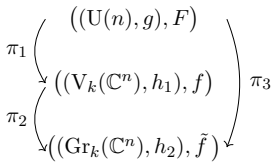
The relation between Langevin processes in the domain and in the image of a Riemannian submersion, which transfers the logarithmic Sobolev inequality from one to the other.
Load-bearing premise
The stated conditions on curvature, temperature, and saddle properties are sufficient to produce a logarithmic Sobolev inequality via the submersion relation.
What would settle it
A concrete Riemannian manifold and potential satisfying the curvature bounds, temperature regime, and saddle-escape properties for which the mixing time of the Langevin dynamics to the Gibbs measure grows superpolynomially in dimension.
Figures
read the original abstract
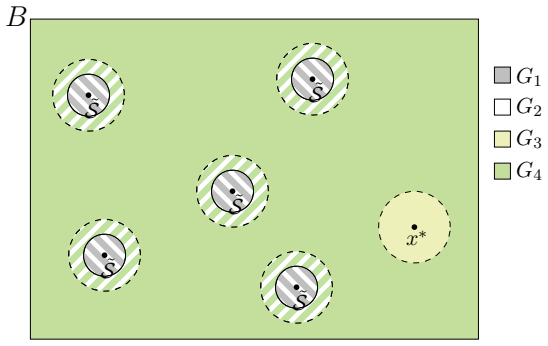
Langevin dynamics on Riemannian manifolds is analyzed. Conditions ensuring the existence of a suitable logarithmic Sobolev inequality (rapid mixing to the Gibbs measure) are identified. These conditions involve the curvature of the manifold, the inverse temperature, escaping directions from saddle points, and exclude barren plateaus and spurious local minima. We show that when these conditions are met, mixing times polynomial in the dimension of the manifold are achievable. This result is obtained through a relation between Langevin processes in the domain and in the image of a Riemannian submersion. Such a relation can be of independent interest.
Editorial analysis
A structured set of objections, weighed in public.
Referee Report
Summary. The manuscript analyzes Langevin dynamics on Riemannian manifolds and identifies conditions on manifold curvature, inverse temperature, escaping directions from saddle points, and the exclusion of barren plateaus and spurious local minima under which a logarithmic Sobolev inequality holds for the Gibbs measure. Rapid (dimension-polynomial) mixing then follows from a transfer relation between the Langevin process on the domain and its image under a Riemannian submersion.
Significance. If the stated conditions are rigorously shown to imply the LSI and the submersion transfer is verified, the result would supply a concrete set of geometric and temperature hypotheses guaranteeing polynomial mixing times on manifolds. The submersion relation itself may be reusable for other stochastic processes on quotient spaces and therefore carries independent technical value.
major comments (1)
- [Abstract / Main theorem statement] The central claim that the listed conditions suffice for an LSI (and hence for polynomial mixing) is load-bearing, yet the manuscript states the existence of such an inequality without supplying the derivation or the verification that the curvature, temperature, and saddle-escape hypotheses actually produce the required Poincaré or log-Sobolev constant.
minor comments (1)
- [Abstract] The abstract asserts that the submersion relation 'can be of independent interest' but provides no comparison with existing literature on stochastic processes under Riemannian submersions or any indication of other potential applications.
Simulated Author's Rebuttal
We thank the referee for the careful reading and for highlighting the need for greater clarity in the main theorem statement. We address the comment below.
read point-by-point responses
-
Referee: [Abstract / Main theorem statement] The central claim that the listed conditions suffice for an LSI (and hence for polynomial mixing) is load-bearing, yet the manuscript states the existence of such an inequality without supplying the derivation or the verification that the curvature, temperature, and saddle-escape hypotheses actually produce the required Poincaré or log-Sobolev constant.
Authors: The manuscript verifies the LSI under the stated hypotheses by combining the Bakry-Émery criterion (applied to the given curvature and inverse-temperature bounds) with the saddle-escape and barren-plateau assumptions to obtain an explicit dimension-polynomial constant; this is carried out in the proof of the main theorem via the Riemannian submersion transfer. The abstract is deliberately concise, but we agree it would benefit from an explicit pointer to this verification and will revise the theorem statement and abstract accordingly. revision: yes
Circularity Check
No significant circularity; derivation self-contained
full rationale
The paper identifies conditions (curvature bounds, inverse temperature, saddle escape properties) claimed to ensure a logarithmic Sobolev inequality on the manifold, then transfers rapid mixing via a Riemannian submersion relation between domain and image processes. No quoted step reduces a prediction or LSI to a fitted parameter, self-definition, or self-citation chain; the submersion relation is explicitly noted as potentially independent. The abstract and reader's assessment show the central claim rests on external verification of the LSI conditions rather than internal reduction to inputs. This is the normal case of a self-contained argument against standard manifold probability benchmarks.
Axiom & Free-Parameter Ledger
axioms (1)
- domain assumption A logarithmic Sobolev inequality holds under the stated curvature and temperature conditions.
Reference graph
Works this paper leans on
-
[1]
M. Creutz. Quarks, Gluons and Lattices . Cambridge Monographs on Mathematical Physics. Cambridge University Press, 2023
2023
-
[2]
N. Boumal. An introduction to optimization on smooth manifolds . To appear with Cambridge University Press. 2022
2022
-
[3]
Absil, R
P.-A. Absil, R. Mahony, and R. Sepulchre. Optimization algorithms on matrix man- ifolds. Princeton University Press, 2008
2008
-
[4]
Differential privacy dynamics of langevin dif- fusion and noisy gradient descent
R. Chourasia, J. Ye, and R. Shokri. “Differential privacy dynamics of langevin dif- fusion and noisy gradient descent”. Advances in Neural Information Processing Sys- tems 34 (2021), pp. 14771–14781
2021
-
[5]
Can stochastic gradient Langevin dynamics provide differ- ential privacy for deep learning?
G. Heller and E. Fetaya. “Can stochastic gradient Langevin dynamics provide differ- ential privacy for deep learning?” 2023 IEEE Conference on Secure and Trustworthy Machine Learning (SaTML). IEEE. 2023, pp. 68–106
2023
- [6]
-
[7]
Brooks, A
S. Brooks, A. Gelman, G. Jones, and X.-L. Meng. Handbook of markov chain monte carlo. CRC press, 2011. 83
2011
-
[8]
Gelman, J
A. Gelman, J. B. Carlin, H. S. Stern, and D. B. Rubin. Bayesian data analysis . Chapman and Hall/CRC, 1995
1995
-
[9]
D. J. MacKay. Information theory, inference and learning algorithms . Cambridge university press, 2003
2003
-
[10]
C. P. Robert, G. Casella, and G. Casella. Monte Carlo statistical methods . Vol. 2. Springer, 2004
2004
-
[11]
Efficient sampling on Riemannian manifolds via Langevin MCMC
X. Cheng, J. Zhang, and S. Sra. “Efficient sampling on Riemannian manifolds via Langevin MCMC”. Advances in Neural Information Processing Systems 35 (2022), pp. 5995–6006
2022
-
[12]
Bakry, I
D. Bakry, I. Gentil, and M. Ledoux. Analysis and Geometry of Markov Diffusion Operators. Grundlehren der mathematischen Wissenschaften. Springer International Publishing, 2013
2013
-
[13]
Poincar´ e and logarithmic Sobolev inequalities by decomposition of the energy landscape
G. Menz and A. Schlichting. “Poincar´ e and logarithmic Sobolev inequalities by decomposition of the energy landscape”. The Annals of Probability 42.5 (2014), pp. 1809–1884
2014
-
[14]
Analysis of langevin monte carlo from poincare to log-sobolev
S. Chewi, M. A. Erdogdu, M. Li, R. Shen, and M. S. Zhang. “Analysis of langevin monte carlo from poincare to log-sobolev”. Foundations of Computational Mathe- matics 25.4 (2025), pp. 1345–1395
2025
-
[15]
Rapid convergence of the unadjusted langevin algo- rithm: Isoperimetry suffices
S. Vempala and A. Wibisono. “Rapid convergence of the unadjusted langevin algo- rithm: Isoperimetry suffices”. Advances in neural information processing systems 32 (2019)
2019
-
[16]
Wibisono
A. Wibisono. Proximal Langevin Algorithm: Rapid Convergence Under Isoperimetry
-
[17]
Riemannian Langevin algorithm for solving semidefinite programs
M. Li and M. A. Erdogdu. “Riemannian Langevin algorithm for solving semidefinite programs”. Bernoulli 29.4 (2023), pp. 3093–3113
2023
-
[18]
Li and M
M. Li and M. A. Erdogdu. Supplement to ”Riemannian Langevin algorithm for solv- ing semidefinite programs”. 2023
2023
- [19]
-
[20]
Matrix product states and projected entangled pair states: Concepts, symmetries, theorems
J. I. Cirac, D. P´ erez-Garc´ ıa, N. Schuch, and F. Verstraete. “Matrix product states and projected entangled pair states: Concepts, symmetries, theorems”. Rev. Mod. Phys. 93 (4 2021), p. 045003
2021
-
[21]
Montvay and G
I. Montvay and G. M¨ unster.Quantum fields on a lattice. Cambridge University Press, 1994
1994
-
[22]
Tensor network manifolds and Riemannian fundamental theorem for tensor networks
P. P´ aez Velasco. “Tensor network manifolds and Riemannian fundamental theorem for tensor networks”. unpublished
-
[23]
E. Hsu. Stochastic Analysis on Manifolds . Contemporary Mathematics. American Mathematical Soc., 2002
2002
-
[24]
Quotient-Space Dif- fusion Model
Y. Xu, Y. Wang, S. Luo, K. Gao, T. He, C. Liu, and D. He. “Quotient-Space Dif- fusion Model”. Submitted to The Fourteenth International Conference on Learning Representations. Under review. 2026
2026
- [25]
- [26]
-
[27]
Motion by mean curvature and Dyson Brownian Motion
C.-P. Huang, D. Inauen, and G. Menon. “Motion by mean curvature and Dyson Brownian Motion”. Electronic Communications in Probability 28 (2023), pp. 1–10
2023
-
[28]
Jolliffe
I. Jolliffe. Principal component analysis. Springer, 2011, pp. 1094–1096
2011
-
[29]
Graph embedding: A general frame- work for dimensionality reduction
S. Yan, D. Xu, B. Zhang, and H.-J. Zhang. “Graph embedding: A general frame- work for dimensionality reduction”. 2005 IEEE Computer Society Conference on Computer Vision and Pattern Recognition (CVPR’05). Vol. 2. IEEE. 2005, pp. 830– 837
2005
-
[30]
A geometric revisit to the trace quotient problem
H. Shen, K. Diepold, and K. H¨ uper. “A geometric revisit to the trace quotient problem”. Proceedings of the 19th International Symposium of Mathematical Theory of Networks and Systems (MTNS 2010) . 2010, p. 1
2010
-
[31]
The effects of mild over-parameterization on the optimization landscape of shallow relu neural networks
I. M. Safran, G. Yehudai, and O. Shamir. “The effects of mild over-parameterization on the optimization landscape of shallow relu neural networks”. Conference on Learning Theory. PMLR. 2021, pp. 3889–3934
2021
-
[32]
Semi-flat minima and saddle points by embedding neural networks to overparameterization
K. Fukumizu, S. Yamaguchi, Y.-i. Mototake, and M. Tanaka. “Semi-flat minima and saddle points by embedding neural networks to overparameterization”. Advances in neural information processing systems 32 (2019)
2019
-
[33]
Cheeger, D
J. Cheeger, D. G. Ebin, and D. G. Ebin. Comparison theorems in Riemannian ge- ometry. Vol. 9. North-Holland Amsterdam, 1975
1975
-
[34]
M. W. Hirsch. Differential topology. Springer Science & Business Media, 2012
2012
-
[35]
F. Wang. Functional inequalities Markov semigroups and spectral theory . Elsevier, 2006
2006
-
[36]
Revuz and M
D. Revuz and M. Yor. Continuous martingales and Brownian motion . Vol. 293. Springer Science & Business Media, 2013
2013
-
[37]
A simple proof of the Poincar´ e inequality for a large class of probability measures
D. Bakry, F. Barthe, P. Cattiaux, and A. Guillin. “A simple proof of the Poincar´ e inequality for a large class of probability measures”. Electronic Communications in Probability 13 (2008), pp. 60–66
2008
-
[38]
Bovier and F
A. Bovier and F. den Hollander. Metastability: A Potential-Theoretic Approach. Die Grundlehren der mathematischen Wissenschaften. Springer International Publish- ing, 2015
2015
-
[39]
J. M. Lee. Introduction to Riemannian manifolds . Vol. 2. Springer, 2018
2018
-
[40]
Wainwright
M. Wainwright. High-Dimensional Statistics: A Non-Asymptotic Viewpoint . Cam- bridge Series in Statistical and Probabilistic Mathematics. Cambridge University Press, 2019
2019
-
[41]
F.-Y. Wang. Analysis for Diffusion Processes on Riemannian Manifolds . World Sci- entific, 2013
2013
-
[42]
A gradient estimate on a manifold with convex boundary
Z. Qian. “A gradient estimate on a manifold with convex boundary”. Proceedings of the Royal Society of Edinburgh: Section A Mathematics 127.1 (1997), pp. 171–179
1997
-
[43]
Sulanke and P
R. Sulanke and P. Wintgen. Differentialgeometrie und Faserb¨ undel. Vol. 48. Springer, 1972
1972
-
[44]
On the estimate of first eigenvalue of a compact Riemannian manifold
J. Q. Zhong. “On the estimate of first eigenvalue of a compact Riemannian manifold”. Sci. Sinica Ser. A 27 (1984), pp. 1265–1273. 85
1984
-
[45]
Weak logarithmic Sobolev inequalities and entropic convergence
P. Cattiaux, I. Gentil, and A. Guillin. “Weak logarithmic Sobolev inequalities and entropic convergence”. Probability theory and related fields 139.3 (2007), pp. 563– 603
2007
-
[46]
Logarithmic Sobolev inequalities and spectral gaps
E. Carlen and M. Loss. “Logarithmic Sobolev inequalities and spectral gaps”. Con- temporary Mathematics 353 (2004), pp. 53–60
2004
-
[47]
A. B. Tsybakov. Introduction to Nonparametric Estimation. Springer New York, NY, 2008
2008
-
[48]
C. Villani. Optimal Transport: Old and New. Grundlehren der mathematischen Wis- senschaften. Springer Berlin Heidelberg, 2008
2008
-
[49]
Riemannian submersions with totally geodesic fibers
R. H. Escobales Jr. “Riemannian submersions with totally geodesic fibers”. Journal of Differential Geometry 10.2 (1975), pp. 253–276
1975
-
[50]
Some isoperimetric inequalities and eigenvalue estimates
C. B. Croke. “Some isoperimetric inequalities and eigenvalue estimates”. Annales scientifiques de l’ ´Ecole Normale Sup´ erieureSer. 4, 13.4 (1980), pp. 419–435
1980
-
[51]
Riemannian geometry as determined by the volumes of small geodesic balls
A. Gray and L. Vanhecke. “Riemannian geometry as determined by the volumes of small geodesic balls”. Acta Mathematica 142 (1979), pp. 157–198
1979
-
[52]
Inequalities for the gamma function
N. Batir. “Inequalities for the gamma function”. Archiv der Mathematik 91.6 (2008), pp. 554–563
2008
-
[53]
´A. Y´ ang¨ uez, T. A. Hahn, and J. Kochanowski.Efficient Quantum Measurements: Computational Max- and Measured R´ enyi Divergences and Applications. 2025. arXiv: 2509.21308
-
[54]
Density Matrix Renormalization Group and Periodic Boundary Conditions: A Quantum Information Perspective
F. Verstraete, D. Porras, and J. I. Cirac. “Density Matrix Renormalization Group and Periodic Boundary Conditions: A Quantum Information Perspective”. Phys. Rev. Lett. 93 (22 2004), p. 227205
2004
-
[55]
R. A. Horn and C. R. Johnson. Matrix analysis. Cambridge university press, 2012
2012
-
[56]
A Grassmann manifold handbook: Basic geometry and computational aspects
T. Bendokat, R. Zimmermann, and P.-A. Absil. “A Grassmann manifold handbook: Basic geometry and computational aspects”. Advances in Computational Mathemat- ics 50.1 (2024), p. 6
2024
-
[57]
Polynomial-time approximation algorithms for the Ising model
M. Jerrum and A. Sinclair. “Polynomial-time approximation algorithms for the Ising model”. SIAM Journal on computing 22.5 (1993), pp. 1087–1116
1993
-
[58]
Petersen
P. Petersen. Riemannian Geometry. Graduate Texts in Mathematics. Springer New York, 2006
2006
-
[59]
Fulton and J
W. Fulton and J. Harris. Representation theory: a first course . Springer Science & Business Media, 2013
2013
-
[60]
J. Q. Gallier and J. Quaintance. Differential geometry and lie groups . Vol. 12. Springer, 2020
2020
-
[61]
The Frobenius norm and the commutator
A. B¨ ottcher and D. Wenzel. “The Frobenius norm and the commutator”. Linear Algebra and its Applications 429.8-9 (Oct. 2008), pp. 1864–1885
2008
-
[62]
M. P. Do Carmo and J. Flaherty Francis. Riemannian geometry. Vol. 6. Springer, 1992
1992
-
[63]
A. Besse. Einstein Manifolds. Classics in Mathematics. Springer Berlin Heidelberg, 2007
2007
-
[64]
Contributions to Riemannian Geometry in the Large
W. Klingenberg. “Contributions to Riemannian Geometry in the Large”. Annals of Mathematics 69.3 (1959), pp. 654–666. 86
1959
-
[65]
M. Berger. A Panoramic View of Riemannian Geometry. Springer Berlin Heidelberg, 2007
2007
-
[66]
The fundamental equations of a submersion
B. O’Neill. “The fundamental equations of a submersion.” Michigan Mathematical Journal 13.4 (1966), pp. 459–469
1966
-
[67]
Submersions and geodesics
B. O’Neill. “Submersions and geodesics”. Duke Math. J. 34.1 (1967), pp. 363–373
1967
-
[68]
The topology of fiber bundles lecture notes
R. L. Cohen. “The topology of fiber bundles lecture notes”. Standford University (1998)
1998
-
[69]
Sub-Riemannian geometry of Stiefel manifolds
C. Autenried and I. Markina. “Sub-Riemannian geometry of Stiefel manifolds”. SIAM Journal on Control and Optimization 52.2 (2014), pp. 939–959
2014
-
[70]
Algorithms for data fitting on some common homogeneous spaces
Q. Rentmeesters et al. “Algorithms for data fitting on some common homogeneous spaces”. PhD thesis. Ph. D. thesis, Universit´ e Catholique de Louvain, Louvain, Bel- gium, 2013
2013
-
[71]
The ultimate upper bound on the injectivity radius of the Stiefel manifold
P.-A. Absil and S. Mataigne. “The ultimate upper bound on the injectivity radius of the Stiefel manifold”. SIAM Journal on Matrix Analysis and Applications 46.2 (2025), pp. 1145–1167
2025
-
[72]
S. K. Lando and A. K. Zvonkin. Graphs on surfaces and their applications . Vol. 141. Springer Science & Business Media, 2013
2013
-
[73]
Grigor’yan
A. Grigor’yan. Lecture notes on Analysis on Manifolds . 2024
2024
-
[74]
Log-Sobolev inequality on non-convex Riemannian manifolds
F.-Y. Wang. “Log-Sobolev inequality on non-convex Riemannian manifolds”. Ad- vances in Mathematics 222.5 (2009), pp. 1503–1520
2009
-
[75]
A brief introduction to Brownian motion on a Riemannian manifold
E. P. Hsu. “A brief introduction to Brownian motion on a Riemannian manifold”. lecture notes (2008)
2008
-
[76]
A theory of the term structure of interest rates
J. C. Cox, J. E. Ingersoll, S. A. Ross, et al. “A theory of the term structure of interest rates”. Econometrica 53.2 (1985), pp. 385–407
1985
-
[77]
Escaping time of a modified CIR process
mathusername. Escaping time of a modified CIR process . Mathematics Stack Ex- change. 2025. https://math.stackexchange.com/q/5117199
-
[78]
The Cox-Ingersoll-Ross process under volatility uncertainty
B. Akhtari and H. Li. “The Cox-Ingersoll-Ross process under volatility uncertainty”. Journal of Mathematical Analysis and Applications 531.1 (2024), p. 127867
2024
-
[79]
J. Steele. Stochastic Calculus and Financial Applications . Stochastic Modelling and Applied Probability. Springer New York, 2012
2012
-
[80]
Oksendal
B. Oksendal. Stochastic differential equations: an introduction with applications . Springer Science & Business Media, 2013
2013
discussion (0)
Sign in with ORCID, Apple, or X to comment. Anyone can read and Pith papers without signing in.