REVIEW 4 major objections 5 minor 1 cited by
Data-efficient inverse design of spinodoid metamaterials
T0 review · 4 major / 5 minor · reviewed 2026-08-15 · deepseek-v4-flash
Pith's one-line read This paper claims that a permutation-equivariant neural network can map spinodoid microstructure parameters to elasticity tensors from only 75 training samples, and that this surrogate is accurate enough for multi-objective inverse design.
desk verdict Solid equivariant-surrogate paper whose '75 data points' headline is undermined by test-set-based model selection; the architecture and demos are good, but the central claim needs an out-of-sample check. read the letter →
The pith
A machine-rendered reading of the paper's core claim, the machinery that carries it, and where it could break.
The reading
What carries the argument
The central object is an $S_3$-permutation-equivariant neural network layer built by parameter sharing: the weight connecting an input index tuple to an output index tuple is determined by the orbit of that pair under simultaneous permutation of indices, so the network is equivariant by construction and never has to learn the six permutations of the angles from data. The output layer restricts the learned tensor to the orthorhombic form of Eq. (11), an anisotropy factor $\kappa(\mathbf{S})=(1-\rho)\prod_i(1-\hat{\theta}_i)$ suppresses anisotropy at the isotropic limits, and squaring the resulting fourth-order tensor $\mathbf{t}$ guarantees positive semidefiniteness. These built-in constraints are what allow training to be restricted to the quotient domain $\theta_1\ge\theta_2\ge\theta_3$ with Latin-hypercube sampling biased toward sensitive regions.
What would settle it
Generate, for fixed structure parameters, many independent random geometries with the same $\mathbf{S}$ and measure the spread of their effective tensors. If the realization-to-realization variance is comparable to the differences the surrogate must resolve, then a model trained on one realization per parameter point and constrained to be permutation-symmetric cannot be distinguished from one that has simply averaged fluctuations; a second test is to train the same network on 75 points sampled from the full domain without the permutation quotient and compare accuracy on permuted test points.
Extended reading notes
Core claim
The central claim is that a permutation-equivariant neural network can learn the map $\mathbf{S}=(\theta_1,\theta_2,\theta_3,\rho) \mapsto \bar{\mathbf{C}}$ (effective elasticity tensor) for spinodoid metamaterials from as few as 75 training pairs, and that this model is sufficiently accurate for inverse design. The architecture enforces equivariance under permutations of $\theta_1,\theta_2,\theta_3$ by sharing weights over orbits of the symmetric group $S_3$ acting on tensor indices, and it additionally builds in minor and major symmetry, orthorhombic alignment, isotropy at $\rho=1$ or $\theta_i=90^\circ$, and positive semidefiniteness of the output. The paper reports that using more than about 200 training points yields no further accuracy gain, and chooses the 75-point model for three gradient-based inverse design tasks: reconstructing a complete target elasticity tensor, minimizing volume fraction under a directional stiffness constraint, and a three-objective task combining a directional modulus lower bound with a prescribed ratio of directional moduli.
Load-bearing premise
The effective tensor of a finite random geometry is treated as exactly symmetric under permutations of the three angles, so training only on $\theta_1\ge\theta_2\ge\theta_3$ and hard-wiring the equivariance is assumed not to bias the surrogate, even though individual realizations only satisfy this statistically.
Editorial extensions
If this is right
- A surrogate accurate enough for inverse design can be calibrated with about 75 structure-property pairs, cutting the data requirement roughly two orders of magnitude relative to previous spinodoid workflows.
- Because the surrogate is differentiable, multi-objective inverse design with equality and inequality constraints reduces to a small gradient-based optimization problem over structure parameters and rotations.
- The same data-efficiency logic should transfer to more expensive properties such as nonlinear elasticity or viscoelastic response, where generating thousands of samples is impractical.
- The built-in constraints keep all surrogate outputs physically admissible, so the optimizer cannot wander into unphysical stiffness tensors.
- Purely experimental calibration datasets, with no simulation at all, become realistic for spinodoid inverse design.
Reading between the lines
- The permutation-equivariance trick is not specific to elasticity: any property that inherits index-permutation symmetry from the spinodoid construction (diffusivity, conductivity, acoustic response) could use the same architecture and likely similar data reductions.
- The 75-point number is a statement about linear elasticity; strongly nonlinear regimes with sharper property landscapes may require more points, or an active-learning extension that places samples adaptively in the most sensitive regions.
- A direct test of the load-bearing equivariance assumption is to compare this model against one trained on the same 75 points without the quotient-domain restriction; if the enforced symmetry mostly averages finite-size fluctuations, the advantage over a full-domain model would shrink.
- The surrogate's differentiability could be used beyond design optimization, for example to map sensitivity of target properties across the design space and identify which parameter regions offer the most control.
Signed reviews
Editorial analysis
A structured set of objections, weighed in public.
Referee Report
Summary. The paper proposes a data-efficient surrogate model for the structure-property map of spinodoid metamaterials, mapping four structure parameters (three angles θ1, θ2, θ3 and volume fraction ρ) to the effective elasticity tensor. The surrogate is a permutation-equivariant neural network that, by construction, enforces equivariance under permutations of the angles, minor and major symmetry, orthorhombic symmetry, isotropy at ρ=1 or θi=90°, and positive semidefiniteness of the output. Training data are generated by sampling reduced ordered domains with Latin Hypercube sampling and using FFT-based homogenization (FANS) to compute effective tensors. The authors compare test errors for training sets of different sizes, select Ndata=75 as sufficient, and then use this surrogate in three inverse design tasks: reconstructing a prescribed elasticity tensor, minimizing volume fraction subject to a directional stiffness constraint, and a multi-objective problem combining volume fraction, a directional Young's modulus, and a modulus ratio. The manuscript claims that 75 structure-property pairs suffice for accurate training and inverse design, far fewer than the thousands used in prior work.
Significance. If the data-efficiency claim is valid, this is a practically important contribution: it would lower the cost of surrogate-based inverse design for spinodoids and, more importantly, make the approach feasible for properties whose simulations or experiments are much more expensive than linear elasticity, such as nonlinear or inelastic behavior. The architecture design is principled: the permutation-equivariant layer with parameter sharing is cleanly derived, and the explicit incorporation of tensor symmetries and positive semidefiniteness is a genuine methodological strength. The inverse design formulation with unconstrained rotation parameters is also well motivated and the three examples are internally consistent. The central quantitative claim, however, is not yet established to the standard the paper itself sets: the choice of 75 data points is made after inspecting the test-error curve, the reported test errors have no variance estimates despite stochastic geometry generation, and the equivariance property is enforced exactly even though the simulated geometries are finite random realizations for which the symmetry holds only statistically.
major comments (4)
- [Sec. 7.1 and Fig. 6] The central claim that 75 data points are sufficient is selected on the basis of the test set. The paper states: 'Of course, both Dtrain75 and Dtest were used in this study when selecting the model.' Because Ndata=75 is chosen after inspecting Ltest over the full range of dataset sizes, the reported test error for the selected model is a post-selection optimistic estimate, not an unbiased out-of-sample evaluation. The abstract and Sec. 8 present the 75-point result as an empirical finding, but the experimental protocol cannot support that claim as stated. The authors should either re-run the dataset-size comparison on a separate validation set and report the test error of the final model on a truly held-out set, or present a nested cross-validation procedure. At minimum, the claim should be restricted to a model selection statement with the caveat made in the abstract and conclusions.
- [Sec. 2, Sec. 4(i), and Sec. 6.2] The exact permutation equivariance enforced in the architecture holds only in expectation for the simulated geometries, not for each finite realization. The paper justifies the symmetry in Sec. 2 by saying 'these symmetries must also be reflected in the effective properties,' but the geometries are generated with Nwave=10,000 random cosine waves and random phases, so a given realization will deviate from the ensemble-mean symmetry. The manuscript does not quantify the magnitude of these deviations, does not check whether the enforced equivariance introduces bias in the surrogate, and does not report how much of the test error is irreducible stochastic noise. This matters because the equivariance constraint is the main source of the claimed 6-fold data reduction. The authors should report the variance of the effective tensor across independent geometry realizations for representative parameters, and ideally show that the permutation-equivariant surrogate performs similarly on permuted input/output pairs as on the original ordered domain.
- [Sec. 4 and Sec. 7.1] The paper attributes the data efficiency to the equivariant architecture ('avoids having to learn them from data'), but no ablation is performed to quantify the benefit of equivariance. Without a baseline non-equivariant network trained on the same datasets with the same hyperparameter budget, it is not possible to tell how much of the strong performance at Ndata=75 comes from the architectural inductive bias and how much from the structure of the problem itself. A simple comparison, e.g., a fully connected network with the same number of parameters and the same normalization, trained on the same datasets and evaluated on Dtest, would make the claimed role of equivariance concrete. This is a load-bearing point because the paper's abstract explicitly presents equivariance as the methodological reason for the low data requirement.
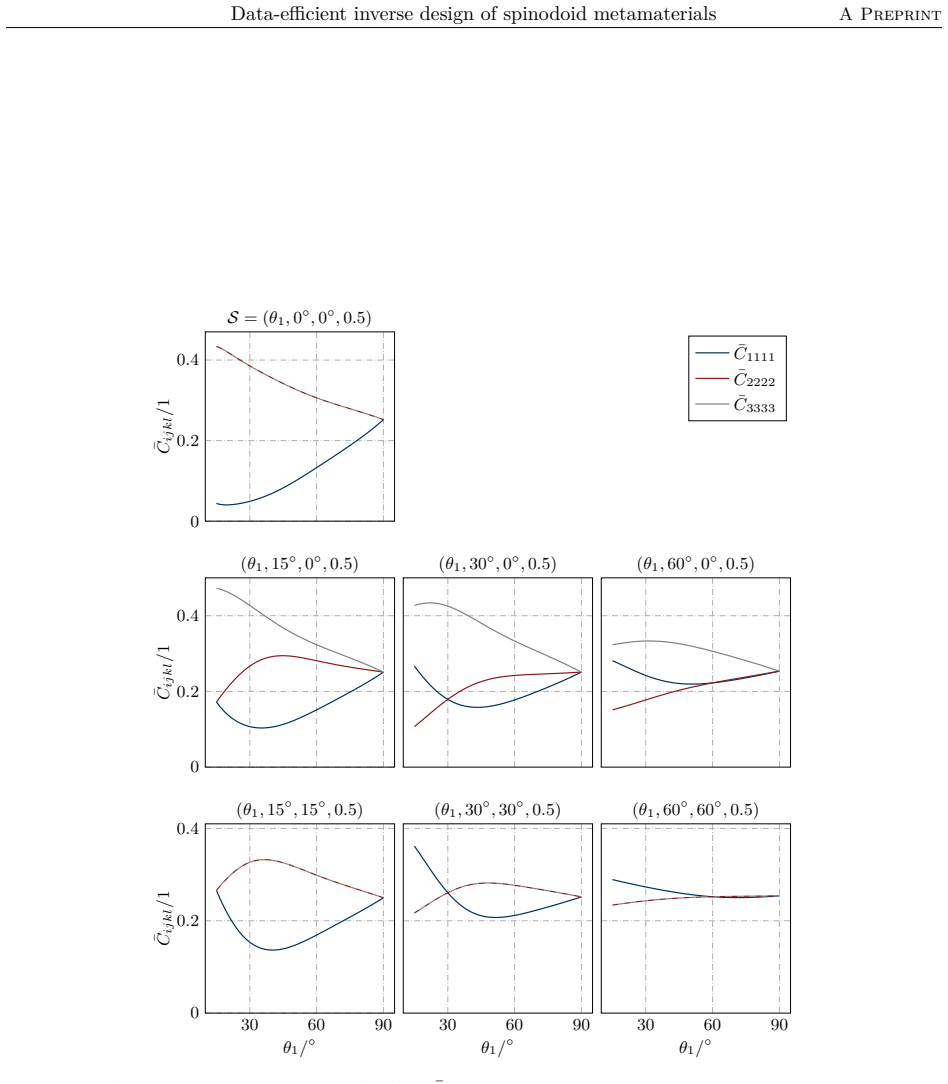
- [Appendix C and Fig. 11] The low-complexity argument used to explain the small data requirement is self-referential. Appendix C evaluates the surrogate trained on 1,000 points to draw conclusions about the smoothness and number of extrema of the true function f, stating that the curves show 'no more than one local extremum.' Smoothness of a neural-network surrogate, however, can be an artifact of the architecture and the regularization, not a property of the simulation-based f. Since this low-complexity claim is used to justify the general conclusion that few data suffice, the authors should either provide evidence from the simulator directly (e.g., FANS evaluations along the same cross-sections) or clearly mark this reasoning as heuristic.
minor comments (5)
- [Abstract] There is a grammar error: 'We create an data-efficient' should read 'We create a data-efficient.'
- [Eq. (6) and Sec. 4(iv)] The admissible domain is defined with θi∈{0°}∪(15°,90°), where the interval is open at 90°, yet requirement (iv) and the factor κ(S) in Eq. (13) refer to isotropy at θi=90°. The authors should clarify whether 90° is included as a limit case or whether the statement should be phrased as θi approaching 90°.
- [Sec. 6.1] The sampling bias exponents bθ=bρ=1.6 are introduced and used, but no sensitivity analysis or justification is provided for this specific choice. Since these exponents change the training distribution, a sentence explaining the choice or a short sensitivity study would be helpful.
- [Sec. 7.2, Example 2] The statement that 'modifying the found structure parameters results in metamaterials with worse behavior' is based on a small local perturbation check. It would be more informative to report a small neighborhood evaluation or a comparison with alternative local optima obtained from different starting points, since the solution of the constrained nonconvex problem is not guaranteed to be global.
- [Fig. 6] The figure includes a 'Predictions for Ndata=75' panel, but the caption does not state which correlation metric or which subset of tensor components is shown. Please specify the plotted quantity and whether all 21 independent components are pooled.
Circularity Check
The '75 data points suffice' claim is selected using the test set, and the low-complexity explanation in Appendix C is self-referential; the forward-map learning itself is not circular.
-
fitted input called prediction
[Sec. 7.1 (Forward model), with confirmation in Appendix B]
"Even the model trained with 75 data points is sufficiently accurate. ... Here, we choose the model trained with Dtrain75 and use it for the subsequent inverse design tasks. Of course, both Dtrain75 and Dtest were used in this study when selecting the model."
The dataset size Ndata=75 is selected by inspecting the test-error curve in Fig. 6, i.e., Dtest is used to choose the headline model. The accuracy then cited for '75 data points are sufficient' is the test error of a model whose size was selected on that same test set. This is test-set-based model selection, so the reported Ltest is the minimum over 11 candidate dataset sizes rather than an unbiased out-of-sample estimate. The data-efficiency claim is therefore a post-selection statement, not an independently validated prediction; Appendix B acknowledges that the choice 'remains somewhat arbitrary.'
-
other
[Appendix C (Sensitivity of the properties with respect to the structure parameters)]
"In order to investigate the complexity of the function f that is to be learnt by the model f̃, the model calibrated with 1,000 data points is evaluated ... The function to be learnt by the surrogate model is therefore of fairly low complexity, which explains the low need for data."
The appendix uses the trained surrogate itself to conclude that the underlying map f is low-complexity, and then uses that conclusion to explain the low data requirement. Smoothness of the surrogate's output is a property of the fitted 313-parameter network, not independent evidence about f. This is a self-referential supporting argument: the surrogate's behavior is used to justify why so little data suffices to train a surrogate. It is not the primary evidence for the 75-point claim, but it is presented as an explanation and is circular in structure.
full rationale
The forward-model learning is not circular: the surrogate is trained on FANS simulation data and tested on a separately generated Dtest, and the architectural requirements (permutation equivariance, minor/major symmetry, orthorhombic form, isotropy limits, positive semidefiniteness) are priors imposed on the ansatz, not target quantities derived from the claim. There is no load-bearing self-citation chain: the spinodoid construction is cited to Kumar et al. and the equivariant layer construction to Ravanbakhsh et al., both external to the present authors. The main circularity is statistical: the headline number Ndata=75 is chosen after inspecting Ltest on Dtest, so the same Dtest cannot independently validate that choice; Appendix B concedes the choice is 'somewhat arbitrary.' A secondary self-referential step is Appendix C, which infers low complexity of f from the trained surrogate and then uses that inference to explain the low data need. These issues weaken the data-efficiency headline but do not reduce the inverse-design demonstrations to their inputs, so the circularity score is moderate rather than high.
Assumptions & free parameters
free parameters (4)
- sampling bias exponents bθ, bρ =
1.6, 1.6
- regularization strength λ_reg =
1e-4
- network width (hidden neurons) =
10 per layer
- sampling and discretization settings Nwave, Nvoxel =
10,000; 128^3
assumptions (4)
- domain assumption Permutations of θ1, θ2, θ3 leave the spinodoid ensemble equivalent up to axis renumbering, so single-realization effective tensors are treated as exactly equivariant.
- domain assumption The effective elasticity tensor of an axis-aligned spinodoid has orthorhombic symmetry with the zero pattern of Eq. (11).
- ad hoc to paper The effective tensor becomes isotropic when ρ=1 or any θi=90°, and the interpolation factor κ(S)=(1−ρ)∏(1−θ̂i) correctly controls the anisotropic part.
- domain assumption The FANS homogenization pipeline with E1/E2=100, Nwave=10,000, and 128^3 voxels produces converged effective tensors matching the true spinodoid properties.
Cite this review
Pith. "Pith review of Data-efficient inverse design of spinodoid metamaterials." pith.science (2026). https://pith.science/paper/EDDZ3F2S
@misc{pith2026250503415,
  author       = {Pith},
  title        = {Pith review of: Data-efficient inverse design of spinodoid metamaterials},
  year         = {2026},
  howpublished = {\url{https://pith.science/paper/EDDZ3F2S}},
  note         = {Machine review of arXiv:2505.03415}
}
read the original abstract
We create an data-efficient and accurate surrogate model for structure-property linkages of spinodoid metamaterials with only 75 data points -- far fewer than the several thousands used in prior works -- and demonstrate its use in multi-objective inverse design. The inverse problem of finding a material microstructure that leads to given bulk properties is of great interest in mechanics and materials science. These inverse design tasks often require a large dataset, which can become unaffordable when considering material behavior that requires more expensive simulations or experiments. We generate a data-efficient surrogate for the mapping between the characteristics of the local material structure and the effective elasticity tensor and use it to inversely design structures with multiple objectives simultaneously. The presented neural network-based surrogate model achieves its data efficiency by inherently satisfying certain requirements, such as equivariance with respect to permutations of structure parameters, which avoids having to learn them from data. The resulting surrogate of the forward model is differentiable, allowing its direct use in gradient-based optimization for the inverse design problem. We demonstrate in three inverse design tasks of varying complexity that this approach yields reliable results while requiring significantly less training data than previous approaches based on neural-network surrogates. This paves the way for inverse design involving nonlinear mechanical behavior, where data efficiency is currently the limiting factor.
Figures


Figures from the paper (7 more)


Forward citations
Cited by 1 Pith paper
-
A topological approach to the Cahn-Hilliard equation and hyperuniform fields
Persistent homology of signed-distance filtrations correlates with and can classify the hyperuniform character of scalar fields, demonstrated on Cahn-Hilliard patterns and Gaussian random fields.
Reference graph
Works this paper leans on
-
[1]
Siddhant Kumar, Stephanie Tan, Li Zheng, and Dennis M. Kochmann. Inverse-designed spin- odoid metamaterials. npj Computational Ma- terials, 6(1):73, 2020. doi:10.1038/s41524-020- 0341-6
-
[2]
Inverse- designed growth-based cellular metamaterials
Sikko Van ’t Sant, Prakash Thakolkaran, Jon` as Mart´ ınez, and Siddhant Kumar. Inverse- designed growth-based cellular metamaterials. Mechanics of Materials , 182:104668, 2023. doi:10.1016/j.mechmat.2023.104668. 13 Data-efficient inverse design of spinodoid metamaterials A Preprint Figure 10: Overview of the surrogate model’s prediction quality for diffe...
arXiv 2023
-
[3]
Mechanical metama- terials associated with stiffness, rigidity and compressibility: A brief review
Xianglong Yu, Ji Zhou, Haiyi Liang, Zhengyi Jiang, and Lingling Wu. Mechanical metama- terials associated with stiffness, rigidity and compressibility: A brief review. Progress in Materials Science , 94:114–173, 2018. doi:10.1016/j.pmatsci.2017.12.003
-
[4]
Design and me- chanical characteristics of auxetic metamate- rial with tunable stiffness
Xian Cheng, Yi Zhang, Xin Ren, Dong Han, Wei Jiang, Xue Gang Zhang, Hui Chen Luo, and Yi Min Xie. Design and me- chanical characteristics of auxetic metamate- rial with tunable stiffness. International Jour- nal of Mechanical Sciences , 223:107286, 2022. doi:10.1016/j.ijmecsci.2022.107286
arXiv 2022
-
[5]
J. B. Berger, H. N. G. Wadley, and R. M. McMeeking. Mechanical metamaterials at the theoretical limit of isotropic elastic stiffness. Na- ture, 543(7646):533–537, 2017. ISSN 1476-4687. doi:10.1038/nature21075
-
[6]
Gorji, Colin Bon- atti, and Dirk Mohr
Thomas Tancogne-Dejean, Marianna Diaman- topoulou, Maysam B. Gorji, Colin Bon- atti, and Dirk Mohr. 3D Plate-Lattices: An Emerging Class of Low-Density Meta- material Exhibiting Optimal Isotropic Stiff- ness. Advanced Materials, 30(45):1803334, 2018. doi:10.1002/adma.201803334
-
[7]
3D-Printed Mechanical Metamateri- als with High Energy Absorption
Shangqin Yuan, Chee Kai Chua, and Kun Zhou. 3D-Printed Mechanical Metamateri- als with High Energy Absorption. Advanced Materials Technologies , 4(3):1800419, 2019. doi:10.1002/admt.201800419
-
[8]
Additively-manufactured lightweight Metamaterials for energy absorp- tion
Mehrdad Mohsenizadeh, Federico Gas- barri, Michael Munther, Ali Beheshti, and Keivan Davami. Additively-manufactured lightweight Metamaterials for energy absorp- tion. Materials & Design , 139:521–530, 2018. doi:10.1016/j.matdes.2017.11.037
Show all 57 references
-
[9]
On anisotropic ver- sions of three-dimensional pentamode metama- terials
Muamer Kadic, Tiemo B¨ uckmann, Robert Schit- tny, and Martin Wegener. On anisotropic ver- sions of three-dimensional pentamode metama- terials. New Journal of Physics , 15(2):023029,
-
[10]
Optimisation of three-dimensional hierar- chical structures with tailored lattice metamate- rial anisotropy
Lei Zhu, Liao Sun, Xiaoyang Wang, and Nan Li. Optimisation of three-dimensional hierar- chical structures with tailored lattice metamate- rial anisotropy. Materials & Design, 210:110083,
-
[11]
Bednarcyk, Louise Le Barbenchon, and Yanyu Chen
Huan Jiang, Brett A. Bednarcyk, Louise Le Barbenchon, and Yanyu Chen. Elastically anisotropic architected metamaterials with en- hanced energy absorption. Thin-Walled Struc- tures, 192:111115, 2023. ISSN 0263-8231. doi:10.1016/j.tws.2023.111115
2023
-
[12]
Jadoon, Karl A
Asghar A. Jadoon, Karl A. Kalina, Manuel K. Rausch, Reese Jones, and Jan N. Fuhg. In- verse design of anisotropic microstructures us- ing physics-augmented neural networks. arXiv,
-
[13]
A novel two- dimensional mechanical metamaterial with negative Poisson’s ratio
Hui Wang, Yuxuan Zhang, Wanqing Lin, and Qing-Hua Qin. A novel two- dimensional mechanical metamaterial with negative Poisson’s ratio. Computa- tional Materials Science , 171:109232, 2020. doi:10.1016/j.commatsci.2019.109232. 14 Data-efficient inverse design of spinodoid metam...
2020
-
[14]
Foam Structures with a Negative Poisson’s Ratio
Roderic Lakes. Foam Structures with a Negative Poisson’s Ratio. Science, 235(4792):1038–1040,
-
[15]
Nega- tive stiffness-induced extreme viscoelastic me- chanical properties: stability and dynam- ics
Yun-Che Wang and Roderic Lakes †. Nega- tive stiffness-induced extreme viscoelastic me- chanical properties: stability and dynam- ics. Philosophical Magazine , 84(35):3785–3801,
-
[16]
Fallah, and Pooya Sareh
Navid Mehreganian, Arash S. Fallah, and Pooya Sareh. Structural Mechanics of Nega- tive Stiffness Honeycomb Metamaterials. Jour- nal of Applied Mechanics , 88(051006), 2021. doi:10.1115/1.4049954
2021 doi
-
[17]
Viscoelas- tic negative stiffness metamaterial with multi- stage load bearing and programmable energy absorption ability
Tianzhen Liu, Cheng Lin, Yonglin Zhang, Jianguo Cai, and Jinglei Yang. Viscoelas- tic negative stiffness metamaterial with multi- stage load bearing and programmable energy absorption ability. International Journal of Smart and Nano Materials , 16(1):1–23, 2025. doi:10.1080/19...
2025
-
[18]
Correa, Timothy Klatt, Sergio Cortes, Michael Haberman, Desiderio Kovar, and Carolyn Seepersad
Dixon M. Correa, Timothy Klatt, Sergio Cortes, Michael Haberman, Desiderio Kovar, and Carolyn Seepersad. Negative stiffness honeycombs for recoverable shock isolation. Rapid Prototyping Journal, 21(2):193–200, 2015. doi:10.1108/RPJ-12-2014-0182
2015 doi
-
[19]
Correa, Carolyn Conner Seepersad, and Michael R
Dixon M. Correa, Carolyn Conner Seepersad, and Michael R. Haberman. Mechanical design of negative stiffness honeycomb materials.Integrat- ing Materials and Manufacturing Innovation , 4 (1):165–175, 2015. doi:10.1186/s40192-015-0038- 8
2015 doi
-
[20]
Vecchio, Olivia F
Kenneth S. Vecchio, Olivia F. Dippo, Kevin R. Kaufmann, and Xiao Liu. High-throughput rapid experimental alloy development (HT- READ). Acta Materialia , 221:117352, 2021. doi:10.1016/j.actamat.2021.117352
2021
-
[21]
Alloy Design Strategies and Fu- ture Trends in High-Entropy Alloys
Jien-Wei Yeh. Alloy Design Strategies and Fu- ture Trends in High-Entropy Alloys. JOM, 65 (12):1759–1771, 2013. doi:10.1007/s11837-013- 0761-6
2013 doi
-
[22]
Kalidindi, and Christian Haase
Avinash Hariharan, Marc Ackermann, Stephan Koss, Ali Khosravani, Johannes Henrich Schleifenbaum, Patrick K¨ ohnen, Surya R. Kalidindi, and Christian Haase. High-Speed 3D Printing Coupled with Machine Learning to Accelerate Alloy Development for Addi- tive Manufacturing. Advanc...
2025 doi
-
[23]
Kalina, and Markus K¨ astner
Alexander Raßloff, Paul Seibert, Karl A. Kalina, and Markus K¨ astner. Inverse design of spinodoid structures using Bayesian optimization. Com- putational Mechanics , 2025. ISSN 1432-0924. doi:10.1007/s00466-024-02587-w
2025 doi
-
[24]
Calderon, Jose J
Camilo E. Calderon, Jose J. Plata, Cor- mac Toher, Corey Oses, Ohad Levy, Marco Fornari, Amir Natan, Michael J. Mehl, Gus Hart, Marco Buongiorno Nardelli, and Stefano Curtarolo. The AFLOW standard for high- throughput materials science calculations. Com- putational Materials S...
2015 doi
-
[25]
Accelerated crystal structure prediction of multi-elements random alloy using expandable features
Taewon Jin, Ina Park, Taesu Park, Jaesik Park, and Ji Hoon Shim. Accelerated crystal structure prediction of multi-elements random alloy using expandable features. Scientific Reports, 11(1): 5194, 2021. doi:10.1038/s41598-021-84544-8
2021 doi
-
[26]
High-throughput materials screening algorithm based on first-principles density functional theory and artificial neural network for high-entropy alloys
Meena Rittiruam, Jakapob Noppakhun, So- rawee Setasuban, Nuttanon Aumnongpho, At- tachai Sriwattana, Suphawich Boonchuay, Tin- nakorn Saelee, Chanthip Wangphon, Annop Ek- tarawong, Patchanee Chammingkwan, Toshiaki Taniike, Supareak Praserthdam, and Piyasan Praserthdam. High-th...
2022 doi
-
[27]
Bayesian optimization for goal-oriented multi-objective inverse material design
Kyohei Hanaoka. Bayesian optimization for goal-oriented multi-objective inverse material design. iScience, 24(7), 2021. ISSN 2589-0042. doi:10.1016/j.isci.2021.102781
2021
-
[28]
Inverse design of dual-phase steel microstruc- tures using generative machine learning model and Bayesian optimization
Navyanth Kusampudi and Martin Diehl. Inverse design of dual-phase steel microstruc- tures using generative machine learning model and Bayesian optimization. Interna- tional Journal of Plasticity , 171:103776, 2023. doi:10.1016/j.ijplas.2023.103776
2023
-
[29]
Inverse Design of Nonlinear Mechan- ics of Bio-inspired Materials Through Interface Engineering and Bayesian Optimization
Wei Zhang, Mingjian Tang, Haoxuan Mu, Xingzi Yang, Xiaowei Zeng, Rui Tuo, Wei, Chen, and Wei Gao. Inverse Design of Nonlinear Mechan- ics of Bio-inspired Materials Through Interface Engineering and Bayesian Optimization. arXiv,
-
[30]
Coli, Emanuele Boattini, Laura Filion, and Marjolein Dijkstra
Gabriele M. Coli, Emanuele Boattini, Laura Filion, and Marjolein Dijkstra. Inverse de- sign of soft materials via a deep learning–based evolutionary strategy. Science Advances, 8(3): eabj6731, 2022. doi:10.1126/sciadv.abj6731
2022 doi
-
[31]
Prakash Thakolkaran, Michael Espinal, Somaya- julu Dhulipala, Siddhant Kumar, and Car- los M. Portela. Experiment-informed finite- strain inverse design of spinodal metamateri- als. Extreme Mechanics Letters, 74:102274, 2025. doi:10.1016/j.eml.2024.102274
2025
-
[32]
Glaesener, and Den- nis M
Jan-Hendrik Bastek, Siddhant Kumar, Bas- tian Telgen, Rapha¨ el N. Glaesener, and Den- nis M. Kochmann. Inverting the struc- ture–property map of truss metamaterials by deep learning. Proceedings of the National Academy of Sciences, 119(1):e2111505119, 2022. doi:10.1073/pnas.2...
2022 doi
-
[33]
Kochmann
Jan-Hendrik Bastek and Dennis M. Kochmann. Inverse design of nonlinear mechanical meta- materials via video denoising diffusion models. Nature Machine Intelligence , 5(12):1466–1475,
-
[34]
Generative Adversarial Networks for Inverse Design of Two-Dimensional Spinodoid Metamateri- als
Sheng Liu and Pınar Acar. Generative Adversarial Networks for Inverse Design of Two-Dimensional Spinodoid Metamateri- als. AIAA Journal , 62(7):2433–2442, 2024. doi:10.2514/1.J063697
2024 doi
- [35]
-
[36]
Inverse Designing Surface Curvatures by Deep Learning
Yaqi Guo, Saurav Sharma, and Siddhant Ku- mar. Inverse Designing Surface Curvatures by Deep Learning. Advanced Intelligent Systems, 6 (6):2300789, 2024. doi:10.1002/aisy.202300789
2024 doi
-
[37]
Meyer, Thomas Tancogne-Dejean, and Dirk Mohr
Paul P. Meyer, Thomas Tancogne-Dejean, and Dirk Mohr. Non-symmetric plate-lattices: Re- current neural network-based design of optimal metamaterials. Acta Materialia , 278:120246,
-
[38]
Niemeyer, and J¨ org Rainer Noennig
Sebastian Wiesenhuetter, Tom Goertzen, Iurii Vakaliuk, Manfred Curbach, Silke Scheerer, Al- ice C. Niemeyer, and J¨ org Rainer Noennig. Triply Periodic Minimal Surfaces – A Novel Design Approach for Lightweight CRC Struc- tures. In Alper Ilki, Derya C ¸ avunt, and Yavuz Selim ...
2023 doi
-
[39]
Inverse design of truss lattice materials with su- perior buckling resistance
Marco Maurizi, Chao Gao, and Filippo Berto. Inverse design of truss lattice materials with su- perior buckling resistance. npj Computational Materials, 8(1):1–12, 2022. doi:10.1038/s41524- 022-00938-w
2022 doi
-
[40]
Es- pinosa
Hanxun Jin, Boyu Zhang, Qianying Cao, Enrui Zhang, Aniruddha Bora, Sridhar Krishnaswamy, George Em Karniadakis, and Horacio D. Es- pinosa. Mechanical characterization and in- verse design of stochastic architected metama- terials using neural operators. arXiv, 2023. doi:10.485...
-
[41]
3D printed ar- chitected shell-based ferroelectric metamaterials with programmable piezoelectric and pyroelec- tric properties
Jiahao Shi, Kang Ju, Haoyu Chen, Armin Mirabolghasemi, Saad Akhtar, Agus Sasmito, and Abdolhamid Akbarzadeh. 3D printed ar- chitected shell-based ferroelectric metamaterials with programmable piezoelectric and pyroelec- tric properties. Nano Energy, 123:109385, 2024. doi:10.10...
2024
-
[42]
Machine learning-based prediction and inverse design of 2D metamaterial structures with tunable deformation-dependent Poisson’s ratio
Jie Tian, Keke Tang, Xianyan Chen, and Xian- qiao Wang. Machine learning-based prediction and inverse design of 2D metamaterial structures with tunable deformation-dependent Poisson’s ratio. Nanoscale, 14(35):12677–12691, 2022. doi:10.1039/D2NR02509D
2022 doi
-
[43]
Stuart Bolton, and Bhisham Sharma
Brittany Wojciechowski, Yutong Xue, Arash Rabbani, J. Stuart Bolton, and Bhisham Sharma. Additively manufactured spinodoid sound absorbers. Additive Manufacturing , 71: 103608, 2023. doi:10.1016/j.addma.2023.103608
2023
- [44]
-
[45]
doi:10.1016/j.actamat.2024.120246
2024
-
[46]
Oliphant, Matt Haberland, Tyler Reddy, David Cournapeau, Evgeni Burovski, Pearu Peterson, Warren Weckesser, Jonathan Bright, St´ efan J
Pauli Virtanen, Ralf Gommers, Travis E. Oliphant, Matt Haberland, Tyler Reddy, David Cournapeau, Evgeni Burovski, Pearu Peterson, Warren Weckesser, Jonathan Bright, St´ efan J. van der Walt, Matthew Brett, Joshua Wilson, K. Jarrod Millman, Nikolay Mayorov, Andrew R. J. Nelson,...
-
[47]
Fourier- Accelerated Nodal Solvers (FANS) for homog- enization problems
Matthias Leuschner and Felix Fritzen. Fourier- Accelerated Nodal Solvers (FANS) for homog- enization problems. Computational Mechanics, 62(3):359–392, 2018. doi:10.1007/s00466-017- 1501-5
2018 doi
-
[48]
Nordmann, M
J. Nordmann, M. Aßmus, and H. Altenbach. Visualising elastic anisotropy: theoretical back- ground and computational implementation. Continuum Mechanics and Thermodynamics, 30 (4):689–708, 2018. doi:10.1007/s00161-018-0635- 9. 17
2018 doi
-
[50]
Inverse design of anisotropic spinodoid materials with prescribed diffusiv- ity
Magnus R¨ oding, Victor W˚ ahlstrand Sk¨ arstr¨ om, and Niklas Lor´ en. Inverse design of anisotropic spinodoid materials with prescribed diffusiv- ity. Scientific Reports , 12(1):17413, 2022. doi:10.1038/s41598-022-21451-6
2022 doi
-
[53]
A software package for sequen- tial quadratic programming
Dieter Kraft. A software package for sequen- tial quadratic programming. Forschungsbericht- Deutsche Forschungs- und Versuchsanstalt fur Luft- und Raumfahrt , 1988
1988
-
[1987]
doi:10.1126/science.235.4792.1038
-
[2004]
doi:10.1080/1478643042000282702
-
[2013]
doi:10.1088/1367-2630/15/2/023029
-
[2020]
doi:10.1038/s41592-019-0686-2
-
[2021]
doi:10.1016/j.matdes.2021.110083
2021
-
[2023]
doi:10.1038/s42256-023-00762-x
- [2024]
Reviewed August 15, 2026 · model on record in the stance chip above.
Discussion (0). Continue with ORCID to comment.