REVIEW 4 major objections 5 minor 50 references
A topological approach to the Cahn-Hilliard equation and hyperuniform fields
T0 review · 4 major / 5 minor · reviewed 2026-08-05 · deepseek-v4-flash
Pith's one-line read The paper shows that local topological summaries of a field—persistence diagrams of a signed-distance filtration—carry enough information to determine whether the field is hyperuniform, and that the link can be inverted to classify fields a
desk verdict Solid numerical extension of TDA hyperuniformity to scalar fields with a defensible central claim, but the label proxy and missing baselines need addressing before I'd trust the inversion claims. read the letter →
The pith
A machine-rendered reading of the paper's core claim, the machinery that carries it, and where it could break.
The reading
What carries the argument
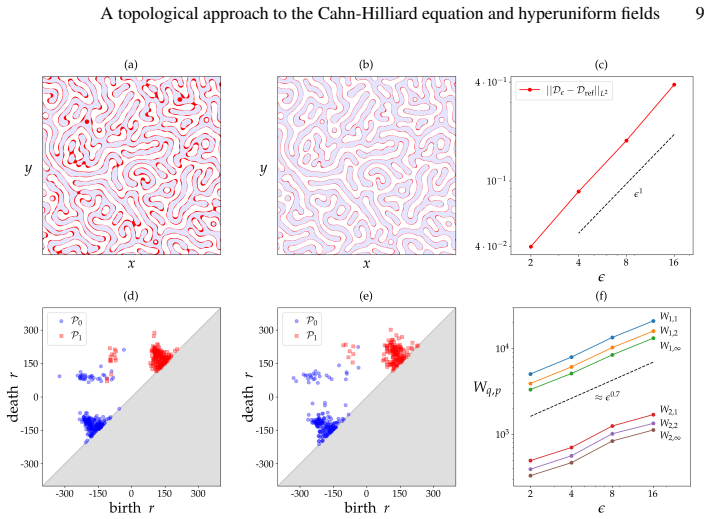
The signed-distance filtration (2.12), X^iso_{r,c} = {x in Ω : D(φ(x),c) ≤ r}, where D is the signed Euclidean distance to the c-isoline of the field. Sweeping r from negative to positive builds sublevel sets that trace valleys, the interface, and hills, and persistent homology of this filtration yields persistence diagrams P0 and P1 recording births and deaths of connected components and loops. The workhorse is the total Wasserstein distance W_{p,q} = W0_{p,q} + W1_{p,q} between diagrams: it is stable with respect to perturbations of the field and serves both as a similarity measure between patterns and, after binning, as the feature vector for the classifier.
What would settle it
Generate Gaussian random fields with exactly known asymptotic exponent alpha on a sequence of increasingly large domains, compute persistence diagrams from the signed-distance filtration, and check whether Wasserstein distances and the trained classifier reproduce the true alpha labels rather than the finite-size eH labels. If the ranking shifts with box size, or changes when the isoline level c is varied, the reported correlation is an artifact of the proxy or the filtration choice.
Extended reading notes
Core claim
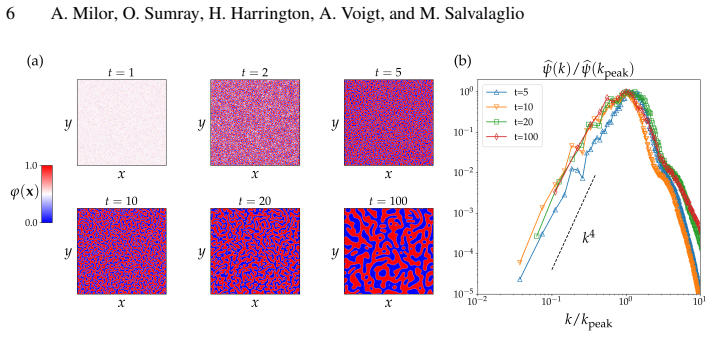
The central claim is that in disordered correlated scalar fields, the distribution of local topological features—encoded as points in persistence diagrams from the signed-distance filtration (2.12)—is systematically tied to the global spectral behavior that defines hyperuniformity. The paper demonstrates this by showing that the Wasserstein distance between persistence diagrams changes predictably with the spectral parameters alpha, H, and K in Gaussian random fields, and that the persistence diagram of a Cahn-Hilliard solution is closest to a Gaussian random field with alpha about 4 and K about 0.64, matching the known k^4 spectrum. The classification experiment turns the correlation into a
Load-bearing premise
The load-bearing premise is that the finite-size estimate eH—computed at the smallest accessible wavevector and thresholded at eH < 0.011—truly separates hyperuniform from non-hyperuniform fields; all reported correlations and the 97.3% classification are measured against this proxy, not against the actual k→0 limit.
Editorial extensions
If this is right
- Persistence diagrams give a finite-size, local measure of hyperuniformity that does not require resolving the k→0 limit directly.
- Wasserstein distances can rank finite patterns by hyperuniform character; the Cahn-Hilliard example shows they identify the closest spectral parameters (alpha ≈ 4) without fitting the spectrum.
- Deviations from self-similarity in coarsening patterns can be quantified for finite interface width, not just in the sharp-interface limit.
- The same signed-distance filtration transfers to other interface and free-boundary problems, since it only needs an isoline and a distance field.
- Binned persistence diagrams can serve as features for surrogate models, enabling screening of large libraries of correlated scalar fields.
Reading between the lines
- If the correlation holds beyond the Gaussian-random-field family, persistence-diagram distances could be inverted for design: specifying a target persistence diagram would constrain the spectral parameters of a generated structure, a route the paper only gestures at.
- The single-isoline choice is a free parameter; testing several levels c in the signed-distance filtration would show whether the Wasserstein ranking of hyperuniform classes is stable or depends on the chosen contour.
- Because eH overestimates H, the 97.3% accuracy is a statement about the finite-size proxy; a stricter check would relabel the data using a rigorous finite-size hyperuniformity test and re-measure classification accuracy.
- A theoretical bound connecting persistence-diagram Wasserstein distances to sharp-interface convergence would turn the fitted sublinear epsilon-convergence exponent into a provable rate, linking topological data analysis stability to the epsilon→0 limit.
Editorial analysis
A structured set of objections, weighed in public.
Referee Report
Summary. The paper proposes a persistent-homology (PH) characterization of hyperuniform scalar fields. It uses a signed-distance filtration (Eq. 2.12) rather than the usual sublevel filtration, computes Wasserstein distances between persistence diagrams (Eq. 2.13), and applies the framework to two systems: numerical solutions of the Cahn-Hilliard equation, where it checks epsilon-convergence and self-similarity, and Gaussian random fields (GRFs) with prescribed spectral parameters (alpha, H, K). The central claim is that hyperuniform characteristics correlate systematically with topological feature distributions, that Wasserstein distances can find the closest GRF match to a Cahn-Hilliard pattern, and that a neural network trained on binned persistence diagrams can classify HU vs non-HU GRFs with 97.3% accuracy (Table 1). The CH validation and the GRF parameter grid provide substantive numerical evidence, but the inference claim is weakened by the choice of training labels and the absence of baseline comparisons.
Significance. If the central claim holds, the paper would extend TDA-based hyperuniformity analysis from point patterns to scalar fields, offering a local geometric descriptor for two-phase microstructures and a potential screening tool for large datasets. The paper is careful in several places: it explicitly notes that the convergence analysis for the topological measure is out of reach, restricts the inverse approach to GRFs, and acknowledges the finite-size overestimation of the hyperuniformity metric. These self-critical statements are a strength. However, the headline classification result does not currently establish that persistence diagrams infer true hyperuniformity, because the labels are derived from a finite-size proxy rather than the known prescribed parameter H. The contribution is promising but needs revision.
major comments (4)
- [§3.3, Eq. (2.5), Eq. (3.2)] The training labels for HU vs non-HU are assigned using the finite-size estimate eH < 0.011, not the prescribed H in Eq. (3.2). Since the GRFs are generated with known H, the true label is available; using eH introduces label noise. Section 2.1 states that eH overestimates H, and the threshold 0.011 is ad hoc. The reported 97.3% accuracy is therefore an agreement with the proxy, not with actual hyperuniformity. Please either use the prescribed H as ground truth, or report the confusion matrix between eH-based labels and prescribed-H labels and quantify the label-noise rate.
- [§3.3, Table 1] No baseline classifier is reported. A simple classifier using eH itself or low-order spectral features would likely achieve high accuracy on this parameter grid, so the 97% accuracy does not by itself demonstrate that topological descriptors add value. Please compare against a non-topological baseline, and ideally evaluate on held-out parameter combinations rather than random 5-fold cross-validation, since each (alpha, H, K) combination has three realizations and random splits may leak the same parameter combination into both train and test.
- [§3.2.2, Fig. 6(a,b)] The central correlation plots show no error bars or significance measures. The distances are computed from a single reference field and only three realizations per parameter combination; it is unclear whether the small variations in Wasserstein distance for H < 10^-2 are meaningful. Adding error bars, confidence intervals, or a statistical test would strengthen the claim that topological features systematically correlate with the global HU character.
- [§2.1 vs §3.3] There is a definitional inconsistency: Section 2.1 says H < 10^-4 is 'effectively HU' and H < 10^-2 is 'nearly HU', while Section 3.3 defines as HU all fields with H <= 10^-2. This broadens the HU class to include nearly HU fields, so the classification result is not directly about hyperuniformity as defined earlier. Please align the terminology or explicitly justify the threshold choice.
minor comments (5)
- [Eq. (2.7)] The displayed formula for the equilibrium profile appears to have a missing closing parenthesis in the tanh argument; please fix the typo.
- [Fig. 3(f) and Eq. (2.13)] The notation for the Wasserstein distance is inconsistent: Eq. (2.13) defines W^k_{p,q}, while the Figure 3(f) caption uses W_{q,p}. Please use a single convention.
- [§2.3] The statement that barcodes/diagrams are 'stable under perturbations of the input' is too broad as written; the stability bound in the following sentence is the precise statement. Consider reformulating.
- [§3.3] The subset ranges for the persistence-diagram binning (e.g., [-15,8] x [0,15] for P0) appear without justification. A short explanation of how these ranges were chosen would improve reproducibility.
- [Data Availability] The Data Availability statement says data will be released only upon acceptance. Since the central inference results are numerical and reproducibility would benefit from immediate release, please consider providing the code/data in a public repository at revision time.
Circularity Check
No significant circularity: PH features are independent of spectral labels; CH benchmarks and Wasserstein-distance comparisons provide external validation; the eH proxy in the NN section is a label-fidelity limitation, not a circular reduction.
full rationale
The paper's derivation chain is not circular. The PH-based Wasserstein distances are validated against known features of the Cahn-Hilliard equation (first-order convergence to Hele-Shaw, k^4 spectral scaling, self-similarity for small epsilon), which are external benchmarks from the PDE literature, not outputs of the persistence computation. GRFs are generated from a prescribed spectral density (Eq. 3.2), and persistence diagrams are computed from the fields via the signed-distance filtration (Eq. 2.12), which is a different mathematical object. The Wasserstein-distance trends in Fig. 6 are empirical correlations, not algebraic identities. The neural network in Section 3.3 is a supervised classifier whose labels are the finite-size spectral ratio eH (threshold 0.011) and whose features are binned persistence diagrams; since the features do not by construction encode eH, the 97% accuracy is a nontrivial learnability result. The acknowledged overestimation of eH by the finite-size estimate (Sect. 2.1) is a label-fidelity caveat, not a circular reduction: the classifier is not fitting eH from persistence diagrams, and no equation in the paper equates persistence diagrams to spectral ratios by construction. The self-citations [29] and [38] are methodological/motivational (neural-network architecture and earlier point-cloud analogue) and are not load-bearing; the scalar-field results are independently computed and tested against known CH behavior. No uniqueness theorem or ansatz is imported from the authors' prior work in a way that forces the conclusions. The threshold choice in Section 3.3 is partially informed by the PH sensitivity observed in Section 3.2.2, but the target remains the standard spectral notion of near-HU (H <= 1e-2), so this is a reasonable modeling choice rather than a circular definition. Overall, the central claim is independently grounded.
Assumptions & free parameters
free parameters (4)
- HU classification threshold eH < 0.011 =
0.011
- NN architecture and binning =
hidden layers 128,128,256; 23x23 bins; ranges [-15,8]x[0,15] and [-8,15]x[0,15]
- Gaussian fit parameters for k_peak(t) =
not given
- Fitted Wasserstein convergence exponent =
~0.7
assumptions (5)
- domain assumption Finite-size hyperuniformity metric eH faithfully approximates the infinite-system limit H
- domain assumption Cahn-Hilliard solutions in the coarsening regime are statistically self-similar and hyperuniform with spectral scaling k^4
- ad hoc to paper Persistence diagrams from the signed-distance filtration (2.12) capture the relevant local geometry of two-phase fields
- domain assumption Random plane-wave GRFs with prescribed spectrum (3.1)-(3.2) span the relevant space of HU scalar fields
- standard math Wasserstein stability bounds apply to the computed diagrams
Cite this review
Pith. "Pith review of A topological approach to the Cahn-Hilliard equation and hyperuniform fields." pith.science (2026). https://pith.science/paper/VPUSKUBD
@misc{pith2026250905339,
  author       = {Pith},
  title        = {Pith review of: A topological approach to the Cahn-Hilliard equation and hyperuniform fields},
  year         = {2026},
  howpublished = {\url{https://pith.science/paper/VPUSKUBD}},
  note         = {Machine review of arXiv:2509.05339}
}
read the original abstract
Hyperuniform structures are disordered, correlated systems in which density fluctuations are suppressed at large scales. Such a property generalizes the concept of order in patterns and is relevant across diverse physical systems. We present a numerical characterization of hyperuniform scalar fields that leverages persistent homology. Topological features across different lengths are represented in persistence diagrams, while similarities or differences between patterns are quantified through Wasserstein distances between these diagrams. We apply this framework to numerical solutions of the Cahn-Hilliard equation, a canonical model for generating hyperuniform scalar fields. We validate the approach against known features of the Cahn-Hilliard equation, including its scaling properties, convergence to the sharp interface limit, and self-similarity of the solutions. We then generalize the approach by studying Gaussian random fields exhibiting different degrees and classes of hyperuniformity, showing how the proposed approach can be exploited to reconstruct global properties from local topological information. Overall, we show how hyperuniform characteristics systematically correlate with distributions of topological features in disordered correlated fields. We expect this analysis to be applicable to a wide range of scalar fields, particularly those involving interfaces and free boundaries.
Figures

Figures from the paper (3 more)


Reference graph
Works this paper leans on
-
[1]
M. E. Aktas, E. Akbas, and A. E. Fatmaoui, Persistence homology of networks: methods and applications. Appl. Netw. Sci.4 (2019), no. 1, 1–28
work page 2019
-
[2]
N. Alikakos, P. Bates, and X. Chen, Convergence of the Cahn-Hilliard equation to the Hele- Shaw model.Arch. Rational Mech. Anal.128(1994), 165–205
work page 1994
-
[3]
R. Backofen, A. Y. A. Altawil, M. Salvalaglio, and A. Voigt, Nonequilibrium hyperuniform states in active turbulence.Proc. Nat. Acad. Sci.121(2024), no. 24, e2320719121 18 A. Milor, O. Sumray, H. Harrington, A. Voigt, and M. Salvalaglio
work page 2024
-
[4]
J. W. Cahn, On spinodal decomposition.Acta Metallurgica9 (1961), no. 9, 795–801
work page 1961
-
[5]
J.W.CahnandJ.E.Hilliard,Freeenergyofanonuniformsystem.I.Interfacialfreeenergy. J. Chem. Phys.28(1958), no. 2, 258–267
work page 1958
-
[6]
L. Q. Chen and J. Shen, Applications of semi-implicit fourier-spectral method to phase field equations.Computer Phys. Commun.108 (1998), no. 2-3, 147–158
work page 1998
-
[7]
M. C. Cross and P. C. Hohenberg, Pattern formation outside of equilibrium.Rev. Mod. Phys. 65(1993), 851–1112
work page 1993
-
[8]
F. De Luca, X. Ma, C. Nardini, and M. E. Cates, Hyperuniformity in phase ordering: the roles of activity, noise, and non-constant mobility.J. Phys. Cond. Matt.36 (2024), 405101
work page 2024
Show all 50 references
-
[9]
Edelsbrunner, J
H. Edelsbrunner, J. Harer et al., Persistent homology-a survey.Contemp. Math.453 (2008), no. 26, 257–282
2008
-
[10]
Edelsbrunner and J
H. Edelsbrunner and J. L. Harer,Computational topology: an introduction. American Math- ematical Society, 2010
2010
-
[11]
H.Edelsbrunner,D.Letscher,andA.Zomorodian,Topologicalpersistenceandsimplification. Discret. Comput. Geometry28(2002), 511–533
2002
-
[12]
D. J. Eyre, Unconditionally gradient stable time marching the cahn-hilliard equation.MRS online proceedings library (OPL)529(1998), 39
1998
-
[13]
2, 353–372
C.Falcó,R.E.Baker,andJ.A.Carrillo,Anonlocal-to-localapproachtoaggregation-diffusion equations.SIAM Review67(2025), no. 2, 353–372
2025
-
[14]
Feng and A
X. Feng and A. Prohl, Numerical analysis of the cahn-hilliard equation and approximation for the hele-shaw problem.Interf. Free Bound.7 (2005), 1–28
2005
-
[15]
Gierer and H
A. Gierer and H. Meinhardt, A theory of biological pattern formation.Kybernetik12 (1972), no. 1, 30–39
1972
-
[16]
J.Comput
L.-P.HeandY.Liu,AclassofstablespectralmethodsfortheCahn-Hilliardequation. J.Comput. Phys.228(2009), no. 14, 5101–5110
2009
-
[17]
D.T.Hristopulos, Gaussianrandomfields ,pp.245–307.SpringerNetherlands,Dordrecht,2020
2020
-
[18]
Y. Jiao, T. Lau, H. Hatzikirou, M. Meyer-Hermann, J. C. C., and S. Torquato, Avian photore- ceptor patterns represent a disordered hyperuniform solution to a multiscale packing problem. Phys. Rev. E89(2014), 022721
2014
-
[19]
M. A. Klatt, G. Last, and N. Henze, A genuine test for hyperuniformity.arXiv preprint arXiv:2210.12790(2022)
2022
-
[20]
npj Comput
S.Kumar,S.Tan,L.Zheng,andD.M.Kochmann,Inverse-designedspinodoidmetamaterials. npj Comput. Materials6 (2020), no. 1, 73
2020
-
[21]
J. S. Langer, Instabilities and pattern formation in crystal growth.Rev. Mod. Phys.52 (1980), 1–28
1980
-
[22]
E. A. Lazar, J. Han, and D. J. Srolovitz, Topological framework for local structure analysis in condensed matter.Proc. Nat. Acad. Sci.112 (2015), no. 43, E5769–E5776
2015
-
[23]
E. A. Lazar, J. K. Mason, R. D. MacPherson, and D. J. Srolovitz, Complete topology of cells, grains, and bubbles in three-dimensional microstructures.Phys. Rev. Lett.109 (2012), no. 9, 095505
2012
-
[24]
B.Li,J.Lowengrub,A.Rätz,andA.Voigt,Geometricevolutionlawsforthincrystallinefilms: modeling and numerics.Commun. Comput. Phys.6 (2009), no. 3, 433
2009
-
[25]
Ma and S
Z. Ma and S. Torquato, Random scalar fields and hyperuniformity.J. Appl. Phys.121 (2017), no. 24, 244904
2017
-
[26]
C.E.MaherandS.Torquato,Localordermetricsformany-particlesystemsacrosslengthscales. Phys. Rev. Res.6(2024), 033262 A topological approach to the Cahn-Hilliard equation and hyperuniform fields 19
2024
-
[27]
Martelli, S
F. Martelli, S. Torquato, N. Giovambattista, and R. Car, Large-scale structure and hyperuni- formity of amorphous ices.Phys. Rev. Lett.119(2017), 136002
2017
-
[28]
Mayer, V
A. Mayer, V. Balasubramanian, T. Mora, and A. M. Walczak, How a well-adapted immune system is organized.Proc. Nat. Acad. Sci.112 (2015), no. 19, 5950–5955
2015
-
[29]
A.H.G.MilorandM.Salvalaglio,Inferringtraitsofhyperuniformityfromlocalstructuresvia persistent homology.J. Phys. Cond. Matt.37(2025), no. 14, 145401
2025
-
[30]
Miranville,The Cahn–Hilliard equation: recent advances and applications
A. Miranville,The Cahn–Hilliard equation: recent advances and applications. SIAM, 2019
2019
-
[31]
Otter, M
N. Otter, M. A. Porter, U. Tillmann, P. Grindrod, and H. A. Harrington, A roadmap for the computation of persistent homology.EPJ Data Sci.6 (2017), 1–38
2017
-
[32]
Oudot and E
S. Oudot and E. Solomon, Inverse problems in topological persistence. InTopological data analysis,editedbyN.A.Baas,G.E.Carlsson,G.Quick,M.Szymik,andM.Thaule,pp.405– 433, Springer International Publishing, Cham, 2020
2020
-
[33]
N.B.PadhanandA.Voigt,Suppressionofhyperuniformityinhydrodynamicscalaractivefield theories. J. Phys. Cond. Matt.37(2025), 105101
2025
-
[34]
Pego, Front migration in the nonlinear Cahn-Hilliard equation.Proc
R. Pego, Front migration in the nonlinear Cahn-Hilliard equation.Proc. Roy. Soc. London A 422(1989), 261–278
1989
-
[35]
Y.Pritchard,A.Sharma,C.Clarkin,H.Ogden,S.Mahajan,andR.J.Sánchez-García,Persistent homology analysis distinguishes pathological bone microstructure in non-linear microscopy images.Scientific Reports13(2023), no. 1, 2522
2023
-
[36]
Rosenkranz, M
M. Rosenkranz, M. Kästner, and I. F. Sbalzarini, Data-efficient inverse design of spinodoid metamaterials. arXiv preprint arXiv:2505.03415(2025)
2025 arXiv
-
[37]
Salvalaglio, M
M. Salvalaglio, M. Bouabdellaoui, M. Bollani, A. Benali, L. Favre, J.-B. Claude, J. Wenger, P. de Anna, F. Intonti, A. Voigt et al., Hyperuniform monocrystalline structures by spinodal solid-state dewetting.Phys. Rev. Lett125(2020), no. 12, 126101
2020
-
[38]
Salvalaglio, D
M. Salvalaglio, D. J. Skinner, J. Dunkel, and A. Voigt, Persistent homology and topological statistics of hyperuniform point clouds.Phys. Rev. Res.6(2024), 023107
2024
-
[39]
M.Salvalaglio,A.Voigt,andS.M.Wise,Doublydegeneratediffuseinterfacemodelsofsurface diffusion.Math. Meth. Appl. Sci.44(2021), no. 7, 5385–5405
2021
-
[40]
Advan.9 (2023), no
D.J.Skinner,H.Jeckel,A.C.Martin,K.Drescher,andJ.Dunkel,Topologicalpackingstatistics of living and nonliving matter.Sci. Advan.9 (2023), no. 36, eadg1261
2023
-
[41]
D.J.Skinner,B.Song,H.Jeckel,E.Jelli,K.Drescher,andJ.Dunkel,Topologicalmetricdetects hidden order in disordered media.Phys. Rev. Lett.126(2021), 048101
2021
-
[42]
arXivpreprintarXiv:2006.16824 (2020)
P.SkrabaandK.Turner,Wassersteinstabilityforpersistencediagrams. arXivpreprintarXiv:2006.16824 (2020)
2006 arXiv
-
[43]
A.Song,K.M.Yim,andA.Monod,Generalizedmorsetheoryofdistancefunctionstosurfaces for persistent homology.Advances in Applied Mathematics166(2025), 102857
2025
-
[44]
S.Torabi,J.Lowengrub,A.Voigt,andS.Wise,Anewphase-fieldmodelforstronglyanisotropic systems.Proc. Roy. Soc. A465(2009), no. 2105, 1337–1359
2009
-
[45]
Torquato, Hyperuniform states of matter.Physics Reports745(2018), 1–95
S. Torquato, Hyperuniform states of matter.Physics Reports745(2018), 1–95
2018
-
[46]
S.TorquatoandF.H.Stillinger,Localdensityfluctuations,hyperuniformity,andordermetrics. Phys. Rev. E68(2003), 041113
2003
-
[47]
K.Vynck,R.Pierrat,R.Carminati,L.S.Froufe-Pérez,F.Scheffold,R.Sapienza,S.Vignolini, and J. J. Sáenz, Light in correlated disordered media.Rev. Mod. Phys.95 (2023), 045003
2023
-
[48]
R.Xie,G.G.Long,S.J.Weigand,S.C.Moss,T.Carvalho,S.Roorda,M.Hejna,S.Torquato, and P. J. Steinhardt, Hyperuniformity in amorphous silicon based on the measurement of the infinite-wavelengthlimitofthestructurefactor. Proc.Nat.Acad.Sci. 110(2013),no.33,13250– 13254 20 A. Milor, O. ...
2013
-
[49]
Yu, C.-W
S. Yu, C.-W. Qiu, Y. Chong, S. Torquato, and N. Park, Engineered disorder in photonics.Nat. Rev. Mater.6(2021), no. 3, 226–243
2021
-
[50]
Y.Zheng,M.A.Klatt,andH.Löwen,Universalhyperuniformityinactivefieldtheories. Phys. Rev. Res.6 (2024), L032056 Abel H. G. Milor Institute of Scientific Computing, Technische Universität Dresden, 01062 Dresden, Germany; abel_henri_guillaume.milor@tu-dresden.de Otto Sumray Max Pla...
2024
Reviewed August 5, 2026 · model on record in the stance chip above.
Discussion (0). Sign in to comment.