REVIEW 3 major objections 5 minor 68 references
Learning from Noise: Enhancing DNNs for Event-Based Vision through Controlled Noise Injection
T0 review · 3 major / 5 minor · reviewed 2026-08-07 · deepseek-v4-flash
Pith's one-line read Noise-injection training beats event filtering for DNN classifiers
desk verdict Useful, broad empirical study of noise-injection training for event-based vision, but missing key hyperparameters and a train/test noise overlap mean the robustness claim is under-specified. read the letter →
The pith
A machine-rendered reading of the paper's core claim, the machinery that carries it, and where it could break.
The reading
What carries the argument
The load-bearing object is the synthetic noise generator and the random-intensity augmentation schedule built on it. Shot noise is modelled by dividing time into steps of length $\Delta t = 1/(\lambda N D)$, where $\lambda$ is the desired intensity in Hz per pixel, $N$ is the pixel count, and $D$ stretches the step so the per-pixel event probability $P = \lambda\Delta t = 1/(N D)$ stays far below one; at each step a random pixel is chosen to emit an event with probability $P$. During noise-injection training, each sample gets a randomly drawn noise level, including zero, so the network sees clean, lightly corrupted, and heavily corrupted versions of the same data. This forces features to be predictive of the object rather than of the noise floor, which is why the accuracy curves stay flat.
What would settle it
Record event streams from a real event camera under controlled temperature and bias settings, measure the actual noise statistics, then compare noise-injection-trained models with filtered baselines on those streams; if the accuracy advantage shrinks or reverses on real noise that is spatially correlated or intensity-dependent, the central claim is weakened. The paper's own real-noise test covers only one dataset, so an independent multi-sensor test would settle the question.
Extended reading notes
Core claim
The central discovery is that exposure to varied noise during training itself is a form of regularisation that transfers across noise intensities. The paper proposes a training variant in which each loaded event sample is assigned a random noise intensity, including zero, and synthetic events generated by a Bernoulli approximation of a Poisson process are added to the sample. Across the three tested event-based classification datasets, this variant yields the highest mean accuracy over the tested noise spectrum for all four architectures, with standard deviations far below the other training variants. For convolution-based and transformer-based models, additionally filtering the test data only lowers accuracy, suggesting the learned representations already absorb the noise; for the graph-convolutional model, moderate nearest-neighbour or interpolation-based filtering still helps, but noise-injection training remains the best overall. The authors report the trade-off honestly: on completely noise-free test data, noise-injection-trained models are sometimes up to about one percentage point behind models trained on filtered data.
Load-bearing premise
The load-bearing premise is that the synthetic Poisson-like shot noise used for both training augmentation and test corruptions behaves like the real background activity of event cameras; if real noise is spatially correlated, intensity-dependent, or otherwise structured differently, the demonstrated robustness may not transfer to deployed systems.
Editorial extensions
If this is right
- Event filtering can be dropped from the preprocessing pipeline for convolutional, transformer, and spiking classifiers without losing accuracy, removing filter latency and the risk of deleting true events.
- Models trained with fixed noise intensity only help near that intensity, while variable noise injection generalises across the whole tested range of 0.01 to 5 Hz/px.
- Combining noise-injection training with filtering is neutral to harmful for convolutional, transformer, and spiking networks, but the graph-convolutional model still gains from moderate filtering, so graph-based models may need a hybrid approach.
- The robustness comes at a small, bounded cost: up to about one percent lower accuracy on perfectly clean inputs, which is the deliberate trade-off for stability.
Reading between the lines
- If the same random-noise schedule were tuned to sensor-specific noise statistics, such as sampling intensities from a distribution matched to temperature or bias settings, the method could become a drop-in calibration step for deployed event cameras.
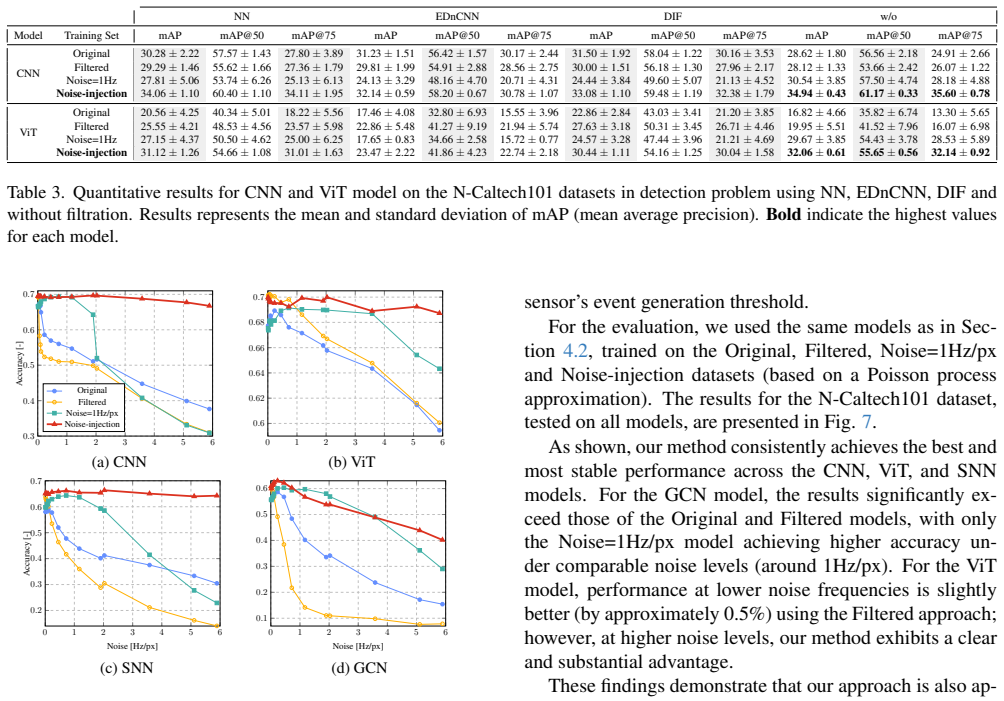
- The supplementary detection experiment suggests the benefit is not limited to classification; object detection on noisy event streams may inherit the same stability without architectural changes.
- Because the graph-convolutional model behaves differently, a promising follow-up is noise-adaptive graph construction or a learned hybrid that combines moderate filtering with noise-injection training specifically for graph representations.
Editorial analysis
A structured set of objections, weighed in public.
Referee Report
Summary. This paper proposes a noise-injection training augmentation method for event-based vision classifiers. The idea is to add synthetic Poisson shot noise of randomly varying intensity to training event streams, so that models become robust to noise at test time without requiring explicit filtering. The authors evaluate the method on three event camera classification datasets (N-Caltech101, N-Cars, Mini N-ImageNet) with four architectures (CNN, ViT, SNN, GCN), compare against three filtering baselines (NN, EDnCNN, DIF), and report mean accuracy and standard deviation across a noise grid from 0.01 to 5 Hz/px. The paper claims that noise-injection training provides stable performance over the noise range and consistently outperforms filtering. Supplementary material includes detection results, a filter-parameter ablation, an experiment with real recorded camera noise on N-Caltech101, and timing measurements.
Significance. If the central claims hold, the method is a simple and potentially practical alternative to event-data filtering: it requires no extra inference-time computation and is architecture-agnostic. The strengths of the manuscript are its breadth of empirical evaluation (four architectures, three datasets, three filtering baselines, plus detection and real-noise experiments in the supplementary) and the release of code. The main robustness claim is plausible, but its status as a generalization result rather than an interpolation result depends crucially on the unstated training-noise sampler; as reported, the claim is not fully falsifiable. The real-noise supplementary experiment is a valuable check but covers only one dataset and shows only partial transfer for some architectures.
major comments (3)
- [Section 3.3 / Section 4.1 / Table 2] The distribution and range of the random noise intensities used in Noise-injection training are never specified. Section 3.3 states only that 'a random value was drawn to determine the corresponding noise intensity,' and Section 4.1 repeats 'various levels of noise.' Since the test grid in Fig. 2 and Table 2 spans 0.01 to 5 Hz/px, the near-flat accuracy curves and very small standard deviations of the Noise-injection row could be interpolation results if the training sampler draws from the same range. Please report the exact sampler (distribution, bounds, and whether the level is redrawn per sample or per epoch), and evaluate at noise levels outside the training range (e.g., 10 and 20 Hz/px) to demonstrate out-of-distribution robustness. The real-noise experiment in Section 10 only covers N-Caltech101 and shows the advantage narrowing for ViT at low noise and reversing for GCN around 1 Hz/px, so it does not settle this concern.
- [Section 3.1 / Section 4.1] The parameter D in Eq. (1) is never given a value, even though Eq. (2) says the Poisson approximation quality depends on it. The 'Filtered' training variant in Section 4.1 also does not state which of the three filter algorithms (NN, EDnCNN, or DIF) and which parameters were used to construct the filtered training set. Both omissions prevent replication of the central comparisons. Please specify D and describe the filtering procedure for the Filtered baseline.
- [Table 2 / Section 4.2] The standard deviations reported in Table 2 are computed across the noise levels, not across repeated training runs. Thus the claim that Noise-injection 'consistently outperforms' filtering and other training variants is based on single runs per configuration. Please report mean and standard deviation over at least 3-5 training seeds for the main results, or explicitly state that the study is single-run and soften the consistency claim accordingly.
minor comments (5)
- [Section 10 (supplementary)] In the supplementary, 'Filtrated' should be 'Filtered'.
- [Section 4.4 / Figure 4] The caption of Figure 4 says 'with an NN-based filter, and without any method,' but the figure labels show 'w/o NN' and 'Ours'; please make the caption and labels consistent.
- [Section 8 (supplementary)] The top-3 accuracy columns in Tables 5-8 are never discussed; please add at least one sentence of commentary or remove them.
- [Section 3.6 / Figure 6] The NN temporal window is set to 10000 µs in Section 3.6, but Figure 6 in the supplementary shows the optimal NN threshold as 5000 for the same dataset; please explain this discrepancy or justify the choice.
- [Section 5] The Discussion section acknowledges the trade-off of reduced accuracy on clean data and the GCN limitation; consider also noting there that the primary evaluation uses the same synthetic noise model for training and testing, which may overstate the method's real-world transfer.
Circularity Check
No significant circularity: the noise-injection evaluation shares a synthetic Poisson noise generator between training and test, but the robustness claim is supported by an external real-noise experiment and does not reduce to a fitted parameter or a load-bearing self-citation.
full rationale
The paper is an empirical benchmarking study; it contains no derivation that reduces to its own inputs. The only overlap that could look circular is that the Poisson shot-noise model (Eqs. 1-2) is used both to corrupt test data (Sec. 4.1) and to define the Noise-injection training augmentation (Sec. 3.3). This is a matched-distribution evaluation, not a self-definitional prediction: the claim is that training with varied noise levels improves accuracy under those noise conditions, which is a standard, falsifiable machine-learning claim. The supplementary real-noise experiment (Sec. 10) tests on real camera noise not generated by Eqs. 1-2 and shows the method remains best or competitive on N-Caltech101, providing external support beyond the synthetic noise model. The paper explicitly acknowledges limitations (Sec. 5): GCN accuracy still degrades with noise, and there is a small clean-accuracy trade-off. The unspecified distribution and bounds of the random noise-intensity sampler in Sec. 3.3 is a reproducibility and generalization concern (if the training sampler matches the test grid 0.01-5 Hz/px, the reported stability is interpolation rather than out-of-distribution robustness), but this is not circularity under the stated criteria. No load-bearing self-citations were found: the only self-citation, [31] for the DIF filter, is a baseline method, not a premise of the noise-injection claim. Therefore the circularity score is 0.
Assumptions & free parameters
free parameters (4)
- Training noise intensity distribution =
not reported
- D parameter in noise model =
not reported
- NN filter temporal window =
10000 µs
- DIF filter parameters =
filter length 15000 µs, scale 4, update factor 0.5
assumptions (3)
- domain assumption Event-camera shot noise can be modeled as an independent per-pixel Poisson process.
- standard math The Bernoulli-trials approximation with P = 1/(N D) sufficiently approximates the Poisson process.
- domain assumption The architectures and event representations (Event Count Image, Voxel Grid, Event Spike Tensor, Voxel Graph) are adequate for classification.
Cite this review
Pith. "Pith review of Learning from Noise: Enhancing DNNs for Event-Based Vision through Controlled Noise Injection." pith.science (2026). https://pith.science/paper/EE3OM4M4
@misc{pith2026250603918,
  author       = {Pith},
  title        = {Pith review of: Learning from Noise: Enhancing DNNs for Event-Based Vision through Controlled Noise Injection},
  year         = {2026},
  howpublished = {\url{https://pith.science/paper/EE3OM4M4}},
  note         = {Machine review of arXiv:2506.03918}
}
read the original abstract
Event-based sensors offer significant advantages over traditional frame-based cameras, especially in scenarios involving rapid motion or challenging lighting conditions. However, event data frequently suffers from considerable noise, negatively impacting the performance and robustness of deep learning models. Traditionally, this problem has been addressed by applying filtering algorithms to the event stream, but this may also remove some of relevant data. In this paper, we propose a novel noise-injection training methodology designed to enhance the neural networks robustness against varying levels of event noise. Our approach introduces controlled noise directly into the training data, enabling models to learn noise-resilient representations. We have conducted extensive evaluations of the proposed method using multiple benchmark datasets (N-Caltech101, N-Cars, and Mini N-ImageNet) and various network architectures, including Convolutional Neural Networks, Vision Transformers, Spiking Neural Networks, and Graph Convolutional Networks. Experimental results show that our noise-injection training strategy achieves stable performance over a range of noise intensities, consistently outperforms event-filtering techniques, and achieves the highest average classification accuracy, making it a viable alternative to traditional event-data filtering methods in an object classification system. Code: https://github.com/vision-agh/DVS_Filtering
Figures


Figures from the paper (5 more)




Reference graph
Works this paper leans on
-
[1]
Inceptive event time- surfaces for object classification using neuromorphic cam- eras
R Wes Baldwin, Mohammed Almatrafi, Jason R Kaufman, Vijayan Asari, and Keigo Hirakawa. Inceptive event time- surfaces for object classification using neuromorphic cam- eras. InImage Analysis and Recognition: 16th Interna- tional Conference, ICIAR 2019, Waterloo, ON, Canada, Au- gust 27–29, 2019, Proceedings, Part II 16, pages 395–403. Springer, 2019. 1, 2
work page 2019
-
[2]
Wes Baldwin, Mohammed Almatrafi, Vijayan Asari, and Keigo Hirakawa
R. Wes Baldwin, Mohammed Almatrafi, Vijayan Asari, and Keigo Hirakawa. Event probability mask (epm) and event denoising convolutional neural network (edncnn) for neuro- morphic cameras. In2020 IEEE/CVF Conference on Com- puter Vision and Pattern Recognition (CVPR), pages 1698– 1707, 2020. 1, 2, 4, 5, 7, 6
work page 2020
-
[3]
Spiking-fer: spiking neu- ral network for facial expression recognition with event cam- eras
Sami Barchid, Benjamin Allaert, Amel Aissaoui, Jos ´e Men- nesson, and Chaabane C Djeraba. Spiking-fer: spiking neu- ral network for facial expression recognition with event cam- eras. InProceedings of the 20th International Conference on Content-based Multimedia Indexing, pages 1–7, 2023. 1, 3
work page 2023
-
[4]
Graph-based object classification for neuromor- phic vision sensing
Y Bi, A Chadha, A Abbas, , E Bourtsoulatze, and Y An- dreopoulos. Graph-based object classification for neuromor- phic vision sensing. In2019 IEEE International Conference on Computer Vision (ICCV). IEEE, 2019. 1, 3
work page 2019
-
[5]
Dynamic graph cnn for event-camera based gesture recognition
Junming Chen, Jingjing Meng, Xinchao Wang, and Junsong Yuan. Dynamic graph cnn for event-camera based gesture recognition. In2020 IEEE International Symposium on Cir- cuits and Systems (ISCAS), pages 1–5. IEEE, 2020. 1, 3
work page 2020
-
[6]
Xuena Chen, Li Su, Jinxiu Zhao, Keni Qiu, Na Jiang, and Guang Zhai. Sign language gesture recognition and classifi- cation based on event camera with spiking neural networks. Electronics, 12(4):786, 2023. 1, 3
work page 2023
-
[7]
Evaluating noise fil- tering for event-based asynchronous change detection im- age sensors
Daniel Czech and Garrick Orchard. Evaluating noise fil- tering for event-based asynchronous change detection im- age sensors. In2016 6th IEEE International Conference on Biomedical Robotics and Biomechatronics (BioRob), pages 19–24. IEEE, 2016. 2
work page 2016
-
[8]
Neuromorphic lip-reading with signed spiking gated recurrent units
Manon Dampfhoffer and Thomas Mesquida. Neuromorphic lip-reading with signed spiking gated recurrent units. In 2024 IEEE/CVF Conference on Computer Vision and Pat- tern Recognition Workshops (CVPRW), pages 2141–2151,
work page 2024
Show all 68 references
-
[9]
Eventtransact: A video transformer-based framework for event-camera based action recognition
Tristan de Blegiers, Ishan Rajendrakumar Dave, Adeel Yousaf, and Mubarak Shah. Eventtransact: A video transformer-based framework for event-camera based action recognition. In2023 IEEE/RSJ International Conference on Intelligent Robots and Systems (IROS), pages 1–7. IEEE,
-
[10]
Frame-free dynamic digital vision
Tobi Delbruck. Frame-free dynamic digital vision. InPro- ceedings of Intl. Symp. on Secure-Life Electronics, Advanced Electronics for Quality Life and Society, pages 21–26. Cite- seer, 2008. 1, 2, 4, 7, 5, 6
2008
-
[11]
Imagenet: A large-scale hierarchical image database
Jia Deng, Wei Dong, Richard Socher, Li-Jia Li, Kai Li, and Li Fei-Fei. Imagenet: A large-scale hierarchical image database. In2009 IEEE Conference on Computer Vision and Pattern Recognition, pages 248–255, 2009. 5
2009
-
[12]
A voxel graph cnn for object classification with event cameras
Yongjian Deng, Hao Chen, Hai Liu, and Youfu Li. A voxel graph cnn for object classification with event cameras. In 2022 IEEE/CVF Conference on Computer Vision and Pat- tern Recognition (CVPR), pages 1162–1171, 2022. 1, 3
2022
-
[13]
Led: A large-scale real-world paired dataset for event camera denoising
Yuxing Duan. Led: A large-scale real-world paired dataset for event camera denoising. In2024 IEEE/CVF Conference on Computer Vision and Pattern Recognition (CVPR), pages 25637–25647, 2024. 1, 2
2024
-
[14]
Aednet: Asynchronous event denoising with spatial-temporal correlation among irregular data
Huachen Fang, Jinjian Wu, Leida Li, Junhui Hou, Weisheng Dong, and Guangming Shi. Aednet: Asynchronous event denoising with spatial-temporal correlation among irregular data. InProceedings of the 30th ACM International Confer- ence on Multimedia, pages 1427–1435, 2022. 2
2022
-
[15]
Spikingjelly: An open-source ma- chine learning infrastructure platform for spike-based intel- ligence.Science Advances, 9(40):eadi1480, 2023
Wei Fang, Yanqi Chen, Jianhao Ding, Zhaofei Yu, Timoth´ee Masquelier, Ding Chen, Liwei Huang, Huihui Zhou, Guoqi Li, and Yonghong Tian. Spikingjelly: An open-source ma- chine learning infrastructure platform for spike-based intel- ligence.Science Advances, 9(40):eadi1480, 2023. 4, 5
2023
-
[16]
Fergus, and P
Li Fei-Fei, R. Fergus, and P. Perona. Learning generative visual models from few training examples: An incremen- tal bayesian approach tested on 101 object categories. In 2004 Conference on Computer Vision and Pattern Recogni- tion Workshop, pages 178–178, 2004. 5
2004
-
[17]
Matthias Fey and Jan E. Lenssen. Fast graph representa- tion learning with PyTorch Geometric. InICLR Workshop on Representation Learning on Graphs and Manifolds, 2019. 5
2019
-
[18]
Splinecnn: Fast geometric deep learning with continuous b-spline kernels
Matthias Fey, Jan Eric Lenssen, Frank Weichert, and Hein- rich M ¨uller. Splinecnn: Fast geometric deep learning with continuous b-spline kernels. InProceedings of the IEEE con- ference on computer vision and pattern recognition, pages 869–877, 2018. 5
2018
-
[19]
Thomas Finateu, Atsumi Niwa, Daniel Matolin, Koya Tsuchimoto, Andrea Mascheroni, Etienne Reynaud, Poo- ria Mostafalu, Frederick Brady, Ludovic Chotard, Flo- rian LeGoff, Hirotsugu Takahashi, Hayato Wakabayashi, Yusuke Oike, and Christoph Posch. 5.10 a 1280×720 back-illuminated...
2020
-
[20]
Low latency auto- motive vision with event cameras.Nature, 2024
Daniel Gehrig and Davide Scaramuzza. Low latency auto- motive vision with event cameras.Nature, 2024. 1
2024
-
[21]
End-to-end learning of repre- sentations for asynchronous event-based data
Daniel Gehrig, Antonio Loquercio, Konstantinos G Derpa- nis, and Davide Scaramuzza. End-to-end learning of repre- sentations for asynchronous event-based data. InProceed- ings of the IEEE/CVF International Conference on Com- puter Vision, pages 5633–5643, 2019. 1, 2, 5
2019
-
[22]
Recurrent vision transformers for object detection with event cameras
Mathias Gehrig and Davide Scaramuzza. Recurrent vision transformers for object detection with event cameras. InPro- ceedings of the IEEE/CVF Conference on Computer Vision and Pattern Recognition (CVPR), 2023. 4
2023
-
[23]
Shining light on the dvs pixel: A tutorial and discussion about biasing 9 and optimization
Rui Grac ¸a, Brian McReynolds, and Tobi Delbruck. Shining light on the dvs pixel: A tutorial and discussion about biasing 9 and optimization. In2023 IEEE/CVF Conference on Com- puter Vision and Pattern Recognition Workshops (CVPRW), pages 4045–4053, 2023. 2
2023
-
[24]
Eventdrop: Data augmentation for event-based learning
Fuqiang Gu, Weicong Sng, Xuke Hu, and Fangwen Yu. Eventdrop: Data augmentation for event-based learning. In Proceedings of the Thirtieth International Joint Conference on Artificial Intelligence, IJCAI-21, pages 700–707. Interna- tional Joint Conferences on Artificial Intellig...
2021
-
[25]
Low Cost and Latency Event Camera Background Activity Denoising.IEEE Trans- actions on Pattern Analysis and Machine Intelligence, 45(1): 785–795, 2023
Shasha Guo and Tobi Delbruck. Low Cost and Latency Event Camera Background Activity Denoising.IEEE Trans- actions on Pattern Analysis and Machine Intelligence, 45(1): 785–795, 2023. 1, 2, 3
2023
-
[26]
Deep residual learning for image recognition
Kaiming He, Xiangyu Zhang, Shaoqing Ren, and Jian Sun. Deep residual learning for image recognition. InProceed- ings of the IEEE conference on computer vision and pattern recognition, pages 770–778, 2016. 4
2016
-
[27]
v2e: From video frames to realistic dvs events
Yuhuang Hu, Shih-Chii Liu, and Tobi Delbruck. v2e: From video frames to realistic dvs events. In2021 IEEE/CVF Con- ference on Computer Vision and Pattern Recognition Work- shops (CVPRW), pages 1312–1321, 2021. 3
2021
-
[28]
Data augmentation by pairing samples for im- ages classification.arXiv preprint arXiv:1801.02929, 2018
Hiroshi Inoue. Data augmentation by pairing samples for im- ages classification.arXiv preprint arXiv:1801.02929, 2018. 3
2018 arXiv
-
[29]
Token-based spatiotemporal representation of the events
Bin Jiang, Zhihao Li, M Salman Asif, Xun Cao, and Zhan Ma. Token-based spatiotemporal representation of the events. InICASSP 2024-2024 IEEE International Confer- ence on Acoustics, Speech and Signal Processing (ICASSP), pages 5240–5244. IEEE, 2024. 1, 2, 3
2024
-
[30]
N-imagenet: Towards robust, fine-grained object recognition with event cameras
Junho Kim, Jaehyeok Bae, Gangin Park, Dongsu Zhang, and Young Min Kim. N-imagenet: Towards robust, fine-grained object recognition with event cameras. InProceedings of the IEEE/CVF International Conference on Computer Vision (ICCV), pages 2146–2156, 2021. 5, 6, 7, 4
2021
-
[31]
Interpolation-based event visual data filtering algorithms
Marcin Kowalczyk and Tomasz Kryjak. Interpolation-based event visual data filtering algorithms. In2023 IEEE/CVF Conference on Computer Vision and Pattern Recognition Workshops (CVPRW), pages 4056–4064, 2023. 1, 2, 4, 7, 5, 6
2023
-
[32]
Imagenet classification with deep convolutional neural net- works
Alex Krizhevsky, Ilya Sutskever, and Geoffrey E Hinton. Imagenet classification with deep convolutional neural net- works. InAdvances in Neural Information Processing Sys- tems. Curran Associates, Inc., 2012. 3
2012
-
[33]
Graph-based asyn- chronous event processing for rapid object recognition
Yijin Li, Han Zhou, Bangbang Yang, Ye Zhang, Zhaopeng Cui, Hujun Bao, and Guofeng Zhang. Graph-based asyn- chronous event processing for rapid object recognition. In Proceedings of the IEEE/CVF International Conference on Computer Vision, pages 934–943, 2021. 1, 3
2021
-
[34]
Neuromorphic data augmentation for training spiking neural networks
Yuhang Li, Youngeun Kim, Hyoungseob Park, Tamar Geller, and Priyadarshini Panda. Neuromorphic data augmentation for training spiking neural networks. InEuropean Confer- ence on Computer Vision, pages 631–649. Springer, 2022. 3
2022
-
[35]
A 128×128 120 db 15µs latency asynchronous temporal con- trast vision sensor.IEEE Journal of Solid-State Circuits, 43 (2):566–576, 2008
Patrick Lichtsteiner, Christoph Posch, and Tobi Delbruck. A 128×128 120 db 15µs latency asynchronous temporal con- trast vision sensor.IEEE Journal of Solid-State Circuits, 43 (2):566–576, 2008. 1
2008
-
[36]
Design of a spatiotemporal correlation filter for event-based sensors
Hongjie Liu, Christian Brandli, Chenghan Li, Shih-Chii Liu, and Tobi Delbruck. Design of a spatiotemporal correlation filter for event-based sensors. In2015 IEEE International Symposium on Circuits and Systems (ISCAS), pages 722–
-
[37]
Decoupled weight decay regularization.arXiv preprint arXiv:1711.05101, 2017
Ilya Loshchilov and Frank Hutter. Decoupled weight decay regularization.arXiv preprint arXiv:1711.05101, 2017. 5
2017 arXiv
-
[38]
Event-based vision meets deep learning on steering prediction for self-driving cars
Ana I Maqueda, Antonio Loquercio, Guillermo Gallego, Narciso Garc´ıa, and Davide Scaramuzza. Event-based vision meets deep learning on steering prediction for self-driving cars. InProceedings of the IEEE conference on computer vision and pattern recognition, pages 5419–5427, 2...
2018
-
[39]
Event-based asynchronous sparse con- volutional networks
Nico Messikommer, Daniel Gehrig, Antonio Loquercio, and Davide Scaramuzza. Event-based asynchronous sparse con- volutional networks. InEuropean Conference on Computer Vision, pages 415–431. Springer, 2020. 1, 2
2020
-
[40]
Event-based moving object detection and tracking
Anton Mitrokhin, Cornelia Ferm ¨uller, Chethan Paramesh- wara, and Yiannis Aloimonos. Event-based moving object detection and tracking. In2018 IEEE/RSJ International Con- ference on Intelligent Robots and Systems (IROS), pages 1–9,
-
[41]
Fast trajectory end-point pre- diction with event cameras for reactive robot control
Marco Monforte, Luna Gava, Massimiliano Iacono, Arren Glover, and Chiara Bartolozzi. Fast trajectory end-point pre- diction with event cameras for reactive robot control. In 2023 IEEE/CVF Conference on Computer Vision and Pat- tern Recognition Workshops (CVPRW), pages 4036–4044,
2023
-
[42]
On-Device Event Filtering with Binary Neural Networks for Pedestrian Detection Using Neuromorphic Vision Sensors
Fernando Cladera Ojeda, Anthony Bisulco, Daniel Kepple, V olkan Isler, and Daniel D Lee. On-Device Event Filtering with Binary Neural Networks for Pedestrian Detection Using Neuromorphic Vision Sensors. In2020 IEEE International Conference on Image Processing (ICIP), pages 308...
2020
-
[43]
Converting static image datasets to spiking neuromorphic datasets using saccades.Frontiers in neuro- science, 9:437, 2015
Garrick Orchard, Ajinkya Jayawant, Gregory K Cohen, and Nitish Thakor. Converting static image datasets to spiking neuromorphic datasets using saccades.Frontiers in neuro- science, 9:437, 2015. 5, 6, 7, 1, 2, 4
2015
-
[44]
A Noise Filtering Algorithm for Event-Based Asynchronous Change Detection Image Sensors on TrueNorth and Its Im- plementation on TrueNorth.Frontiers in Neuroscience, 12: 118, 2018
Vandana Padala, Arindam Basu, and Garrick Orchard. A Noise Filtering Algorithm for Event-Based Asynchronous Change Detection Image Sensors on TrueNorth and Its Im- plementation on TrueNorth.Frontiers in Neuroscience, 12: 118, 2018. 1, 2
2018
-
[45]
Automatic differentiation in pytorch
Adam Paszke, Sam Gross, Soumith Chintala, Gregory Chanan, Edward Yang, Zachary DeVito, Zeming Lin, Al- ban Desmaison, Luca Antiga, and Adam Lerer. Automatic differentiation in pytorch. InNIPS-W, 2017. 5
2017
-
[46]
The effectiveness of data aug- mentation in image classification using deep learning.arXiv preprint arXiv:1712.04621, 2017
Luis Perez and Jason Wang. The effectiveness of data aug- mentation in image classification using deep learning.arXiv preprint arXiv:1712.04621, 2017. 3
2017 arXiv
-
[47]
Rios-Navarro, S
A. Rios-Navarro, S. Guo, G Abarajithan, K. Vijayakumar, A. Linares-Barranco, T. Aarrestad, R. Kastner, and T. Del- bruck. Within-camera multilayer perceptron dvs denoising. In2023 IEEE/CVF Conference on Computer Vision and Pat- tern Recognition Workshops (CVPRW), pages 3933–3942,
-
[48]
Alberto Sabater, Luis Montesano, and Ana C. Murillo. Event transformer. a sparse-aware solution for efficient event data 10 processing. In2022 IEEE/CVF Conference on Computer Vi- sion and Pattern Recognition Workshops (CVPRW), pages 2676–2685, 2022. 1, 2, 3
2022
-
[49]
Aegnn: Asynchronous event-based graph neural networks
Simon Schaefer, Daniel Gehrig, and Davide Scaramuzza. Aegnn: Asynchronous event-based graph neural networks. InProceedings of the IEEE/CVF conference on computer vi- sion and pattern recognition, pages 12371–12381, 2022. 1, 3, 4, 5
2022
-
[50]
Grad-cam: visual explanations from deep networks via gradient-based localization.International journal of com- puter vision, 128:336–359, 2020
Ramprasaath R Selvaraju, Michael Cogswell, Abhishek Das, Ramakrishna Vedantam, Devi Parikh, and Dhruv Ba- tra. Grad-cam: visual explanations from deep networks via gradient-based localization.International journal of com- puter vision, 128:336–359, 2020. 7
2020
-
[51]
Eventmix: An efficient data augmentation strategy for event-based learning
Guobin Shen, Dongcheng Zhao, and Yi Zeng. Eventmix: An efficient data augmentation strategy for event-based learning. Information Sciences, 644:119170, 2023. 3
2023
-
[52]
Hats: Histograms of aver- aged time surfaces for robust event-based object classifica- tion
Amos Sironi, Manuele Brambilla, Nicolas Bourdis, Xavier Lagorce, and Ryad Benosman. Hats: Histograms of aver- aged time surfaces for robust event-based object classifica- tion. InProceedings of the IEEE conference on computer vision and pattern recognition, pages 1731–1740, 20...
2018
-
[53]
An event- driven classifier for spiking neural networks fed with syn- thetic or dynamic vision sensor data.Frontiers in neuro- science, 11:350, 2017
Evangelos Stromatias, Miguel Soto, Teresa Serrano- Gotarredona, and Bernab ´e Linares-Barranco. An event- driven classifier for spiking neural networks fed with syn- thetic or dynamic vision sensor data.Frontiers in neuro- science, 11:350, 2017. 1, 3
2017
-
[54]
EventRPG: Event data augmentation with relevance propagation guidance
Mingyuan Sun, Donghao Zhang, Zongyuan Ge, Jiaxu Wang, Jia Li, Zheng Fang, and Renjing Xu. EventRPG: Event data augmentation with relevance propagation guidance. InIn- ternational Conference on Learning Representations, 2024. 3
2024
-
[55]
Maxvit: Multi-axis vision transformer
Zhengzhong Tu, Hossein Talebi, Han Zhang, Feng Yang, Peyman Milanfar, Alan Bovik, and Yinxiao Li. Maxvit: Multi-axis vision transformer. InEuropean conference on computer vision, pages 459–479. Springer, 2022. 4
2022
-
[56]
Matching networks for one shot learning.Ad- vances in neural information processing systems, 29, 2016
Oriol Vinyals, Charles Blundell, Timothy Lillicrap, Daan Wierstra, et al. Matching networks for one shot learning.Ad- vances in neural information processing systems, 29, 2016. 5
2016
-
[57]
An SNN-Based and Neuromorphic-Hardware-Implementable Noise Filter with Self-adaptive Time Window for Event- Based Vision Sensor
Kanglin Xiao, Xiaoxin Cui, Kefei Liu, Xiaole Cui, et al. An SNN-Based and Neuromorphic-Hardware-Implementable Noise Filter with Self-adaptive Time Window for Event- Based Vision Sensor. In2021 International Joint Conference on Neural Networks (IJCNN), pages 1–8. IEEE, 2021. 2
2021
-
[58]
Event voxel set transformer for spatiotemporal representation learning on event streams.IEEE Transactions on Circuits and Systems for Video Technology, 2024
Bochen Xie, Yongjian Deng, Zhanpeng Shao, Qingsong Xu, and Youfu Li. Event voxel set transformer for spatiotemporal representation learning on event streams.IEEE Transactions on Circuits and Systems for Video Technology, 2024. 1, 2
2024
-
[59]
De- noising for dynamic vision sensor based on augmented spa- tiotemporal correlation.IEEE Transactions on Circuits and Systems for Video Technology, 2023
Ninghui Xu, Lihui Wang, Jiajia Zhao, and Zhiting Yao. De- noising for dynamic vision sensor based on augmented spa- tiotemporal correlation.IEEE Transactions on Circuits and Systems for Video Technology, 2023. 1, 2
2023
-
[60]
Image data aug- mentation for deep learning: A survey.arXiv preprint arXiv:2204.08610, 2022
Suorong Yang, Weikang Xiao, Mengchen Zhang, Suhan Guo, Jian Zhao, and Furao Shen. Image data aug- mentation for deep learning: A survey.arXiv preprint arXiv:2204.08610, 2022. 3
2022 arXiv
-
[61]
Temporal-wise at- tention spiking neural networks for event streams classifica- tion
Man Yao, Huanhuan Gao, Guangshe Zhao, Dingheng Wang, Yihan Lin, Zhaoxu Yang, and Guoqi Li. Temporal-wise at- tention spiking neural networks for event streams classifica- tion. InProceedings of the IEEE/CVF international confer- ence on computer vision, pages 10221–10230, 2021. 1, 3
2021
-
[62]
mixup: Beyond empirical risk minimiza- tion.arXiv preprint arXiv:1710.09412, 2017
Hongyi Zhang, Moustapha Cisse, Yann N Dauphin, and David Lopez-Paz. mixup: Beyond empirical risk minimiza- tion.arXiv preprint arXiv:1710.09412, 2017. 3 11 Learning from Noise: Enhancing DNNs for Event-Based Vision through Controlled Noise Injection Supplementary Material
2017 arXiv
-
[63]
Detection results In order to examine the impact of our method on another, more complex task, we used the N-Caltech101 dataset for object detection. For this purpose, we employed YOLOX as the detection head and exactly the same CNN and ViT architectures as in the classificatio...
-
[64]
The results are presented in Figure
Ablation over different filter parameters In order to evaluate the impact of filter parameter set- tings on denoising effectiveness and overall network per- formance, an ablation study was conducted for both the NN and DIF methods, using the baseline CNN model and the N-Clatec...
-
[65]
Initially, the True Positive Rate (TPR) and the False Pos- itive Rate (FPR) were evaluated for various filter thresholds
Due to the fact that the EDnCNN only returns the prob- ability of an event to be noise, which should be set to 50%, it was excluded from this analysis. Initially, the True Positive Rate (TPR) and the False Pos- itive Rate (FPR) were evaluated for various filter thresholds. Sub...
1932
-
[66]
Real Noise Analysis In order to verify that our method also works with real noise, we employed genuine noise obtained from an event cam- era. To achieve this, an event stream was recorded from a sensor observing a static scene under constant illumination, thereby ensuring that...
-
[67]
Timing results Filtering, as an additional pre-processing step, requires ad- ditional computational resources and increases the overall processing time of the system. Although event reduction through filtering simplifies the generation of representations due to a reduced numbe...
-
[68]
The average and std values are presented in Table 2
Detail results Tables 5, 6, 7 and 8 present detailed top-1 and top-3 accu- racy results for all versions of the training data:Original, Filtered,Noise=1Hz/pxandNoise-injection. The average and std values are presented in Table 2. Figures 8 and 9 illustrate additional GradCAM a...
1929
Reviewed August 7, 2026 · model on record in the stance chip above.
Discussion (0). Sign in to comment.