REVIEW 5 major objections 8 minor 50 references
Monocular Obstacle Avoidance Based on Inverse PPO for Fixed-wing UAVs
T0 review · 5 major / 8 minor · reviewed 2026-08-12 · deepseek-v4-flash
Pith's one-line read The paper claims that a fixed-wing UAV can avoid unknown obstacles at cruise speeds above 30 m/s using only a single onboard camera, by combining one-frame monocular depth inference with an inverse PPO controller whose adaptive entropy…
desk verdict A solid systems paper with a real but modest empirical contribution, whose formal framing and deployment claims outrun the evidence. read the letter →
The pith
A machine-rendered reading of the paper's core claim, the machinery that carries it, and where it could break.
The reading
What carries the argument
The load-bearing object is "inverse PPO", a PPO variant that replaces the usual advantage estimate with an "inferring advantage" built from a hand-designed dense reward, and couples that loss to an adaptive entropy module. The reward has four terms: a target-arrival bonus, a collision penalty, a distance-progress term, and a path-alignment term that rewards staying close to the planned trajectory; the alignment term is what produces smooth fixed-wing turns. On the perception side, a fine-tuned monocular depth model turns one RGB frame into a depth map, and a lightweight NPU-friendly backbone encodes it into a 256-dimensional latent state that is concatenated with the goal distance and bearing. The adaptive entropy term scales exploration by the share of successful episodes in the current batch, which the paper argues counters PPO's tendency to over-rely on historical data.
What would settle it
A controlled HIL or field test that places a small obstacle below the depth model's reliable size range in the flight path with less lead time than the aircraft needs to start a turn at 30 m/s, and records whether the controller collides, would settle the central claim.
Extended reading notes
Core claim
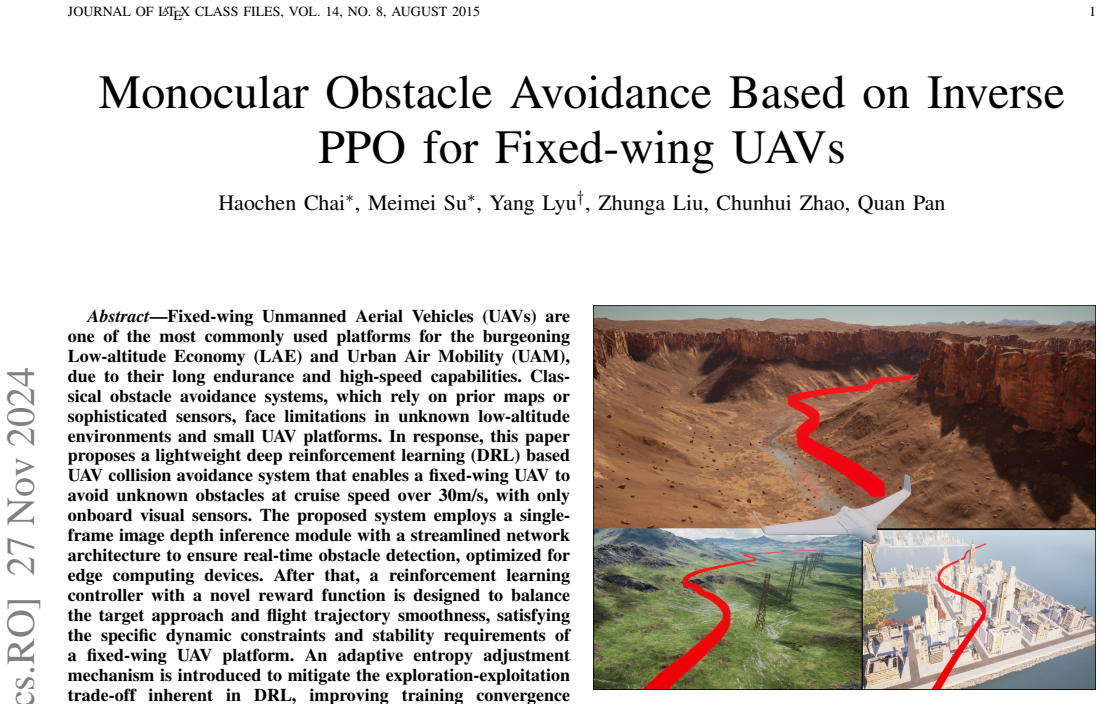
The central discovery claimed is that a complete monocular obstacle-avoidance loop, from one RGB frame to a feasible fixed-wing maneuver, can run on edge hardware at 30 m/s. The perception module is a fine-tuned single-frame depth estimator whose output is encoded by a lightweight backbone into a latent vector; the controller is a PPO variant whose advantage function is computed from a dense reward with target, collision, distance-progress, and trajectory-alignment terms, plus an adaptive entropy term. In the reported experiments the proposed method reaches 86%, 80%, and 74% success in city, line-cruising, and valley scenes, beating PPO (82%, 76%, 69%) and the other baselines, and the hardware-in-the-loop runs on a low-power NPU board show the policy producing smoother and shorter paths than a sample-based motion-primitives method in the two more complex scenes. The paper also states its own limit: inferred depth may not be reliable for sudden, small obstacles, and real-flight tests are not yet done.
Load-bearing premise
The load-bearing premise is that one RGB frame converted by the fine-tuned monocular depth model is accurate and timely enough for avoidance decisions at 30 m/s, including for sudden or small obstacles; the paper's conclusion concedes that inferred depth may fail precisely there.
Editorial extensions
If this is right
- Fixed-wing UAVs can navigate unknown low-altitude environments without prior maps, LiDAR, or heavy sensors, relying on a single RGB camera and an edge NPU.
- Single-frame depth inference avoids the latency and memory cost of multi-frame depth stacks, making real-time avoidance at cruise speed feasible on lightweight hardware.
- The adaptive entropy schedule shortens training and reaches higher cumulative reward than fixed-entropy PPO, lowering the cost of policy learning.
- The smoothness-aware reward reduces abrupt course changes, which lessens strain on fixed-wing control systems and energy consumption.
- The same framework deploys on a low-power edge platform in hardware-in-the-loop tests, indicating the policy can run outside a desktop-class GPU.
Reading between the lines
- A direct way to strengthen the result would be an ablation that feeds the controller ground-truth depth instead of inferred depth; the gap between those success rates would separate perception errors from policy errors, which the paper does not report.
- The "inverse" in inverse PPO should not be read as inverse reinforcement learning: the reward is still hand-designed, and the advantage is inferred from that reward, not learned from demonstrations.
- The adaptive entropy schedule is independent of the perception stack, so it could be transferred to other PPO-based navigation or control tasks where exploration collapses early.
- Real-flight tests on a VTOL fixed-wing platform, which the paper names as future work, are the natural next check, because the HIL simulator cannot capture depth sensor noise and wind disturbances.
Signed reviews
Editorial analysis
A structured set of objections, weighed in public.
Referee Report
Summary. The manuscript proposes a monocular vision-based obstacle avoidance system for fixed-wing UAVs. A single RGB frame is processed by a fine-tuned ZoeDepth network into a depth map, encoded by StarNet-S1, and fed together with target-relative distance and angle into a PPO-style policy. The paper introduces a hand-crafted reward composed of target, collision, distance-progress, and track-alignment terms, an 'inverse PPO' formulation that rewrites the advantage function from this reward, and an 'adaptive entropy' coefficient scaled by the success rate in a batch. Experiments use AirSim with JSBSim dynamics: ablations of the reward and entropy terms, comparisons with PPO, TRPO, A3C, DQN, and DDPG across three scenes (City, Line-cruising, Valley), and a hardware-in-the-loop deployment on an OrangePi 5B with an RK3588s NPU. The paper claims success rates up to 86%, smoother trajectories, and edge-device feasibility, and it releases source code.
Significance. If the empirical claims are sustained, the system would be a valuable proof-of-concept for low-cost, high-speed fixed-wing avoidance in unknown environments. The paper has real strengths: public code, a realistic AirSim/JSBSim training setup, multiple environment types, a hardware-in-the-loop implementation on an NPU, and ablations isolating the reward and entropy modifications. However, the central 'real-time at 30 m/s' claim is not accompanied by end-to-end latency, frame-rate, or depth-accuracy measurements, and the theoretical sections contain undefined constants, an unsupported importance-sampling expression, and an incomplete proof. As written, the contribution is a promising engineering system with preliminary evaluation rather than a fully validated algorithmic advance.
major comments (5)
- [V-D] The real-time claim for cruise speed over 30 m/s is not supported by quantitative timing or depth-quality data. Section V-D describes the OrangePi 5B setup and shows trajectory comparisons, but it reports no inference latency for the ZoeDepth depth module, no frame rate, no control-loop period, and no quantitative comparison of inferred depth against ground truth. At 30 m/s, a 100 ms perception delay corresponds to roughly 3 m of travel, and the conclusion itself concedes that inferred depth may fail on sudden small obstacles. Please report end-to-end latency (depth inference plus encoding plus policy), depth error on representative frames, and a timing budget against the episode step rate actually achieved in the HIL experiments.
- [IV-C] Theorem 4.1 and its proof are not mathematically coherent. The theorem statement uses constants eta, sigma, zeta, kappa, m, lambda, T, and k without defining them, and Eq. (22) contains an expression with V^m C_k / ||pi_theta(s,a)-pi_theta(s',a)||^m whose denominator can vanish; the limit in Eq. (23) refers to H^k_N, which is never defined. The proof of Theorem 4.1 is a list of inequalities with no derivation linking Lemma 4.1 to Eqs. (24)-(26), and the constant kappa in Eq. (26) depends on Exp(R), which is not defined. Either provide a rigorous statement with all constants specified and a valid proof, or remove the theorem and state clearly that the adaptive entropy term is a heuristic.
- [IV-B] The importance-sampling derivation in Eq. (18) and the clipped loss in Eq. (27) are not the standard PPO objective and are not justified. Eq. (18) introduces a state-distribution ratio pi_theta(s)/pi_theta'(s) alongside the usual action ratio, but no argument is given for why this ratio is tractable or unbiased; Eq. (27) then uses pi_theta/pi_theta' multiplied by pi_theta(s)/pi_theta'(s) with InA_theta, while standard PPO uses pi_theta(a|s)/pi_theta_old(a|s) with an advantage estimated under the old policy. The notation theta versus theta' is also inconsistent with Eq. (17), where theta is the pre-update parameter vector. Please clarify which distribution is old, which is new, and either derive the estimator rigorously or replace it with the standard clipped PPO objective.
- [IV-C] The definition and interpretation of the entropy term are internally inconsistent. Definition 4.1 states that higher H corresponds to greater utilization and lower H to greater exploration, but since H is a positive multiple of the Shannon entropy of the policy, higher H is the standard maximum-entropy direction of increasing exploration. Eq. (20) additionally scales H by Ms/Batch, the fraction of successful episodes in the batch, so the 'adaptive entropy' is a success-weighted entropy rather than an adjusted entropy coefficient; the text does not explain why a higher success rate should scale entropy. Please reconcile the direction of the effect and state precisely how the entropy coefficient changes with the success ratio.
- [V-C, Table II] The policy comparison table reports success rates without confidence intervals, number of seeds, or significance tests. The differences are small (e.g., 86.0 vs 82.0 in City, 80.0 vs 76.0 in Line-cruising, 74.0 vs 69.0 in Valley), and with 100 trials per scenario a few random seeds could easily change the ordering. The header 'Success Rate (%, down-arrow)' also conflicts with the text, which implies higher is better. Please report mean and standard deviation over multiple seeds and a statistical test, or qualify the claim as a point estimate.
minor comments (8)
- [IV-B, Eq. (17)] InA is just the standard advantage A = Q - V; calling it 'inferring' is confusing. Please use standard notation or explain what is inferred.
- [III-A, Eq. (7)] Use atan2 rather than arctan for alpha so that the angle covers the correct quadrant.
- [III-A, Eq. (9) and Table I] The action set contains seven yaw values from Eq. (9) plus the continue-last-action option, but Table I reports Action Dimension 8; the discrete action list should be stated explicitly.
- [IV-C, Eq. (22)] The formula includes T, k, N, lambda, and m with no stated ranges; T is used both as horizon in Eq. (22) and in the proof's condition T >= 10 zeta kappa log 10 zeta. Please define all symbols.
- [V-C] The claim that each test is repeated 100 times per scenario does not state how many seeds or random obstacle configurations were used; please specify.
- [V-D] The conclusion that the algorithm makes 'quick decisions in real-time' is asserted in the text but no timing measurement is reported; this should be either measured or removed.
- [References] Reference [40] cites a textbook for TRPO instead of the original paper (Schulman et al., 2015); please add the primary reference.
- [Throughout] Typos such as 'Entrophy', 'pratical', 'ia a inferring', and 'outperforme' should be corrected.
Circularity Check
No load-bearing circularity: the central results are benchmarked externally, though the ‘inverse PPO’ label renames the standard PPO objective.
-
renaming known result
[Section IV-B Eq. (17) and Section IV-C3 Eq. (30)]
"InA θ (st, at) ∆ = InQ θ (st, at) − InV θ (st) = Est,at [P l rt+l] − Est [P l rt+l], (17) ... LInverse = LCLIP − w1LV F+ w2LENT, (30)"
By the paper’s own equations, the “inferring advantage” in Eq. 17 is the standard advantage Q − V, and the final objective Eq. 30 is the standard PPO clipped surrogate loss with a value term and an entropy bonus. Labeling this combination “inverse PPO” does not connect it to inverse RL; it is a re-description of the standard objective. This semantic re-labeling is not what produces the reported success rates: Table II compares all methods in the same simulator and the HIL trials use an external sample-based baseline, so the central empirical claims are measured, not derived from the label.
full rationale
The paper’s load-bearing evidence is external and empirical. Section V-C compares the proposed controller against PPO, TRPO, A3C, DQN, and DDPG under identical simulation conditions (Table II), and Section V-D compares it with the sample-based method of reference [50] in hardware-in-the-loop tests. These outcomes are not obtained by substituting the paper’s equations; they are simulation/hardware results, so no fitted parameter or definition is being relabeled as a prediction. The main circularity-adjacent issue is terminological: Eq. 17 defines InA as Q − V and Eq. 30 is the standard PPO loss L^{CLIP} − w1 L^{VF} + w2 L^{ENT}; calling this “inverse PPO” is a renamed standard formulation rather than an inverse-RL derivation. This is a presentation weakness, not a circular derivation. There is no load-bearing self-citation: the depth module [45], backbone [46], simulators [48], [49], and baseline [50] are external works. The conclusion explicitly concedes that inferred depth may be inaccurate for sudden small obstacles; that is a robustness/limitation disclosure, and it should be weighed as a correctness risk rather than as circularity. Overall, the derivation chain does not reduce to its own inputs, so the circularity score is low.
Assumptions & free parameters
free parameters (3)
- Reward weights C1, C2, C3, C4 =
30, -30, 0.5, 1.0
- Value and entropy loss coefficients w1, w2 =
0.5, 0.1
- Waypoint distance lambda =
not reported
assumptions (4)
- domain assumption JSBSim and AirSim provide an accurate model of fixed-wing dynamics and visual sensing for training and validation.
- domain assumption The pre-trained ZoeDepth model can be fine-tuned to produce reliable metric depth in unseen low-altitude environments.
- ad hoc to paper The importance-sampled objective with the state-distribution ratio pi_theta(s)/pi_theta'(s) is a valid training objective.
- ad hoc to paper Theorem 4.1 holds under the constants eta, sigma, zeta, kappa, m, lambda, and T, which are never specified.
Cite this review
Pith. "Pith review of Monocular Obstacle Avoidance Based on Inverse PPO for Fixed-wing UAVs." pith.science (2026). https://pith.science/paper/EE5KODQA
@misc{pith2026241118009,
  author       = {Pith},
  title        = {Pith review of: Monocular Obstacle Avoidance Based on Inverse PPO for Fixed-wing UAVs},
  year         = {2026},
  howpublished = {\url{https://pith.science/paper/EE5KODQA}},
  note         = {Machine review of arXiv:2411.18009}
}
read the original abstract
Fixed-wing Unmanned Aerial Vehicles (UAVs) are one of the most commonly used platforms for the burgeoning Low-altitude Economy (LAE) and Urban Air Mobility (UAM), due to their long endurance and high-speed capabilities. Classical obstacle avoidance systems, which rely on prior maps or sophisticated sensors, face limitations in unknown low-altitude environments and small UAV platforms. In response, this paper proposes a lightweight deep reinforcement learning (DRL) based UAV collision avoidance system that enables a fixed-wing UAV to avoid unknown obstacles at cruise speed over 30m/s, with only onboard visual sensors. The proposed system employs a single-frame image depth inference module with a streamlined network architecture to ensure real-time obstacle detection, optimized for edge computing devices. After that, a reinforcement learning controller with a novel reward function is designed to balance the target approach and flight trajectory smoothness, satisfying the specific dynamic constraints and stability requirements of a fixed-wing UAV platform. An adaptive entropy adjustment mechanism is introduced to mitigate the exploration-exploitation trade-off inherent in DRL, improving training convergence and obstacle avoidance success rates. Extensive software-in-the-loop and hardware-in-the-loop experiments demonstrate that the proposed framework outperforms other methods in obstacle avoidance efficiency and flight trajectory smoothness and confirm the feasibility of implementing the algorithm on edge devices. The source code is publicly available at \url{https://github.com/ch9397/FixedWing-MonoPPO}.
Figures


Figures from the paper (3 more)


Reference graph
Works this paper leans on
-
[1]
Low-altitude intelligent transportation: system architecture, in- frastructure, and key technologies
Changqing Huang, Shifeng Fang, Hua Wu, Yong Wang, and Yichen Yang. Low-altitude intelligent transportation: system architecture, in- frastructure, and key technologies. Journal of Industrial Information Integration, page 100694, 2024
work page 2024
-
[2]
Urban air mobility: History, ecosystem, market potential, and challenges
Adam P Cohen, Susan A Shaheen, and Emily M Farrar. Urban air mobility: History, ecosystem, market potential, and challenges. IEEE Transactions on Intelligent Transportation Systems , 22(9):6074–6087, 2021
work page 2021
-
[3]
Fixed-wing uav based air- to-ground channel measurement and modeling at 2.7 ghz in rural environment
Yue Lyu, Wei Wang, and Peng Chen. Fixed-wing uav based air- to-ground channel measurement and modeling at 2.7 ghz in rural environment. IEEE Transactions on Antennas and Propagation , 2024
work page 2024
-
[4]
Adaptive mutant particle swarm optimization based precise cargo airdrop of unmanned aerial vehicles
An Zhang, Han Xu, Wenhao Bi, and Shuangfei Xu. Adaptive mutant particle swarm optimization based precise cargo airdrop of unmanned aerial vehicles. Applied Soft Computing , 130:109657, 2022
work page 2022
-
[5]
Backstepping and dynamic inversion combined controller for auto-landing of fixed wing uavs
Mihai Lungu. Backstepping and dynamic inversion combined controller for auto-landing of fixed wing uavs. Aerospace Science and Technology, 96:105526, 2020
work page 2020
-
[6]
Cooperative sensing enhanced uav path-following and obstacle avoidance with variable formation
Changheng Wang, Zhiqing Wei, Wangjun Jiang, Haoyue Jiang, and Zhiyong Feng. Cooperative sensing enhanced uav path-following and obstacle avoidance with variable formation. IEEE Transactions on Vehicular Technology, 2024
work page 2024
-
[7]
Anytime motion planning using the rrt
Sertac Karaman, Matthew R Walter, Alejandro Perez, Emilio Frazzoli, and Seth Teller. Anytime motion planning using the rrt. In 2011 IEEE international conference on robotics and automation , pages 1478–1483. IEEE, 2011
2011
-
[8]
Spline-based motion planning for autonomous guided vehicles in a dynamic environment
Tim Mercy, Ruben Van Parys, and Goele Pipeleers. Spline-based motion planning for autonomous guided vehicles in a dynamic environment. IEEE Transactions on Control Systems Technology , 26(6):2182–2189, 2017
work page 2017
Show all 50 references
-
[9]
Learning-based fixed-wing uav reactive maneuver control for obstacle avoidance
Jianfa Wu, Honglun Wang, Yiheng Liu, Menghua Zhang, and Tiancai Wu. Learning-based fixed-wing uav reactive maneuver control for obstacle avoidance. Aerospace Science and Technology , 126:107623, 2022
2022
-
[10]
Openstreetmap-based autonomous nav- igation with lidar naive-valley-path obstacle avoidance
Miguel ´Angel Mu ˜noz-Ba˜n´on, Edison Velasco-Sanchez, Francisco A Candelas, and Fernando Torres. Openstreetmap-based autonomous nav- igation with lidar naive-valley-path obstacle avoidance. IEEE Transac- tions on Intelligent Transportation Systems , 23(12):24428–24438, 2022
2022
-
[11]
Nvradar- net: Real-time radar obstacle and free space detection for autonomous driving
Alexander Popov, Patrik Gebhardt, Ke Chen, and Ryan Oldja. Nvradar- net: Real-time radar obstacle and free space detection for autonomous driving. In 2023 IEEE International Conference on Robotics and Automation (ICRA), pages 6958–6964. IEEE, 2023
2023
-
[12]
Unmanned aerial vehicle path planning based on a* algorithm and its variants in 3d environment
Dilip Mandloi, Rajeev Arya, and Ajit K Verma. Unmanned aerial vehicle path planning based on a* algorithm and its variants in 3d environment. International Journal of System Assurance Engineering and Management, 12(5):990–1000, 2021
2021
-
[13]
Bi-risk-rrt based efficient motion planning for autonomous ground vehicles
Han Ma, Fei Meng, Chengwei Ye, Jiankun Wang, and Max Q-H Meng. Bi-risk-rrt based efficient motion planning for autonomous ground vehicles. IEEE Transactions on Intelligent Vehicles , 7(3):722– 733, 2022
2022
-
[14]
Gmr-rrt*: Sampling-based path planning using gaussian mixture regression
Jiankun Wang, Tingguang Li, Baopu Li, and Max Q-H Meng. Gmr-rrt*: Sampling-based path planning using gaussian mixture regression. IEEE Transactions on Intelligent Vehicles, 7(3):690–700, 2022
2022
-
[15]
Champion-level drone racing using deep reinforcement learning
Elia Kaufmann, Leonard Bauersfeld, Antonio Loquercio, Matthias M¨uller, Vladlen Koltun, and Davide Scaramuzza. Champion-level drone racing using deep reinforcement learning. Nature, 620(7976):982–987, 2023
2023
-
[16]
Learn to navigate autonomously through deep reinforcement learning
Keyu Wu, Han Wang, Mahdi Abolfazli Esfahani, and Shenghai Yuan. Learn to navigate autonomously through deep reinforcement learning. IEEE Transactions on Industrial Electronics , 69(5):5342–5352, 2021
2021
-
[17]
A uav navigation approach based on deep reinforcement learning in large cluttered 3d environments
Yuntao Xue and Weisheng Chen. A uav navigation approach based on deep reinforcement learning in large cluttered 3d environments. IEEE Transactions on Vehicular Technology, 72(3):3001–3014, 2022
2022
-
[18]
Visual navigation in real-world indoor environments using end-to-end deep reinforcement learning
Jon ´aˇs Kulh ´anek, Erik Derner, and Robert Babu ˇska. Visual navigation in real-world indoor environments using end-to-end deep reinforcement learning. IEEE Robotics and Automation Letters, 6(3):4345–4352, 2021
2021
-
[19]
Human-guided reinforcement learning with sim-to-real transfer for autonomous navigation
Jingda Wu, Yanxin Zhou, Haohan Yang, Zhiyu Huang, and Chen Lv. Human-guided reinforcement learning with sim-to-real transfer for autonomous navigation. IEEE Transactions on Pattern Analysis and Machine Intelligence, 2023
2023
-
[20]
Vision-based distributed multi-uav collision avoidance via deep reinforcement learning for navigation
Huaxing Huang, Guijie Zhu, Zhun Fan, Hao Zhai, Yuwei Cai, Ze Shi, Zhaohui Dong, and Zhifeng Hao. Vision-based distributed multi-uav collision avoidance via deep reinforcement learning for navigation. In 2022 IEEE/RSJ International Conference on Intelligent Robots and Systems (...
2022
-
[21]
Autonomous navigation of uavs in large-scale complex environments: A deep rein- forcement learning approach
Chao Wang, Jian Wang, Yuan Shen, and Xudong Zhang. Autonomous navigation of uavs in large-scale complex environments: A deep rein- forcement learning approach. IEEE Transactions on Vehicular Technol- ogy, 68(3):2124–2136, 2019
2019
-
[22]
Towards monocular vision based obstacle avoidance through deep reinforcement learning
Linhai Xie, Sen Wang, Andrew Markham, and Niki Trigoni. Towards monocular vision based obstacle avoidance through deep reinforcement learning. arXiv preprint arXiv:1706.09829 , 2017
2017 arXiv
-
[23]
Depth-cuprl: Depth-imaged contrastive unsupervised prioritized representations in reinforcement learning for mapless navigation of unmanned aerial vehicles
Junior C de Jesus, Victor A Kich, Alisson H Kolling, Ricardo B Grando, Rodrigo S Guerra, and Paulo LJ Drews. Depth-cuprl: Depth-imaged contrastive unsupervised prioritized representations in reinforcement learning for mapless navigation of unmanned aerial vehicles. In 2022 IEE...
2022
-
[24]
R ´enyi state entropy maximization for exploration acceleration in reinforcement learning
Mingqi Yuan, Man-On Pun, and Dong Wang. R ´enyi state entropy maximization for exploration acceleration in reinforcement learning. IEEE Transactions on Artificial Intelligence , 4(5):1154–1164, 2022
2022
-
[25]
Proximal policy optimization algorithms
John Schulman, Filip Wolski, Prafulla Dhariwal, Alec Radford, and Oleg Klimov. Proximal policy optimization algorithms. arXiv preprint arXiv:1707.06347, 2017
2017 arXiv
-
[26]
E. W. Dijkstra. A note on two problems in connexion with graphs. Numerische Mathematik, 1(1), 1959
1959
-
[27]
A formal basis for the heuristic determination of minimum cost paths
Peter E Hart, Nils J Nilsson, and Bertram Raphael. A formal basis for the heuristic determination of minimum cost paths. IEEE transactions on Systems Science and Cybernetics , 4(2):100–107, 1968
1968
-
[28]
Global path planning using artificial potential fields
Charles W Warren. Global path planning using artificial potential fields. In 1989 IEEE International Conference on Robotics and Automation , pages 316–317. IEEE Computer Society, 1989
1989
-
[29]
Optimal path planning using rrt* based approaches: a survey and future directions
Iram Noreen, Amna Khan, and Zulfiqar Habib. Optimal path planning using rrt* based approaches: a survey and future directions. International Journal of Advanced Computer Science and Applications , 7(11), 2016
2016
-
[30]
Vfh* tdt (vfh* with time dependent tree): A new laser rangefinder based obstacle avoidance method designed for envi- ronment with non-static obstacles
Andrej Babinec, Franti ˇsek Ducho ˇn, Martin Dekan, Peter P ´aszt´o, and Michal Kelemen. Vfh* tdt (vfh* with time dependent tree): A new laser rangefinder based obstacle avoidance method designed for envi- ronment with non-static obstacles. Robotics and autonomous systems , 62...
2014
-
[31]
Implementing dubins airplane paths on fixed-wing uavs
Timothy McLain, Randall W Beard, and Mark Owen. Implementing dubins airplane paths on fixed-wing uavs. 2014
2014
-
[32]
Nonlinear mpc for collision avoidance and control of uavs with dynamic obstacles
Bj ¨orn Lindqvist, Sina Sharif Mansouri, Ali-akbar Agha-mohammadi, and George Nikolakopoulos. Nonlinear mpc for collision avoidance and control of uavs with dynamic obstacles. IEEE robotics and automation letters, 5(4):6001–6008, 2020
2020
-
[33]
Deep reinforcement learning with experience replay based on sarsa
Dongbin Zhao, Haitao Wang, Kun Shao, and Yuanheng Zhu. Deep reinforcement learning with experience replay based on sarsa. In 2016 IEEE symposium series on computational intelligence (SSCI) , pages 1–
2016
-
[34]
Q-learning
Christopher JCH Watkins and Peter Dayan. Q-learning. Machine learning, 8:279–292, 1992
1992
-
[35]
Understanding multi-step deep reinforcement learning: A systematic study of the dqn target
J Fernando Hernandez-Garcia and Richard S Sutton. Understanding multi-step deep reinforcement learning: A systematic study of the dqn target. arXiv preprint arXiv:1901.07510 , 2019
1901 arXiv
-
[36]
Deep reinforcement learning with double q-learning
Hado Van Hasselt, Arthur Guez, and David Silver. Deep reinforcement learning with double q-learning. In Proceedings of the AAAI conference on artificial intelligence , volume 30, 2016
2016
-
[37]
Dueling network architectures for deep reinforce- ment learning
Ziyu Wang, Tom Schaul, Matteo Hessel, Hado Hasselt, Marc Lanctot, and Nando Freitas. Dueling network architectures for deep reinforce- ment learning. In International conference on machine learning , pages 1995–2003. PMLR, 2016
1995
-
[38]
Continuous control with deep reinforcement learning
Timothy P Lillicrap, Jonathan J Hunt, Alexander Pritzel, Nicolas Heess, Tom Erez, Yuval Tassa, David Silver, and Daan Wierstra. Continuous control with deep reinforcement learning. arXiv preprint arXiv:1509.02971, 2015
2015 arXiv
-
[39]
Soft actor-critic: Off-policy maximum entropy deep reinforcement learning with a stochastic actor
Tuomas Haarnoja, Aurick Zhou, Pieter Abbeel, and Sergey Levine. Soft actor-critic: Off-policy maximum entropy deep reinforcement learning with a stochastic actor. In International conference on machine learning, pages 1861–1870. PMLR, 2018
2018
-
[40]
Deep Reinforcement Learning Hands-On: Apply modern RL methods, with deep Q-networks, value iteration, policy gradients, TRPO, AlphaGo Zero and more
Maxim Lapan. Deep Reinforcement Learning Hands-On: Apply modern RL methods, with deep Q-networks, value iteration, policy gradients, TRPO, AlphaGo Zero and more . Packt Publishing Ltd, 2018
2018
-
[41]
Position-agnostic autonomous navigation in vineyards with deep reinforcement learning
Mauro Martini, Simone Cerrato, Francesco Salvetti, Simone Angarano, and Marcello Chiaberge. Position-agnostic autonomous navigation in vineyards with deep reinforcement learning. In 2022 IEEE 18th in- ternational conference on automation science and engineering (CASE) , pages ...
2022
-
[42]
Mgrl: Graph neural network based inference in a markov network with reinforcement learning for visual navigation
Yi Lu, Yaran Chen, Dongbin Zhao, and Dong Li. Mgrl: Graph neural network based inference in a markov network with reinforcement learning for visual navigation. Neurocomputing, 421:140–150, 2021. JOURNAL OF LATEX CLASS FILES, VOL. 14, NO. 8, AUGUST 2015 12
2021
-
[43]
Design and experimental validation of deep reinforcement learning-based fast trajectory planning and control for mobile robot in unknown environment
Runqi Chai, Hanlin Niu, Joaquin Carrasco, Farshad Arvin, Hujun Yin, and Barry Lennox. Design and experimental validation of deep reinforcement learning-based fast trajectory planning and control for mobile robot in unknown environment. IEEE Transactions on Neural Networks and ...
2022
-
[44]
Temporal-logic-based reward shaping for continuing reinforcement learning tasks
Yuqian Jiang, Suda Bharadwaj, Bo Wu, Rishi Shah, Ufuk Topcu, and Peter Stone. Temporal-logic-based reward shaping for continuing reinforcement learning tasks. In Proceedings of the AAAI Conference on artificial Intelligence , volume 35, pages 7995–8003, 2021
2021
-
[45]
Zoedepth: Zero-shot transfer by combining relative and metric depth
Shariq Farooq Bhat, Reiner Birkl, Diana Wofk, Peter Wonka, and Matthias M ¨uller. Zoedepth: Zero-shot transfer by combining relative and metric depth. arXiv preprint arXiv:2302.12288 , 2023
2023 arXiv
-
[46]
Rewrite the stars
Xu Ma, Xiyang Dai, Yue Bai, Yizhou Wang, and Yun Fu. Rewrite the stars. In Proceedings of the IEEE/CVF Conference on Computer Vision and Pattern Recognition, pages 5694–5703, 2024
2024
-
[47]
Deep learning on mobile devices through neural processing units and edge computing
Tianxiang Tan and Guohong Cao. Deep learning on mobile devices through neural processing units and edge computing. In IEEE IN- FOCOM 2022-IEEE Conference on Computer Communications , pages 1209–1218. IEEE, 2022
2022
-
[48]
Airsim: High-fidelity visual and physical simulation for autonomous vehicles
Shital Shah, Debadeepta Dey, Chris Lovett, and Ashish Kapoor. Airsim: High-fidelity visual and physical simulation for autonomous vehicles. In Field and Service Robotics , 2017
2017
-
[49]
Jsbsim: An open source flight dynamics model in c++
Jon Berndt. Jsbsim: An open source flight dynamics model in c++. In AIAA Modeling and Simulation Technologies Conference and Exhibit , page 4923, 2004
2004
-
[50]
Motion primitives and 3d path planning for fast flight through a forest
Aditya A Paranjape, Kevin C Meier, Xichen Shi, Soon-Jo Chung, and Seth Hutchinson. Motion primitives and 3d path planning for fast flight through a forest. The International Journal of Robotics Research , 34(3):357–377, 2015
2015
Reviewed August 12, 2026 · model on record in the stance chip above.
Discussion (0). Continue with ORCID to comment.