REVIEW 3 major objections 6 minor 18 cited by
TesserAct: Learning 4D Embodied World Models
T0 review · 3 major / 6 minor · reviewed 2026-08-16 · deepseek-v4-flash
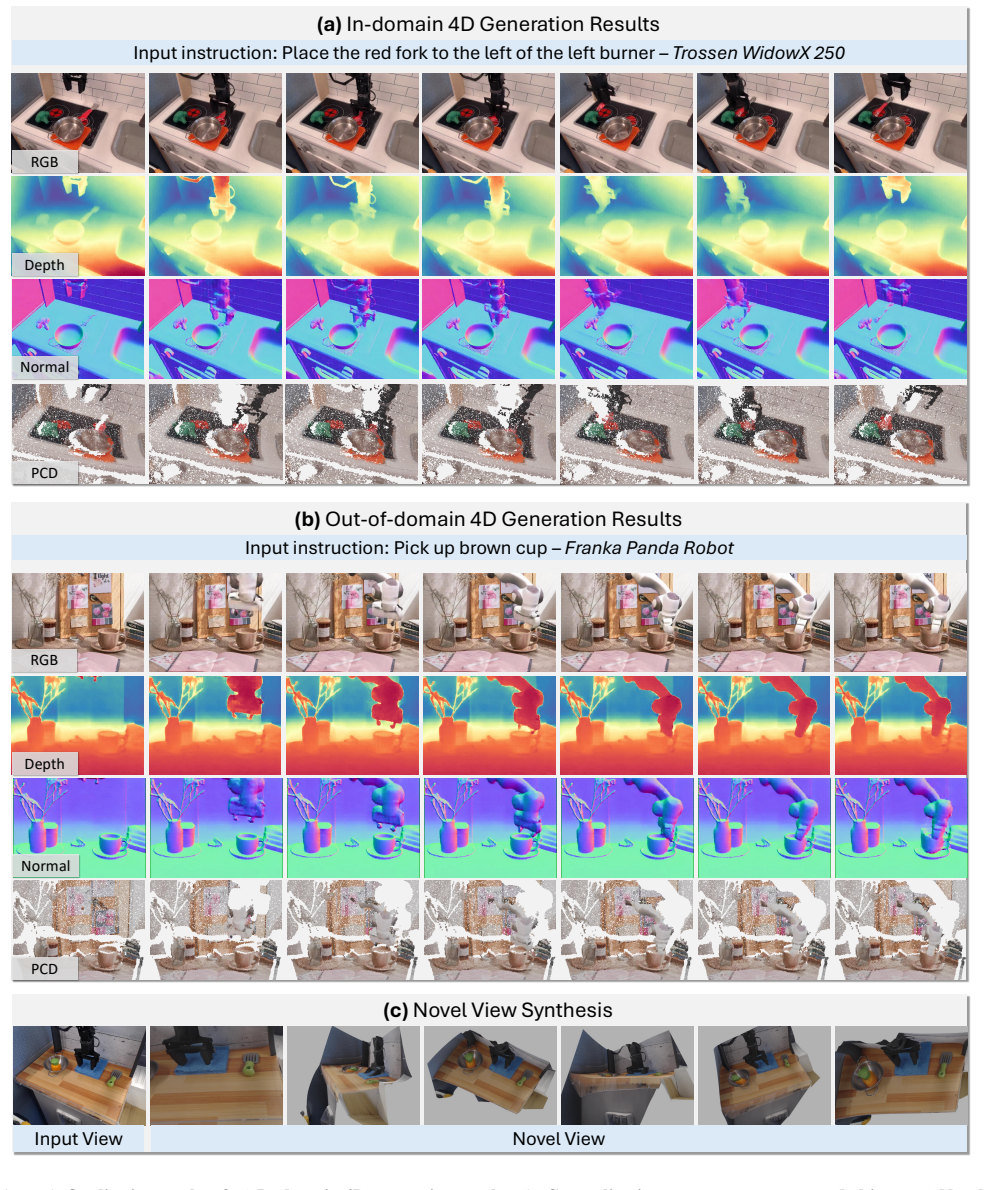
Pith's one-line read TesserAct learns a 4D embodied world model as RGB-DN video generation, and the reconstructed point clouds improve robot manipulation policies over 2D video world models.
desk verdict TesserAct is a credible engineering step in 3D-aware world models, but the abstract's 'significantly outperforms' claim rests on a Table 3 that lacks error bars and cannot support it. read the letter →
The pith
A machine-rendered reading of the paper's core claim, the machinery that carries it, and where it could break.
The reading
What carries the argument
The load-bearing machinery is the RGB-DN video representation: each generated frame carries color, depth, and surface normals, which together act as a compact stand-in for a 4D scene. A latent video diffusion transformer is fine-tuned with separate input projectors for the three modalities and output branches that predict denoised depth and normal maps alongside color, preserving the pretrained RGB generation while adding geometry. The reconstruction stage then refines each depth map by integrating the predicted normals under a perspective-camera constraint, and couples frames using optical-flow-derived masks: a temporal consistency loss aligns dynamic and background regions across adjacent frames, and a regularization loss keeps the optimized depth near the generated depth. These pieces convert per-frame generated maps into a single space-time coherent point cloud that carries the argument from pixels to action.
What would settle it
On held-out RT-1 and Bridge scenes, capture the same tabletop configurations with a calibrated depth sensor and compare the reconstructed point clouds against those produced by the paper's auto-annotation pipeline; if the Chamfer distance in the grasping region is large, or if retraining the inverse-dynamics policy on measured geometry changes the RLBench success spread, the central dependence on off-the-shelf annotations is falsified.
Extended reading notes
Core claim
The paper's claim, stated in its own terms, is that a conditional RGB-DN video diffusion model is a viable 4D embodied world model. Given the current image, depth map, normal map, and a text instruction, the model generates future RGB-DN videos; because depth and normal are produced jointly with color rather than estimated from the generated video afterward, the predicted geometry is more accurate and yields lower Chamfer distances on reconstructed point clouds than RGB-only baselines. The reconstructed 4D scenes are temporally coherent, support novel view synthesis from a monocular input, and can be converted into action sequences through a PointNet-based inverse dynamics model. Across nine RLBench tasks, the policy learned from these 4D scenes outperforms the re-implemented UniPi video world model on seven of them.
Load-bearing premise
The real-world half of the training data is labeled by automatic depth and normal estimators, and the entire pipeline assumes these auto-generated labels are accurate enough to serve as ground truth for geometry and for the point clouds that drive action prediction.
Editorial extensions
If this is right
- Video-based world models can be turned into 4D scene models by adding depth and normal channels, avoiding per-scene optimization of explicit 4D neural representations.
- Jointly predicting depth and normal with color produces lower point-cloud reconstruction error than predicting color first and estimating geometry afterward.
- An inverse-dynamics policy trained on reconstructed point-cloud states outperforms a 2D video world model baseline on seven of nine RLBench manipulation tasks.
- The same RGB-DN video generation supports novel view synthesis, matching or beating a Gaussian-splatting video reconstruction method in quality while taking about one minute instead of two hours.
- Existing 2D robot video datasets can be converted into 4D embodied training data with off-the-shelf depth and normal estimators.
Reading between the lines
- Since the RGB-DN representation only captures a single visible surface, a natural extension is multi-view RGB-DN generation; the paper's own limitation note points to this, and integrating several predicted views could yield closed 4D scenes rather than front-facing shells.
- The optical-flow-based temporal consistency loss and normal-integration refinement are not specific to robot videos, so the same recipe could be applied to general monocular video-to-4D reconstruction tasks where depth, normal, and flow estimators already exist.
- A testable stress test is whether the framework's advantage persists when point clouds are built from ground-truth metric depth instead of auto-estimated labels; this would separate the contribution of the RGB-DN world model architecture from the contribution of the annotation pipeline.
- If auto-annotated geometry is systematically biased, retraining with a modest amount of real metric-depth video could restore the gains; the architecture itself does not depend on the particular estimator.
Signed reviews
Editorial analysis
A structured set of objections, weighed in public.
Referee Report
Summary. TesserAct proposes to learn a 4D embodied world model by training a video diffusion model to jointly generate RGB, depth, and normal videos from a current frame and a language instruction. The paper collects a dataset of simulated RLBench videos with ground-truth depth and synthesized normals, plus real-world Fractal, Bridge, and Something-SomethingV2 videos annotated with off-the-shelf depth and normal estimators. It fine-tunes CogVideoX with additional depth/normal input/output projectors, reconstructs 4D point clouds by normal-integrated depth optimization with optical-flow-based consistency and regularization losses, and uses a PointNet-based inverse dynamics model on the point clouds for manipulation. Experiments report improved depth/normal metrics, Chamfer distances, novel view synthesis, and success rates on 9 RLBench tasks compared to UniPi* and Image-BC baselines.
Significance. The approach is well-motivated and the RGB-DN video representation is a pragmatic intermediate for 3D-aware prediction. The measured improvements on synthetic RLBench depth/normal quality and Chamfer distance (e.g., 0.0811 vs 0.2570 for OpenSora in Table 2) are substantial, and the qualitative generalization to unseen scenes and embodiments is promising. The main weakness is that the headline policy-learning claim is not supported with statistical significance: Table 3 reports 100-episode success rates without error bars, confidence intervals, or multiple seeds, and the 7-of-9 advantage over UniPi* is within sampling noise for most tasks. The quantitative ablation of the proposed losses is also missing. With these issues addressed, the paper would be a solid contribution.
major comments (3)
- [5.2, Table 3] The abstract claims TesserAct 'significantly outperforms' prior video-based world models, and Table 3 is the sole empirical support. Success rates are averaged over 100 episodes without standard deviations, confidence intervals, or repeated seeds. For binary outcomes, the standard error of a success rate is at most about 5 percentage points, and the standard error of the difference between two such rates is roughly 6–7 points. Thus the reported gaps are mostly not statistically significant (e.g., close box 88 vs 81, z≈1.4; put knife 70 vs 66; water plants 41 vs 35), and even a one-sided sign test on 7 wins out of 9 gives p≈0.09. Please report per-seed means, confidence intervals, or significance tests, and soften the claim accordingly.
- [5.1.2, Figure 3 / Sec. 4.3] The consistency and regularization losses are introduced as novel contributions, but the ablation is limited to qualitative images in Figure 3. No quantitative comparison (e.g., Chamfer distance, depth AbsRel, or normal error with and without each loss) is provided. Without numbers, the claim that 'Consistency and Regularization Loss are effective' cannot be assessed. Please add a quantitative ablation table, at least on the RLBench subset where ground truth is available.
- [4.1, Table 2] Real-domain depth and normal annotations are produced by RollingDepth and Marigold-LCM, and Table 2 evaluates the real-domain results against these same off-the-shelf estimates. This setup cannot detect systematic bias in those estimators; if they are inaccurate on robot manipulation scenes, the reported 'high-quality 4D scenes' may reflect modeling of estimator artifacts rather than true geometry. Please validate on a subset with sensor ground truth (e.g., a depth camera) or an independent estimator, and state the limitation in the paper. This does not invalidate the RLBench policy comparison, which uses simulator ground truth, but it qualifies the real-domain 4D claims.
minor comments (6)
- [3.2, Eq. (3)] The second quadratic term in Eq. (3) repeats \(\partial_u\tilde{d}\); it should presumably be \(\partial_v\tilde{d}\).
- [5.1.1] The dataset name 'Bridage' should be 'Bridge'.
- [Table 2] The column labeled '11.25◦' should specify that it is the percentage of pixels within 11.25° (higher is better), and the SSIM values appear to be percentages; please clarify the units.
- [4.3, Eq. (5)] The text defines the static mask with 'smaller than threshold c' while Eq. (5) uses \(\le c\); please make the inequality consistent.
- [Supplementary Table 5] The supplementary text refers to 'Eq.12' when describing the loss parameters, but the main-text loss objective is Eq. (7). Please correct the cross-reference.
- [General] The paper does not state whether code and trained models will be released; for reproducibility, please include a release statement or explicitly note why this is not possible.
Circularity Check
No significant circularity: the derivation chain is self-contained and every evaluated quantity is measured against external or independently annotated targets.
full rationale
The paper's central derivation is a standard supervised pipeline: (i) it builds a 4D video dataset with synthetic RLBench ground truth plus off-the-shelf depth/normal annotations, (ii) it fine-tunes CogVideoX to denoise RGB-DN latents with the usual diffusion objective (Eq. 4), and (iii) it converts generated RGB-DN videos into point clouds by optimizing the normal-integration loss (Eq. 3) with cross-frame consistency and regularization terms (Eqs. 5-7). None of these equations reduces by construction to the reported outcome: the video diffusion loss is a standard denoising objective against dataset targets, the reconstruction losses are optimization objectives over generated geometry, and the downstream policy success (Table 3) is measured in the RLBench simulator with ground-truth dynamics, not derived from any fitted parameter of the model. The pseudo-label concern for real-domain data (RollingDepth and Marigold-LCM annotations used both for training and evaluation) is a data-quality and external-validity issue, not a circularity: the model is not fitting a parameter and then reporting that same fit as a prediction. The statistical weakness of Table 3 (no error bars or significance tests) is a correctness risk, not a circular structure. Self-citations to prior work by the same authors (e.g., UniPi, 3D-VLA) appear as background or as baselines, and no load-bearing claim is justified only by a self-citation; no uniqueness theorem is invoked, and no ansatz is smuggled in through citation. The paper is therefore self-contained against external benchmarks for the purposes of this pass.
Assumptions & free parameters
free parameters (2)
- Reconstruction loss weights (lambda_d, lambda_b, lambda_g1, lambda_g2) =
RT-1/Bridge: 20, 200, 20, 20; RLBench: 20, 200, 2, 2
- Optical flow static/dynamic threshold c =
not reported
assumptions (4)
- ad hoc to paper Off-the-shelf depth and normal estimators (RollingDepth, Marigold-LCM, DSINE) produce annotations accurate enough to serve as training targets.
- standard math The normal-integration optimization (Eq. 3) plus consistency and regularization losses recovers a geometrically consistent 4D scene from relative depth maps.
- domain assumption RAFT optical flow reliably separates static and dynamic regions in generated videos.
- domain assumption CogVideoX's pretrained video prior transfers to the new depth and normal branches with zero-initialized adapters.
Cite this review
Pith. "Pith review of TesserAct: Learning 4D Embodied World Models." pith.science (2026). https://pith.science/paper/EEEHFAGT
@misc{pith2026250420995,
  author       = {Pith},
  title        = {Pith review of: TesserAct: Learning 4D Embodied World Models},
  year         = {2026},
  howpublished = {\url{https://pith.science/paper/EEEHFAGT}},
  note         = {Machine review of arXiv:2504.20995}
}
read the original abstract
This paper presents an effective approach for learning novel 4D embodied world models, which predict the dynamic evolution of 3D scenes over time in response to an embodied agent's actions, providing both spatial and temporal consistency. We propose to learn a 4D world model by training on RGB-DN (RGB, Depth, and Normal) videos. This not only surpasses traditional 2D models by incorporating detailed shape, configuration, and temporal changes into their predictions, but also allows us to effectively learn accurate inverse dynamic models for an embodied agent. Specifically, we first extend existing robotic manipulation video datasets with depth and normal information leveraging off-the-shelf models. Next, we fine-tune a video generation model on this annotated dataset, which jointly predicts RGB-DN (RGB, Depth, and Normal) for each frame. We then present an algorithm to directly convert generated RGB, Depth, and Normal videos into a high-quality 4D scene of the world. Our method ensures temporal and spatial coherence in 4D scene predictions from embodied scenarios, enables novel view synthesis for embodied environments, and facilitates policy learning that significantly outperforms those derived from prior video-based world models.
Figures


Figures from the paper (8 more)


Forward citations
Cited by 18 Pith papers
-
Masked Visual Actions for Unified World Modeling
A single video model finetuned on masked pixel trajectories acts as both forward and inverse robot world model, enabling policy evaluation, planning, and action extraction.
-
HyperShadow: A Benchmark for Detecting 3D Projections of Higher-Dimensional Spatial Objects
Shadows of 4D–6D objects projected to 3D are detectable by learned point-cloud models and by a zero-parameter rigidity residual, but not by intrinsic-dimension estimation.
-
4D-LRM: Large Space-Time Reconstruction Model From and To Any View at Any Time
4D-LRM is a transformer that maps sparse posed frames scattered across time to a cloud of 4D Gaussians and renders any query view at any query time in under 1.5 seconds.
-
LAWM-3D: Learning 3D-Aware Latent Actions from Human Videos for Generalizable Robot World Models
LAWM-3D learns 3D-aware latent actions from multi-view human videos by combining VGGT geometric alignment with RGB-depth reconstruction, improving robot world model prediction and generalization.
-
DerainSplat: Feed-Forward Clean 3D Gaussian Splatting from Sparse Rainy Views
DerainSplat reconstructs clean 3D Gaussian scenes from sparse rainy views in a single forward pass by predicting weather factors and using support maps to guide matching and appearance fusion.
-
SG-WAM: Self-Guided World Modeling in Geometry-Aware Policy Space
A 0.9B policy that couples action generation with latent future-state prediction in its own representation space, plus geometric supervision, reaches 98.5% LIBERO and 73% LIBERO-Plus.
-
ContactFlow: A video action conditioning that transfers across embodiments
A contact-point-based action representation lets a video world model transfer manipulation knowledge across human and robot embodiments.
-
Xiaomi-Robotics-1: Scaling Vision-Language-Action Models with over 100K Hours of Real-World Trajectories
Pre-training a VLA model on 100k hours of auto-labeled UMI trajectories, then post-training on robot data, yields SOTA simulated manipulation and data-efficient fine-tuning.
-
MVISTA-4D: View-Consistent 4D World Model with Test-Time Action Inference for Robotic Manipulation
A geometry-consistent multi-view RGBD 4D world model for robot manipulation, whose actions are recovered by test-time optimization of a learned trajectory latent, outperforming single- and dual-view world-model baseli...
-
4DNeX: Feed-Forward 4D Generative Modeling Made Easy
4DNeX generates dynamic 3D point clouds and matching RGB video from a single image by fine-tuning a pretrained video diffusion model on a large pseudo-annotated 4D dataset.
-
Quo Vadis, World Modeling?
An agent-centric reframing of world modeling, replacing physical state prediction with 'information transitions' organized into six proxy functions and three empowerment levels.
-
BWM: A Low-Cost High-Fidelity World Simulator for Robot Learning
BWM is an action-conditioned video world model that, on the WorldArena benchmark and a six-task physical-robot test, outperforms compared simulators both as a data generator and as a policy evaluator.
-
MoWorld: A Flash World Model
MoWorld achieves up to 50 FPS real-time interactive world simulation on NPUs by combining a 3D-native data engine, curriculum cross-frame pretraining, autoregressive distillation, and mixed-precision parallel inference.
-
RoDyn: Taming Interactive Robot-Dynamic 2.5D World Model for Robotic Manipulation
Abstract describes RoDyn but full text describes iMoWM; the record is internally inconsistent and the headline claims are absent from the body.
-
RoboScape: Physics-informed Embodied World Model
RoboScape jointly learns RGB video, depth, and keypoint-token consistency in one autoregressive world model, improving video quality, geometry, action control, synthetic-data policy training, and policy evaluation for...
-
3DFlowAction: Learning Cross-Embodiment Manipulation from 3D Flow World Model
A diffusion world model predicts 3D optical flow as an embodiment-agnostic action plan, and constrained optimization converts the flow into robot arm actions.
-
VRAG: Learning World Models for Interactive Video Generation
VRAG improves long-horizon interactive video generation by conditioning autoregressive diffusion on retrieved historical frames and explicit global state, outperforming long-context baselines on the tested Minecraft a...
-
Reinforcement Learning: From Algorithms To Foundation Models
A dissertation uniting the author's published results: non-exploitable Nash-DQN policies and the FightLadder benchmark for games, plus diffusion/consistency-model world models for RL — a compilation rather than new results.
Reference graph
Works this paper leans on
-
[1]
A separation princi- ple for control in the age of deep learning
Alessandro Achille and Stefano Soatto. A separation princi- ple for control in the age of deep learning. Annual Review of Control, Robotics, and Autonomous Systems, 1:287–307,
-
[2]
Gwangbin Bae and Andrew J. Davison. Rethinking inductive biases for surface normal estimation. In IEEE/CVF Confer- ence on Computer Vision and Pattern Recognition (CVPR),
-
[3]
4d-fy: Text-to-4d generation using hybrid score distillation sampling
Sherwin Bahmani, Ivan Skorokhodov, Victor Rong, Gordon Wetzstein, Leonidas Guibas, Peter Wonka, Sergey Tulyakov, Jeong Joon Park, Andrea Tagliasacchi, and David B Lindell. 4d-fy: Text-to-4d generation using hybrid score distillation sampling. In Proceedings of the IEEE/CVF Conference on Computer Vision and Pattern Recognition, pages 7996–8006,
-
[4]
Bertsekas
Dimitri P. Bertsekas. Dynamic Programming and Optimal Control. Athena Scientific, 1995. 2
1995
-
[5]
Zoedepth: Zero-shot trans- fer by combining relative and metric depth
Shariq Farooq Bhat, Reiner Birkl, Diana Wofk, Peter Wonka, and Matthias M ¨uller. Zoedepth: Zero-shot trans- fer by combining relative and metric depth. arXiv preprint arXiv:2302.12288, 2023. 14
arXiv 2023
-
[6]
Rt-1: Robotics transformer for real-world control at scale
Anthony Brohan, Noah Brown, Justice Carbajal, Yevgen Chebotar, Joseph Dabis, Chelsea Finn, Keerthana Gopalakr- ishnan, Karol Hausman, Alex Herzog, Jasmine Hsu, et al. Rt-1: Robotics transformer for real-world control at scale. arXiv preprint arXiv:2212.06817, 2022. 3, 4, 6, 13, 18
arXiv 2022
-
[7]
Rt-2: Vision-language-action models transfer web knowledge to robotic control
Anthony Brohan, Noah Brown, Justice Carbajal, Yevgen Chebotar, Xi Chen, Krzysztof Choromanski, Tianli Ding, Danny Driess, Avinava Dubey, Chelsea Finn, et al. Rt-2: Vision-language-action models transfer web knowledge to robotic control. arXiv preprint arXiv:2307.15818, 2023. 2
arXiv 2023
-
[8]
Genie: Generative interactive environments
Jake Bruce, Michael D Dennis, Ashley Edwards, Jack Parker- Holder, Yuge Shi, Edward Hughes, Matthew Lai, Aditi Mavalankar, Richie Steigerwald, Chris Apps, et al. Genie: Generative interactive environments. In Forty-first Interna- tional Conference on Machine Learning, 2024. 2
2024
Show all 85 references
-
[9]
Bilateral normal integration
Xu Cao, Hiroaki Santo, Boxin Shi, Fumio Okura, and Ya- suyuki Matsushita. Bilateral normal integration. In European Conference on Computer Vision, pages 552–567. Springer,
-
[10]
Spatialvlm: Endowing vision-language models with spatial reasoning capabilities
Boyuan Chen, Zhuo Xu, Sean Kirmani, Brain Ichter, Dorsa Sadigh, Leonidas Guibas, and Fei Xia. Spatialvlm: Endowing vision-language models with spatial reasoning capabilities. In Proceedings of the IEEE/CVF Conference on Computer Vision and Pattern Recognition (CVPR), pages 144...
-
[11]
Trans- dreamer: Reinforcement learning with transformer world models
Chang Chen, Yi-Fu Wu, Jaesik Yoon, and Sungjin Ahn. Trans- dreamer: Reinforcement learning with transformer world models. arXiv preprint arXiv:2202.09481, 2022. 2
2022 arXiv
-
[12]
Recurrent environment simulators
Silvia Chiappa, S ´ebastien Racaniere, Daan Wierstra, and Shakir Mohamed. Recurrent environment simulators. arXiv preprint arXiv:1704.02254, 2017. 2
2017 arXiv
-
[13]
Palm-e: An embodied multimodal language model
Danny Driess, Fei Xia, Mehdi SM Sajjadi, Corey Lynch, Aakanksha Chowdhery, Brian Ichter, Ayzaan Wahid, Jonathan Tompson, Quan Vuong, Tianhe Yu, et al. Palm-e: An embodied multimodal language model. arXiv preprint arXiv:2303.03378, 2023. 2
2023 arXiv
-
[14]
Video language planning
Yilun Du, Mengjiao Yang, Pete Florence, Fei Xia, Ayzaan Wahid, Brian Ichter, Pierre Sermanet, Tianhe Yu, Pieter Abbeel, Joshua B Tenenbaum, et al. Video language planning. arXiv preprint arXiv:2310.10625, 2023. 2
2023 arXiv
-
[15]
Learn- ing universal policies via text-guided video generation
Yilun Du, Sherry Yang, Bo Dai, Hanjun Dai, Ofir Nachum, Josh Tenenbaum, Dale Schuurmans, and Pieter Abbeel. Learn- ing universal policies via text-guided video generation. Ad- vances in Neural Information Processing Systems, 36, 2024. 2, 7
2024
-
[16]
Integrating the normal field of a surface in the presence of discontinuities
Jean-Denis Durou, Jean-Fran c ¸ois Aujol, and Fr ´ed´eric Courteille. Integrating the normal field of a surface in the presence of discontinuities. In International Workshop on En- ergy Minimization Methods in Computer Vision and Pattern Recognition, pages 261–273. Springer, 2009. 3
2009
-
[17]
Metrics for finite markov decision processes
Norm Ferns, Prakash Panangaden, and Doina Precup. Metrics for finite markov decision processes. In UAI, pages 162–169,
-
[18]
Foundation models in robotics: Applications, challenges, and the fu- ture
Roya Firoozi, Johnathan Tucker, Stephen Tian, Anirudha Majumdar, Jiankai Sun, Weiyu Liu, Yuke Zhu, Shuran Song, Ashish Kapoor, Karol Hausman, et al. Foundation models in robotics: Applications, challenges, and the fu- ture. The International Journal of Robotics Research, page ...
2023
-
[19]
The” something something” video database for learning and evaluating visual common sense
Raghav Goyal, Samira Ebrahimi Kahou, Vincent Michal- ski, Joanna Materzynska, Susanne Westphal, Heuna Kim, Valentin Haenel, Ingo Fruend, Peter Yianilos, Moritz Mueller- Freitag, et al. The” something something” video database for learning and evaluating visual common sense. In...
2017
-
[20]
Generating exe- cutable action plans with environmentally-aware language models
Maitrey Gramopadhye and Daniel Szafir. Generating exe- cutable action plans with environmentally-aware language models. arXiv preprint arXiv:2210.04964, 2022. 2
2022 arXiv
-
[21]
Recurrent world models facilitate policy evolution
David Ha and J¨urgen Schmidhuber. Recurrent world models facilitate policy evolution. In Advances in Neural Information Processing Systems. Curran Associates, Inc., 2018. 2
2018
-
[22]
Mastering atari with discrete world models
Danijar Hafner, Timothy P Lillicrap, Mohammad Norouzi, and Jimmy Ba. Mastering atari with discrete world models. In International Conference on Learning Representations, 2021. 2
2021
-
[23]
Denoising diffu- sion probabilistic models
Jonathan Ho, Ajay Jain, and Pieter Abbeel. Denoising diffu- sion probabilistic models. Advances in neural information processing systems, 33:6840–6851, 2020. 3
2020
-
[24]
3d-llm: Injecting the 3d world into large language models
Yining Hong, Haoyu Zhen, Peihao Chen, Shuhong Zheng, Yilun Du, Zhenfang Chen, and Chuang Gan. 3d-llm: Injecting the 3d world into large language models. Advances in Neural Information Processing Systems, 36:20482–20494, 2023. 2
2023
-
[25]
An embodied generalist agent in 3d world
Jiangyong Huang, Silong Yong, Xiaojian Ma, Xiongkun Linghu, Puhao Li, Yan Wang, Qing Li, Song-Chun Zhu, Baox- iong Jia, and Siyuan Huang. An embodied generalist agent in 3d world. arXiv preprint arXiv:2311.12871, 2023. 2
2023 arXiv
-
[26]
Stephen James, Zicong Ma, David Rovick Arrojo, and An- drew J. Davison. Rlbench: The robot learning benchmark & learning environment. IEEE Robotics and Automation Letters,
-
[27]
Bc-z: Zero-shot task generalization with robotic imitation learning
Eric Jang, Alex Irpan, Mohi Khansari, Daniel Kappler, Fred- erik Ebert, Corey Lynch, Sergey Levine, and Chelsea Finn. Bc-z: Zero-shot task generalization with robotic imitation learning. In Conference on Robot Learning, pages 991–1002. PMLR, 2022. 7
2022
-
[28]
Planning with diffusion for flexible behavior synthe- sis
Michael Janner, Yilun Du, Joshua B Tenenbaum, and Sergey Levine. Planning with diffusion for flexible behavior synthe- sis. arXiv preprint arXiv:2205.09991, 2022. 2
2022 arXiv
-
[29]
Vima: General robot manipulation with multimodal prompts
Yunfan Jiang, Agrim Gupta, Zichen Zhang, Guanzhi Wang, Yongqiang Dou, Yanjun Chen, Li Fei-Fei, Anima Anand- kumar, Yuke Zhu, and Linxi Fan. Vima: General robot manipulation with multimodal prompts. arXiv preprint arXiv:2210.03094, 2(3):6, 2022. 2
-
[30]
Consistent4d: Consistent 360 {\deg} dynamic object genera- tion from monocular video
Yanqin Jiang, Li Zhang, Jin Gao, Weimin Hu, and Yao Yao. Consistent4d: Consistent 360 {\deg} dynamic object genera- tion from monocular video. arXiv preprint arXiv:2311.02848,
-
[31]
Video depth without video models, 2024
Bingxin Ke, Dominik Narnhofer, Shengyu Huang, Lei Ke, Torben Peters, Katerina Fragkiadaki, Anton Obukhov, and Konrad Schindler. Video depth without video models, 2024. 3, 4
2024
-
[32]
Repurpos- ing diffusion-based image generators for monocular depth estimation
Bingxin Ke, Anton Obukhov, Shengyu Huang, Nando Met- zger, Rodrigo Caye Daudt, and Konrad Schindler. Repurpos- ing diffusion-based image generators for monocular depth estimation. In Proceedings of the IEEE/CVF Conference on Computer Vision and Pattern Recognition, pages 9492–9502,
-
[33]
3d gaussian splatting for real-time radiance field rendering
Bernhard Kerbl, Georgios Kopanas, Thomas Leimk¨uhler, and George Drettakis. 3d gaussian splatting for real-time radiance field rendering. ACM Trans. Graph., 42(4):139–1, 2023. 3, 7
2023
-
[34]
Openvla: An open-source vision-language-action model
Moo Jin Kim, Karl Pertsch, Siddharth Karamcheti, Ted Xiao, Ashwin Balakrishna, Suraj Nair, Rafael Rafailov, Ethan Foster, Grace Lam, Pannag Sanketi, et al. Openvla: An open-source vision-language-action model. arXiv preprint arXiv:2406.09246, 2024. 2
2024 arXiv
-
[35]
Auto-encoding variational bayes
Diederik P Kingma. Auto-encoding variational bayes. arXiv preprint arXiv:1312.6114, 2013. 3, 4
2013 arXiv
-
[36]
Exponential moving average versus moving exponential average
Frank Klinker. Exponential moving average versus moving exponential average. Mathematische Semesterberichte, 58: 97–107, 2011. 13
2011
-
[37]
Aesthetic predictor
LAION-AI. Aesthetic predictor. https://github.com/ LAION-AI/aesthetic-predictor, 2022. 7
2022
-
[38]
State representation learning for control: An overview
Timoth´ee Lesort, Natalia D ´ıaz-Rodr´ıguez, Jean-Franois Goudou, and David Filliat. State representation learning for control: An overview. Neural Networks, 108:379–392,
-
[39]
Pre-trained language models for interactive decision-making
Shuang Li, Xavier Puig, Chris Paxton, Yilun Du, Clinton Wang, Linxi Fan, Tao Chen, De-An Huang, Ekin Aky ¨urek, Anima Anandkumar, et al. Pre-trained language models for interactive decision-making. Advances in Neural Information Processing Systems, 35:31199–31212, 2022. 2
2022
-
[40]
Dreamitate: Real-world visuomotor policy learning via video generation
Junbang Liang, Ruoshi Liu, Ege Ozguroglu, Sruthi Sudhakar, Achal Dave, Pavel Tokmakov, Shuran Song, and Carl V on- drick. Dreamitate: Real-world visuomotor policy learning via video generation. arXiv preprint arXiv:2406.16862, 2024. 2
2024 arXiv
-
[41]
Align your gaussians: Text-to-4d with dynamic 3d gaussians and composed diffusion models
Huan Ling, Seung Wook Kim, Antonio Torralba, Sanja Fi- dler, and Karsten Kreis. Align your gaussians: Text-to-4d with dynamic 3d gaussians and composed diffusion models. In Proceedings of the IEEE/CVF Conference on Computer Vision and Pattern Recognition, pages 8576–8588, 2024. 3
2024
-
[42]
Prentice-Hall, Inc., 1994
Lennart Ljung and Torkel Glad.Modeling of dynamic systems. Prentice-Hall, Inc., 1994. 2
1994
-
[43]
Trans- formers are sample efficient world models
Vincent Micheli, Eloi Alonso, and Franc ¸ois Fleuret. Trans- formers are sample efficient world models. arXiv preprint arXiv:2209.00588, 2022. 2
2022 arXiv
-
[44]
Nerf: Representing scenes as neural radiance fields for view syn- thesis
Ben Mildenhall, Pratul P Srinivasan, Matthew Tancik, Jonathan T Barron, Ravi Ramamoorthi, and Ren Ng. Nerf: Representing scenes as neural radiance fields for view syn- thesis. Communications of the ACM , 65(1):99–106, 2021. 3
2021
-
[45]
Point-e: A system for generat- ing 3d point clouds from complex prompts
Alex Nichol, Heewoo Jun, Prafulla Dhariwal, Pamela Mishkin, and Mark Chen. Point-e: A system for generat- ing 3d point clouds from complex prompts. arXiv preprint arXiv:2212.08751, 2022. 6
2022 arXiv
-
[46]
Video generation models as world simu- lators
OpenAI. Video generation models as world simu- lators. https : / / openai . com / index / video - generation - models - as - world - simulators/,
-
[47]
Scalable diffusion models with transformers
William Peebles and Saining Xie. Scalable diffusion models with transformers. In Proceedings of the IEEE/CVF Inter- national Conference on Computer Vision, pages 4195–4205,
-
[48]
The colosseum: A bench- mark for evaluating generalization for robotic manipulation
Wilbert Pumacay, Ishika Singh, Jiafei Duan, Ranjay Krishna, Jesse Thomason, and Dieter Fox. The colosseum: A bench- mark for evaluating generalization for robotic manipulation
-
[49]
Pointnet++: Deep hierarchical feature learning on point sets in a metric space
Charles Ruizhongtai Qi, Li Yi, Hao Su, and Leonidas J Guibas. Pointnet++: Deep hierarchical feature learning on point sets in a metric space. Advances in neural information processing systems, 30, 2017. 6
2017
-
[50]
Learning transferable visual models from natural language supervi- sion
Alec Radford, Jong Wook Kim, Chris Hallacy, Aditya Ramesh, Gabriel Goh, Sandhini Agarwal, Girish Sastry, Amanda Askell, Pamela Mishkin, Jack Clark, et al. Learning transferable visual models from natural language supervi- sion. In International conference on machine learning, ...
2021
-
[51]
Planning with large language models via corrective re-prompting
Shreyas Sundara Raman, Vanya Cohen, Eric Rosen, Ifrah Idrees, David Paulius, and Stefanie Tellex. Planning with large language models via corrective re-prompting. arXiv preprint arXiv:2211.09935, 2022. 2
2022 arXiv
-
[52]
Zero-shot text-to-image generation
Aditya Ramesh, Mikhail Pavlov, Gabriel Goh, Scott Gray, Chelsea V oss, Alec Radford, Mark Chen, and Ilya Sutskever. Zero-shot text-to-image generation. In International confer- ence on machine learning , pages 8821–8831. Pmlr, 2021. 14
2021
-
[53]
Dreamgaussian4d: Generative 4d gaussian splatting
Jiawei Ren, Liang Pan, Jiaxiang Tang, Chi Zhang, Ang Cao, Gang Zeng, and Ziwei Liu. Dreamgaussian4d: Generative 4d gaussian splatting. arXiv preprint arXiv:2312.17142, 2023. 3
2023 arXiv
-
[54]
High-resolution image synthesis with latent diffusion models
Robin Rombach, Andreas Blattmann, Dominik Lorenz, Patrick Esser, and Bj ¨orn Ommer. High-resolution image synthesis with latent diffusion models. In Proceedings of the IEEE/CVF conference on computer vision and pattern recognition, pages 10684–10695, 2022. 3
2022
-
[55]
Text-to-4d dy- namic scene generation
Uriel Singer, Shelly Sheynin, Adam Polyak, Oron Ashual, Iurii Makarov, Filippos Kokkinos, Naman Goyal, Andrea Vedaldi, Devi Parikh, Justin Johnson, et al. Text-to-4d dy- namic scene generation. arXiv preprint arXiv:2301.11280,
-
[56]
Dyna, an integrated architecture for learn- ing, planning, and reacting
Richard S Sutton. Dyna, an integrated architecture for learn- ing, planning, and reacting. ACM Sigart Bulletin, 2(4):160– 163, 1991. 2
1991
-
[57]
Aether: Geometric-aware unified world modeling
Aether Team, Haoyi Zhu, Yifan Wang, Jianjun Zhou, Wen- zheng Chang, Yang Zhou, Zizun Li, Junyi Chen, Chunhua Shen, Jiangmiao Pang, et al. Aether: Geometric-aware unified world modeling. arXiv preprint arXiv:2503.18945, 2025. 2
2025 arXiv
-
[58]
Open X-Embodiment: Robotic learning datasets and RT-X models
Open X-Embodiment Team. Open X-Embodiment: Robotic learning datasets and RT-X models. https://arxiv. org/abs/2310.08864, 2023. 4
2023 arXiv
-
[59]
Raft: Recurrent all-pairs field transforms for optical flow
Zachary Teed and Jia Deng. Raft: Recurrent all-pairs field transforms for optical flow. In Computer Vision–ECCV 2020: 16th European Conference, Glasgow, UK, August 23–28, 2020, Proceedings, Part II 16, pages 402–419. Springer, 2020. 5
2020
-
[60]
Neural discrete representation learning
Aaron Van Den Oord, Oriol Vinyals, et al. Neural discrete representation learning. Advances in neural information pro- cessing systems, 30, 2017. 3, 4
2017
-
[61]
Bridgedata v2: A dataset for robot learning at scale
Homer Walke, Kevin Black, Abraham Lee, Moo Jin Kim, Max Du, Chongyi Zheng, Tony Zhao, Philippe Hansen- Estruch, Quan Vuong, Andre He, Vivek Myers, Kuan Fang, Chelsea Finn, and Sergey Levine. Bridgedata v2: A dataset for robot learning at scale. In Conference on Robot Learning ...
2023
-
[62]
Shape of motion: 4d reconstruc- tion from a single video
Qianqian Wang, Vickie Ye, Hang Gao, Jake Austin, Zhengqi Li, and Angjoo Kanazawa. Shape of motion: 4d reconstruc- tion from a single video. arXiv preprint arXiv:2407.13764,
-
[63]
Describe, explain, plan and select: interactive planning with llms enables open-world multi-task agents
Zihao Wang, Shaofei Cai, Guanzhou Chen, Anji Liu, Xiaojian Ma, and Yitao Liang. Describe, explain, plan and select: interactive planning with llms enables open-world multi-task agents. In Thirty-seventh Conference on Neural Information Processing Systems, 2023. 2
2023
-
[64]
Pandora: Towards general world model with natural language actions and video states
Jiannan Xiang, Guangyi Liu, Yi Gu, Qiyue Gao, Yuting Ning, Yuheng Zha, Zeyu Feng, Tianhua Tao, Shibo Hao, Yemin Shi, et al. Pandora: Towards general world model with natural language actions and video states. arXiv preprint arXiv:2406.09455, 2024. 2
2024 arXiv
-
[65]
Sv4d: Dynamic 3d content generation with multi-frame and multi-view consistency
Yiming Xie, Chun-Han Yao, Vikram V oleti, Huaizu Jiang, and Varun Jampani. Sv4d: Dynamic 3d content generation with multi-frame and multi-view consistency. arXiv preprint arXiv:2407.17470, 2024. 3
2024 arXiv
-
[66]
Yuliang Xiu, Jinlong Yang, Xu Cao, Dimitrios Tzionas, and Michael J. Black. ECON: Explicit Clothed humans Optimized via Normal integration. In Proceedings of the IEEE/CVF Con- ference on Computer Vision and Pattern Recognition (CVPR),
-
[67]
Learn- ing interactive real-world simulators
Mengjiao Yang, Yilun Du, Kamyar Ghasemipour, Jonathan Tompson, Dale Schuurmans, and Pieter Abbeel. Learn- ing interactive real-world simulators. arXiv preprint arXiv:2310.06114, 2023. 2
2023 arXiv
-
[68]
Foundation models for deci- sion making: Problems, methods, and opportunities
Sherry Yang, Ofir Nachum, Yilun Du, Jason Wei, Pieter Abbeel, and Dale Schuurmans. Foundation models for deci- sion making: Problems, methods, and opportunities. arXiv preprint arXiv:2303.04129, 2023. 2
2023 arXiv
-
[69]
Cogvideox: Text-to-video diffusion models with an expert transformer
Zhuoyi Yang, Jiayan Teng, Wendi Zheng, Ming Ding, Shiyu Huang, Jiazheng Xu, Yuanming Yang, Wenyi Hong, Xiao- han Zhang, Guanyu Feng, et al. Cogvideox: Text-to-video diffusion models with an expert transformer. arXiv preprint arXiv:2408.06072, 2024. 4, 6, 7, 13
2024 arXiv
-
[70]
Stablenormal: Reducing diffusion variance for stable and sharp normal
Chongjie Ye, Lingteng Qiu, Xiaodong Gu, Qi Zuo, Yushuang Wu, Zilong Dong, Liefeng Bo, Yuliang Xiu, and Xiaoguang Han. Stablenormal: Reducing diffusion variance for stable and sharp normal. arXiv preprint arXiv:2406.16864, 2024. 5
2024 arXiv
-
[71]
4dgen: Grounded 4d content gener- ation with spatial-temporal consistency
Yuyang Yin, Dejia Xu, Zhangyang Wang, Yao Zhao, and Yunchao Wei. 4dgen: Grounded 4d content gener- ation with spatial-temporal consistency. arXiv preprint arXiv:2312.17225, 2023. 3
2023 arXiv
-
[72]
Freeman, and Jiajun Wu
Hong-Xing Yu, Haoyi Duan, Charles Herrmann, William T. Freeman, and Jiajun Wu. Wonderworld: Interactive 3d scene generation from a single image. arXiv:2406.09394, 2024. 5
2024 arXiv
-
[73]
Building cooperative embodied agents modularly with large language models
Hongxin Zhang, Weihua Du, Jiaming Shan, Qinhong Zhou, Yilun Du, Joshua B Tenenbaum, Tianmin Shu, and Chuang Gan. Building cooperative embodied agents modularly with large language models. arXiv preprint arXiv:2307.02485 ,
-
[74]
Combo: Compositional world models for embodied multi- agent cooperation
Hongxin Zhang, Zeyuan Wang, Qiushi Lyu, Zheyuan Zhang, Sunli Chen, Tianmin Shu, Yilun Du, and Chuang Gan. Combo: Compositional world models for embodied multi- agent cooperation. arXiv preprint arXiv:2404.10775, 2024. 2
2024 arXiv
-
[75]
Animate124: Animating one image to 4d dynamic scene
Yuyang Zhao, Zhiwen Yan, Enze Xie, Lanqing Hong, Zhen- guo Li, and Gim Hee Lee. Animate124: Animating one image to 4d dynamic scene. arXiv preprint arXiv:2311.14603, 2023. 3
2023 arXiv
-
[76]
3d-vla: A 3d vision-language-action generative world model
Haoyu Zhen, Xiaowen Qiu, Peihao Chen, Jincheng Yang, Xin Yan, Yilun Du, Yining Hong, and Chuang Gan. 3d-vla: A 3d vision-language-action generative world model. arXiv preprint arXiv:2403.09631, 2024. 2, 5, 14
2024 arXiv
-
[77]
Open-sora: Democratizing efficient video production for all, 2024
Zangwei Zheng, Xiangyu Peng, Tianji Yang, Chenhui Shen, Shenggui Li, Hongxin Liu, Yukun Zhou, Tianyi Li, and Yang You. Open-sora: Democratizing efficient video production for all, 2024. 2, 3, 4, 6
2024
-
[78]
clip-score: CLIP Score for Py- Torch
SUN Zhengwentai. clip-score: CLIP Score for Py- Torch. https : / / github . com / taited / clip - score, 2023. Version 0.1.1. 7
2023
-
[79]
Robodreamer: Learning composi- tional world models for robot imagination
Siyuan Zhou, Yilun Du, Jiaben Chen, Yandong Li, Dit-Yan Yeung, and Chuang Gan. Robodreamer: Learning composi- tional world models for robot imagination. arXiv preprint arXiv:2404.12377, 2024. 2
2024 arXiv
-
[80]
Irasim: Learning interactive real- robot action simulators
Fangqi Zhu, Hongtao Wu, Song Guo, Yuxiao Liu, Chilam Cheang, and Tao Kong. Irasim: Learning interactive real- robot action simulators. arXiv preprint arXiv:2406.14540,
-
[81]
˚Astr¨om and Bj¨orn Wittenmark
Karl J. ˚Astr¨om and Bj¨orn Wittenmark. Adaptive control of linear time-invariant systems. Automatica, 9(6):551–564,
-
[84]
Video Diffusion Model Details We trained an RGB-DN video diffusion model using the CogVideoX [69] architecture
Implementation Details 1.1. Video Diffusion Model Details We trained an RGB-DN video diffusion model using the CogVideoX [69] architecture. On the input side, our depth normal projector and RGB projector shared the same archi- tecture. On the output side, our Conv3DNet consist...
-
[85]
Data Annotation In this section, we first compare our data generation method with 3D-VLA [76]
More Qualitative Results 2.1. Data Annotation In this section, we first compare our data generation method with 3D-VLA [76]. They use ZoeDepth [5] for depth map estimation and directly map them into 3D space. The com- parison results, shown in Figure 6, evaluate the quality of...
-
[1973]
2 TesserAct: Learning 4D Embodied World Models Supplementary Material
-
[2023]
Accessed: 2024-10-01. 2
2024
Reviewed August 16, 2026 · model on record in the stance chip above.
Discussion (0). Continue with ORCID to comment.