REVIEW 4 major objections 6 minor 75 references
Wi-Fringe: Leveraging Text Semantics in WiFi CSI-Based Device-Free Named Gesture Recognition
T0 review · 4 major / 6 minor · reviewed 2026-08-14 · deepseek-v4-flash
Pith's one-line read Wi-Fi can name a gesture it was never trained on by projecting the signal into the semantics of English words.
desk verdict An honest first pass at zero-shot WiFi gesture recognition with a clever RF-to-text projection, but the evaluation cherry-picks semantically close unseen classes, so the headline 62–90% is a best-case result, not a general capability. read the letter →
The pith
A machine-rendered reading of the paper's core claim, the machinery that carries it, and where it could break.
The reading
What carries the argument
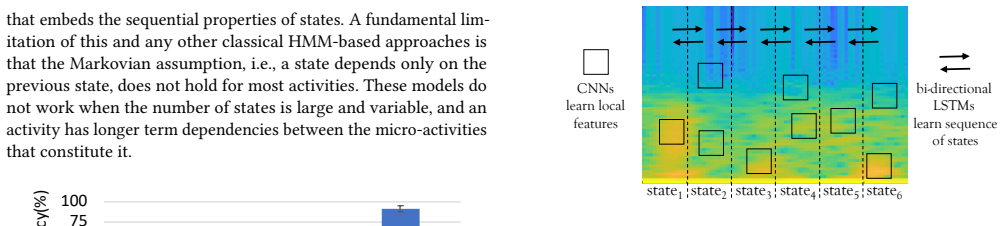
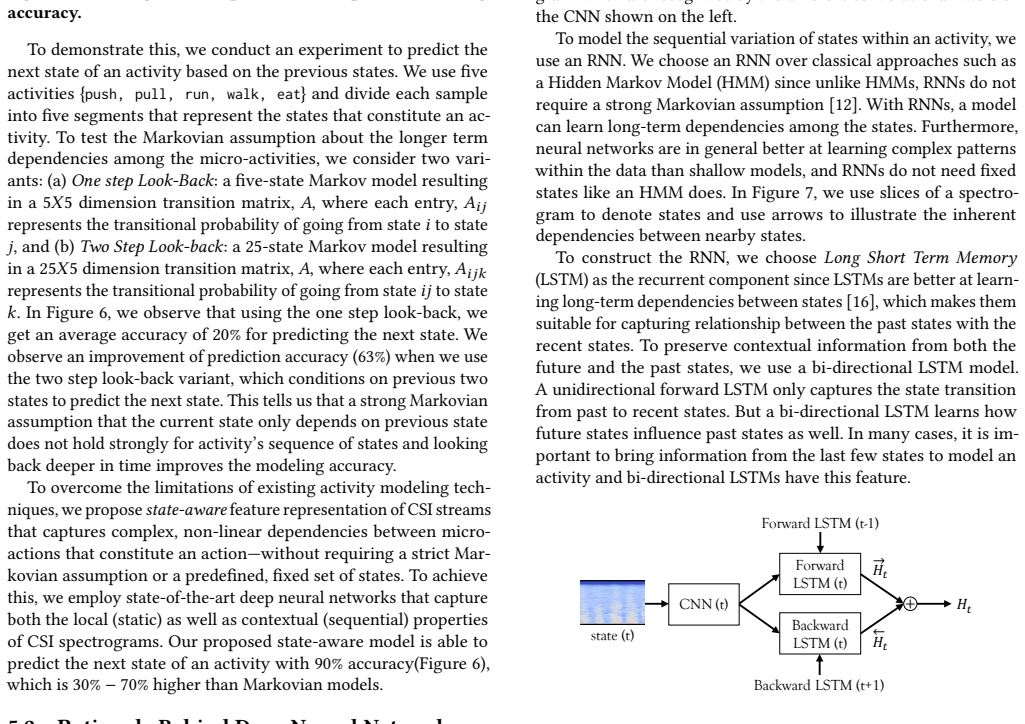
The load-bearing object is the joint cross-modal projection of the State-Aware Representation (SAR). SAR is a CSI-stream embedding produced by a CNN over spectrogram segments followed by a bi-directional LSTM, so it encodes both local spectral patterns and the temporal sequence of micro-states that make up an activity. Two fully connected heads then project SAR into the word-embedding space and the activity-attribute space; the final class score for an activity name $a_i$ is $P_i = d_i \cdot F_A + w_i \cdot F_W$, converted to probabilities by a softmax. This is what carries the argument: the only bridge between an untrained activity and its radio signature is the text-domain geometry shared by the seen and unseen names.
What would settle it
Train the cross-modal projection on seen classes recorded in one room with one set of volunteers, then test on unseen classes performed by different volunteers in a different room; if zero-shot accuracy on those unseen classes falls to near chance while seen-class accuracy remains high, the projection is encoding room- or person-specific signal statistics rather than the text-semantic relationship.
Extended reading notes
Core claim
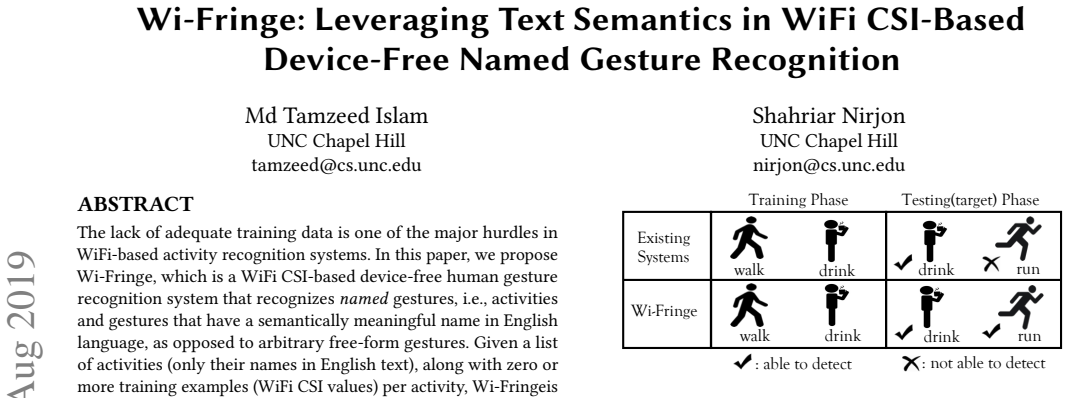
The paper's central claim is that zero-shot learning is possible for WiFi-based gesture recognition: a system can label an activity it has never seen in training, provided it knows the activity's English name and has trained on at least one semantically related activity. The mechanism is a learned cross-modal projection that sends a state-aware representation of a CSI stream into two text-derived vector spaces simultaneously—a word-embedding space, where words used in similar contexts are close, and an activity-attribute space, where verbs are described by binary attributes such as use of hands, legs, or objects. For a candidate activity name, the model scores the CSI segment by the dot product of its projected vector with that name's word embedding plus that name's attribute vector, then takes a softmax over the candidate labels. A separate threshold-based stage first decides whether the input comes from a seen or an unseen class, so seen classes are not confused with unseen ones. Because the projection is trained only to align seen activities with their text vectors, the paper argues it can generalize to unseen names whose text vectors lie near those of seen activities. The reported result is 62–90 percent accuracy as the number of unseen classes ranges from six to two, with baseline classifiers that lack the text projection stuck near random on unseen classes.
Load-bearing premise
The whole scheme stands on the assumption that the mapping learned from WiFi signals of a few seen activities to their text-vector counterparts transfers to activities, people, and rooms the system never saw during training.
Editorial extensions
If this is right
- A user could extend a deployed WiFi recognizer to a new gesture simply by typing its English name, with no new CSI recordings, as long as a semantically related trained class exists.
- The state-aware representation alone improves supervised recognition: seen-class accuracy reaches 82 percent versus 74 percent for a CNN classifier on the same data, and next-state prediction beats one- and two-step Markov baselines by 30–70 percentage points.
- The system degrades gracefully: accuracy falls from about 90 percent with two unseen classes to about 62 percent with six, and stays about 40 percentage points above random for seven unseen classes.
- Because the representation and projection components are modular, they can be combined with the environment- and multi-person-invariance methods the paper identifies as unsolved, potentially making zero-shot recognition robust to room and user changes.
Reading between the lines
- If the learned RF-to-text projection is genuinely semantic rather than a per-user fingerprint, the same projection idea should transfer across sensing modalities: an acoustic or body-worn inertial sensor with the same activity set could share the same text space, letting one modality's training data label another modality's test data. This is an extension the paper does not test.
- The reported experiments keep at least one semantically close seen class for every unseen class; a practical deployment could choose which activities to record so that their embedding neighborhoods cover the intended unseen vocabulary. The paper's own distance-sensitivity experiment, where accuracy for unseen pull drops from above 90 percent when push is the close seen class to about 60 percent wh
- The decisive untested boundary is environment and user transfer: the four volunteers and two rooms are shared between training and testing, so a leave-one-room-out or leave-one-user-out zero-shot evaluation would show whether the projection encodes semantics or room-specific radio statistics. This follows from the paper's own acknowledgment that environment and multi-person effects are not modeled
Signed reviews
Editorial analysis
A structured set of objections, weighed in public.
Referee Report
Summary. Wi-Fringe proposes a zero-shot learning system for WiFi CSI-based device-free activity recognition. The system maps a state-aware CSI representation (CNN plus bi-directional LSTM) onto two externally defined text-derived spaces: word2vec embeddings and verb attribute vectors from dictionary definitions. A two-stage classifier first decides whether an input segment belongs to a seen or unseen class using a K-means distance threshold, and then classifies the segment by softmax over the combined word-embedding and attribute projections. The paper reports 62--90% accuracy for two to six unseen classes on a newly collected dataset of 20 activities from four volunteers in two rooms, and claims to be the first RF-based zero-shot activity recognition system.
Significance. If the reported results are representative, the paper would make a meaningful contribution: it proposes a concrete mechanism for transferring semantic knowledge from text to RF sensing, introduces a state-aware representation that improves supervised classification, and provides a comparison of joint versus single-space projections. The work is also notable for collecting a 20-class WiFi CSI gesture dataset, which is larger than typical prior datasets. However, the core claim of recognizing arbitrary named activities without training examples is currently supported only under a favorable evaluation protocol, and the paper's own experiments show that performance degrades markedly as semantic distance between seen and unseen classes increases. The contribution is therefore significant but not yet convincingly established at the level claimed in the title and abstract.
major comments (4)
- [Sec. 9.1 and Sec. 9.4] The headline zero-shot accuracy is measured only on unseen classes that were deliberately selected to have at least one semantically close seen class. Sec. 9.1 states: 'while selecting unseen classes, we keep at least one class from the seen classes which is close to it in word embedding and attribute space,' and the same restriction is acknowledged in Sec. 9.4. This makes the 62--90% numbers a measure of a favorable regime, not of the claimed capability to recognize arbitrary user-supplied named activities. Figure 17 confirms that the selection rule is load-bearing: accuracy for pull drops from above 90% when push is the closest seen class to about 60% when kick is used. The evaluation should be repeated with unseen classes sampled independently of their semantic proximity to the seen classes, or the claims should be restricted to the semantically-adjacent setting.
- [Sec. 7.2 and Sec. 9.3] The seen-versus-unseen threshold Omega in Eq. (6) is tuned on the evaluated data. Sec. 9.3 reports that the optimum threshold is 4.75 based on the accuracy curves in Figure 15, with no separate validation split. Since the same threshold is used in the end-to-end evaluation of Sec. 9.4, the reported end-to-end accuracy includes information from the test distribution. The authors should either select Omega with a held-out set or report cross-validated seen/unseen detection accuracy.
- [Sec. 8.1, Sec. 8.5, and Sec. 10] All experiments train and test on the same four volunteers and the same two rooms. There is no user-independent or environment-independent evaluation, and Sec. 10 explicitly states that the representation 'does not consider environment or multi-person effect.' Because the central novelty is a cross-modal projection that must transfer to unseen classes, unseen users, and new environments, the current evidence does not establish that the projection generalizes beyond the training population. A leave-one-user-out or leave-one-room-out experiment is needed to support the deployment-level claim.
- [Sec. 9.1 and Fig. 17] The paper's own semantic-distance analysis reveals a sharp degradation that the abstract-level summary does not convey. Figure 17 shows accuracy falling from above 90% to about 60% as the joint word-embedding and attribute distance increases from push to kick. This suggests that the system is better described as recognizing unseen classes that are near seen classes, rather than recognizing unseen classes generally. The authors should report accuracy as a function of semantic distance for all unseen classes, not only for the selected favorable sets.
minor comments (6)
- [Abstract and Sec. 1] The phrase 'the first system, called the Wi-Fringe' is redundant; 'the first system' would suffice. Also, the text frequently presents 'Wi-Fringe' and 'Wi-Fringeis' as one word in the extracted text; these spacing issues should be corrected throughout.
- [Sec. 1, Contributions] The contribution bullet claims that Wi-Fringe 'beats state-of-the-art WiFi-based activity recognition algorithms by 30%,' but the reported comparison in Figure 14 shows an 8-percentage-point improvement over the CNN baseline (82% vs 74%) and about 20 percentage points over the SVM baseline (82% vs 62%). The 30% figure is not directly supported by the presented experiments and should be clarified or removed.
- [Sec. 5.1 and Fig. 6] The Markov-baseline experiment in Figure 6 is described only briefly. It is unclear how the states are defined and labeled for the one-step and two-step Markov models, and whether the 20% and 63% numbers correspond to the same state definitions used for the bi-LSTM. More detail is needed for this comparison to be interpretable.
- [Sec. 6.2] The claim that word2vec places 'run' closer to 'pull' than to 'walk' is interesting but is not backed by a quantitative example. Since the entire approach depends on the quality of the external embeddings, providing the actual distances or a small table would strengthen the motivation.
- [Sec. 8.4] The data augmentation procedure is described as increasing the dataset 'by about 20 times,' but it is not stated whether the augmented samples are used in both the projection training and the classification training, or only in one. This affects the interpretability of the supervised and zero-shot results.
- [Sec. 9.4 and Fig. 16] The end-to-end evaluation in Figure 16 does not report error bars or variance, although accuracy numbers are given in the text. For a dataset of this size, confidence intervals would help the reader assess the reliability of the 73--84% claims.
Circularity Check
No circularity: the RF-to-text projection is trained only on seen classes, and unseen-class labels are not used in training; the reported restriction to semantically close unseen classes is an explicit evaluation caveat rather than a definitional equivalence.
full rationale
Wi-Fringe's derivation chain is a standard zero-shot learning pipeline. The cross-modal projection is trained by minimizing the distance between the state-aware CSI representation of seen classes and external text-domain vectors (Word2Vec and attribute embeddings). Equations (2)-(5) score candidate labels by dot products between the projected CSI representation and the text vectors of the candidate class names; none of these equations uses the unseen class's CSI or its label during training. The unseen-class labels enter only at inference as user-provided candidate tags, exactly as the paper states: 'The user-provided additional labels do not have any influence on the training phase. They are only used in the classification step after the training has been completed.' Thus the core prediction is not equivalent to its inputs by construction. The main caveat is in Sec 9.1: 'while selecting unseen classes, we keep at least one class from the seen classes which is close to it in word embedding and attribute space.' This is an evaluation-selection rule that makes the reported 62-90% accuracy a measure of near-transfer rather than arbitrary zero-shot transfer. However, this is an explicitly acknowledged limitation, not a circular derivation: the method would still compute the same equations for distant classes, and Sec 10 and Fig. 17 even show accuracy degrading with semantic distance. The threshold Omega in Sec 7.2 is empirically tuned, but it gates seen vs. unseen and does not determine the unseen class label, so it is not a fitted parameter disguised as a prediction. The paper's self-citations ([20], [21], [52]) are not load-bearing: [21] is mentioned as prior zero-shot sound work and is explicitly said to be not directly applicable, and no uniqueness theorem from the authors' own prior work is invoked to force the design. The same-volunteer/same-room evaluation is a generalization risk, but the paper discloses it in Sec 10 ('The proposed representation learning algorithm does not consider environment or multi-person effect'), and this is a validity concern, not circularity. Overall, the derivation is self-contained with respect to its inputs, and no prediction reduces to a fit or to a self-citation chain.
Assumptions & free parameters
free parameters (5)
- segment count n =
5
- CNN depth and dense width =
3 layers, 16-64 channels, 1000-dim dense
- bi-LSTM hidden units =
500
- seen-vs-unseen threshold Omega =
4.75
- data augmentation factor =
20x
assumptions (5)
- domain assumption WiFi signal characteristics of an activity correlate with the semantic and attribute content of its English name (Sec 1: 'The intuition behind Wi-Fringe is that the WiFi signature of an activity correlates with the corresponding verb's semantic and attribute information').
- domain assumption Unseen classes must be semantically close to at least one seen class in word embedding and attribute space for zero-shot classification to work (Sec 9.1 and Sec 10).
- domain assumption The RF-to-text projection learned from four volunteers in two rooms transfers to new users, orientations, and environments (implicit in the Sec 8 protocol and acknowledged as an unhandled limitation in Sec 10).
- domain assumption Phase information in CSI is too noisy to use; only the amplitude is used (Sec 3.1).
- ad hoc to paper Markovian state dependence is insufficient; a bi-LSTM is needed to model micro-activity context (Sec 5.1).
Cite this review
Pith. "Pith review of Wi-Fringe: Leveraging Text Semantics in WiFi CSI-Based Device-Free Named Gesture Recognition." pith.science (2026). https://pith.science/paper/EG2WIANQ
@misc{pith2026190806803,
  author       = {Pith},
  title        = {Pith review of: Wi-Fringe: Leveraging Text Semantics in WiFi CSI-Based Device-Free Named Gesture Recognition},
  year         = {2026},
  howpublished = {\url{https://pith.science/paper/EG2WIANQ}},
  note         = {Machine review of arXiv:1908.06803}
}
read the original abstract
The lack of adequate training data is one of the major hurdles in WiFi-based activity recognition systems. In this paper, we propose Wi-Fringe, which is a WiFi CSI-based device-free human gesture recognition system that recognizes named gestures, i.e., activities and gestures that have a semantically meaningful name in English language, as opposed to arbitrary free-form gestures. Given a list of activities (only their names in English text), along with zero or more training examples (WiFi CSI values) per activity, Wi-Fringe is able to detect all activities at runtime. In other words, a subset of activities that Wi-Fringe detects do not require any training examples at all.
Figures


Figures from the paper (11 more)




Reference graph
Works this paper leans on
-
[1]
[n. d.]. Intel NUC mini PC. https://www.intel.com/content/www/us/en/products/ boards-kits/nuc.html. ([n. d.])
-
[2]
[n. d.]. Intel Ultimate N WiFi Link 5300. https://www.intel.com/content/www/ us/en/wireless-products/ultimate-n-wifi-link-5300-brief.html. ([n. d.])
-
[3]
[n. d.]. WordLink Dictionary API. https://developer.wordnik.com/. ([n. d.])
-
[4]
Heba Abdelnasser, Moustafa Youssef, and Khaled A Harras. 2015. Wigest: A ubiquitous wifi-based gesture recognition system. In Computer Communications (INFOCOM), 2015 IEEE Conference on . IEEE, 1472–1480
work page 2015
-
[5]
Fadel Adib and Dina Katabi. 2013. See through walls with WiFi! Vol. 43. ACM
work page 2013
-
[6]
Fadel Adib, Hongzi Mao, Zachary Kabelac, Dina Katabi, and Robert C Miller. 2015. Smart homes that monitor breathing and heart rate. In Proceedings of the 33rd annual ACM conference on human factors in computing systems . ACM, 837–846
work page 2015
-
[7]
Zeynep Akata, Florent Perronnin, Zaid Harchaoui, and Cordelia Schmid. 2016. Label-embedding for image classification. IEEE transactions on pattern analysis and machine intelligence 38, 7 (2016), 1425–1438
work page 2016
-
[8]
Davide Anguita, Alessandro Ghio, Luca Oneto, Xavier Parra, and Jorge L Reyes- Ortiz. 2012. Human activity recognition on smartphones using a multiclass hardware-friendly support vector machine. In International workshop on ambient assisted living. Springer, 216–223
work page 2012
Show all 75 references
-
[9]
Davide Anguita, Alessandro Ghio, Luca Oneto, Xavier Parra, and Jorge Luis Reyes-Ortiz. 2013. A public domain dataset for human activity recognition using smartphones.. In Esann
2013
-
[10]
Zhenghua Chen, Le Zhang, Chaoyang Jiang, Zhiguang Cao, and Wei Cui. 2018. WiFi CSI Based Passive Human Activity Recognition Using Attention Based BLSTM. IEEE Transactions on Mobile Computing (2018)
2018
-
[11]
Heng-Tze Cheng, Martin Griss, Paul Davis, Jianguo Li, and Di You. 2013. To- wards zero-shot learning for human activity recognition using semantic attribute sequence model. In Proceedings of the 2013 ACM international joint conference on Pervasive and ubiquitous computing . AC...
2013
-
[12]
Timothy DelSole. 2000. A fundamental limitation of Markov models. Journal of the atmospheric sciences 57, 13 (2000), 2158–2168
2000
-
[13]
Yan Duan, Marcin Andrychowicz, Bradly Stadie, OpenAI Jonathan Ho, Jonas Schneider, Ilya Sutskever, Pieter Abbeel, and Wojciech Zaremba. 2017. One- shot imitation learning. In Advances in neural information processing systems . 1087–1098
2017
-
[14]
John R Firth. 1957. A synopsis of linguistic theory, 1930-1955. Studies in linguistic analysis (1957)
1957
-
[15]
Andrea Frome, Greg S Corrado, Jon Shlens, Samy Bengio, Jeff Dean, Tomas Mikolov, et al. 2013. Devise: A deep visual-semantic embedding model. In Ad- vances in neural information processing systems . 2121–2129
2013
-
[16]
Ian Goodfellow, Yoshua Bengio, Aaron Courville, and Yoshua Bengio. 2016. Deep learning. Vol. 1. MIT press Cambridge
2016
-
[17]
Daniel Halperin, Wenjun Hu, Anmol Sheth, and David Wetherall. 2011. Tool release: Gathering 802.11 n traces with channel state information.ACM SIGCOMM Computer Communication Review 41, 1 (2011), 53–53
2011
-
[18]
Wenfeng He, Kaishun Wu, Yongpan Zou, and Zhong Ming. 2015. Wig: Wifi-based gesture recognition system. In Computer Communication and Networks (ICCCN), 2015 24th International Conference on . IEEE, 1–7
2015
-
[19]
Sepp Hochreiter. 1998. The vanishing gradient problem during learning recurrent neural nets and problem solutions. International Journal of Uncertainty, Fuzziness and Knowledge-Based Systems 6, 02 (1998), 107–116
1998
-
[20]
Md Tamzeed Islam, Bashima Islam, and Shahriar Nirjon. 2017. SoundSifter: Mitigating overhearing of continuous listening devices. In Proceedings of the 15th Annual International Conference on Mobile Systems, Applications, and Services . ACM, 29–41
2017
-
[21]
Md Tamzeed Islam and Shahriar Nirjon. 2019. SoundSemantics: exploiting seman- tic knowledge in text for embedded acoustic event classification. In Proceedings of the 18th International Conference on Information Processing in Sensor Networks . ACM, 217–228
2019
-
[22]
Wenjun Jiang, Chenglin Miao, Fenglong Ma, Shuochao Yao, Yaqing Wang, Ye Yuan, Hongfei Xue, Chen Song, Xin Ma, Dimitrios Koutsonikolas, et al . 2018. Towards Environment Independent Device Free Human Activity Recognition. In Proceedings of the 24th Annual International Conferen...
2018
-
[23]
Gregory Koch. 2015. Siamese neural networks for one-shot image recognition
2015
-
[24]
Elyor Kodirov, Tao Xiang, Zhenyong Fu, and Shaogang Gong. 2015. Unsupervised domain adaptation for zero-shot learning. In Proceedings of the IEEE International Conference on Computer Vision . 2452–2460
2015
-
[25]
Elyor Kodirov, Tao Xiang, and Shaogang Gong. 2017. Semantic autoencoder for zero-shot learning. arXiv preprint arXiv:1704.08345 (2017)
2017 arXiv
-
[26]
Ahmed E Kosba, Ahmed Saeed, and Moustafa Youssef. 2012. Rasid: A robust wlan device-free passive motion detection system. In Pervasive computing and communications (PerCom), 2012 IEEE international conference on . IEEE, 180–189
2012
-
[27]
K Krishna and Narasimha M Murty. 1999. Genetic K-means algorithm. IEEE Transactions on Systems Man And Cybernetics-Part B: Cybernetics 29, 3 (1999), 433–439. 13
1999
-
[28]
Jennifer R Kwapisz, Gary M Weiss, and Samuel A Moore. 2011. Activity recogni- tion using cell phone accelerometers. ACM SigKDD Explorations Newsletter 12, 2 (2011), 74–82
2011
-
[29]
Christoph H Lampert, Hannes Nickisch, and Stefan Harmeling. 2014. Attribute- based classification for zero-shot visual object categorization. IEEE Transactions on Pattern Analysis and Machine Intelligence 36, 3 (2014), 453–465
2014
-
[30]
Hong Li, Wei Yang, Jianxin Wang, Yang Xu, and Liusheng Huang. 2016. WiFinger: talk to your smart devices with finger-grained gesture. In Proceedings of the 2016 ACM International Joint Conference on Pervasive and Ubiquitous Computing. ACM, 250–261
2016
-
[31]
Kun Liu, Wu Liu, Huadong Ma, Wenbing Huang, and Xiongxiong Dong. 2017. Generalized Zero-Shot Learning for Action Recognition with Web-Scale Video Data. arXiv preprint arXiv:1710.07455 (2017)
2017 arXiv
-
[32]
Xuefeng Liu, Jiannong Cao, Shaojie Tang, and Jiaqi Wen. 2014. Wi-Sleep: Contact- less sleep monitoring via WiFi signals. In Real-Time Systems Symposium (RTSS), 2014 IEEE. IEEE, 346–355
2014
-
[33]
Xuefeng Liu, Jiannong Cao, Shaojie Tang, Jiaqi Wen, and Peng Guo. 2016. Con- tactless respiration monitoring via off-the-shelf WiFi devices. IEEE Transactions on Mobile Computing 15, 10 (2016), 2466–2479
2016
-
[34]
Wen-kai Lu and Qiang Zhang. 2009. Deconvolutive short-time Fourier transform spectrogram. IEEE Signal Processing Letters 16, 7 (2009), 576–579
2009
-
[35]
Junyi Ma, Hao Wang, Daqing Zhang, Yasha Wang, and Yuxiang Wang. 2016. A survey on wi-fi based contactless activity recognition. In Ubiquitous Intelligence & Computing, Advanced and Trusted Computing, Scalable Computing and Com- munications, Cloud and Big Data Computing, Intern...
2016
-
[36]
Naveen Madapana and Juan P Wachs. 2017. A semantical & analytical approach for zero shot gesture learning. In Automatic Face & Gesture Recognition (FG 2017), 2017 12th IEEE International Conference on . IEEE, 796–801
2017
-
[37]
Greg Malysa, Dan Wang, Lorin Netsch, and Murtaza Ali. 2016. Hidden Markov model-based gesture recognition with FMCW radar. In Signal and Information Processing (GlobalSIP), 2016 IEEE Global Conference on . IEEE, 1017–1021
2016
-
[38]
Tomas Mikolov, Kai Chen, Greg Corrado, and Jeffrey Dean. 2013. Efficient estimation of word representations in vector space.arXiv preprint arXiv:1301.3781 (2013)
2013 arXiv
-
[39]
Tomas Mikolov, Ilya Sutskever, Kai Chen, Greg S Corrado, and Jeff Dean. 2013. Distributed representations of words and phrases and their compositionality. In Advances in neural information processing systems . 3111–3119
2013
-
[40]
Mohammad Norouzi, Tomas Mikolov, Samy Bengio, Yoram Singer, Jonathon Shlens, Andrea Frome, Greg S Corrado, and Jeffrey Dean. 2013. Zero-shot learning by convex combination of semantic embeddings. arXiv preprint arXiv:1312.5650 (2013)
2013 arXiv
-
[41]
Mark Palatucci, Dean Pomerleau, Geoffrey E Hinton, and Tom M Mitchell. 2009. Zero-shot learning with semantic output codes. InAdvances in neural information processing systems. 1410–1418
2009
-
[42]
Sameera Palipana, David Rojas, Piyush Agrawal, and Dirk Pesch. 2018. FallDeFi: Ubiquitous Fall Detection using Commodity Wi-Fi Devices. Proceedings of the ACM on Interactive, Mobile, Wearable and Ubiquitous Technologies 1, 4 (2018), 155
2018
-
[43]
Mari Partio, Bogdan Cramariuc, Moncef Gabbouj, and Ari Visa. 2002. Rock texture retrieval using gray level co-occurrence matrix. In Proc. of 5th Nordic Signal Processing Symposium, Vol. 75. Citeseer
2002
-
[44]
Qifan Pu, Sidhant Gupta, Shyamnath Gollakota, and Shwetak Patel. 2013. Whole- home gesture recognition using wireless signals. InProceedings of the 19th annual international conference on Mobile computing & networking . ACM, 27–38
2013
-
[45]
Karthik Ramasubramanian. [n. d.]. Using a complex-baseband architecture in FMCW radar systems. ([n. d.])
-
[46]
Matthias Schulz, Daniel Wegemer, and Matthias Hollick. 2017. Nexmon: Build Your Own Wi-Fi Testbeds With Low-Level MAC and PHY-Access Using Firmware Patches on Off-the-Shelf Mobile Devices. In Proceedings of the 11th Workshop on Wireless Network Testbeds, Experimental Evaluatio...
2017
-
[47]
Ivan W Selesnick and C Sidney Burrus. 1998. Generalized digital Butterworth filter design. IEEE Transactions on signal processing 46, 6 (1998), 1688–1694
1998
-
[48]
Stephan Sigg, Ulf Blanke, and Gerhard Troster. 2014. The telepathic phone: Frictionless activity recognition from wifi-rssi. In Pervasive Computing and Com- munications (PerCom), 2014 IEEE International Conference on . IEEE, 148–155
2014
-
[49]
Stephan Sigg, Markus Scholz, Shuyu Shi, Yusheng Ji, and Michael Beigl. 2014. RF-sensing of activities from non-cooperative subjects in device-free recognition systems using ambient and local signals. IEEE Transactions on Mobile Computing 13, 4 (2014), 907–920
2014
-
[50]
Stephan Sigg, Shuyu Shi, and Yusheng Ji. 2013. Rf-based device-free recognition of simultaneously conducted activities. In Proceedings of the 2013 ACM conference on Pervasive and ubiquitous computing adjunct publication . ACM, 531–540
2013
-
[51]
Richard Socher, Milind Ganjoo, Christopher D Manning, and Andrew Ng. 2013. Zero-shot learning through cross-modal transfer. In Advances in neural informa- tion processing systems. 935–943
2013
-
[52]
Ravi Srinivasan, Md Tamzeed Islam, Bashima Islam, Zeyu Wang, Tamim Sookoor, Omprakash Gnawali, and Shahriar Nirjon. [n. d.]. Preventive Maintenance of Centralized HVAC Systems: Use of Acoustic Sensors, Feature Extraction, and Unsupervised Learning
-
[53]
Joseph Turian, Lev Ratinov, and Yoshua Bengio. 2010. Word representations: a simple and general method for semi-supervised learning. In Proceedings of the 48th annual meeting of the association for computational linguistics . Association for Computational Linguistics, 384–394
2010
-
[54]
Raghav H Venkatnarayan, Griffin Page, and Muhammad Shahzad. 2018. Multi- User Gesture Recognition Using WiFi. In Proceedings of the 16th Annual Interna- tional Conference on Mobile Systems, Applications, and Services . ACM, 401–413
2018
-
[55]
Oriol Vinyals, Charles Blundell, Tim Lillicrap, Daan Wierstra, et al. 2016. Match- ing networks for one shot learning. In Advances in Neural Information Processing Systems. 3630–3638
2016
-
[56]
Aditya Virmani and Muhammad Shahzad. 2017. Position and Orientation Agnos- tic Gesture Recognition Using WiFi. InProceedings of the 15th Annual International Conference on Mobile Systems, Applications, and Services . ACM, 252–264
2017
-
[57]
Fangxin Wang, Wei Gong, and Jiangchuan Liu. 2018. On Spatial Diversity in WiFi-based Human Activity Recognition: A Deep Learning based Approach.IEEE Internet of Things Journal (2018)
2018
-
[58]
Guanhua Wang, Yongpan Zou, Zimu Zhou, Kaishun Wu, and Lionel M Ni. 2016. We can hear you with wi-fi! IEEE Transactions on Mobile Computing 15, 11 (2016), 2907–2920
2016
-
[59]
Wei Wang, Alex X Liu, and Muhammad Shahzad. 2016. Gait recognition using wifi signals. In Proceedings of the 2016 ACM International Joint Conference on Pervasive and Ubiquitous Computing . ACM, 363–373
2016
-
[60]
Wei Wang, Alex X Liu, Muhammad Shahzad, Kang Ling, and Sanglu Lu. 2015. Understanding and modeling of wifi signal based human activity recognition. In Proceedings of the 21st Annual International Conference on Mobile Computing and Networking. ACM, 65–76
2015
-
[61]
Yi Wang, Xinli Jiang, Rongyu Cao, and Xiyang Wang. 2015. Robust indoor human activity recognition using wireless signals. Sensors 15, 7 (2015), 17195–17208
2015
-
[62]
Yan Wang, Jian Liu, Yingying Chen, Marco Gruteser, Jie Yang, and Hongbo Liu
-
[63]
Yuxi Wang, Kaishun Wu, and Lionel M Ni. 2017. Wifall: Device-free fall detection by wireless networks. IEEE Transactions on Mobile Computing 16, 2 (2017), 581– 594
2017
-
[64]
B Wu. 1992. An introduction to neural networks and their applications in manufacturing. Journal of Intelligent Manufacturing 3, 6 (1992), 391–403
1992
-
[65]
Wei Xi, Jizhong Zhao, Xiang-Yang Li, Kun Zhao, Shaojie Tang, Xue Liu, and Zhiping Jiang. 2014. Electronic frog eye: Counting crowd using wifi. In Infocom, 2014 proceedings ieee . IEEE, 361–369
2014
-
[66]
Yongqin Xian, Zeynep Akata, Gaurav Sharma, Quynh Nguyen, Matthias Hein, and Bernt Schiele. 2016. Latent embeddings for zero-shot classification. InProceedings of the IEEE Conference on Computer Vision and Pattern Recognition . 69–77
2016
-
[67]
Xun Xu, Timothy Hospedales, and Shaogang Gong. 2017. Transductive zero-shot action recognition by word-vector embedding. International Journal of Computer Vision 123, 3 (2017), 309–333
2017
-
[68]
Shichao Yue, Hao He, Hao Wang, Hariharan Rahul, and Dina Katabi. 2018. Ex- tracting Multi-Person Respiration from Entangled RF Signals. Proceedings of the ACM on Interactive, Mobile, Wearable and Ubiquitous Technologies 2, 2 (2018), 86
2018
-
[69]
Rowan Zellers and Yejin Choi. 2017. Zero-shot activity recognition with verb attribute induction. arXiv preprint arXiv:1707.09468 (2017)
2017 arXiv
-
[70]
Ziming Zhang and Venkatesh Saligrama. 2015. Zero-shot learning via seman- tic similarity embedding. In Proceedings of the IEEE international conference on computer vision. 4166–4174
2015
-
[71]
Mingmin Zhao, Fadel Adib, and Dina Katabi. 2016. Emotion recognition using wireless signals. In Proceedings of the 22nd Annual International Conference on Mobile Computing and Networking . ACM, 95–108
2016
-
[72]
Zheng Y., Zhang Y
Qian K Yang Z. Zheng Y., Zhang Y. 2019. Zero-Effort Cross-Domain Gesture Recognition with Wi-Fi. (2019)
2019
-
[73]
Han Zou, Yuxun Zhou, Jianfei Yang, Hao Jiang, Lihua Xie, and Costas J Spanos
-
[2014]
In Proceedings of the 20th annual international conference on Mobile computing and networking
E-eyes: device-free location-oriented activity identification using fine- grained wifi signatures. In Proceedings of the 20th annual international conference on Mobile computing and networking . ACM, 617–628
-
[2018]
In 2018 IEEE International Conference on Communications (ICC)
Deepsense: Device-free human activity recognition via autoencoder long- term recurrent convolutional network. In 2018 IEEE International Conference on Communications (ICC). IEEE, 1–6. 14
2018
Reviewed August 14, 2026 · model on record in the stance chip above.
Discussion (0). Continue with ORCID to comment.