REVIEW 2 major objections 10 minor 57 references
Hardware-efficient erasure-error detection with an integer fluxonium
T0 review · 2 major / 10 minor · reviewed 2026-07-30 · grok-4.5
Pith's one-line read A single integer fluxonium turns most relaxation into detectable erasures and checks them without an ancilla, cutting gate error in half after postselection.
desk verdict Solid ancilla-free erasure-check experiment on integer fluxonium with honest postselected gains; check back-action keeps it from being a high-bias erasure qubit yet. read the letter →
The pith
A machine-rendered reading of the paper's core claim, the machinery that carries it, and where it could break.
The reading
What carries the argument
Integer-fluxonium g–f encoding at zero flux: parity and wave-function support forbid direct |f⟩↔|g⟩ transitions while a parameter window nulls the logical resonator shift χ_gf ≪ χ_ge, enabling the same resonator to discriminate |e⟩ without dephasing the computational manifold.
What would settle it
Repeat the lifetime, echo and randomized-benchmarking sequences while deliberately increasing the erasure-check photon number or duration; if the post-selected gains reverse or the residual Pauli error rises faster than the discarded leakage, the claimed net benefit of ancilla-free checks disappears.
Extended reading notes
Core claim
In a single integer fluxonium encoded with logical states |g⟩ and |f⟩ and erasure state |e⟩, the architecture converts the dominant |f⟩→|e⟩ decays into detectable erasures and supports ancilla-free mid-circuit checks on the shared readout resonator because the logical dispersive shift can be nulled. Post-selecting against those checks yields an 8.4-fold rise in |f⟩ lifetime (to 5.087 ± 0.685 ms), a 1.38-fold Hahn-echo gain (to 620 ± 14 µs), and average single-qubit gate error reduced from 0.061(2) % to 0.030(5) %, with roughly 94 % of leakage identified.
Load-bearing premise
The mid-circuit resonator checks themselves must not convert erasures into undetected Pauli errors faster than post-selection can remove them; the measured false-negative rate and excess check-induced error show this is still fragile.
Editorial extensions
If this is right
- A single physical qubit plus one shared resonator can supply both final readout and mid-circuit erasure flags, cutting the hardware overhead of dual-rail erasure qubits.
- Post-selection already halves single-qubit gate error and multiplies T1 by eight, giving a concrete near-term performance boost even before full error correction.
- Because erasures are strongly state-asymmetric (mostly from |f⟩), erasure-aware decoders gain free prior information that can raise thresholds further.
- Zero-flux operation reduces the bias current needed relative to half-flux fluxonium, lowering potential heating from bias lines.
Reading between the lines
- If the check-induced collapse of the erasure-state lifetime can be cured—by a weaker drive, a dedicated ancilla, or bath engineering—the same device geometry would immediately satisfy the high erasure-bias condition the authors still lack.
- The demonstrated χ_gf-nulling window is fabrication-tolerant enough that multi-qubit chips could share a common resonator design rule, simplifying scaling of ancilla-free erasure lattices.
- State-asymmetric erasures plus the measured false-negative statistics supply a concrete noise model that existing erasure-aware surface-code simulators can plug in today to forecast logical thresholds.
Editorial analysis
A structured set of objections, weighed in public.
Referee Report
Summary. The manuscript demonstrates a single integer fluxonium operated as a g–f erasure qubit, with logical states |g>,|f> and erasure state |e>. Two enabling device properties are established: (i) a relaxation hierarchy T1^{f→e} ≈ 0.4–0.6 ms versus T1^{f→g} ≈ 4–6 ms, so most |f> decay is convertible to detectable erasures; and (ii) a design point with chi_ge/2pi = 1.86±0.03 MHz and chi_gf/2pi = −11.9±13.8 kHz, enabling ancilla-free mid-circuit erasure checks through the same resonator used for final readout. Postselecting against detected erasures yields conditional improvements: |f> lifetime 0.606→5.087 ms (8.4x), Hahn echo 450→620 µs (1.38x), and RB error per sqrt(X) 0.061(2)%→0.030(5)%, with ~94% of leakage identified. The authors characterize check imperfections — 0.4% false positives, 7.8% false negatives traced to a check-induced collapse of T1^{e→g} to ~20 µs (App. L), 374 Hz induced decoherence versus 17.6 Hz predicted pure dephasing, and 2.49% added error per check of unknown origin — and explicitly state the device does not yet satisfy the erasure-bias condition.
Significance. If the results hold, this is a useful hardware-level advance for erasure-qubit architectures: it replaces the dual-rail-plus-ancilla footprint with a single three-level device whose readout resonator performs both erasure checks and final readout. Strengths that deserve emphasis: the central claims are measured device metrics, not simulations — conditional T1, echo, and RB improvements are each shown with multi-cadence data; the chi_gf-nulling design point is confirmed spectroscopically with uncertainties; the leakage accounting combines LRB with direct classification-error histograms; and the Monte-Carlo postselection model reproduces the non-exponential postselected decay, supporting the T_f→g extraction. The authors also report the check's failure modes (7.8% false negatives, 2.49%/check excess error of unknown origin) rather than burying them, and correctly stop short of claiming erasure bias. The work sits within current consensus on erasure qubits; correctness risk is confined to the quantitative severity of check back-action, which my major comments ask the authors to compute from existing data.
major comments (2)
- [§III.E.2, §IV, App. L] §III.E.2, §IV, App. L: The manuscript's central caveat — that missed erasures degrade erasure bias — is left qualitative, yet the paper's own numbers quantify it and the result is material to the platform claim. Single-check false negatives (7.8%, from the check-induced collapse of T_e→g to ~20 µs) plus between-check e→g decay at the natural T_e→g (~3% at 16 µs cadence) imply ~11% of f→e events terminate as undetected |f>→|g> bit flips: an injected Pauli rate ~Gamma_f→e × 0.11 ≈ 220 Hz for a qubit in |f>, comparable to the bare Gamma_f→g ≈ 1/(4–6 ms). The effective bias thus falls from ~10:1 to ~5:1 precisely when the checks run. Please add this accounting — detected-erasure vs undetected-Pauli rates at the demonstrated cadences. All inputs are already measured; no new data are needed.
- [Fig. 4(d,e), Fig. 5(d), Eq. (3)] Two quantitative points need reconciliation. (i) Fig. 4(e) shows Pauli error flat vs check cadence, yet the missed-erasure cascade should inject Pauli error growing with check rate. A rough estimate gives only ~10^-3 %/sqrt(X) at the 80-Clifford cadence — below LRB resolution — so the flatness is expected; please state this bound explicitly so Fig. 4(e) is not read as excluding the cascade channel. (ii) The 2.49±0.19% added error per check is 5x the Eq. (3) incoherent budget and of unknown origin. Please decompose it into leakage vs Pauli using the cadence-resolved LRB data already in hand, and report the per-check added error after postselection (the operationally relevant figure). If the excess is mostly detectable leakage, the platform conclusion is strengthened; if Pauli, the §IV bias concern is sharpened — either answer changes the interpretation of the headline RB result.
minor comments (10)
- [§III.E.4, Eq. (3)] Eq. (3): the two lines use inconsistent conventions — 1/2 vs 1/3 on the T1^{f→e} term, and T_phi^E vs T2^E. The first line appears to be an editing remnant. Also, using 1/3 sits oddly with App. F, which derives t/(2 T1^{f→e}) for the leakage contribution to gate fidelity; the 1/2 choice would raise the budget to ~0.52%. The conclusion (excess >> budget) is unchanged, but the formula should be internally consistent.
- [Abstract / §III.D] The RB improvement is quoted as 0.061(2)% → 0.030(5)%, i.e. relative to the checks-present value; the no-check baseline is 0.049(2)%. Please also state the net improvement versus no checks (0.049% → 0.030%), which is the operationally relevant figure for the proposed operating mode.
- [§II.B, final paragraph] The claim that no-click back-action 'conserves state purity and can be echoed away' needs justification or a reference. For a superposition input, conditional no-jump evolution is a deterministic but non-unitary amplitude reweighting of |g> vs |f>; clarify in what sense it cancels in the echo/RB measurements.
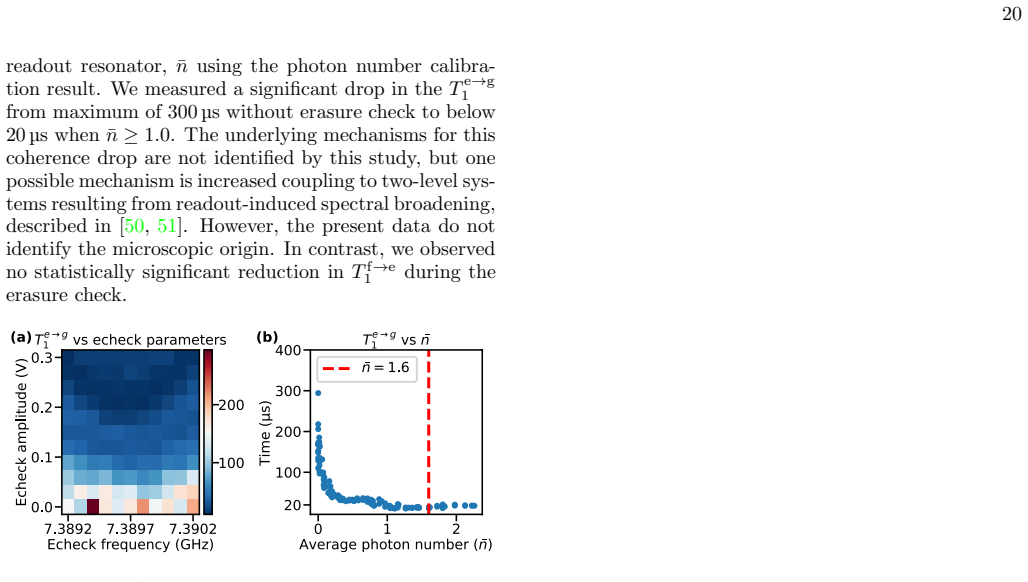
- [§III.E.2 / App. L] Since a JTWPA provides high readout efficiency, state whether reducing nbar (with longer integration) or re-optimizing the check frequency was explored to mitigate the T_e→g collapse. Fig. 13 suggests nbar organizes the data — is the collapse purely nbar-dependent at fixed detuning? This is the dominant missed-erasure channel, so even negative results are worth reporting.
- [Table II, App. B] State which cooldown (Cycle 1 or 2) produced the main-text results. kappa_i differs 5.6x between cycles (0.078 vs 0.439 MHz), suggesting parameter drift; please comment on the reproducibility of the chi_gf nulling across cooldowns.
- [§III.D] State explicitly how '94% of leakage identified' is computed: the postselection rate 0.039(1)%/sqrt(X) exceeds the LRB leakage 0.033(6)%/sqrt(X), so the figure cannot be a simple ratio of those two numbers.
- [§II.B vs Fig. 1(b) caption] Well positions are given as phi/2pi = ±1 in the text but 'approximately ±2pi' in the figure caption — reconcile the units/phrasing.
- [Note added / Refs. [34, 36]] Please add one or two sentences delineating the delta over prior/concurrent single-fluxonium erasure work [34, 36] — e.g., that those establish erasure conversion whereas this work adds ancilla-free mid-circuit checks via chi_gf nulling and postselected RB — rather than leaving this to the note added.
- [Fig. 4(e), Fig. 5(a)] 'Cadence' is expressed in Cliffords in RB (Fig. 4) and microseconds in the coherence measurements (Fig. 3); give the µs equivalents (50–140 Cliffords ≈ 11–31 µs) to ease comparison. Fig. 5(a): the false-positive rate 0.4±1.0% has an uncertainty exceeding the central value — consider quoting an upper bound.
- [Throughout] Typos/typesetting: heading 'MEASUREMENT RESUL TS'; 'evaulate' (end of §II.C); 'neaer' (App. E); 'Nubmber of Cliffords' (Fig. 10 axis); 'to approximately models' (App. D.2); missing spaces around kets in the abstract ('states|g>,|f>encode').
Circularity Check
No significant circularity: central claims are measured device metrics (spectra, χ, T1/T2E, RB/LRB, classification errors), not tautologies from fitted definitions or self-citation chains.
full rationale
This is an experimental device paper. Load-bearing results—χ_ge ≫ |χ_gf|, T_f→e ≪ T_f→g, postselected lifetime/echo/gate gains, false-positive/negative rates, and LRB error budgets—are obtained from independent measurements (spectroscopy, population decay, Hahn echo, Clifford RB with mid-circuit checks, IQ histograms). Spectroscopy-fitted E_C, E_J, E_L and AC-Stark-calibrated n̄ are standard instrument parameters used to operate and model the device, not recycled as theoretical “predictions.” The χ_gf≈0 design space is Hamiltonian-simulated then measured on the fabricated chip; agreement is empirical validation, not definitional identity. Postselected T1 “reflecting” fitted T_f→g is a consistency check between two analyses of decay data, not a forced prediction. Theory comparisons (measurement-induced dephasing Eq. 1 vs measured 374 Hz; incoherent check-error budget Eq. 3 vs 2.49%) explicitly report discrepancies rather than claiming success by construction. Self-citations (integer-fluxonium / g-f erasure literature) supply context and related proposals; none is a uniqueness theorem that forces the experimental claims. No step reduces a claimed first-principles or predictive result to its own fitted input.
Assumptions & free parameters
free parameters (6)
- Fluxonium energies EC, EJ, EL =
EC/h=1.392 GHz, EJ/h=5.056 GHz, EL/h=0.193 GHz (cycle 1)
- Qubit-resonator coupling g and resonator κi, κc =
g/2π≈97 MHz; κc/2π≈1.37 MHz, κi/2π≈0.078 MHz (cycle 1)
- Erasure-check frequency, duration, amplitude (¯n) =
1.1 µs, ¯n≈1.7 on |e⟩, fd=7.39020 GHz (cycle 1)
- Effective rates Tf→e, Te→g, Tf→g and Tqb in three-state fit =
Tf→e~400–600 µs; Te→g~200–300 µs; Tf→g~4–6 ms
- Two-photon gate drive amplitude and frequency =
70 ns plateau, 10 ns edges; values from iterative calibration (Fig. 14)
- ¯n/V_RO^2 Stark calibration constant =
¯n/V_RO^2=25.3 V^-2
assumptions (6)
- domain assumption Markovian three-level rate equations (and thermal detailed balance) adequately describe |g⟩,|e⟩,|f⟩ population dynamics between checks.
- domain assumption Dispersive circuit-QED measurement theory (χ shifts, measurement-induced dephasing formula) applies to the erasure check.
- domain assumption Parity selection at zero flux forbids one-photon |g⟩↔|f⟩; computational gates proceed via effective two-photon drive through |e⟩.
- domain assumption Leakage randomized benchmarking (Wood–Gambetta-type) correctly partitions Pauli vs leakage per √X under the implemented Clifford decomposition.
- standard math Standard rotating-wave and adiabatic-elimination approximations for the driven three-level system.
- ad hoc to paper Postselection on mid-circuit |e⟩ detections is a valid proxy for the benefit of erasure information in this characterization (not a full fault-tolerant decoder).
Cite this review
Pith. "Pith review of Hardware-efficient erasure-error detection with an integer fluxonium." pith.science (2026). https://pith.science/paper/EGADUBPI
@misc{pith2026260727123,
  author       = {Pith},
  title        = {Pith review of: Hardware-efficient erasure-error detection with an integer fluxonium},
  year         = {2026},
  howpublished = {\url{https://pith.science/paper/EGADUBPI}},
  note         = {Machine review of arXiv:2607.27123}
}
abstract
Erasure-error detection can improve the efficiency of quantum error correction by revealing the times and locations of their error events. In this work, we demonstrate erasure conversions and mid-circuit erasure detections in a single integer fluxonium, in which the states $\mathrm{|g\rangle, |f\rangle}$ encode the logical states and $\mathrm{|e\rangle}$ encodes the erasure state. The integer fluxonium suppresses direct $|\mathrm{f} \rangle \rightarrow |\mathrm{g} \rangle$ transitions and allows the dominant $|\mathrm{f} \rangle \rightarrow |\mathrm{e}\rangle$ transitions to be converted into detectable erasures. Furthermore, we identified a design space that nullifies the resonant-frequency shift between the two logical states, enabling ancilla-free mid-circuit erasure checks using the same resonator employed for final readout. By discarding the detected erasure events, we achieved an 8.4-fold increase in the $|\mathrm{f}\rangle$ state lifetime, a 1.38-fold increase in the Hahn-echo time, and a reduction of single-qubit gate error from 0.061(2)% to 0.030(5)%. Our results establish integer fluxonium as a hardware-efficient platform for erasure-error detection and conversion, while identifying the improvements required to realize an effective erasure qubit with high erasure bias.
Figures


Figures from the paper (10 more)



Reference graph
Works this paper leans on
-
[1]
We calculated this error rate as 1 2 [P(e|f) + P(e|g)], for which we measured a value of 0.4±1.0% [Fig
False-positive error rate The false-positive error rate denotes the probabil- ity that a logical state (|f⟩or|g⟩) is misclassified as the erasure state|e⟩. We calculated this error rate as 1 2 [P(e|f) + P(e|g)], for which we measured a value of 0.4±1.0% [Fig. 5(a)]. This error predominantly occurred when the system was initialized in|f⟩, which can be seen...
-
[2]
We measured a significantly higher false-negative error rate of 7.8±1.7% compared to false-positive error rate
False-negative error rate False-negative error rate is the probability of failing to detect a prepared erasure state, calculated as 1−P(e|e). We measured a significantly higher false-negative error rate of 7.8±1.7% compared to false-positive error rate. This value exceeds the limit expected from intrinsic re- laxation alone. We attribute this enhancement ...
-
[3]
From a linear fit, we extracted the erasure-check- induced decoherence rate of ∆Γ echeck 2E /2π=374±72 Hz [Fig
Erasure-check-induced decoherence The erasure-check-induced decoherence was calculated by comparing the Hahn-echo decoherence rates measured with and without the erasure checks across various ca- dences. From a linear fit, we extracted the erasure-check- induced decoherence rate of ∆Γ echeck 2E /2π=374±72 Hz [Fig. 5(c)]. We compared the erasure-check-indu...
-
[4]
Erasure-check-induced gate error Lastly, the erasure-check-induced gate error is obtained by comparing the average gate fidelity with and without the erasure checks as a function of number of erasure checks per √ Xgate [Fig. 5(d)]. From the linear fit, we estimate each erasure check adds 2.49±0.19% additional error. Since each erasure check adds additiona...
-
[5]
J. Preskill, Reliable quantum computers, Proceed- ings of the Royal Society A: Mathematical, Phys- ical and Engineering Sciences454, 385 (1998), https://royalsocietypublishing.org/rspa/article- pdf/454/1969/385/633961/rspa.1998.0167.pdf
arXiv 1998
-
[6]
Acharya, D
R. Acharya, D. A. Abanin, L. Aghababaie-Beni, I. Aleiner, T. I. Andersen, M. Ansmann, F. Arute, K. Arya, A. Asfaw, N. Astrakhantsev, J. Atalaya, R. Babbush, D. Bacon, B. Ballard, J. C. Bardin, J. Bausch, A. Bengtsson, A. Bilmes, S. Blackwell, S. Boixo, G. Bortoli, A. Bourassa, J. Bovaird, L. Brill, M. Broughton, D. A. Browne, B. Buchea, B. B. Buck- ley, D...
2025
-
[7]
Bravyi and A
S. Bravyi and A. Vargo, Simulation of rare events in quantum error correction, Phys. Rev. A88, 062308 (2013)
2013
-
[8]
A. G. Fowler, Analytic asymptotic performance of topo- logical codes, Phys. Rev. A87, 040301(R) (2013)
2013
Show all 57 references
-
[9]
F. H. E. Watson and S. D. Barrett, Logical error rate scal- ing of the toric code, New Journal of Physics16, 093045 (2014)
2014
-
[10]
A. G. Fowler, M. Mariantoni, J. M. Martinis, and A. N. Cleland, Surface codes: Towards practical large-scale quantum computation, Phys. Rev. A86, 032324 (2012)
2012
-
[11]
Grassl, T
M. Grassl, T. Beth, and T. Pellizzari, Codes for the quan- tum erasure channel, Phys. Rev. A56, 33 (1997)
1997
-
[12]
C. H. Bennett, D. P. DiVincenzo, and J. A. Smolin, Ca- pacities of quantum erasure channels, Phys. Rev. Lett. 78, 3217 (1997)
1997
-
[13]
Dumer, A
I. Dumer, A. A. Kovalev, and L. P. Pryadko, Thresh- olds for correcting errors, erasures, and faulty syndrome measurements in degenerate quantum codes, Phys. Rev. Lett.115, 050502 (2015)
2015
-
[14]
Knill, Scalable quantum computing in the presence of large detected-error rates, Phys
E. Knill, Scalable quantum computing in the presence of large detected-error rates, Phys. Rev. A71, 042322 (2005)
2005
-
[15]
T. M. Stace, S. D. Barrett, and A. C. Doherty, Thresholds for topological codes in the presence of loss, Phys. Rev. Lett.102, 200501 (2009)
2009
-
[16]
S. D. Barrett and T. M. Stace, Fault tolerant quantum computation with very high threshold for loss errors, Phys. Rev. Lett.105, 200502 (2010)
2010
-
[17]
Colmenarez, S
L. Colmenarez, S. Kim, and M. M¨ uller, Fundamental thresholds for computational and erasure errors via the coherent information, PRX Quantum6, 040327 (2025)
2025
-
[18]
S. Gu, A. Retzker, and A. Kubica, Fault-tolerant quan- tum architectures based on erasure qubits, Phys. Rev. Res.7, 013249 (2025)
2025
-
[19]
Sahay, J
K. Sahay, J. Jin, J. Claes, J. D. Thompson, and S. Puri, High-threshold codes for neutral-atom qubits with biased erasure errors, Phys. Rev. X13, 041013 (2023)
2023
-
[20]
Kubica, A
A. Kubica, A. Haim, Y. Vaknin, H. Levine, F. Brand˜ ao, and A. Retzker, Erasure qubits: Overcoming theT 1 limit in superconducting circuits, Phys. Rev. X13, 041022 (2023)
2023
-
[21]
S. Gu, Y. Vaknin, A. Retzker, and A. Kubica, Optimizing quantum error-correction protocols with erasure qubits, PRX Quantum6, 040354 (2025)
2025
-
[22]
Acharya, I
R. Acharya, I. Aleiner, R. Allen, T. I. Andersen, M. Ans- mann, F. Arute, K. Arya, A. Asfaw, J. Atalaya, R. Bab- bush, D. Bacon, J. C. Bardin, J. Basso, A. Bengtsson, S. Boixo, G. Bortoli, A. Bourassa, J. Bovaird, L. Brill, M. Broughton, B. B. Buckley, D. A. Buell, T. Burger, ...
2023
-
[23]
Z. Chen, J. Kelly, C. Quintana, R. Barends, B. Camp- bell, Y. Chen, B. Chiaro, A. Dunsworth, A. G. Fowler, E. Lucero, E. Jeffrey, A. Megrant, J. Mutus, M. Nee- ley, C. Neill, P. J. J. O’Malley, P. Roushan, D. Sank, A. Vainsencher, J. Wenner, T. C. White, A. N. Korotkov, and J....
2016
-
[24]
Chiaro and Y
B. Chiaro and Y. Zhang, Active leakage cancellation in single qubit gates, Phys. Rev. Lett.135, 130601 (2025)
2025
-
[25]
Y. Xin, S. L. M. van der Meer, M. Serra-Peralta, T. H. F. Vroomans, M. Finkel, H. M. Veen, M. W. Beekman, and L. DiCarlo, Improved error correction with leakage re- duction units built into qubit measurement in a super- conducting quantum processor (2025), arXiv:2511.17460 [quant-ph]
2025
-
[26]
X. Yang, J. Chu, Z. Guo, W. Huang, Y. Liang, J. Liu, J. Qiu, X. Sun, Z. Tao, J. Zhang, J. Zhang, L. Zhang, Y. Zhou, W. Guo, L. Hu, J. Jiang, Y. Liu, X. Linpeng, T. Chen, Y. Chen, J. Niu, S. Liu, Y. Zhong, and D. Yu, Coupler-assisted leakage reduction for scalable quantum error...
2024
-
[27]
Lacroix, L
N. Lacroix, L. Hofele, A. Remm, O. Benhayoune- Khadraoui, A. McDonald, R. Shillito, S. Lazar, C. Hellings, F. m. c. Swiadek, D. Colao-Zanuz, A. Flasby, M. B. Panah, M. Kerschbaum, G. J. Norris, A. Blais, A. Wallraff, and S. Krinner, Fast flux-activated leakage reduction for su...
2025
-
[28]
J. F. Marques, H. Ali, B. M. Varbanov, M. Finkel, H. M. Veen, S. L. M. van der Meer, S. Valles-Sanclemente, N. Muthusubramanian, M. Beekman, N. Haider, B. M. Terhal, and L. DiCarlo, All-microwave leakage reduction units for quantum error correction with superconducting transmo...
2023
-
[29]
Shim and C
Y.-P. Shim and C. Tahan, Semiconductor-inspired design principles for superconducting quantum computing, Na- ture Communications7, 11059 (2016)
2016
-
[30]
D. L. Campbell, Y.-P. Shim, B. Kannan, R. Winik, D. K. Kim, A. Melville, B. M. Niedzielski, J. L. Yo- der, C. Tahan, S. Gustavsson, and W. D. Oliver, Uni- versal nonadiabatic control of small-gap superconducting qubits, Phys. Rev. X10, 041051 (2020)
2020
-
[31]
Levine, A
H. Levine, A. Haim, J. S. C. Hung, N. Alidoust, M. Kalaee, L. DeLorenzo, E. A. Wollack, P. Arrangoiz- Arriola, A. Khalajhedayati, R. Sanil, H. Moradinejad, Y. Vaknin, A. Kubica, D. Hover, S. Aghaeimeibodi, J. A. Alcid, C. Baek, J. Barnett, K. Bawdekar, P. Bienias, H. A. Carson...
2024
-
[32]
Huang, X
W. Huang, X. Sun, J. Zhang, Z. Guo, P. Huang, Y. Liang, Y. Liu, D. Sun, Z. Wang, Y. Xiong, X. Yang, J. Zhang, L. Zhang, J. Chu, W. Guo, J. Jiang, S. Liu, J. Niu, J. Qiu, Z. Tao, Y. Zhou, X. Linpeng, Y. Zhong, and D. Yu, Logical multi-qubit entanglement with dual-rail supercond...
2026 doi
-
[33]
J. S.-C. Hung, A. Haim, M. Raha, G. Kim, Z. Huang, M.-H. Chou, M. D’Ewart, E. Davis, A. Mishra, P. A. Ar- riola, A. Khalajhedayati, D. Hover, F. G. S. L. Brand˜ ao, A. A. Clerk, A. Retzker, H. Levine, and O. Painter, Fast, high-fidelity erasure detection of dual-rail qubits wi...
2026 arXiv
-
[34]
K. S. Chou, T. Shemma, H. McCarrick, T.-C. Chien, J. D. Teoh, P. Winkel, A. Anderson, J. Chen, J. C. Cur- tis, S. J. de Graaf, J. W. O. Garmon, B. Gudlewski, W. D. Kalfus, T. Keen, N. Khedkar, C. U. Lei, G. Liu, P. Lu, Y. Lu, A. Maiti, L. Mastalli-Kelly, N. Mehta, S. O. Mundha...
2024
-
[35]
S. J. de Graaf, S. H. Xue, B. J. Chapman, J. D. Teoh, T. Tsunoda, P. Winkel, J. W. O. Garmon, K. M. Chang, L. Frunzio, S. Puri, and R. J. Schoelkopf, A mid-circuit erasure check on a dual-rail cavity qubit using the joint- photon number-splitting regime of circuit qed, npj Qua...
2025
-
[36]
Koottandavida, I
A. Koottandavida, I. Tsioutsios, A. Kargioti, C. R. Smith, V. R. Joshi, W. Dai, J. D. Teoh, J. C. Curtis, L. Frunzio, R. J. Schoelkopf, and M. H. Devoret, Erasure detection of a dual-rail qubit encoded in a double-post superconducting cavity, Phys. Rev. Lett.132, 180601 (2024)
2024
-
[37]
Mehta, J
N. Mehta, J. D. Teoh, T. Noh, A. Agrawal, A. An- derson, B. Birdsall, A. Brahmbhatt, W. Byrd, M. Ca- cioppo, A. Cabrera, L. Carroll, J. Chen, T.-C. Chien, R. Chamberlain, J. C. Curtis, D. Danso, S. R. Desigan, F. D’Acounto, B. H. Elfeky, S. M. Farzaneh, C. Foley, B. Gudlewski,...
2025 arXiv
-
[38]
C. Liu, Y. Li, J. Wang, Q. Guan, L. Jin, L. Ma, R. Hu, T. Wang, X. Zhu, H.-F. Yu, C. Deng, and X. Ma, Con- verting qubit relaxation into erasures with a single flux- onium (2026), arXiv:2601.11086 [quant-ph]
2026
-
[39]
J. Mai, Q. Liu, X. Deng, Y. Cai, Z. Ni, L. Zhang, L. Hu, P. Zheng, S. Liu, Y. Xu, and D. Yu, A biased-erasure cav- ity qubit with hardware-efficient quantum error detection (2026), arXiv:2601.21616 [quant-ph]
2026
-
[40]
J. Wang, R. A. Mencia, V. E. Manucharyan, and M. G. Vavilov, Erasure conversion in integer fluxonium qubits, PRX Quantum7, 020339 (2026)
2026
-
[41]
Liu, Y.-Y
B.-J. Liu, Y.-Y. Wang, Y.-X. Wang, M. Badbaria, S. Puri, and C. Wang, Hardware-efficient erasure qubits with superconducting transmon qutrits (2026), arXiv:2604.08672 [quant-ph]
2026 arXiv
-
[42]
Ardati, S
W. Ardati, S. L´ eger, S. Kumar, V. N. Suresh, D. Nico- las, C. Mori, F. D’Esposito, T. Vakhtel, O. Buisson, Q. Ficheux, and N. Roch, Using bifluxon tunneling to protect the fluxonium qubit, Phys. Rev. X14, 041014 (2024)
2024
-
[43]
R. A. Mencia, W.-J. Lin, H. Cho, M. G. Vavilov, and V. E. Manucharyan, Integer fluxonium qubit, PRX Quantum5, 040318 (2024)
2024
-
[44]
J.-H. Wang, H. Xiong, J.-Z. Yang, H.-Y. Zhang, Y.-P. Song, and L.-M. Duan, Transmon-assisted high-fidelity controlled-zgates for integer fluxonium qubits, Phys. Rev. Appl.24, 034044 (2025)
2025
-
[45]
M. A. Gingras, B. M. Niedzielski, K. A. Grossklaus, D. Miller, F. Contipelli, K. Azar, L. D. Burkhart, G. Calusine, D. Davis, R. D. Pi˜ nero, J. M. Gertler, T. M. Hazard, C. F. Hirjibehedin, D. K. Kim, J. M. Knecht, A. J. Melville, C. O’Connell, R. A. Rood, A. Sabbah, H. Stick...
2026
-
[46]
Emerson, R
J. Emerson, R. Alicki, and K. ˙Zyczkowski, Scalable noise estimation with random unitary operators, Journal of Optics B: Quantum and Semiclassical Optics7, S347 (2005)
2005
-
[47]
C. J. Wood and J. M. Gambetta, Quantification and characterization of leakage errors, Phys. Rev. A97, 032306 (2018)
2018
-
[48]
R. Li, K. Kubo, Y. Ho, Z. Yan, Y. Nakamura, and H. Goto, Realization of high-fidelity cz gate based on a double-transmon coupler, Phys. Rev. X14, 041050 (2024)
2024
-
[49]
R. Li, K. Kubo, Y. Ho, Z. Yan, S. Inoue, Y. Nakamura, and H. Goto, Capacitively shunted double-transmon cou- pler realizing bias-free idling and a high-fidelity cz gate, Phys. Rev. Appl.23, 064069 (2025)
2025
-
[50]
Gambetta, A
J. Gambetta, A. Blais, D. I. Schuster, A. Wallraff, L. Frunzio, J. Majer, M. H. Devoret, S. M. Girvin, and R. J. Schoelkopf, Qubit-photon interactions in a cavity: Measurement-induced dephasing and number splitting, Phys. Rev. A74, 042318 (2006)
2006
-
[51]
T. Abad, J. Fern´ andez-Pend´ as, A. Frisk Kockum, and G. Johansson, Universal fidelity reduction of quantum operations from weak dissipation, Phys. Rev. Lett.129, 150504 (2022)
2022
-
[52]
D. I. Schuster, A. Wallraff, A. Blais, L. Frunzio, R.-S. Huang, J. Majer, S. M. Girvin, and R. J. Schoelkopf, ac stark shift and dephasing of a superconducting qubit strongly coupled to a cavity field, Phys. Rev. Lett.94, 123602 (2005)
2005
-
[53]
Schirk, F
J. Schirk, F. Wallner, L. Huang, I. Tsitsilin, N. Bruck- moser, L. Koch, D. Bunch, N. Glaser, G. Huber, M. Knudsen, G. Krylov, A. Marx, F. Pfeiffer, L. Richard, F. Roy, J. Romeiro, M. Singh, L. S¨ odergren, E. Dio- nis, D. Sugny, M. Werninghaus, K. Liegener, C. Schnei- der, an...
2025
-
[54]
Huang, J
Z. Huang, J. S.-C. Hung, M. Raha, M.-H. Chou, H. Levine, A. Retzker, C. T. Hann, D. Hover, F. G. S. L. Brand˜ ao, A. A. Clerk, A. Haim, and O. Painter, Readout-induced degradation of transmon lifetimes: in- terplay of tlss and qubit spectral reshaping (2026), arXiv:2603.13857 ...
2026
-
[55]
Thorbeck, Z
T. Thorbeck, Z. Xiao, A. Kamal, and L. C. G. Govia, Readout-induced suppression and enhancement of super- conducting qubit lifetimes, Phys. Rev. Lett.132, 090602 (2024). 12 APPENDIX A: MEASUREMENT SETUP Measurements of the integer fluxonium were conducted in a Bluefors XLD600 ...
2024
-
[56]
Three-state decay model The first method solves a system of ordinary differen- tial equations (ODEs) that describe the time-evolution of the occupancy probabilities (p g, pe, pf ) for|g⟩,|e⟩,|f⟩ states, respectively: dpf dt =−(Γ f→e 1 + Γf→g 1 )pf + Γe→f 1 pe + Γg→f 1 pg dpe d...
-
[57]
The ODEs track continuous probabili- ties, so they cannot easily capture the discrete digital nature of erasure detection events and the subsequent post-selection process
Numerical simulation of erasure check While the ODE approach is efficient for fitting ensem- ble averages, it is less suited for simulating mid-circuit erasure checks. The ODEs track continuous probabili- ties, so they cannot easily capture the discrete digital nature of erasu...
Reviewed July 30, 2026 · model on record in the stance chip above.
Discussion (0). Continue with ORCID to comment.