REVIEW 2 major objections 5 minor 43 references
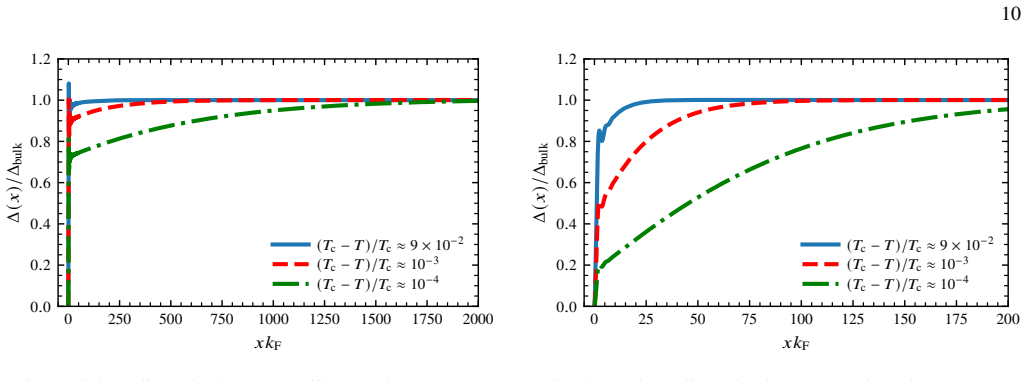
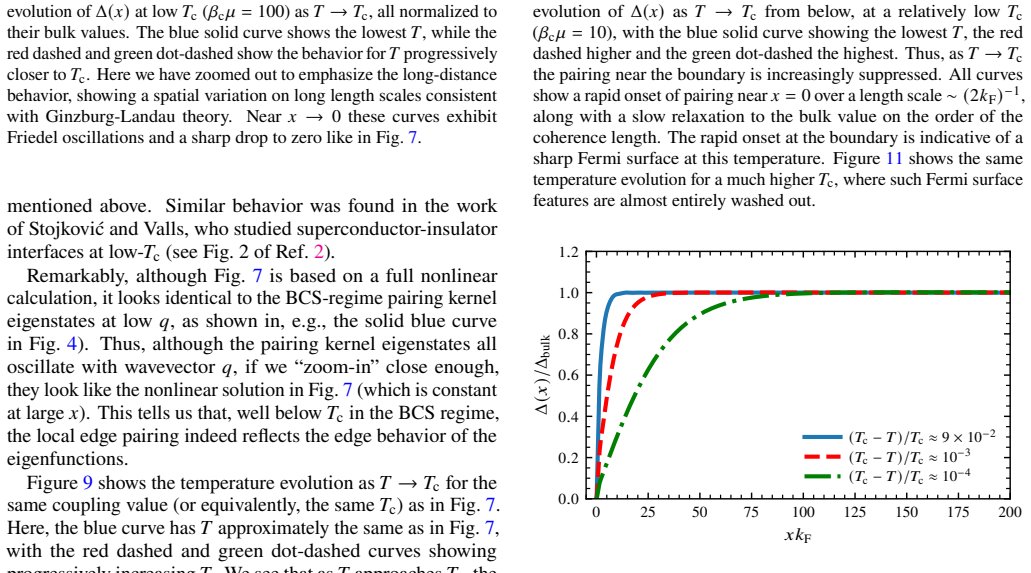
In a half-space Fermi superfluid, the local pairing amplitude rises from zero at the hard wall and shows Friedel oscillations at wavevector 2k_F that are suppressed as coupling moves from the BCS to the BEC regime.
Reviewed by Pith at T0; open to challenge. T0 means a machine referee read the full paper against a public rubric. the ladder, T0–T4 →
In a semi-infinite superfluid, the local pairing amplitude rises from zero at a hard wall with 2k_F Friedel oscillations in the BCS regime that are progressively washed out toward the BEC regime.
T0 review reviewed 2026-08-03 challenge →
load-bearing objection Careful, honest extension of BCS boundary theory to the crossover; the no-surface-state claim is numerically supported but not proven, and the below-T_c analysis is a GL model rather than full BdG. the 2 major comments →
Pairing near the boundary of a box-shaped trap in the BEC-BCS crossover
The pith
A machine-rendered reading of the paper's core claim, the machinery that carries it, and where it could break.
The reading
Core claim
The authors solve the linearized BCS gap equation for a semi-infinite superfluid with a hard-wall boundary, treating the pairing instability as an eigenvalue problem for an integral kernel K_Lambda. They find that the kernel's generalized eigenfunctions form a continuum labeled by wavevector q, with eigenvalues equal to the bulk values; the off-diagonal part that enforces the boundary condition does not alter the essential spectrum, and no bound states (which would signal surface superconductivity) appear numerically. These eigenfunctions are cutoff-independent, so the kernel can be renormalized by the same Lippmann-Schwinger procedure used for the bulk. Below T_c, adding a Ginzburg-Landau n
What carries the argument
The central object is the pairing kernel K_Lambda(x,x') for the linearized T_c gap equation in the half-slab geometry, expressed in a cosine basis as a singular diagonal piece plus a compact off-diagonal piece that imposes the hard-wall condition. Its continuum eigenfunctions, normalized with a residue R(q) that emerges from principal-value products, are universal (cutoff-independent) even though the eigenvalues are not; the Lippmann-Schwinger renormalization replaces the eigenvalues by E_R(q) while leaving the eigenfunctions untouched. This basis then carries the expansion of the nonlinear pairing problem below T_c.
Load-bearing premise
The central result depends on the unproven completeness of the continuum eigenfunctions of the pairing kernel: the authors state they have not directly proven completeness and find no numerical evidence for bound states, but if a square-normalizable bound state existed below the continuum, the edge pairing could acquire a localized surface component.
What would settle it
A direct numerical search for square-normalizable eigenfunctions of the pairing kernel with eigenvalues below the continuum bottom E_Lambda(0), using a fine grid and a large box, would settle the surface-state question; the authors' numerics find none. Experimentally, measuring the local pairing profile near the wall of a box-trapped Fermi gas across the crossover—e.g., via momentum-resolved photoemission or rf spectroscopy—would reveal the 2k_F oscillations in the BCS regime and their absence at unitarity.
If this is right
- In the weak-coupling BCS regime, the local pairing amplitude near a hard wall follows approximately Δ(x) = Δ_bulk[1 − sin(2k_F x)/(2k_F x)], with oscillations at wavevector 2k_F and a rise on a length scale ~(2k_F)^{-1}.
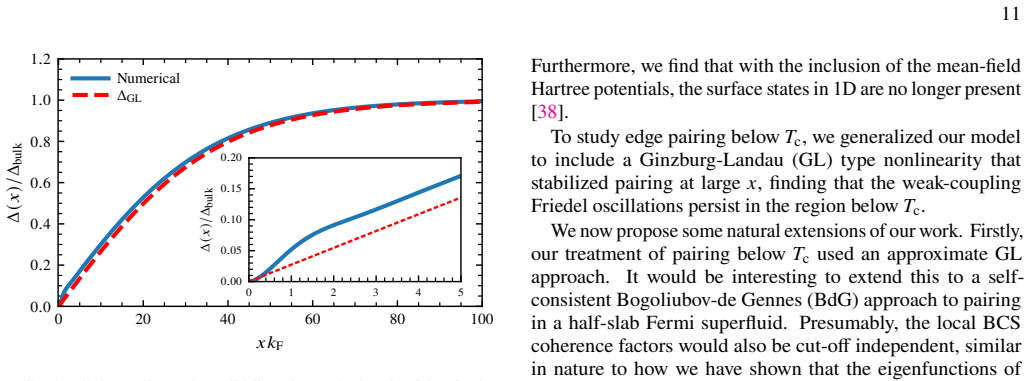
- As coupling increases toward the BEC regime, Friedel oscillations are suppressed and the edge profile approaches the smooth Ginzburg-Landau solution, with a quadratic rise near the wall rather than a linear one.
- The edge pairing profile is universal: after renormalization it is independent of the ultraviolet cutoff.
- No surface-bound-state pairing instability (surface superconductivity) exists for 3D contact-interaction superfluids; the half-slab transition temperature equals the bulk T_c.
- The same kernel-eigenfunction approach can be extended to a self-consistent Bogoliubov-de Gennes treatment below T_c or to a finite box geometry, where the box T_c may differ from the bulk T_c.
Where Pith is reading between the lines
- If the predicted 2k_F oscillations are real, they should be visible in a box-trapped Fermi gas as a spatial modulation of the pairing gap near the walls, measurable with local probes such as momentum-resolved photoemission or rf spectroscopy.
- The contrast between 1D models (which show surface bound states) and 2D/3D contact-interaction models (which do not) suggests a dimensionality threshold: surface pairing enhancement may require quasi-1D confinement or a longer-ranged interaction kernel.
- A rigorous proof or disproof of completeness of the continuum eigenfunctions would settle the surface-state question; the weak bound derived in the paper (E ≥ 2E(0)) does not rule out a bound state below the continuum but above 2E(0).
- The universal edge profile implies that the boundary of a box trap is a clean place to measure the BEC-BCS crossover parameter, since the shape of Δ(x) near the wall encodes coupling strength in a cutoff-independent way.
Editorial analysis
A structured set of objections, weighed in public.
Referee Report
Summary. The paper studies the local pairing amplitude of attractively interacting fermions in a three-dimensional semi-infinite half-slab with a hard wall, across the BEC-BCS crossover. At T_c, the authors analyze the linearized pairing kernel in a cosine basis, use Weyl's theorem and an analytic ansatz to show that the essential spectrum is the bulk spectrum, and construct numerically the corresponding continuum eigenfunctions. They normalize these eigenfunctions and build a renormalized, cutoff-independent pairing kernel. Below T_c, they add a Ginzburg-Landau-type cubic nonlinearity and solve the resulting equation in the eigenfunction basis. The central claims are that (i) the edge pairing profile rises from zero at the wall with 2k_F Friedel oscillations in the weak-coupling BCS regime, which are suppressed toward the BEC regime, and (ii) within this model there is no surface-bound-state (surface-superconductivity) instability.
Significance. If the claims hold, the paper gives a concrete, falsifiable prediction for box-trapped cold-atom experiments and provides an interesting contrast to surface-superconductivity instabilities found in one-dimensional and two-dimensional settings. The linearized T_c analysis is careful: the analytic ansatz and numerical diagonalization agree, the cutoff-independence argument based on convergent differences is convincing, and the numerical methods are documented in enough detail to be reproduced. The strengths of the paper are the explicit regularization procedure and the demonstration that the eigenfunction shapes are universal. However, the no-surface-state conclusion and the below-T_c Friedel-oscillation persistence both rest on an unproven completeness assumption and on a phenomenological nonlinear model, so the significance is conditional on closing those gaps.
major comments (2)
- [§V, Eqs. (39)-(40); §VI, Eq. (48); Appendix C] The completeness of the continuum eigenfunctions \barΔ_q is assumed, not established. The authors state in Sec. V that they have not directly proven completeness. Appendix C proves only E ≥ 2EΛ(0); since EΛ(0)<0, the interval [2EΛ(0), EΛ(0)) remains open for a square-normalizable bound state below the continuum. The numerical diagonalization in Appendix D is finite-dimensional and cannot exclude such a state. If a bound state exists, Eq. (39) is false, the spectral representation Eq. (40) is incomplete, and the expansion Eq. (48) misses a localized surface-pairing component. This affects both the 'no surface pairing instability' conclusion and the below-T_c edge profile. Please either prove the required completeness (or a bound excluding bound states) or explicitly reformulate the central results as conditional on the numerically supported absence of bound states.
- [§VI, Eq. (43)] The below-T_c equation is a Ginzburg-Landau-inspired cubic with an arbitrary coefficient β, not a self-consistent BdG or microscopic BCS equation. The cancellation of β in Δ(x)/Δ_bulk normalizes the overall scale only; it does not establish that the local cubic model reproduces the correct nonlocal self-consistent pairing. The persistence of 2k_F Friedel oscillations below T_c is therefore demonstrated only within this phenomenological model. The paper acknowledges this in Sec. VII, but the abstract and Fig. 1 present the result more generally. A derivation of the nonlinear term from the microscopic action or a BdG calculation in the half-slab geometry (at least in the BCS regime) is needed to make the main claim fully load-bearing.
minor comments (5)
- [Fig. 1 and Sec. I text] The blue solid curve in Fig. 1 corresponds to βc μ=5, i.e., k_B T_c/μ≃0.2, but the text says 'blue solid (k_B T_c/μ≃0.1 or k_F a_s≃−1.39)', which duplicates the red dashed value. Please correct this inconsistency.
- [Eq. (43) and Appendix D] The nonlinear term is written Δ^3 in Eq. (43), |Δ|^3 in Eq. (D18), and β|Δ|²Δ in Appendix B. Since the order parameter can be complex, use β|Δ|²Δ consistently, or explicitly state the reality/positivity convention.
- [Notation] β denotes inverse temperature in the figures (βc μ) and in Appendix D, while it is the GL nonlinear coefficient in Eq. (43) and Appendix B. Rename one of them to avoid ambiguity.
- [References] Ref. [38] (the 2D case) is cited as unpublished; please provide a preprint identifier or publication status if available.
- [Abstract and Title] The abstract uses 'BEC-BCS crossover' while the title and body use 'BCS-BEC crossover' or 'BEC-BCS crossover' inconsistently; unify the terminology.
Circularity Check
No significant circularity: the central derivation is self-contained, with minor non-load-bearing caveats.
full rationale
The paper's derivation chain is not circular. The pairing kernel eigenfunctions are obtained by solving the linearized gap equation (Eq. 17) with the explicit ansatz (Eq. 18), and the resulting eigenfunctions are verified both by direct numerical diagonalization of the discretized kernel and by comparison with the analytically derived Eq. (28); they are not fitted to the final pairing profile. Cutoff independence is established through convergent differences (Eqs. 22-23) following the standard Lippmann-Schwinger renormalization, not by adjusting parameters to reproduce the target result. The below-Tc analysis adds a Ginzburg-Landau nonlinearity (Eq. 43) with an arbitrary coefficient β, but β cancels in the normalized profiles (Eqs. 46, 51), so no fitted parameter is disguised as a prediction. The Friedel oscillations below Tc are not assumed: the authors explicitly note that eigenfunction structure need not survive the nonlinear problem, then demonstrate that it does by solving the nonlinear equation. The remaining caveats are limitations, not circularity. First, completeness of the continuum eigenfunctions is explicitly unproven ('we have not directly proven completeness', Sec. V), and the spectral representations (Eqs. 39, 42) and the below-Tc basis expansion (Eq. 48) rely on it; a hypothetical bound state would invalidate these steps. This is an open mathematical gap, not a circular reduction. Second, the concluding remark about 2D surface states cites an unpublished self-reference (Ref. [38]), but this is not load-bearing for the paper's central 3D result, which is numerically supported in the present work. No definitional equivalence, fitted-input-as-prediction, or self-citation chain forces the main conclusions.
Axiom & Free-Parameter Ledger
free parameters (1)
- β_GL =
unspecified/arbitrary (cancels in normalized Δ/Δ_bulk)
axioms (6)
- domain assumption BCS mean-field Hamiltonian and gap equation (Eqs. 2 and 4) describe attractively interacting fermions across the BEC-BCS crossover.
- domain assumption Lippmann-Schwinger equation (Eq. 1) relates the bare contact coupling λ to the s-wave scattering length a_s.
- domain assumption The same bulk counterterm renormalizes the edge eigenvalues; no additional boundary counterterms are needed.
- ad hoc to paper The continuum eigenfunctions of the pairing kernel are complete; no discrete bound states exist.
- ad hoc to paper Below T_c the pairing dynamics is governed by Eq. (43) with a cubic GL nonlinearity β|Δ|^3.
- domain assumption Hard-wall Dirichlet boundary condition Δ(0)=0 for the half-slab.
Cite this review
Pith. "Pith review of Pairing near the boundary of a box-shaped trap in the BEC-BCS crossover." pith.science (2026). https://pith.science/paper/EGMTNY2R
@misc{pith2026260729620,
  author       = {Pith},
  title        = {Pith review of: Pairing near the boundary of a box-shaped trap in the BEC-BCS crossover},
  year         = {2026},
  howpublished = {\url{https://pith.science/paper/EGMTNY2R}},
  note         = {Machine review of arXiv:2607.29620}
}
read the original abstract
We study pairing of attractively interacting fermions confined to a box-shaped trap. In contrast to the infinite translationally-invariant case, where the local pairing order is spatially uniform and undergoes the Bose-Einstein Condensate to Bardeen-Cooper-Schrieffer (BEC-BCS) crossover as interactions are varied, in this case the local pairing is expected to vary rapidly near the edge of the box. We address this problem in the limit of a semi-infinite superfluid, finding that the nature of the edge pairing depends sensitively on the coupling. The local pairing exhibits Friedel-like oscillations in the weak coupling BCS regime that are suppressed with increasing coupling strength towards the BEC regime.
Figures



Reference graph
Works this paper leans on
-
[1]
This should be chosen to be much larger than all other length scales,e.g.,theFermiwavelengthandthecoherencelength
Discrete cosine transform Let𝐿 be the effective finite system size cutoff in real space. This should be chosen to be much larger than all other length scales,e.g.,theFermiwavelengthandthecoherencelength. Let 𝑁 be the number of discrete sample points in both the physical space and momentum space. The grid size in real space is then defined asΔ𝑥=𝐿/(𝑁−1) and...
-
[2]
Wecanturn thisintoaHermitianmatrixeigenvalueproblembyintroducing an auxiliary function𝑢(𝑘) , which is related to the pairing functionvia Δ(𝑘𝑚)=𝑢(𝑘 𝑚)/ √︁ 𝑤𝑘𝑚
At𝑇 c At𝑇c, the gap equation is an integral eigenvalue problem given in𝑘-space as (Again, note we have slightly different𝜋 conventions relative to the main text) 1 𝜆Δ(𝑘)= ∞∫ 0 d𝑘′KΛ(𝑘,𝑘 ′)Δ(𝑘′),(D9) where KΛ(𝑘,𝑘 ′)=E Λ(𝑘)𝛿(𝑘−𝑘 ′)− 1 2𝜋 𝑓Λ 𝑘,𝑘′.(D10) UsingthedefinitionsoftheDCTfromSec.D1oftheAppendix the discretized𝑇c-equation becomes 1 𝜆Δ(𝑘𝑛)= 𝑁−1∑︁ 𝑚=0 K...
-
[3]
Below𝑇 c To analyze the regime of𝑇 <𝑇c, we extend the linear𝑇c- equation by adding a Ginzburg-Landau-like (GL) nonlinear term to stabilize the bulk pairing far away from the boundary. Thusweseektosolvethefollowingnonlinearintegralequation Δ(𝑥)=𝑔 Λ c ∞∫ 0 d𝑥′KΛ(𝑥,𝑥′)Δ(𝑥′)+𝑔 c𝛽GL|Δ(𝑥)| 3,(D18) where 1/𝑔Λ c =E Λ(𝑞 0) isthecutoff-dependentcriticalcoupling at𝑇...
-
[4]
Boundary Effects in Superconductors
P. G. de Gennes, “Boundary Effects in Superconductors”, Rev. Mod. Phys.36, 225 (1964)
1964
-
[5]
Order parameter near a superconductor-insulator interface
B. P. Stojković and O. T. Valls, “Order parameter near a superconductor-insulator interface", Phys. Rev. B47, 5922 (1993)
1993
-
[6]
Size effects and characteristic lengths in superconducting films and interfaces
B. P. Stojković and O. T. Valls, “Size effects and characteristic lengths in superconducting films and interfaces", Phys. Rev. B 49, 3413 (1994)
1994
-
[7]
Shape resonances in supercon- ducting thin films
J.M. Blatt and C.J. Thompson, “Shape resonances in supercon- ducting thin films”, Phys. Rev. Lett.10, 332 (1963)
1963
-
[8]
Bardeen-Cooper-Schrieffer Theory of Finite-Size Superconducting Metallic Grains
A. M. Garcia-Garcia, J. D. Urbina, Emil A. Yuzbashyan, Klaus Richter, and Boris L. Altshuler, “Bardeen-Cooper-Schrieffer Theory of Finite-Size Superconducting Metallic Grains” Phys. Rev. Lett.100, 187001 (2008)
2008
-
[9]
BCS supercon- ductivity near the band edge: Exact results for one and several bands
D. Valentinis, D. van der Marel and C. Berthod, “BCS supercon- ductivity near the band edge: Exact results for one and several bands”, Phys. Rev. B94, 024511 (2016)
2016
-
[10]
Riseandfallof shape resonances in thin films of BCS superconductors
D.Valentinis,D.vanderMarelandC.Berthod,“Riseandfallof shape resonances in thin films of BCS superconductors”, Phys. Rev. B94054516 (2016)
2016
-
[11]
Periodicity of superconducting shaperesonancesinthinfilms
D. Valentinis and C. Berthod, “Periodicity of superconducting shaperesonancesinthinfilms”Phys.Rev.B102,054518(2020)
2020
-
[12]
Boundary superconduc- tivity in the BCS Model
C. Hainzl, B. Roos, and R. Seiringer, “Boundary superconduc- tivity in the BCS Model”, J. Spectr. Theory121507 (2022)
2022
-
[13]
BCS Critical Temperature on Half- Spaces
B. Roos and R. Seiringer, “BCS Critical Temperature on Half- Spaces”, Arch. Rational Mech. Anal.24920 (2025)
2025
-
[14]
Andreev bound states and their signatures
J.A. Sauls, “Andreev bound states and their signatures”, Phil. Trans. R. Soc. A 376:20180140 (2018)
2018
-
[15]
Onset of surface superconductivity
T. Giamarchi, M.T. Béal-Monod, and O.T. Valls, “Onset of surface superconductivity”, Phys. Rev. B41, 11033 (1990)
1990
-
[16]
Self-consistent microscopic theory of surface superconductivity
R. J. Troy and A. T. Dorsey, “Self-consistent microscopic theory of surface superconductivity”, Phys. Rev. B51, 11728 (1995)
1995
-
[17]
Boundary states with elevated criticaltemperaturesinBardeen-Cooper-Schrieffersuperconduc- tors
A. Samoilenka and E. Babaev, “Boundary states with elevated criticaltemperaturesinBardeen-Cooper-Schrieffersuperconduc- tors”, Phys. Rev. B101, 134512 (2020)
2020
-
[18]
Microscopic description of surface superconductivity
M.D.Croitoru,A.A.Shanenko,Y.Chen,A.Vagov,andJ.Albino Aguiar, “Microscopic description of surface superconductivity”, Phys. Rev. B102, 054513 (2020)
2020
-
[19]
Surface Pair- Density-Wave Superconducting and Superfluid States
M. Barkman, A. Samoilenka, and E. Babaev, “Surface Pair- Density-Wave Superconducting and Superfluid States”, Phys. Rev. Lett.122, 165302 (2019)
2019
-
[20]
Bose-EinsteinCondensationofAtomsinaUniform Potential
A. L. Gaunt, T. F. Schmidutz, I. Gotlibovych, R. P. Smith, and Z. Hadzibabic,“Bose-EinsteinCondensationofAtomsinaUniform Potential”, Phys. Rev. Lett.110, 200406 (2013)
2013
-
[21]
Homogeneous Atomic Fermi Gases
B. Mukherjee, Z. Yan, P. B. Patel, Z. Hadzibabic, T. Yefsah, J. Struck, and M. W. Zwierlein, “Homogeneous Atomic Fermi Gases”, Phys. Rev. Lett.118, 123401 (2017)
2017
-
[22]
Quasiparticle Energy in a Strongly Interacting Homogeneous Bose-Einstein Condensate
R. Lopes, C. Eigen, A. Barker, K. G. H. Viebahn, M. Robert- de-Saint-Vincent, N. Navon, Z. Hadzibabic, and R. P. Smith, “Quasiparticle Energy in a Strongly Interacting Homogeneous Bose-Einstein Condensate” Phys. Rev. Lett.118, 210401 (2017)
2017
-
[23]
Universal Scaling Laws in the Dynamics of a Homogeneous Unitary Bose Gas
C. Eigen, J. A. P. Glidden, R. Lopes, N. Navon, Z. Hadzibabic, R. P. Smith, “Universal Scaling Laws in the Dynamics of a Homogeneous Unitary Bose Gas” Phys. Rev. Lett.119, 250404 (2017)
2017
-
[24]
Two-Dimensional Homogeneous Fermi Gases
K. Hueck, N. Luick, L. Sobirey, J. Siegl, T. Lompe, and H. Moritz, “Two-Dimensional Homogeneous Fermi Gases”, Phys. Rev. Lett.120, 060402 (2018). 16
2018
-
[25]
From single-particle excitations to sound waves in a box-trapped atomic BEC
S.J.Garratt,C.Eigen,J.Zhang,P.Turzák,R.Lopes,R.P.Smith, Z. Hadzibabic, and N. Navon, “From single-particle excitations to sound waves in a box-trapped atomic BEC”, Phys. Rev. A99, 021601 (2019)
2019
-
[26]
Elliptic flow in a strongly-interacting normal Bose gas
R. J. Fletcher, J. Man, R. Lopes, P. Christodoulou, J. Schmitt, M. Sohmen, N. Navon, R. P. Smith, and Z. Hadzibabic, “Elliptic flow in a strongly-interacting normal Bose gas”, Phys. Rev. A98, 011601 (2018)
2018
-
[27]
Boiling a Unitary Fermi Liquid
Z. Yan, P. B. Patel, B. Mukherjee, R. J. Fletcher, J. Struck, and Martin W. Zwierlein, “Boiling a Unitary Fermi Liquid”, Phys. Rev. Lett.122, 093401 (2019)
2019
-
[28]
Measuring the Hydrodynamic Linear Response of a Unitary Fermi Gas
L. Baird, X. Wang, S. Roof and J. E. Thomas, “Measuring the Hydrodynamic Linear Response of a Unitary Fermi Gas”, Phys. Rev. Lett.123, 160402 (2019)
2019
-
[29]
Universal Sound Diffusion in a Strongly Interacting Fermi Gas
P. B. Patel, Z. Yan, B. Mukherjee, R. J. Fletcher, J. Struck, and M. W. Zwierlein, “Universal Sound Diffusion in a Strongly Interacting Fermi Gas”, Science370, 1222 (2020)
2020
-
[30]
Quantum gases in optical boxes
N. Navon, R. P. Smith, and Z. Hadzibabic, “Quantum gases in optical boxes”, Nature Physics17, 1334 (2021)
2021
-
[31]
Resonantly paired fermionic superfluids
V. Gurarie and L. Radzihovsky, “Resonantly paired fermionic superfluids”, Annals of Physics322, 2 (2007)
2007
-
[32]
BCS theory for trapped ultracold fermions
G. Bruun,Y. Castin, R. Dum, and K. Burnett, “BCS theory for trapped ultracold fermions", Eur. Phys. J. D7, 433 (1998)
1998
-
[33]
Renormalization of the Hartree-Fock- Bogoliubov Equations in the Case of a Zero Range Pairing Interaction
A. Bulgac and Y. Yu, “Renormalization of the Hartree-Fock- Bogoliubov Equations in the Case of a Zero Range Pairing Interaction", Phys. Rev. Lett.88, 042504 (2002)
2002
-
[34]
Microscopic derivation of the Ginzburg-Landau Equations in the theory of superconductivity
L.P. Gorkov, “Microscopic derivation of the Ginzburg-Landau Equations in the theory of superconductivity”, Zh. Eksp. Teor. Fiz.36, 1918-1923 (1959) Sov. Phys. JETP36, 1364 (1959)
1918
-
[35]
Correctionstolocal-density approximation for superfluid trapped fermionic atoms from the Wigner-Kirkwoodℏ expansion
P.Schuck,M.Urban,andX.Viñas,“Correctionstolocal-density approximation for superfluid trapped fermionic atoms from the Wigner-Kirkwoodℏ expansion", Eur. Phys. J. A59, 164 (2023)
2023
-
[36]
Equation for the superfluid gap obtained by coarse graining the Bogoliubov–de Gennes equations throughout the BCS-BEC crossover
S. Simonucci and G. C. Strinati, “Equation for the superfluid gap obtained by coarse graining the Bogoliubov–de Gennes equations throughout the BCS-BEC crossover”, Phys. Rev. B89, 054511 (2014)
2014
-
[37]
Nonlocal equation for the superconductinggapparameter
S. Simonucci and G. C. Strinati, “Nonlocal equation for the superconductinggapparameter”,Phys.Rev.B96,054502(2017)
2017
-
[38]
Über gewöhnliche Differentialgleichungen mit Sin- gularitäten und die zugehörigen Entwicklungen willkürlicher Funktionen
H. Weyl, “Über gewöhnliche Differentialgleichungen mit Sin- gularitäten und die zugehörigen Entwicklungen willkürlicher Funktionen” Mathematische Annalen68, 220 (1909)
1909
-
[39]
Methods of Modern Mathematical Physics I: Functional Analysis
M. Reed and B. Simon, “Methods of Modern Mathematical Physics I: Functional Analysis” (Academic Press, New York, 1980)
1980
-
[40]
Superconductivity Near a Quantum Critical Point: Bounds on the Transition Temperature in the 𝛾-Model
A. Elezaby and A. Abanov, “Superconductivity Near a Quantum Critical Point: Bounds on the Transition Temperature in the 𝛾-Model” arXiv:2512.20009
-
[41]
Patton and D.E
K.R. Patton and D.E. Sheehy, Unpublished
-
[42]
Finite total three-particle scattering rates
R. G. Newton and R. Shtokhamer, “Finite total three-particle scattering rates”, Phys. Rev. A14, 642 (1976)
1976
-
[43]
Dispersion relations for causal Green’s functions: Derivations using the Poincaré-Bertrand theorem and its generalizations
K. T. R. Davies, R. W. Davies, and G. D. White, “Dispersion relations for causal Green’s functions: Derivations using the Poincaré-Bertrand theorem and its generalizations”, J. Math. Phys.31, 1356 (1990)
1990
This paper was first reviewed by deepseek-v4-flash on August 3, 2026.
discussion (0)
Sign in with ORCID, Apple, or X to comment. Anyone can read and Pith papers without signing in.