REVIEW 3 major objections 4 minor 80 references
First resolved observations of a highly asymmetric debris disc around HD 160305 with VLT/SPHERE
T0 review · 3 major / 4 minor · reviewed 2026-08-14 · deepseek-v4-flash
Pith's one-line read The debris disc around HD 160305 is resolved for the first time as an almost edge-on ring at 86 au whose two sides differ in surface brightness by a ratio of 0.73 ± 0.18, with dust scattering light strongly forward.
desk verdict Solid new debris disc detection; the two-sided asymmetry is tentative and the ratio direction is internally inconsistent. read the letter →
The pith
A machine-rendered reading of the paper's core claim, the machinery that carries it, and where it could break.
The reading
What carries the argument
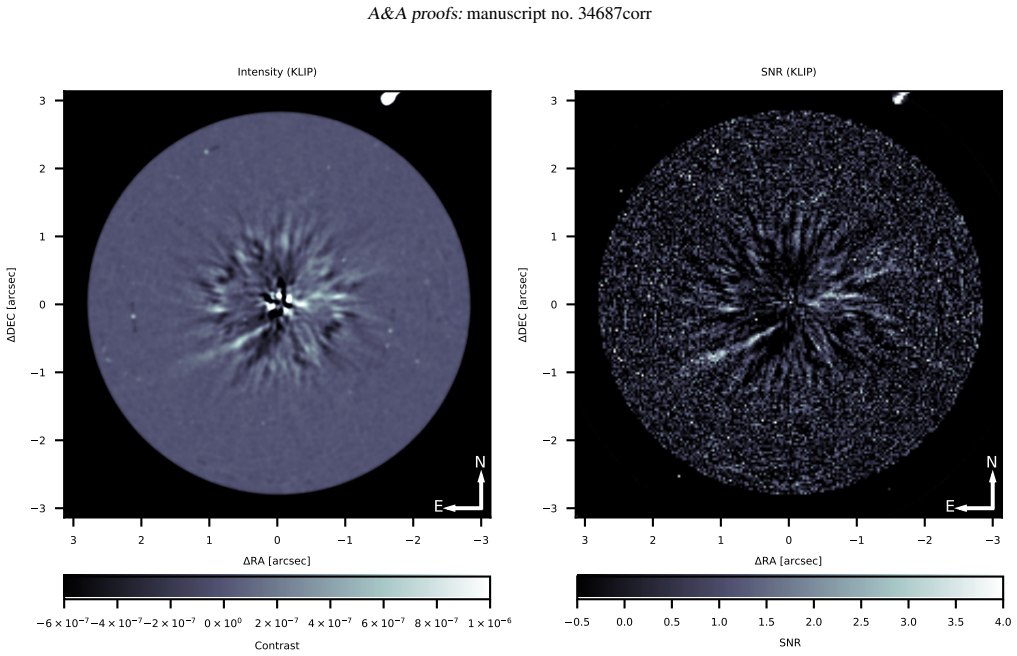
The load-bearing machinery is the parametric ring model GRaTer: a radial surface-density distribution that falls off as a power law on both sides of a reference radius $R_0$, combined with a Henyey-Greenstein scattering phase function controlled by the anisotropy factor $g$. Synthetic images from this model are convolved with the stellar PSF and projected through the same KLIP/ADI eigenvector basis as the data, so the comparison absorbs the post-processing self-subtraction; $\chi^2$ minimization over the bright south-east side sets the ring geometry ($R_0 \approx 86$ au, $i \approx 82^\circ$, PA $\approx 122.5^\circ$, width $\approx 27$ au), and negative injection of scaled models into raw frames measures the two-sided surface-brightness ratio ($\Phi_E/\Phi_W = 0.73\pm0.18$).
What would settle it
Observe HD 160305 again with a deeper SPHERE run or with ALMA at comparable angular resolution and measure the north-west side of the ring: if the NW emission seen at signal-to-noise 1–2 per resolution element does not reappear above signal-to-noise ~5 at the same projected position and position angle in an independent epoch (or in thermal continuum), the two-sided asymmetry is an artifact of residual speckles; if it reappears, the asymmetry is real and the three proposed origins can be separated by comparing the radial extents of the bright and faint sides.
Extended reading notes
Core claim
The paper's central discovery is that HD 160305 hosts a resolved, strongly inclined debris ring seen in scattered light: a near-edge-on ($i \approx 82^\circ$) belt at $R_0 \approx 86$ au with a deprojected width of about 27 au. The disc is not symmetric: its southern front side is much brighter than its northern back side, which the authors attribute to forward-scattering dust grains with an anisotropy factor $g>0.5$, and its south-east side is brighter than its north-west side, with a measured surface-brightness ratio of $0.73\pm0.18$ between the bright and faint sides. The paper argues that the two-sided asymmetry is real but that the data cannot yet choose among a planet-sculpted over-density, the recent breakup of a massive planetesimal, or the pericenter glow of an eccentric ring. It also shows that all ten point sources detected at both epochs are background stars, and that the disc-to-star scattered-light ratio is about $1.4\times10^{-4}$, close to the thermal fractional luminosity.
Load-bearing premise
The load-bearing assumption is that the faint north-west side of the disc is genuine disc emission rather than residual speckle noise; that side is detected at only 1–2 signal-to-noise per resolution element, and the measured $0.73\pm0.18$ two-sided brightness ratio is derived inside that low-signal region.
Editorial extensions
If this is right
- The resolved ring at about 86 au revises the earlier SED-based estimate of 58 ± 13 au upward, because small grains are inefficient emitters and can sit hotter than black bodies; the scattered-light geometry is a more direct measure of the parent belt.
- The front-to-back brightness contrast constrains the dust scattering phase function to g > 0.5, which in turn restricts the typical grain sizes and compositions in the ring.
- No companion more massive than about 1 Jupiter mass is detected beyond 2 arcseconds in the IRDIS field, and all ten point sources seen at both epochs are background stars, leaving super-Earth-mass perturbers as a still-open explanation for the asymmetry.
- The quantified two-sided ratio of 0.73 ± 0.18 gives a concrete target for follow-up observations designed to distinguish a planet-sculpted resonance from a recent planetesimal breakup and from the pericenter glow of an eccentric ring.
Reading between the lines
- If the NW-side detection is real, the steep outer surface-density slope (α_out ≈ -5 to -10) beyond the ring is steeper than the canonical -1.5 halo slope, which would point to a dynamically recent event; this combination is a natural next test with deeper imaging of the outer profile.
- The stellar rotation axis derived in the paper (i* ≈ 58°) differs from the disc inclination (i ≈ 82°), hinting at a possible spin-orbit misalignment; the paper notes it as speculative, but follow-up stellar activity or asteroseismic measurements could turn the hint into a constraint on formation history.
- A testable extension not pursued in the paper: in the eccentric-ring/pericenter-glow scenario the faint side should be radially more extended than the bright side, so measuring the radial width of each side separately in deeper data would discriminate among the three proposed explanations.
Signed reviews
Editorial analysis
A structured set of objections, weighed in public.
Referee Report
Summary. This manuscript reports the first resolved scattered-light images of the debris disc around the young F9V star HD 160305, observed with VLT/SPHERE IRDIS at two epochs (May 2015 and May 2016). Using KLIP and TLOCI ADI reduction, the authors detect a highly inclined ring-like disc. A grid of GRaTer models, forward-modeled through the same KLIP pipeline to account for ADI biases, yields a ring radius of about 86-90 au, a deprojected FWHM of about 27 au, an inclination of about 82°, a position angle of about 122.5°, and an anisotropic scattering factor of about 0.5. The south-east side is detected with an integrated S/N of 16.8, while the north-west side is much fainter (S/N of 1-2 per resolution element). A negative-injection experiment gives a surface brightness ratio between the two sides of 0.73 ± 0.18. All 15 point sources in the IRDIS field are classified as background stars, 10 by common proper motion and 5 by statistical probability. The authors discuss three explanations for the azimuthal asymmetry: a sculpting planet, the recent breakup of a massive planetesimal, and an eccentric ring with pericenter glow.
Significance. If the ring parameters are correct, this paper adds a new resolved debris disc to the small scattered-light sample and provides a useful comparison between SED-inferred and resolved disc radii. The forward-modeling strategy with GRaTer and KLIP projection is a credible treatment of ADI biases, and the two-epoch confirmation of the south-east side, the careful astrometric analysis of point sources, and the explicit discussion of possible asymmetry origins are definite strengths. However, the headline two-sided asymmetry is quantitatively not yet secure, for the reasons detailed below, and the paper currently overstates the confidence with which this asymmetry is established. The ring detection itself is credible and valuable.
major comments (3)
- [Section 4.3 and Abstract] The reported ratio Phi_E/Phi_W = 0.73 ± 0.18 (south-east to north-west) contradicts the text and abstract, which state that the south-east side is the bright side and the north-west side is barely detected. A ratio of 0.73 would imply that the SE side is fainter than the NW side, and the abstract's phrase 'surface brightness ratio of 0.73 between the bright and the faint sides' is therefore internally inconsistent. In addition, the Discussion (Section 5) twice refers to a 'south-west to north-east' asymmetry, swapping the axis labels from the definition in Section 4.3. Please correct the ratio definition (e.g., report bright/faint = 1.37 ± 0.33 if 0.73 is faint/bright) and use consistent axis labels throughout the paper.
- [Sections 4 and 4.3, Fig. 8] The quantitative two-sided asymmetry rests on the north-west side, which has per-resolution-element S/N of only 1-2 and is described in the text as 'very marginal'. The NW side is not detected in the first epoch, so the asymmetry has not been confirmed in an independent observation; it appears only in the 2016 epoch. The negative-injection minimization measures the optimum model flux by minimizing residuals inside masks located where speckle noise is non-Gaussian and strong (near the AO correction radius). At this S/N, the minimum of the criterion in Fig. 8 could be produced by partial cancellation against a residual speckle rather than by genuine NW disc emission. The quoted uncertainty (quadrature of 3.5e-7 and 10^-8) does not include this speckle-correlation or model-morphology uncertainty. Please provide a robustness check, such as a split-epoch (first/second half of the 2016 sequence) comparison of the NW side, an injection of symmetric models with local noise to assess the significance of the residual minimum, or an explicit downgrading of the asymmetry claim to 'tentative, single-epoch detection'.
- [Section 4.2 and Abstract] The abstract's claim 'g>0.5' is stronger than the grid supports. The best grid model has g=0.5, the grid sampling for g is only {0.25, 0.5, 0.75}, and the text says preferred values are 'systematically higher than 0.5 but rarely higher than 0.75'. With only three grid points, this is a statement about the histogram of the 1% best models, not a robustly measured lower limit. Please report the scattering anisotropy as g ≈ 0.5 (or 'g ≳ 0.5, coarse grid') and align the abstract wording with the actual grid sampling.
minor comments (4)
- [Section 5] The Discussion twice refers to a 'south-west to north-east' asymmetry, but Sections 4.3 defines the asymmetry as 'south-east to north-west'. Please unify the axis terminology.
- [Section 4.3 and Fig. 8] The criterion minimized in Fig. 8 is called the 'mean squared error' but is written as Σ without an explicit definition; please define it and label the blue and red curves directly in the figure caption.
- [Table B.1] After frame sorting, 54 of 64 frames (epoch 1) and 119 of 144 frames (epoch 2) were retained; please report the effective on-sky exposure time after sorting, not only the raw integration time.
- [Appendix A] The assumed 10% uncertainty on vsini is not justified; please state whether this is a conservative estimate or based on measurement precision.
Circularity Check
No equation-level circularity; the only mild circularity is that the fit masks are seeded by an approximate ellipse close to the best-fit parameters, so the fitted geometry partly confirms the mask geometry.
-
other
[Section 4.1, Fig. 5 caption]
"Masks e and g are based on approximate ellipse parameters, close to the disc parameters."
The intensity scaling factor and the chi-square goodness-of-fit are computed only inside masks e and g, and these masks are drawn from an approximate ellipse that is already close to the disc parameters being fitted. Every model in the grid is therefore scored on a data region preselected with a near-final geometry, so the best-fit R0, i, and PA are partly inherited from the mask rather than independently measured. This is a selection-level circularity, not a strict identity: the parameter grid is broad and the fit is not logically forced, but the optimization is not fully independent of its own input geometry.
full rationale
The paper is an observational model-fitting study rather than a first-principles derivation, and most of its claims rest on the two-epoch SPHERE images, the proper-motion analysis of the point sources, and the forward-modelled GRaTer grid fits. The self-citations (Perrot et al. 2016 for the fitting method, Choquet et al. 2016 for forward modelling, Augereau et al. 1999 for GRaTer) are methodological and are not load-bearing for the headline detection or the disc parameters. The one mild circularity is the use of masks that are based on an approximate ellipse close to the best-fit parameters to define the flux-scaling and chi-square regions, which makes the fitted geometry partly confirm the geometry assumed in the masks. The low signal-to-noise ratio of the north-west side and the inconsistent labelling of the 0.73 surface-brightness ratio are real correctness and interpretation risks, but they are not circular reasoning.
Assumptions & free parameters
free parameters (8)
- R0 (ring radius) =
86 au (grid best); 90.8±9.6 au (Gaussian fit to 1% best models)
- alpha_in (inner slope) =
10 (best); 10.1±9.3
- alpha_out (outer slope) =
-5 (best); -7.1±2.7
- i (inclination) =
82 deg (best); 82.3±0.8 deg
- PA (position angle) =
122.5 deg (best); 122.4±2.0 deg
- g (Henyey-Greenstein anisotropy) =
0.5 (best on grid); reported as g>0.5
- h (aspect ratio) =
0.005 (best); upper limit <0.025
- Surface brightness scaling factor =
not tabulated (Amoeba fit)
assumptions (5)
- domain assumption The detected structure is a ring-like debris disc rather than an edge-on filled disc or an unusual artifact
- domain assumption Dust scattering follows a single-parameter Henyey-Greenstein phase function
- domain assumption The radial density profile is a two-power-law (Augereau et al. 1999)
- domain assumption HD 160305 is a member of the Beta Pictoris Moving Group with age 23±3 Myr
- domain assumption The NW emission is astrophysical disc emission rather than residual speckle
Cite this review
Pith. "Pith review of First resolved observations of a highly asymmetric debris disc around HD 160305 with VLT/SPHERE." pith.science (2026). https://pith.science/paper/EHRJQAHG
@misc{pith2026190805335,
  author       = {Pith},
  title        = {Pith review of: First resolved observations of a highly asymmetric debris disc around HD 160305 with VLT/SPHERE},
  year         = {2026},
  howpublished = {\url{https://pith.science/paper/EHRJQAHG}},
  note         = {Machine review of arXiv:1908.05335}
}
abstract
Context. Direct imaging of debris discs gives important information about their nature, their global morphology, and allows us to identify specific structures possibly in connection with the presence of gravitational perturbers. It is the most straightforward technique to observe planetary systems as a whole. Aims. We present the first resolved images of the debris disc around the young F-type star HD 160305, detected in scattered light using the VLT/SPHERE instrument in the near infrared. Methods. We used a post-processing method based on angular differential imaging and synthetic images of debris discs produced with a disc modelling code (GRaTer) to constrain the main characteristics of the disc around HD 160305. All of the point sources in the field of the IRDIS camera were analysed with an astrometric tool to determine whether they are bound objects or background stars. Results. We detect a very inclined (~ 82{\deg}) ring-like debris disc located at a stellocentric distance of about 86au (deprojected width ~27 au). The disc displays a brightness asymmetry between the two sides of the major axis, as can be expected from scattering properties of dust grains. We derive an anisotropic scattering factor g>0.5. A second right-left asymmetry is also observed with respect to the minor axis. We measure a surface brightness ratio of 0.73 $\pm$ 0.18 between the bright and the faint sides. Because of the low signal-to-noise ratio (S/N) of the images we cannot easily discriminate between several possible explanations for this left-right asymmetry, such as perturbations by an unseen planet, the aftermath of the breakup of a massive planetesimal, or the pericenter glow effect due to an eccentric ring. Two epochs of observations allow us to reject the companionship hypothesis for the 15 point sources present in the field.
Figures


Figures from the paper (5 more)


Reference graph
Works this paper leans on
-
[1]
Augereau , J. C., Lagrange , A. M., Mouillet , D., Papaloizou , J. C. B., & Grorod , P. A. 1999, , 348, 557
work page 1999
-
[2]
Augereau , J. C., Nelson , R. P., Lagrange , A. M., Papaloizou , J. C. B., & Mouillet , D. 2001, , 370, 447
work page 2001
-
[3]
2015, , 577, A42
Baraffe , I., Homeier , D., Allard , F., & Chabrier , G. 2015, , 577, A42
2015
-
[4]
Bell , C. P. M., Mamajek , E. E., & Naylor , T. 2015, , 454, 593
2015
-
[5]
Beuzit , J.-L., Vigan , A., Mouillet , D., et al. 2019, arXiv e-prints
work page 2019
-
[6]
Boccaletti , A., Sezestre , E., Lagrange , A.-M., et al. 2018, , 614, A52
work page 2018
-
[7]
2015, , 526, 230
Boccaletti , A., Thalmann , C., Lagrange , A.-M., et al. 2015, , 526, 230
2015
-
[8]
Bonnefoy , M., Perraut , K., Lagrange , A.-M., et al. 2018, ArXiv e-prints
work page 2018
Show all 80 references
-
[9]
2017, in SF2A-2017: Proceedings of the Annual meeting of the French Society of Astronomy and Astrophysics, ed
Chauvin , G., Desidera , S., Lagrange , A.-M., et al. 2017, in SF2A-2017: Proceedings of the Annual meeting of the French Society of Astronomy and Astrophysics, ed. C. Reyl \'e , P. Di Matteo , F. Herpin , E. Lagadec , A. Lan c on , Z. Meliani , & F. Royer , 331--335
2017
-
[10]
D., Chen , C
Choquet , \'E ., Perrin , M. D., Chen , C. H., et al. 2016, , 817, L2
2016
-
[11]
U., Turatto , M., Gratton , R
Claudi , R. U., Turatto , M., Gratton , R. G., et al. 2008, in , Vol. 7014, Ground-based and Airborne Instrumentation for Astronomy II, 70143E
2008
-
[12]
2017, in SF2A-2017: Proceedings of the Annual meeting of the French Society of Astronomy and Astrophysics, ed
Delorme , P., Meunier , N., Albert , D., et al. 2017, in SF2A-2017: Proceedings of the Annual meeting of the French Society of Astronomy and Astrophysics, ed. C. Reyl \'e , P. Di Matteo , F. Herpin , E. Lagadec , A. Lan c on , Z. Meliani , & F. Royer , 347--361
2017
-
[13]
2008, in , Vol
Dohlen , K., Langlois , M., Saisse , M., et al. 2008, in , Vol. 7014, Ground-based and Airborne Instrumentation for Astronomy II, 70143L
2008
-
[14]
2017, , 601, A7
Feldt , M., Olofsson , J., Boccaletti , A., et al. 2017, , 601, A7
2017
-
[15]
E., Malo , L., et al
Gagn \'e , J., Mamajek , E. E., Malo , L., et al. 2018, , 856, 23
2018
-
[16]
Gaia Collaboration , Brown , A. G. A., Vallenari , A., et al. 2018, , 616, A1
2018
-
[17]
2018, , 615, A92
Galicher , R., Boccaletti , A., Mesa , D., et al. 2018, , 615, A92
2018
-
[18]
2011, Experimental Astronomy, 30, 59
Guerri , G., Daban , J.-B., Robbe-Dubois , S., et al. 2011, Experimental Astronomy, 30, 59
2011
-
[19]
Hedman , M. M. & Stark , C. C. 2015, , 811, 67
2015
-
[20]
Henyey , L. G. & Greenstein , J. L. 1941, , 93, 70
1941
-
[21]
2007, , 662, 1067
Hern \'a ndez , J., Hartmann , L., Megeath , T., et al. 2007, , 662, 1067
2007
-
[22]
C., Schneider , G., Hollenbach , D., et al
Hines , D. C., Schneider , G., Hollenbach , D., et al. 2007, , 671, L165
2007
-
[23]
M., Duch \^e ne , G., & Matthews , B
Hughes , A. M., Duch \^e ne , G., & Matthews , B. C. 2018, , 56, 541
2018
-
[24]
P., Wyatt , M
Jackson , A. P., Wyatt , M. C., Bonsor , A., & Veras , D. 2014, , 440, 3757
2014
-
[25]
P., & Graham , J
Kalas , P., Fitzgerald , M. P., & Graham , J. R. 2007, , 661, L85
2007
-
[26]
R., Chiang , E., et al
Kalas , P., Graham , J. R., Chiang , E., et al. 2008, Science, 322, 1345
2008
-
[27]
R., & Clampin , M
Kalas , P., Graham , J. R., & Clampin , M. 2005, , 435, 1067
2005
-
[28]
G., Rajan , A., Wang , J
Kalas , P. G., Rajan , A., Wang , J. J., et al. 2015, , 814, 32
2015
-
[29]
2012, , 62, 67
Kiraga , M. 2012, , 62, 67
2012
-
[30]
L., Mo \'o r , A., Szalai , T., et al
Kiss , L. L., Mo \'o r , A., Szalai , T., et al. 2011, , 411, 117
2011
-
[31]
C., Kama , M., & Matra , L
Kral , Q., Marino , S., Wyatt , M. C., Kama , M., & Matra , L. 2018, arXiv e-prints
2018
-
[32]
2015, , 573, A39
Kral , Q., Th \'e bault , P., Augereau , J.-C., Boccaletti , A., & Charnoz , S. 2015, , 573, A39
2015
-
[33]
Kuchner , M. J. & Holman , M. J. 2003, , 588, 1110
2003
-
[34]
2010, Science, 329, 57
Lagrange , A.-M., Bonnefoy , M., Chauvin , G., et al. 2010, Science, 329, 57
2010
-
[35]
2016, , 586, L8
Lagrange , A.-M., Langlois , M., Gratton , R., et al. 2016, , 586, L8
2016
-
[36]
2014, in , Vol
Langlois , M., Vigan , A., Dohlen , K., et al. 2014, in , Vol. 9147, Ground-based and Airborne Instrumentation for Astronomy V, 91479P
2014
-
[37]
2013, in Proceedings of the Third AO4ELT Conference, ed
Langlois , M., Vigan , A., Moutou , C., et al. 2013, in Proceedings of the Third AO4ELT Conference, ed. S. Esposito & L. Fini , 63
2013
-
[38]
Lee , E. J. & Chiang , E. 2016, , 827, 125
2016
-
[39]
& Song , I
Lee , J. & Song , I. 2018, , 475, 2955
2018
-
[40]
& Kuchner , M
Lyra , W. & Kuchner , M. 2013, , 499, 184
2013
-
[41]
R., Ingraham , P., et al
Macintosh , B., Graham , J. R., Ingraham , P., et al. 2014, Proceedings of the National Academy of Science, 111, 12661
2014
-
[42]
2016, in , Vol
Maire , A.-L., Langlois , M., Dohlen , K., et al. 2016, in , Vol. 9908, Ground-based and Airborne Instrumentation for Astronomy VI, 990834
2016
-
[43]
2013, , 762, 88
Malo , L., Doyon , R., Lafreni \`e re , D., et al. 2013, , 762, 88
2013
-
[44]
Mamajek , E. E. & Bell , C. P. M. 2014, , 445, 2169
2014
-
[45]
2014, in , Vol
Marois , C., Correia , C., Galicher , R., et al. 2014, in , Vol. 9148, Adaptive Optics Systems IV, 91480U
2014
-
[46]
2006, , 641, 556
Marois , C., Lafreni \`e re , D., Doyon , R., Macintosh , B., & Nadeau , D. 2006, , 641, 556
2006
-
[47]
2015, , 576, A121
Mesa , D., Gratton , R., Zurlo , A., et al. 2015, , 576, A121
2015
-
[48]
2017, , 600, A83
Messina , S., Millward , M., Buccino , A., et al. 2017, , 600, A83
2017
-
[49]
2012, , 545, A111
Milli , J., Mouillet , D., Lagrange , A.-M., et al. 2012, , 545, A111
2012
-
[50]
2017, , 599, A108
Milli , J., Vigan , A., Mouillet , D., et al. 2017, , 599, A108
2017
-
[51]
2015, , 814, 42
Mo \'o r , A., Henning , T., Juh \'a sz , A., et al. 2015, , 814, 42
2015
-
[52]
2016, , 826, 123
Mo \'o r , A., K \'o sp \'a l , \'A ., \'A brah \'a m , P., et al. 2016, , 826, 123
2016
-
[53]
D., Papaloizou , J
Mouillet , D., Larwood , J. D., Papaloizou , J. C. B., & Lagrange , A. M. 1997, , 292, 896
1997
-
[54]
M., Ginski , C., et al
Neuh \"a user , R., Hohle , M. M., Ginski , C., et al. 2015, , 448, 376
2015
-
[55]
2016, , 591, A108
Olofsson , J., Samland , M., Avenhaus , H., et al. 2016, , 591, A108
2016
-
[56]
2008, in Astronomical Society of the Pacific Conference Series, Vol
Pavlov , A., Feldt , M., & Henning , T. 2008, in Astronomical Society of the Pacific Conference Series, Vol. 394, Astronomical Data Analysis Software and Systems XVII, ed. R. W. Argyle , P. S. Bunclark , & J. R. Lewis , 581
2008
-
[57]
& Krivov , A
Pawellek , N. & Krivov , A. V. 2015, , 454, 3207
2015
-
[58]
Pecaut , M. J. & Mamajek , E. E. 2013, , 208, 9
2013
-
[59]
Pecaut , M. J. & Mamajek , E. E. 2016, , 461, 794
2016
-
[60]
2016, , 590, L7
Perrot , C., Boccaletti , A., Pantin , E., et al. 2016, , 590, L7
2016
-
[61]
Poppenhaeger , K., Auchettl , K., & Wolk , S. J. 2017, , 468, 4018
2017
-
[62]
2008, , 480, 551
Reche , R., Beust , H., Augereau , J.-C., & Absil , O. 2008, , 480, 551
2008
-
[63]
Richert , A. J. W., Getman , K. V., Feigelson , E. D., et al. 2018, , 477, 5191
2018
-
[64]
C., Reyl \'e , C., Derri \`e re , S., & Picaud , S
Robin , A. C., Reyl \'e , C., Derri \`e re , S., & Picaud , S. 2003, , 409, 523
2003
-
[65]
2013, Ph.D
Schneider , A. 2013, Ph.D. Thesis, University of Georgia, USA
2013
-
[66]
A., Becklin , E
Schneider , G., Smith , B. A., Becklin , E. E., et al. 1999, , 513, L127
1999
-
[67]
2018, , 613, L6
Sissa , E., Olofsson , J., Vigan , A., et al. 2018, , 613, L6
2018
-
[68]
Smith , W. H. 1987, , 99, 1344
1987
-
[69]
Song , I., Zuckerman , B., & Bessell , M. S. 2012, , 144, 8
2012
-
[70]
2012, , 755, L28
Soummer , R., Pueyo , L., & Larkin , J. 2012, , 755, L28
2012
-
[71]
Strubbe , L. E. & Chiang , E. I. 2006, , 648, 652
2006
-
[72]
2009, , 505, 1269
Th \'e bault , P. 2009, , 505, 1269
2009
-
[73]
2012, , 547, A92
Thebault , P., Kral , Q., & Ertel , S. 2012, , 547, A92
2012
-
[74]
& Wu , Y
Th \'e bault , P. & Wu , Y. 2008, , 481, 713
2008
-
[75]
2007, , 474, 653
van Leeuwen , F. 2007, , 474, 653
2007
-
[76]
2010, in , Vol
Vigan , A., Moutou , C., Langlois , M., et al. 2010, in , Vol. 7735, Ground-based and Airborne Instrumentation for Astronomy III, 77352X
2010
-
[77]
Williams , J. P. & Cieza , L. A. 2011, , 49, 67
2011
-
[78]
C., Dermott , S
Wyatt , M. C., Dermott , S. F., Telesco , C. M., et al. 1999, , 527, 918
1999
-
[79]
, " * write output.state after.block = add.period write newline
ENTRY address author booktitle chapter edition editor howpublished institution journal key month note number organization pages publisher school series title type volume year label extra.label sort.label short.list INTEGERS output.state before.all mid.sentence after.sentence a...
-
[80]
write newline
" write newline "" before.all 'output.state := FUNCTION n.dashify 't := "" t empty not t #1 #1 substring "-" = t #1 #2 substring "--" = not "--" * t #2 global.max substring 't := t #1 #1 substring "-" = "-" * t #2 global.max substring 't := while if t #1 #1 substring * t #2 gl...
Reviewed August 14, 2026 · model on record in the stance chip above.
Discussion (0). Continue with ORCID to comment.