Efficient Real-World Dehazing via Physics-Inspired Global-Local Decoupling
Pith reviewed 2026-06-25 21:13 UTC · model grok-4.3
The pith
PGL-Net splits dehazing into global distribution rectification and local detail refinement using physics-inspired modules for efficient real-world performance.
A machine-rendered reading of the paper's core claim, the machinery that carries it, and where it could break.
Core claim
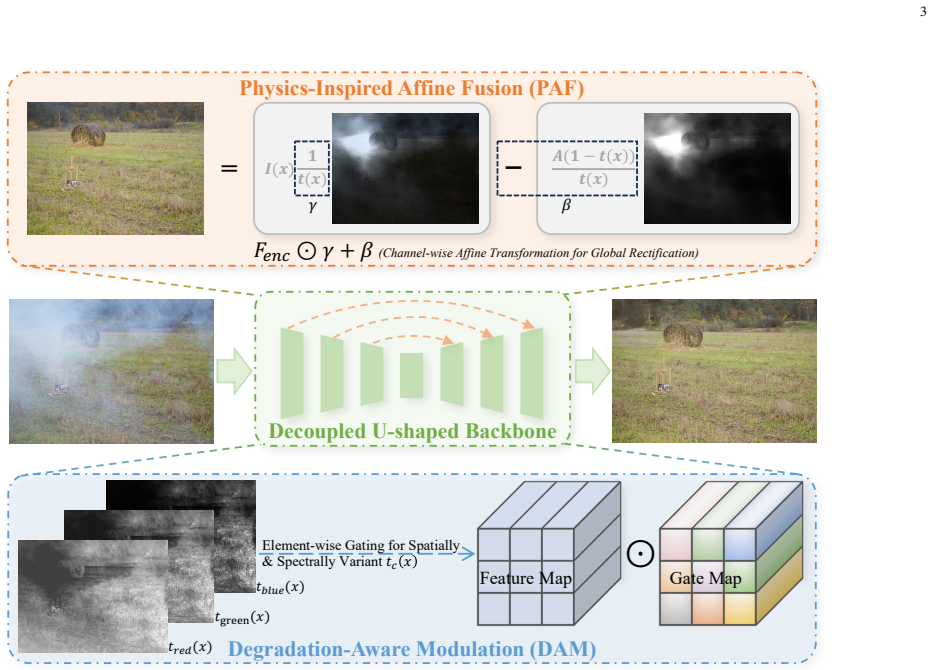
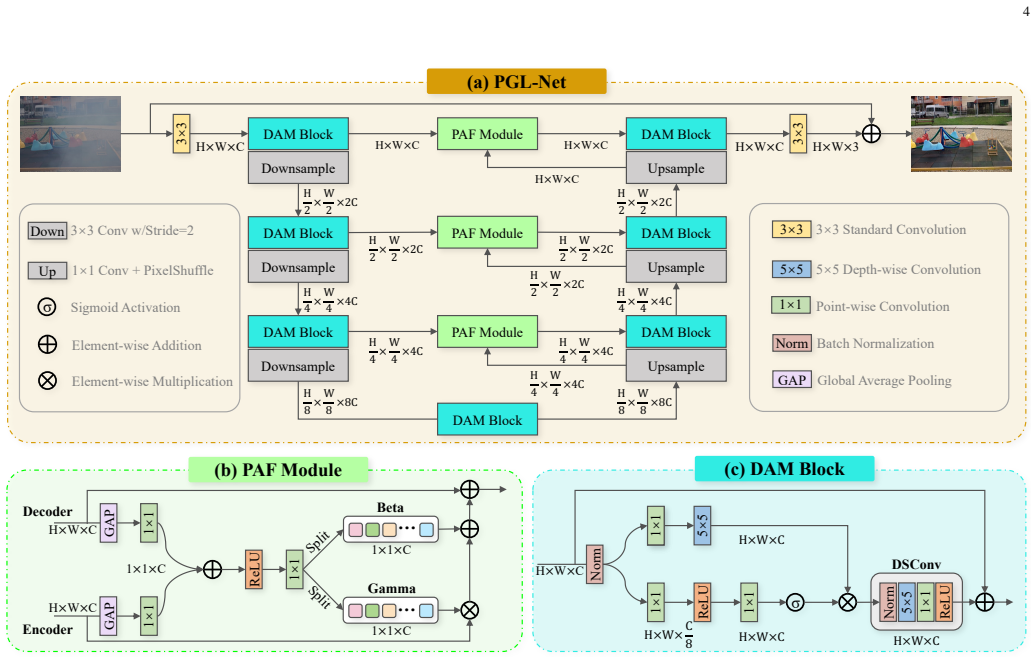
PGL-Net decouples dehazing into global distribution rectification performed by the Physics-Inspired Affine Fusion module across hierarchical skip connections and local structural refinement performed by the compact Degradation-Aware Modulation block through dynamic feature modulation, thereby embedding physical inductive biases at the operator level without explicit parameter estimation and yielding state-of-the-art restoration quality together with substantially lower complexity on real-world benchmarks.
What carries the argument
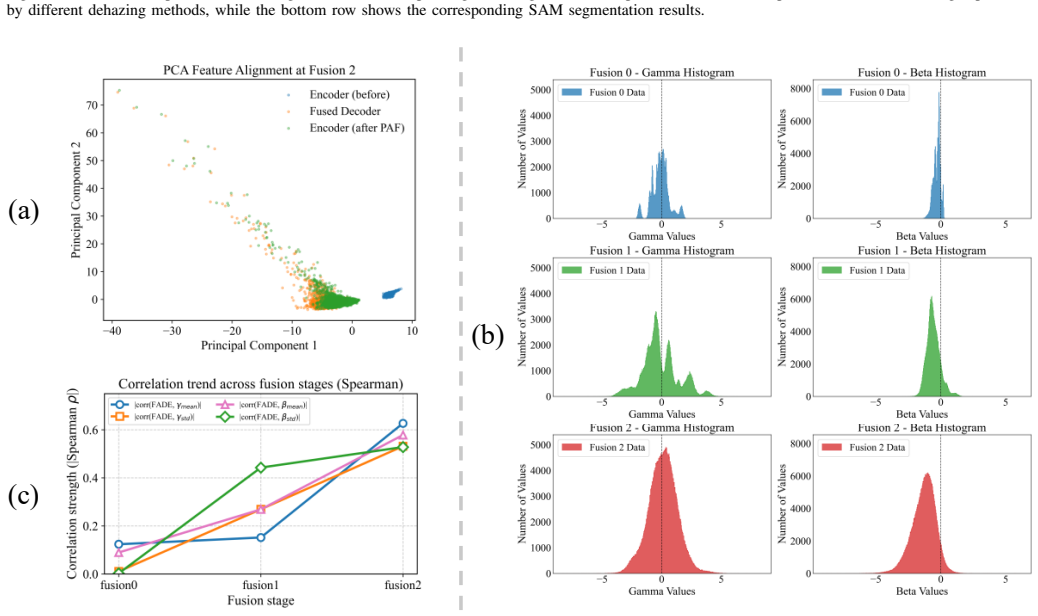
Physics-Inspired Global-Local Decoupling that uses PAF for globally conditioned alignment and DAM for adaptive local modulation.
If this is right
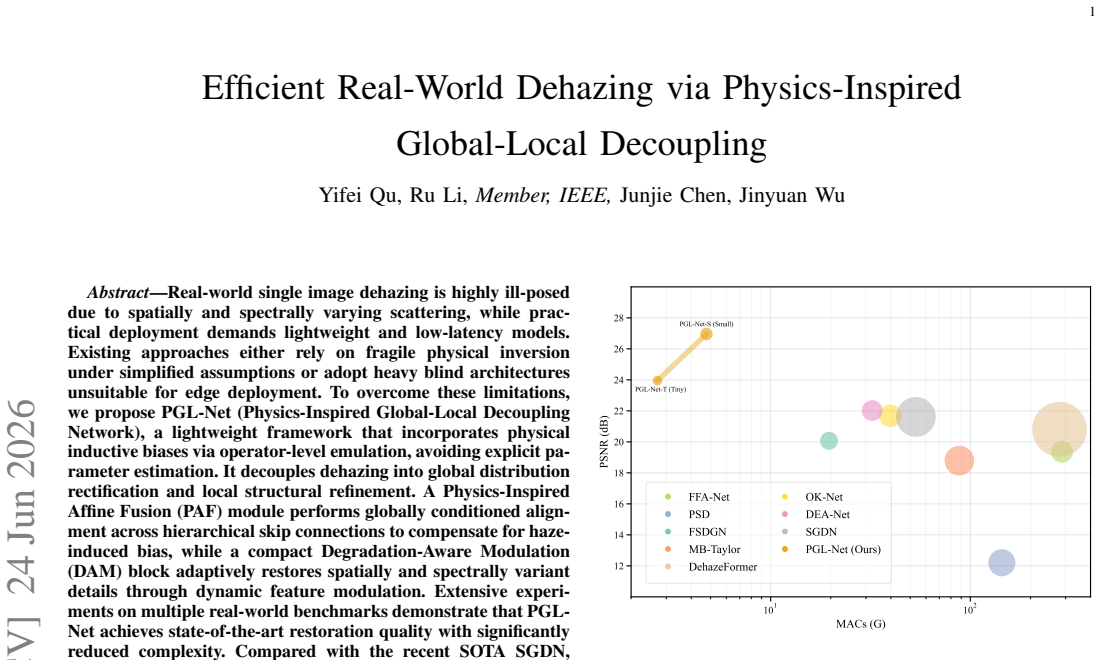
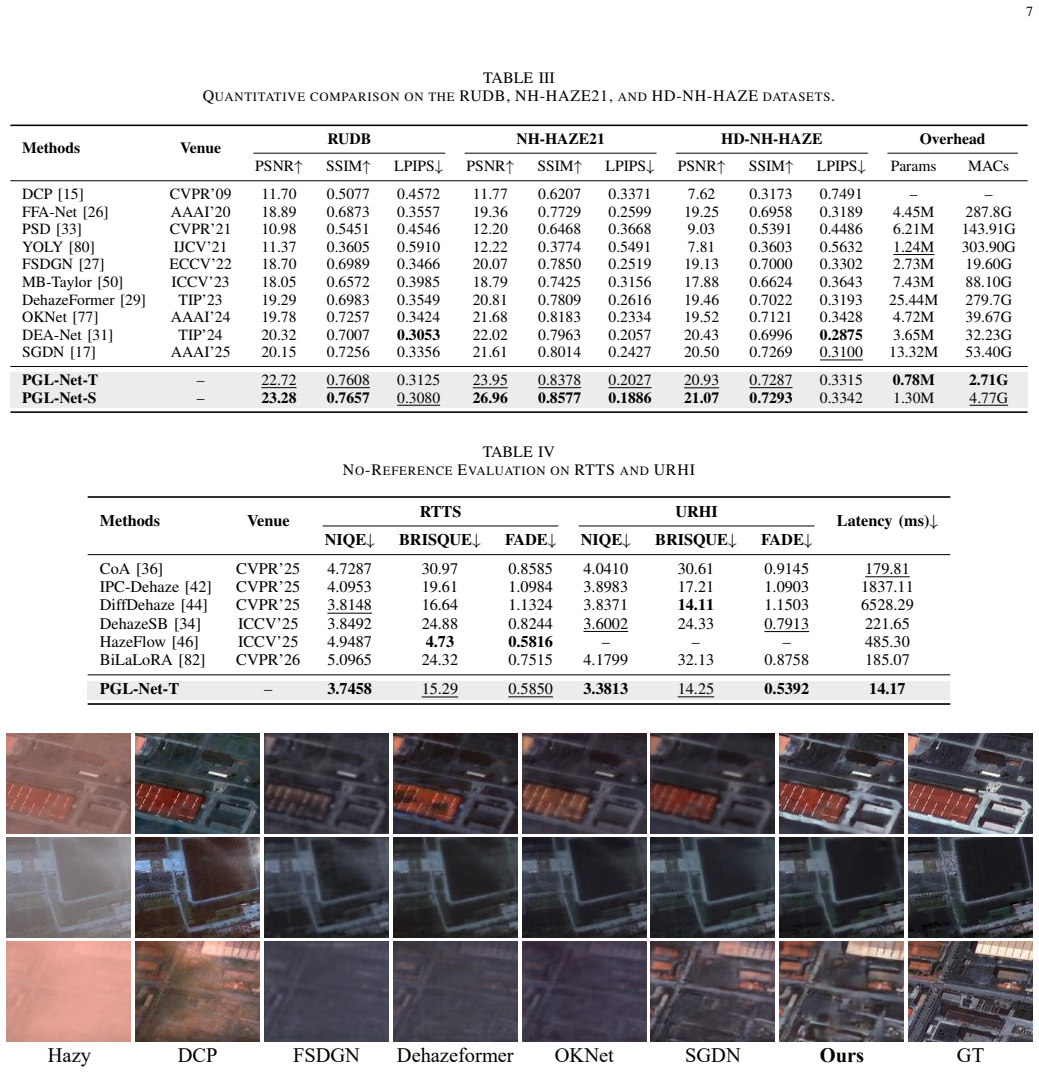
- PGL-Net-T raises PSNR by up to 2.6 dB over the prior SOTA SGDN on real-world benchmarks.
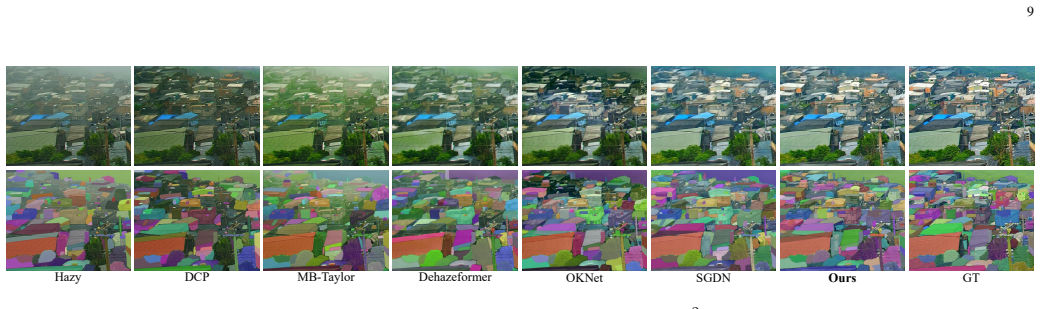
- The same tiny variant reduces inference latency by more than 10 times while improving downstream object detection accuracy.
- The global-local split removes the need for explicit physical parameter maps yet still compensates for haze-induced bias.
- Hierarchical skip-connection alignment plus dynamic modulation suffices for handling both global and local degradation components.
Where Pith is reading between the lines
- The same global-local split could be tested on other restoration problems such as low-light enhancement or underwater imaging where degradations also vary spatially.
- Replacing explicit physical inversion with operator emulation may lower the data requirements for training compared with purely data-driven heavy models.
- Measuring performance on synthetic haze with controlled spectral variation would isolate whether the modulation block truly captures wavelength-dependent effects.
Load-bearing premise
The chosen real-world benchmarks capture the full range of spatially and spectrally varying scattering and that the PAF and DAM modules embed useful physical biases through operator emulation without explicit parameter estimation.
What would settle it
A new real-world test set containing stronger spatial or spectral haze variation on which PGL-Net-T shows no PSNR gain over SGDN or loses its latency advantage.
Figures
read the original abstract
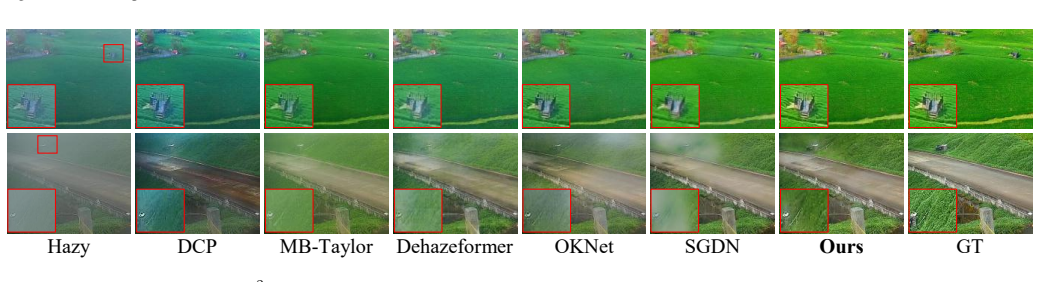
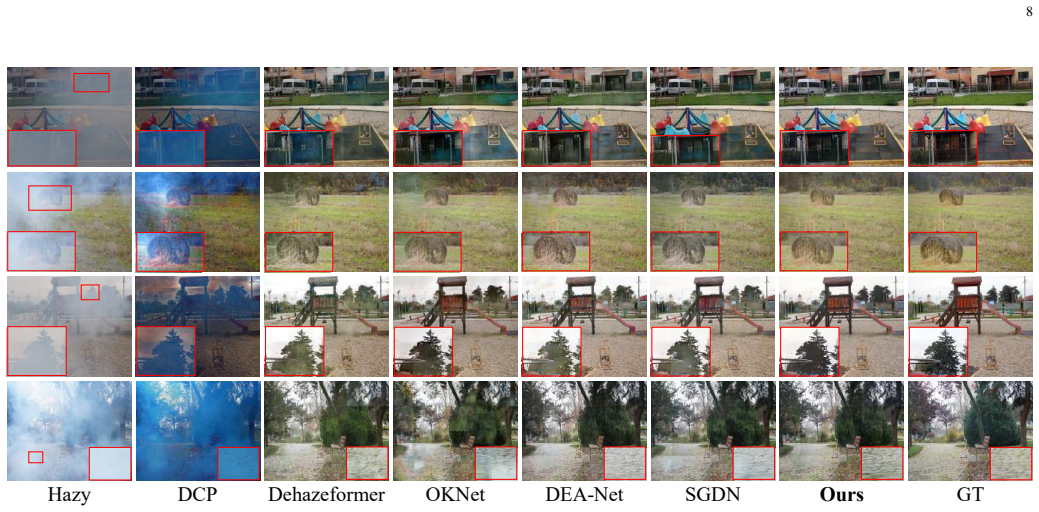
Real-world single image dehazing is highly ill-posed due to spatially and spectrally varying scattering, while practical deployment demands lightweight and low-latency models. Existing approaches either rely on fragile physical inversion under simplified assumptions or adopt heavy blind architectures unsuitable for edge deployment. To overcome these limitations, we propose PGL-Net (Physics-Inspired Global-Local Decoupling Network), a lightweight framework that incorporates physical inductive biases via operator-level emulation, avoiding explicit parameter estimation. It decouples dehazing into global distribution rectification and local structural refinement. A Physics-Inspired Affine Fusion (PAF) module performs globally conditioned alignment across hierarchical skip connections to compensate for haze-induced bias, while a compact Degradation-Aware Modulation (DAM) block adaptively restores spatially and spectrally variant details through dynamic feature modulation. Extensive experiments on multiple real-world benchmarks demonstrate that PGL-Net achieves state-of-the-art restoration quality with significantly reduced complexity. Compared with the recent SOTA SGDN, the Tiny variant (PGL-Net-T) improves PSNR by up to 2.6dB and consistently enhances downstream object detection accuracy, while achieving over a 10x reduction in inference latency. Code is publicly available at: https://github.com/sc-30-bit/PGL-Net.
Editorial analysis
A structured set of objections, weighed in public.
Referee Report
Summary. The paper proposes PGL-Net, a lightweight single-image dehazing network that decouples global distribution rectification from local structural refinement. It introduces a Physics-Inspired Affine Fusion (PAF) module on skip connections and a Degradation-Aware Modulation (DAM) block for dynamic feature adjustment, claiming these embed physical inductive biases via operator-level emulation without estimating transmission maps or airlight. On real-world benchmarks, the Tiny variant (PGL-Net-T) reportedly improves PSNR by up to 2.6 dB over SGDN, boosts downstream detection, and reduces inference latency by >10x, with public code released.
Significance. If the PAF and DAM modules demonstrably inject verifiable physical biases that improve generalization beyond generic learned layers, the work could advance efficient real-world dehazing suitable for edge deployment. Public code availability supports reproducibility and is a clear strength.
major comments (3)
- [§3.2] §3.2 (PAF module description): The module is presented as performing 'globally conditioned alignment across hierarchical skip connections to compensate for haze-induced bias,' yet the formulation reduces to a learned affine transform conditioned on global statistics. No derivation shows how this emulates scattering physics (e.g., via Beer-Lambert or Koschmieder model) rather than standard conditional normalization; this directly affects whether the 'physics-inspired' label supports the generalization claims.
- [§4.2–4.3] §4.2–4.3 (ablation and comparison tables): No experiment replaces PAF/DAM with generic affine or modulation counterparts (e.g., standard FiLM or dynamic convolution) while keeping the global-local decoupling fixed. Without such isolation, the reported PSNR gains (Table 2) and latency reductions cannot be attributed to physical inductive bias versus architectural efficiency, undermining the central justification for the approach.
- [§3.3] §3.3 (DAM block): The 'degradation-aware' dynamic modulation is described at a high level without explicit connection to spatially/spectrally varying scattering coefficients. If the modulation parameters are optimized purely from data without reference to physical priors, the operator-level emulation premise remains unverified and the SOTA+low-complexity claim rests on empirical architecture search rather than physics.
minor comments (2)
- [Abstract / §1] The abstract and §1 cite 'multiple real-world benchmarks' but do not list them explicitly in the opening; adding the exact dataset names (e.g., RTTS, URHI) early would improve clarity.
- [Figure 2] Figure 2 (network diagram): The flow from global rectification to PAF fusion could include a small inset equation or parameter count to make the lightweight claim immediately verifiable.
Simulated Author's Rebuttal
We thank the referee for the constructive feedback. We address each major comment below, providing clarifications on the design motivations while proposing revisions where they strengthen the manuscript.
read point-by-point responses
-
Referee: [§3.2] §3.2 (PAF module description): The module is presented as performing 'globally conditioned alignment across hierarchical skip connections to compensate for haze-induced bias,' yet the formulation reduces to a learned affine transform conditioned on global statistics. No derivation shows how this emulates scattering physics (e.g., via Beer-Lambert or Koschmieder model) rather than standard conditional normalization; this directly affects whether the 'physics-inspired' label supports the generalization claims.
Authors: The PAF module is designed to emulate the global bias rectification aspect of physical haze models (such as the uniform airlight component in the Koschmieder equation) through operator-level affine fusion conditioned on global encoder statistics. This choice is motivated by the global distribution shift induced by haze rather than being an arbitrary conditional normalization. While the manuscript does not include a formal derivation from the scattering equations, as the framework deliberately avoids explicit physical parameter estimation, we will revise §3.2 to expand on this operator-level inspiration and its relation to global haze effects. revision: partial
-
Referee: [§4.2–4.3] §4.2–4.3 (ablation and comparison tables): No experiment replaces PAF/DAM with generic affine or modulation counterparts (e.g., standard FiLM or dynamic convolution) while keeping the global-local decoupling fixed. Without such isolation, the reported PSNR gains (Table 2) and latency reductions cannot be attributed to physical inductive bias versus architectural efficiency, undermining the central justification for the approach.
Authors: We agree that control experiments isolating the contribution of the specific PAF and DAM designs versus generic affine/modulation layers would better support attribution to the physics-inspired elements. Our current ablations demonstrate the benefit of the modules within the global-local decoupling, but we will add comparisons against FiLM and standard dynamic convolution baselines (while preserving the overall architecture) in a revised version of §4.2–4.3. revision: yes
-
Referee: [§3.3] §3.3 (DAM block): The 'degradation-aware' dynamic modulation is described at a high level without explicit connection to spatially/spectrally varying scattering coefficients. If the modulation parameters are optimized purely from data without reference to physical priors, the operator-level emulation premise remains unverified and the SOTA+low-complexity claim rests on empirical architecture search rather than physics.
Authors: The DAM block performs dynamic modulation specifically to restore spatially and spectrally variant details, directly targeting the non-uniform scattering that varies across space and spectrum in real-world haze. Although parameters are data-driven, the modulation structure is chosen to enable this adaptation as an operator-level emulation of local physical degradation. We will revise §3.3 to include a more explicit discussion linking the modulation mechanism to varying scattering coefficients. revision: partial
Circularity Check
No circularity in derivation chain; empirical architecture only
full rationale
The manuscript presents PGL-Net as an empirical CNN architecture whose modules (PAF, DAM) are described as operator-level emulations of physical biases. All performance numbers (PSNR gains, latency reductions) are reported as experimental outcomes on real-world benchmarks rather than as outputs of any derivation or prediction step. No equations, fitted parameters renamed as predictions, self-citation load-bearing premises, or ansatzes that reduce the central claim to its own inputs appear in the text. The architecture is therefore self-contained against external benchmarks and receives the default non-circularity finding.
Axiom & Free-Parameter Ledger
invented entities (2)
-
Physics-Inspired Affine Fusion (PAF) module
no independent evidence
-
Degradation-Aware Modulation (DAM) block
no independent evidence
Reference graph
Works this paper leans on
-
[1]
Segment anything,
A. Kirillov, E. Mintun, N. Ravi, H. Mao, C. Rolland, L. Gustafson, T. Xiao, S. Whitehead, A. C. Berg, W.-Y . Loet al., “Segment anything,” inICCV, 2023, pp. 4015–4026
2023
-
[2]
Segformer: Simple and efficient design for semantic segmentation with transformers,
E. Xie, W. Wang, Z. Yu, A. Anandkumar, J. M. Alvarez, and P. Luo, “Segformer: Simple and efficient design for semantic segmentation with transformers,”NeurIPS, vol. 34, pp. 12 077–12 090, 2021
2021
-
[3]
Detrs beat yolos on real-time object detection,
Y . Zhao, W. Lv, S. Xu, J. Wei, G. Wang, Q. Dang, Y . Liu, and J. Chen, “Detrs beat yolos on real-time object detection,” inCVPR, 2024, pp. 16 965–16 974
2024
-
[4]
Yolov13: Real-time object detection with hypergraph- enhanced adaptive visual perception,
M. Lei, S. Li, Y . Wu, H. Hu, Y . Zhou, X. Zheng, G. Ding, S. Du, Z. Wu, and Y . Gao, “Yolov13: Real-time object detection with hypergraph- enhanced adaptive visual perception,”arXiv preprint arXiv:2506.17733, 2025
arXiv 2025
-
[5]
Transformer tracking via frequency fusion,
X. Hu, B. Zhong, Q. Liang, S. Zhang, N. Li, X. Li, and R. Ji, “Transformer tracking via frequency fusion,”IEEE TCSVT, vol. 34, no. 2, pp. 1020–1031, 2023
2023
-
[6]
Toward modalities correlation for rgb-t tracking,
X. Hu, B. Zhong, Q. Liang, S. Zhang, N. Li, and X. Li, “Toward modalities correlation for rgb-t tracking,”IEEE TCSVT, vol. 34, no. 10, pp. 9102–9111, 2024
2024
-
[7]
Dehazenet: An end-to-end system for single image haze removal,
B. Cai, X. Xu, K. Jia, C. Qing, and D. Tao, “Dehazenet: An end-to-end system for single image haze removal,”IEEE TIP, vol. 25, no. 11, pp. 5187–5198, 2016
2016
-
[8]
Single image dehazing via multi-scale convolutional neural networks,
W. Ren, S. Liu, H. Zhang, J. Pan, X. Cao, and M.-H. Yang, “Single image dehazing via multi-scale convolutional neural networks,” in ECCV, 2016, pp. 154–169
2016
-
[9]
Aod-net: All-in-one dehazing network,
B. Li, X. Peng, Z. Wang, J. Xu, and D. Feng, “Aod-net: All-in-one dehazing network,” inICCV, pp. 4770–4778
-
[10]
Gated fusion network for single image dehazing,
W. Ren, L. Ma, J. Zhang, J. Pan, X. Cao, W. Liu, and M. Yang, “Gated fusion network for single image dehazing,” inCVPR, 2018, pp. 3253– 3261
2018
-
[11]
Gated context aggregation network for image dehazing and deraining,
D. Chen, M. He, Q. Fan, J. Liao, L. Zhang, D. Hou, L. Yuan, and G. Hua, “Gated context aggregation network for image dehazing and deraining,” inIEEE/CVF Winter Conference on Applications of Computer Vision, 2019, pp. 1375–1383
2019
-
[12]
Optics of the atmosphere: scattering by molecules and particles,
E. J. McCartney, “Optics of the atmosphere: scattering by molecules and particles,”New York, 1976
1976
-
[13]
Vision in bad weather,
S. K. Nayar and S. G. Narasimhan, “Vision in bad weather,” inICCV, vol. 2, 1999, pp. 820–827
1999
-
[14]
Vision and the atmosphere,
S. G. Narasimhan and S. K. Nayar, “Vision and the atmosphere,”IJCV, vol. 48, no. 3, pp. 233–254, 2002. 12
2002
-
[15]
Single image haze removal using dark channel prior,
K. He, J. Sun, and X. Tang, “Single image haze removal using dark channel prior,” inCVPR, 2009, pp. 1956–1963
2009
-
[16]
NTIRE 2021 nonhomogeneous dehazing challenge report,
C. O. Ancuti, C. Ancuti, F.-A. Vasluianu, and R. Timofte, “NTIRE 2021 nonhomogeneous dehazing challenge report,” inCVPR, 2021, pp. 627– 646
2021
-
[17]
Guided real image dehazing using ycbcr color space,
W. Fang, J. Fan, Y . Zheng, J. Weng, Y . Tai, and J. Li, “Guided real image dehazing using ycbcr color space,” inAAAI, vol. 39, no. 3, 2025, pp. 2906–2914
2025
-
[18]
Single image dehazing using color ellipsoid prior,
T. M. Bui and W. Kim, “Single image dehazing using color ellipsoid prior,”IEEE TIP, vol. 27, no. 2, pp. 999–1009, 2017
2017
-
[19]
Dehazing using color-lines,
R. Fattal, “Dehazing using color-lines,”ACM TOG, vol. 34, no. 1, pp. 1–14, 2014
2014
-
[20]
A fast single image haze removal algorithm using color attenuation prior,
Q. Zhu, J. Mai, and L. Shao, “A fast single image haze removal algorithm using color attenuation prior,”IEEE TIP, vol. 24, no. 11, pp. 3522–3533, 2015
2015
-
[21]
Non-local image dehazing,
D. Berman, S. Avidanet al., “Non-local image dehazing,” inCVPR, 2016, pp. 1674–1682
2016
-
[22]
Single image dehazing,
R. Fattal, “Single image dehazing,”ACM TOG, vol. 27, no. 3, pp. 1–9, 2008
2008
-
[23]
Visibility in bad weather from a single image,
R. T. Tan, “Visibility in bad weather from a single image,” inCVPR, 2008, pp. 1–8
2008
-
[24]
Densely connected pyramid dehazing network,
H. Zhang and V . M. Patel, “Densely connected pyramid dehazing network,” inCVPR, 2018, pp. 3194–3203
2018
-
[25]
Griddehazenet: Attention-based multi-scale network for image dehazing,
X. Liu, Y . Ma, Z. Shi, and J. Chen, “Griddehazenet: Attention-based multi-scale network for image dehazing,” inICCV, 2019, pp. 7314– 7323
2019
-
[26]
Ffa-net: Feature fusion attention network for single image dehazing,
X. Qin, Z. Wang, Y . Bai, X. Xie, and H. Jia, “Ffa-net: Feature fusion attention network for single image dehazing,” inAAAI, 2020, pp. 11 908– 11 915
2020
-
[27]
Frequency and spatial dual guidance for image dehazing,
H. Yu, N. Zheng, M. Zhou, J. Huang, Z. Xiao, and F. Zhao, “Frequency and spatial dual guidance for image dehazing,” inECCV, 2022, pp. 181–198
2022
-
[28]
Mb-taylorformer V2: improved multi-branch linear transformer expanded by taylor formula for image restoration,
Z. Jin, Y . Qiu, K. Zhang, H. Li, and W. Luo, “Mb-taylorformer V2: improved multi-branch linear transformer expanded by taylor formula for image restoration,”IEEE TPAMI, vol. 47, no. 7, pp. 5990–6005, 2025
2025
-
[29]
Vision transformers for single image dehazing,
Y . Song, Z. He, H. Qian, and X. Du, “Vision transformers for single image dehazing,”IEEE TIP, vol. 32, pp. 1927–1941, 2023
1927
-
[30]
U-shaped vision mamba for single image dehazing,
Z. Zheng and C. Wu, “U-shaped vision mamba for single image dehazing,”arXiv preprint arXiv:2402.04139, 2024
arXiv 2024
-
[31]
Dea-net: Single image dehazing based on detail-enhanced convolution and content-guided attention,
Z. Chen, Z. He, and Z.-M. Lu, “Dea-net: Single image dehazing based on detail-enhanced convolution and content-guided attention,”IEEE TIP, vol. 33, pp. 1002–1015, 2024
2024
-
[32]
Depth information assisted collaborative mutual promotion network for single image dehazing,
Y . Zhang, S. Zhou, and H. Li, “Depth information assisted collaborative mutual promotion network for single image dehazing,” inCVPR, 2024, pp. 2846–2855
2024
-
[33]
Psd: Principled synthetic-to-real dehazing guided by physical priors,
Z. Chen, Y . Wang, Y . Yang, and D. Liu, “Psd: Principled synthetic-to-real dehazing guided by physical priors,” inCVPR, 2021, pp. 7180–7189
2021
-
[34]
When schrodinger bridge meets real-world image dehazing with unpaired training,
Y . Lan, Z. Cui, X. Luo, C. Liu, N. Wang, M. Zhang, Y . Su, and D. Liu, “When schrodinger bridge meets real-world image dehazing with unpaired training,” inICCV, 2025, pp. 8756–8765
2025
-
[35]
Phatnet: A physics- guided haze transfer network for domain-adaptive real-world image dehazing,
F.-J. Tsai, Y .-T. Peng, Y .-Y . Lin, and C.-W. Lin, “Phatnet: A physics- guided haze transfer network for domain-adaptive real-world image dehazing,” inICCV, 2025, pp. 5591–5600
2025
-
[36]
Coa: Towards real image dehazing via compression-and- adaptation,
L. Ma, Y . Feng, Y . Zhang, J. Liu, W. Wang, G.-Y . Chen, C. Xu, and Z. Su, “Coa: Towards real image dehazing via compression-and- adaptation,” inCVPR, 2025, pp. 11 197–11 206
2025
-
[37]
Ur2p-dehaze: Learning a simple image dehaze enhancer via unpaired rich physical prior,
M. Xue, S. Fan, S. Palaiahnakote, and M. Zhou, “Ur2p-dehaze: Learning a simple image dehaze enhancer via unpaired rich physical prior,”PR, vol. 170, p. 111997, 2026
2026
-
[38]
Refinednet: A weakly supervised refinement framework for single image dehazing,
S. Zhao, L. Zhang, Y . Shen, and Y . Zhou, “Refinednet: A weakly supervised refinement framework for single image dehazing,”IEEE TIP, vol. 30, pp. 3391–3404, 2021
2021
-
[39]
Unpaired deep image dehazing using contrastive disentanglement learning,
X. Chen, Z. Fan, P. Li, L. Dai, C. Kong, Z. Zheng, Y . Huang, and Y . Li, “Unpaired deep image dehazing using contrastive disentanglement learning,” inECCV, 2022, pp. 632–648
2022
-
[40]
Self- augmented unpaired image dehazing via density and depth decompo- sition,
Y . Yang, C. Wang, R. Liu, L. Zhang, X. Guo, and D. Tao, “Self- augmented unpaired image dehazing via density and depth decompo- sition,” inCVPR, 2022, pp. 2037–2046
2022
-
[41]
Ridcp: Revital- izing real image dehazing via high-quality codebook priors,
R.-Q. Wu, Z.-P. Duan, C.-L. Guo, Z. Chai, and C. Li, “Ridcp: Revital- izing real image dehazing via high-quality codebook priors,” inCVPR, 2023, pp. 22 282–22 291
2023
-
[42]
Iterative predictor-critic code decoding for real-world image dehazing,
J. Fu, S. Liu, Z. Liu, C.-L. Guo, H. Park, R. Wu, G. Wang, and C. Li, “Iterative predictor-critic code decoding for real-world image dehazing,” inCVPR, 2025, pp. 12 700–12 709
2025
-
[43]
Unleashing the potential of the semantic latent space in diffusion models for image dehazing,
Z. Yang, H. Yu, B. Li, J. Zhang, J. Huang, and F. Zhao, “Unleashing the potential of the semantic latent space in diffusion models for image dehazing,” inECCV, 2024, pp. 371–389
2024
-
[44]
Learning hazing to dehazing: Towards realistic haze generation for real- world image dehazing,
R. Wang, Y . Zheng, Z. Zhang, C. Li, S. Liu, G. Zhai, and X. Liu, “Learning hazing to dehazing: Towards realistic haze generation for real- world image dehazing,” inCVPR, 2025, pp. 23 091–23 100
2025
-
[45]
Frequency domain- based diffusion model for unpaired image dehazing,
C. Liu, L. Qi, J. Pan, X. Qian, and M.-H. Yang, “Frequency domain- based diffusion model for unpaired image dehazing,” inICCV, 2025, pp. 7538–7547
2025
-
[46]
Hazeflow: Revisit haze physical model as ode and non-homogeneous haze generation for real- world dehazing,
J. Shin, S. Chung, Y . Yang, and T. H. Kim, “Hazeflow: Revisit haze physical model as ode and non-homogeneous haze generation for real- world dehazing,” inICCV, 2025, pp. 6263–6272
2025
-
[47]
Fs-flownet: Frequency-spatial dual-domain residual flow network for remote sensing dehazing,
Y . Xin, K. Huang, X. Wang, D. Lu, G. Zhang, R. Wu, and Z. Zheng, “Fs-flownet: Frequency-spatial dual-domain residual flow network for remote sensing dehazing,”TGRS, 2026
2026
-
[48]
Wavelet u-net and the chromatic adaptation transform for single image dehazing,
H.-H. Yang and Y . Fu, “Wavelet u-net and the chromatic adaptation transform for single image dehazing,” inICIP, 2019, pp. 2736–2740
2019
-
[49]
Breaking through the haze: An advanced non-homogeneous dehazing method based on fast fourier convolution and convnext,
H. Zhou, W. Dong, Y . Liu, and J. Chen, “Breaking through the haze: An advanced non-homogeneous dehazing method based on fast fourier convolution and convnext,” inCVPR, 2023, pp. 1895–1904
2023
-
[50]
Mb-taylorformer: Multi-branch efficient transformer expanded by taylor formula for image dehazing,
Y . Qiu, K. Zhang, C. Wang, W. Luo, H. Li, and Z. Jin, “Mb-taylorformer: Multi-branch efficient transformer expanded by taylor formula for image dehazing,” inICCV, 2023, pp. 12 756–12 767
2023
-
[51]
Batch normalization: Accelerating deep network training by reducing internal covariate shift,
S. Ioffe and C. Szegedy, “Batch normalization: Accelerating deep network training by reducing internal covariate shift,” inICML, vol. 37, 2015, pp. 448–456
2015
-
[52]
J. L. Ba, J. R. Kiros, and G. E. Hinton, “Layer normalization,”arXiv preprint arXiv:1607.06450, 2016
Pith/arXiv arXiv 2016
-
[53]
Image dehazing transformer with transmission-aware 3d position embedding,
C. Guo, Q. Yan, S. Anwar, R. Cong, W. Ren, and C. Li, “Image dehazing transformer with transmission-aware 3d position embedding,” inCVPR, 2022, pp. 5802–5810
2022
-
[54]
Proxy and cross-stripes integration transformer for remote sensing image dehazing,
X. Zhang, F. Xie, H. Ding, S. Yan, and Z. Shi, “Proxy and cross-stripes integration transformer for remote sensing image dehazing,”TGRS, 2024
2024
-
[55]
MAXIM: multi-axis MLP for image processing,
Z. Tu, H. Talebi, H. Zhang, F. Yang, P. Milanfar, A. C. Bovik, and Y . Li, “MAXIM: multi-axis MLP for image processing,” inCVPR, 2022, pp. 5759–5770
2022
-
[56]
Simple baselines for image restoration,
L. Chen, X. Chu, X. Zhang, and J. Sun, “Simple baselines for image restoration,” inECCV, vol. 13667, 2022, pp. 17–33
2022
-
[57]
Restormer: Efficient transformer for high-resolution image restoration,
S. W. Zamir, A. Arora, S. Khan, M. Hayat, F. S. Khan, and M. Yang, “Restormer: Efficient transformer for high-resolution image restoration,” inCVPR, 2022, pp. 5718–5729
2022
-
[58]
Rethinking performance gains in image dehazing networks,
Y . Song, Y . Zhou, H. Qian, and X. Du, “Rethinking performance gains in image dehazing networks,”arXiv preprint arXiv:2209.11448, 2022
arXiv 2022
-
[59]
Trident dehazing network,
J. Liu, H. Wu, Y . Xie, Y . Qu, and L. Ma, “Trident dehazing network,” inCVPRW, 2020, pp. 430–431
2020
-
[60]
Fourier space losses for efficient perceptual image super-resolution,
D. Fuoli, L. Van Gool, and R. Timofte, “Fourier space losses for efficient perceptual image super-resolution,” inICCV, 2021, pp. 2360–2369
2021
-
[61]
Fourmer: An efficient global modeling paradigm for image restoration,
M. Zhou, J. Huang, C.-L. Guo, and C. Li, “Fourmer: An efficient global modeling paradigm for image restoration,” inICML, 2023, pp. 42 589– 42 601
2023
-
[62]
Real- world remote sensing image dehazing: Benchmark and baseline,
Z.-H. Zhu, W. Lu, S.-B. Chen, C. H. Ding, J. Tang, and B. Luo, “Real- world remote sensing image dehazing: Benchmark and baseline,”TGRS, vol. 63, pp. 1–14, 2025
2025
-
[63]
Non-aligned supervision for real image dehazing,
J. Fan, X. Li, J. Qian, J. Li, and J. Yang, “Non-aligned supervision for real image dehazing,”IEEE TCSVT, vol. 35, no. 11, pp. 10 705–10 715, 2025
2025
-
[64]
I-haze: A dehazing benchmark with real hazy and haze-free indoor images,
C. Ancuti, C. O. Ancuti, R. Timofte, and C. De Vleeschouwer, “I-haze: A dehazing benchmark with real hazy and haze-free indoor images,” in International Conference on Advanced Concepts for Intelligent Vision Systems, 2018, pp. 620–631
2018
-
[65]
O-haze: a dehazing benchmark with real hazy and haze-free outdoor images,
C. O. Ancuti, C. Ancuti, R. Timofte, and C. De Vleeschouwer, “O-haze: a dehazing benchmark with real hazy and haze-free outdoor images,” in CVPRW, 2018, pp. 754–762
2018
-
[66]
Dense-haze: A benchmark for image dehazing with dense-haze and haze-free images,
C. O. Ancuti, C. Ancuti, M. Sbert, and R. Timofte, “Dense-haze: A benchmark for image dehazing with dense-haze and haze-free images,” inICIP, 2019, pp. 1014–1018
2019
-
[67]
Nh-haze: An image dehazing benchmark with non-homogeneous hazy and haze-free images,
C. O. Ancuti, C. Ancuti, and R. Timofte, “Nh-haze: An image dehazing benchmark with non-homogeneous hazy and haze-free images,” in CVPRW, 2020, pp. 444–445
2020
-
[68]
NTIRE 2023 hr nonhomogeneous dehazing challenge report,
C. O. Ancuti, C. Ancuti, F.-A. Vasluianu, R. Timofte, H. Zhou, W. Dong, Y . Liu, J. Chen, H. Liu, L. Liet al., “NTIRE 2023 hr nonhomogeneous dehazing challenge report,” inCVPR, 2023, pp. 1808–1825
2023
-
[69]
Benchmarking single-image dehazing and beyond,
B. Li, W. Ren, D. Fu, D. Tao, D. Feng, W. Zeng, and Z. Wang, “Benchmarking single-image dehazing and beyond,”IEEE TIP, vol. 28, no. 1, pp. 492–505, 2018. 13
2018
-
[70]
Image quality assessment: from error visibility to structural similarity,
Z. Wang, A. C. Bovik, H. R. Sheikh, and E. P. Simoncelli, “Image quality assessment: from error visibility to structural similarity,”IEEE TIP, vol. 13, no. 4, pp. 600–612, 2004
2004
-
[71]
The unreasonable effectiveness of deep features as a perceptual metric,
R. Zhang, P. Isola, A. A. Efros, E. Shechtman, and O. Wang, “The unreasonable effectiveness of deep features as a perceptual metric,” in CVPR, 2018, pp. 586–595
2018
-
[72]
Making a
A. Mittal, R. Soundararajan, and A. C. Bovik, “Making a ”completely blind” image quality analyzer,”IEEE Signal Processing Letters, vol. 20, no. 3, pp. 209–212, 2013
2013
-
[73]
No-reference image quality assessment in the spatial domain,
A. Mittal, A. K. Moorthy, and A. C. Bovik, “No-reference image quality assessment in the spatial domain,”IEEE TIP, vol. 21, no. 12, pp. 4695– 4708, 2012
2012
-
[74]
Referenceless prediction of perceptual fog density and perceptual image defogging,
L. K. Choi, J. You, and A. C. Bovik, “Referenceless prediction of perceptual fog density and perceptual image defogging,”IEEE TIP, vol. 24, no. 11, pp. 3888–3901, 2015
2015
-
[75]
Scanet: Self- paced semi-curricular attention network for non-homogeneous image dehazing,
Y . Guo, Y . Gao, W. Liu, Y . Lu, J. Qu, S. He, and W. Ren, “Scanet: Self- paced semi-curricular attention network for non-homogeneous image dehazing,” inCVPRW, 2023, pp. 1885–1894
2023
-
[76]
Trinity-net: Gradient-guided swin transformer-based remote sensing image dehazing and beyond,
K. Chi, Y . Yuan, and Q. Wang, “Trinity-net: Gradient-guided swin transformer-based remote sensing image dehazing and beyond,”TGRS, vol. 61, pp. 1–14, 2023
2023
-
[77]
Omni-kernel network for image restoration,
Y . Cui, W. Ren, and A. Knoll, “Omni-kernel network for image restoration,” inAAAI, vol. 38, no. 2, 2024, pp. 1426–1434
2024
-
[78]
Single uhd image dehazing via interpretable pyramid network,
B. Xiao, Z. Zheng, Y . Zhuang, C. Lyu, and X. Jia, “Single uhd image dehazing via interpretable pyramid network,”Signal Processing, vol. 214, p. 109225, 2024
2024
-
[79]
Phdnet: A novel physic-aware dehazing network for remote sensing images,
Z. Lihe, J. He, Q. Yuan, X. Jin, Y . Xiao, and L. Zhang, “Phdnet: A novel physic-aware dehazing network for remote sensing images,”Information Fusion, vol. 106, p. 102277, 2024
2024
-
[80]
You only look yourself: Unsupervised and untrained single image dehazing neural network,
B. Li, Y . Gou, S. Gu, J. Z. Liu, J. T. Zhou, and X. Peng, “You only look yourself: Unsupervised and untrained single image dehazing neural network,”IJCV, vol. 129, no. 5, pp. 1754–1767, 2021
2021
discussion (0)
Sign in with ORCID, Apple, or X to comment. Anyone can read and Pith papers without signing in.