REVIEW 3 major objections 5 minor 44 references
The paper argues that 6G, as specified, cannot yet natively support AI-agent communication and identifies six concrete gaps plus five directions to close them.
Reviewed by Pith at T0; open to challenge. T0 means a machine referee read the full paper against a public rubric. the ladder, T0–T4 →
T0 review · deepseek-v4-flash
2026-08-01 15:52 UTC pith:EI7QL3P2
load-bearing objection A solid, clearly written position paper on agent communications for 6G; its gap analysis leans on the author's SOVA framework, which is a defensible but normative choice that could use more backing. the 3 major comments →
AI Agent Communications in AI-Native 6G Network: Status, Challenges and Opportunities
The pith
A machine-rendered reading of the paper's core claim, the machinery that carries it, and where it could break.
Core claim
The paper's central claim is that the AI-native 6G network, with its planned capabilities, is a promising foundation for the SOVA framework for AI-agent communication, but current and draft 6G specifications (Release 19 and 20) do not yet provide the mechanisms the framework requires. Specifically, the paper identifies six gaps: deficient cross-layer service orchestration, missing semantic interoperability (no universal ontology for agents), QoS-driven slicing instead of semantic slicing, centralized security architecture versus decentralized trust, protocol-efficiency mismatch between enterprise-grade agent protocols and mobile edge constraints, and a synchronization gap between 3GPP and th
What carries the argument
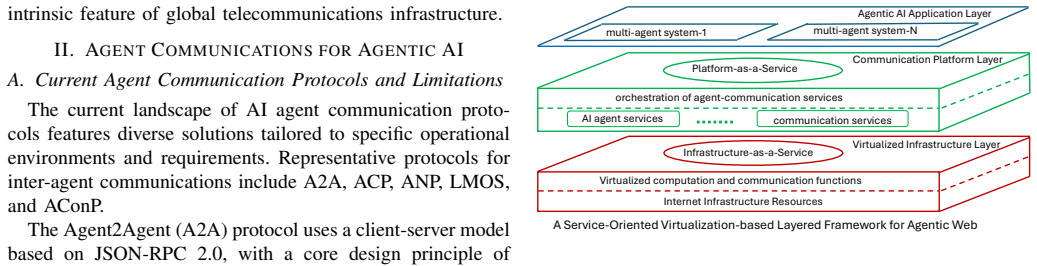
The SOVA (Service-Oriented Virtualization-Based Architecture) framework is the evaluative lens: a three-layer model that abstracts infrastructure and agent capabilities into composable services. The paper also relies on the mapping between five 6G attributes (advanced slicing, pervasive service-based architecture, AI-as-a-Service, intent-based networking, and semantic communications) and SOVA's requirements, and on the six-gap analysis that defines the deficiencies of current specifications.
Load-bearing premise
The paper measures 6G's adequacy against the requirements of the SOVA framework; if SOVA's requirements (such as semantic slicing, bidirectional cross-layer orchestration, and hybrid trust) are not actually necessary for large-scale AI-agent communication, then the gaps it identifies are not deficiencies of 6G but features of that particular architectural vision.
What would settle it
A field trial in which a multi-agent system using a standard protocol such as A2A successfully requests and obtains a URLLC slice reconfiguration on a Release 19/20 6G testbed, using only standard NEF/API mechanisms and within the latency required by the agent's task, would directly contradict the infrastructure-orchestration gap.
If this is right
- 6G standardization should adopt the five proposed directions; otherwise, agent communication will remain an over-the-top application rather than a native network feature.
- Agent protocol developers (A2A, ACP, ANP, LMOS, AGNTCY) would need to coordinate with 3GPP to ensure their protocols interface with the 6G control plane.
- Semantic slicing, if implemented, would let the network allocate resources based on task meaning, reducing over-provisioning in multi-agent workloads.
- Hybrid trust bridging centralized AKA with decentralized DIDs would enable secure peer-to-peer agent interactions without sacrificing 6G latency budgets.
- Edge-native protocol transcoding would allow heavy enterprise protocols (e.g., JSON-RPC/gRPC) to run efficiently on resource-constrained edge devices.
Where Pith is reading between the lines
- The same six gaps would likely apply to any network infrastructure trying to support agent communication, not just 6G; the analysis is a general checklist for 'agent-native' networking.
- If semantic slicing becomes standard, it may change how network resource allocation is priced and metered, moving from volume-based to intent-based charging.
- The paper's gap analysis could be turned into a testable benchmark: define a concrete multi-agent task suite, run it over a 6G testbed, and measure the failure modes corresponding to each gap.
- The proposed eNWDAF broker direction blurs the line between network operator and application provider, which may raise new governance and liability questions.
Editorial analysis
A structured set of objections, weighed in public.
Referee Report
Summary. This position paper argues that current and draft 6G specifications (3GPP Release 19/20) do not yet provide the protocol-level mechanisms needed to support AI-agent communication under the Service-Oriented Virtualization-Based Architecture (SOVA), a framework previously proposed by the author. The paper reviews the current landscape of agent communication protocols (A2A, ACP, ANP, LMOS, AConP), maps six 6G architectural attributes (network slicing, service-based architecture, AI-as-a-Service, intent-based networking, semantic communications, and compute-network convergence) onto SOVA's requirements, and then identifies six gaps: cross-layer orchestration, semantic interoperability, semantic slicing, decentralized trust, protocol efficiency, and standardization synchronization. It closes with five research directions, including a Semantic Slice Management Function, intent-translation APIs, an eNWDAF-based agentic broker, edge-native protocol transcoding, and hybrid trust architectures. The analysis is qualitative and architectural, without formal derivations or quantitative evaluation.
Significance. If the central claim is accepted, the paper provides a useful bridge between the 6G standardization community and the rapidly evolving agent-protocol ecosystem. Its strengths include a structured comparison of eight agent protocols, a concrete mapping of 6G architectural paradigms to SOVA requirements, and a specific list of research directions that are actionable and testable. The synchronization gap between 3GPP and IETF/W3C/open-source consortia is a real and under-appreciated problem. However, the significance is conditional: because the gap analysis uses the author's own SOVA framework as the normative benchmark, the paper must either justify that benchmark independently or clearly limit its claims to SOVA-relative gaps. The proposed directions, such as SSMF and edge transcoding, are concrete enough to be falsified in prototyping, which is a strength. With the normative framing corrected, the paper would be a valuable vision contribution.
major comments (3)
- [Section II.B, Section IV, Table II] The central gap analysis is circular. Table II labels the right-hand column 'AI Agent Protocol Requirements,' but the entries—semantic slicing, decentralized trust, bidirectional cross-layer orchestration, adaptive meta-protocol negotiation, and semantic-aware network exposure—are essentially the design choices of SOVA, the author's own framework from [7]. The paper does not independently derive these requirements from external sources; TR 22.870 is cited only at a high level (agent interoperability, discovery, task management) and is not used to justify the specific requirement set. As a result, the finding that current 6G specifications lack these mechanisms is true by construction relative to SOVA. Please either derive the requirement set from external use cases and protocol constraints (e.g., TR 22.870, IETF/W3C requirements, or measurable agent-communication failure modes) or explic
- [Section III.C and Section IV.F] 3GPP document status is mischaracterized. Section III.C states 'TR 23.801 mandates that the 6G network natively support AI Agent Discovery,' and Section IV.F states '3GPP TR 22.870 mandates stringent requirements.' Both documents are Technical Reports (studies), not normative specifications; they do not mandate. This is a load-bearing accuracy issue because the paper's claims about what 6G does or does not 'mandate' support the gap analysis. Please revise to 'proposes,' 'identifies,' or 'states a requirement in a study,' and verify all 3GPP citation statuses.
- [Section III vs Section IV, Table I] There is an unresolved tension between the alignment claims in Section III and the gap analysis in Section IV. Section III.C says AIaaS 'aligns flawlessly with the SOVA framework,' and Table I says 6G capabilities 'realize' the virtualized infrastructure, 'fulfill' service orientation, and 'enable' cross-domain discovery. Yet Section IV then identifies gaps in the very same areas (cross-layer orchestration, semantic interoperability, slicing, trust, efficiency). The paper should explicitly distinguish potential architectural alignment from current specification readiness and clarify that Section III describes the trajectory while Section IV describes the present state.
minor comments (5)
- [Section III.C heading] Typo: 'AI-as-a-Serivce' should read 'AI-as-a-Service.' The manuscript also uses inconsistent spacing 'SOV A' instead of 'SOVA' in many places.
- [Section II.A and Reference [39]] The text refers to the Open Agent Schema Framework (OASF) in AGNTCY, but [39] is the OCI Runtime Specification. The citation does not support the OASF claim; please add a correct reference.
- [Section IV.E] The claim that 'Text-based JSON serialization results in 30% to 50% larger payloads than binary formats' is presented without a citation or measurement. It is plausible, but for a gap analysis that rests on efficiency, please provide a source or mark it as an illustrative estimate.
- [Section III.A and IV.E] Hyperbolic phrasing such as 'infinitely granular' slicing and 'devastatingly inefficient' protocol handling should be replaced with more measured, technically precise language.
- [Table I and Table II] Table I uses present-tense 'realizes' and 'fulfills' while the surrounding text is about future potential. Make the tense consistent with Section IV's gap analysis (e.g., 'would support' or 'is positioned to support').
Circularity Check
The gap analysis is benchmarked on the author's own SOVA framework, making the six 'gaps' true by construction rather than derived from independent agent-communication requirements.
specific steps
-
self definitional
[Abstract / Section IV (Gap Analysis) opening]
"By critically examining 6G’s key architectural paradigms and their potential to fulfill SOVA’s requirements, this paper identifies gaps between 6G standards and the demands of AI agent communication. ... These gaps exist precisely at the intersection where the demands of the SOVA framework for agent communication meet the current and developing capabilities of the 6G network infrastructure."
The paper equates 'the demands of AI agent communication' with SOVA's requirements. Both the Abstract and the Section IV introduction state that gaps are found by testing 6G against SOVA. Since SOVA is the author's own framework and no independent derivation of its requirements is given, the result that 6G has gaps is true by construction: a gap is defined as any place where 6G fails to satisfy SOVA. TR 22.870 is cited only at a general level (interoperability, discovery, task management) and is not used to derive the specific requirement set.
-
self citation load bearing
[Section II.B (Service-Oriented Virtualization for Agent Communications)]
"To resolve the interoperability crisis and bridge the infrastructure gap in current agent protocols, we proposed the Service-Oriented Virtualization-Based Architecture (SOVA) in our previous work [7] ... Therefore, SOVA offers a unified architectural framework that not only accommodates the coexistence of hybrid agent protocols ..."
SOVA, the normative benchmark for the entire assessment, is imported from the author's own prior paper [7]. No machine-checked, code-reproduced, or independently falsifiable validation of SOVA's requirements is cited. The central question 'does 6G support SOVA?' therefore rests on a self-citation: the framework to be supported is the author's own proposal, and its requirements are not independently established before being used to define 6G gaps.
-
self definitional
[Section IV.A / IV.C and Table II (Gap Analysis)]
"The SOVA framework inherently requires an integrated cross-layer architecture ... A key requirement of the SOVA framework for agent communications is the ability to compose and provision network services tailored to highly diverse multi-agent interactions. ... real-time, continuous cross-layer resource negotiation driven by the SOVA framework"
Table II's 'AI Agent Protocol Requirement' column is populated with SOVA's design choices—cross-layer orchestration 'driven by the SOVA framework', semantic slicing, decentralized trust, adaptive meta-protocol negotiation. The corresponding gaps are then the absence of these features in 6G. This makes the gap analysis a self-consistency check of 6G against the author's architecture, not a derivation from agent-communication needs; under a different benchmark, several listed gaps would become optional or disappear.
full rationale
This is a survey/assessment paper rather than a quantitative derivation, and many of its individual observations about 6G have independent, checkable content: Rel-19/20 drafts are indeed QoS-driven in slicing, use centralized AKA-based trust, lack a standardized agent ontology, and do not yet specify SOVA-style semantic slicing or cross-layer orchestration. Those facts could be verified against public 3GPP specs. However, the paper's central gap analysis is framed entirely around SOVA, the author's own prior framework [7], and the requirement set in Table II is essentially SOVA's design choices (one row is literally 'driven by the SOVA framework'). The abstract concedes that SOVA's effectiveness 'has yet to be fully assessed,' which reinforces that SOVA is a proposed, not established, benchmark. Thus the finding that current 6G falls short of the SOVA requirements is true by construction; what is not established is that those SOVA requirements are necessary for large-scale AI-agent communication. This is a partial, moderate circularity—not a fabricated parameter fit or uniqueness-theorem chain—so the score is 6 rather than 8-10. The circularity could be removed by deriving the requirement set from an external anchor such as TR 22.870 or from protocol interoperability needs, and treating SOVA as one concrete instance of those requirements rather than as the definitional benchmark.
Axiom & Free-Parameter Ledger
axioms (4)
- domain assumption SOVA framework is a valid and necessary architectural benchmark for AI-agent communication.
- domain assumption The cited draft 3GPP specifications (TR 23.801 v0.7.0, TR 33.801 v0.5.0, TR 22.870, TS 28.530) accurately represent the current 6G standardization trajectory, and omissions in those drafts are real gaps.
- domain assumption AI-native 6G capabilities (recursive slicing, pervasive SBA, AIaaS, intent-based networking, and semantic communication) will materialize as described in the cited literature.
- domain assumption AI-agent communication actually requires decentralized identities, semantic slicing, and cross-layer resource negotiation to scale.
invented entities (3)
-
Semantic Slice Management Function (SSMF)
no independent evidence
-
Core Agents and RAN Agents
no independent evidence
-
Semantic Intrusion Detection Systems (S-IDS)
no independent evidence
read the original abstract
The rapid development of agentic AI and multi-agent systems is establishing AI agent communication as a fundamental requirement for the future Internet. While a diverse array of agent communication protocols has recently emerged, these solutions currently suffer from interoperability crises and infrastructure gaps. The newly proposed Service-Oriented Virtualization-Based Architecture (SOVA) offers an architectural framework to address these challenges for agent communication, which expects seamless support from the network infrastructure. The emerging AI-native 6G network is promising as a robust foundation for the SOVA framework, thereby greatly facilitating AI agent communication; however, its effectiveness in supporting the SOVA framework has yet to be fully assessed. To bridge the distinct research trajectories of AI-native 6G networks and AI agent communications, this paper investigates the capabilities of current and proposed 6G network architectures and protocol specifications for supporting the SOVA framework for AI agent communications. By critically examining 6G's key architectural paradigms and their potential to fulfill SOVA's requirements, this paper identifies gaps between 6G standards and the demands of AI agent communication. Based on this gap analysis, this paper outlines research and development directions to ensure that the future 6G network can natively empower AI agent communications in the era of agentic AI.
Figures
Reference graph
Works this paper leans on
-
[1]
The rise and potential of large language model based agents: A survey,
Z. Xi, W. Chen, X. Guo, W. He, Y . Ding, B. Hong, M. Zhang, J. Wang, S. Jin, E. Zhou,et al., “The rise and potential of large language model based agents: A survey,”Science China Information Sciences, vol. 68, no. 2, p. 121101, 2025
2025
-
[2]
AI agents vs. agentic AI: A conceptual taxonomy, applications and challenges,
R. Sapkota, K. I. Roumeliotis, and M. Karkee, “AI agents vs. agentic AI: A conceptual taxonomy, applications and challenges,”Information Fusion, vol. 126, p. 103599, February 2026
2026
-
[3]
Beyond self-talk: A communication-centric survey of LLM- based multi-agent systems,
B. Yan, Z. Zhou, L. Zhang, L. Zhang, Z. Zhou, D. Miao, Z. Li, C. Li, and X. Zhang, “Beyond self-talk: A communication-centric survey of LLM- based multi-agent systems,”arXiv preprint arXiv:2502.14321, 2025
Pith/arXiv arXiv 2025
-
[4]
Agent communications toward agentic AI at edge-a case study of the Agent2Agent protocol,
Q. Duan and Z. Lu, “Agent communications toward agentic AI at edge-a case study of the Agent2Agent protocol,” in2025 IEEE 11th Interna- tional Conference on Edge Computing and Scalable Cloud (EdgeCom), pp. 150–155, November 2025
2025
-
[5]
A. Ehtesham, A. Singh, G. K. Gupta, and S. Kumar, “A survey of agent interoperability protocols: Model context protocol (MCP), agent communication protocol (ACP), agent-to-agent protocol (A2A), and agent network protocol (ANP),”arXiv preprint arXiv:2505.02279, 2025
Pith/arXiv arXiv 2025
-
[6]
D. Kong, S. Lin, Z. Xu, Z. Wang, M. Li, Y . Li, Y . Zhang, Z. Sha, Y . Li, C. Lin,et al., “A survey of LLM-driven AI agent communication: Protocols, security risks, and defense countermeasures,”arXiv preprint arXiv:2506.19676, 2025
arXiv 2025
-
[7]
Ai agent communications in the future Inter- net—paving a path toward the agentic Web,
Q. Duan and Z. Lu, “Ai agent communications in the future Inter- net—paving a path toward the agentic Web,”Future Internet, vol. 18, no. 3, p. 171, 2026
2026
-
[8]
Overview of AI and communication for 6G network: Fundamentals, challenges, and future research opportunities,
Q. Cui, X. You, N. Wei, G. Nan, X. Zhang, J. Zhang, X. Lyu, M. Ai, X. Tao, Z. Feng,et al., “Overview of AI and communication for 6G network: Fundamentals, challenges, and future research opportunities,” Science China Information Sciences, vol. 68, no. 7, p. 171301, 2025
2025
-
[9]
A review on agent-to-agent protocol: concept, state-of-the-art, challenges and future directions,
P. P. Ray, “A review on agent-to-agent protocol: concept, state-of-the-art, challenges and future directions,”Authorea Preprints, 2025
2025
-
[10]
Building a secure agentic AI application leveraging A2A protocol,
I. Habler, K. Huang, V . S. Narajala, and P. Kulkarni, “Building a secure agentic AI application leveraging A2A protocol,”arXiv preprint arXiv:2504.16902, 2025
Pith/arXiv arXiv 2025
-
[11]
Agent Communication Protocol (ACP)
“Agent Communication Protocol (ACP).” https:// agentcommunicationprotocol.dev/introduction/welcome. Accessed: 2026-7-20
2026
-
[12]
Agent network protocol technical white paper,
G. Chang, E. Lin, C. Yuan, R. Cai, B. Chen, X. Xie, and Y . Zhang, “Agent network protocol technical white paper,”arXiv preprint arXiv:2508.00007, July 2025
Pith/arXiv arXiv 2025
-
[13]
A survey on decentralized identifiers and verifiable creden- tials,
C. Mazzocca, A. Acar, S. Uluagac, R. Montanari, P. Bellavista, and M. Conti, “A survey on decentralized identifiers and verifiable creden- tials,”IEEE Communications Surveys & Tutorials, vol. 27, pp. 3641 – 3671, December 2025
2025
-
[14]
JSON-LD: A JSON-based Serialization for Linked Data version 1.1
W3C, “JSON-LD: A JSON-based Serialization for Linked Data version 1.1.” https://www.w3.org/TR/json-ld11/, July 2022. Accessed: 2026-7- 20
2022
-
[15]
Language Model Operating System (LMOS)
Eclipse, “Language Model Operating System (LMOS).” https://eclipse. dev/lmos/. Accessed: 2026-7-20
2026
-
[16]
Message Queuing Telemetry Transport (MQTT) version 5.0
OASIS, “Message Queuing Telemetry Transport (MQTT) version 5.0.” https://www.oasis-open.org/standard/mqtt-v5-0-os/, March 2019. Ac- cessed: 2026-7-20
2019
-
[17]
RFC 7252: The Constrained Application Protocol (CoAP)
IETF, “RFC 7252: The Constrained Application Protocol (CoAP).” https: //datatracker.ietf.org/doc/html/rfc7252, June 2014. Accessed: 2026-7-20
2014
-
[18]
AGNTCY Origins
AGNTCY/docs, “AGNTCY Origins.” https://docs.agntcy.org/, 2025. Ac- cessed: 2026-7-20
2025
-
[19]
Performance evaluation of microservices communication with rest, graphql, and grpc,
M. Niswar, R. A. Safruddin, A. Bustamin, and I. Aswad, “Performance evaluation of microservices communication with rest, graphql, and grpc,” International Journal of Electronics and Telecommunication, vol. 70, no. 2, pp. 429–436, 2024
2024
-
[20]
A comprehensive review of AI-native 6G: integrating semantic communications, reconfigurable intelligent surfaces, and edge intelligence for next-generation connec- tivity,
F. C. Ogenyi, C. N. Ugwu, and O. P.-C. Ugwu, “A comprehensive review of AI-native 6G: integrating semantic communications, reconfigurable intelligent surfaces, and edge intelligence for next-generation connec- tivity,”Frontiers in Communications and Networks, vol. 6, p. 1655410, 2025
2025
-
[21]
An overview of network slicing for 5G,
S. Zhang, “An overview of network slicing for 5G,”IEEE Wireless Communications, vol. 26, no. 3, pp. 111–117, 2019
2019
-
[22]
AI-native network slicing for 6G networks,
W. Wu, C. Zhou, M. Li, H. Wu, H. Zhou, N. Zhang, X. S. Shen, and W. Zhuang, “AI-native network slicing for 6G networks,”IEEE Wireless Communications, vol. 29, no. 1, pp. 96–103, 2022
2022
-
[23]
Convergence of networking and cloud/edge computing: Status, challenges, and opportunities,
Q. Duan, S. Wang, and N. Ansari, “Convergence of networking and cloud/edge computing: Status, challenges, and opportunities,”IEEE Network, vol. 34, no. 6, pp. 148–155, 2020
2020
-
[24]
Y . Li, X. Zhang, Y . Zhang, and W. Wang, “Towards ubiquitous 6G com- puting and networking convergence: Architecture and mechanism for cross-domain resource coordination,”arXiv preprint arXiv:2606.15073, 2026
arXiv 2026
-
[25]
Joint network slicing, routing, and in-network computing for energy-efficient 6G,
Z. Sasan, M. Shokrnezhad, S. Khorsandi, and T. Taleb, “Joint network slicing, routing, and in-network computing for energy-efficient 6G,” in2024 IEEE Wireless Communications and Networking Conference (WCNC), pp. 1–6, 2024
2024
-
[26]
Predictive network slic- ing resource orchestration: A VNF approach,
A. C ´ardenas, L. Sigcha, and M. Mosahebfard, “Predictive network slic- ing resource orchestration: A VNF approach,”Future Internet, vol. 18, no. 3, p. 149, 2026
2026
-
[27]
Converged service- based architecture for next-generation mobile communication networks,
K. Du, L. Wang, Z. Zhu, Y . Yan, and X. Wen, “Converged service- based architecture for next-generation mobile communication networks,” in2023 IEEE Wireless Communications and Networking Conference (WCNC), pp. 1–6, 2023
2023
-
[28]
6G architecture design: From overall, logical and networking perspective,
X. D. Duan, X. Y . Wang, L. Lu, N. X. Shi, C. Liu, T. Zhang, and T. Sun, “6G architecture design: From overall, logical and networking perspective,”IEEE communications magazine, vol. 61, no. 7, pp. 158– 164, 2023
2023
-
[29]
Service-based architecture for 6G RAN: A cloud native platform that provides everything as a service,
G. Liu, N. Li, C. Yuan, S. Chen, and X. Liu, “Service-based architecture for 6G RAN: A cloud native platform that provides everything as a service,”Sensors, vol. 25, no. 14, p. 4428, 2025
2025
-
[30]
Towards 6G native-AI edge networks: A semantic-aware and agentic intelligence paradigm,
C. Feng, A. Zhang, G. Min, Y . Huang, T. Q. Quek, and X. You, “Towards 6G native-AI edge networks: A semantic-aware and agentic intelligence paradigm,”arXiv preprint arXiv:2512.04405, 2025
arXiv 2025
-
[31]
TR 23.801 Study on Architecture for 6G System, Version 0.7.0,
3GPP, “TR 23.801 Study on Architecture for 6G System, Version 0.7.0,” June 2026. Accessed: 2026-7-10
2026
-
[32]
Intelligent and autonomous management in cloud-native future networks—a survey on related standards from an architectural perspective,
Q. Duan, “Intelligent and autonomous management in cloud-native future networks—a survey on related standards from an architectural perspective,”Future Internet, vol. 13, no. 2, p. 42, 2021
2021
-
[33]
Evolved NWDAF towards a fully distributed artificial intelligence in the 6G network architecture,
N. V . de Souza Neto, M. A. Gonc ¸alves, D. R. C. Oliveira, D. N. Molinos, R. Moreira, and F. de Oliveira Silva, “Evolved NWDAF towards a fully distributed artificial intelligence in the 6G network architecture,” inWorkshop de Redes 6G (W6G), pp. 15–25, SBC, 2024
2024
-
[34]
LLM- enabled NWDAF: A step toward AI-native 6G network intelligence,
H. Daniel, O. Alhussein, C. Li, J. Liang, and E. Damiani, “LLM- enabled NWDAF: A step toward AI-native 6G network intelligence,” https://doi.org/10.21203/rs.3.rs-8526650/v1, 2026
-
[35]
Agentic AI empowered intent-based networking for 6g,
G. Jiang, K. Wang, X. Chen, and Y . Huang, “Agentic AI empowered intent-based networking for 6g,”arXiv preprint arXiv:2601.06640, 2026
arXiv 2026
-
[36]
Semantic communication: A survey on research landscape, challenges, and future directions,
T. M. Getu, G. Kaddoum, and M. Bennis, “Semantic communication: A survey on research landscape, challenges, and future directions,” Proceedings of the IEEE, vol. 112, no. 11, pp. 1649–1685, 2025
2025
-
[37]
Semantic communication empowered 6G networks: Techniques, applications, and challenges,
Y . Wang, H. Han, Y . Feng, J. Zheng, and B. Zhang, “Semantic communication empowered 6G networks: Techniques, applications, and challenges,”IEEE Access, vol. 13, pp. 28293–28314, 2025
2025
-
[38]
Resource optimization for semantic communication in 6G networks: A survey,
S. Sharif, F. Khandaker, M. Naeem, and W. Ejaz, “Resource optimization for semantic communication in 6G networks: A survey,”IEEE Open Journal of the Communications Society, vol. 7, February 2026
2026
-
[39]
Open Container Initiative Runtime Specification
OCI, “Open Container Initiative Runtime Specification.” https://specs. opencontainers.org/runtime-spec/?v=v1.0.2, November 2025. Accessed: 2026-7-20
2025
-
[40]
A framework for AI-native semantic-based dynamic slicing for 6G networks,
M. R. Chowdhury, E. Hammad, L. Loven, S. Pirttikangas, A. P. Da Silva, and W. Saad, “A framework for AI-native semantic-based dynamic slicing for 6G networks,”arXiv preprint arXiv:2510.10756, 2025
arXiv 2025
-
[41]
TS 28.530 Management and orchestration; Concepts, use cases and requirements, Version 19.0.0,
3GPP, “TS 28.530 Management and orchestration; Concepts, use cases and requirements, Version 19.0.0,” March 2025. Accessed: 2026-7-10
2025
-
[42]
TR 33.801 Study on Security for the 6G System, Version 0.5.0,
3GPP, “TR 33.801 Study on Security for the 6G System, Version 0.5.0,” June 2026. Accessed: 2026-7-10
2026
-
[43]
TR 22.870 Study on 6G Use Cases and Service Requirements, Version 20.0.0,
3GPP, “TR 22.870 Study on 6G Use Cases and Service Requirements, Version 20.0.0,” March 2026. Accessed: 2026-7-10
2026
-
[44]
AI-native PHY-layer in 6G orchestrated spectrum- aware networks,
P.-M. Mutescu, A.-I. Petrariu, E. Coca, C. Patachia-Sultanoiu, R. M. Mi- hai, and A. Lavric, “AI-native PHY-layer in 6G orchestrated spectrum- aware networks,”Sensors, vol. 25, no. 23, p. 7206, 2025
2025
discussion (0)
Sign in with ORCID, Apple, or X to comment. Anyone can read and Pith papers without signing in.